REVIEW 4 major objections 4 minor 1 cited by
Leveraging Large Language Model for Intelligent Log Processing and Autonomous Debugging in Cloud AI Platforms
T0 review · 4 major / 4 minor · reviewed 2026-08-06 · deepseek-v4-flash
Pith's one-line read The paper claims that an LLM-based pipeline, LLM-ID, improves fault-location accuracy by 16.2% over mainstream log-analysis methods and always achieves the lowest recovery delay.
desk verdict Plausible architecture, but the paper's only quantitative claim is absent from the experiments and the reported numbers contradict themselves. read the letter →
The pith
A machine-rendered reading of the paper's core claim, the machinery that carries it, and where it could break.
The reading
What carries the argument
The central mechanism is a three-stage semantic inference chain. The fuzzy-matching attention module (FAM) builds multi-scale windows (sizes 3, 5, 7) and computes softmax similarity scores between each window and prototype event templates, producing stable event embeddings. The hierarchical multi-hop attention reasoning module constructs a bidirectional attention graph between events, iteratively updates node representations over R rounds, and outputs a root-cause attention score $\psi_i \in [0,1]$ for each event. The Bayesian Policy Shaping module models each action's confidence as a Beta distribution whose parameters come from an MLP, then multiplies the actor-critic policy by the expected confidence to produce the final recovery strategy.
What would settle it
Re-run LLM-ID on a clearly documented Loghub subset with a fixed train/test split, and check whether the 16.2% fault-location accuracy improvement over Deformable DETR, GCN-FR, TL-FD/FR, and SSL-AD, and the lowest recovery delay at every depth, both reappear; if the accuracy gain collapses or another baseline matches the recovery time, the central claim is false.
Extended reading notes
Core claim
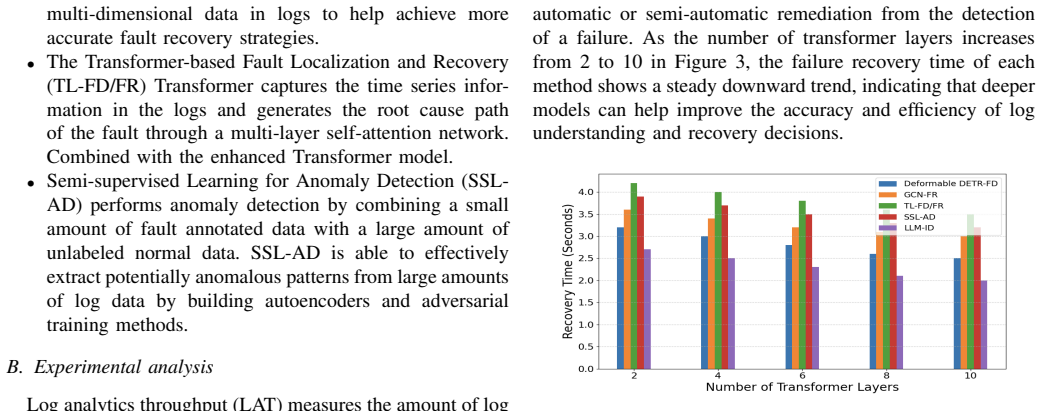
On the Loghub dataset, the authors report that LLM-ID raises fault-location accuracy by 16.2% over four baselines (Deformable DETR, GCN-FR, TL-FD/FR, and SSL-AD) and keeps the lowest debugging recovery time at every tested model depth, from 2.7 s down to 2.0 s as transformer layers grow. The claimed source of the gain is the semantic cascade: unsupervised event-template abstraction, hierarchical multi-hop attention over the event graph, and policy-guided recovery driven by LLM suggestions. The paper also reports higher log-analysis throughput than the baselines for all parameter configurations.
Load-bearing premise
The entire 16.2% improvement rests on an unstated choice of Loghub subset and a held-out split that prevents the fine-tuned 6.7B LLM from having memorized the test logs; the paper never discloses the split, the log types, the annotation alignment, or the baseline tuning.
Editorial extensions
If this is right
- Log analysis shifts from fixed rule matching to context-aware semantic reasoning, so failures that share no keywords can still be linked to a common root cause.
- Recovery actions can be generated and ranked without hand-coded playbooks, enabling adaptation to failure modes the system has not seen before.
- The reported throughput and recovery-time scaling with model capacity suggest the framework can be deployed on large cloud log streams.
- A 16.2% improvement in fault-location accuracy, if reproducible, would make LLM-based debugging a practical alternative to current log-analysis tools.
Reading between the lines
- The experiments section presents throughput and recovery-time curves but never displays the fault-location accuracy numbers behind the 16.2% headline, so the central quantitative claim is not supported by the evaluation as written.
- The paper gives no details on which Loghub subset was used, how the train/test split was made, or how the fine-tuned LLM was prevented from seeing test logs, so the headline result could hinge on evaluation choices rather than the method itself.
- The Bayesian confidence-shaping mechanism is a generic way to modulate an LLM's action suggestions, so it could transfer to other decision-making tasks beyond log debugging, such as code repair or incident triage.
Editorial analysis
A structured set of objections, weighed in public.
Referee Report
Summary. The paper proposes LLM-ID, an LLM-based framework for intelligent log processing and autonomous debugging in cloud AI platforms. The method combines a multi-scale fuzzy-matching attention module for log structuring, a hierarchical multi-hop attention mechanism built on a fine-tuned 6.7B transformer for semantic reasoning and fault-chain reconstruction, and a Bayesian policy-shaped reinforcement learning planner for recovery actions. The abstract claims a 16.2% improvement in fault-location accuracy over mainstream methods, with experiments on the Loghub dataset. The manuscript includes equations for the attention mechanism, the Beta-distribution confidence shaping, and a joint loss function, plus figures reporting log-analytics throughput and debugging-recovery time.
Significance. If the empirical claims were substantiated, LLM-ID could offer a practical contribution to automated log analysis and remediation in cloud environments, combining semantic understanding with policy-guided recovery. The architecture is clearly described and the loss formulation is coherent, giving the proposal face value as a principled integration of LLM reasoning and reinforcement learning. However, the central quantitative claim—a 16.2% accuracy gain—is never measured or reported in the experimental section, which instead reports only throughput and recovery time. The absence of a held-out test split, baseline accuracy numbers, significance tests, and variance measures means the paper does not currently support its headline claims, and the internal inconsistency in the throughput comparison further undermines confidence in the reported results.
major comments (4)
- [Abstract and Section IV-B] The abstract's central claim of a 16.2% improvement in fault-location accuracy is never measured, defined, or reported in the experiments. Section IV-B defines and reports only 'Log Analytics Throughput' and 'Debugging Recovery Time' (Figures 2 and 3), with no accuracy metric, root-cause hit rate, confusion matrix, or baseline accuracy numbers. This is the paper's leading empirical claim and must be directly evaluated or the claim must be removed.
- [Section IV-A] The experimental protocol does not describe the train/validation/test split of the Loghub dataset, the specific subset used for fine-tuning the 6.7B LLM, or how fault annotations are aligned with the evaluation. Without a held-out test split, the reported gains could reflect in-sample fitting, since the fault scores and recovery policy are trained on the same dataset. This is a load-bearing omission for any generalization claim.
- [Section IV-B] The text states that LLM-ID throughput increases by 'more than 30%' (1500 to 1950 records/s, which is exactly 30%) while Deformable DETR-FD increases by 'about 33%' and is described as 'slightly lower than LLM-ID'. Since 33% exceeds 30%, this comparison is arithmetically inconsistent and the reported numbers cannot support the claim that LLM-ID has the best throughput scaling.
- [Section IV-B, last sentence] The sentence 'the recovery time of TL-FD/FR is the highest (4.2 s→3.5 s), suggesting that pure Transformer is not inferior to other methods in terms of recovery speed' is self-contradictory: the highest recovery time indicates inferior speed, not non-inferiority. This needs correction or clarification.
minor comments (4)
- [Equation (12) and surrounding text] The text refers to 'KLregex' but Equation (12) contains a KL divergence term; please correct the typo and define the distributions P_conf and P_uniform explicitly.
- [Equations (5)–(7)] The attention matrix is written as A_ij in Equations (5) and (6) but as A^(r)_ij in Equation (7); the round index should be handled consistently.
- [Section IV-B] The experiments report averages over 3 runs but provide no standard deviations, error bars, significance tests, or per-run results, so the reader cannot assess variability or statistical reliability.
- [References] Several references appear tangential to the log-analysis topic (e.g., [1], [5], [8], [9]); please check that every cited work is genuinely relevant to the claims made in the text.
Assumptions & free parameters
free parameters (7)
- Multi-scale window set S =
{3,5,7}
- Inference rounds R =
3
- Temperature tau in fuzzy matching =
unspecified
- Loss weights lambda_1, lambda_2, lambda_3 =
unspecified
- Beta prior parameters alpha_a, beta_a =
learned, not reported
- Prototype template vectors p_k =
unspecified
- Learning rate, gamma, entropy coefficient, batch size =
5e-5, 0.99, 0.01, 64
assumptions (5)
- domain assumption Loghub provides ground-truth fault annotations for a relevant cloud AI platform workload.
- domain assumption Fine-tuning a 6.7B transformer on log sequences yields reliable semantic understanding for fault reasoning.
- ad hoc to paper The multiscale fuzzy-matching attention module produces event templates that preserve fault-related information.
- ad hoc to paper The joint loss L_total trains a policy whose Beta-shaped confidence improves recovery decisions.
- domain assumption The RL environment rewards recovery actions in a way that matches real cloud incident costs.
invented entities (3)
-
Fuzzy-Matching Attention Module (FAM)
-
Hierarchical Multi-Hop Attention Reasoning mechanism
-
Bayesian Policy Shaping (BPs)
Cite this review
Pith. "Pith review of Leveraging Large Language Model for Intelligent Log Processing and Autonomous Debugging in Cloud AI Platforms." pith.science (2026). https://pith.science/paper/5RZZG66G
@misc{pith2026250617900,
  author       = {Pith},
  title        = {Pith review of: Leveraging Large Language Model for Intelligent Log Processing and Autonomous Debugging in Cloud AI Platforms},
  year         = {2026},
  howpublished = {\url{https://pith.science/paper/5RZZG66G}},
  note         = {Machine review of arXiv:2506.17900}
}
read the original abstract
With the increasing complexity and rapid expansion of the scale of AI systems in cloud platforms, the log data generated during system operation is massive, unstructured, and semantically ambiguous, which brings great challenges to fault location and system self-repair. In order to solve this problem, this paper proposes an intelligent log processing and automatic debugging framework based on Large Language Model (LLM), named Intelligent Debugger (LLM-ID). This method is extended on the basis of the existing pre-trained Transformer model, and integrates a multi-stage semantic inference mechanism to realize the context understanding of system logs and the automatic reconstruction of fault chains. Firstly, the system log is dynamically structured, and the unsupervised clustering and embedding mechanism is used to extract the event template and semantic schema. Subsequently, the fine-tuned LLM combined with the multi-round attention mechanism to perform contextual reasoning on the log sequence to generate potential fault assumptions and root cause paths. Furthermore, this paper introduces a reinforcement learning-based policy-guided recovery planner, which is driven by the remediation strategy generated by LLM to support dynamic decision-making and adaptive debugging in the cloud environment. Compared with the existing rule engine or traditional log analysis system, the proposed model has stronger semantic understanding ability, continuous learning ability and heterogeneous environment adaptability. Experiments on the cloud platform log dataset show that LLM-ID improves the fault location accuracy by 16.2%, which is significantly better than the current mainstream methods
Figures


Forward citations
Cited by 1 Pith paper
-
ReLog: Execution-Aware Logging with Runtime Feedback for LLM-Oriented Debugging
ReLog iteratively writes and rewrites logging statements guided by runtime feedback, and its logs beat static logging baselines on Defects4J debugging tasks.
Reference graph
Works this paper leans on
-
[1]
Hades: Hardware accelerated decoding for efficient speculation in large language models,
Z. Yang, Y . Jin, and X. Xu, “Hades: Hardware accelerated decoding for efficient speculation in large language models,”arXiv preprint arXiv:2412.19925, 2024
arXiv 2024
-
[2]
Revolutionizing cloud modernization through ai integra- tion,
G. Sanodia, “Revolutionizing cloud modernization through ai integra- tion,”Turkish Journal of Computer and Mathematics Education, vol. 15, no. 2, pp. 266–283, 2024
work page 2024
-
[3]
Y . Jin and Z. Yang, “Scalability optimization in cloud-based ai inference services: Strategies for real-time load balancing and automated scaling,” arXiv preprint arXiv:2504.15296, 2025
work page Pith review arXiv 2025
-
[4]
D. L. Pissanidis and K. Demertzis, “Integrating ai/ml in cybersecurity: An analysis of open xdr technology and its application in intrusion detection and system log management,” 2023
work page 2023
-
[5]
Advances in appfl: A comprehensive and extensible federated learning framework,
Z. Li, S. He, Z. Yang, M. Ryu, K. Kim, and R. Madduri, “Advances in appfl: A comprehensive and extensible federated learning framework,” arXiv preprint arXiv:2409.11585, 2024
arXiv 2024
-
[6]
Machine learning algorithms-a review,
B. Maheshet al., “Machine learning algorithms-a review,”International Journal of Science and Research (IJSR).[Internet], vol. 9, no. 1, pp. 381–386, 2020
work page 2020
-
[7]
A. Grattafiori, A. Dubey, A. Jauhri, A. Pandey, A. Kadian, A. Al-Dahle, A. Letman, A. Mathur, A. Schelten, A. Vaughanet al., “The llama 3 herd of models,”arXiv preprint arXiv:2407.21783, 2024
arXiv 2024
-
[8]
Exploring diverse methods in visual question answering,
P. Li, Q. Yang, X. Geng, W. Zhou, Z. Ding, and Y . Nian, “Exploring diverse methods in visual question answering,” in2024 5th International Conference on Electronic Communication and Artificial Intelligence (ICECAI). IEEE, 2024, pp. 681–685
work page 2024
Show all 39 references
-
[9]
Style transfer: From stitching to neural networks,
X. Xu, Z. Wang, Y . Zhang, Y . Liu, Z. Wang, Z. Xu, M. Zhao, and H. Luo, “Style transfer: From stitching to neural networks,” in2024 5th International Conference on Big Data & Artificial Intelligence & Software Engineering (ICBASE). IEEE, 2024, pp. 526–530
2024
-
[10]
Generative adversarial nets,
I. J. Goodfellow, J. Pouget-Abadie, M. Mirza, B. Xu, D. Warde-Farley, S. Ozair, A. Courville, and Y . Bengio, “Generative adversarial nets,” Advances in neural information processing systems, vol. 27, 2014
2014
-
[11]
Variational autoencoder,
L. Pinheiro Cinelli, M. Ara ´ujo Marins, E. A. Barros da Silva, and S. Lima Netto, “Variational autoencoder,” inVariational methods for machine learning with applications to deep networks. Springer, 2021, pp. 111–149
2021
-
[12]
Covid-19 localization and recognition on chest radiographs based on yolov5 and efficientnet,
T. Zhang, B. Zhang, F. Zhao, and S. Zhang, “Covid-19 localization and recognition on chest radiographs based on yolov5 and efficientnet,” in 2022 7th International Conference on Intelligent Computing and Signal Processing (ICSP). IEEE, 2022, pp. 1827–1830
2022
-
[13]
Towards real-time and personalized code generation,
H. Xu, X. Wang, and H. Chen, “Towards real-time and personalized code generation,” inProceedings of the 33rd ACM International Conference on Information and Knowledge Management, 2024, p. 5568–5569
2024
-
[14]
Machine learning: Trends, perspec- tives, and prospects,
M. I. Jordan and T. M. Mitchell, “Machine learning: Trends, perspec- tives, and prospects,”Science, vol. 349, no. 6245, pp. 255–260, 2015
2015
-
[15]
An ensemble approach to stock price prediction using deep learning and time series models,
M. Sui, C. Zhang, L. Zhou, S. Liao, and C. Wei, “An ensemble approach to stock price prediction using deep learning and time series models,” in2024 IEEE 6th International Conference on Power, Intelligent Com- puting and Systems (ICPICS). IEEE, 2024, pp. 793–797
2024
-
[16]
Hedge fund portfolio construction using polymodel theory and itransformer,
S. Zhao, Z. Dong, Z. Cao, and R. Douady, “Hedge fund portfolio construction using polymodel theory and itransformer,”arXiv preprint arXiv:2408.03320, 2024
2024 arXiv
-
[17]
A comparative study on enhancing prediction in social network advertisement through data augmentation,
Q. Yang, P. Li, X. Xu, Z. Ding, W. Zhou, and Y . Nian, “A comparative study on enhancing prediction in social network advertisement through data augmentation,” in2024 4th International Conference on Machine Learning and Intelligent Systems Engineering (MLISE). IEEE, 2024, pp. 214–218
2024
-
[18]
Deception detection from linguistic and physiological data streams using bimodal convolutional neural networks,
P. Li, M. Abouelenien, R. Mihalcea, Z. Ding, Q. Yang, and Y . Zhou, “Deception detection from linguistic and physiological data streams using bimodal convolutional neural networks,” in2024 5th International Conference on Information Science, Parallel and Distributed Systems (I...
2024
-
[19]
RAG-RLRC-LaySum at BioLaySumm: Integrating retrieval-augmented generation and readability control for layman summarization of biomedical texts,
Y . Ji, Z. Li, R. Meng, S. Sivarajkumar, Y . Wang, Z. Yu, H. Ji, Y . Han, H. Zeng, and D. He, “RAG-RLRC-LaySum at BioLaySumm: Integrating retrieval-augmented generation and readability control for layman summarization of biomedical texts,” inProceedings of the 23rd Workshop on...
2024
-
[20]
Data- driven digital twins for monitoring the health and performance of converters,
Y . Li, B. Bohara, H. S. Krishnamoorthy, and J. Seshadrinath, “Data- driven digital twins for monitoring the health and performance of converters,” in2024 IEEE International Communications Energy Con- ference (INTELEC), 2024, pp. 1–6
2024
-
[21]
A narrative review on large ai models in lung cancer screening, diagnosis, and treatment planning,
J. Zhong, Y . Wang, D. Zhu, and Z. Wang, “A narrative review on large ai models in lung cancer screening, diagnosis, and treatment planning,” arXiv preprint arXiv:2506.07236, 2025
2025 arXiv
-
[22]
Gpt-4 technical report,
J. Achiam, S. Adler, S. Agarwal, L. Ahmad, I. Akkaya, F. L. Aleman, D. Almeida, J. Altenschmidt, S. Altman, S. Anadkatet al., “Gpt-4 technical report,”arXiv preprint arXiv:2303.08774, 2023
2023 arXiv
-
[23]
Give: Structured reasoning of large language models with knowledge graph inspired veracity extrapolation,
J. He, M. D. Ma, J. Fan, D. Roth, W. Wang, and A. Ribeiro, “Give: Structured reasoning of large language models with knowledge graph inspired veracity extrapolation,” 2025. [Online]. Available: https://arxiv.org/abs/2410.08475
2025 arXiv
-
[24]
Self-give: Associative thinking from limited structured knowledge for enhanced large language model reasoning,
J. He, J. Fan, B. Jiang, I. Houine, D. Roth, and A. Ribeiro, “Self-give: Associative thinking from limited structured knowledge for enhanced large language model reasoning,” 2025. [Online]. Available: https://arxiv.org/abs/2505.15062
2025
-
[25]
Enhancing code llms with reinforcement learning in code generation,
J. Wang, Z. Zhang, Y . He, Y . Song, T. Shi, Y . Li, H. Xu, K. Wu, G. Qian, Q. Chenet al., “Enhancing code llms with reinforcement learning in code generation,”arXiv preprint arXiv:2412.20367, 2024
2024 arXiv
-
[26]
Assertion detection in clinical natural language processing using large language models,
Y . Ji, Z. Yu, and Y . Wang, “Assertion detection in clinical natural language processing using large language models,” in2024 IEEE 12th International Conference on Healthcare Informatics (ICHI), 2024, pp. 242–247
2024
-
[27]
Research on large language model cross-cloud privacy protection and collaborative training based on federated learning,
Z. Yang, Y . Jin, Y . Zhang, J. Liu, and X. Xu, “Research on large language model cross-cloud privacy protection and collaborative training based on federated learning,”arXiv preprint arXiv:2503.12226, 2025
2025 arXiv
-
[28]
Visual large language models for generalized and specialized applications,
Y . Li, Z. Lai, W. Bao, Z. Tan, A. Dao, K. Sui, J. Shen, D. Liu, H. Liu, and Y . Kong, “Visual large language models for generalized and specialized applications,”arXiv preprint arXiv:2501.02765, 2025
2025 arXiv
-
[29]
Contextual hourglass network for semantic segmentation of high resolution aerial imagery,
P. Li, Y . Lin, and E. Schultz-Fellenz, “Contextual hourglass network for semantic segmentation of high resolution aerial imagery,” in2024 5th International Conference on Electronic Communication and Artificial Intelligence (ICECAI). IEEE, 2024, pp. 15–18
2024
-
[30]
Adaptive fault tolerance mechanisms of large language models in cloud computing environ- ments,
Y . Jin, Z. Yang, X. Xu, Y . Zhang, and S. Ji, “Adaptive fault tolerance mechanisms of large language models in cloud computing environ- ments,”arXiv preprint arXiv:2503.12228, 2025
2025 arXiv
-
[31]
Mt2st: Adaptive multi-task to single-task learning,
D. Liu and Y . Yu, “Mt2st: Adaptive multi-task to single-task learning,” arXiv preprint arXiv:2406.18038, 2024
2024 arXiv
-
[32]
Empowering developers: Ai-infused cloud services for software engineering,
Y . Xu and K. Wu, “Empowering developers: Ai-infused cloud services for software engineering,”Asian American Research Letters Journal, vol. 1, no. 1, 2024
2024
-
[33]
Autonomous monitors for detecting failures early and reporting interpretable alerts in cloud operations,
A. Hrusto, P. Runeson, and M. C. Ohlsson, “Autonomous monitors for detecting failures early and reporting interpretable alerts in cloud operations,” inProceedings of the 46th International Conference on Software Engineering: Software Engineering in Practice, 2024, pp. 47– 57
2024
-
[34]
Enhancing security in cloud computing using artificial intelligence (ai),
D. Stutz, J. T. de Assis, A. A. Laghari, A. A. Khan, N. Andreopoulos, A. Terziev, A. Deshpande, D. Kulkarni, and E. G. Grata, “Enhancing security in cloud computing using artificial intelligence (ai),”Applying Artificial Intelligence in Cybersecurity Analytics and Cyber Threat...
2024
-
[35]
Managing data dependencies in cloud-based big data pipelines: Challenges, solutions, and performance optimization strate- gies,
N. A. B. Hassan, “Managing data dependencies in cloud-based big data pipelines: Challenges, solutions, and performance optimization strate- gies,”Orient Journal of Emerging Paradigms in Artificial Intelligence and Autonomous Systems, vol. 15, no. 2, pp. 20–28, 2025
2025
-
[36]
Ai agentic workflows and enterprise apis: Adapting api architectures for the age of ai agents,
V . Tupe and S. Thube, “Ai agentic workflows and enterprise apis: Adapting api architectures for the age of ai agents,”arXiv preprint arXiv:2502.17443, 2025
2025 arXiv
-
[37]
Transforming the hybrid cloud for emerging ai workloads,
D. Chen, A. Youssef, R. Pendse, A. Schleife, B. K. Clark, H. Hamann, J. He, T. Laino, L. Varshney, Y . Wanget al., “Transforming the hybrid cloud for emerging ai workloads,”arXiv preprint arXiv:2411.13239, 2024
2024 arXiv
-
[38]
Lo- gai: A library for log analytics and intelligence,
Q. Cheng, A. Saha, W. Yang, C. Liu, D. Sahoo, and S. Hoi, “Lo- gai: A library for log analytics and intelligence,”arXiv preprint arXiv:2301.13415, 2023
2023 arXiv
-
[39]
Architecting resilient cloud-native apis: Autonomous fault recovery in event-driven microservices ecosystems,
S. Tadi, “Architecting resilient cloud-native apis: Autonomous fault recovery in event-driven microservices ecosystems,”Journal of Scientific and Engineering Research, vol. 9, no. 3, pp. 293–305, 2022
2022
Reviewed August 6, 2026 · model on record in the stance chip above.
Discussion (0). Sign in to comment.