REVIEW 5 major objections 4 minor 2 cited by
Reconstructing Barrow Holographic Dark Energy in $f(Q,T)$ Gravity and Cosmic Constraint
T0 review · 5 major / 4 minor · reviewed 2026-08-15 · deepseek-v4-flash
Pith's one-line read Fractal dark energy with maximal deformation fits late-time data
desk verdict A workmanlike BHDE-in-f(Q,T) fit with real data and code, but the model is ~75 AIC units worse than ΛCDM and the Hubble-tension relief claim is contradicted by the paper's own numbers. read the letter →
The pith
A machine-rendered reading of the paper's core claim, the machinery that carries it, and where it could break.
The reading
What carries the argument
The load-bearing object is the Barrow holographic dark-energy density $\rho_{\mathrm{de}}=3c^2 H^{2-\Delta}$, which encodes quantum-gravitational corrections to horizon entropy and reduces to the standard holographic density at $\Delta=0$. It is fed into the $f(Q,T)=mQ+\alpha T$ field equations in the coincident gauge, where $Q=6H^2$ and the $\alpha T$ term allows energy exchange between geometry and matter; the paper invokes this exchange to bypass the known failure of the Hubble cutoff in general relativity. The reconstruction step inverts the modified Friedmann equations under a constant $w_{\mathrm{de}}$ ansatz, expressing both densities in terms of $H(z)$ and its derivative, so that matter is never imposed as a conserved fluid. The analytic $\Delta=1$ solution carries the argument: it is the expression whose fit to the combined data yields the paper's $H_0$ and transition-redshift results.
What would settle it
Fix $\Delta$ to the Big Bang Nucleosynthesis upper bound on Barrow entropy, $\Delta\approx1.4\times10^{-4}$, and re-run the full cosmic-chronometer, BAO, and supernova fit; if the model still reproduces the data and the reconstructed matter density still tracks $(1+z)^3$, the Barrow-entropy interpretation survives, whereas if that fit collapses, the data-preferred $\Delta=1$ is only a flexible late-time background with no holographic content.
Extended reading notes
Core claim
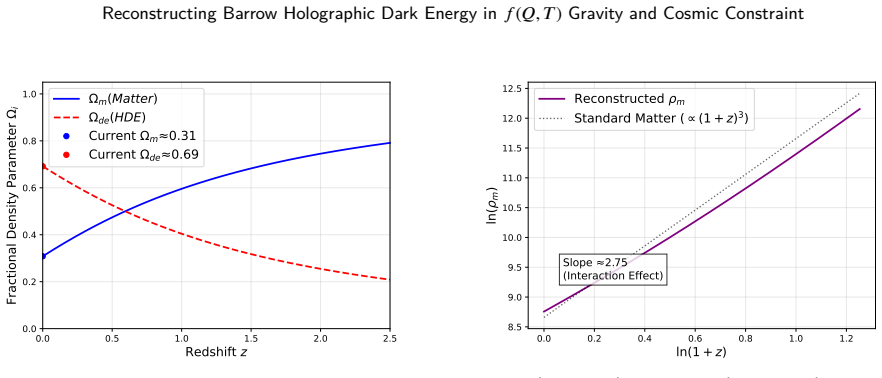
Within coincident-gauge $f(Q,T)$ gravity with $f(Q,T)=mQ+\alpha T$ and $n=1$ for analytic solvability, the paper takes Barrow holographic dark energy, $\rho_{\mathrm{de}}=3c^2 H^{2-\Delta}$, with the Hubble radius $L=H^{-1}$ as the infrared cutoff. Inverting the modified Friedmann equations under a constant dark-energy equation of state $w_{\mathrm{de}}$ reconstructs $\rho_{\mathrm{de}}$ and $\rho_m$ as functions of $H$ and its derivative, making matter a derived output of the system. For $\Delta=1$ the expansion history $H(z)$ is analytic, and the fit to cosmic-chronometer, BAO, and Type Ia supernova data yields $H_0=67.1^{+6.5}_{-6.4}\ \mathrm{km\,s^{-1}\,Mpc^{-1}}$ (95% limits), $w_{\mathrm{de}}$ close to $-1$, present density parameters $\Omega_m\approx0.31$ and $\Omega_{\mathrm{de}}\approx0.69$, and a reconstructed matter density scaling roughly as $(1+z)^{2.75}$. The paper concludes that maximal Barrow deformation is needed for the model to show a transition from deceleration to acceleration at $z_t\approx0.8$, that the non-minimal coupling improves the fit over minimal coupling, and that the Hubble tension is alleviated relative to $\Lambda$CDM.
Load-bearing premise
The load-bearing premise is that the Hubble horizon remains a legitimate holographic cutoff inside $f(Q,T)$ gravity, with $\rho_{\mathrm{de}}=3c^2 H^{2-\Delta}$, even though in standard general relativity this cutoff gives the wrong dark-energy equation of state; the paper's only rationale for the rescue is that the $\alpha T$ coupling changes the dynamics.
Editorial extensions
If this is right
- If the central claim is right, the Hubble horizon — the simplest infrared cutoff — becomes viable in non-minimal gravity, removing the obstruction that rules it out in general relativity.
- The preference for $\Delta=1$ over $\Delta=0$ and $0.5$ means the data favor the most deformed, fractal-like horizon entropy among the cases considered, so cosmological observations could probe the microstructure of horizon entropy.
- The reconstructed matter density scales with slope about $2.75$, close to the dust value 3, so the model recovers the matter-dominated era and today's $\Omega_m\approx0.31$ without assuming matter conservation.
- A CMB-consistent $H_0$ of about 67 km/s/Mpc from the full data combination would shift the Hubble tension toward the late-universe side, because no early-universe physics is added in this model.
- The predicted deceleration-to-acceleration transition at $z_t\approx0.8$ and present $w_{\mathrm{eff}}\approx-0.6$ are concrete expansion-history signatures that differ from $\Lambda$CDM's constant jerk.
Reading between the lines
- Inference: because the constant-$w_{\mathrm{de}}$ ansatz is imposed before fitting, the successful $H(z)$ curves could be reproduced by a flexible dark-energy parametrization; deriving $w_{\mathrm{de}}(z)$ from the non-conservation equation and checking whether the best-fit parameters yield $w_{\mathrm{de}}\approx-1$ without imposing it would test the holographic content directly.
- Inference: the paper's own cited Big Bang Nucleosynthesis bound ($\Delta\lesssim1.4\times10^{-4}$) is far below the preferred $\Delta=1$; re-fitting with $\Delta$ fixed to that bound would reveal whether the data preference comes from the holographic entropy structure or merely from the extra freedom in $H(z)$.
- Inference: the $\alpha T$ coupling implies the matter sector is not conserved, which should leave an imprint in structure growth such as $f\sigma_8$ at $z\sim0.5$; growth-rate data could distinguish this interacting holographic model from $\Lambda$CDM at a level the background fit cannot.
- Inference: extending the analytic $n=1$ solutions to $n\neq1$ numerically would produce high-redshift signatures in BAO and CMB distance priors, giving a way to test whether the model's viability survives outside the linear-$Q$ baseline.
Signed reviews
Editorial analysis
A structured set of objections, weighed in public.
Referee Report
Summary. The paper reconstructs Barrow Holographic Dark Energy (BHDE) within f(Q,T) gravity, assuming the action f(Q,T)=mQ^n+αT, restricting to n=1, and taking the Hubble horizon as the infrared cutoff with ρ_de=3c^2 H^{2−Δ}. A constant dark-energy equation of state w_de is imposed a priori, and the matter density is reconstructed from the modified Friedmann equations rather than assumed conserved. The authors derive analytical H(z) solutions for Δ=0, 0.5, and 1, then constrain the parameters with cosmic chronometers, BAO (including DESI DR2), and Pantheon+ supernova data using MCMC. They report that the maximal-deformation case Δ=1 fits the data with H0≈67–67.4 km/s/Mpc, consistent with Planck, and claim that the model effectively alleviates the Hubble tension and provides a viable alternative to ΛCDM.
Significance. If the claims were fully supported, the paper would offer a new phenomenological framework combining non-metric modified gravity with holographic dark energy, with complete analytical background solutions and constraints from current data. Strengths include the explicit analytical solutions, the use of up-to-date BAO (DESI DR2) and Pantheon+ data, and the public availability of code and chains. However, the central claim that the model actually tests the holographic hypothesis is not established, because the dark-energy equation of state is imposed rather than derived from the modified dynamics. The statistical comparison shows the model is strongly disfavored relative to ΛCDM, and the preferred Δ=1 region is in conflict with BBN bounds. The paper is therefore more a study of a specific parameterized background than a validated alternative cosmology.
major comments (5)
- [Section 3, Eqs. (24), (29)–(33)] The constant-w_de ansatz in Eq. (29) is imposed a priori, and Eq. (33) is obtained by substituting the assumed Barrow form ρ_de=3c^2H^{2−Δ} (Eq. 24) into the inverted Friedmann equations (30)–(31). Consequently, the fitted H(z) is largely predetermined by these inputs, and the data constrain parameters of a chosen functional form rather than test whether the Hubble-horizon cutoff in f(Q,T) actually generates an accelerating solution. The reconstructed matter density (Eq. 31) and the derived Ω_m≈0.31 and slope 2.75 are outputs of the same ansatz, not independent checks. To support the claim of testing BHDE, the authors would need to derive w_de from the modified continuity equation, or explicitly reframe the analysis as a phenomenological consistency test with the holographic density imposed.
- [Table 3 and Section 6] There is a direct numerical inconsistency in the reported Hubble constant: Table 3 gives H0=67.1^{+6.5}_{-6.4} for the full CC+BAO+SNIa combination, whereas the Conclusion states H0=67.4^{+1.9}_{-1.9}. The tighter error bar in the conclusion is not justified by any quoted dataset or model change, and the discrepancy is not discussed. This undermines the claim of alleviating the Hubble tension, since an uncertainty of ±6.5 is consistent with both the Planck and SH0ES measurements, making the conclusion as stated misleading.
- [Table 4 and Section 6] The statistical comparison with ΛCDM is strongly unfavorable for the BHDE model. The best BHDE case (Δ=1) has AIC=2133.32 and BIC=2172.53, versus ΛCDM's AIC=2058.68 and BIC=2108.09, corresponding to ΔAIC≈75 and ΔBIC≈64. By conventional information-criterion thresholds, this constitutes decisive evidence against the model. The text acknowledges the deviation but then concludes that the model 'provides a theoretical framework' and 'effectively alleviates the Hubble constant tension.' These conclusions are not consistent with the model-selection statistics and should be substantially tempered.
- [Section 6, final paragraph] The paper states that the preferred maximal-deformation case Δ=1 conflicts with Big Bang Nucleosynthesis bounds of Δ≲1.4×10^{-4} from Ref. [70]. Since the best fit is at Δ=1, this independent constraint effectively rules out the parameter region favored by the cosmological fit. Merely noting the discrepancy 'warrants further investigation' is insufficient for a claim of model viability; a joint analysis including the BBN prior, or at minimum a detailed discussion of whether the BBN bound applies to this f(Q,T) framework, is required before the model can be presented as a viable alternative to ΛCDM.
- [Eq. (14) and Table 3 priors] For n=1 and α=0, Eq. (14) reduces to ρ=−3mH^2. Thus a positive energy density requires m<0, and the adopted prior 1/m∈[−2,0] forces this sign by construction. The paper does not discuss the physical meaning of a negative coefficient m in the gravitational action, nor does it justify the one-sided priors on c, α, and 1/m. Since the sign of m is load-bearing for the energy budget, this sign-tuning should be explicitly acknowledged and physically motivated; otherwise the fit is a phenomenological sign adjustment rather than a test of the modified gravity.
minor comments (4)
- [Table 3 caption and text] The parameter α is called 'a' in Table 3, but is denoted α throughout the derivation; please use one symbol consistently and define it in the caption.
- [Section 3, text after Eq. (38)] The sentence 'We also consider the case where α=1 that reduces it to the minimal matter-energy-momentum tensor coupling' appears to be a typo; the minimal coupling case is α=0, while α=1 is a specific non-minimal coupling value.
- [General] The paper uses 'HDE' and 'BHDE' interchangeably in places; please use consistent terminology to avoid confusion.
- [Section 4, paragraph on Pantheon+] The text says 'we use Pantheon+ dataset who comprises 1701 SNIa samples'; this should be 'which comprises'.
Circularity Check
Partial circularity: the reconstructed matter density used to 'validate' the model is the same field-equation inversion used to define the fit, so the claimed Ωm and scaling checks are consistency conditions, not independent predictions.
-
self definitional
[Section 3, Eqs. (30)-(33); Section 5, Fig. 2]
"By inverting the modified Friedmann equations (18) and (19) under the ansatz of a constant dark energy equation of state wde, we explicitly reconstruct the evolution of the energy densities. ... To verify the physical viability of this reconstruction, we plot the evolution of the derived fractional density parameters ... which are inferred from Eq. (30) and (31). ... The log-log plot reveals a linear relation with a slope of approximately 2.75. ... This confirms that our model does not lack regular matter; rather, it successfully reconstructs a physically consistent interacting matter component."
Eqs. (30) and (31) are obtained by inverting the same modified Friedmann equations (18)-(19) under the constant-wde ansatz. Eq. (33), and hence the fitted H(z), comes from substituting the assumed Barrow density ρde=3c^2H^{2−Δ} (Eq. 24) into Eq. (30). The 'reconstructed' ρm is therefore the residual required to satisfy the model's own Friedmann equations, not an independent observable. The reported Ωm≈0.31 and slope 2.75 are algebraic consequences of the fitted parameters and the ansatz; presenting them as 'verification' or 'confirmation' is a consistency check of the reconstruction, not a test of BHDE against independent data.
full rationale
The central derivation is a self-consistent reconstruction: with f(Q,T)=mQ+αT, a constant dark-energy equation of state, and ρde=3c^2H^{2−Δ}, Eqs. (30)-(33) determine H(z), and the resulting H(z) is compared with external CC/BAO/SNIa data. That comparison is not circular: the data are external, the parameters are fitted, and the model can be (and is, by AIC/BIC) disfavored relative to ΛCDM. No load-bearing self-citation or imported uniqueness theorem appears. The circularity lies in the 'validation' of the matter component: ρm (Eq. 31) is obtained by inverting the same field equations used to derive the fitted H(z), so Ωm≈0.31 and the log-log slope 2.75 are determined by the ansatz and fitted parameters rather than being independent predictions. The paper itself states that these equations 'determine how the fluid densities must evolve to be consistent with the modified geometry,' so the later claim that they 'confirm' the model's physical consistency is a self-consistency check. Separately, the conclusion quotes H0=67.4±1.9 while Table 3 reports H0=67.1+6.5−6.4; this internal inconsistency undermines the Hubble-tension claim but is not a circularity. The constant-wde ansatz is also an input rather than a derivation, weakening the claim that the data validate Hubble-horizon BHDE, but it is an openly stated parameterization rather than a circular step.
Assumptions & free parameters
free parameters (7)
- H0 =
67.1+6.5/-6.4 km/s/Mpc (Table 3); 67.4±1.9 quoted in Conclusion
- c =
-8.4+2.0/-1.7
- α (also labeled a) =
-0.171+0.078/-0.071
- 1/m =
-0.95+0.30/-0.32
- wde =
-0.98+0.34/-0.35 (text: -1.01+0.38/-0.40)
- Mb =
-19.41+0.20/-0.22
- rd =
146+15/-13 Mpc
assumptions (6)
- domain assumption The universe is described by a flat FLRW metric in the coincident gauge, with Q=6H^2.
- domain assumption Matter is a perfect fluid with T^μν=diag(-ρ,p,p,p).
- ad hoc to paper The holographic dark energy density takes the Barrow form ρde=3c^2H^{2-Δ} with the Hubble horizon as cutoff.
- ad hoc to paper The dark energy equation of state wde is constant.
- ad hoc to paper The gravitational action is f(Q,T)=mQ^n+αT and the analysis is restricted to n=1.
- domain assumption Radiation is neglected in the late universe.
Cite this review
Pith. "Pith review of Reconstructing Barrow Holographic Dark Energy in $f(Q,T)$ Gravity and Cosmic Constraint." pith.science (2026). https://pith.science/paper/WK5BH3TS
@misc{pith2026250617933,
  author       = {Pith},
  title        = {Pith review of: Reconstructing Barrow Holographic Dark Energy in $f(Q,T)$ Gravity and Cosmic Constraint},
  year         = {2026},
  howpublished = {\url{https://pith.science/paper/WK5BH3TS}},
  note         = {Machine review of arXiv:2506.17933}
}
abstract
In this work, we reconstruct the cosmological evolution of Barrow Holographic Dark Energy (BHDE) within the framework of modified gravity $f(Q,T)$. Working in the coincident gauge, we incorporate the holographic principle into non-metric gravity with non-minimal matter coupling. To address the dynamical complexity, we adopt a reconstruction approach, deriving the matter density evolution from the modified field equations rather than imposing a conserved fluid a priori. We perform parameter estimation using the latest observational data, including Type Ia supernovae, BAO, and direct Hubble parameter measurements. Our results show that the model provides a theoretical framework to describe late-time cosmic evolution and the universe's accelerated expansion. Despite the additional complexity introduced, the model offers an alternative approach for investigating dark energy within modified gravity theories.
Figures


Figures from the paper (3 more)


Forward citations
Cited by 2 Pith papers
-
Reconstructing $f(R)$ gravity from Viaggiu Holographic Dark Energy under Hubble, Event Horizon and Granda Oliveros cutoffs
Explicit f(R) forms obtained by equating VHDE density to curvature density under Hubble, event-horizon and Granda-Oliveros cutoffs describe late-time acceleration and satisfy standard viability conditions.
-
The Lambert $W$ equation of state in light of DESI BAO
Fitting the Lambert W dark-fluid EoS to DESI BAO + Pantheon+ + cosmic chronometers gives H0=67.4±1.2 km/s/Mpc and θ1=0.087, θ2=-3.36, with AIC comparable to but BIC strongly against ΛCDM.
Reference graph
Works this paper leans on
-
[70]
Prabir Rudra and Kinsuk Giri. “Observational constraint in 𝑓 (𝑅, 𝑇 ) gravity from the cosmic chronometers and some standard distance measurement parameters”. en. In: Nuclear Physics B 967 (June 2021), p. 115428. ISSN: 05503213. DOI: 10.1016/j.nuclphysb.2021. 115428. URL: https://linkinghub.elsevier.com/retrieve/pii/S0550321321001255 (visited on 12/05/2024...
-
[1]
Discovery of a supernova explosion at half the age of the Universe
S. Perlmutter et al. “Discovery of a supernova explosion at half the age of the Universe”. In: Nature 391.6662 (Jan. 1998), pp. 51–54. ISSN: 1476-4687. DOI: 10.1038/34124. URL: https://doi.org/10.1038/34124 (cit. on p. 1)
doi:10.1038/34124 1998
-
[2]
Observational Evidence from Supernovae for an Accelerating Universe and a Cosmological Constant
Adam G. Riess et al. “Observational Evidence from Supernovae for an Accelerating Universe and a Cosmological Constant”. In: The Astronomical Journal 116.3 (Sept. 1998), pp. 1009–1038. ISSN: 0004-6256. DOI: 10 . 1086 / 300499. URL: http : / / dx . doi . org / 10.1086/300499 (cit. on p. 1)
doi:10.1086/300499 1998
-
[3]
Structure in the COBE Differential Microwave Radiometer First- Year Maps
G. F. Smoot et al. “Structure in the COBE Differential Microwave Radiometer First- Year Maps”. In: apjl 396 (Sept. 1992), p. L1. DOI: 10.1086/186504 (cit. on p. 1)
doi:10.1086/186504 1992
-
[4]
Planck2018 results: VI. Cosmological parameters
N. Aghanim et al. “Planck2018 results: VI. Cosmological parameters”. In:Astronomy & Astrophysics641 (Sept. 2020), A6. ISSN: 1432-0746. DOI: 10.1051/0004-6361/201833910. URL: http://dx.doi.org/10.1051/0004-6361/201833910 (cit. on p. 1)
-
[5]
Daniel J. Eisenstein et al. “Detection of the Baryon Acoustic Peak in the LargeScale Correlation Function of SDSS Luminous Red Galaxies”. In: The Astrophysical Journal 633.2 (Nov. 2005), pp. 560–574. ISSN: 1538-4357. DOI: 10.1086/466512. URL: http://dx.doi.org/10. 1086/466512 (cit. on p. 1)
doi:10.1086/466512 2005
-
[7]
Scott Dodelson et al. “The Three-dimensional Power Spectrum from Angular Clustering of Galaxies in Early Sloan Digital Sky Survey Data”. In: The Astrophysical Journal 572.1 (June 2002), pp. 140–156. ISSN: 1538-4357. DOI: 10.1086/340225 . URL: http://dx.doi. org/10.1086/340225 (cit. on p. 1)
doi:10.1086/340225 2002
-
[8]
Will J. Percival et al. “Measuring the Baryon Acoustic Oscillation scale using the Sloan Digital Sky Survey and 2dF Galaxy Redshift Survey: Measuring the BAO scale”. In: Monthly Notices of the Royal Astronomical Society 381.3 (Sept. 2007), pp. 1053–1066. ISSN: 1365-2966. DOI: 10.1111/j.1365-2966.2007.12268.x. URL: http://dx.doi.org/10.1111/j.1365-2966.200...
arXiv 2007
Show all 69 references
-
[9]
Cosmic chronometers: constraining the equation of state of dark energy. I: H(z) measurements
Daniel Stern et al. “Cosmic chronometers: constraining the equation of state of dark energy. I: H(z) measurements”. In:Journal of Cosmology and Astroparticle Physics 2010.02 (Feb. 2010), pp. 008–008. ISSN: 1475-7516. DOI: 10.1088/1475- 7516/2010/02/008 . URL: http: //dx.doi.or...
2010 doi
-
[10]
Raising the bar: new constraints on the Hubble parameter with cosmic chronometers at z 2
Michele Moresco. “Raising the bar: new constraints on the Hubble parameter with cosmic chronometers at z 2”. In: Monthly Notices of the Royal Astronomical Society: Letters 450.1 (Apr. 2015), pp. L16–L20. ISSN: 1745-3925. DOI: 10.1093/mnrasl/slv037 . URL: http: //dx.doi.org/10....
2015 doi
-
[11]
Oxford University Press, Feb
Steven Weinberg.Cosmology. Oxford University Press, Feb. 2008.ISBN: 9780198526827. DOI: 10.1093/oso/9780198526827.001.0001 (cit. on p. 1)
2008
-
[12]
The Cosmological Constant
Sean M. Carroll. “The Cosmological Constant”. In: Living Reviews in Relativity 4.1 (Feb. 2001). ISSN: 1433-8351. DOI: 10.12942/lrr- 2001-1. URL: http://dx.doi.org/10.12942/lrr-2001-1 (cit. on p. 1)
2001 doi
-
[13]
A Comprehensive Measurement of the Local Value of the Hubble Constant with 1 km s-1 Mpc-1 Uncertainty from the Hubble Space Telescope and the SH0ES Team
Adam G. Riess et al. “A Comprehensive Measurement of the Local Value of the Hubble Constant with 1 km s-1 Mpc-1 Uncertainty from the Hubble Space Telescope and the SH0ES Team”. In: The Astrophysical Journal Letters 934.1 (July 2022), p. L7. ISSN: 2041-8213. DOI: 10.3847/2041-8...
2022 doi
-
[14]
Modified gravity and cosmology
Timothy Clifton et al. “Modified gravity and cosmology”. In: Physics Reports 513.1-3 (Mar. 2012), pp. 1–189. ISSN: 0370-1573. DOI: 10.1016/j.physrep.2012.01.001. URL: http://dx.doi.org/10.1016/j.physrep.2012.01.001 (cit. on p. 1)
2012 doi
-
[15]
Non-linear Lagrangians and cosmological theory
H. A. Buchdahl. “Non-linear Lagrangians and cosmological theory”. In: MNRAS 150 (Jan. 1970), p. 1. DOI: 10.1093/mnras/150.1.1 (cit. on p. 1)
1970 doi
-
[16]
Modified Gauss-Bonnet theory as gravitational alternative for dark energy
Shin’ichi Nojiri and Sergei D. Odintsov. “Modified Gauss-Bonnet theory as gravitational alternative for dark energy”. In: Physics Letters B 631.1 (2005), pp. 1–6. ISSN: 0370-2693. DOI: https://doi.org/10.1016/j.physletb.2005.10.010 . URL: https://www. sciencedirect.com/science/...
2005 doi
-
[17]
INTRODUCTION TO MODIFIED GRAVITY AND GRAVITATIONAL ALTERNATIVE FOR DARK ENERGY
Shin’ichi Nojiri and Sergei D. Odintsov. “INTRODUCTION TO MODIFIED GRAVITY AND GRAVITATIONAL ALTERNATIVE FOR DARK ENERGY”. In: International Journal of Geometric Methods in Modern Physics 04.01 (Feb. 2007), pp. 115–145. ISSN: 1793-6977. DOI: 10.1142/s0219887807001928. URL: htt...
2007 doi
-
[18]
f(T) teleparallel gravity and cosmology
Yi-Fu Cai et al. “f(T) teleparallel gravity and cosmology”. In:Reports on Progress in Physics79.10 (Sept. 2016), p. 106901. ISSN: 1361-6633. DOI: 10.1088/0034-4885/79/10/106901. URL: http://dx.doi.org/10.1088/0034-4885/79/10/106901 (cit. on p. 2)
2016 doi
-
[19]
Dark torsion as the cosmic speed-up
Gabriel R. Bengochea and Rafael Ferraro. “Dark torsion as the cosmic speed-up”. In:Physical Review D 79.12 (June 2009). ISSN: 1550-2368. DOI: 10.1103/physrevd.79.124019. URL: http://dx.doi.org/10.1103/PhysRevD.79.124019 (cit. on p. 2)
2009 doi
-
[20]
Review on f(Q) gravity
Lavinia Heisenberg. “Review on f(Q) gravity”. In: Physics Reports 1066 (2024). Review on f(Q) gravity, pp. 1–78. ISSN: 0370-1573. DOI: https://doi.org/10.1016/j.physrep.2024.02.001 . URL: https://www.sciencedirect.com/science/article/pii/ S0370157324000516 (cit. on pp. 2, 3)
2024 doi
-
[21]
Slow-roll inflation in f(Q) non-metric gravity
Salvatore Capozziello and Mehdi Shokri. “Slow-roll inflation in f(Q) non-metric gravity”. In: Physics of the Dark Universe 37 (2022), p. 101113. ISSN: 2212-6864. DOI: https://doi.org/10.1016/j.dark.2022.101113 . URL: https://www.sciencedirect.com/ science/article/pii/S221268642...
2022
-
[22]
Model-independent reconstruction of f(Q) non-metric gravity
Salvatore Capozziello and Rocco D’ Agostino. “Model-independent reconstruction of f(Q) non-metric gravity”. In: Physics Letters B 832 (2022), p. 137229. ISSN: 0370-2693. DOI: https : / / doi . org / 10 . 1016 / j . physletb . 2022 . 137229. URL: https : / / www . sciencedirect...
2022
-
[23]
𝑓 (𝑅, 𝑇 ) gravity
Tiberiu Harko et al. “ 𝑓 (𝑅, 𝑇 ) gravity”. In: Phys. Rev. D 84 (2 July 2011), p. 024020. DOI: 10 . 1103 / PhysRevD . 84 . 024020. URL: https://link.aps.org/doi/10.1103/PhysRevD.84.024020 (cit. on p. 2)
2011 doi
-
[24]
Finite-time future singularities in modified GaussBonnet and f(R,G) gravity and singularity avoidance
Kazuharu Bamba et al. “Finite-time future singularities in modified GaussBonnet and f(R,G) gravity and singularity avoidance”. In: The European Physical Journal C 67 (2009), pp. 295–310. URL: https://api.semanticscholar.org/CorpusID:43293585 (cit. on p. 2)
2009
-
[25]
Modified teleparallel theories of gravity
Sebastian Bahamonde, Christian G. Böhmer, and Matthew Wright. “Modified teleparallel theories of gravity”. In: Physical Review D 92.10 (Nov. 2015). ISSN: 1550-2368. DOI: 10.1103/physrevd.92.104042 . URL: http://dx.doi.org/10.1103/PhysRevD.92.104042 (cit. on p. 2)
2015 doi
-
[26]
Noether symmetry approach in 𝑓 (𝑇 , 𝐵) teleparallel cosmology
Sebastian Bahamonde and Salvatore Capozziello. “Noether symmetry approach in 𝑓 (𝑇 , 𝐵) teleparallel cosmology”. In: The European Physical Journal C 77.2 (Feb. 2017). ISSN: 1434-6052. DOI: 10 . 1140 / epjc / s10052 - 017 - 4677 - 0. URL: http : / / dx . doi . org / 10.1140/epjc...
2017 doi
-
[27]
𝑓 (𝑅, 𝑇𝜇𝜈 𝑇 𝜇𝜈 ) gravity and Cardassian-like expansion as one of its consequences
Nihan Katrc and Mehmet Kavuk. “ 𝑓 (𝑅, 𝑇𝜇𝜈 𝑇 𝜇𝜈 ) gravity and Cardassian-like expansion as one of its consequences”. In: The European Physical Journal Plus 129.8 (Aug. 2014). ISSN: 2190-5444. DOI: 10.1140/epjp/i2014- 14163- 6 . URL: http://dx.doi.org/10. 1140/epjp/i2014-14163-6...
2014 doi
-
[28]
𝑓 (𝑄, 𝑇 ) gravity
Yixin Xu et al. “𝑓 (𝑄, 𝑇 ) gravity”. In: The European Physical Journal C 79.8 (Aug. 2019). ISSN: 1434-6052. DOI: 10.1140/epjc/s10052- 019-7207-4 . URL: http://dx.doi.org/10.1140/epjc/s10052-019-7207-4 (cit. on pp. 2–4)
2019 doi
-
[29]
Non-metricity with boundary terms: 𝑓 (𝑄, 𝐶) gravity and cosmology
Avik De, Tee-How Loo, and Emmanuel N. Saridakis. “Non-metricity with boundary terms: 𝑓 (𝑄, 𝐶) gravity and cosmology”. In: Journal of Cosmology and Astroparticle Physics 2024.03 (Mar. 2024), p. 050. DOI: 10.1088/1475-7516/2024/03/050 . URL: https://dx.doi. org/10.1088/1475-7516...
2024 doi
-
[30]
𝑓 (𝑇 , 𝑇) gravity and cosmology
Tiberiu Harko et al. “𝑓 (𝑇 , 𝑇) gravity and cosmology”. In:Journal of Cosmology and Astroparticle Physics2014.12 (Dec. 2014), pp. 021–021. ISSN: 1475-7516. DOI: 10.1088/1475-7516/2014/12/021 . URL: http://dx.doi.org/10.1088/1475-7516/2014/12/021 (cit. on p. 2)
2014 doi
-
[31]
Everything You Always Wanted To Know About The Cosmological Constant Problem (But Were Afraid To Ask)
Jerome Martin. “Everything You Always Wanted To Know About The Cosmological Constant Problem (But Were Afraid To Ask)”. en. In: Comptes Rendus. Physique 13.6-7 (July 2012). arXiv:1205.3365 [astro-ph], pp. 566–665. ISSN: 1878-1535. DOI: 10.1016/j.crhy.2012. 04.008. URL: http://...
2012 arXiv
-
[32]
’t Hooft
G. ’t Hooft. Dimensional Reduction in Quantum Gravity . 1993. arXiv: gr-qc/9310026 [gr-qc] . URL: https://arxiv.org/abs/gr- qc/9310026 (cit. on p. 2)
1993 arXiv
-
[33]
Effective Field Theory, Black Holes, and the Cosmological Constant
Andrew G. Cohen, David B. Kaplan, and Ann E. Nelson. “Effective Field Theory, Black Holes, and the Cosmological Constant”. In: Phys. Rev. Lett. 82.25 (June 1999). Publisher: American Physical Society, pp. 4971–4974. DOI: 10.1103/PhysRevLett.82.4971. URL: https: //link.aps.org/d...
1999 doi
-
[34]
A model of holographic dark energy
Miao Li. “A model of holographic dark energy”. In: Physics Letters B 603.1 (2004), pp. 1–5. ISSN: 0370-2693. DOI: https://doi.org/ 10.1016/j.physletb.2004.10.014 . URL: https://www.sciencedirect.com/science/article/pii/S0370269304014388 (cit. on pp. 2, 4)
2004 doi
-
[35]
Entropy bounds and dark energy
Stephen D.H. Hsu. “Entropy bounds and dark energy”. In: Physics Letters B 594.1-2 (July 2004), pp. 13–16. ISSN: 0370-2693. DOI: 10. 1016/j.physletb.2004.05.020. URL: http://dx.doi.org/10.1016/j.physletb.2004.05.020 (cit. on p. 2)
2004 doi
-
[36]
Reconstructing 𝑓 (𝑅) theory according to holographic dark energy
Xing Wu and Zong-Hong Zhu. “Reconstructing 𝑓 (𝑅) theory according to holographic dark energy”. en. In: Physics Letters B 660.4 (Feb. 2008), pp. 293–298. ISSN: 03702693. DOI: 10 . 1016 / j . physletb . 2007 . 12 . 031. URL: https : / / linkinghub . elsevier . com / retrieve/pii...
2008
-
[37]
Holographic Dark Energy Cosmological Models in f(G) Theory
A.Y. Shaikh, S.V . Gore, and S.D. Katore. “Holographic Dark Energy Cosmological Models in f(G) Theory”. en. In:New Astronomy 80 (Oct. 2020), p. 101420. ISSN: 13841076. DOI: 10.1016/j.newast.2020.101420. URL: https://linkinghub.elsevier.com/retrieve/ pii/S1384107619302866 (visi...
2020
-
[38]
Reconciling Tsallis holographic dark energy models in modified 𝑓 (𝑇 , 𝐵) gravitational framework
M. Zubair, Lala Rukh Durrani, and Saira Waheed. “Reconciling Tsallis holographic dark energy models in modified 𝑓 (𝑇 , 𝐵) gravitational framework”. en. In: The European Physical Journal Plus 136.9 (Sept. 2021), p. 943. ISSN: 2190-5444. DOI: 10.1140/epjp/s13360-021- 01905-y. URL...
2021 doi
-
[39]
Sharif and Ayesha Ikram
M. Sharif and Ayesha Ikram. Cosmic Evolution of Holographic Dark Energy in 𝑓 (𝐺, 𝑇 ) Gravity. en. arXiv:1902.05925 [gr-qc, physics:hep- th]. Apr. 2019. URL: http://arxiv.org/abs/1902.05925 (visited on 09/04/2024) (cit. on p. 2)
1902 arXiv
-
[40]
Renyi Holographic Dark Energy and Its Behaviour in f(G) Gravity
M. K. Alam, S. S. Singh, and L. A. Devi. “Renyi Holographic Dark Energy and Its Behaviour in f(G) Gravity”. en. In: Astrophysics 66.3 (Sept. 2023), pp. 383–410. ISSN: 0571-7256, 1573-8191. DOI: 10.1007/s10511-023-09798-8 . URL: https://link.springer.com/ 10.1007/s10511-023-097...
2023 doi
-
[41]
Myrzakulov et al
N. Myrzakulov et al. Barrow Holographic Dark Energy in f(Q,T) gravity . en. arXiv:2408.03961 [gr-qc]. Aug. 2024. URL: http://arxiv. org/abs/2408.03961 (visited on 09/04/2024) (cit. on p. 2)
2024 arXiv
-
[43]
Barrow holographic dark energy model in f(R, T) theory
Kanchan Devi, Ajay Kumar, and Pankaj Kumar. “Barrow holographic dark energy model in f(R, T) theory”. en. In: Astrophysics and Space Science 369.7 (July 2024), p. 73. ISSN: 0004-640X, 1572-946X. DOI: 10.1007/s10509-024-04338-y . URL: https://link.springer. com/10.1007/s10509-0...
2024 doi
-
[44]
Gravitation and electricity
H. Weyl. “Gravitation and electricity”. In: Sitzungsber. Preuss. Akad. Wiss. Berlin (Math. Phys. ) 1918 (1918), p. 465 (cit. on p. 2)
1918
-
[45]
Nonmetricity formulation of general relativity and its scalar-tensor extension
Laur Järv et al. “Nonmetricity formulation of general relativity and its scalar-tensor extension”. In: Physical Review D 97.12 (June 2018). ISSN: 2470-0029. DOI: 10.1103/physrevd.97.124025. URL: http://dx.doi.org/10.1103/PhysRevD.97.124025 (cit. on p. 2)
2018 doi
-
[46]
Cosmology in symmetric teleparallel gravity and its dynamical system
Jianbo Lu, Xin Zhao, and Guoying Chee. Cosmology in symmetric teleparallel gravity and its dynamical system . 2019. arXiv: 1906.08920 [gr-qc]. URL: https://arxiv.org/abs/1906.08920 (cit. on p. 4)
2019 arXiv
-
[47]
Barrow holographic dark energy
Emmanuel N. Saridakis. “Barrow holographic dark energy”. In: Phys. Rev. D 102 (12 Dec. 2020), p. 123525. DOI: 10.1103/PhysRevD. 102.123525. URL: https://link.aps.org/doi/10.1103/PhysRevD.102.123525 (cit. on p. 5)
2020 doi
-
[48]
Statefinder diagnosis for holographic dark energy models in modified 𝑓 (𝑅, 𝑇 ) gravity
C. P. Singh and Pankaj Kumar. “Statefinder diagnosis for holographic dark energy models in modified 𝑓 (𝑅, 𝑇 ) gravity”. en. In: Astrophysics and Space Science 361.5 (May 2016), p. 157. ISSN: 0004-640X, 1572-946X. DOI: 10.1007/s10509-016-2740-1 . URL: http://link. springer.com/10...
2016 doi
-
[49]
The 6dF Galaxy Survey: baryon acoustic oscillations and the local Hubble constant: 6dFGS: BAOs and the local Hubble constant
Florian Beutler et al. “The 6dF Galaxy Survey: baryon acoustic oscillations and the local Hubble constant: 6dFGS: BAOs and the local Hubble constant”. In: Monthly Notices of the Royal Astronomical Society 416.4 (July 2011), pp. 3017–3032. ISSN: 0035-8711. DOI: 10 . 1111/j.1365...
2011
-
[50]
Completed SDSS-IV extended Baryon Oscillation Spectroscopic Survey: Cosmological implications from two decades of spectroscopic surveys at the Apache Point Observatory
Shadab Alam et al. “Completed SDSS-IV extended Baryon Oscillation Spectroscopic Survey: Cosmological implications from two decades of spectroscopic surveys at the Apache Point Observatory”. In: Phys. Rev. D 103 (8 Apr. 2021), p. 083533. DOI: 10.1103/PhysRevD.103. 083533. URL: ...
2021 doi
-
[51]
DESI DR2 results. I. Baryon acoustic oscillations from the Lyman alpha forest
M. Abdul Karim et al. “DESI DR2 results. I. Baryon acoustic oscillations from the Lyman alpha forest”. In: Physical Review D 112.8 (Oct. 2025). ISSN: 2470-0029. DOI: 10.1103/2wwn-xjm5. URL: http://dx.doi.org/10.1103/2wwn-xjm5 (cit. on p. 7)
2025 doi
-
[52]
DESI DR2 results. II. Measurements of baryon acoustic oscillations and cosmological constraints
M. Abdul Karim et al. “DESI DR2 results. II. Measurements of baryon acoustic oscillations and cosmological constraints”. In: Physical Review D 112.8 (Oct. 2025). ISSN: 2470-0029. DOI: 10.1103/tr6y- kpc6. URL: http://dx.doi.org/10.1103/tr6y- kpc6 (cit. on p. 7)
2025 doi
-
[53]
Cosmological Parameter Inference with Bayesian Statistics
Luis E. Padilla et al. “Cosmological Parameter Inference with Bayesian Statistics”. In: Universe 7.7 (June 2021), p. 213. ISSN: 2218-1997. DOI: 10.3390/universe7070213. URL: http://dx.doi.org/10.3390/universe7070213 (cit. on p. 7)
2021 doi
-
[54]
emcee: The MCMC Hammer
D. Foreman-Mackey et al. “emcee: The MCMC Hammer”. In: PASP 125 (2013), pp. 306–312. DOI: 10.1086/670067. eprint: 1202.3665 (cit. on p. 7)
2013 arXiv
-
[55]
DESI 2024 VI: Cosmological Constraints from the Measurements of Baryon Acoustic Oscillations
DESI Collaboration et al. DESI 2024 VI: Cosmological Constraints from the Measurements of Baryon Acoustic Oscillations . 2024. arXiv: 2404.03002 [astro-ph.CO]. URL: https://arxiv.org/abs/2404.03002 (cit. on p. 7)
2024 arXiv
-
[56]
Cosmic chronometers to calibrate the ladders and measure the curvature of the Universe. A model-independent study
Arianna Favale, Adrià Gómez-Valent, and Marina Migliaccio. “Cosmic chronometers to calibrate the ladders and measure the curvature of the Universe. A model-independent study”. In: Monthly Notices of the Royal Astronomical Society 523.3 (June 2023), pp. 3406–3422. ISSN: 1365-29...
2023 doi
-
[57]
Setting the Stage for Cosmic Chronometers. II. Impact of Stellar Population Synthesis Models Systematics and Full Covariance Matrix
Michele Moresco et al. “Setting the Stage for Cosmic Chronometers. II. Impact of Stellar Population Synthesis Models Systematics and Full Covariance Matrix”. In: The Astrophysical Journal 898.1 (July 1, 2020), p. 82. ISSN: 0004-637X, 1538-4357. DOI: 10.3847/1538- 4357/ab9eb0. ...
2020 doi
-
[58]
Unveiling the Universe with emerging cosmological probes
Michele Moresco et al. “Unveiling the Universe with emerging cosmological probes”. In: Living Reviews in Relativity 25.1 (Dec. 2022), p. 6. ISSN: 2367-3613, 1433-8351. DOI: 10.1007/s41114-022-00040-z . URL: https://link.springer.com/10.1007/s41114-022- 00040-z (visited on 01/2...
2022 doi
-
[59]
Four new observational H(z) data from luminous red galaxies in the Sloan Digital Sky Survey data release seven
Cong Zhang et al. “Four new observational H(z) data from luminous red galaxies in the Sloan Digital Sky Survey data release seven”. In: Research in Astronomy and Astrophysics 14.10 (Oct. 2014), p. 1221. DOI: 10.1088/1674-4527/14/10/002 . URL: https://doi.org/ 10.1088/1674-4527...
2014 doi
-
[60]
Constraints on the redshift dependence of the dark energy potential
Joan Simon, Licia Verde, and Raul Jimenez. “Constraints on the redshift dependence of the dark energy potential”. In: Phys. Rev. D 71 (12 June 2005), p. 123001. DOI: 10.1103/PhysRevD.71.123001 . URL: https://link.aps.org/doi/10.1103/PhysRevD.71.123001 (cit. on p. 9). Zhang et ...
2005 doi
-
[61]
Improved constraints on the expansion rate of the Universe up to z 1.1 from the spectroscopic evolution of cosmic chronometers
M. Moresco et al. “Improved constraints on the expansion rate of the Universe up to z 1.1 from the spectroscopic evolution of cosmic chronometers”. In: Journal of Cosmology and Astroparticle Physics 2012.08 (Aug. 2012), p. 006. DOI: 10.1088/1475-7516/2012/08/
2012 doi
-
[62]
URL: https://doi.org/10.1088/1475-7516/2012/08/006 (cit. on p. 9)
2012 doi
-
[63]
Constraints on the Equation of State of Dark Energy and the Hubble Constant from Stellar Ages and the Cosmic Microwave Background*
Raul Jimenez et al. “Constraints on the Equation of State of Dark Energy and the Hubble Constant from Stellar Ages and the Cosmic Microwave Background*”. In: The Astrophysical Journal 593.2 (Aug. 2003), p. 622. DOI: 10.1086/376595 . URL: https://doi.org/ 10.1086/376595 (cit. on p. 9)
2003 doi
-
[64]
A 6% measurement of the Hubble parameter at 𝑧 ∼ 0 .45: direct evidence of the epoch of cosmic re-acceleration
Michele Moresco et al. “A 6% measurement of the Hubble parameter at 𝑧 ∼ 0 .45: direct evidence of the epoch of cosmic re-acceleration”. In: Journal of Cosmology and Astroparticle Physics 2016.05 (May 2016), p. 014. DOI: 10 . 1088 / 1475 - 7516 / 2016 / 05 / 014. URL: https://d...
2016 doi
-
[65]
Age-dating luminous red galaxies observed with the Southern African Large Telescope
A. L. Ratsimbazafy et al. “Age-dating luminous red galaxies observed with the Southern African Large Telescope”. In: Monthly Notices of the Royal Astronomical Society 467.3 (Feb. 2017), pp. 3239–3254. ISSN: 0035-8711. DOI: 10.1093/mnras/stx301 . eprint: https: //academic.oup.c...
2017 doi
-
[66]
Toward a Better Understanding of Cosmic Chronometers: A New Measurement of H(z) at 𝑧 ∼ 0 .7
Nicola Borghi, Michele Moresco, and Andrea Cimatti. “Toward a Better Understanding of Cosmic Chronometers: A New Measurement of H(z) at 𝑧 ∼ 0 .7”. In: The Astrophysical Journal Letters 928.1 (Mar. 2022), p. L4. DOI: 10 . 3847 / 2041 - 8213 / ac3fb2. URL: https : //doi.org/10.3...
2022 doi
-
[67]
The Pantheon+ Analysis: The Full Data Set and Light-curve Release
Dan Scolnic et al. “The Pantheon+ Analysis: The Full Data Set and Light-curve Release”. In: The Astrophysical Journal 938.2 (Oct. 2022), p. 113. ISSN: 1538-4357. DOI: 10.3847/1538-4357/ac8b7a. URL: http://dx.doi.org/10.3847/1538-4357/ac8b7a (cit. on p. 9)
2022 doi
-
[68]
The Pantheon+ Analysis: Cosmological Constraints
Dillon Brout et al. “The Pantheon+ Analysis: Cosmological Constraints”. In: The Astrophysical Journal 938.2 (Oct. 2022), p. 110. ISSN: 1538-4357. DOI: 10.3847/1538-4357/ac8e04. URL: http://dx.doi.org/10.3847/1538-4357/ac8e04 (cit. on p. 9)
2022 doi
-
[69]
GetDist: a Python package for analysing Monte Carlo samples
Antony Lewis. GetDist: a Python package for analysing Monte Carlo samples . 2019. arXiv: 1910.13970 [astro-ph.IM]. URL: https: //arxiv.org/abs/1910.13970 (cit. on p. 10)
2019 arXiv
-
[71]
Big Bang Nucleosynthesis constraints on Barrow entropy
John D. Barrow, Spyros Basilakos, and Emmanuel N. Saridakis. “Big Bang Nucleosynthesis constraints on Barrow entropy”. In: Physics Letters B 815 (2021), p. 136134. ISSN: 0370-2693. DOI: https : / / doi . org / 10 . 1016 / j . physletb . 2021 . 136134. URL: https : //www.scienc...
2021
Reviewed August 15, 2026 · model on record in the stance chip above.
Discussion (0). Continue with ORCID to comment.