REVIEW 3 major objections 9 minor 242 references
Imputation of Longitudinal Data Using GANs: Challenges and Implications for Classification
T0 review · 3 major / 9 minor · reviewed 2026-08-06 · deepseek-v4-flash
Pith's one-line read This survey argues that GAN-based imputation of longitudinal data rarely states which missing-data mechanism it assumes, and that this omission, together with neglect of static features, class imbalance, and mixed data types, undermines…
desk verdict A genuinely useful survey of GAN-based longitudinal data imputation whose qualitative gap analysis is plausible, but the quantitative meta-claims rest on a corpus that is not fully disclosed and are undermined by an internal counting inconsistency. read the letter →
The pith
A machine-rendered reading of the paper's core claim, the machinery that carries it, and where it could break.
The reading
What carries the argument
The argument is carried by three working objects. First, the missingness mechanism trichotomy—missing completely at random (MCAR), missing at random (MAR), and missing not at random (MNAR)—together with the missingness mask and temporal decay used to encode what is observed and how far apart observations are. Second, the eight-category taxonomy of GAN-based imputation approaches, which the survey uses to organise the 56 papers and to ask, for each family, whether it states an assumption, uses static features, handles imbalance, or supports mixed types. Third, the meta-analytic counts (e.g., over 70% without a stated assumption, 85% combining approaches, 41% using auxiliary data or models) that turn the taxonomy into a quantitative gap analysis. The machinery does the work of converting 'methods vary' into 'methods leave the same foundational choices unstated.'
What would settle it
A reader could rerun the paper's search string on the same five databases and count, from full texts, how many studies explicitly state a missingness assumption; if the share with a stated assumption were above half rather than below 30%, the survey's central gap would be refuted. A second check: if most studies were found to evaluate under MAR or MNAR masking rather than uniform random masking, the claim that the field defaults to MCAR would be wrong.
Extended reading notes
Core claim
On the paper's own terms, the central claim is that the field of GAN-based longitudinal data imputation has matured in architectural sophistication while leaving foundational data assumptions unspecified. The paper proposes a taxonomy of eight approach families—recurrence-based, attention-enhanced, mask reconstruction, latent-space optimisation, GAN inversion, uncertainty-enhanced, data transformation, and auxiliary data/model-enhanced methods—and then evaluates 56 selected papers against the data-level challenges of longitudinal classification. Its headline quantitative findings are that over 70% of studies do not state a missingness assumption, roughly 85% combine at least two approaches, only a handful address class imbalance directly, and almost none integrate static features to account for instance heterogeneity or jointly generate mixed data types. From a longitudinal-data perspective, the paper argues, these gaps matter because irregular sampling and dropout make missingness informative, and imputers that default to MCAR or ignore the static component can distort the temporal correlations classification depends on.
Load-bearing premise
The review's quantitative claims stand on the assumption that the 56 papers returned by its search and screening criteria fairly represent all GAN-based longitudinal imputation work; if that selection is biased, the reported percentages lose their force.
Editorial extensions
If this is right
- If the gap analysis is right, published imputation accuracy numbers are often optimistic: training under random masking certifies performance mainly for MCAR, not for the dropout and irregular-sampling patterns that dominate real longitudinal data.
- Joint end-to-end models that attach a classification objective to the imputation GAN should be expected to beat two-phase pipelines because the auxiliary task counteracts error propagation and conditions imputation on class information, a pattern the survey documents across several recent methods.
- Attention-based and latent-space optimisation approaches will keep growing as the default response to long, sparse sequences, while uncertainty quantification is an early-stage direction with little standardised evaluation.
- Researchers adopting GAIN-style mask reconstruction should state their missingness assumption explicitly; the survey's reading is that default MCAR conflicts with informative missingness and needs theoretical guarantees under MAR and MNAR.
- The absence of a universally accepted quality metric for imputed longitudinal data means that RMSE/MAE improvements should not be read as classification improvements; the paper's metric-usage tables give a baseline for forming such standards.
Reading between the lines
- A testable extension of the survey's claim: re-evaluating the same 56 methods under MNAR-generated dropout (e.g., monotone missingness) should shrink the reported performance gap between GAN imputers and simpler baselines, since most methods were tuned under MCAR-style random masking.
- The survey's finding that static features are ignored suggests a concrete benchmark: on EHR-style data with strong baseline covariates, a GAN that conditions imputation on static features should improve downstream classification for minority subgroups, something the reviewed methods rarely measure.
- The paper's own metric analysis implies that imputation error and classification performance can diverge; a reader could rank the surveyed methods by change in AUC rather than RMSE and get a materially different leaderboard.
Editorial analysis
A structured set of objections, weighed in public.
Referee Report
Summary. This manuscript surveys GAN-based imputation for longitudinal data, claiming to be the first such survey from a longitudinal-data-classification perspective. It defines key terms (longitudinal data, irregular sampling, missingness mechanisms, temporal decay), reviews seminal GAN architectures, organizes 56 papers into eight approach categories, tabulates recurrence-based, attention-enhanced, and non-recurrence methods in Tables 3-5, and uses these to quantify gaps: over 70% of studies do not state a missingness assumption, 85% combine approaches, static features and instance heterogeneity are mostly ignored, and class imbalance and mixed data types are rarely jointly handled. It concludes with practical guidance on approach selection, metric usage, and future research directions.
Significance. The survey addresses a genuine gap: prior surveys cover GAN imputation in general, time series, or EHR data, but not the longitudinal-data-specific problems of instance heterogeneity, irregular sampling, and missingness assumptions. Its formal definitions and taxonomy are useful, and the summary tables give a compact map of the field. The paper is honest about limitations and offers concrete future directions, such as MNAR guarantees, random effects, and standardized evaluation of imputed-sample quality. The main load-bearing element is the gap analysis; those percentages are only as good as the reproducibility of the corpus and coding, and that reproducibility is currently missing. With a full study list, a PRISMA flow diagram, and a coding protocol, the paper could become a valuable reference. The paper does not ship code or a reproducible artifact, so the missing artifact is the study corpus itself, which is more damaging in a survey than in a methods paper.
major comments (3)
- [§3.4, §6.1, §6.3.1, Table 5] The central quantitative claims—'85% of works employ a combination of at least two approaches' (Section 6.1), 'over 70% of the studies did not specify a missing data assumption' (Section 6.3.1), and '75% of studies applying GAIN do not specify the assumed missing data mechanism' (Section 6.2.1)—are not auditable because the corpus is not fully disclosed. Section 3.4 jumps from screening directly to 'there remained 56 articles' without a PRISMA flow diagram, and no list of the 56 included studies is provided in the paper or a supplement. There is also no coding protocol defining what counts as 'specifying a missing data assumption' or 'combining approaches,' and no inter-rater reliability is reported. The judgment calls in Section 3.3 make this non-trivial: univariate time series are excluded, yet city-level air quality is treated as longitudinal (Section 6.1.3), and Table 5 lists MNIST for P-BiGAN despite criterion 8 excluding image data. Without an audit trail, the percentages may reflect screening bias rather than properties of the literature. Please provide the full study list, a PRISMA flow diagram, the coding instrument, and either dual coding or a clearly delimited single-coder protocol with sensitivity checks.
- [§5.11, §6.3.2, §6.3.3, Tables 3-5] The gap claims about class imbalance and static features are internally inconsistent. Section 5.11 says 'only one method covered directly addressed class imbalance [205]', while Section 6.3.3 says 'Only one study has attempted to jointly address the class imbalance and missing values [9]'; these are different claims. Both conflict with the tables: Table 3 marks [187] as 'Imbalanced SMOTE', Table 4 marks [188] as 'Imbalanced SMOTE', and Table 5 lists [9] as addressing class imbalance via class-specific imputation. Similarly, Section 5.11 says 'A couple of methods [188, 187] addressed instance heterogeneity', but Section 6.3.2 says 'Most existing methods, except [187, 188, 6], overlook static features and instance heterogeneity', and the tables only flag static features for [187] and [188]. The paper must define 'directly addressed' versus 'jointly address', reconcile the counts with the tables, and correct the narrative to match its own coding.
- [§6.2.1, §6.3.1] The missingness-assumption variable is not defined consistently across the paper. Section 6.3.1 reports 'over 70% of the studies did not specify a missing data assumption', while Section 6.2.1 reports '75% of studies applying GAIN do not specify the assumed missing data mechanism'; the denominator of the latter is unclear. The text also alternates between 'did not specify' and 'default to MCAR through random masking', which are different observations: one concerns what the authors of the reviewed papers stated, and the other concerns what the training regime implies. Please provide the exact coding rule (what counts as specifying, e.g., an explicit statement versus train-time masking), report per-study coding, and state the denominators for each percentage.
minor comments (9)
- [§3.2] The text says 'Scorpus'; this should be 'Scopus'.
- [§4, first paragraph] The sentence 'In particular, we focus on Additionally, we discuss...' is an incomplete sentence and should be rewritten.
- [Abstract] The phrase 'with a focus whether GANS have adequately addressed' should read 'with a focus on whether GANs have adequately addressed'.
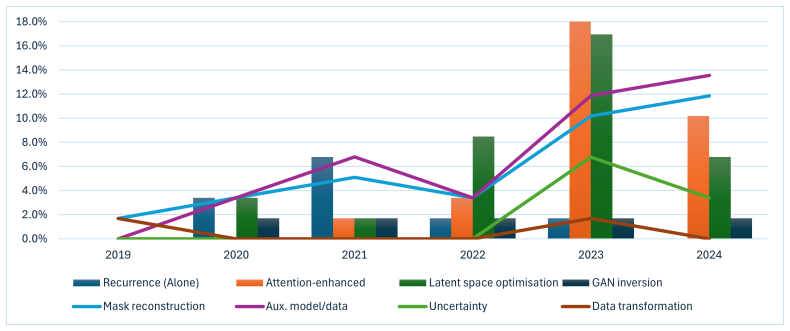
- [§6.1.2] The same subsection reports that GAN inversion appeared in 'only 1% of studies over the years' and later that '9% used GAN inversion'; these numbers should be harmonized.
- [§2.1.1] The definitions are labeled 1, 2, 4, and 5, with no Definition 3; the numbering should be fixed.
- [§5.3] The text says 'GCGAI attempts to improve imputation quality'; this should be 'FCGAI' for consistency.
- [References and §5.3/Table 5] References [155] and [156] appear to be the same paper by Psychogyios et al., yet [156] is cited as the 'iGAIN' method in Section 5.3 and Table 5; please verify the citation mapping and remove the duplicate entry.
- [§6.3.3 and Table 7] Section 6.3.3 says 'Less than 15% of studies reviewed used AUC', which appears inconsistent with Table 7 reporting 50% AUC usage; clarify whether this refers specifically to using AUC to evaluate minority-class robustness rather than general classification evaluation.
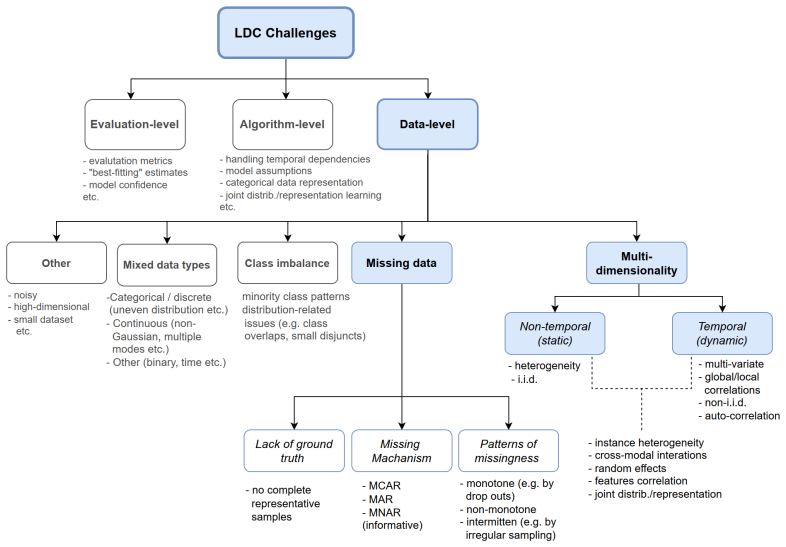
- [§5.11 and Figure 4] Section 5.11 refers to 'Figure 4 presents a taxonomy of common GAN-based LDI challenges', but Figure 4 is the topology of LDC challenges; the reference or the caption should be corrected.
Circularity Check
No significant circularity; survey claims are empirical meta-analytic summaries, and the paper's self-citations are illustrative rather than load-bearing.
full rationale
This is a survey with no formal derivation chain whose conclusions could reduce to its inputs by construction. The central claims—that over 70% of reviewed GAN-based LDI studies do not state a missingness assumption, that 85% combine at least two approaches, and that static features, class imbalance, and mixed data types are rarely addressed—are empirical meta-analytic summaries of a 56-paper corpus assembled under described inclusion criteria. They are not definitions of the phenomena they report, nor fitted parameters renamed as predictions. The paper does self-cite its own prior works [187, 188] as examples of methods that address instance heterogeneity and static-feature fusion, and [154] for the non-existence of a universally optimal imputation technique, but these citations are illustrative supporting evidence within a literature review, not the load-bearing justification for a derived result. Even if the corpus selection were biased or the percentages unstable, that would be a correctness or reproducibility concern, not circularity. No equation or category in the paper is defined in terms of the outcome it is used to establish.
Assumptions & free parameters
assumptions (3)
- domain assumption The PRISMA-based search and manual screening process selected a representative set of studies for meta-analysis.
- domain assumption The categorisation of methods into eight approaches is a valid partitioning of the literature.
- domain assumption Usage percentages across the reviewed papers are meaningful for assessing evaluation practice.
Cite this review
Pith. "Pith review of Imputation of Longitudinal Data Using GANs: Challenges and Implications for Classification." pith.science (2026). https://pith.science/paper/GTMJDO2R
@misc{pith2026250618007,
  author       = {Pith},
  title        = {Pith review of: Imputation of Longitudinal Data Using GANs: Challenges and Implications for Classification},
  year         = {2026},
  howpublished = {\url{https://pith.science/paper/GTMJDO2R}},
  note         = {Machine review of arXiv:2506.18007}
}
read the original abstract
Longitudinal data is commonly utilised across various domains, such as health, biomedical, education and survey studies. This ubiquity has led to a rise in statistical, machine and deep learning-based methods for Longitudinal Data Classification (LDC). However, the intricate nature of the data, characterised by its multi-dimensionality, causes instance-level heterogeneity and temporal correlations that add to the complexity of longitudinal data analysis. Additionally, LDC accuracy is often hampered by the pervasiveness of missing values in longitudinal data. Despite ongoing research that draw on the generative power and utility of Generative Adversarial Networks (GANs) to address the missing data problem, critical considerations include statistical assumptions surrounding longitudinal data and missingness within it, as well as other data-level challenges like class imbalance and mixed data types that impact longitudinal data imputation (LDI) and the subsequent LDC process in GANs. This paper provides a comprehensive overview of how GANs have been applied in LDI, with a focus whether GANS have adequately addressed fundamental assumptions about the data from a LDC perspective. We propose a categorisation of main approaches to GAN-based LDI, highlight strengths and limitations of methods, identify key research trends, and provide promising future directions. Our findings indicate that while GANs show great potential for LDI to improve usability and quality of longitudinal data for tasks like LDC, there is need for more versatile approaches that can handle the wider spectrum of challenges presented by longitudinal data with missing values. By synthesising current knowledge and identifying critical research gaps, this survey aims to guide future research efforts in developing more effective GAN-based solutions to address LDC challenges.
Figures


Figures from the paper (7 more)


Reference graph
Works this paper leans on
-
[205]
Xutao Weng, Hong Song, Yucong Lin, You Wu, Xi Zhang, Bowen Liu, and Jian Yang. A joint learning method for incomplete and imbal- anced data in electronic health record based on generative adversarial networks. Comput. Biol. Medicine , 168:107687, 2024
work page 2024
-
[9]
Sanfilippo, and Girish Dwivedi
Saqib Ejaz Awan, Mohammed Bennamoun, Ferdous Sohel, Frank M. Sanfilippo, and Girish Dwivedi. Imputation of missing data with class 69 imbalance using conditional generative adversarial networks. Neuro- computing, 453:164–171, 2021
2021
-
[187]
Sharon Torao-Pingi, Richi Nayak, and Md. Abul Bashar. Conditional generative adversarial network for early classification of longitudinal datasets using an imputation approach. ACM Trans. Knowl. Discov. Data, 18(5):132:1–132:25, 2024
work page 2024
-
[188]
Sharon Torao-Pingi, Duoyi Zhang, Md. Abul Bashar, and Richi Nayak. Joint representation learning with generative adversarial imputation network for improved classification of longitudinal data. Data Sci. Eng., 9(1):5–25, 2024
work page 2024
-
[1]
The treatment of missing values and its effect on classifier accuracy
Edgar Acuna and Caroline Rodriguez. The treatment of missing values and its effect on classifier accuracy. In Classification, clustering, and data mining applications , pages 639–647. Springer, 2004
2004
-
[2]
Investigating Under and Overfitting in Wasserstein Generative Adversarial Networks
Ben Adlam, Charles Weill, and Amol Kapoor. Investigating under and overfitting in wasserstein generative adversarial networks. CoRR, abs/1910.14137, 2019
work page Pith review arXiv 1910
-
[3]
Neighborhood-aware autoencoder for missing value imputation
Helena Aidos and Pedro Tom´ as. Neighborhood-aware autoencoder for missing value imputation. In 28th European Signal Processing Confer- ence, EUSIPCO 2020, Amsterdam, Netherlands, January 18-21, 2021 , pages 1542–1546. IEEE, 2020
2020
-
[4]
Ahmad Al-Qerem, Ali Mohd Ali, Hani Attar, Shadi Nashwan, Liany- ong Qi, Mohammad Kazem Moghimi, and Ahmed A. A. Solyman. Synthetic generation of multidimensional data to improve classification model validity. ACM J. Data Inf. Qual. , 15(3):37:1–37:20, 2023
2023
Show all 242 references
-
[5]
What regularized auto-encoders learn from the data-generating distribution
Guillaume Alain and Yoshua Bengio. What regularized auto-encoders learn from the data-generating distribution. J. Mach. Learn. Res. , 15(1):3563–3593, 2014
2014
-
[6]
Improving sepsis prediction per- formance using conditional recurrent adversarial networks
Merve Apalak and Kamran Kiasaleh. Improving sepsis prediction per- formance using conditional recurrent adversarial networks. IEEE Ac- cess, 10:134466–134476, 2022
2022
-
[7]
Towards principled methods for training generative adversarial networks
Mart´ ın Arjovsky and L´ eon Bottou. Towards principled methods for training generative adversarial networks. 2017
2017
-
[8]
Wasserstein generative adversarial networks
Mart´ ın Arjovsky, Soumith Chintala, and L´ eon Bottou. Wasserstein generative adversarial networks. In Doina Precup and Yee Whye Teh, editors, Proceedings of the 34th International Conference on Machine Learning, ICML 2017, Sydney, NSW, Australia, 6-11 August 2017 , volume 70...
2017
-
[10]
Estimating conditional transfer entropy in time series using mutual information and nonlinear prediction
Payam Shahsavari Baboukani, Carina Graversen, Emina Alickovic, and Jan Østergaard. Estimating conditional transfer entropy in time series using mutual information and nonlinear prediction. Entropy, 22(10):1124, 2020
2020
-
[11]
Neural ma- chine translation by jointly learning to align and translate
Dzmitry Bahdanau, Kyunghyun Cho, and Yoshua Bengio. Neural ma- chine translation by jointly learning to align and translate. In Yoshua Bengio and Yann LeCun, editors, 3rd International Conference on Learning Representations, ICLR 2015, San Diego, CA, USA, May 7-9, 2015, Confer...
2015
-
[12]
Multiple imputation with missing data indicators
Lauren J Beesley, Irina Bondarenko, Michael R Elliot, Allison W Kurian, Steven J Katz, and Jeremy MG Taylor. Multiple imputation with missing data indicators. Statistical methods in medical research , 30(12):2685–2700, 2021
2021
-
[13]
Sched- uled sampling for sequence prediction with recurrent neural networks
Samy Bengio, Oriol Vinyals, Navdeep Jaitly, and Noam Shazeer. Sched- uled sampling for sequence prediction with recurrent neural networks. pages 1171–1179, 2015
2015
-
[14]
Curriculum learning
Yoshua Bengio, J´ erˆ ome Louradour, Ronan Collobert, and Jason We- ston. Curriculum learning. In Andrea Pohoreckyj Danyluk, L´ eon Bot- tou, and Michael L. Littman, editors, Proceedings of the 26th Annual International Conference on Machine Learning, ICML 2009, Montreal, Queb...
2009
-
[15]
An imbalance-aware deep neural network for early prediction of preeclampsia
Rachel Bennett, Zuber D Mulla, Pavan Parikh, Alisse Hauspurg, and Talayeh Razzaghi. An imbalance-aware deep neural network for early prediction of preeclampsia. Plos one, 17(4):e0266042, 2022
2022
-
[16]
Autoencoders and their applications in machine learn- ing: a survey
Kamal Berahmand, Fatemeh Daneshfar, Elaheh Sadat Salehi, Yuefeng Li, and Yue Xu. Autoencoders and their applications in machine learn- ing: a survey. Artif. Intell. Rev. , 57(2):28, 2024
2024
-
[17]
A novel missing data imputation 70 approach based on clinical conditional generative adversarial networks applied to EHR datasets
Michele Bernardini, Anastasiia Doinychko, Luca Romeo, Emanuele Frontoni, and Massih-Reza Amini. A novel missing data imputation 70 approach based on clinical conditional generative adversarial networks applied to EHR datasets. Comput. Biol. Medicine , 163:107188, 2023
2023
-
[18]
BEGAN: boundary equilibrium generative adversarial networks
David Berthelot, Tom Schumm, and Luke Metz. BEGAN: boundary equilibrium generative adversarial networks. CoRR, abs/1703.10717, 2017
2017 arXiv
-
[19]
Karan Bhanot, Saloni Dash, Joseph Pedersen, Isabelle Guyon, and Kristin P. Bennett. Quantifying resemblance of synthetic medical time- series. In 29th European Symposium on Artificial Neural Networks, Computational Intelligence and Machine Learning, ESANN 2021, On- line event ...
2021
-
[20]
Multi- indicator water time series imputation with autoregressive generative adversarial networks
Jing Bi, Zichao Wang, Haitao Yuan, Kun Ni, and Junfei Qiao. Multi- indicator water time series imputation with autoregressive generative adversarial networks. In IEEE International Conference on Systems, Man, and Cybernetics, SMC 2022, Prague, Czech Republic, October 9-12, 202...
2022
-
[21]
Deep generative modelling: A comparative review of vaes, gans, nor- malizing flows, energy-based and autoregressive models
Sam Bond-Taylor, Adam Leach, Yang Long, and Chris G Willcocks. Deep generative modelling: A comparative review of vaes, gans, nor- malizing flows, energy-based and autoregressive models. IEEE Trans- actions on Pattern Analysis and Machine Intelligence , 2021
2021
-
[22]
Generative adversarial networks in time series: A systematic literature review
Eoin Brophy, Zhengwei Wang, Qi She, and Tom´ as Ward. Generative adversarial networks in time series: A systematic literature review. ACM Comput. Surv. , 55(10):199:1–199:31, 2023
2023
-
[23]
C. F. Caiafa, Z. Sun, T. Tanaka, P. Marti-Puig, and J. Sol´ e-Casals. Machine learning methods with noisy, incomplete or small datasets. Applied Sciences, 11(9):4132, 2021
2021
-
[24]
BRITS: bidirectional recurrent imputation for time series
Wei Cao, Dong Wang, Jian Li, Hao Zhou, Lei Li, and Yitan Li. BRITS: bidirectional recurrent imputation for time series. In Samy Bengio, Hanna M. Wallach, Hugo Larochelle, Kristen Grauman, Nicol` o Cesa- Bianchi, and Roman Garnett, editors, Advances in Neural Information Proces...
2018
-
[25]
Multitask learning
Rich Caruana. Multitask learning. pages 95–133, 1998. 71
1998
-
[26]
Machine and deep learning for longitudinal biomedical data: a review of methods and applications
Anna Cascarano, Jordi Mur-Petit, Jer´ onimo Hern´ andez-Gonz´ alez, Ma- rina Camacho, Nina de Toro Eadie, Polyxeni Gkontra, Marc Chadeau- Hyam, Jordi Vitri` a, and Karim Lekadir. Machine and deep learning for longitudinal biomedical data: a review of methods and applications. ...
2023
-
[27]
ANODE- GAN: incomplete time series imputation by augmented neural ode- based generative adversarial networks
Zhuoqing Chang, Shubo Liu, Zhaohui Cai, and Guoqing Tu. ANODE- GAN: incomplete time series imputation by augmented neural ode- based generative adversarial networks. In Lazaros Iliadis, Antonios Papaleonidas, Plamen Angelov, and Chrisina Jayne, editors, Artificial Neural Netwo...
2023
-
[28]
Chawla, Kevin W
Nitesh V. Chawla, Kevin W. Bowyer, Lawrence O. Hall, and W. Philip Kegelmeyer. SMOTE: synthetic minority over-sampling technique. J. Artif. Intell. Res. , 16:321–357, 2002
2002
-
[29]
Z. Che, S. Purushotham, K. Cho, D. Sontag, and Y. Liu. Recurrent neural networks for multivariate time series with missing values. Sci- entific reports, 8(1):1–12, 2018
2018
-
[30]
Neural ordinary differential equations
Tian Qi Chen, Yulia Rubanova, Jesse Bettencourt, and David Du- venaud. Neural ordinary differential equations. In Samy Bengio, Hanna M. Wallach, Hugo Larochelle, Kristen Grauman, Nicol` o Cesa- Bianchi, and Roman Garnett, editors, Advances in Neural Information Processing Syst...
2018
-
[31]
Class-imbalanced deep learning via a class-balanced ensemble
Zhi Chen, Jiang Duan, Li Kang, and Guoping Qiu. Class-imbalanced deep learning via a class-balanced ensemble. IEEE Trans. Neural Net- works Learn. Syst., 33(10):5626–5640, 2022
2022
-
[32]
Malin, Jon Duke, Wal- ter F
Edward Choi, Siddharth Biswal, Bradley A. Malin, Jon Duke, Wal- ter F. Stewart, and Jimeng Sun. Generating multi-label discrete patient records using generative adversarial networks. In Finale Doshi-Velez, Jim Fackler, David C. Kale, Rajesh Ranganath, Byron C. Wallace, and Jen...
2017
-
[33]
Kempa-Liehr
Maximilian Christ, Nils Braun, Julius Neuffer, and Andreas W. Kempa-Liehr. Time series feature extraction on basis of scalable hy- pothesis tests (tsfresh - A python package). Neurocomputing, 307:72– 77, 2018
2018
-
[34]
On the constrained time-series generation problem
Andrea Coletta, Sriram Gopalakrishnan, Daniel Borrajo, and Svitlana Vyetrenko. On the constrained time-series generation problem. In Alice Oh, Tristan Naumann, Amir Globerson, Kate Saenko, Moritz Hardt, and Sergey Levine, editors, Advances in Neural Information Process- ing Sy...
2023
-
[35]
Antonia Creswell, Tom White, Vincent Dumoulin, Kai Arulkumaran, Biswa Sengupta, and Anil A. Bharath. Generative adversarial net- works: An overview. IEEE Signal Process. Mag. , 35(1):53–65, 2018
2018
-
[36]
Glass, Greg Lever, Jimeng Sun, and Cao Xiao
Limeng Cui, Siddharth Biswal, Lucas M. Glass, Greg Lever, Jimeng Sun, and Cao Xiao. CONAN: complementary pattern augmentation for rare disease detection. In The Thirty-Fourth AAAI Conference on Artificial Intelligence, AAAI 2020, The Thirty-Second Innovative Ap- plications of ...
2020
-
[37]
A decoder-only foundation model for time-series forecasting
Abhimanyu Das, Weihao Kong, Rajat Sen, and Yichen Zhou. A decoder-only foundation model for time-series forecasting. InForty-first International Conference on Machine Learning, ICML 2024, Vienna, Austria, July 21-27, 2024 . OpenReview.net, 2024
2024
-
[38]
Saloni Dash, Andrew Yale, Isabelle Guyon, and Kristin P. Bennett. Medical time-series data generation using generative adversarial net- works. In Martin Michalowski and Robert Moskovitch, editors, Arti- ficial Intelligence in Medicine - 18th International Conference on Ar- tif...
2020
-
[39]
Anurika Priyanjali De Silva, Margarita Moreno-Betancur, Alysha Madhu De Livera, Katherine Jane Lee, and Julie Anne Simpson. A comparison of multiple imputation methods for handling missing values in longitudinal data in the presence of a time-varying covariate with a non-linea...
2017
-
[40]
Flexible imputation of missing data
Hakan Demirtas. Flexible imputation of missing data. Journal of statistical software, 85:1–5, 2018
2018
-
[41]
Matteson
Grace Deng, Cuize Han, Tommaso Dreossi, Clarence Lee, and David S. Matteson. IB-GAN: A unified approach for multivariate time series classification under class imbalance. In Arindam Banerjee, Zhi-Hua Zhou, Evangelos E. Papalexakis, and Matteo Riondato, editors, Pro- ceedings o...
2022
-
[42]
Matteson
Grace Deng, Cuize Han, and David S. Matteson. Extended missing data imputation via gans for ranking applications. Data Min. Knowl. Discov., 36(4):1498–1520, 2022
2022
-
[43]
Peter Diggle and Michael G. Kenward. Informative drop-out in longi- tudinal data analysis. Journal of the Royal Statistical Society: Series C (Applied Statistics), 43(1):49–73, 1994
1994
-
[44]
Density esti- mation using real NVP
Laurent Dinh, Jascha Sohl-Dickstein, and Samy Bengio. Density esti- mation using real NVP. In 5th International Conference on Learning Representations, ICLR 2017, Toulon, France, April 24-26, 2017, Con- ference Track Proceedings. OpenReview.net, 2017
2017
-
[45]
Adversarial feature learning
Jeff Donahue, Philipp Kr¨ ahenb¨ uhl, and Trevor Darrell. Adversarial feature learning. 2017
2017
-
[46]
Principled missing data methods for researchers
Yuchang Dong and Chao-Ying Joanne Peng. Principled missing data methods for researchers. SpringerPlus, 2(1):1–17, 2013. 74
2013
-
[47]
Adarnn: Adaptive learning and fore- casting of time series
Yuntao Du, Jindong Wang, Wenjie Feng, Sinno Jialin Pan, Tao Qin, Renjun Xu, and Chongjun Wang. Adarnn: Adaptive learning and fore- casting of time series. In Gianluca Demartini, Guido Zuccon, J. Shane Culpepper, Zi Huang, and Hanghang Tong, editors, CIKM ’21: The 30th ACM Inte...
2021
-
[48]
Augmented neu- ral odes
Emilien Dupont, Arnaud Doucet, and Yee Whye Teh. Augmented neu- ral odes. In Hanna M. Wallach, Hugo Larochelle, Alina Beygelzimer, Florence d’Alch´ e-Buc, Emily B. Fox, and Roman Garnett, editors,Ad- vances in Neural Information Processing Systems 32: Annual Confer- ence on Ne...
2019
-
[49]
Roy, and Zoubin Ghahramani
Gintare Karolina Dziugaite, Daniel M. Roy, and Zoubin Ghahramani. Training generative neural networks via maximum mean discrepancy optimization. In Marina Meila and Tom Heskes, editors, Proceedings of the Thirty-First Conference on Uncertainty in Artificial Intelligence, UAI 2...
2015
-
[50]
Atiya, and Firuz Kamalov
Dina Elreedy, Amir F. Atiya, and Firuz Kamalov. A theoretical distri- bution analysis of synthetic minority oversampling technique (SMOTE) for imbalanced learning. Mach. Learn., 113(7):4903–4923, 2024
2024
-
[51]
Craig K. Enders. Analyzing longitudinal data with missing values. Rehabilitation psychology, 56(4):267, 2011
2011
-
[52]
Hyland, and Gunnar R¨ atsch
Crist´ obal Esteban, Stephanie L. Hyland, and Gunnar R¨ atsch. Real- valued (medical) time series generation with recurrent conditional gans. CoRR, abs/1706.02633, 2017
2017 arXiv
-
[53]
Predicting sequences of clinical events by using a personalized temporal latent embedding model
Crist´ obal Esteban, Danilo Schmidt, Denis Krompass, and Volker Tresp. Predicting sequences of clinical events by using a personalized temporal latent embedding model. In Prabhakaran Balakrishnan, Jaideep Sri- vatsava, Wai-Tat Fu, Sanda M. Harabagiu, and Fei Wang, editors,2015...
2015
-
[54]
Wind power time series missing data imputation based on generative adversarial network
Hang Fan, Xuemin Zhang, and Shengwei Mei. Wind power time series missing data imputation based on generative adversarial network. In 2021 IEEE 4th international electrical and energy conference (CIEEC), pages 1–6. IEEE, 2021
2021
-
[55]
Towards sus- tainable compressive population health: A gan-based year-by-year im- putation method
Yujie Feng, Jiangtao Wang, Yasha Wang, and Xu Chu. Towards sus- tainable compressive population health: A gan-based year-by-year im- putation method. ACM Trans. Comput. Heal., 4(1):8:1–8:18, 2023
2023
-
[56]
Completing missing prevalence rates for multiple chronic diseases by jointly lever- aging both intra- and inter-disease population health data correlations
Yujie Feng, Jiangtao Wang, Yasha Wang, and Sumi Helal. Completing missing prevalence rates for multiple chronic diseases by jointly lever- aging both intra- and inter-disease population health data correlations. In Jure Leskovec, Marko Grobelnik, Marc Najork, Jie Tang, and Lei...
2021
-
[57]
Prati, Bartosz Krawczyk, and Francisco Herrera
Alberto Fern´ andez, Salvador Garc´ ıa, Mikel Galar, Ronaldo C. Prati, Bartosz Krawczyk, and Francisco Herrera. Learning from imbalanced data sets, volume 10. Springer, 2018
2018
-
[58]
Generative ad- versarial networks for biomedical time series forecasting and imputa- tion
Sven Festag, Joachim Denzler, and Cord Spreckelsen. Generative ad- versarial networks for biomedical time series forecasting and imputa- tion. J. Biomed. Informatics , 129:104058, 2022
2022
-
[59]
Medical multivariate time series imputation and forecasting based on a recurrent conditional wasserstein GAN and attention
Sven Festag and Cord Spreckelsen. Medical multivariate time series imputation and forecasting based on a recurrent conditional wasserstein GAN and attention. J. Biomed. Informatics , 139:104320, 2023
2023
-
[60]
Discovering statistics using IBM SPSS statistics: and sex and drugs and rock ’n’ roll, 4th Edition
Andy Field. Discovering statistics using IBM SPSS statistics: and sex and drugs and rock ’n’ roll, 4th Edition . Sage, 2013
2013
-
[61]
Fitzmaurice, Nan M
Garrett M. Fitzmaurice, Nan M. Laird, and James H. Ware. Applied longitudinal analysis, volume 998. John Wiley & Sons, 2012
2012
-
[62]
Edward W. Frees. Longitudinal and panel data: analysis and applica- tions in the social sciences . Cambridge University Press, 2004
2004
-
[63]
Charlie Frogner, Chiyuan Zhang, Hossein Mobahi, Mauricio Araya- Polo, and Tomaso A. Poggio. Learning with a wasserstein loss. In Corinna Cortes, Neil D. Lawrence, Daniel D. Lee, Masashi Sugiyama, 76 and Roman Garnett, editors, Advances in Neural Information Process- ing System...
2015
-
[64]
Latent space configuration for improved gen- eralization in supervised autoencoder neural networks
Nikita Gabdullin. Latent space configuration for improved gen- eralization in supervised autoencoder neural networks. CoRR, abs/2402.08441, 2024
2024 arXiv
-
[65]
Missing data imputation framework for bridge structural health monitoring based on slim generative adversarial net- works
Shuai Gao, Wenlong Zhao, Chunfeng Wan, Huachen Jiang, Youliang Ding, and Songtao Xue. Missing data imputation framework for bridge structural health monitoring based on slim generative adversarial net- works. Measurement, 204:112095, 2022
2022
-
[66]
An unsupervised context-free forecasting method for structural health monitoring by generative adversarial networks with progressive growing and self-attention
Shuai Gao, Zhengbo Zou, Zhenwei Zhou, Chunfeng Wan, Liyu Xie, and Songtao Xue. An unsupervised context-free forecasting method for structural health monitoring by generative adversarial networks with progressive growing and self-attention. Structural Health Monitoring , page 1...
2024
-
[67]
A data-driven data-augmentation method based on slim- generative adversarial imputation networks for short-term ship-motion attitude prediction
Xiaoyu Geng, Qian Sun, Yibing Li, Sitong Zhang, Zitao Zhou, and Yifan Wang. A data-driven data-augmentation method based on slim- generative adversarial imputation networks for short-term ship-motion attitude prediction. Ocean Engineering, 299:117364, 2024
2024
-
[68]
A review of generative adversarial networks for electronic health records: applications, evalu- ation measures and data sources
Ghadeer Ghosheh, Jin Li, and Tingting Zhu. A review of generative adversarial networks for electronic health records: applications, evalu- ation measures and data sources. CoRR, abs/2203.07018, 2022
2022 arXiv
-
[69]
Ghosheh, Jin Li, and Tingting Zhu
Ghadeer O. Ghosheh, Jin Li, and Tingting Zhu. A survey of genera- tive adversarial networks for synthesizing structured electronic health records. ACM Comput. Surv. , 56(6):147:1–147:34, 2024
2024
-
[70]
Research methods in applied settings: An integrated approach to design and anal- ysis
Jeffrey A Gliner, George A Morgan, and Nancy L Leech. Research methods in applied settings: An integrated approach to design and anal- ysis. Routledge, 2011
2011
-
[71]
Goldberger, Luis A
Ary L. Goldberger, Luis A. Amaral, Leon Glass, Jeffrey M. Hausdorff, Plamen Ch. Ivanov, Roger G. Mark, et al. Physiobank, physiotoolkit, and physionet: components of a new research resource for complex physiologic signals. Circulation, 101(23):e215–e220, 2000. 77
2000
-
[72]
Goodfellow, Jean Pouget-Abadie, Mehdi Mirza, Bing Xu, David Warde-Farley, Sherjil Ozair, Aaron C
Ian J. Goodfellow, Jean Pouget-Abadie, Mehdi Mirza, Bing Xu, David Warde-Farley, Sherjil Ozair, Aaron C. Courville, and Yoshua Bengio. Generative adversarial nets. In Zoubin Ghahramani, Max Welling, Corinna Cortes, Neil D. Lawrence, and Kilian Q. Weinberger, editors, Advances ...
2014
-
[73]
Courville, and Yoshua Bengio
Anirudh Goyal, Alex Lamb, Ying Zhang, Saizheng Zhang, Aaron C. Courville, and Yoshua Bengio. Professor forcing: A new algorithm for training recurrent networks. In Daniel D. Lee, Masashi Sugiyama, Ulrike von Luxburg, Isabelle Guyon, and Roman Garnett, editors, Ad- vances in Ne...
2016
-
[74]
Borgwardt, Malte J
Arthur Gretton, Karsten M. Borgwardt, Malte J. Rasch, Bernhard Sch¨ olkopf, and Alexander J. Smola. A kernel method for the two- sample-problem. pages 513–520, 2006
2006
-
[75]
Groenwold
Rolf H. Groenwold. Informative missingness in electronic health record systems: the curse of knowing. Diagnostic and prognostic research , 4(1):1–6, 2020
2020
-
[76]
Courville
Ishaan Gulrajani, Faruk Ahmed, Mart´ ın Arjovsky, Vincent Dumoulin, and Aaron C. Courville. Improved training of wasserstein gans. In Isabelle Guyon, Ulrike von Luxburg, Samy Bengio, Hanna M. Wallach, Rob Fergus, S. V. N. Vishwanathan, and Roman Garnett, editors, Ad- vances in...
2017
-
[77]
A data imputation method for multivariate time series based on generative adversarial network
Zijian Guo, Yiming Wan, and Hao Ye. A data imputation method for multivariate time series based on generative adversarial network. Neurocomputing, 360:185–197, 2019
2019
-
[78]
Mehak Gupta, Thao-Ly T. Phan, H. Timothy Bunnell, and Rahma- tollah Beheshti. Concurrent imputation and prediction on EHR data using bi-directional gans: Bi-gans for EHR imputation and prediction. In Hongmei Jiang, Xiuzhen Huang, and Jiajie Zhang, editors, BCB 78 ’21: 12th ACM...
2021
-
[79]
Yoccoz, and Jean-Michel Gaillard
Sandra Hamel, Nigel G. Yoccoz, and Jean-Michel Gaillard. Statistical evaluation of parameters estimating autocorrelation and individual het- erogeneity in longitudinal studies. Methods in Ecology and Evolution , 3(4):731–742, 2012
2012
-
[80]
Mengersen
Conor Hassan, Robert Salomone, and Kerrie L. Mengersen. Federated variational inference methods for structured latent variable models. CoRR, abs/2302.03314, 2023
2023 arXiv
-
[81]
Closing the data gap: A comparative study of missing value imputation algorithms in time series datasets
Sepideh Hassankhani Dolatabadi, Ivana Budinsk´ a, Rafe Behmanesh- pour, and Emil Gatial. Closing the data gap: A comparative study of missing value imputation algorithms in time series datasets. In Pro- ceedings of the Computational Methods in Systems and Software , pages 77–9...
2023
-
[82]
Deep resid- ual learning for image recognition
Kaiming He, Xiangyu Zhang, Shaoqing Ren, and Jian Sun. Deep resid- ual learning for image recognition. In 2016 IEEE Conference on Com- puter Vision and Pattern Recognition, CVPR 2016, Las Vegas, NV, USA, June 27-30, 2016 , pages 770–778. IEEE Computer Society, 2016
2016
-
[83]
Multivariate time series missing value filling based on trans-gan model
Pengfei He, Jianwu Dang, Jingyu Yang, and Biao Yue. Multivariate time series missing value filling based on trans-gan model. In 2023 3rd International Conference on Intelligent Communications and Comput- ing (ICC), pages 377–381. IEEE, 2023
2023
-
[84]
TCGAN: convolutional generative adversarial network for time series classification and clustering
Fanling Huang and Yangdong Deng. TCGAN: convolutional generative adversarial network for time series classification and clustering. Neural Networks, 165:868–883, 2023
2023
-
[85]
Interpretable temporal gans for industrial imbalanced multivariate time series simulation and classification
Hao Huang, Chenxiao Xu, and Shinjae Yoo. Interpretable temporal gans for industrial imbalanced multivariate time series simulation and classification. In Chih-Cheng Hung, Jiman Hong, Alessio Bechini, and Eunjee Song, editors, SAC ’21: The 36th ACM/SIGAPP Symposium on Applied C...
2021
-
[86]
Deep con- volutional generative adversarial networks for traffic data imputation encoding time series as images
Tongge Huang, Pranamesh Chakraborty, and Anuj Sharma. Deep con- volutional generative adversarial networks for traffic data imputation encoding time series as images. International journal of transportation science and technology, 12(1):1–18, 2023
2023
-
[87]
CC-GAIN: clustering and classification-based generative adversarial imputation network for miss- ing electricity consumption data imputation
Junhwa Hwang and Dongjun Suh. CC-GAIN: clustering and classification-based generative adversarial imputation network for miss- ing electricity consumption data imputation. Expert Syst. Appl. , 255:124507, 2024
2024
-
[88]
Hwang, S
U. Hwang, S. Choi, H. B. Lee, and S. Yoon. Adversarial training for disease prediction from electronic health records with missing data. arXiv preprint arXiv:1711.04126 , 2017
2017 arXiv
-
[89]
How to deal with missing data in supervised deep learning? InThe Tenth Inter- national Conference on Learning Representations, ICLR 2022, Virtual Event, April 25-29, 2022
Niels Bruun Ipsen, Pierre-Alexandre Mattei, and Jes Frellsen. How to deal with missing data in supervised deep learning? InThe Tenth Inter- national Conference on Learning Representations, ICLR 2022, Virtual Event, April 25-29, 2022 . OpenReview.net, 2022
2022
-
[90]
Iwana and Seiichi Uchida
Brian K. Iwana and Seiichi Uchida. An empirical survey of data aug- mentation for time series classification with neural networks. Plos one, 16(7):e0254841, 2021
2021
-
[91]
A wide range of missing impu- tation approaches in longitudinal data: a simulation study and real data analysis
Mina Jahangiri, Anoshirvan Kazemnejad, Keith S Goldfeld, Maryam S Daneshpour, Shayan Mostafaei, Davood Khalili, Mohammad Reza Moghadas, and Mahdi Akbarzadeh. A wide range of missing impu- tation approaches in longitudinal data: a simulation study and real data analysis. BMC Me...
2023
-
[92]
Time-series generation by contrastive imitation
Daniel Jarrett, Ioana Bica, and Mihaela van der Schaar. Time-series generation by contrastive imitation. In Marc’Aurelio Ranzato, Alina Beygelzimer, Yann N. Dauphin, Percy Liang, and Jennifer Wortman Vaughan, editors, Advances in Neural Information Processing Systems 34: Annua...
2021
-
[93]
Johnson and Taghi M
Justin M. Johnson and Taghi M. Khoshgoftaar. Survey on deep learn- ing with class imbalance. J. Big Data , 6:27, 2019. 80
2019
-
[94]
Re- booting ACGAN: auxiliary classifier gans with stable training
Minguk Kang, Woohyeon Shim, Minsu Cho, and Jaesik Park. Re- booting ACGAN: auxiliary classifier gans with stable training. In Marc’Aurelio Ranzato, Alina Beygelzimer, Yann N. Dauphin, Percy Liang, and Jennifer Wortman Vaughan, editors, Advances in Neural Information Processing...
2021
-
[95]
LSTM fully convolutional networks for time series classification
Fazle Karim, Somshubra Majumdar, Houshang Darabi, and Shun Chen. LSTM fully convolutional networks for time series classification. IEEE Access, 6:1662–1669, 2018
2018
-
[96]
Training generative adversarial networks with limited data
Tero Karras, Miika Aittala, Janne Hellsten, Samuli Laine, Jaakko Lehtinen, and Timo Aila. Training generative adversarial networks with limited data. In Hugo Larochelle, Marc’Aurelio Ranzato, Raia Hadsell, Maria-Florina Balcan, and Hsuan-Tien Lin, editors, Advances in Neural I...
2020
-
[97]
IGANI: iterative generative adver- sarial networks for imputation with application to traffic data
Amir Kazemi and Hadi Meidani. IGANI: iterative generative adver- sarial networks for imputation with application to traffic data. IEEE Access, 9:112966–112977, 2021
2021
-
[98]
Maksims Kazijevs and Manar D. Samad. Deep imputation of missing values in time series health data: A review with benchmarking. J. Biomed. Informatics, 144:104440, 2023
2023
-
[99]
Mixed data impu- tation using generative adversarial networks
Wasif Khan, Nazar Zaki, Amir Ahmad, Mohammad Mehedy Masud, Luqman Ali, Nasloon Ali, and Luai Awad Ahmed. Mixed data impu- tation using generative adversarial networks. IEEE Access, 10:124475– 124490, 2022
2022
-
[100]
A survey of miss- ing data imputation using generative adversarial networks
Jaeyoon Kim, Donghyun Tae, and Junhee Seok. A survey of miss- ing data imputation using generative adversarial networks. In 2020 International Conference on Artificial Intelligence in Information and Communication, ICAIIC 2020, Fukuoka, Japan, February 19-21, 2020, pages 454–4...
2020
-
[101]
Kingma and Prafulla Dhariwal
Diederik P. Kingma and Prafulla Dhariwal. Glow: Generative flow with invertible 1x1 convolutions. pages 10236–10245, 2018. 81
2018
-
[102]
Kingma and Max Welling
Diederik P. Kingma and Max Welling. Auto-encoding variational bayes. 2014
2014
-
[103]
On convergence and stability of gans
Naveen Kodali, Jacob Abernethy, James Hays, and Zsolt Kira. On convergence and stability of gans. arXiv preprint arXiv:1705.07215 , 2017
2017 arXiv
-
[104]
Resilience mediates the longitudinal relationships between social support and mental health outcomes in multiple sclerosis
Emily Koelmel, Abbey J Hughes, Kevin N Alschuler, and Dawn M Ehde. Resilience mediates the longitudinal relationships between social support and mental health outcomes in multiple sclerosis. Archives of physical medicine and rehabilitation , 98(6):1139–1148, 2017
2017
-
[105]
Federated optimization: Distributed optimization beyond the datacenter
Jakub Koneˇ cn´ y, Brendan McMahan, and Daniel Ramage. Federated optimization: Distributed optimization beyond the datacenter. CoRR, abs/1511.03575, 2015
2015 arXiv
-
[106]
Learning from imbalanced data: open challenges and future directions
Bartosz Krawczyk. Learning from imbalanced data: open challenges and future directions. Prog. Artif. Intell., 5(4):221–232, 2016
2016
-
[107]
Colin Lea, Ren´ e Vidal, Austin Reiter, and Gregory D. Hager. Temporal convolutional networks: A unified approach to action segmentation. In Gang Hua and Herv´ e J´ egou, editors,Computer Vision - ECCV 2016 Workshops - Amsterdam, The Netherlands, October 8-10 and 15-16, 2016, ...
2016
-
[108]
Recent advances in generative adversarial networks for gene expression data: a comprehensive review
Minhyeok Lee. Recent advances in generative adversarial networks for gene expression data: a comprehensive review. Mathematics, 11(14):3055, 2023
2023
-
[109]
Contextual im- putation with missing sequence of EEG signals using generative adver- sarial networks
Woonghee Lee, Jaeyoung Lee, and Younghoon Kim. Contextual im- putation with missing sequence of EEG signals using generative adver- sarial networks. IEEE Access, 9:151753–151765, 2021
2021
-
[110]
MMD GAN: towards deeper understanding of mo- ment matching network
Chun-Liang Li, Wei-Cheng Chang, Yu Cheng, Yiming Yang, and Barnab´ as P´ oczos. MMD GAN: towards deeper understanding of mo- ment matching network. In Isabelle Guyon, Ulrike von Luxburg, Samy Bengio, Hanna M. Wallach, Rob Fergus, S. V. N. Vishwanathan, and Roman Garnett, edito...
2017
-
[111]
Multi- state time series imputation using generative adversarial network with applications to traffic data
Haitao Li, Qian Cao, Qiaowen Bai, Zhihui Li, and Hongyu Hu. Multi- state time series imputation using generative adversarial network with applications to traffic data. Neural Comput. Appl. , 35(9):6545–6567, 2023
2023
-
[112]
Trend-aware data imputation based on generative adversarial network for time series
Han Li, Zhenxiong Liu, Jixiang Niu, Zhongguo Yang, and Sikandar Ali. Trend-aware data imputation based on generative adversarial network for time series. Int. J. Inf. Technol. Syst. Approach , 16(3):1–17, 2023
2023
-
[113]
Bidirectional stackable recurrent generative adversarial imputa- tion network for specific emitter missing data imputation
Haozhe Li, Yilin Liao, Zijian Tian, Zhaoran Liu, Jiaqi Liu, and Xinggao Liu. Bidirectional stackable recurrent generative adversarial imputa- tion network for specific emitter missing data imputation. IEEE Trans. Inf. Forensics Secur., 19:2967–2980, 2024
2024
-
[114]
Cairns, Jingsong Li, and Tingting Zhu
Jin Li, Benjamin J. Cairns, Jingsong Li, and Tingting Zhu. Generating synthetic mixed-type longitudinal electronic health records for artificial intelligent applications. npj Digit. Medicine , 6, 2023
2023
-
[115]
Steven Cheng-Xian Li, Bo Jiang, and Benjamin M. Marlin. Misgan: Learning from incomplete data with generative adversarial networks. In 7th International Conference on Learning Representations, ICLR 2019, New Orleans, LA, USA, May 6-9, 2019 . OpenReview.net, 2019
2019
-
[116]
Steven Cheng-Xian Li and Benjamin M. Marlin. Learning from irregularly-sampled time series: A missing data perspective. In Pro- ceedings of the 37th International Conference on Machine Learning, ICML 2020, 13-18 July 2020, Virtual Event , volume 119 of Proceed- ings of Machine...
2020
-
[117]
Time series forecasting with missing data using generative adversarial networks and bayesian inference
Xiaoou Li. Time series forecasting with missing data using generative adversarial networks and bayesian inference. Inf., 15(4):222, 2024
2024
-
[118]
Lipton, David C
Zachary C. Lipton, David C. Kale, and Randall C. Wetzel. Directly modeling missing data in sequences with rnns: Improved classification of clinical time series. In Finale Doshi-Velez, Jim Fackler, David C. Kale, Byron C. Wallace, and Jenna Wiens, editors, Proceedings of the 83...
2016
-
[119]
Roderick J. A. Little and Donald B. Rubin. Statistical Analysis with Missing Data, volume 793. John Wiley & Sons, Hoboken, NJ, USA, 3 edition, 2019. Wiley Series in Probability and Statistics
2019
-
[120]
A test of missing completely at random for mul- tivariate data with missing values
Roderick JA Little. A test of missing completely at random for mul- tivariate data with missing values. Journal of the American statistical Association, 83(404):1198–1202, 1988
1988
-
[121]
Little and Mijke Rhemtulla
Todd D. Little and Mijke Rhemtulla. Planned missing data designs for developmental researchers. Child Development Perspectives, 7(4):199– 204, 2013
2013
-
[122]
Glowimp: Combining GLOW and GAN for multivariate time series imputation
Caizheng Liu, Houquan Zhou, Zhi Sun, and Guangfan Cui. Glowimp: Combining GLOW and GAN for multivariate time series imputation. In Yongxuan Lai, Tian Wang, Min Jiang, Guangquan Xu, Wei Liang, and Aniello Castiglione, editors, Algorithms and Architectures for Par- allel Process...
2021
-
[123]
Handling missing values in healthcare data: A systematic review of deep learning-based imputation techniques
Mingxuan Liu, Siqi Li, Han Yuan, Marcus Eng Hock Ong, Yilin Ning, Feng Xie, Seyed Ehsan Saffari, Yuqing Shang, Victor Volovici, Bibhas Chakraborty, and Nan Liu. Handling missing values in healthcare data: A systematic review of deep learning-based imputation techniques. Ar- ti...
2023
-
[124]
Generative pretrained hierarchical transformer for time series forecast- ing
Zhiding Liu, Jiqian Yang, Mingyue Cheng, Yucong Luo, and Zhi Li. Generative pretrained hierarchical transformer for time series forecast- ing. In Ricardo Baeza-Yates and Francesco Bonchi, editors, Proceed- ings of the 30th ACM SIGKDD Conference on Knowledge Discovery and Data ...
2024
-
[125]
Multivariate time series imputation with generative adversarial net- works
Yonghong Luo, Xiangrui Cai, Ying Zhang, Jun Xu, and Xiaojie Yuan. Multivariate time series imputation with generative adversarial net- works. In Samy Bengio, Hanna M. Wallach, Hugo Larochelle, Kristen 84 Grauman, Nicol` o Cesa-Bianchi, and Roman Garnett, editors,Advances in Ne...
2018
-
[126]
E 2gan: End-to-end generative adversarial network for multivariate time series imputation
Yonghong Luo, Ying Zhang, Xiangrui Cai, and Xiaojie Yuan. E 2gan: End-to-end generative adversarial network for multivariate time series imputation. In Sarit Kraus, editor, Proceedings of the Twenty-Eighth International Joint Conference on Artificial Intelligence, IJCAI 2019, ...
2019
-
[127]
Rare disease prediction by generating quality-assured electronic health records
Fenglong Ma, Yaqing Wang, Jing Gao, Houping Xiao, and Jing Zhou. Rare disease prediction by generating quality-assured electronic health records. In Carlotta Demeniconi and Nitesh V. Chawla, editors, Pro- ceedings of the 2020 SIAM International Conference on Data Mining, SDM 2...
2020
-
[128]
Cottrell
Qianli Ma, Sen Li, and Garrison W. Cottrell. Adversarial joint-learning recurrent neural network for incomplete time series classification.IEEE Trans. Pattern Anal. Mach. Intell. , 44(4):1765–1776, 2022
2022
-
[129]
Parallel generative adversarial imputation network for multivariate missing time-series reconstruction and its application to aeroengines
Song Ma, Zeng-Song Xu, and Tao Sun. Parallel generative adversarial imputation network for multivariate missing time-series reconstruction and its application to aeroengines. IEEE Trans. Instrum. Meas., 72:1– 16, 2023
2023
-
[130]
Xudong Mao, Qing Li, Haoran Xie, Raymond Y. K. Lau, Zhen Wang, and Stephen Paul Smolley. Least squares generative adversarial net- works. In IEEE International Conference on Computer Vision, ICCV 2017, Venice, Italy, October 22-29, 2017, pages 2813–2821. IEEE Com- puter Society, 2017
2017
-
[131]
Marcus, Anthony F
Daniel S. Marcus, Anthony F. Fotenos, John G. Csernansky, John C. Morris, and Randy L. Buckner. Open access series of imaging studies: Longitudinal MRI data in nondemented and demented older adults. J. Cogn. Neurosci., 22(12):2677–2684, 2010
2010
-
[132]
A survey on machine and statistical learning for longitudinal analysis of 85 neuroimaging data in alzheimer’s disease
Gerard Mart´ ı-Juan, Gerard Sanroma-Guell, and Gemma Piella. A survey on machine and statistical learning for longitudinal analysis of 85 neuroimaging data in alzheimer’s disease. Comput. Methods Programs Biomed., 189:105348, 2020
2020
-
[133]
Mescheder, Andreas Geiger, and Sebastian Nowozin
Lars M. Mescheder, Andreas Geiger, and Sebastian Nowozin. Which training methods for gans do actually converge? In Jennifer G. Dy and Andreas Krause, editors, Proceedings of the 35th International Confer- ence on Machine Learning, ICML 2018, Stockholmsm¨ assan, Stockholm, Swed...
2018
-
[134]
Generative semi-supervised learning for multivariate time series imputation
Xiaoye Miao, Yangyang Wu, Jun Wang, Yunjun Gao, Xudong Mao, and Jianwei Yin. Generative semi-supervised learning for multivariate time series imputation. In Thirty-Fifth AAAI Conference on Artifi- cial Intelligence, AAAI 2021, Thirty-Third Conference on Innovative Applications...
2021
-
[135]
Conditional generative adversarial nets
Mehdi Mirza and Simon Osindero. Conditional generative adversarial nets. CoRR, abs/1411.1784, 2014
2014 arXiv
-
[136]
Spectral normalization for generative adversarial networks
Takeru Miyato, Toshiki Kataoka, Masanori Koyama, and Yuichi Yoshida. Spectral normalization for generative adversarial networks. In 6th International Conference on Learning Representations, ICLR 2018, Vancouver, BC, Canada, April 30 - May 3, 2018, Conference Track Proceedings....
2018
-
[137]
Introduction to machine learning with Python: a guide for data scientists
Andreas C M¨ uller and Sarah Guido. Introduction to machine learning with Python: a guide for data scientists . ” O’Reilly Media, Inc. ”, 2016
2016
-
[138]
Ng and Michael I
Andrew Y. Ng and Michael I. Jordan. On discriminative vs. genera- tive classifiers: A comparison of logistic regression and naive bayes. In Thomas G. Dietterich, Suzanna Becker, and Zoubin Ghahramani, ed- itors, Advances in Neural Information Processing Systems 14 [Neural Info...
2001
-
[139]
Caffo, Nilay D
Che Ngufor, Holly Van Houten, Brian S. Caffo, Nilay D. Shah, and Rozalina G. McCoy. Mixed effect machine learning: A framework for 86 predicting longitudinal change in hemoglobin a1c. J. Biomed. Infor- matics, 89:56–67, 2019
2019
-
[140]
Long short- term memory bayesian neural network for air pollution forecast
Huynh Anh Duy Nguyen, Quang Phuc Ha, Hiep Duc, Merched Azzi, Ningbo Jiang, Xavier Barth´ el´ emy, and Matthew Riley. Long short- term memory bayesian neural network for air pollution forecast. IEEE Access, 11:35710–35725, 2023
2023
-
[141]
Semi- supervised adversarial discriminative domain adaptation
Thai-Vu Nguyen, Anh Nguyen, Nghia Le, and Bac Le. Semi- supervised adversarial discriminative domain adaptation. Appl. Intell., 53(12):15909–15922, 2023
2023
-
[142]
MBGAN: an improved generative ad- versarial network with multi-head self-attention and bidirectional RNN for time series imputation
Qingjian Ni and Xuehan Cao. MBGAN: an improved generative ad- versarial network with multi-head self-attention and bidirectional RNN for time series imputation. Eng. Appl. Artif. Intell. , 115:105232, 2022
2022
-
[143]
Semi-supervised learning with generative adversarial networks
Augustus Odena. Semi-supervised learning with generative adversarial networks. CoRR, abs/1606.01583, 2016
2016 arXiv
-
[144]
Conditional image synthesis with auxiliary classifier gans
Augustus Odena, Christopher Olah, and Jonathon Shlens. Conditional image synthesis with auxiliary classifier gans. In Doina Precup and Yee Whye Teh, editors, Proceedings of the 34th International Confer- ence on Machine Learning, ICML 2017, Sydney, NSW, Australia, 6–11 August ...
2017
-
[145]
STING: self- attention based time-series imputation networks using GAN
Eunkyu Oh, Taehun Kim, Yunhu Ji, and Sushil Khyalia. STING: self- attention based time-series imputation networks using GAN. In James Bailey, Pauli Miettinen, Yun Sing Koh, Dacheng Tao, and Xindong Wu, editors, IEEE International Conference on Data Mining, ICDM 2021, Auckland,...
2021
-
[146]
Osborne and Ariel Rubinstein
Martin J. Osborne and Ariel Rubinstein. A Course in Game Theory . The MIT Press, 1994
1994
-
[147]
Missing data imputation method combining random forest and generative adversarial imputation net- work
Hongsen Ou, Yunan Yao, and Yi He. Missing data imputation method combining random forest and generative adversarial imputation net- work. Sensors, 24(4):1112, 2024. 87
2024
-
[148]
The prisma 2020 statement: an updated guideline for reporting systematic reviews
Matthew J Page, Joanne E McKenzie, Patrick M Bossuyt, Isabelle Boutron, Tammy C Hoffmann, Cynthia D Mulrow, Larissa Shamseer, Jennifer M Tetzlaff, Elie A Akl, Sue E Brennan, et al. The prisma 2020 statement: an updated guideline for reporting systematic reviews. Bmj, 372, 2021
2020
-
[149]
Effective handling of missing values in datasets for classification using machine learning methods
Ashokkumar Palanivinayagam and Robertas Damasevicius. Effective handling of missing values in datasets for classification using machine learning methods. Inf., 14(2):92, 2023
2023
-
[150]
An improved generative adversarial network to oversample imbalanced datasets
Tingting Pan, Witold Pedrycz, Jie Yang, and Jian Wang. An improved generative adversarial network to oversample imbalanced datasets. Eng. Appl. Artif. Intell. , 132:107934, 2024
2024
-
[151]
Towards generating real-world time series data
Hengzhi Pei, Kan Ren, Yuqing Yang, Chang Liu, Tao Qin, and Dong- sheng Li. Towards generating real-world time series data. In James Bailey, Pauli Miettinen, Yun Sing Koh, Dacheng Tao, and Xindong Wu, editors, IEEE International Conference on Data Mining, ICDM 2021, Auckland, N...
2021
-
[152]
Tscdd-gan: A conditional dual-discriminator generative adversarial network for incomplete time series data imputa- tion and clustering
Bo Peng and Chen Dong. Tscdd-gan: A conditional dual-discriminator generative adversarial network for incomplete time series data imputa- tion and clustering. In 2024 5th International Conference on Computer Vision, Image and Deep Learning (CVIDL) , pages 1193–1197. IEEE, 2024
2024
-
[153]
Maximum likelihood esti- mation of hidden markov models for continuous longitudinal data with missing responses and dropout
F Pennoni, F Bartolucci, S Pandolfi, et al. Maximum likelihood esti- mation of hidden markov models for continuous longitudinal data with missing responses and dropout. In Data Science Everywhere: Innova- tions in Statistical Computing , pages 22–23. 2022
2022
-
[154]
A comparative look at the resilience of discriminative and generative classifiers to miss- ing data in longitudinal datasets
Sharon Torao Pingi, Md Abul Bashar, and Richi Nayak. A comparative look at the resilience of discriminative and generative classifiers to miss- ing data in longitudinal datasets. In L.A.F. Park, H.M. Gomes, M.G. Doborjeh, Y.L. Boo, Y.S. Koh, Y. Zhao, G. Williams, and S. Simoff...
2022
-
[156]
Missing value imputation methods for electronic health records
Konstantinos Psychogyios, Loukas Ilias, Christos Ntanos, and Dim- itris Askounis. Missing value imputation methods for electronic health records. IEEE Access, 11:21562–21574, 2023
2023
-
[157]
Linglong Qian, Tao Wang, Jun Wang, Hugh Logan Ellis, Robin Mitra, Richard J. B. Dobson, and Zina M. Ibrahim. How deep is your guess? A fresh perspective on deep learning for medical time-series imputation. CoRR, abs/2407.08442, 2024
2024 arXiv
-
[158]
Informer-wgan: High missing rate time series imputation based on adversarial training and a self-attention mechanism
Yufan Qian, Limei Tian, Baichen Zhai, Shufan Zhang, and Rui Wu. Informer-wgan: High missing rate time series imputation based on adversarial training and a self-attention mechanism. Algorithms, 15(7):252, 2022
2022
-
[159]
Imputegan: Generative adversarial network for multivariate time series imputation
Rui Qin and Yong Wang. Imputegan: Generative adversarial network for multivariate time series imputation. Entropy, 25(1):137, 2023
2023
-
[160]
Hierarchically gated re- current neural network for sequence modeling
Zhen Qin, Songlin Yang, and Yiran Zhong. Hierarchically gated re- current neural network for sequence modeling. In Alice Oh, Tristan Naumann, Amir Globerson, Kate Saenko, Moritz Hardt, and Sergey Levine, editors, Advances in Neural Information Processing Systems 36: Annual Con...
2023
-
[161]
A closer look at GAN priors: Exploiting intermediate features for enhanced model inversion attacks
Yixiang Qiu, Hao Fang, Hongyao Yu, Bin Chen, Meikang Qiu, and Shu-Tao Xia. A closer look at GAN priors: Exploiting intermediate features for enhanced model inversion attacks. CoRR, abs/2407.13863, 2024
2024 arXiv
-
[162]
Unsupervised repre- sentation learning with deep convolutional generative adversarial net- works
Alec Radford, Luke Metz, and Soumith Chintala. Unsupervised repre- sentation learning with deep convolutional generative adversarial net- works. 2016
2016
-
[163]
Konerding, and Vijay S
Bharath Ramsundar, Steven Kearnes, Patrick Riley, Dale Webster, David E. Konerding, and Vijay S. Pande. Massively multitask net- works for drug discovery. CoRR, abs/1502.02072, 2015. 89
2015 arXiv
-
[164]
A data-driven missing value imputation approach for longitudinal datasets.Artif
Caio Eduardo Ribeiro and Alex Alves Freitas. A data-driven missing value imputation approach for longitudinal datasets.Artif. Intell. Rev., 54(8):6277–6307, 2021
2021
-
[165]
Bermano, and Daniel Cohen-Or
Daniel Roich, Ron Mokady, Amit H. Bermano, and Daniel Cohen-Or. Pivotal tuning for latent-based editing of real images. ACM Trans. Graph., 42(1):6:1–6:13, 2023
2023
-
[166]
Stabilizing training of generative adversarial networks through regularization
Kevin Roth, Aur´ elien Lucchi, Sebastian Nowozin, and Thomas Hof- mann. Stabilizing training of generative adversarial networks through regularization. In Isabelle Guyon, Ulrike von Luxburg, Samy Ben- gio, Hanna M. Wallach, Rob Fergus, S. V. N. Vishwanathan, and Ro- man Garnet...
2017
-
[167]
Latent ordinary differential equations for irregularly-sampled time series
Yulia Rubanova, Tian Qi Chen, and David Duvenaud. Latent ordinary differential equations for irregularly-sampled time series. In Hanna M. Wallach, Hugo Larochelle, Alina Beygelzimer, Florence d’Alch´ e-Buc, Emily B. Fox, and Roman Garnett, editors, Advances in Neural In- forma...
2019
-
[168]
Donald B. Rubin. Inference and missing data. Biometrika, 63(3):581– 592, 1976
1976
-
[169]
Bayesian GAN
Yunus Saatci and Andrew Gordon Wilson. Bayesian GAN. In Is- abelle Guyon, Ulrike von Luxburg, Samy Bengio, Hanna M. Wallach, Rob Fergus, S. V. N. Vishwanathan, and Roman Garnett, editors, Ad- vances in Neural Information Processing Systems 30: Annual Confer- ence on Neural Inf...
2017
-
[170]
Learning deep generative models
Ruslan Salakhutdinov. Learning deep generative models. Annual Re- view of Statistics and Its Application , 2:361–385, 2015
2015
-
[171]
Goodfellow, Wojciech Zaremba, Vicki Cheung, Alec Radford, and Xi Chen
Tim Salimans, Ian J. Goodfellow, Wojciech Zaremba, Vicki Cheung, Alec Radford, and Xi Chen. Improved techniques for training gans. In 90 Daniel D. Lee, Masashi Sugiyama, Ulrike von Luxburg, Isabelle Guyon, and Roman Garnett, editors, Advances in Neural Information Process- ing...
2016
-
[172]
Deepar: Probabilistic forecasting with autoregressive recurrent networks
David Salinas, Valentin Flunkert, Jan Gasthaus, and Tim Januschowski. Deepar: Probabilistic forecasting with autoregressive recurrent networks. International journal of forecasting , 36(3):1181– 1191, 2020
2020
-
[173]
A survey on generative adversarial networks for imbalance problems in computer vision tasks
Vignesh Sampath, I˜ naki Maurtua, Juan Jos´ e Aguilar Mart´ ın, and Aitor Gutierrez. A survey on generative adversarial networks for imbalance problems in computer vision tasks. Journal of Big Data , 8(1):27, 2021
2021
-
[174]
Tem- poral harmony: Bridging gaps in multivariate time series data with gan-transformer integration
MK Saravana, MS Roopa, JS Arunalatha, and KR Venugopal. Tem- poral harmony: Bridging gaps in multivariate time series data with gan-transformer integration. In 2024 IEEE International Conference on Interdisciplinary Approaches in Technology and Management for Social Innovation...
2024
-
[175]
Toward causal representation learning
Bernhard Sch¨ olkopf, Francesco Locatello, Stefan Bauer, Nan Rosemary Ke, Nal Kalchbrenner, Anirudh Goyal, and Yoshua Bengio. Toward causal representation learning. Proc. IEEE, 109(5):612–634, 2021
2021
-
[176]
Gen- erating missing values for simulation purposes: a multivariate ampu- tation procedure
Rianne Margaretha Schouten, Peter Lugtig, and Gerko Vink. Gen- erating missing values for simulation purposes: a multivariate ampu- tation procedure. Journal of Statistical Computation and Simulation , 88(15):2909–2930, 2018
2018
-
[177]
Generative adversarial networks assist missing data imputation: A comprehensive survey and evalua- tion
Reza Shahbazian and Sergio Greco. Generative adversarial networks assist missing data imputation: A comprehensive survey and evalua- tion. IEEE Access, 11:88908–88928, 2023
2023
-
[178]
Using machine learn- ing to analyze longitudinal data: A tutorial guide and best-practice recommendations for social science researchers
Abhishek Sheetal, Zhou Jiang, and Lee Di Milia. Using machine learn- ing to analyze longitudinal data: A tutorial guide and best-practice recommendations for social science researchers. Applied Psychology, 72(3):1339–1364, 2023. 91
2023
-
[179]
Ac-gan learns a biased dis- tribution
Rui Shu, Hung Bui, and Stefano Ermon. Ac-gan learns a biased dis- tribution. In NIPS Workshop on Bayesian Deep Learning , volume 8, 2017
2017
-
[180]
Satya Narayan Shukla and Benjamin M. Marlin. A survey on prin- ciples, models and methods for learning from irregularly sampled time series: From discretization to attention and invariance. CoRR, abs/2012.00168, 2020
2012 arXiv
-
[181]
DAGAN: generative adversarial network with dual attention-enhanced GRU for multivariate time series imputation
Hongtao Song, Xiangran Fang, Dan Lu, and Qilong Han. DAGAN: generative adversarial network with dual attention-enhanced GRU for multivariate time series imputation. In Biao Luo, Long Cheng, Zheng- Guang Wu, Hongyi Li, and Chaojie Li, editors, Neural Information Processing - 30...
2023
-
[182]
A review of deep learning methods for irregularly sampled medical time series data
Chenxi Sun, Shenda Hong, Moxian Song, and Hongyan Li. A review of deep learning methods for irregularly sampled medical time series data. CoRR, abs/2010.12493, 2020
2010 arXiv
-
[183]
Deep learning versus conventional methods for missing data imputa- tion: A review and comparative study
Yige Sun, Jing Li, Yifan Xu, Tingting Zhang, and Xiaofeng Wang. Deep learning versus conventional methods for missing data imputa- tion: A review and comparative study. Expert Syst. Appl., 227:120201, 2023
2023
-
[184]
DTIN: dual transformer-based imputation nets for multivariate time series emitter missing data
Ziyue Sun, Haozhe Li, Wenhai Wang, Jiaqi Liu, and Xinggao Liu. DTIN: dual transformer-based imputation nets for multivariate time series emitter missing data. Knowl. Based Syst. , 284:111270, 2024
2024
-
[185]
Aggarwal, Prasenjit Mitra, and Suhang Wang
Xianfeng Tang, Huaxiu Yao, Yiwei Sun, Charu C. Aggarwal, Prasenjit Mitra, and Suhang Wang. Joint modeling of local and global tempo- ral dynamics for multivariate time series forecasting with missing val- ues. In The Thirty-Fourth AAAI Conference on Artificial Intelligence, AA...
2020
-
[186]
Palani Thanaraj, B
K. Palani Thanaraj, B. Parvathavarthini, Urcun John Tanik, V. Ra- jinikanth, Seifedine Nimer Kadry, and Krishnamurthy Kamalanand. Implementation of deep neural networks to classify EEG signals us- ing gramian angular summation field for epilepsy diagnosis. CoRR, abs/2003.04534, 2020
2003 arXiv
-
[189]
Towards good practices for data aug- mentation in GAN training
Ngoc-Trung Tran, Viet-Hung Tran, Ngoc-Bao Nguyen, Trung-Kien Nguyen, and Ngai-Man Cheung. Towards good practices for data aug- mentation in GAN training. CoRR, abs/2006.05338, 2020
2006 arXiv
-
[190]
On the jensen- shannon divergence and variational distance
Shi-Chun Tsai, Wen-Guey Tzeng, and Hsin-Lung Wu. On the jensen- shannon divergence and variational distance. IEEE Trans. Inf. Theory, 51(9):3333–3336, 2005
2005
-
[191]
Gating revisited: Deep multi-layer rnns that can be trained
Mehmet Ozgur Turkoglu, Stefano D’Aronco, Jan Dirk Wegner, and Konrad Schindler. Gating revisited: Deep multi-layer rnns that can be trained. IEEE Trans. Pattern Anal. Mach. Intell. , 44(8):4081–4092, 2022
2022
-
[192]
Gramian angular and markov transition fields applied to time series ordinal classification
V´ ıctor Manuel Vargas, Rafael Ayll´ on-Gavil´ an, Antonio Manuel Dur´ an- Rosal, Pedro Antonio Guti´ errez, C´ esar Herv´ as-Mart´ ınez, and David Guijo-Rubio. Gramian angular and markov transition fields applied to time series ordinal classification. In Ignacio Rojas, Gonzal...
2023
-
[193]
Gomez, Lukasz Kaiser, and Illia Polosukhin
Ashish Vaswani, Noam Shazeer, Niki Parmar, Jakob Uszkoreit, Llion Jones, Aidan N. Gomez, Lukasz Kaiser, and Illia Polosukhin. Atten- tion is all you need. In Isabelle Guyon, Ulrike von Luxburg, Samy Bengio, Hanna M. Wallach, Rob Fergus, S. V. N. Vishwanathan, and Roman Garnett...
2017
-
[194]
Random effects models for longitudinal data
Geert Verbeke, Geert Molenberghs, and Dimitris Rizopoulos. Random effects models for longitudinal data. InLongitudinal research with latent variables, pages 37–96. Springer, Berlin, Heidelberg, 2010
2010
-
[195]
Extracting and composing robust features with denoising autoencoders
Pascal Vincent, Hugo Larochelle, Yoshua Bengio, and Pierre-Antoine Manzagol. Extracting and composing robust features with denoising autoencoders. In William W. Cohen, Andrew McCallum, and Sam T. Roweis, editors, Machine Learning, Proceedings of the Twenty-Fifth International ...
2008
-
[196]
Extracting and composing robust features with denoising autoencoders
Pascal Vincent, Hugo Larochelle, Yoshua Bengio, and Pierre-Antoine Manzagol. Extracting and composing robust features with denoising autoencoders. In William W. Cohen, Andrew McCallum, and Sam T. Roweis, editors, Machine Learning, Proceedings of the Twenty-Fifth International ...
2008
-
[197]
Stacked denoising autoencoders: Learning useful representations in a deep network with a local denoising criterion
Pascal Vincent, Hugo Larochelle, Isabelle Lajoie, Yoshua Bengio, and Pierre-Antoine Manzagol. Stacked denoising autoencoders: Learning useful representations in a deep network with a local denoising criterion. J. Mach. Learn. Res. , 11:3371–3408, 2010
2010
-
[198]
Score test for missing at ran- dom or not under logistic missingness models
Hairu Wang, Zhiping Lu, and Yukun Liu. Score test for missing at ran- dom or not under logistic missingness models. Biometrics, 79(2):1268– 1279, 2023
2023
-
[199]
FTGAN: A novel gan-based data augmentation method coupled 94 time-frequency domain for imbalanced bearing fault diagnosis
Haoyu Wang, Peng Li, Xun Lang, Dapeng Tao, Jun Ma, and Xiang Li. FTGAN: A novel gan-based data augmentation method coupled 94 time-frequency domain for imbalanced bearing fault diagnosis. IEEE Trans. Instrum. Meas., 72:1–14, 2023
2023
-
[200]
TL- GRU: time and location gated recurrent unit for multivariate time se- ries imputation
Ruimin Wang, Zhenghui Zhang, Qiankun Wang, and Jianzhi Sun. TL- GRU: time and location gated recurrent unit for multivariate time se- ries imputation. EURASIP J. Adv. Signal Process. , 2022(1):74, 2022
2022
-
[201]
MAGAN: margin adaptation for generative adversarial networks
Ruohan Wang, Antoine Cully, Hyung Jin Chang, and Yiannis Demiris. MAGAN: margin adaptation for generative adversarial networks. CoRR, abs/1704.03817, 2017
2017 arXiv
-
[202]
Local–global correlation fusion-based graph neural network for remaining useful life prediction
Yucheng Wang, Min Wu, Ruibing Jin, Xiaoli Li, Lihua Xie, and Zhenghua Chen. Local–global correlation fusion-based graph neural network for remaining useful life prediction. IEEE Transactions on Neural Networks and Learning Systems , 2023
2023
-
[203]
Continuous imputation of missing values in time series via wasserstein generative adversarial imputation networks and varia- tional auto-encoders model
Yunsheng Wang, Xinghan Xu, Lei Hu, Jianwei Liu, Xiaohui Yan, and Weijie Ren. Continuous imputation of missing values in time series via wasserstein generative adversarial imputation networks and varia- tional auto-encoders model. Physica A: Statistical Mechanics and its Applic...
2024
-
[204]
Generation of syn- thetic electronic health records using a federated GAN
John Weldon, Tom´ as Ward, and Eoin Brophy. Generation of syn- thetic electronic health records using a federated GAN. CoRR, abs/2109.02543, 2021
2021 arXiv
-
[206]
Memory networks
Jason Weston, Sumit Chopra, and Antoine Bordes. Memory networks. 2015
2015
-
[207]
Albrecht, and Alethea Nystrom
Micha/suppress l Wiatrak, Stefan V. Albrecht, and Alethea Nystrom. Sta- bilizing generative adversarial networks: A survey. arXiv preprint arXiv:1910.00927, 2019
1910 arXiv
-
[208]
Williams and David Zipser
Ronald J. Williams and David Zipser. A learning algorithm for continu- ally running fully recurrent neural networks.Neural Comput., 1(2):270– 280, 1989. 95
1989
-
[209]
Matthews, Jennifer Pellowski, and Ofer Harel
Jessica Wood, Gregory J. Matthews, Jennifer Pellowski, and Ofer Harel. Comparing different planned missingness designs in longitudinal studies. Sankhya B, 81(2):226–250, 2019
2019
-
[210]
Imputing missing indoor air quality data with inverse mapping generative adversarial network
Zejun Wu, Chao Ma, Xiaochuan Shi, Libing Wu, Yi Dong, and Milos Stojmenovic. Imputing missing indoor air quality data with inverse mapping generative adversarial network. Building and Environment , 215:108896, 2022
2022
-
[211]
From one-hot encoding to privacy-preserving syn- thetic electronic health records embedding
Xiayu Xiang, Shaoming Duan, Hezhong Pan, Peiyi Han, Jiahao Cao, and Chuanyi Liu. From one-hot encoding to privacy-preserving syn- thetic electronic health records embedding. In Zhihong Tian, Lihua Yin, and Zhaoquan Gu, editors, CIAT 2020: International Conference on Cyberspace...
2020
-
[212]
Deep learning for temporal data representation in electronic health records: A system- atic review of challenges and methodologies
Feng Xie, Han Yuan, Yilin Ning, Marcus Eng Hock Ong, Mengling Feng, Wynne Hsu, Bibhas Chakraborty, and Nan Liu. Deep learning for temporal data representation in electronic health records: A system- atic review of challenges and methodologies. J. Biomed. Informatics , 126:103980, 2022
2022
-
[213]
Hovy, Thang Luong, and Quoc Le
Qizhe Xie, Zihang Dai, Eduard H. Hovy, Thang Luong, and Quoc Le. Unsupervised data augmentation for consistency training. In Hugo Larochelle, Marc’Aurelio Ranzato, Raia Hadsell, Maria-Florina Balcan, and Hsuan-Tien Lin, editors, Advances in Neural Information Process- ing Syst...
2020
-
[214]
A deep learning-based unsupervised method to im- pute missing values in patient records for improved management of car- diovascular patients
Da Xu, Jessica Qiuhua Sheng, Paul Jen-Hwa Hu, Ting Shuo Huang, and Chih-Chin Hsu. A deep learning-based unsupervised method to im- pute missing values in patient records for improved management of car- diovascular patients. IEEE J. Biomed. Health Informatics, 25(6):2260– 2272, 2021
2021
-
[215]
Modeling tabular data using conditional GAN
Lei Xu, Maria Skoularidou, Alfredo Cuesta-Infante, and Kalyan Veera- machaneni. Modeling tabular data using conditional GAN. In Hanna M. Wallach, Hugo Larochelle, Alina Beygelzimer, Florence d’Alch´ e-Buc, Emily B. Fox, and Roman Garnett, editors, Advances 96 in Neural Informa...
2019
-
[216]
A multi-task learning-based gen- erative adversarial network for red tide multivariate time series impu- tation
Longfei Xu, Lingyu Xu, and Jie Yu. A multi-task learning-based gen- erative adversarial network for red tide multivariate time series impu- tation. Complex & Intelligent Systems , 9(2):1363–1376, 2023
2023
-
[217]
Time series imputation with GAN inversion and decay connection
Longfei Xu, Lingyu Xu, and Jie Yu. Time series imputation with GAN inversion and decay connection. Inf. Sci., 643:119234, 2023
2023
-
[218]
AME: attention and memory enhancement in hyper- parameter optimization
Nuo Xu, Jianlong Chang, Xing Nie, Chunlei Huo, Shiming Xiang, and Chunhong Pan. AME: attention and memory enhancement in hyper- parameter optimization. In IEEE/CVF Conference on Computer Vi- sion and Pattern Recognition, CVPR 2022, New Orleans, LA, USA, June 18-24, 2022 , page...
2022
-
[219]
Improving gans with A dynamic discriminator
Ceyuan Yang, Yujun Shen, Yinghao Xu, Deli Zhao, Bo Dai, and Bolei Zhou. Improving gans with A dynamic discriminator. In Sanmi Koyejo, S. Mohamed, A. Agarwal, Danielle Belgrave, K. Cho, and A. Oh, edi- tors, Advances in Neural Information Processing Systems 35: Annual Conferenc...
2022
-
[220]
Adversarial recurrent time series imputation
Shuo Yang, Minjing Dong, Yunhe Wang, and Chang Xu. Adversarial recurrent time series imputation. IEEE Trans. Neural Networks Learn. Syst., 34(4):1639–1650, 2023
2023
-
[221]
Fasching
Yinchong Yang, Zhiliang Wu, Volker Tresp, and Peter A. Fasching. Categorical EHR imputation with generative adversarial nets. In 2019 IEEE International Conference on Healthcare Informatics, ICHI 2019, Xi’an, China, June 10-13, 2019 , pages 1–10. IEEE, 2019
2019
-
[222]
Yeh, Chen Chen, Teck-Yian Lim, Alexander G
Raymond A. Yeh, Chen Chen, Teck-Yian Lim, Alexander G. Schwing, Mark Hasegawa-Johnson, and Minh N. Do. Semantic image inpainting with deep generative models. pages 6882–6890, 2017
2017
-
[223]
Elec- tronic medical records imputation by temporal generative adversarial network
Yunfei Yin, Zheng Yuan, Islam Md Tanvir, and Xianjian Bao. Elec- tronic medical records imputation by temporal generative adversarial network. BioData Mining, 17(1):19, 2024. 97
2024
-
[224]
Time- series generative adversarial networks
Jinsung Yoon, Daniel Jarrett, and Mihaela van der Schaar. Time- series generative adversarial networks. In Hanna M. Wallach, Hugo Larochelle, Alina Beygelzimer, Florence d’Alch´ e-Buc, Emily B. Fox, and Roman Garnett, editors, Advances in Neural Information Process- ing System...
2019
-
[225]
GAIN: missing data imputation using generative adversarial nets
Jinsung Yoon, James Jordon, and Mihaela van der Schaar. GAIN: missing data imputation using generative adversarial nets. In Jen- nifer G. Dy and Andreas Krause, editors, Proceedings of the 35th International Conference on Machine Learning, ICML 2018, Stock- holmsm¨ assan, Stoc...
2018
-
[226]
Mizrahi, Nahid Farhady Ghalaty, Thomas Jarvinen, Ashwin S
Jinsung Yoon, Michel J. Mizrahi, Nahid Farhady Ghalaty, Thomas Jarvinen, Ashwin S. Ravi, Peter Brune, Fanyu Kong, Dave Anderson, George Lee, Arie Meir, Farhana Bandukwala, Elli Kanal, Sercan ¨O. Arik, and Tomas Pfister. Ehr-safe: generating high-fidelity and privacy- preservin...
2023
-
[227]
Modelling patient sequences for rare disease detection with semi-supervised generative adversarial nets
Kezi Yu, Yunlong Wang, and Yong Cai. Modelling patient sequences for rare disease detection with semi-supervised generative adversarial nets. In Vincent Lemaire, Simon Malinowski, Anthony J. Bagnall, Alexis Bondu, Thomas Guyet, and Romain Tavenard, editors, Advanced An- alytic...
2019
-
[228]
Adaptive weighted discriminator for training generative adversarial networks
Vasily Zadorozhnyy, Qiang Cheng, and Qiang Ye. Adaptive weighted discriminator for training generative adversarial networks. In IEEE Conference on Computer Vision and Pattern Recognition, CVPR 2021, virtual, June 19-25, 2021 , pages 4781–4790. Computer Vision Founda- tion / IEEE, 2021
2021
-
[229]
Toward the imputation and prediction of condition monitoring data with missing values
Di Zhang, Canbing Li, and Jizhong Zhu. Toward the imputation and prediction of condition monitoring data with missing values. In 2023 98 IEEE/IAS Industrial and Commercial Power System Asia (I&CPS Asia), pages 996–1002. IEEE, 2023
2023
-
[230]
Abul Bashar
Duoyi Zhang, Richi Nayak, and Md. Abul Bashar. Pre-gating and contextual attention gate - A new fusion method for multi-modal data tasks. Neural Networks, 179:106553, 2024
2024
-
[231]
Woodruff
Hui Zhang and David P. Woodruff. Medical missing data imputation by stackelberg gan. 2018
2018
-
[232]
So- largan: Multivariate solar data imputation using generative adversar- ial network
Weike Zhang, Yongqiang Luo, Yuan Zhang, and Dipti Srinivasan. So- largan: Multivariate solar data imputation using generative adversar- ial network. IEEE Transactions on Sustainable Energy, 12(1):743–746, 2020
2020
-
[233]
A robust joint modeling approach for longitudinal data with informative dropouts
Weiping Zhang, Feiyue Xie, and Jiaxin Tan. A robust joint modeling approach for longitudinal data with informative dropouts. Comput. Stat., 35(4):1759–1783, 2020
2020
-
[234]
Gupta, and Jingbo Shang
Xiyuan Zhang, Ranak Roy Chowdhury, Rajesh K. Gupta, and Jingbo Shang. Large language models for time series: A survey. CoRR, abs/2402.01801, 2024
2024 arXiv
-
[235]
Missing data imputation for health care big data using denoising autoencoder with generative adversarial network
Yinbing Zhang. Missing data imputation for health care big data using denoising autoencoder with generative adversarial network. Scalable Comput. Pract. Exp. , 25(5):3850–3857, 2024
2024
-
[236]
Missing value imputation in multivariate time series with end-to-end generative adversarial networks
Ying Zhang, Baohang Zhou, Xiangrui Cai, Wenya Guo, Xiaoke Ding, and Xiaojie Yuan. Missing value imputation in multivariate time series with end-to-end generative adversarial networks. Inf. Sci., 551:67–82, 2021
2021
-
[237]
A systematic review of generative adversarial imputation network in missing data imputa- tion
Yuqing Zhang, Runtong Zhang, and Butian Zhao. A systematic review of generative adversarial imputation network in missing data imputa- tion. Neural Comput. Appl., 35(27):19685–19705, 2023
2023
-
[238]
QAR data im- putation using generative adversarial network with self-attention mech- anism
Jingqi Zhao, Chuitian Rong, Xin Dang, and Huabo Sun. QAR data im- putation using generative adversarial network with self-attention mech- anism. Big Data Min. Anal. , 7(1):12–28, 2024. 99
2024
-
[239]
Leon Zhao
Yi Zheng, Qi Liu, Enhong Chen, Yong Ge, and J. Leon Zhao. Exploit- ing multi-channels deep convolutional neural networks for multivariate time series classification. Frontiers Comput. Sci., 10(1):96–112, 2016
2016
-
[241]
Informer: Beyond efficient transformer for long sequence time-series forecasting
Haoyi Zhou, Shanghang Zhang, Jieqi Peng, Shuai Zhang, Jianxin Li, Hui Xiong, and Wancai Zhang. Informer: Beyond efficient transformer for long sequence time-series forecasting. In Thirty-Fifth AAAI Con- ference on Artificial Intelligence, AAAI 2021, Thirty-Third Conference on ...
2021
-
[242]
Federated con- ditional generative adversarial nets imputation method for air quality missing data
Xu Zhou, Xiaofeng Liu, Gongjin Lan, and Jian Wu. Federated con- ditional generative adversarial nets imputation method for air quality missing data. Knowl. Based Syst. , 228:107261, 2021
2021
-
[243]
Local and global temporal correlations for longitudinal data
Yang Zhou, Shu-Chin Lin, and Jane-Ling Wang. Local and global temporal correlations for longitudinal data. J. Multivar. Anal. , 167:1– 14, 2018
2018
-
[244]
Jun-Yan Zhu, Philipp Kr¨ ahenb¨ uhl, Eli Shechtman, and Alexei A. Efros. Generative visual manipulation on the natural image manifold. In Bas- tian Leibe, Jiri Matas, Nicu Sebe, and Max Welling, editors, Computer Vision - ECCV 2016 - 14th European Conference, Amsterdam, The Ne...
2016
Reviewed August 6, 2026 · model on record in the stance chip above.
Discussion (0). Continue with ORCID to comment.