Modulator-Assisted Zeno Control of Energy Transfer in Quantum Batteries
Pith reviewed 2026-05-19 08:37 UTC · model grok-4.3
The pith
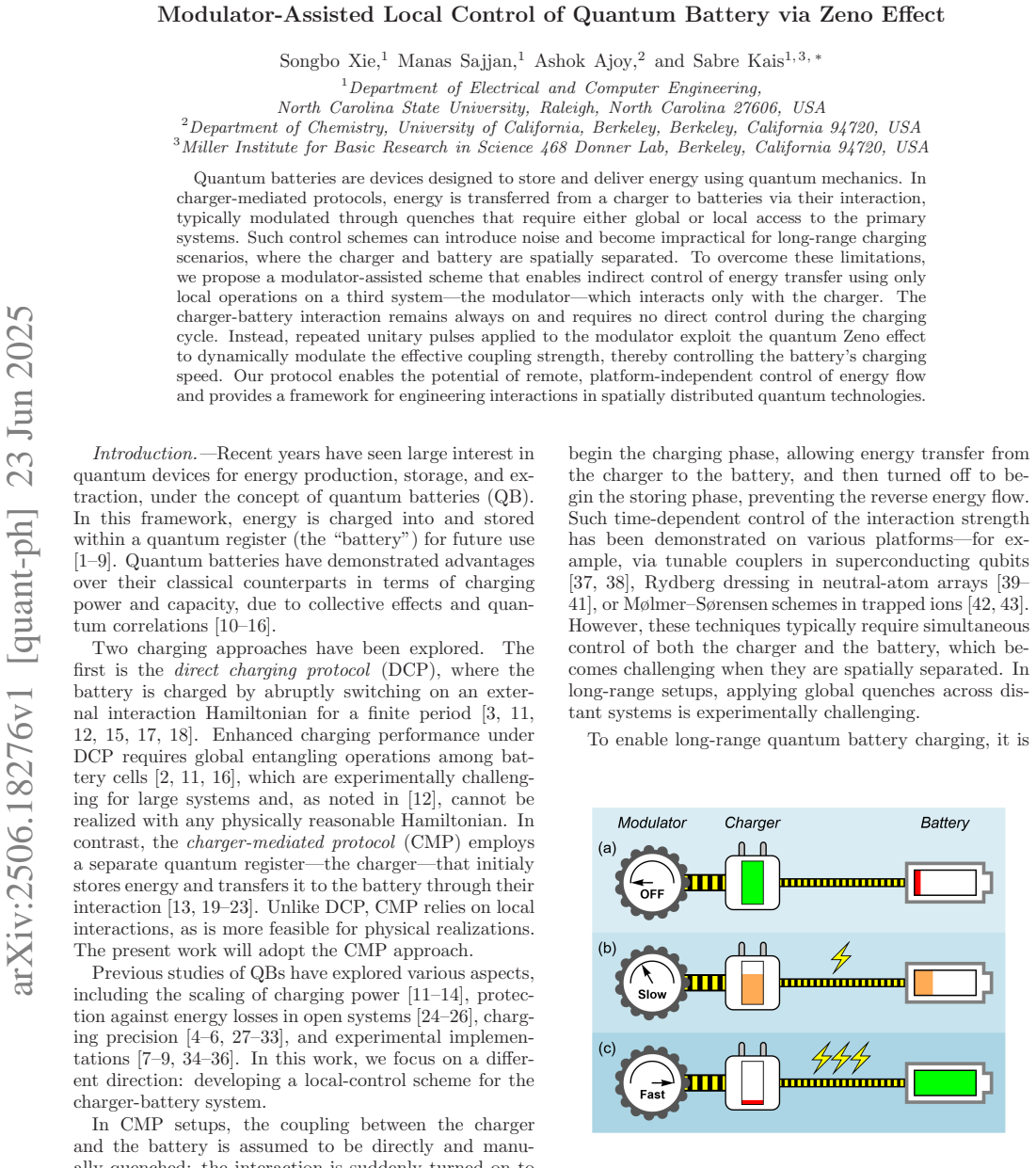
An auxiliary modulator qubit uses repeated local operations to switch quantum battery charging on and off through a Zeno-like reshaping of the effective Hamiltonian.
A machine-rendered reading of the paper's core claim, the machinery that carries it, and where it could break.
Core claim
The authors establish that repeated local unitary operations applied to an auxiliary modulator qubit exploit a Zeno-like mechanism to reshape the effective Hamiltonian, switching the charger-battery energy transfer on and off while the underlying interaction remains always on. This protocol is shown to function in a minimal three-body model and to remain effective outside the strict fast-control limit. When applied to a collective many-body battery architecture, the method preserves the enhancement of charging power that scales as N to the three-halves with the number of battery units.
What carries the argument
The modulator-assisted Zeno control, in which repeated local unitaries on the auxiliary qubit suppress transitions to produce a controllable effective Hamiltonian that modulates the charger-battery coupling.
If this is right
- Energy transfer can be halted on demand to avoid reverse flow from battery back to charger.
- The control protocol continues to function when the local operations are applied at finite rather than infinite speed.
- Charging power enhancement scaling as N to the three-halves is retained in collective many-body batteries.
- Indirect regulation becomes possible without experimental manipulation of the direct charger-battery interaction.
Where Pith is reading between the lines
- The method may simplify hardware requirements in quantum battery experiments by moving control to a separate auxiliary qubit.
- Combining this Zeno modulation with existing many-body charging schemes could yield further improvements in overall efficiency.
- The approach opens a route to testing how Zeno control behaves when additional noise or decoherence channels are present in larger systems.
Load-bearing premise
The repeated local unitary operations on the modulator qubit can be executed rapidly enough relative to the natural system dynamics to generate usable Zeno-like suppression.
What would settle it
Measure the energy transfer rate in the three-qubit model while varying the repetition frequency of the modulator operations; if the effective coupling strength does not drop toward zero as the frequency increases, the Zeno-control claim is falsified.
Figures

read the original abstract
Efficient operation of quantum batteries requires not only fast energy transfer but also the ability to halt the charging process to prevent reverse flow. Existing approaches typically rely on direct control of the charger-battery interaction, which can be experimentally demanding. Here we propose a modulator-assisted quantum battery protocol that enables indirect control of energy transfer while keeping the interaction always on. By applying repeated local unitary operations to an auxiliary modulator qubit, we exploit a Zeno-like mechanism to dynamically reshape the effective Hamiltonian and switch the charger-battery coupling on and off. We demonstrate this mechanism in a minimal three-body model and show that it remains effective beyond the ideal fast-control limit. We further extend the protocol to a collective many-body architecture, where it preserves the characteristic enhancement of charging power, scaling as $N^{3/2}$ with the number of battery units. Our results establish modulator-assisted Zeno control as a scalable route to regulating energy transfer in quantum batteries, and we further discuss a possible implementation in an NV-$\Cs$ spin platform.
Editorial analysis
A structured set of objections, weighed in public.
Referee Report
Summary. The manuscript proposes a modulator-assisted Zeno protocol for controlling energy transfer in quantum batteries. Repeated local unitary operations on an auxiliary modulator qubit are used to dynamically reshape the effective charger-battery Hamiltonian via a Zeno-like mechanism, enabling on/off switching of the interaction without direct control. The protocol is demonstrated numerically in a minimal three-body model, shown to remain effective beyond the strict fast-control limit, and extended to a collective many-body architecture in which the N^{3/2} charging-power scaling is claimed to be preserved.
Significance. If the central claims hold, the work provides a scalable, indirect control route for quantum batteries that avoids direct modulation of the charger-battery coupling. The demonstration beyond the ideal fast-control limit and the retention of collective superradiant enhancement are notable strengths. The suggested NV-Cs implementation adds experimental relevance. The approach could simplify hardware requirements for regulating charging dynamics in larger quantum battery systems.
major comments (1)
- Many-body section: the claim that the protocol preserves the N^{3/2} scaling under finite-rate modulator control is not supported by explicit verification. The manuscript shows the scaling in the three-body case but appears to extrapolate the same protocol to the collective architecture without demonstrating that finite-speed local unitaries on the modulator do not generate residual cross terms, dephasing, or inhomogeneous broadening that would suppress the collective enhancement and restore linear scaling. An explicit check (numerical or perturbative) of the effective all-to-all coupling structure under finite control rate is required to substantiate the central many-body claim.
minor comments (2)
- Abstract and introduction: the phrasing 'remains effective beyond the ideal fast-control limit' would benefit from a quantitative statement of the control-rate range explored (e.g., ratio of modulation period to system timescale).
- Notation: ensure consistent use of symbols for the modulator qubit operators and the effective Hamiltonian across sections; a brief table of symbols would improve readability.
Simulated Author's Rebuttal
We thank the referee for the positive overall assessment and for identifying a point that requires clarification in the many-body section. We address the comment below and have revised the manuscript to strengthen the supporting analysis.
read point-by-point responses
-
Referee: Many-body section: the claim that the protocol preserves the N^{3/2} scaling under finite-rate modulator control is not supported by explicit verification. The manuscript shows the scaling in the three-body case but appears to extrapolate the same protocol to the collective architecture without demonstrating that finite-speed local unitaries on the modulator do not generate residual cross terms, dephasing, or inhomogeneous broadening that would suppress the collective enhancement and restore linear scaling. An explicit check (numerical or perturbative) of the effective all-to-all coupling structure under finite control rate is required to substantiate the central many-body claim.
Authors: We agree that an explicit verification of the many-body scaling at finite modulator rate strengthens the central claim. In the revised manuscript we have added a new subsection containing both a perturbative expansion of the effective Hamiltonian and numerical simulations for N up to 8. The perturbative analysis shows that the leading-order corrections from finite-rate local unitaries preserve the all-to-all interaction structure; residual cross terms and dephasing contributions remain O(1/N) or smaller and do not restore linear scaling within the parameter window where the Zeno condition holds. The numerical results confirm that the charging power continues to follow an N^{3/2} fit even when the modulator period is only moderately faster than the charger-battery coupling time. These additions directly address the concern and substantiate the preservation of collective enhancement. revision: yes
Circularity Check
No circularity: derivation applies established Zeno effect to new battery-control architecture
full rationale
The paper derives the modulator-assisted protocol by applying repeated local unitaries on an auxiliary qubit to induce Zeno-like reshaping of the effective charger-battery Hamiltonian. This is shown first in an explicit three-body model with numerical checks beyond the fast-control limit, then extended analytically to the collective many-body case where the N^{3/2} scaling is preserved by the structure of the all-to-all coupling under the modulated effective Hamiltonian. No step reduces by construction to a fitted parameter, self-definition, or load-bearing self-citation; the central claims rest on standard quantum-Zeno dynamics plus direct simulation of the finite-rate protocol, remaining self-contained against external benchmarks.
Axiom & Free-Parameter Ledger
axioms (1)
- standard math Standard quantum mechanics and the quantum Zeno effect under repeated unitary operations apply to the charger-modulator-battery system.
Forward citations
Cited by 1 Pith paper
-
Drive-Only Interaction Engineering via Dynamical Freezing
Dynamical freezing of a driven modulator qubit controls the detuning between two target qubits, switching their native exchange interaction between resonant (iSWAP) and off-resonant (suppressed) regimes via drive freq...
Reference graph
Works this paper leans on
-
[1]
We define the charger’s energy to be Ec = Tr(ρH mc). The battery’s energy is Eb = Tr[ ρH b], where we define the battery’s Hamiltonian to be H b ≡ ω1(1b − σb z), with the identity operator 1 ensuring the lowest energy to be 0. Here, ρ is the density operator for the three-qubit system. Assuming g ≪ ω0, the rotating wave approximation (R W A) can be applied....
-
[2]
The above discus- sion shows that we can dynamically switch the interac- tion between the charger and the battery by controlling whether pulses are applied to the external modulator. In Fig. 2(c), we begin with an idle period, indicated by the first yellow region, during which no pulses are applied and the energy remains stored in the charger. Pulses are t...
-
[3]
F. Campaioli, S. Gherardini, J. Q. Quach, M. Polini, and G. M. Andolina, Rev. Mod. Phys. 96, 031001 (2024)
work page 2024
- [4]
-
[5]
T. P. Le, J. Levinsen, K. Modi, M. M. Parish, and F. A. Pollock, Phys. Rev. A 97, 022106 (2018)
work page 2018
- [6]
-
[7]
A. C. Santos, B. C ¸ akmak, S. Campbell, and N. T. Zinner, Phys. Rev. E 100, 032107 (2019)
work page 2019
- [8]
-
[9]
J. Q. Quach, K. E. McGhee, L. Ganzer, D. M. Rouse, B. W. Lovett, E. M. Gauger, J. Keeling, G. Cerullo, D. G. Lidzey, and T. Virgili, Sci. Adv. 8, eabk3160 (2022)
work page 2022
-
[10]
C.-K. Hu, J. Qiu, P. J. Souza, J. Yuan, Y. Zhou, L. Zhang, J. Chu, X. Pan, L. Hu, J. Li, et al. , Quan- tum Science and Technology 7, 045018 (2022)
work page 2022
-
[11]
I. Maillette de Buy Wenniger, S. Thomas, M. Maffei, S. Wein, M. Pont, N. Belabas, S. Prasad, A. Harouri, A. Lema ˆ ıtre, I. Sagnes, et al. , Phys. Rev. Lett. 131, 260401 (2023)
work page 2023
-
[12]
K. V. Hovhannisyan, M. Perarnau-Llobet, M. Huber, and A. Ac ´ ın, Phys. Rev. Lett.111, 240401 (2013)
work page 2013
-
[13]
F. C. Binder, S. Vinjanampathy, K. Modi, and J. Goold, New J. Phys. 17, 075015 (2015)
work page 2015
-
[14]
F. Campaioli, F. A. Pollock, F. C. Binder, L. C´ eleri, J. Goold, S. Vinjanampathy, and K. Modi, Phys. Rev. Lett. 118, 150601 (2017)
work page 2017
-
[15]
G. M. Andolina, M. Keck, A. Mari, V. Giovannetti, and M. Polini, Phys. Rev. B 99, 205437 (2019)
work page 2019
-
[16]
S. Juli` a-Farr´ e, T. Salamon, A. Riera, M. N. Bera, and M. Lewenstein, Phys. Rev. Research 2, 023113 (2020)
work page 2020
-
[17]
D. Rossini, G. M. Andolina, D. Rosa, M. Carrega, and M. Polini, Phys. Rev. Lett. 125, 236402 (2020)
work page 2020
-
[18]
J.-Y. Gyhm, D. ˇSafr´ anek, and D. Rosa, Phys. Rev. Lett. 128, 140501 (2022)
work page 2022
-
[19]
D. Rossini, G. M. Andolina, and M. Polini, Phys. Rev. B 100, 115142 (2019)
work page 2019
-
[20]
D. Rosa, D. Rossini, G. M. Andolina, M. Polini, and M. Carrega, J. High Energy Phys. 2020 (11), 1
work page 2020
-
[21]
G. M. Andolina, D. Farina, A. Mari, V. Pellegrini, V. Giovannetti, and M. Polini, Phys. Rev. B 98, 205423 (2018)
work page 2018
-
[22]
D. Ferraro, M. Campisi, G. M. Andolina, V. Pellegrini, and M. Polini, Phys. Rev. Lett. 120, 117702 (2018)
work page 2018
- [23]
-
[24]
A. Crescente, M. Carrega, M. Sassetti, and D. Ferraro, Phys. Rev. B 102, 245407 (2020)
work page 2020
-
[25]
A. Delmonte, A. Crescente, M. Carrega, D. Ferraro, and M. Sassetti, Entropy 23, 612 (2021)
work page 2021
-
[26]
J. Liu, D. Segal, and G. Hanna, J. Phys. Chem. C 123, 18303 (2019)
work page 2019
-
[27]
J. Q. Quach and W. J. Munro, Phys. Rev. Appl. 14, 024092 (2020)
work page 2020
- [28]
-
[29]
A. Crescente, M. Carrega, M. Sassetti, and D. Ferraro, New J. Phys. 22, 063057 (2020)
work page 2020
-
[30]
A. C. Santos, A. Saguia, and M. S. Sarandy, Phys. Rev. E 101, 062114 (2020)
work page 2020
-
[31]
L. F. Moraes, A. Saguia, A. C. Santos, and M. S. Sarandy, Europhys. Lett. 136, 23001 (2022)
work page 2022
-
[32]
O. Abah, G. De Chiara, M. Paternostro, and R. Puebla, Phys. Rev. Research 4, L022017 (2022)
work page 2022
- [33]
-
[34]
S. Imai, O. G¨ uhne, and S. Nimmrichter, Phys. Rev. A 107, 022215 (2023)
work page 2023
-
[35]
P. Bakhshinezhad, B. R. Jablonski, F. C. Binder, and N. Friis, Phys. Rev. E 109, 014131 (2024)
work page 2024
-
[36]
J. Fink, R. Bianchetti, M. Baur, M. G¨ oppl, L. Steffen, S. Filipp, P. J. Leek, A. Blais, and A. Wallraff, Phys. Rev. Lett. 103, 083601 (2009)
work page 2009
- [37]
- [38]
-
[39]
A. O. Niskanen, Y. Nakamura, and J.-S. Tsai, Phys. Rev. B 73, 094506 (2006)
work page 2006
-
[40]
A. Niskanen, K. Harrabi, F. Yoshihara, Y. Nakamura, S. Lloyd, and J. S. Tsai, Science 316, 723 (2007)
work page 2007
-
[41]
G. K. Brennen, C. M. Caves, P. S. Jessen, and I. H. Deutsch, Phys. Rev. Lett. 82, 1060 (1999)
work page 1999
- [42]
-
[43]
D. Bluvstein, A. Omran, H. Levine, A. Keesling, G. Se- meghini, S. Ebadi, T. T. Wang, A. A. Michailidis, N. Maskara, W. W. Ho, et al. , Science 371, 1355 (2021)
work page 2021
- [44]
-
[45]
D. Leibfried, B. DeMarco, V. Meyer, D. Lucas, M. Bar- rett, J. Britton, W. M. Itano, B. Jelenkovi´ c, C. Langer, T. Rosenband, et al. , Nature 422, 412 (2003)
work page 2003
-
[46]
A. Blais, R.-S. Huang, A. Wallraff, S. M. Girvin, and R. J. Schoelkopf, Phys. Rev. A 69, 062320 (2004)
work page 2004
-
[47]
L. DiCarlo, J. M. Chow, J. M. Gambetta, L. S. Bishop, B. R. Johnson, D. Schuster, J. Majer, A. Blais, L. Frun- zio, S. Girvin, et al. , Nature 460, 240 (2009)
work page 2009
- [48]
- [49]
-
[50]
Supplemental material (2025)
work page 2025
-
[51]
D. Dhar, L. Grover, and S. Roy, Phys. Rev. Lett. 96, 100405 (2006)
work page 2006
-
[52]
H. Singh, Arvind, and K. Dorai, Phys. Rev. A 90, 052329 1 (2014)
work page 2014
-
[53]
C. C. Gerry and P. L. Knight, Introductory quantum op- tics (Cambridge university press, 2023)
work page 2023
-
[54]
S. Gherardini, F. Campaioli, F. Caruso, and F. C. Binder, Phys. Rev. Research 2, 013095 (2020)
work page 2020
-
[55]
E. L. Hahn, Phys. Rev. 80, 580 (1950)
work page 1950
-
[56]
M. H. Levitt and R. Freeman, J. Magn. Reson. 33, 473 (1979)
work page 1979
- [57]
-
[58]
A. R. Hogan and A. M. Martin, Phys. Scr. 99, 055118 (2024)
work page 2024
- [59]
-
[60]
S. Seidov and S. Mukhin, Phys. Rev. A 109, 022210 (2024). Supplemental Materials: Modulator-Assisted Local Contro l of Quantum Battery via Zeno effect I. DERIV ATION OF EQ. (3) The operators in the original interaction Hamiltonian 2 g(σc +σb − + σc −σb +) can be expressed more explicitly as: 2g(1m ⊗ |1⟩⟨0|c ⊗ σb − + h.c.), (S1) where h.c. is the Hermitian ...
work page 2024
discussion (0)
Sign in with ORCID, Apple, or X to comment. Anyone can read and Pith papers without signing in.