REVIEW 3 major objections 5 minor 78 references
Revisiting the Electroweak Supersymmetry from the Generalized Minimal Supergravity
T0 review · 3 major / 5 minor · reviewed 2026-08-15 · deepseek-v4-flash
Pith's one-line read Within the GmSUGRA framework, a comprehensive random scan with current collider, relic-density, and direct-detection constraints finds that sbottom-neutralino coannihilation is a viable neutralino dark-matter mechanism for the first time…
desk verdict Useful, checkable update of GmSUGRA scans under LZ 2024 and lattice-QCD (g-2), but the headline sbottom-coannihilation claim is directly contradicted inside the paper and needs a focused scan before it can stand. read the letter →
The pith
A machine-rendered reading of the paper's core claim, the machinery that carries it, and where it could break.
The reading
What carries the argument
The carrying object is the GmSUGRA boundary condition itself: a generalized SU(5)-based supergravity in which an adjoint Higgs field modifies the GUT-scale gauge kinetic function, producing the non-universal gaugino mass relation $M_2 - M_3 = \frac{5}{3}(M_1 - M_3)$, equivalently $M_3 = \frac{5}{2}M_1 - \frac{3}{2}M_2$, and scalar mass relations that allow light electroweak sleptons and gauginos while squarks are heavy. The argument runs on a Markov-chain Monte Carlo–driven random scan over this parameter space, with each point processed by a spectrum calculator and filtered through bounds on the Higgs mass, B-physics observables, sparticle masses, relic density, and spin-independent and spin-dependent direct-detection cross sections. The specific claim about sbottom-neutralino coannihilation rests on the near-degeneracy condition $m_{\tilde{b}_1} \approx m_{\tilde{\chi}^0_1}$ in the $\mu<0$ scan, realized as a mass gap of about 80 GeV at the benchmark point, which makes the lightest sbottom the next-to-lightest supersymmetric particle and enables efficient coannihilation.
What would settle it
Run a dedicated high-density scan (grid or focused Markov-chain sampling) of the GmSUGRA parameter space restricted to the sbottom-neutralino mass-degenerate window, $m_{\tilde{b}_1} - m_{\tilde{\chi}^0_1}$ between 0 and 100 GeV, for both signs of $\mu$, using the same constraints; if relic-density-compatible red points appear for $\mu>0$ as well, the claimed exclusive $\mu<0$ sbottom coannihilation is a sampling artifact. An experimental cross-check would be a collider search for a compressed $\sim 1.3$ TeV sbottom with an $\sim 80$ GeV mass gap decaying to $b$ plus missing energy, whose discovery would support the benchmark point and whose exclusion would challenge it.
Extended reading notes
Core claim
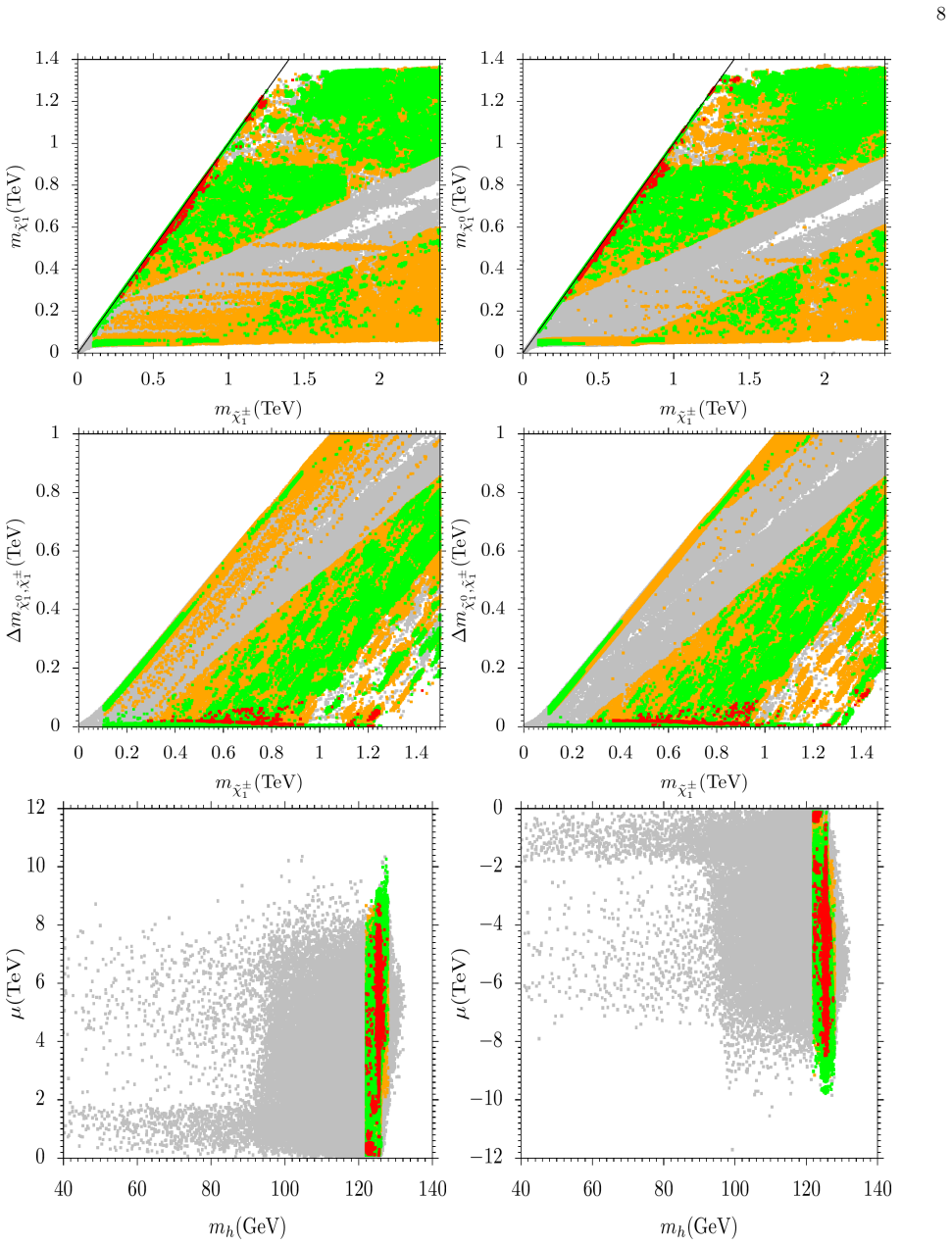
The central claim is that within the MSSM under the GmSUGRA boundary conditions, a broad random scan filtered by radiative electroweak symmetry breaking, collider sparticle mass bounds, B-physics observables, the Higgs mass, the observed cosmological relic-density range, and current direct-detection limits reveals the full menu of neutralino dark-matter mechanisms, and specifically, for the first time in this framework, sbottom-neutralino coannihilation as a viable mechanism, exclusively for $\mu<0$. The representative solution, Point 6 of Table I, has a lightest sbottom at 1.321 TeV, a bino-like lightest neutralino at 1.240 TeV, and $\Omega h^2 = 0.120$, consistent with the observed relic density. The paper also claims that the $\mu<0$ parameter space is broader and more flexible than $\mu>0$: the Higgs- and $Z$-funnel regions survive for $\mu<0$ but are largely excluded for $\mu>0$ by direct detection, and the gluino-coannihilation region is strongly squeezed by collider bounds. The authors further report that the supersymmetric contribution to the muon anomalous magnetic moment falls within $1\sigma$–$2\sigma$ of the updated Standard Model value, so the model is not in tension with the now-reduced $g-2$ anomaly. They caution, however, that the scan density in the sbottom channel is limited, so the new red-point region should be confirmed by more focused scanning.
Load-bearing premise
The central claim depends on the random scan adequately covering the sbottom-neutralino coannihilation region; the paper itself says that scan density there is low and that the sparse points are an artifact of scanning, so the claimed first-time sbottom channel, and its absence for $\mu>0$, could be an artifact of scanning rather than a genuine feature of the model.
Editorial extensions
If this is right
- Sbottom-neutralino coannihilation joins stau, stop, chargino, and gluino coannihilation plus the $A$/H/$Z$ funnels as a viable neutralino dark-matter mechanism in GmSUGRA, but only for $\mu<0$, with a concrete benchmark at $m_{\tilde{b}_1}\approx 1.321$ TeV and $m_{\tilde{\chi}^0_1}\approx 1.240$ TeV.
- The $\mu<0$ scenario retains a substantially larger viable parameter space than $\mu>0$, so future collider searches for electroweakinos and sleptons, and upcoming direct-detection exposures, should treat the negative-$\mu$ regime as a primary target.
- The surviving dark-matter mechanisms are mostly compressed electroweak spectra, with sleptons, stops, sbottoms, or charginos nearly degenerate with the neutralino at mass splittings below roughly ten percent.
- The model's supersymmetric contribution to the muon anomalous magnetic moment stays within $1\sigma$–$2\sigma$ of the updated Standard Model value, so this framework neither requires nor is excluded by the residual $g-2$ discrepancy.
- Several benchmark points fall within the expected sensitivity of the next collider runs and the next generation of direct-detection experiments, giving testable predictions for where new physics should appear first.
Reading between the lines
- The paper's own admission of scan sparsity implies that the $\mu<0$-only sbottom channel is a conjecture awaiting a dedicated scan; a denser scan could either confirm a genuine sign-asymmetry rooted in the spectrum or reveal that the channel also exists for $\mu>0$.
- If the muon $g-2$ anomaly continues to shrink as lattice-QCD inputs improve, the traditional preference for $\mu>0$ weakens, and the map of viable $\mu<0$ mechanisms this paper provides would become the default geography for electroweak supersymmetry searches.
- Because the generalized gaugino mass relation makes the gluino mass a derived quantity, the strongly constrained gluino-coannihilation channel suggests that the electroweak coannihilation channels are the more robust discovery windows, a prioritization that collider searches could adopt.
- Re-analysing existing compressed-sbottom search data in the 1–1.3 TeV range with the specific kinematics of an $\sim 80$ GeV mass gap would directly test the benchmark point without waiting for new data.
Signed reviews
Editorial analysis
A structured set of objections, weighed in public.
Referee Report
Summary. This paper performs a random scan of the MSSM parameter space in the Generalized Minimal Supergravity (GmSUGRA) framework using ISAJET, allowing both signs of the Higgsino mass parameter mu and treating soft scalar masses, gaugino masses, trilinears, tan beta, and sign(mu) as free inputs. The scan is filtered by REWSB, neutralino LSP conditions, LEP/LHC sparticle bounds, Higgs mass, B-physics constraints, Planck 2018 relic density, and current LZ/XENONnT direct-detection limits. The authors report viable dark matter mechanisms for mu<0 and mu>0, including stau, chargino, stop, sbottom, and gluino coannihilation, as well as A-, H-, and Z-funnel annihilation, and they claim that sbottom-neutralino coannihilation appears for the first time in GmSUGRA and only for mu<0. They also report that the supersymmetric contribution to (g-2)_mu remains within about 2 sigma of the updated SM prediction, and they give benchmark spectra in Tables I and II.
Significance. If established, a first observation of sbottom-neutralino coannihilation in GmSUGRA would be a nontrivial result, because the GUT-scale scalar mass relations in Eqs. (6)-(8) correlate the sbottom mass with the squark sector, making near-degenerate sbottom-LSP solutions non-generic. The paper also provides a useful mapping of the surviving parameter space under current LHC, Planck, and direct-detection constraints, with concrete benchmark points and a standard set of constraints. The use of ISAJET with a Metropolis-Hastings scan and the explicit list of experimental filters is appropriate. However, the central novelty is not currently supported by the text: Section III states that the published scan has no red sbottom-coannihilation points and calls this an artifact of scanning, while the abstract, Section IV, and Table I claim the opposite. The A-funnel mass range also disagrees between the abstract and Section III. These contradictions must be resolved before the results can be relied upon.
major comments (3)
- [Section III (sbottom paragraph), Abstract, Section IV, Table I] The central novelty claim is internally contradicted. In the sbottom paragraph, the text first says 'viable red points near 1-1.3 TeV hint at possible sbottom coannihilation' and then immediately states 'in our present study, somehow we do not have a large density of green and orange points in these channels, so in the results, no red points. This is an artifact of scanning.' The abstract nonetheless claims 'for the first time sbottom-neutralino coannihilation solutions in GmSUGRA,' and Table I Point 6 is labeled as sbottom-neutralino coannihilation with an Omega h^2 value consistent with the Planck range. As written, the published scan contains no red point in this channel, so neither the first-time claim nor Point 6 is supported. Please either provide the actual red points from a dedicated scan, with their coordinates and the constraints they pass, or remove the 'for the first time' claim and relabel Point 6 accordingly.
- [Abstract vs Section III (A-funnel paragraph)] The abstract states that pseudoscalar Higgs masses in the A-funnel lie in the range 0.4-1.4 TeV, while Section III states that funnel solutions are present for mA from approximately 1.2 TeV to 2.9 TeV. These are mutually incompatible ranges. The authors should correct one of them, or specify that the abstract range refers to a different quantity such as the LSP mass rather than mA. This discrepancy, together with the sbottom issue, makes it difficult to extract reliable quantitative conclusions from the paper.
- [Table I (Omega h^2 entries for Points 5 and 6)] In Table I, the Omega h^2 entries for Points 5 and 6 are printed as '116' and '120'; these should presumably be 0.116 and 0.120, since as printed they are far outside the Planck 2018 5-sigma range. Because Point 6 is the central sbottom-coannihilation benchmark, the table must be unambiguous. Please also state explicitly whether Point 6 is a red point from the published scan or a separate solution; if it comes from a different or additional scan, that scan must be documented.
minor comments (5)
- [Section III, first sentence before Table I] The sentence before Table I reads only 'we have studied the GmSUGRA' and is an incomplete fragment; it should be completed or deleted.
- [Eq. (1)] The formula for Delta a_mu^SUSY is dimensionally inconsistent as written: M_i mu tan beta / m_SUSY^4 has mass dimension -2, while a_mu is dimensionless. The muon mass squared is presumably implicit in the full expression and should be shown explicitly or the formula should be presented as a schematic estimate.
- [Section II, constraint (e), Eq. (15)] The lower limit for BR(Bs -> mu+ mu-) is printed as '0.8 x 1--9'; this appears to be a typo for 0.8 x 10^{-9}.
- [Figure captions, Figures 1 and 2] The word 'underrsaturated' appears in the captions and should be corrected to 'undersaturated'; 'S-particles' should be 'sparticles'.
- [Abstract and Section IV, sbottom claim wording] The claims that sbottom coannihilation is 'absent for mu>0' and 'for the first time' are stronger than what a random scan can establish, especially given the admitted under-sampling of this channel. These statements should be softened to 'not observed in this scan' unless a dedicated scan is provided.
Circularity Check
No significant circularity: the scan is externally constrained; the sbottom coannihilation claim is internally inconsistent, not circular.
full rationale
The paper's derivation chain is a random scan over GmSUGRA parameters, with spectra computed by ISAJET and filtered by external constraints (LHC sparticle mass bounds, Planck 2018 relic density, LZ direct detection). The central claim—first sbottom–neutralino coannihilation in GmSUGRA for mu<0—is not obtained by fitting a parameter to the target relic density; it is a classification of scan outputs. The GmSUGRA boundary conditions (Eqs. 2–8) are model definitions from prior work, not results derived from the target. Self-citations ([15]–[17], [38]) motivate the scenario and contextualize the novelty claim but do not carry the derivation; the scan is self-contained against external benchmarks. The internal problem is consistency, not circularity: Section III states 'In our present study, somehow we do not have a large density of green and orange points in these channels, so in the results, no red points. This is an artifact of scanning,' while the abstract and Table I (Point 6) claim a viable sbottom-coannihilation benchmark with Omega h^2 = 0.120. This contradiction undermines confidence in the claimed region, and the abstract's A-funnel range (0.4–1.4 TeV) conflicts with Section III's 1.2–2.9 TeV. These are correctness/consistency defects, not circular reductions: no equation is defined in terms of the result, and no fitted quantity is relabeled as a prediction.
Assumptions & free parameters
free parameters (9)
- mU0 (universal scalar mass) =
scanned 0-9000 GeV; benchmark values in Tables I/II (e.g., 6588, 112.1, 82.2 GeV)
- M1 (bino gaugino mass) =
scanned 80-3000 GeV; benchmark values e.g., 2009, 2498 GeV
- M2 (wino gaugino mass) =
scanned 100-3100 GeV; benchmark values e.g., 3095, 2883 GeV
- mL (left slepton mass) =
scanned 100-1200 GeV; benchmark values e.g., 827.8, 692 GeV
- mEc (right slepton mass) =
scanned 100-1200 GeV; benchmark values e.g., 811, 1033 GeV
- mHu, mHd (Higgs soft masses) =
scanned 100-5000 GeV; benchmark values e.g., 1021, 4285 GeV
- AU=AD, AE (trilinear couplings) =
AU=AD scanned -16000 to 16000 GeV; AE scanned -6000 to 6000 GeV; benchmark values listed
- tan beta =
scanned 2 to 60; benchmark values e.g., 37.7, 36.5, 46.7
- sign of mu (Higgsino mass parameter) =
discrete choice: mu<0 or mu>0; benchmark tables give values like -6789.4 GeV and +7037.7 GeV
assumptions (5)
- domain assumption GmSUGRA boundary conditions: gauge coupling and gaugino mass relations of Eqs. (2)-(5), and scalar mass relations of Eqs. (6)-(8), derived from SU(5) adjoint breaking
- domain assumption R-parity conservation and a neutralino LSP that saturates the observed dark matter relic density
- domain assumption ISAJET 7.85 and associated B-physics and dark matter tools produce correct spectra, relic densities, and cross sections
- standard math Gauge coupling unification alpha1 = alpha2 = alpha3 at the GUT scale
- domain assumption Standard halo model assumptions for direct detection interpretations
Cite this review
Pith. "Pith review of Revisiting the Electroweak Supersymmetry from the Generalized Minimal Supergravity." pith.science (2026). https://pith.science/paper/XZD7MHEH
@misc{pith2026250618442,
  author       = {Pith},
  title        = {Pith review of: Revisiting the Electroweak Supersymmetry from the Generalized Minimal Supergravity},
  year         = {2026},
  howpublished = {\url{https://pith.science/paper/XZD7MHEH}},
  note         = {Machine review of arXiv:2506.18442}
}
abstract
We explore the Electroweak Supersymmetry (EWSUSY) scenario within the Minimal Supersymmetric Standard Model (MSSM) under the Generalized Minimal Supergravity (GmSUGRA) framework, given that the anomalous magnetic moment of the muon may now be consistent with the Standard Model (SM) prediction, we consider both signs of the Higgsino mass parameter, $\mu < 0$ and $\mu > 0$. A comprehensive scan of the parameter space is performed, subject to the experimental constraints from the LHC SUSY searches, Planck 2018 relic density, and LUX-ZEPLIN (LZ) direct detection limits. We identify the viable regions featuring neutralino dark matter production via coannihilation with stau, chargino, stop, sbottom, and gluino, as well as through $A$-funnel, Higgs-resonance, and $Z$-resonance mechanisms. Notably, the $\mu < 0$ scenario yields a broader allowed parameter space, including for the first time sbottom-neutralino coannihilation solutions in GmSUGRA, which are absent for $\mu > 0$. While the Higgs-pole and $Z$-pole regions for $\mu > 0$ are largely excluded by the current LZ bounds, substantial viable regions remain for $\mu < 0$. Gluino coannihilation scenarios are strongly constrained by the current LHC data. The characteristic mass ranges of interest include sbottoms (0.7-1.3~TeV), stops (up to 1.0~TeV for $\mu > 0$ and 1.3~TeV for $\mu < 0$), staus and charginos (up to 1.5~TeV), and pseudoscalar Higgs bosons in the $A$-funnel (0.4-1.4~TeV). Moreover, the supersymmetric contributions to the muon anomalous magnetic moment remain within a $2\sigma$ deviation from the SM prediction. And our findings suggest that significant portions of the parameter space can be probed at the future LHC SUSY searches and upcoming dark matter direct detection experiments.
Figures


Figures from the paper (2 more)


Reference graph
Works this paper leans on
-
[1]
For re- cent LHC searches see [60–68]
In the case of small mass gaps, these decay channels are closed, and the loop-suppressed decay ˜t1 → c ˜χ0 1 becomes dominant [58, 59]. For re- cent LHC searches see [60–68]. In all of these studies, the maximum stop mass considered is 1.2 TeV, which is consistent with the maximum stop mass allowed by all constraints (red points) in our findings, indicati...
work page 2022
-
[2]
S. Dimopoulos, S. Raby and F. Wilczek, Phys. Rev. D 24, 1681-1683 (1981) doi:10.1103/PhysRevD.24.1681; U. Amaldi, W. de Boer and H. Furstenau, Phys. Lett. B 260, 447-455 (1991) doi:10.1016/0370-2693(91)91641- 8; J. R. Ellis, S. Kelley and D. V. Nanopoulos, Phys. Lett. B 260, 131-137 (1991) doi:10.1016/0370- 2693(91)90980-5; P. Langacker, J. Phys. G 29, 35...
arXiv 1981
-
[3]
H. Georgi and S. L. Glashow, Phys. Rev. Lett. 28, 1494 (1972) doi:10.1103/PhysRevLett.28.1494
-
[4]
J. C. Pati and A. Salam, Phys. Rev. D 10, 275-289 (1974) [erratum: Phys. Rev. D 11, 703-703 (1975)] doi:10.1103/PhysRevD.10.275
-
[5]
R. N. Mohapatra and J. C. Pati, Phys. Rev. D 11, 2558 (1975) doi:10.1103/PhysRevD.11.2558
-
[6]
H. Fritzsch and P. Minkowski, Annals Phys. 93, 193-266 (1975) doi:10.1016/0003-4916(75)90211-0
-
[7]
H. Georgi, AIP Conf. Proc. 23, 575-582 (1975) doi:10.1063/1.2947450
-
[8]
H. Goldberg, Phys. Rev. Lett. 50, 1419 (1983) [erratum: Phys. Rev. Lett. 103, 099905 (2009)] doi:10.1103/PhysRevLett.50.1419; J. R. Ellis, J. S. Hagelin, D. V. Nanopoulos, K. A. Olive and M. Srednicki, Nucl. Phys. B 238, 453-476 (1984) doi:10.1016/0550-3213(84)90461-9
Show all 78 references
-
[9]
Jungman, M
For reviews, see G. Jungman, M. Kamionkowski and K. Griest, Phys. Rept. 267, 195-373 (1996) doi:10.1016/0370-1573(95)00058-5 [arXiv:hep- ph/9506380 [hep-ph]]; K. A. Olive, [arXiv:astro- ph/0301505 [astro-ph]]; J. L. Feng, eConf C0307282, L11 (2003) [arXiv:hep-ph/0405215 [hep-p...
1996
-
[10]
Slavich, S
P. Slavich, S. Heinemeyer, E. Bagnaschi, H. Bahl, M. Goodsell, H. E. Haber, T. Hahn, R. Harlander, W. Hollik and G. Lee, et al. Eur. Phys. J. C 81 (2021) no.5, 450 doi:10.1140/epjc/s10052-021-09198-2 [arXiv:2012.15629 [hep-ph]]
2021 arXiv
-
[11]
ATLAS Collaboration, ATLAS-CONF-2019-040
2019
-
[14]
CMS Collaboration, CMS PAS SUS-19-005
-
[15]
CMS Collaboration, CMS PAS SUS-19-006
-
[16]
Ahmed, I
W. Ahmed, I. Khan, T. Li, S. Raza and W. Zhang, Phys. Lett. B 832 (2022), 137216 doi:10.1016/j.physletb.2022.137216 [arXiv:2202.11011 13 [hep-ph]]
2022
-
[17]
Zhang, W
W. Zhang, W. Ahmed, I. Khan, T. Li and S. Raza, Phys. Rev. D 110, no.5, 055006 (2024) doi:10.1103/PhysRevD.110.055006 [arXiv:2304.01082 [hep-ph]]
2024 arXiv
-
[18]
I. Khan, W. Ahmed, T. Li and S. Raza, Phys. Rev. D109 (2024) no.7, 075051 doi:10.1103/PhysRevD.109.075051 [arXiv:2312.07863 [hep-ph]]
2024 arXiv
-
[19]
Aad et al
G. Aad et al. [ATLAS], Phys. Rev. Lett. 125 (2020) no.5, 051801 doi:10.1103/PhysRevLett.125.051801 [arXiv:2002.12223 [hep-ex]]
2020 arXiv
-
[20]
A. M. Sirunyan et al. [CMS], JHEP 04 (2021), 123 doi:10.1007/JHEP04(2021)123 [arXiv:2012.08600 [hep- ex]]
2021 arXiv
-
[21]
Aad et al
G. Aad et al. [ATLAS], Eur. Phys. J. C 81 (2021) no.12, 1118 doi:10.1140/epjc/s10052-021-09749-7 [arXiv:2106.01676 [hep-ex]]
2021 arXiv
-
[22]
Aad et al
G. Aad et al. [ATLAS], Phys. Rev. D 104 (2021) no.11, 112010 doi:10.1103/PhysRevD.104.112010 [arXiv:2108.07586 [hep-ex]]
2021 arXiv
-
[23]
Tumasyan et al
A. Tumasyan et al. [CMS], Phys. Lett. B 842 (2023), 137460 doi:10.1016/j.physletb.2022.137460 [arXiv:2205.09597 [hep-ex]]
2023
-
[24]
Aad et al
G. Aad et al. [ATLAS], JHEP 08 (2022), 104 doi:10.1007/JHEP08(2022)104 [arXiv:2202.07953 [hep- ex]]
2022 arXiv
-
[25]
Aprile et al
E. Aprile et al. [XENON], Phys. Rev. Lett. 121 (2018) no.11, 111302 doi:10.1103/PhysRevLett.121.111302 [arXiv:1805.12562 [astro-ph.CO]]
2018 arXiv
-
[26]
Aprile et al
E. Aprile et al. [XENON], Phys. Rev. Lett. 122 (2019) no.14, 141301 doi:10.1103/PhysRevLett.122.141301 [arXiv:1902.03234 [astro-ph.CO]]
2019 arXiv
-
[27]
Amole et al
C. Amole et al. [PICO], Phys. Rev. D 100 (2019) no.2, 022001 doi:10.1103/PhysRevD.100.022001 [arXiv:1902.04031 [astro-ph.CO]]
2019 arXiv
-
[28]
Meng et al
Y. Meng et al. [PandaX-4T], Phys. Rev. Lett. 127 (2021) no.26, 261802 doi:10.1103/PhysRevLett.127.261802 [arXiv:2107.13438 [hep-ex]]
2021 arXiv
-
[29]
Aalbers et al
J. Aalbers et al. [LZ], Phys. Rev. Lett. 131 (2023) no.4, 041002 doi:10.1103/PhysRevLett.131.041002 [arXiv:2207.03764 [hep-ex]]
2023 arXiv
- [30]
-
[31]
Huang et al
Z. Huang et al. [PandaX], Phys. Lett. B 834 (2022), 137487 doi:10.1016/j.physletb.2022.137487 [arXiv:2208.03626 [hep-ex]]
2022
-
[32]
Khalil, S., & Moretti, S. (2017). Supersymmetry beyond minimality: from theory to experiment. CRC Press
2017
-
[33]
Ahmed, I
W. Ahmed, I. Khan, J. Li, T. Li, S. Raza and W. Zhang, Phys. Lett. B 827 (2022), 136879 doi:10.1016/j.physletb.2022.136879 [arXiv:2104.03491 [hep-ph]]
2022
-
[34]
D. P. Aguillard et al. [Muon g-2], Phys. Rev. Lett. 131, no.16, 161802 (2023) doi:10.1103/PhysRevLett.131.161802 [arXiv:2308.06230 [hep-ex]]
2023
-
[35]
Abi et al
B. Abi et al. [Muon g-2], Phys. Rev. Lett. 126, no.14, 141801 (2021) doi:10.1103/PhysRevLett.126.141801 [arXiv:2104.03281 [hep-ex]]
2021
-
[36]
D. P. Aguillard et al. [Muon g-2], [arXiv:2506.03069 [hep- ex]]
-
[37]
Aliberti, T
R. Aliberti, T. Aoyama, E. Balzani, A. Bashir, G. Ben- ton, J. Bijnens, V. Biloshytskyi, T. Blum, D. Boito and M. Bruno, et al. [arXiv:2505.21476 [hep-ph]]
-
[38]
R. K. Barman, G. B´ elanger, B. Bhat- tacherjee, R. M. Godbole and R. Sengupta, Phys. Rev. Lett. 131, no.1, 011802 (2023) doi:10.1103/PhysRevLett.131.011802 [arXiv:2207.06238 [hep-ph]]
2023 arXiv
-
[39]
I. Khan, W. Ahmed, T. Li, S. Raza and A. Muhammad, [arXiv:2501.12039 [hep-ph]]
-
[40]
Li and D
T. Li and D. V. Nanopoulos, Phys. Lett. B 692, 121-125 (2010) doi:10.1016/j.physletb.2010.07.024 [arXiv:1002.4183 [hep-ph]]
2010 arXiv
-
[41]
Balazs, T
C. Balazs, T. Li, D. V. Nanopoulos and F. Wang, JHEP 09, 003 (2010) doi:10.1007/JHEP09(2010)003 [arXiv:1006.5559 [hep-ph]]
2010 arXiv
-
[42]
Cheng, J
T. Cheng, J. Li, T. Li, D. V. Nanopoulos and C. Tong, Eur. Phys. J. C73, 2322 (2013) doi:10.1140/epjc/s10052- 013-2322-0 [arXiv:1202.6088 [hep-ph]]
2013 arXiv
-
[43]
H. Baer, F. E. Paige, S. D. Protopopescu and X. Tata, [arXiv:hep-ph/0001086 [hep-ph]]
-
[44]
[ATLAS, CDF, CMS and D0], [arXiv:1403.4427 [hep-ex]]
-
[45]
Belanger, F
G. Belanger, F. Boudjema, A. Pukhov and R. K. Singh, JHEP 11, 026 (2009) doi:10.1088/1126- 6708/2009/11/026 [arXiv:0906.5048 [hep-ph]]. H. Baer, S. Kraml, S. Sekmen and H. Summy, JHEP 03, 056 (2008) doi:10.1088/1126-6708/2008/03/056 [arXiv:0801.1831 [hep-ph]]
2009 arXiv
-
[46]
R. L. Workman et al. [Particle Data Group], PTEP2022, 083C01 (2022) doi:10.1093/ptep/ptac097
2022 doi
-
[47]
Aad et al
G. Aad et al. [ATLAS and CMS Collaborations], JHEP 1608, 045 (2016) doi:10.1007/JHEP08(2016)045 [arXiv:1606.02266 [hep-ex]]
2016 arXiv
-
[48]
B. C. Allanach, A. Djouadi, J. L. Kneur, W. Porod and P. Slavich, JHEP 0409, 044 (2004) doi:10.1088/1126- 6708/2004/09/044
2004 doi
-
[49]
H. Baer, M. Brhlik, D. Castano and X. Tata, Phys. Rev. D 58, 015007 (1998) doi:10.1103/PhysRevD.58.015007 [arXiv:hep-ph/9712305 [hep-ph]]
1998 arXiv
-
[50]
K. S. Babu and C. F. Kolda, Phys. Rev. Lett. 84, 228- 231 (2000) doi:10.1103/PhysRevLett.84.228 [arXiv:hep- ph/9909476 [hep-ph]]
2000
-
[51]
Dedes, H
A. Dedes, H. K. Dreiner and U. Nierste, Phys. Rev. Lett. 87, 251804 (2001) doi:10.1103/PhysRevLett.87.251804 [arXiv:hep-ph/0108037 [hep-ph]]
2001 arXiv
-
[52]
J. K. Mizukoshi, X. Tata and Y. Wang, Phys. Rev. D 66, 115003 (2002) doi:10.1103/PhysRevD.66.115003 [arXiv:hep-ph/0208078 [hep-ph]]
2002 arXiv
-
[53]
Aaij et al
R. Aaij et al. [LHCb Collaboration], Phys. Rev. Lett. 110, no. 2, 021801 (2013) doi:10.1103/PhysRevLett.110.021801 [arXiv:1211.2674 [hep-ex]]
2013 arXiv
- [54]
- [55]
-
[56]
Aghanim et al
N. Aghanim et al. [Planck], Astron. Astrophys. 641, A1 (2020) doi:10.1051/0004-6361/201833880 [arXiv:1807.06205 [astro-ph.CO]]
2020 arXiv
-
[57]
Aprile et al
E. Aprile et al. [XENON], Phys. Rev. Lett. 131, no.4, 041003 (2023) doi:10.1103/PhysRevLett.131.041003 [arXiv:2303.14729 [hep-ex]]
2023 arXiv
-
[58]
D. S. Akerib et al. [LZ], Phys. Rev. D 101, no.5, 052002 (2020) doi:10.1103/PhysRevD.101.052002 [arXiv:1802.06039 [astro-ph.IM]]
2020 arXiv
-
[59]
K. i. Hikasa and M. Kobayashi, Phys. Rev. D 36, 724 (1987)
1987
-
[60]
Muhlleitner and E
M. Muhlleitner and E. Popenda, JHEP 04, 095 (2011) doi:10.1007/JHEP04(2011)095 [arXiv:1102.5712 [hep-ph]]. 14
2011 arXiv
- [61]
- [62]
-
[63]
Aaboud et al
M. Aaboud et al. [ATLAS], Eur. Phys. J. C 77, no.12, 898 (2017) [arXiv:1708.03247 [hep-ex]]
2017 arXiv
- [64]
-
[65]
Aaboud et al
M. Aaboud et al. [ATLAS], Eur. Phys. J. C 80, no.8, 754 (2020) [arXiv:1903.07570 [hep-ex]]
2020 arXiv
-
[66]
Aad et al
G. Aad et al. [ATLAS], Phys. Rev. D 103, no.11, 112006 (2021) [arXiv:2102.10874 [hep-ex]]
2021 arXiv
-
[67]
Aad et al
G. Aad et al. [ATLAS], Eur. Phys. J. C 80, no.8, 737 (2020) [arXiv:2004.14060 [hep-ex]]
2020 arXiv
- [68]
- [69]
- [70]
-
[71]
Aad et al
G. Aad et al. [ATLAS], Phys. Rev. D 104, no.3, 032014 (2021) [arXiv:2103.08189 [hep-ex]]
2021 arXiv
- [72]
- [73]
-
[74]
[CMS], [arXiv:2207.02254 [hep-ex]]
-
[75]
[CMS], [arXiv:2208.02717 [hep-ex]]
-
[76]
H. Baer, V. Barger, X. Tata and K. Zhang, Symmetry 14, no.10, 2061 (2022) [arXiv:2209.00063 [hep-ph]]
2022 arXiv
-
[77]
H. Baer, V. Barger, X. Tata and K. Zhang, [arXiv:2212.09198 [hep-ph]]
-
[78]
[ATLAS], ATL-PHYS-PUB-2021-019
2021
-
[79]
Aad et al
G. Aad et al. [ATLAS], Eur. Phys. J. C 83, no.7, 561 (2023) doi:10.1140/epjc/s10052-023-11543-6 [arXiv:2211.08028 [hep-ex]]
2023 arXiv
-
[80]
Aoyama, N
T. Aoyama, N. Asmussen, M. Benayoun, J. Bij- nens, T. Blum, M. Bruno, I. Caprini, C. M. Carloni Calame, M. C` e and G. Colangelo, et al. Phys. Rept. 887, 1-166 (2020) doi:10.1016/j.physrep.2020.07.006 [arXiv:2006.04822 [hep-ph]]
2020 arXiv
Reviewed August 15, 2026 · model on record in the stance chip above.
Discussion (0). Continue with ORCID to comment.