REVIEW 3 major objections 5 minor 68 references
Normality Prior Guided Multi-Semantic Fusion Network for Unsupervised Image Anomaly Detection
T0 review · 3 major / 5 minor · reviewed 2026-08-15 · deepseek-v4-flash
Pith's one-line read The paper claims that injecting semantic features of normal samples into an autoencoder's decoder—instead of relying on a compressed bottleneck alone—lets unsupervised models localize logical anomalies like missing or extra parts, and…
desk verdict A real SOTA claim on MVTec LOCO AD with public code, but the paper's own ablations don't yet pin the gain on the new codebook mechanism. read the letter →
The pith
A machine-rendered reading of the paper's core claim, the machinery that carries it, and where it could break.
The reading
What carries the argument
The load-bearing component is the normal multi-level codebook: at each encoder level $k$, features are passed through an atrous convolution block $\theta$ and replaced by the nearest entry $v_k$ in a learnable codebook $V_k$ with $d=16$ entries, using a straight-through gradient estimator for training. These quantized normal features, together with upsampled CLIP text-encoded global context and the one-class embedding, are concatenated and fused by LeWinBlocks before each decoder block. This forces the reconstruction path to pass through discrete normal prototypes, so abnormal inputs are re-rendered as their closest normal versions, and the anomaly score is the summed per-level cosine distance between encoder and decoder features. A second branch stores aggregated normal features in a coreset-subsampled memory bank and scores structural anomalies by nearest-neighbor distance, and the two score maps are normalized and weighted-combined.
What would settle it
Train the logical branch with codebook entries randomly sampled from normal features and then frozen; if pixel-sPRO on the logical-anomaly subset stays near 69.0%, the learned quantization is not the active ingredient. Alternatively, construct synthetic anomalies by replacing small regions with the nearest normal codebook entry while keeping global context fixed: the method predicts sharply higher reconstruction error, and any such input that reconstructs cleanly would refute the normality-prior mechanism.
Extended reading notes
Core claim
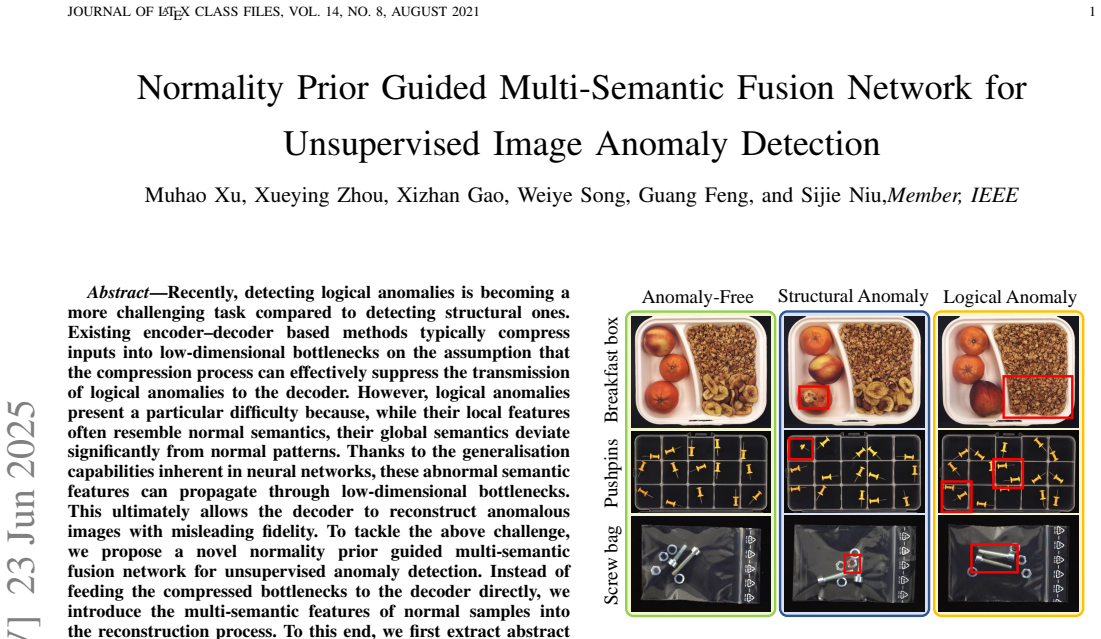
The central discovery the authors are trying to establish is that the failure mode of reconstruction-based logical anomaly detection is not compression itself, but the absence of a normality prior at the decoder. Previous encoder-decoder methods assume a low-dimensional bottleneck suppresses anomalous semantics; the paper argues that neural generalization lets those semantics leak through, so anomalous images are reconstructed with misleading fidelity. The remedy is to replace the bottleneck-only input with a multi-semantic fusion of the one-class embedding, abstract global context from a CLIP text encoder fed with category names, and learnable vector-quantized codebooks that store representative normal features at multiple levels. During inference the decoder is biased to output normal semantics, so anomalies appear as large errors between encoder and decoder features. With this architecture the authors report best-known logical anomaly localization on MVTec LOCO AD, and a separate memory-bank structural branch raises overall localization to 75.8% pixel-sPRO and detection to 85.9% image-AUROC.
Load-bearing premise
The entire logical branch rests on the assumption that a codebook of only 16 prototype vectors per level, plus the category-name text feature, is rich enough to cover normal feature variation while remaining far from anomalous features; if abnormal patterns sit close to normal prototypes, the reconstruction will faithfully reproduce them and the reported gain collapses.
Editorial extensions
If this is right
- If the reported result holds, the proposed architecture is currently the best published method on MVTec LOCO AD for logical and structural anomaly localization, ahead of GCAD, RD, and PatchCore.
- Reconstruction-based anomaly detectors can be improved more by changing what the decoder sees than by making the bottleneck tighter: normality priors, not lower dimensionality, suppress anomaly leakage.
- The logical branch alone localizes logical anomalies at 69.0% pixel-sPRO, 14.9 points above the structural branch on the same subset, while the structural branch reaches 82.0% on structural anomalies, so the two-module split is doing complementary work.
- On structural-dominated MVTec AD, the full model remains competitive at 98.6% image-AUROC and 98.3% pixel-AUROC, suggesting the multi-semantic additions do not sacrifice structural performance.
- Because the global context comes from category-name text encoding rather than anomaly labels, the method stays unsupervised and can transfer to other named product categories without anomaly annotation.
Reading between the lines
- A testable extension is to vary codebook size $d$ across a wide range: if pixel-sPRO stays flat until $d$ approaches the number of training images, the codebook acts more as a compression device than as a semantic prior, and most of the gain would come from the CLIP context term.
- The framework suggests a general recipe for other reconstruction tasks: when a decoder can hallucinate semantically plausible but wrong content, injecting stable normal prototypes may help more than shrinking the latent space further.
- One implicit limit the authors do not test is that the CLIP text prior is class-name-dependent, so logical-anomaly gains may degrade on open-set categories without a clean textual label; a zero-shot variant would need to compare text-prompt choices.
- The two-branch separation leaves a gap the authors acknowledge: a unified representation jointly encoding structural integrity and semantic consistency would be needed before one model, rather than two specialized modules, is doing the full detection job.
Signed reviews
Editorial analysis
A structured set of objections, weighed in public.
Referee Report
Summary. The manuscript proposes NPGMF, a two-branch unsupervised anomaly detection method for both structural and logical anomalies. The logical branch uses a frozen ImageNet pre-trained encoder and a multi-semantic fusion decoder that injects two normality priors: an abstract global context obtained from a frozen CLIP text encoder through a trainable fully connected layer, and per-level vector-quantised codebooks of normal-sample features. The decoder fuses these cues with one-class bottleneck features and is trained with cosine, MSE, and VQ losses. The structural branch is a coreset memory-bank method based on pre-trained features. The two anomaly score maps are normalized on a validation set and combined with fixed weights, followed by Gaussian smoothing. The paper reports state-of-the-art results on MVTec LOCO AD (pixel-sPRO 75.8%, image-AUROC 85.9%), competitive results on MVTec AD, and strong results on BTAD, and states that source code is publicly available.
Significance. If the reported numbers are reproducible, this is a practically relevant result: it is a strong improvement on logical anomaly localization on an established external benchmark, and the method combines standard components (reverse distillation, VQ codebooks, CLIP text features, a memory-bank structural branch) in a sensible way. The release of source code is a concrete asset, and the comparison tables cover the relevant baselines. The central architectural idea, biasing reconstruction with learned normal-sample priors, is worth reporting. However, the strength of the claim is currently limited by two issues: a supposedly important training mechanism is invoked in the Discussion but never specified, and the ablation evidence does not currently show that the codebook/CLIP prior, rather than the score fusion rule, is responsible for the headline gain.
major comments (3)
- [Sec. IV-B; Table V] The Discussion text (Section IV-B, paragraph beginning 'Furthermore, we adopt...') credits part of the performance to a 'gradient-preference-based feature selection mechanism and a discriminative feature learning strategy', but no such mechanism is described in Section III, in the loss functions (Eqs. 2-6), or in the training details. This is a load-bearing completeness issue: the central claim is about the proposed architecture, so if this mechanism is part of the method it must be defined and ablated separately, and if it is not part of the method the attribution is incorrect. Please either specify the mechanism with equations or an algorithm, add an ablation that isolates its contribution, or remove the passages that credit it.
- [Table V; Eq. (11)] The ablation in Table V shows logical-branch progress from a baseline of 0.596 to only 0.622 with all logical components, while the structural branch alone reaches 0.680 and the reported 0.758 appears only after fusing the branches by Eq. (11). The paper does not report the actual values of alpha and beta (the text only says 'the proportion of mu and sigma to 1:3'), does not sweep them, and does not report the validation-set normalization statistics mu_log, sigma_log, mu_str, sigma_str used in Eq. (11). Without this information, the gain from 0.622 to 0.758 (or 0.680 to 0.758) cannot be attributed to the normality-prior codebook; it may be largely due to the fusion rule and the chosen weights. Please report the fusion parameters, a sensitivity analysis over them, and, if possible, the individual branch score contributions to the combined map.
- [Sec. III-A3; Eq. (2)] Equation (2) is dimensionally inconsistent as written. The quantized feature e^k is obtained by applying the atrous convolution theta to f_E^k, whose output has channel dimension C_k/4, while the loss is written with f_E^k itself, whose channel dimension is C_k. As written, the VQ loss cannot be computed because the two arguments have different dimensions; presumably the first term should use theta(f_E^k) or equivalent notation. Since Eq. (2) defines the optimization objective for the codebooks, this must be corrected for the method to be reproducible.
minor comments (5)
- [Sec. IV-A; Eq. (11)] The sentence 'we set the proportion of mu and sigma to 1:3' is ambiguous; it presumably means alpha=1 and beta=3 in Eq. (11), but as written it does not specify how the proportion maps to the equation.
- [Tables I-III; Figure 8] The name of the baseline method is printed inconsistently as 'Patch Core' in some places and 'PatchCore' in others; please standardize.
- [Sec. II; Sec. IV] There are small typographical issues throughout, including 'pre-trianed' in the Related Work heading and inconsistent spacing in 'V AE', 'VQ-V AE', and 'S–T'; a careful proofread is needed.
- [Table II] The caption says best results are in red and second-best in blue, but no legend is provided, and the color information is lost in the text version; please state the values explicitly or add a clear legend.
- [Sec. IV-A; Table V] No error bars or multiple-seed results are reported for the headline numbers or ablations; reporting mean and standard deviation over at least three runs would strengthen the quantitative claims.
Circularity Check
No significant circularity: the SOTA claim rests on external benchmark evaluations, and no derivation step reduces to its own inputs.
full rationale
The paper's core derivation is an architecture whose components (frozen ImageNet encoder, frozen CLIP text encoder with a trainable FC layer, VQ codebooks trained only on normal training features, and a memory-bank structural branch) are instantiated before any anomaly scores are computed. Reconstruction discrepancy maps (Eqs. 3-7) and the structural distance maps (Eqs. 8-10) are forward-computed quantities; the final fusion in Eq. 11 standardizes these maps using validation statistics and mixes them with weights, but the paper does not fit alpha, beta, or the codebook to the reported MVTec LOCO pixel-sPRO or image-AUROC numbers. The benchmark tables therefore compare an independently constructed system against external baselines rather than restating an input. The only questionable passage is Sec. IV-B's unexplained 'gradient-preference-based feature selection mechanism and a discriminative feature learning strategy,' which is not defined in Sec. III or in any loss function and plausibly echoes the authors' prior work [11]; however, because the paper provides no equation or fitted quantity by which this phrase determines the reported results, this is a completeness/reproducibility concern, not a demonstrable circular step. Accordingly the analysis finds no circularity and assigns a low score reflecting only the minor, non-load-bearing gesture toward an unexplained self-referential component.
Assumptions & free parameters
free parameters (4)
- Fusion weights alpha and beta (ratio 1:3) =
alpha:beta = 1:3 on MVTec LOCO AD
- Codebook size d =
16 entries per level
- Gaussian smoothing sigma =
4
- Loss weights lambda_1, lambda_2, lambda_3 =
1, 1, 1
assumptions (4)
- domain assumption Frozen ImageNet pre-trained features transfer to industrial anomaly detection.
- domain assumption CLIP text embeddings of category names provide a stable global context of normality that is invariant to anomaly type.
- domain assumption Vector quantization onto a small codebook (d=16 per level) maps both normal and anomalous features to representative normal entries while preserving enough distinction for normal inputs.
- ad hoc to paper The normalized scores from the two branches can be combined with a single fixed weight ratio across all five categories of MVTec LOCO AD.
Cite this review
Pith. "Pith review of Normality Prior Guided Multi-Semantic Fusion Network for Unsupervised Image Anomaly Detection." pith.science (2026). https://pith.science/paper/UHV66WR3
@misc{pith2026250618544,
  author       = {Pith},
  title        = {Pith review of: Normality Prior Guided Multi-Semantic Fusion Network for Unsupervised Image Anomaly Detection},
  year         = {2026},
  howpublished = {\url{https://pith.science/paper/UHV66WR3}},
  note         = {Machine review of arXiv:2506.18544}
}
read the original abstract
Recently, detecting logical anomalies is becoming a more challenging task compared to detecting structural ones. Existing encoder decoder based methods typically compress inputs into low-dimensional bottlenecks on the assumption that the compression process can effectively suppress the transmission of logical anomalies to the decoder. However, logical anomalies present a particular difficulty because, while their local features often resemble normal semantics, their global semantics deviate significantly from normal patterns. Thanks to the generalisation capabilities inherent in neural networks, these abnormal semantic features can propagate through low-dimensional bottlenecks. This ultimately allows the decoder to reconstruct anomalous images with misleading fidelity. To tackle the above challenge, we propose a novel normality prior guided multi-semantic fusion network for unsupervised anomaly detection. Instead of feeding the compressed bottlenecks to the decoder directly, we introduce the multi-semantic features of normal samples into the reconstruction process. To this end, we first extract abstract global semantics of normal cases by a pre-trained vision-language network, then the learnable semantic codebooks are constructed to store representative feature vectors of normal samples by vector quantisation. Finally, the above multi-semantic features are fused and employed as input to the decoder to guide the reconstruction of anomalies to approximate normality. Extensive experiments are conducted to validate the effectiveness of our proposed method, and it achieves the SOTA performance on the MVTec LOCO AD dataset with improvements of 5.7% in pixel-sPRO and 2.6% in image-AUROC. The source code is available at https://github.com/Xmh-L/NPGMF.
Figures


Figures from the paper (4 more)


Reference graph
Works this paper leans on
-
[11]
Discriminative feature learning framework with gradient preference for anomaly detection,
M. Xu, X. Zhou, X. Gao, W. He, and S. Niu, “Discriminative feature learning framework with gradient preference for anomaly detection,” IEEE Transactions on Instrumentation and Measurement, vol. 72, pp. 1–10, 2022
work page 2022
-
[1]
Unsupervised machine anomaly detection using autoencoder and temporal convolutional net- work,
Z. Li, Y . Sun, L. Yang, Z. Zhao, and X. Chen, “Unsupervised machine anomaly detection using autoencoder and temporal convolutional net- work,”IEEE Transactions on Instrumentation and Measurement, vol. 71, pp. 1–13, 2022
work page 2022
-
[2]
Vitalnet: Anomaly on industrial textured surfaces with hybrid transformer,
X. Tao, C. Adak, P.-J. Chun, S. Yan, and H. Liu, “Vitalnet: Anomaly on industrial textured surfaces with hybrid transformer,”IEEE Transactions on Instrumentation and Measurement, vol. 72, pp. 1–13, 2023
work page 2023
-
[3]
Deep one-class classifi- cation via interpolated gaussian descriptor,
Y . Chen, Y . Tian, G. Pang, and G. Carneiro, “Deep one-class classifi- cation via interpolated gaussian descriptor,” inProceedings of the AAAI Conference on Artificial Intelligence (AAAI), vol. 36, no. 1, 2022, pp. 383–392
work page 2022
-
[4]
Gan-based anomaly detection: A review,
X. Xia, X. Pan, N. Li, X. He, L. Ma, X. Zhang, and N. Ding, “Gan-based anomaly detection: A review,”Neurocomputing, vol. 493, pp. 497–535, 2022
2022
-
[5]
Cloud-edge coordinated traffic anomaly detection for industrial cyber-physical systems,
T. Yang, W. Hao, Q. Yang, and W. Wang, “Cloud-edge coordinated traffic anomaly detection for industrial cyber-physical systems,”Expert Systems with Applications, vol. 230, p. 120668, 2023
work page 2023
-
[6]
Itran: A novel transformer-based approach for industrial anomaly detection and local- ization,
X. Cai, R. Xiao, Z. Zeng, P. Gong, and Y . Ni, “Itran: A novel transformer-based approach for industrial anomaly detection and local- ization,”Engineering Applications of Artificial Intelligence, vol. 125, p. 106677, 2023
work page 2023
-
[7]
Crowded scene analysis: A survey,
T. Li, H. Chang, M. Wang, B. Ni, R. Hong, and S. Yan, “Crowded scene analysis: A survey,”IEEE Transactions on Circuits and Systems for Video Technology, vol. 25, no. 3, pp. 367–386, 2014
work page 2014
Show all 68 references
-
[8]
Feature retention guidance-based asymmet- ric distillation network for industrial precision surface defect detection,
H. Yang, T. Liu, and Z. Yin, “Feature retention guidance-based asymmet- ric distillation network for industrial precision surface defect detection,” IEEE Transactions on Instrumentation and Measurement, pp. 1–1, 2025. JOURNAL OF LATEX CLASS FILES, VOL. 14, NO. 8, AUGUST 2021 11
2025
-
[9]
Towards total recall in industrial anomaly detection,
K. Roth, L. Pemula, J. Zepeda, B. Sch ¨olkopf, T. Brox, and P. Gehler, “Towards total recall in industrial anomaly detection,” inProceedings of the IEEE/CVF Conference on Computer Vision and Pattern Recognition (CVPR), 2022, pp. 14 318–14 328
2022
-
[10]
Anomaly-gan: A data augmentation method for train surface anomaly detection,
R. Liu, W. Liu, Z. Zheng, L. Wang, L. Mao, Q. Qiu, and G. Ling, “Anomaly-gan: A data augmentation method for train surface anomaly detection,”Expert Systems with Applications, vol. 228, p. 120284, 2023
2023
-
[12]
Be- yond dents and scratches: Logical constraints in unsupervised anomaly detection and localization,
P. Bergmann, K. Batzner, M. Fauser, D. Sattlegger, and C. Steger, “Be- yond dents and scratches: Logical constraints in unsupervised anomaly detection and localization,”International Journal of Computer Vision, vol. 130, no. 4, pp. 947–969, 2022
2022
-
[13]
Panda: Adapting pretrained features for anomaly detection and segmentation,
T. Reiss, N. Cohen, L. Bergman, and Y . Hoshen, “Panda: Adapting pretrained features for anomaly detection and segmentation,” inPro- ceedings of the IEEE/CVF Conference on Computer Vision and Pattern Recognition (CVPR), 2021, pp. 2806–2814
2021
-
[14]
Learning memory-guided normality for anomaly detection,
H. Park, J. Noh, and B. Ham, “Learning memory-guided normality for anomaly detection,” inProceedings of the IEEE/CVF Conference on Computer Vision and Pattern Recognition (CVPR), 2020, pp. 14 372– 14 381
2020
-
[15]
Visual anomaly detection via partition memory bank module and error estimation,
P. Xing and Z. Li, “Visual anomaly detection via partition memory bank module and error estimation,”IEEE Transactions on Circuits and Systems for Video Technology, vol. 33, no. 8, pp. 3596–3607, 2023
2023
-
[16]
Self-attention memory- augmented wavelet-cnn for anomaly detection,
K. Wu, L. Zhu, W. Shi, W. Wang, and J. Wu, “Self-attention memory- augmented wavelet-cnn for anomaly detection,”IEEE Transactions on Circuits and Systems for Video Technology, vol. 33, no. 3, pp. 1374– 1385, 2022
2022
-
[17]
Mvtec ad–a comprehensive real-world dataset for unsupervised anomaly detection,
P. Bergmann, M. Fauser, D. Sattlegger, and C. Steger, “Mvtec ad–a comprehensive real-world dataset for unsupervised anomaly detection,” inProceedings of the IEEE/CVF Conference on Computer Vision and Pattern Recognition (CVPR), 2019, pp. 9592–9600
2019
-
[18]
Anomaly detection via reverse distillation from one-class embedding,
H. Deng and X. Li, “Anomaly detection via reverse distillation from one-class embedding,” inProceedings of the IEEE/CVF Conference on Computer Vision and Pattern Recognition (CVPR), 2022, pp. 9737– 9746
2022
-
[19]
Generative neural networks for anomaly detection in crowded scenes,
T. Wang, M. Qiao, Z. Lin, C. Li, H. Snoussi, Z. Liu, and C. Choi, “Generative neural networks for anomaly detection in crowded scenes,” IEEE Transactions on Information Forensics and Security, vol. 14, no. 5, pp. 1390–1399, 2018
2018
-
[20]
Template-guided hierarchical feature restoration for anomaly detection,
H. Guo, L. Ren, J. Fu, Y . Wang, Z. Zhang, C. Lan, H. Wang, and X. Hou, “Template-guided hierarchical feature restoration for anomaly detection,” inProceedings of the IEEE/CVF International Conference on Computer Vision (ICCV), 2023, pp. 6447–6458
2023
-
[21]
Pointwise motion image (pmi): A novel motion representation and its applications to abnormality detection and behavior recognition,
Q. Dong, Y . Wu, and Z. Hu, “Pointwise motion image (pmi): A novel motion representation and its applications to abnormality detection and behavior recognition,”IEEE Transactions on Circuits and Systems for Video Technology, vol. 19, no. 3, pp. 407–416, 2009
2009
-
[22]
Memorizing structure-texture correspondence for image anomaly detection,
K. Zhou, J. Li, Y . Xiao, J. Yang, J. Cheng, W. Liu, W. Luo, J. Liu, and S. Gao, “Memorizing structure-texture correspondence for image anomaly detection,”IEEE transactions on neural networks and learning systems, vol. 33, no. 6, pp. 2335–2349, 2021
2021
-
[23]
Learning transferable visual models from natural language supervision,
A. Radford, J. W. Kim, C. Hallacy, A. Ramesh, G. Goh, S. Agarwal, G. Sastry, A. Askell, P. Mishkin, J. Clarket al., “Learning transferable visual models from natural language supervision,” inInternational Conference on Machine Learning (ICML). PMLR, 2021, pp. 8748– 8763
2021
-
[24]
Sub-image anomaly detection with deep pyramid correspondences,
N. Cohen and Y . Hoshen, “Sub-image anomaly detection with deep pyramid correspondences,”arXiv preprint arXiv:2005.02357, 2020
2005 arXiv
-
[25]
Uninformed students: Student-teacher anomaly detection with discriminative latent embeddings,
P. Bergmann, M. Fauser, D. Sattlegger, and C. Steger, “Uninformed students: Student-teacher anomaly detection with discriminative latent embeddings,” inProceedings of the IEEE/CVF Conference on Computer Vision and Pattern Recognition (CVPR), 2020, pp. 4183–4192
2020
-
[26]
Student-teacher feature pyramid matching for unsupervised anomaly detection,
G. Wang, S. Han, E. Ding, and D. Huang, “Student-teacher feature pyramid matching for unsupervised anomaly detection,”arXiv preprint arXiv:2103.04257, 2021
2021 arXiv
-
[27]
Multiresolution knowledge distillation for anomaly detection,
M. Salehi, N. Sadjadi, S. Baselizadeh, M. H. Rohban, and H. R. Rabiee, “Multiresolution knowledge distillation for anomaly detection,” inProceedings of the IEEE/CVF Conference on Computer Vision and Pattern Recognition (CVPR), 2021, pp. 14 902–14 912
2021
-
[28]
Ganomaly: Semi- supervised anomaly detection via adversarial training,
S. Akcay, A. Atapour-Abarghouei, and T. P. Breckon, “Ganomaly: Semi- supervised anomaly detection via adversarial training,” inProceedings of the Asian Conference on Computer Vision (ACCV). Springer, 2019, pp. 622–637
2019
-
[29]
Towards visually explaining variational autoencoders,
W. Liu, R. Li, M. Zheng, S. Karanam, Z. Wu, B. Bhanu, R. J. Radke, and O. Camps, “Towards visually explaining variational autoencoders,” inProceedings of the IEEE/CVF Conference on Computer Vision and Pattern Recognition (CVPR), 2020, pp. 8642–8651
2020
-
[30]
Adversarial 3d convolutional auto- encoder for abnormal event detection in videos,
C. Sun, Y . Jia, H. Song, and Y . Wu, “Adversarial 3d convolutional auto- encoder for abnormal event detection in videos,”IEEE Transactions on Multimedia, vol. 23, pp. 3292–3305, 2020
2020
-
[31]
Pull & push: Leveraging differential knowledge distillation for efficient unsupervised anomaly detection and localization,
Q. Zhou, S. He, H. Liu, T. Chen, and J. Chen, “Pull & push: Leveraging differential knowledge distillation for efficient unsupervised anomaly detection and localization,”IEEE Transactions on Circuits and Systems for Video Technology, vol. 35, no. 5, pp. 2176 – 2189, 2022
2022
-
[32]
Logicad: Explainable anomaly detection via vlm-based text feature extraction,
E. Jin, Q. Feng, Y . Mou, G. Lakemeyer, S. Decker, O. Simons, and J. Stegmaier, “Logicad: Explainable anomaly detection via vlm-based text feature extraction,” inProceedings of the AAAI Conference on Artificial Intelligence, vol. 39, no. 4, 2025, pp. 4129–4137
2025
-
[33]
Neural discrete representation learning,
A. Van Den Oord, O. Vinyalset al., “Neural discrete representation learning,”Advances in Neural Information Processing Systems (NIPS), vol. 30, 2017
2017
-
[34]
High- resolution image synthesis with latent diffusion models,
R. Rombach, A. Blattmann, D. Lorenz, P. Esser, and B. Ommer, “High- resolution image synthesis with latent diffusion models,” inProceedings of the IEEE/CVF conference on computer vision and pattern recognition, 2022, pp. 10 684–10 695
2022
-
[35]
Generating diverse structure for image inpainting with hierarchical vq-vae,
J. Peng, D. Liu, S. Xu, and H. Li, “Generating diverse structure for image inpainting with hierarchical vq-vae,” inProceedings of the IEEE/CVF Conference on Computer Vision and Pattern Recognition, 2021, pp. 10 775–10 784
2021
-
[36]
Low bit-rate speech coding with vq-vae and a wavenet decoder,
C. G ˆarbacea, A. van den Oord, Y . Li, F. S. Lim, A. Luebs, O. Vinyals, and T. C. Walters, “Low bit-rate speech coding with vq-vae and a wavenet decoder,” inICASSP 2019-2019 IEEE International Conference on Acoustics, Speech and Signal Processing (ICASSP). IEEE, 2019, pp. 735–739
2019
-
[37]
Msmc- tts: Multi-stage multi-codebook vq-vae based neural tts,
H. Guo, F. Xie, X. Wu, F. K. Soong, and H. MengFellow, “Msmc- tts: Multi-stage multi-codebook vq-vae based neural tts,”IEEE/ACM Transactions on Audio, Speech, and Language Processing, 2023
2023
-
[38]
Unsupervised brain imaging 3d anomaly detection and segmentation with transformers,
W. H. Pinaya, P.-D. Tudosiu, R. Gray, G. Rees, P. Nachev, S. Ourselin, and M. J. Cardoso, “Unsupervised brain imaging 3d anomaly detection and segmentation with transformers,”Medical Image Analysis, vol. 79, p. 102475, 2022
2022
-
[39]
Fast unsupervised brain anomaly detection and segmentation with diffusion models,
W. H. Pinaya, M. S. Graham, R. Gray, P. F. Da Costa, P.-D. Tudosiu, P. Wright, Y . H. Mah, A. D. MacKinnon, J. T. Teo, R. Jageret al., “Fast unsupervised brain anomaly detection and segmentation with diffusion models,” inInternational Conference on Medical Image Computing and ...
2022
-
[40]
Intrusion detection for high-speed railways based on unsupervised anomaly detection models,
Y . Wang, Z. Yu, and L. Zhu, “Intrusion detection for high-speed railways based on unsupervised anomaly detection models,”Applied Intelligence, vol. 53, no. 7, pp. 8453–8466, 2023
2023
-
[41]
Unified vision-language pre-training for image captioning and vqa,
L. Zhou, H. Palangi, L. Zhang, H. Hu, J. Corso, and J. Gao, “Unified vision-language pre-training for image captioning and vqa,” inProceed- ings of the AAAI Conference on Artificial Intelligence (AAAI), vol. 34, no. 07, 2020, pp. 13 041–13 049
2020
-
[42]
Label2label: A language modeling framework for multi-attribute learning,
W. Li, Z. Cao, J. Feng, J. Zhou, and J. Lu, “Label2label: A language modeling framework for multi-attribute learning,” inEuropean Confer- ence on Computer Vision (ECCV). Springer, 2022, pp. 562–579
2022
-
[43]
Clip4caption: Clip for video caption,
M. Tang, Z. Wang, Z. Liu, F. Rao, D. Li, and X. Li, “Clip4caption: Clip for video caption,” inProceedings of the 29th ACM International Conference on Multimedia, 2021, pp. 4858–4862
2021
-
[44]
Multimodal local-global attention network for affective video content analysis,
Y . Ou, Z. Chen, and F. Wu, “Multimodal local-global attention network for affective video content analysis,”IEEE Transactions on Circuits and Systems for Video Technology, vol. 31, no. 5, pp. 1901–1914, 2021
1901
-
[45]
Virtex: Learning visual representations from textual annotations,
K. Desai and J. Johnson, “Virtex: Learning visual representations from textual annotations,” inProceedings of the IEEE/CVF Conference on Computer Vision and Pattern Recognition (CVPR), 2021, pp. 11 162– 11 173
2021
-
[46]
A simple baseline for open-vocabulary semantic segmentation with pre- trained vision-language model,
M. Xu, Z. Zhang, F. Wei, Y . Lin, Y . Cao, H. Hu, and X. Bai, “A simple baseline for open-vocabulary semantic segmentation with pre- trained vision-language model,” inEuropean Conference on Computer Vision (ECCV). Springer, 2022, pp. 736–753
2022
-
[47]
X-clip: End- to-end multi-grained contrastive learning for video-text retrieval,
Y . Ma, G. Xu, X. Sun, M. Yan, J. Zhang, and R. Ji, “X-clip: End- to-end multi-grained contrastive learning for video-text retrieval,” in Proceedings of the 30th ACM International Conference on Multimedia, 2022, pp. 638–647
2022
-
[48]
Hit: Hier- archical transformer with momentum contrast for video-text retrieval,
S. Liu, H. Fan, S. Qian, Y . Chen, W. Ding, and Z. Wang, “Hit: Hier- archical transformer with momentum contrast for video-text retrieval,” inProceedings of the IEEE/CVF International Conference on Computer Vision (ICCV), 2021, pp. 11 915–11 925. JOURNAL OF LATEX CLASS FILES, ...
2021
-
[49]
Clip-gen: Language- free training of a text-to-image generator with clip,
Z. Wang, W. Liu, Q. He, X. Wu, and Z. Yi, “Clip-gen: Language- free training of a text-to-image generator with clip,”arXiv preprint arXiv:2203.00386, 2022
2022 arXiv
-
[50]
Long movie clip classification with state-space video models,
M. M. Islam and G. Bertasius, “Long movie clip classification with state-space video models,” inEuropean Conference on Computer Vision (ECCV). Springer, 2022, pp. 87–104
2022
-
[51]
Cris: Clip- driven referring image segmentation,
Z. Wang, Y . Lu, Q. Li, X. Tao, Y . Guo, M. Gong, and T. Liu, “Cris: Clip- driven referring image segmentation,” inProceedings of the IEEE/CVF Conference on Computer Vision and Pattern Recognition (CVPR), 2022, pp. 11 686–11 695
2022
-
[52]
Per-clip video object segmentation,
K. Park, S. Woo, S. W. Oh, I. S. Kweon, and J.-Y . Lee, “Per-clip video object segmentation,” inProceedings of the IEEE/CVF Conference on Computer Vision and Pattern Recognition (CVPR), 2022, pp. 1352– 1361
2022
-
[53]
An elementary proof of a theorem of johnson and lindenstrauss,
S. Dasgupta and A. Gupta, “An elementary proof of a theorem of johnson and lindenstrauss,”Random Structures & Algorithms, vol. 22, no. 1, pp. 60–65, 2003
2003
-
[54]
Steger, M
C. Steger, M. Ulrich, and C. Wiedemann,Machine vision algorithms and applications[M]. John Wiley & Sons, 2018
2018
-
[55]
f-anogan: Fast unsupervised anomaly detection with generative adversarial networks,
T. Schlegl, P. Seeb ¨ock, S. M. Waldstein, G. Langs, and U. Schmidt- Erfurth, “f-anogan: Fast unsupervised anomaly detection with generative adversarial networks,”Medical image analysis, vol. 54, pp. 30–44, 2019
2019
-
[56]
Variational autoencoder based anomaly detection using reconstruction probability,
J. An and S. Cho, “Variational autoencoder based anomaly detection using reconstruction probability,”Special lecture on IE, vol. 2, no. 1, pp. 1–18, 2015
2015
-
[57]
Improv- ing unsupervised defect segmentation by applying structural similarity to autoencoders,
P. Bergmann, S. L ¨owe, M. Fauser, D. Sattlegger, and C. Steger, “Improv- ing unsupervised defect segmentation by applying structural similarity to autoencoders,”arXiv preprint arXiv:1807.02011, 2018
2018 arXiv
-
[58]
Padim: a patch dis- tribution modeling framework for anomaly detection and localization,
T. Defard, A. Setkov, A. Loesch, and R. Audigier, “Padim: a patch dis- tribution modeling framework for anomaly detection and localization,” inInternational Conference on Pattern Recognition (ICPR). Springer, 2021, pp. 475–489
2021
-
[59]
Vt- adl: A vision transformer network for image anomaly detection and localization,
P. Mishra, R. Verk, D. Fornasier, C. Piciarelli, and G. L. Foresti, “Vt- adl: A vision transformer network for image anomaly detection and localization,” in2021 IEEE 30th International Symposium on Industrial Electronics (ISIE). IEEE, 2021, pp. 01–06
2021
-
[60]
Deep residual learning for image recognition,
K. He, X. Zhang, S. Ren, and J. Sun, “Deep residual learning for image recognition,” inroceedings of the IEEE/CVF Conference on Computer Vision and Pattern Recognition, 2016, pp. 770–778
2016
-
[61]
Aggregated resid- ual transformations for deep neural networks,
S. Xie, R. Girshick, P. Doll ´ar, Z. Tu, and K. He, “Aggregated resid- ual transformations for deep neural networks,” inProceedings of the IEEE/CVF Conference on Computer Vision and Pattern Recognition (CVPR), 2017, pp. 1492–1500
2017
-
[62]
Uformer: A general u-shaped transformer for image restoration,
Z. Wang, X. Cun, J. Bao, W. Zhou, J. Liu, and H. Li, “Uformer: A general u-shaped transformer for image restoration,” inProceedings of the IEEE/CVF Conference on Computer Vision and Pattern Recognition (CVPR), 2022, pp. 17 683–17 693
2022
-
[63]
Learn- ing global-local correspondence with semantic bottleneck for logical anomaly detection,
H. Yao, W. Yu, W. Luo, Z. Qiang, D. Luo, and X. Zhang, “Learn- ing global-local correspondence with semantic bottleneck for logical anomaly detection,”arXiv preprint arXiv:2303.05768, 2023
2023 arXiv
-
[64]
Adam: A method for stochastic optimization,
D. P. Kingma and J. Ba, “Adam: A method for stochastic optimization,” arXiv preprint arXiv:1412.6980, 2014
2014 arXiv
-
[65]
Patch svdd: Patch-level svdd for anomaly detection and segmentation,
J. Yi and S. Yoon, “Patch svdd: Patch-level svdd for anomaly detection and segmentation,” inProceedings of the Asian Conference on Computer Vision (ACCV), 2020
2020
-
[66]
Draem-a discriminatively trained reconstruction embedding for surface anomaly detection,
V . Zavrtanik, M. Kristan, and D. Sko ˇcaj, “Draem-a discriminatively trained reconstruction embedding for surface anomaly detection,” in Proceedings of the IEEE/CVF International Conference on Computer Vision (ICCV), 2021, pp. 8330–8339
2021
-
[67]
Cutpaste: Self-supervised learning for anomaly detection and localization,
C.-L. Li, K. Sohn, J. Yoon, and T. Pfister, “Cutpaste: Self-supervised learning for anomaly detection and localization,” inProceedings of the IEEE/CVF Conference on Computer Vision and Pattern Recognition (CVPR), 2021, pp. 9664–9674
2021
-
[68]
Same same but differnet: Semi-supervised defect detection with normalizing flows,
M. Rudolph, B. Wandt, and B. Rosenhahn, “Same same but differnet: Semi-supervised defect detection with normalizing flows,” inProceed- ings of the IEEE/CVF Winter Conference on Applications of Computer Vision, 2021, pp. 1907–1916
2021
Reviewed August 15, 2026 · model on record in the stance chip above.
Discussion (0). Continue with ORCID to comment.