Topological crystals and soliton lattices in a Gross-Neveu model with Hilbert-space fragmentation
Pith reviewed 2026-05-19 07:50 UTC · model grok-4.3
The pith
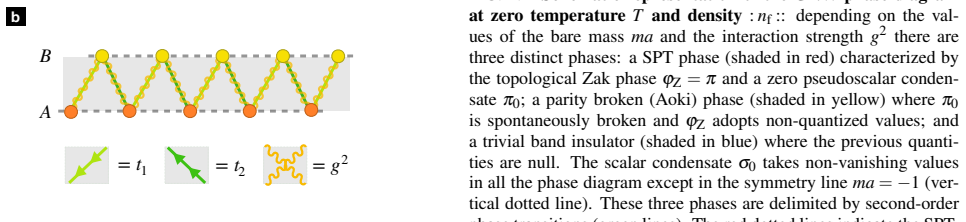
Along the symmetry line the Gross-Neveu-Wilson model hosts topological crystals and parity-broken soliton lattices formed by real-space Hilbert-space fragmentation.
A machine-rendered reading of the paper's core claim, the machinery that carries it, and where it could break.
Core claim
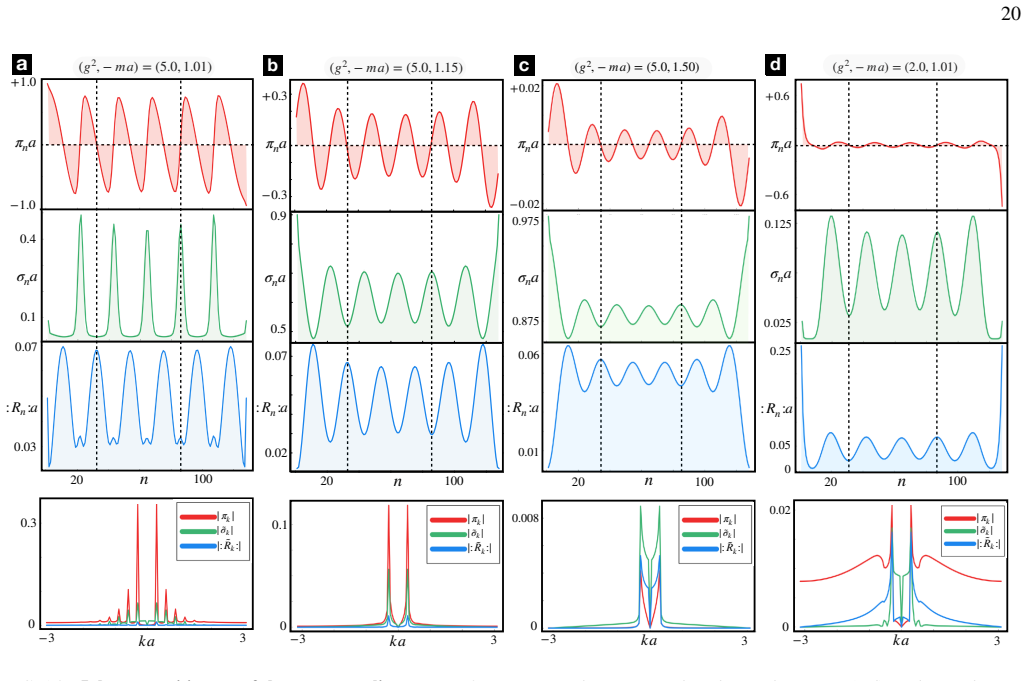
At zero temperature and along the symmetry line, the ground states consist of inhomogeneous configurations generated by real-space Hilbert-space fragmentation. Weak coupling produces topological crystals in which periodic topological defects separate fragmented subchains and localize the doped fermions. At stronger coupling a transition occurs to a parity-broken soliton lattice formed by a periodic array of anti-kinks, each binding one doped fermion while generating a modulated pseudoscalar order parameter. These structures provide concrete realizations of inhomogeneous phases in a lattice field theory.
What carries the argument
Real-space Hilbert-space fragmentation, which divides the lattice into subchains separated by immobile topological defects that bind doped fermions or holes at their centers.
If this is right
- Doping the symmetry-protected topological phase produces localized charges or holes at periodic arrangements of immobile topological defects.
- Increasing interactions drives a transition to a parity-broken phase with a modulated pseudoscalar condensate realized as a soliton lattice of anti-kinks.
- Quasi-spiral profiles appear away from the symmetry line with wavevector k equal to 2π times the density.
- The results supply non-perturbative evidence for chiral spirals outside the large-N limit in lattice field theories.
Where Pith is reading between the lines
- If the fragmentation mechanism holds, similar topological crystals could appear in other lattice models that possess symmetry-protected topological phases at finite density.
- Quantum simulators could directly image the defect positions and measure fermion binding by tuning the coupling strength across the reported transition.
- The density-wavevector relation k = 2πρ offers a testable prediction for spiral phases in related fermionic lattice systems beyond the Gross-Neveu model.
Load-bearing premise
Matrix product state simulations with finite bond dimension and system size accurately capture the ground-state entanglement structure and periodic defect ordering without truncation or finite-size artifacts that would alter the reported arrangements or wavevectors.
What would settle it
A quantum simulation of the Gross-Neveu-Wilson model that fails to detect the predicted sequence of periodic defect spacings at weak coupling or the anti-kink lattice at strong coupling along the symmetry line would falsify the central claim.
Figures





read the original abstract
We explore the finite-density phase diagram of the single-flavour Gross-Neveu-Wilson (GNW) model using matrix product state (MPS) simulations. At zero temperature and along the symmetry line of the phase diagram, we find a sequence of inhomogeneous ground states that arise through a real-space version of the mechanism of Hilbert-space fragmentation. For weak interactions, doping the symmetry-protected topological (SPT) phase of the GNW model leads to localized charges or holes at periodic arrangements of immobile topological defects separating the fragmented subchains: a topological crystal. Increasing the interactions, we observe a transition into a parity-broken phase with a pseudoscalar condensate displaying a modulated periodic pattern. This soliton lattice is a sequence of topological charges corresponding to anti-kinks, which also bind the doped fermions at their respective centers. Out of this symmetry line, we show that quasi-spiral profiles appear with a characteristic wavevector set by the density $k = 2{\pi}{\rho}$, providing non-perturbative evidence for chiral spirals beyond the large-N limit. These results demonstrate that various exotic inhomogeneous phases can arise in lattice field theories, and motivate the use of quantum simulators to confirm such QCD-inspired phenomena in future experiments.
Editorial analysis
A structured set of objections, weighed in public.
Referee Report
Summary. The paper explores the finite-density phase diagram of the single-flavour Gross-Neveu-Wilson (GNW) model using matrix product state (MPS) simulations. At zero temperature along the symmetry line, it reports a sequence of inhomogeneous ground states arising from real-space Hilbert-space fragmentation: topological crystals with periodic arrangements of immobile topological defects at weak interactions, transitioning to a parity-broken soliton lattice with modulated pseudoscalar condensate at stronger interactions. Away from the symmetry line, quasi-spiral profiles appear with wavevector k = 2πρ, providing non-perturbative evidence for chiral spirals beyond the large-N limit.
Significance. If the MPS results hold under rigorous convergence checks, the work would be significant for exhibiting how real-space fragmentation produces exotic inhomogeneous phases in a lattice field theory, including topological crystals and soliton lattices. It supplies direct numerical evidence for density-driven modulated condensates and chiral spirals in the GNW model without relying on large-N approximations or fitted parameters, and the use of MPS for finite-density simulations in this setting is a clear methodological strength.
major comments (2)
- [Numerical results / MPS simulations] Numerical results section (MPS simulations of inhomogeneous phases): The manuscript provides no explicit bond-dimension scaling, truncation-error estimates, or finite-size extrapolations for the reported periodic defect positions, wavevectors, and condensate modulations. Since the central claim of topological crystals and soliton lattices rests on these specific spatial arrangements being intrinsic rather than artifacts of finite D or L, quantitative convergence data (e.g., comparison of defect spacing for D=64 vs. D=128 and L=40 vs. L=120) are required to substantiate the identifications.
- [Results on symmetry line] Section on the fragmentation mechanism and symmetry line: The transition from topological crystals to the parity-broken soliton lattice is described qualitatively via charge distributions and condensates, but lacks a quantitative diagnostic (such as the growth of inter-subchain entanglement or the effective decoupling of Hilbert-space sectors) that would confirm the real-space fragmentation picture is load-bearing for the observed periodicity.
minor comments (2)
- [Abstract and results away from symmetry line] The abstract and main text refer to 'quasi-spiral profiles' with k=2πρ; a brief comparison figure or explicit formula relating the observed modulation to the free-fermion spiral expectation would improve clarity for readers unfamiliar with the large-N literature.
- [Model definition] Notation for the pseudoscalar condensate and topological charge operators should be defined once in the model section to avoid ambiguity when discussing the soliton lattice.
Simulated Author's Rebuttal
We thank the referee for their detailed and constructive report. We respond to each of the major comments below and indicate the changes we will make to the manuscript.
read point-by-point responses
-
Referee: [Numerical results / MPS simulations] Numerical results section (MPS simulations of inhomogeneous phases): The manuscript provides no explicit bond-dimension scaling, truncation-error estimates, or finite-size extrapolations for the reported periodic defect positions, wavevectors, and condensate modulations. Since the central claim of topological crystals and soliton lattices rests on these specific spatial arrangements being intrinsic rather than artifacts of finite D or L, quantitative convergence data (e.g., comparison of defect spacing for D=64 vs. D=128 and L=40 vs. L=120) are required to substantiate the identifications.
Authors: We agree with the referee that explicit convergence checks are essential to support the central claims. Although our MPS simulations were performed with bond dimensions up to 128 and system sizes up to 120, showing consistent results, the manuscript would benefit from including these data. In the revised manuscript, we will add bond-dimension scaling, truncation-error estimates, and finite-size extrapolations for the defect positions, wavevectors, and condensate modulations, including the suggested comparisons. revision: yes
-
Referee: [Results on symmetry line] Section on the fragmentation mechanism and symmetry line: The transition from topological crystals to the parity-broken soliton lattice is described qualitatively via charge distributions and condensates, but lacks a quantitative diagnostic (such as the growth of inter-subchain entanglement or the effective decoupling of Hilbert-space sectors) that would confirm the real-space fragmentation picture is load-bearing for the observed periodicity.
Authors: We acknowledge that the current presentation relies on qualitative descriptions of the charge distributions and condensates. To provide a more quantitative confirmation of the real-space Hilbert-space fragmentation, we will include in the revised manuscript an analysis of inter-subchain entanglement entropies or sector decoupling measures, which should demonstrate the effective separation of the Hilbert space sectors responsible for the observed periodic structures. revision: yes
Circularity Check
MPS simulations yield independent numerical evidence for inhomogeneous phases with only minor self-citation
full rationale
The paper obtains its central claims about topological crystals and soliton lattices directly from matrix product state simulations of the Gross-Neveu-Wilson Hamiltonian at finite density along the symmetry line. Ground-state properties, defect arrangements, and modulated condensates are computed variationally without any analytical derivation that reduces to a fitted parameter, self-definition, or self-citation chain by the paper's own equations. Self-citations on Hilbert-space fragmentation supply background context but are not load-bearing; the reported phases are falsifiable outputs of the numerical method benchmarked against the model's Hamiltonian.
Axiom & Free-Parameter Ledger
free parameters (2)
- interaction strength
- fermion density
axioms (2)
- domain assumption The GNW Hamiltonian on a finite lattice with open or periodic boundaries admits a well-defined ground state that can be approximated by an MPS with finite bond dimension.
- domain assumption Real-space Hilbert-space fragmentation produces immobile topological defects that remain stable at zero temperature.
Lean theorems connected to this paper
-
IndisputableMonolith/Foundation/Cost/FunctionalEquation.leanwashburn_uniqueness_aczel unclear?
unclearRelation between the paper passage and the cited Recognition theorem.
sequence of inhomogeneous ground states that arise through a real-space version of the mechanism of Hilbert-space fragmentation, leading to topological crystals at weak interactions and a parity-broken soliton lattice at stronger interactions
-
IndisputableMonolith/Foundation/AlexanderDuality.leanalexander_duality_circle_linking unclear?
unclearRelation between the paper passage and the cited Recognition theorem.
quasi-spiral profiles appear with a characteristic wavevector set by the density k = 2πρ
What do these tags mean?
- matches
- The paper's claim is directly supported by a theorem in the formal canon.
- supports
- The theorem supports part of the paper's argument, but the paper may add assumptions or extra steps.
- extends
- The paper goes beyond the formal theorem; the theorem is a base layer rather than the whole result.
- uses
- The paper appears to rely on the theorem as machinery.
- contradicts
- The paper's claim conflicts with a theorem or certificate in the canon.
- unclear
- Pith found a possible connection, but the passage is too broad, indirect, or ambiguous to say the theorem truly supports the claim.
Reference graph
Works this paper leans on
-
[1]
We start by considering :nf:= ±1, namely doping the system with a single fermion/hole
Groundstate topological phases for an extra fermion above half filling Let us now discuss how these constraints allow to pre- dict possible inhomogeneities of the condensate upon doping :nf:̸= 0. We start by considering :nf:= ±1, namely doping the system with a single fermion/hole. The sector that contains the ground state can again be easily identified b...
-
[2]
Low-energy excitations and finite-size scaling for an extra fermion above half filling In the variational MPS formalism, one needs not restrict to the groundstate but may also target low-energy excitations. This is done by imposing an orthogonality constraint with the previously found groundstate |ϕgs⟩, and proceeding re- cursively by enlarging the set of...
-
[3]
Real-space fragmentation for two extra fermions above half filling Let us now increase the doping to two fermions/holes, fo- cusing first on the :nf:= +2 scenario. In this case, the accom- modation of the extra fermion requires abandoning the sector ddd = (1,1, · · ·,1,1). The only possibility is that one of the con- served charges at a site nb changes fr...
-
[4]
Topological crystals and soliton lattices for many fermions above half filling The results in Fig. 13 reinforce the central message of our work: the emergence of crystalline structures through Hilbert- space fragmentation in the doped GNW model. As shown in Fig. 13, as one increases the doping but still at low densities, e.g. :nf:= 6 extra fermions in a c...
-
[5]
S.C thanks support from FPU23/02915 scholarship from the MCIU
-
[6]
Gell-Mann, Symmetries of baryons and mesons, Phys
M. Gell-Mann, Symmetries of baryons and mesons, Phys. Rev. 125, 1067 (1962)
work page 1962
-
[7]
Gell-Mann, A schematic model of baryons and mesons, Physics Letters 8, 214 (1964)
M. Gell-Mann, A schematic model of baryons and mesons, Physics Letters 8, 214 (1964)
work page 1964
-
[8]
H. Fritzsch, M. Gell-Mann, and H. Leutwyler, Advantages of the Color Octet Gluon Picture, Phys. Lett. B 47, 365 (1973)
work page 1973
-
[9]
M. G. Alford, A. Schmitt, K. Rajagopal, and T. Sch¨afer, Color superconductivity in dense quark matter, Rev. Mod. Phys. 80, 1455 (2008)
work page 2008
-
[10]
D. J. Gross and F. Wilczek, Ultraviolet behavior of non-abelian gauge theories, Phys. Rev. Lett. 30, 1343 (1973)
work page 1973
-
[11]
H. D. Politzer, Reliable perturbative results for strong interac- tions?, Phys. Rev. Lett. 30, 1346 (1973)
work page 1973
-
[12]
Hooft, A planar diagram theory for strong interactions, Nu- clear Physics B 72, 461 (1974)
G. Hooft, A planar diagram theory for strong interactions, Nu- clear Physics B 72, 461 (1974)
work page 1974
-
[13]
Coleman, Aspects of Symmetry: Selected Erice Lectures (Cambridge University Press, 1988)
S. Coleman, Aspects of Symmetry: Selected Erice Lectures (Cambridge University Press, 1988)
work page 1988
-
[14]
D. V . Deryagin, D. Yu. Grigoriev, and V . A. Rubakov, Stand- ing wave ground state in high density, zero temperature qcd at large nc, International Journal of Modern Physics A 07, 659 (1992)
work page 1992
-
[15]
E. Shuster and D. Son, On finite-density qcd at large nc, Nu- clear Physics B 573, 434 (2000)
work page 2000
-
[16]
T. Kojo, Y . Hidaka, L. McLerran, and R. D. Pisarski, Quarky- onic chiral spirals, Nuclear Physics A 843, 37 (2010)
work page 2010
-
[17]
L. McLerran and R. D. Pisarski, Phases of dense quarks at large nc, Nuclear Physics A 796, 83 (2007)
work page 2007
-
[18]
K. Fukushima and C. Sasaki, The phase diagram of nuclear and quark matter at high baryon density, Progress in Particle and Nuclear Physics 72, 99 (2013)
work page 2013
-
[19]
A Quarkyonic Phase in Dense Two Color Matter?
S. Hands, S. Kim, and J.-I. Skullerud, A Quarkyonic Phase in Dense Two Color Matter?, Phys. Rev. D 81, 091502 (2010), arXiv:1001.1682 [hep-lat]
work page internal anchor Pith review Pith/arXiv arXiv 2010
-
[20]
K. G. Wilson, Confinement of quarks, Phys. Rev. D 10, 2445 (1974)
work page 1974
-
[21]
T. DeGrand and C. DeTar,Lattice Methods for Quantum Chro- modynamics (WORLD SCIENTIFIC, 2006)
work page 2006
-
[22]
K. Nagata, Finite-density lattice qcd and sign problem: Cur- rent status and open problems, Progress in Particle and Nu- clear Physics 127, 103991 (2022)
work page 2022
-
[23]
M. Troyer and U.-J. Wiese, Computational complexity and fundamental limitations to fermionic quantum monte carlo simulations, Phys. Rev. Lett. 94, 170201 (2005)
work page 2005
- [24]
-
[25]
A. Alexandru, G. m. c. Bas ¸ar, P. F. Bedaque, and N. C. War- rington, Complex paths around the sign problem, Rev. Mod. Phys. 94, 015006 (2022)
work page 2022
-
[26]
M. Cristoforetti, F. Di Renzo, and L. Scorzato (AuroraScience Collaboration), New approach to the sign problem in quantum field theories: High density qcd on a lefschetz thimble, Phys. Rev. D 86, 074506 (2012)
work page 2012
-
[27]
Bedaque, Paulo F., A complex path around the sign problem, EPJ Web Conf. 175, 01020 (2018)
work page 2018
-
[28]
S. R. White, Density matrix formulation for quantum renor- malization groups, Phys. Rev. Lett. 69, 2863 (1992)
work page 1992
-
[29]
J. I. Cirac, D. P´erez-Garc´ia, N. Schuch, and F. Verstraete, Ma- trix product states and projected entangled pair states: Con- cepts, symmetries, theorems, Rev. Mod. Phys. 93, 045003 (2021)
work page 2021
-
[30]
R. P. Feynman, Simulating physics with computers, Interna- tional Journal of Theoretical Physics 21, 467 (1982). 23
work page 1982
-
[31]
J. I. Cirac and P. Zoller, Goals and opportunities in quantum simulation, Nature Physics 8, 264 (2012)
work page 2012
-
[32]
H. P. B ¨uchler, M. Hermele, S. D. Huber, M. P. A. Fisher, and P. Zoller, Atomic quantum simulator for lattice gauge theories and ring exchange models, Phys. Rev. Lett.95, 040402 (2005)
work page 2005
-
[33]
S.-L. Zhu, B. Wang, and L.-M. Duan, Simulation and detec- tion of dirac fermions with cold atoms in an optical lattice, Phys. Rev. Lett. 98, 260402 (2007)
work page 2007
-
[34]
R. Sch ¨utzhold, M. Uhlmann, L. Petersen, H. Schmitz, A. Friedenauer, and T. Sch¨atz, Analogue of cosmological par- ticle creation in an ion trap, Phys. Rev. Lett. 99, 201301 (2007)
work page 2007
-
[35]
N. Goldman, A. Kubasiak, A. Bermudez, P. Gaspard, M. Lewenstein, and M. A. Martin-Delgado, Non-abelian op- tical lattices: Anomalous quantum hall effect and dirac fermions, Phys. Rev. Lett. 103, 035301 (2009)
work page 2009
-
[36]
S. P. Jordan, K. S. M. Lee, and J. Preskill, Quantum algorithms for quantum field theories, Science 336, 1130 (2012)
work page 2012
-
[37]
J. I. Cirac, P. Maraner, and J. K. Pachos, Cold atom simulation of interacting relativistic quantum field theories, Phys. Rev. Lett. 105, 190403 (2010)
work page 2010
-
[38]
A. Bermudez, L. Mazza, M. Rizzi, N. Goldman, M. Lewen- stein, and M. A. Martin-Delgado, Wilson fermions and ax- ion electrodynamics in optical lattices, Phys. Rev. Lett. 105, 190404 (2010)
work page 2010
- [39]
- [40]
- [41]
-
[42]
D. Banerjee, M. Dalmonte, M. M ¨uller, E. Rico, P. Stebler, U.-J. Wiese, and P. Zoller, Atomic quantum simulation of dy- namical gauge fields coupled to fermionic matter: From string breaking to evolution after a quench, Phys. Rev. Lett. 109, 175302 (2012)
work page 2012
-
[43]
D. Banerjee, M. B ¨ogli, M. Dalmonte, E. Rico, P. Stebler, U.-J. Wiese, and P. Zoller, Atomic quantum simulation ofU(n) and SU(n) non-abelian lattice gauge theories, Phys. Rev. Lett.110, 125303 (2013)
work page 2013
-
[44]
U. Wiese, Ultracold quantum gases and lattice systems: quan- tum simulation of lattice gauge theories, Annalen der Physik 525, 777–796 (2013)
work page 2013
- [45]
-
[46]
M. Dalmonte and S. Montangero, Lattice gauge theory simulations in the quantum informa- tion era, Contemporary Physics 57, 388 (2016), https://doi.org/10.1080/00107514.2016.1151199
-
[47]
M. C. Ba ˜nuls and K. Cichy, Review on novel methods for lat- tice gauge theories, Reports on Progress in Physics83, 024401 (2020)
work page 2020
-
[48]
M. C. Ba ˜nuls, R. Blatt, J. Catani, A. Celi, J. I. Cirac, M. Dalmonte, L. Fallani, K. Jansen, M. Lewenstein, S. Mon- tangero, C. A. Muschik, B. Reznik, E. Rico, L. Tagliacozzo, K. Van Acoleyen, F. Verstraete, U.-J. Wiese, M. Wingate, J. Zakrzewski, and P. Zoller, Simulating lattice gauge theories within quantum technologies, The European Physical Journal...
-
[49]
M. Aidelsburger, L. Barbiero, A. Bermudez, T. Chanda, A. Dauphin, D. Gonz ´alez-Cuadra, P. R. Grzybowski, S. Hands, F. Jendrzejewski, J. J ¨unemann, G. Juzeli ¯unas, V . Kasper, A. Piga, S.-J. Ran, M. Rizzi, G. Sierra, L. Tagli- acozzo, E. Tirrito, T. V . Zache, J. Zakrzewski, E. Zo- har, and M. Lewenstein, Cold atoms meet lattice gauge theory, Philosophi...
-
[50]
N. Klco, A. Roggero, and M. J. Savage, Standard model physics and the digital quantum revolution: thoughts about the interface, Reports on Progress in Physics 85, 064301 (2022)
work page 2022
-
[51]
C. W. Bauer, Z. Davoudi, A. B. Balantekin, T. Bhat- tacharya, M. Carena, W. A. de Jong, P. Draper, A. El-Khadra, N. Gemelke, M. Hanada, D. Kharzeev, H. Lamm, Y .-Y . Li, J. Liu, M. Lukin, Y . Meurice, C. Monroe, B. Nachman, G. Pagano, J. Preskill, E. Rinaldi, A. Roggero, D. I. San- tiago, M. J. Savage, I. Siddiqi, G. Siopsis, D. Van Zanten, N. Wiebe, Y . ...
work page 2023
-
[52]
M. Buballa and S. Carignano, Inhomogeneous chiral conden- sates, Progress in Particle and Nuclear Physics 81, 39 (2015)
work page 2015
-
[53]
Y . Nambu and G. Jona-Lasinio, Dynamical model of elemen- tary particles based on an analogy with superconductivity. i, Phys. Rev. 122, 345 (1961)
work page 1961
-
[54]
Y . Nambu and G. Jona-Lasinio, Dynamical model of elemen- tary particles based on an analogy with superconductivity. ii, Phys. Rev. 124, 246 (1961)
work page 1961
-
[55]
S. P. Klevansky, The nambu—jona-lasinio model of quantum chromodynamics, Rev. Mod. Phys. 64, 649 (1992)
work page 1992
-
[56]
D. J. Gross and A. Neveu, Dynamical symmetry breaking in asymptotically free field theories, Phys. Rev. D 10, 3235 (1974)
work page 1974
-
[57]
Schwinger, Gauge invariance and mass
J. Schwinger, Gauge invariance and mass. ii, Phys. Rev. 128, 2425 (1962)
work page 1962
-
[58]
S. Coleman, R. Jackiw, and L. Susskind, Charge shielding and quark confinement in the massive schwinger model, Annals of Physics 93, 267 (1975)
work page 1975
-
[59]
Coleman, More about the massive schwinger model, Annals of Physics 101, 239 (1976)
S. Coleman, More about the massive schwinger model, Annals of Physics 101, 239 (1976)
work page 1976
-
[60]
’t Hooft, A two-dimensional model for mesons, Nuclear Physics B 75, 461 (1974)
G. ’t Hooft, A two-dimensional model for mesons, Nuclear Physics B 75, 461 (1974)
work page 1974
-
[61]
Witten, Baryons in the 1n expansion, Nuclear Physics B 160, 57 (1979)
E. Witten, Baryons in the 1n expansion, Nuclear Physics B 160, 57 (1979)
work page 1979
-
[62]
W. Fischler, J. Kogut, and L. Susskind, Quark confinement in unusual environments, Phys. Rev. D19, 1188 (1979)
work page 1979
-
[63]
Y .-C. Kao and Y .-W. Lee, Inhomogeneous chiral condensate in the schwinger model at finite density, Phys. Rev. D 50, 1165 (1994)
work page 1994
-
[64]
M. C. Ba ˜nuls, K. Cichy, J. I. Cirac, K. Jansen, and S. K ¨uhn, Density induced phase transitions in the schwinger model: A study with matrix product states, Phys. Rev. Lett.118, 071601 (2017)
work page 2017
-
[65]
H. R. Christiansen and F. A. Schaposnik, Multiflavor correla- tion functions in non-abelian gauge theories at finite fermion density in two dimensions, Phys. Rev. D 55, 4920 (1997)
work page 1997
- [66]
-
[67]
N. D. Mermin and H. Wagner, Absence of ferromagnetism or antiferromagnetism in one- or two-dimensional isotropic heisenberg models, Phys. Rev. Lett. 17, 1133 (1966). 24
work page 1966
-
[68]
S. Coleman, There are no goldstone bosons in two dimensions, Communications in Mathematical Physics 31, 259 (1973)
work page 1973
-
[69]
E. Witten, Chiral symmetry, the 1/n expansion and the su(n) thirring model, Nuclear Physics B 145, 110 (1978)
work page 1978
-
[70]
R. Ciccone, L. Di Pietro, and M. Serone, Inhomogeneous phase of the chiral gross-neveu model, Phys. Rev. Lett. 129, 071603 (2022)
work page 2022
-
[71]
Jacobs, Critical behavior in a class of O (n)-invariant field theories in two dimensions, Phys
L. Jacobs, Critical behavior in a class of O (n)-invariant field theories in two dimensions, Phys. Rev. D 10, 3956 (1974)
work page 1974
-
[72]
B. J. Harrington and A. Yildiz, Restoration of dynamically broken symmetries at finite temperature, Phys. Rev. D11, 779 (1975)
work page 1975
-
[73]
R. Peierls, On ising’s model of ferromagnetism, Mathemati- cal Proceedings of the Cambridge Philosophical Society 32, 477–481 (1936)
work page 1936
-
[74]
R. F. Dashen, B. Hasslacher, and A. Neveu, Semiclassical bound states in an asymptotically free theory, Phys. Rev. D 12, 2443 (1975)
work page 1975
-
[75]
R. Ciccone, L. Di Pietro, and M. Serone, Anomalies and per- sistent order in the chiral gross-neveu model, Journal of High Energy Physics 2024, 211 (2024)
work page 2024
-
[76]
U. Wolff, The phase diagram of the infinite-n gross-neveu model at finite temperature and chemical potential, Physics Letters B 157, 303 (1985)
work page 1985
-
[77]
V . Sch¨on and M. Thies, Emergence of the skyrme crystal in gross-neveu and ’t hooft models at finite density, Phys. Rev. D 62, 096002 (2000)
work page 2000
-
[78]
K. Ohwa, Crystalline ground state in chiral gross-neveu and cooper pair models at finite densities, Phys. Rev. D65, 085040 (2002)
work page 2002
-
[79]
M. Thies and K. Urlichs, Revised phase diagram of the gross- neveu model, Phys. Rev. D67, 125015 (2003)
work page 2003
-
[80]
Thies, Analytical solution of the gross-neveu model at fi- nite density, Phys
M. Thies, Analytical solution of the gross-neveu model at fi- nite density, Phys. Rev. D69, 067703 (2004)
work page 2004
discussion (0)
Sign in with ORCID, Apple, or X to comment. Anyone can read and Pith papers without signing in.