REVIEW 3 major objections 5 minor 87 references
The influence of interior structure and thermal state on impact melt generation upon large impacts onto terrestrial planets
T0 review · 3 major / 5 minor · reviewed 2026-08-15 · deepseek-v4-flash
Pith's one-line read Melt efficiency peaks when melting depth equals lithosphere thickness.
desk verdict A systematic, internally consistent simulation study that gives planetary scientists a practical empirical scaling law for impact melt volume, with the main caveat that the law's absolute calibration leans on unvalidated latent-heat compensation. read the letter →
The pith
A machine-rendered reading of the paper's core claim, the machinery that carries it, and where it could break.
The reading
What carries the argument
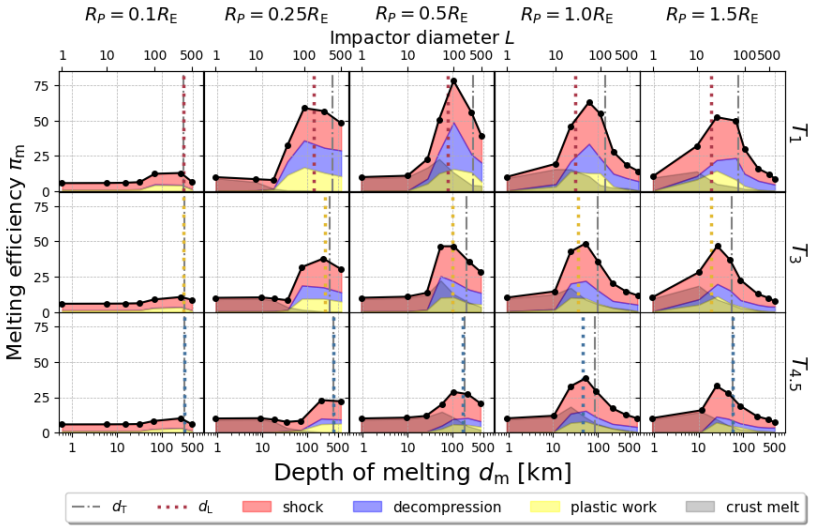
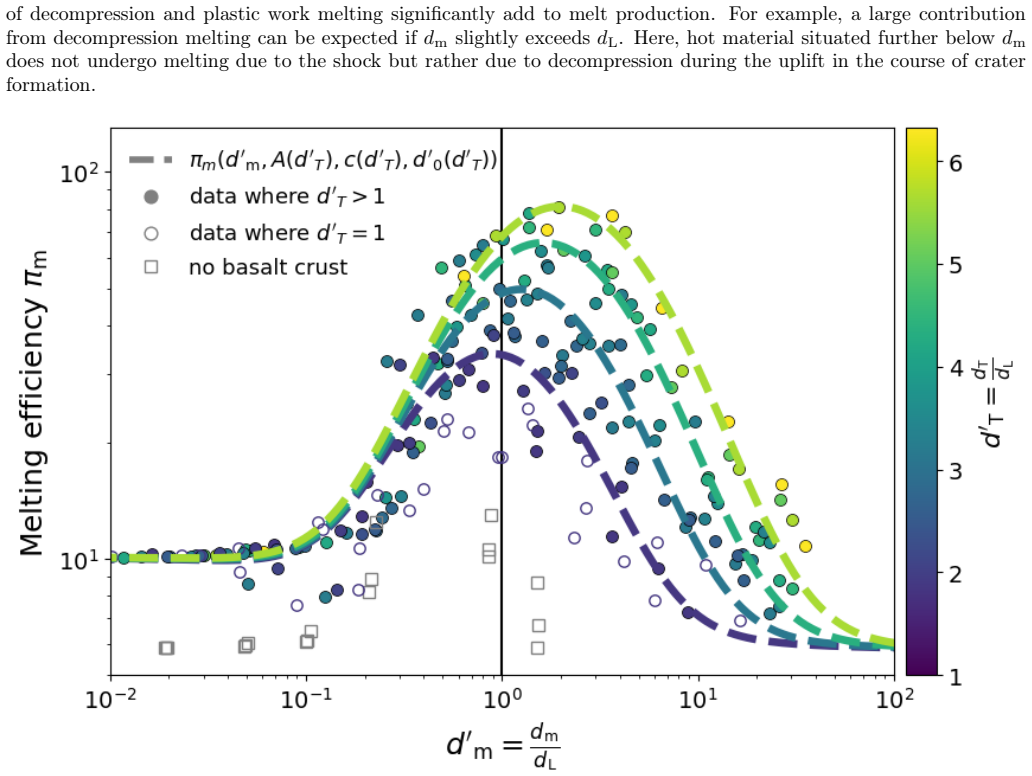
The carrying machinery is the pair of normalized length scales $d'_m = d_m/d_L$ and $d'_T = d_T/d_L$, where $d_m$ is the depth below the impact point where shock melt is most abundant (set by impactor size), $d_L$ is the lithosphere thickness, and $d_T$ is the center of the supersolidus depth range — the depth interval where the geotherm is at or above the solidus. The empirical law combines a hyperbolic-tangent baseline that interpolates between a cold crustal melting efficiency $\pi^c_m \approx 10.1$ and a cold mantle melting efficiency $\pi^m_m \approx 5.81$ with a Gaussian peak term; the peak position $d'_0$, amplitude $A$, and width $c$ are linear functions of $d'_T$ (Eqs. 19–21). These two ratios collapse melting-efficiency data from planets with radii 0.1–1.5 $R_E$, core size ratios 0.2–0.8, and ages 1–4.5 Gyr onto a single family of curves.
What would settle it
Run the same impact scenarios with a thermodynamic model that includes the energy absorbed by melting explicitly and no ad hoc cutoffs; if the resulting melting efficiencies differ from the compensated values by more than the scatter around Eqs. 16–21, the empirical law's amplitudes need recalibration.
Extended reading notes
Core claim
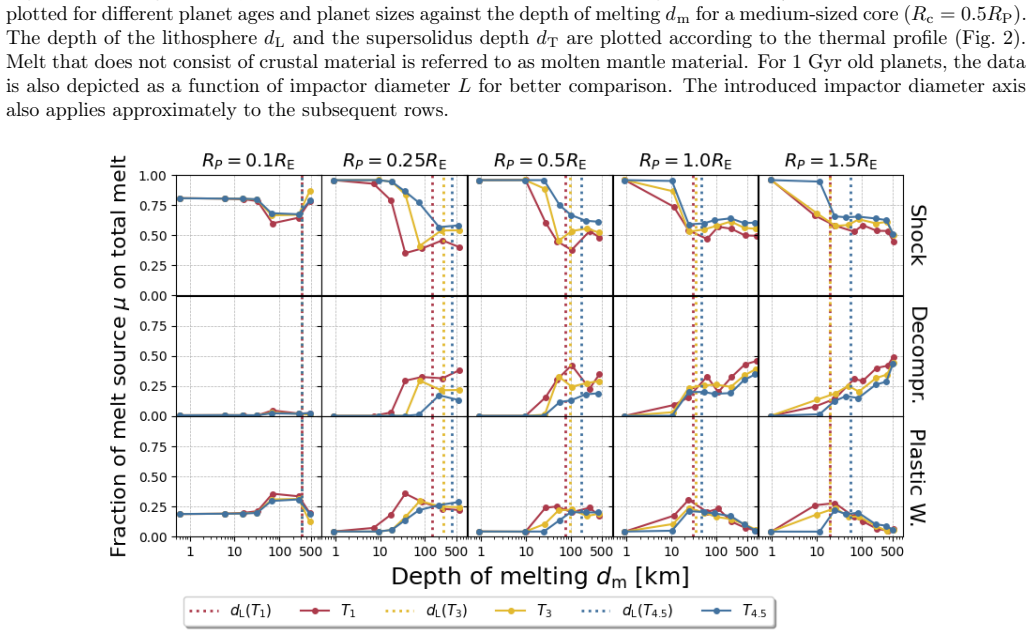
On the paper's own terms, the discovery is that the normalized melt production (melting efficiency $\pi_m = V_\mathrm{melt}/V_\mathrm{impactor}$) for impacts on stagnant-lid terrestrial planets is governed by the ratio $d_m/d_L$ of the depth of melting to the lithosphere thickness, not by impactor size alone. Melting efficiency peaks when $d_m$ is roughly equal to $d_L$ or up to about three times larger, and the peak amplitude is set by the ratio $d_T/d_L$ of the supersolidus depth to lithosphere thickness. This reproduces the otherwise counterintuitive observation that larger planets are melted most efficiently by smaller impactors, while smaller planets are melted most efficiently by larger impactors, and explains why melting efficiency maxima are typically highest on Earth-size planets. The paper further claims that shock melting dominates but decompression and plastic-work melting contribute significantly (up to about 50% and 20–35%, respectively), and that classical scaling laws that account only for shock melting underestimate melt production once the impactor's length scale approaches the target's thermal structure. The empirical law of Eqs. 16–21 summarizes the result for planets with $d'_T > 1$.
Load-bearing premise
The results depend on the assumption that discarding barely melted material at the edges of the melt zone roughly cancels the overestimate caused by ignoring the energy that melting itself absorbs; if that cancellation is wrong, every reported melting efficiency and every fitted peak amplitude is off in absolute terms.
Editorial extensions
If this is right
- For basin-forming impacts on stagnant-lid planets, melt volume can be estimated from a planet's radial thermal structure and thermal age alone, using Eqs. 16–21, without a new full impact simulation.
- Each planet size has a specific impactor-size window, corresponding to a melting depth of roughly 1–3 lithosphere thicknesses, in which craters are especially prone to melt overflow because melting efficiency is maximal there.
- Older, cooler planets produce substantially less impact melt: about 40% less for large planets and 60% less for small planets between 1 and 4.5 Gyr after formation.
- Large cores reduce melting efficiency only on old planets, through more efficient cooling of the mantle, rather than through any direct mechanical effect of the core itself.
- Under a lunar-like impactor flux, Moon-sized planets accumulate the most melt relative to their volume over 4.5 Gyr, despite also cooling efficiently.
Reading between the lines
- Testable extension: if Eqs. 16–21 survive testing with codes that include latent heat explicitly, they offer a fast way to estimate impact melt production for stagnant-lid exoplanets from interior-structure retrieval, and to bracket magma-ocean generation during accretion.
- The ratio framework suggests that the same $d'_m$ curve might hold for targets with thin or mobile lithospheres, such as early Mars or resurfaced Venus-like planets, if the mechanical boundary-layer thickness is substituted for $d_L$; this is not tested in the paper.
- Because the empirical law was fit only for $d'_T > 1$, applying it to cold, conductive bodies like the smallest modeled planets is an extrapolation, and extending the fit to $d'_T \le 1$ would require additional simulations.
- The flux projection probably underestimates early melt production because thermal profiles younger than 1 Gyr were not modeled; including post-accretion profiles could raise the cumulative melt estimate for Moon-sized planets.
Signed reviews
Editorial analysis
A structured set of objections, weighed in public.
Referee Report
Summary. The paper investigates impact-induced melt production on generic terrestrial planets by combining 1D parameterized thermal evolution models with 2D iSALE hydrocode impact simulations. It spans planet radii 0.1–1.5 R_Earth, core-to-planet radius ratios 0.2–0.8, thermal ages 1, 3, and 4.5 Gyr, and impactor diameters 1–1000 km (more than 200 runs). The central quantity is the melting efficiency π_m = V_melt/V_impactor, and the authors show that peaks in π_m occur when the depth of melting d_m is comparable to the lithospheric thickness d_L (d_m/d_L ≈ 1 to 3), that larger planets are most efficiently melted by smaller impactors while smaller planets favor larger impactors, and that core size has little effect except for old, large-core cases. They propose an empirical scaling law (Eqs. 16–21) expressing π_m as a function of d'_m = d_m/d_L and d'_T = d_T/d_L, and they use a lunar impactor flux to estimate cumulative melt production over 4.5 Gyr, concluding that Moon-sized planets produce the most melt relative to their volume. The paper also compares its results with classical homogeneous-target scaling laws and argues that those laws underestimate melt production when target thermal structure and pressure gradients are important.
Significance. If the qualitative trends survive scrutiny, this is a substantial advance: it extends impact melt scaling from homogeneous targets to thermally and structurally layered stagnant-lid planets, systematically includes decompression and plastic-work melting alongside shock melting, and provides a compact parameterization that could be applied without new hydrocode runs. The study is unusually comprehensive in its parameter coverage, the qualitative regime separation (crust melting, peak-efficiency, and deep mantle regimes) is physically plausible and internally consistent, and the authors have published replication data, which strengthens reproducibility. The main significance risk is that the quantitative, absolute calibration of the empirical law and the cumulative melt volumes inherits an unquantified systematic bias from the melt diagnostic and from fitting the law to the same simulation suite, so the predictive power beyond the calibrated cases is not yet demonstrated.
major comments (3)
- [Section 2.3, Eq. (8) and following truncations] The melt diagnostic neglects latent heat because of ANEOS limitations, and the three ad hoc truncations (melt domain cut at 5L, 25 K below the solidus, and discard of melt fractions below 2%) are not calibrated. The manuscript states that melt volumes are 'likely an overestimate' and that the truncations 'should help to compensate for it to some extent,' but no test against an energy-conserving melt estimate is provided. Because every π_m value entering the empirical law (Eqs. 16–21) and the cumulative melt volumes in Fig. 10 inherit this bias, this is a load-bearing uncertainty for the paper's quantitative claims. I request either an explicit calibration of the truncations against at least a subset of runs with a latent-heat-corrected melt calculation, or a clear error budget that propagates a plausible range of latent-heat corrections through the fitted amplitude A in Eq. (20).
- [Eqs. (16)–(21), Fig. 9] The 'predictive' empirical law is a least-squares fit to the same simulation data it is compared with in Fig. 9, so the agreement in that figure is by construction. The paper is transparent that the formulas are empirical, but the abstract and Section 4.1 present them as 'predict[ing] melt generation as a function of radial structure and thermal age.' Please rephrase the claim as an interpolation/parameterization of the explored parameter space, and ideally validate the law on withheld cases (e.g., a subset of runs not used in the fit) or on independent data such as basin melt volumes on Mars or the Moon. At minimum, provide the fit uncertainties on Eqs. (19)–(21) so users can judge extrapolation risks.
- [Appendix A and Fig. 10] The velocity scaling exponent b = 0.986 is calibrated on data from a single Mars-like target structure (Manske et al. 2021) over only three impact velocities (10, 15, 20 km/s), but it is applied to all planet sizes, thermal ages, core ratios, and scaled up to 23.85 km/s in the cumulative melt production estimates of Fig. 10. The manuscript acknowledges that the scaling 'may be strongly dependent on the impact and target conditions,' but does not quantify the resulting uncertainty. Please add a sensitivity test that uses alternative scaling exponents (e.g., the value from Pierazzo et al. 1997 or a range bracketing the fitted slope) and show how the accumulated melt volumes and the conclusion about Moon-sized planets change.
minor comments (5)
- [Section 3.2.1] The text near the discussion of shock melting says 'shock melting, which is the dominant melting mechanism at vi≥15 km/s'; the symbol 'vi' should be 'v_imp' for consistency with the rest of the paper.
- [Section 2.3] The description of the melt-domain truncation is ambiguous: 'truncated the entire melt domain at a fixed radius of 5 impactor diameters L around the depth of one impactor diameter' could be read as centered at depth z = L or as a cylindrical/spherical cut; please state the exact centroid and geometry used.
- [Section 4.1] When the thermal profile does not intersect the solidus, d_T is set equal to d_L, which gives d'_T = 1, but the empirical law is restricted to d'_T > 1. Please clarify how users should handle planets with no supersolidus depth, and whether the restriction is physical or a fit-range limitation.
- [Figure 14 and Eqs. (19)–(21)] The fit parameters d'_0, A, and c are shown with standard deviations in Fig. 14, but the standard deviations are not propagated into the final scaling law; please state that the plotted lines are the mean regression and either include confidence bands or explicitly note their absence.
- [Appendix B.1, Eqs. (24)–(25)] The cubic polynomial approximations to the solidus and liquidus are used only in the thermal evolution models, while the impact models use Eq. (7); this is stated but easy to miss. Please add a sentence in the main text (Section 2.1) reiterating that the impact simulations use the Simon–Glatzel forms, not the cubics.
Circularity Check
The empirical π_m scaling law (Eqs. 16-21) is a least-squares fit to the same simulation data it is presented as predicting, so the Fig. 9 agreement is built in; the central new deliverable is partly a re-description of the input data.
-
fitted input called prediction
[Section 4.1 ("Melting efficiency parameterization", Eqs. 16-21) and Appendix D ("Melting efficiency scaling")]
"We parameterize our numerically determined melting efficiencies as a function of d′m and d′T, as shown in Figure 9 as thick, dashed lines. ... The following fit may be used to estimate the melting efficiency on planets with similar structure and thermal profiles ... In our approach to parameterizing our melting efficiency data, we fit each relevant melting efficiency curve (d′T >1), consisting of multiple runs with varying impactor size ... Finally, we fitted the parameters by a linear regression as a function of d′T, resulting in the introduced scaling law."
Eqs. 16-18 define π_m as a tanh baseline plus a Gaussian peak whose parameters d′_0, A, c are then linearly regressed on d′_T in Eqs. 19-21. Each of those parameter curves is obtained by fitting the melting-efficiency data from the same set of hydrocode runs that are shown as filled dots in Fig. 9. The agreement between the dashed fit curves and the data is therefore guaranteed by construction: the 'empirical law' is a compression of the simulation output, not an independent prediction of it. The abstract's claim that the paper proposes formulas 'to predict melt generation as a function of radial structure and thermal age' is, for this law, a re-description of the fitted simulations rather than an out-of-sample test.
full rationale
The physical content of the paper—the existence of a melting-efficiency peak near d_m ≈ d_L, the shift of that peak with planet size, and the significant contributions of decompression and plastic-work melting—is a genuine output of the hydrocode simulations and is not circular. The latent-heat neglect and the ad hoc truncations described in Section 2.3 are a calibration/correctness risk, not a circularity. The velocity-scaling slope b = 0.986 is calibrated on the authors' own earlier dataset (Manske et al. 2021), but that is a separate published dataset and the power-law form is taken from Pierazzo et al. (1997); I treat it as calibration rather than circularity. The substantial circularity is confined to the presentation of the empirical scaling law: Eqs. 16-21 are obtained by least-squares fits to the very melting-efficiency curves they are then said to predict, so the match in Fig. 9 is built in. Because this fitted law is one of the paper's central practical deliverables, the circularity is partial rather than total, and the qualitative mechanism-based conclusions remain independent.
Assumptions & free parameters
free parameters (7)
- Initial potential temperature T_pot =
1400 K (R_P = 0.1, 0.25 R_E); 1600 K (R_P >= 0.5 R_E)
- Plume surface fraction =
0.01
- Velocity scaling slope b =
0.986
- Empirical fit coefficients d'_0 =
0.2432, 0.6791
- Empirical fit amplitude A =
10.5774, 15.3064
- Empirical fit width c =
0.023, 0.5364
- Melt truncation thresholds =
5L radius, 25 K below solidus, 2% melt fraction cutoff
assumptions (8)
- standard math The peak shock pressure method reconstructs the thermodynamic path using Rankine-Hugoniot curves and isentropic release, and this path determines melt fraction.
- domain assumption 2D vertical impacts at 90 degrees are representative of melt production; obliquity effects are only accounted for by heuristic reduction factors.
- domain assumption A single impact velocity of 15 km/s is representative, with power-law scaling to other velocities.
- domain assumption M-ANEOS and the ROCK strength model with the listed parameters describe the dunite, basalt, and iron behavior in the impact simulations.
- domain assumption The lunar Neukum Production Function and Holsapple-Housen scaling describe the impactor flux on all generic planets over 4.5 Gyr.
- domain assumption Stagnant-lid thermal evolution with a plume area fraction of 0.01 captures the thermal state of generic terrestrial planets.
- ad hoc to paper The melt overestimate from neglecting latent heat is adequately compensated by the adopted truncations.
- ad hoc to paper The empirical scaling law is valid only for planets whose geotherm intersects the solidus (d'_T > 1).
Cite this review
Pith. "Pith review of The influence of interior structure and thermal state on impact melt generation upon large impacts onto terrestrial planets." pith.science (2026). https://pith.science/paper/MYUINVGU
@misc{pith2026250618718,
  author       = {Pith},
  title        = {Pith review of: The influence of interior structure and thermal state on impact melt generation upon large impacts onto terrestrial planets},
  year         = {2026},
  howpublished = {\url{https://pith.science/paper/MYUINVGU}},
  note         = {Machine review of arXiv:2506.18718}
}
abstract
We investigate the melt production of planetary impacts as a function of planet size ($R/R_\mathrm{Earth}$=0.1-1.5), impactor size ($L$=1-1000 km), and core size ratio ($R_\mathrm{core}/R$=0.2-0.8) using a combination of parameterized convection models and fully dynamical 2D impact simulations. To this end, we introduce a new method to determine impact-induced melt volumes which we normalize by the impactor volume for better comparability. We find that this normalized melt production, or melting efficiency, is enhanced for large planets when struck by smaller impactors, while for small planets, melting efficiency is elevated when impacted by larger impactors. This diverging behavior can be explained by the thickness of the planets' thermal boundary layer and the shapes of their thermal and lithostatic pressure profiles. We also find that melting efficiency maxima are usually highest on Earth-size planets. We show that the melting efficiency is only affected by core size ratio for large cores and older planets, where melt production is decreased significantly compared to smaller core size ratios. Projecting the lunar impactor flux on the generic planets, we find that Moon-sized planets produce the most melt throughout their evolution, relative to planet volume. Contrary to previous scaling laws, our method accounts for melt production by decompression or plastic work in addition to shock melting. We find that traditional scaling laws underestimate melt production on length scales where variations in the target planets' lithology, temperature, and lithostatic pressure become significant. We propose empirical formulas to predict melt generation as a function of radial structure and thermal age.
Figures


Figures from the paper (11 more)




Reference graph
Works this paper leans on
-
[1]
author Abramov, O. , author Wong, S.M. , author Kring, D.A. , year 2012 . title Differential melt scaling for oblique impacts on terrestrial planets . journal Icarus volume 218 , pages 906--916 . :10.1016/j.icarus.2011.12.022
-
[2]
author Agee, C.B. , author Draper, D.S. , year 2004 . title Experimental constraints on the origin of Martian meteorites and the composition of the Martian mantle . journal Earth Planet. Sci. Lett. volume 224 , pages 415--429 . :10.1016/j.epsl.2004.05.022
-
[3]
, author O'Keefe, J.D
author Ahrens, T.J. , author O'Keefe, J.D. , year 1972 . title Shock melting and vaporization of lunar rocks and minerals . journal The moon volume 4 , pages 214--249
1972
-
[4]
o hlen, R. , author Maller, A. , author Nakajima, M. , author W \
author Allibert, L. , author Landeau, M. , author R \"o hlen, R. , author Maller, A. , author Nakajima, M. , author W \"u nnemann, K. , year 2023 . title Planetary impacts: Scaling of crater depth from subsonic to supersonic conditions . journal J. Geophys. Res. volume 128 . :10.1029/2023JE007823
-
[5]
, author Ruppel, H.M
author Amsden, A.A. , author Ruppel, H.M. , author Hirt, C.W. , year 1980 . title SALE: a simplified ALE computer program for fluid flow at all speeds . type Technical Report number LA-8095, TRN: 80-015132 . Los Alamos National Laboratory
1980
-
[6]
author Anderson, F.S. , author Smrekar, S.E. , year 2006 . title Global mapping of crustal and lithospheric thickness on Venus . journal J. Geophys. Res. volume 111 . :10.1029/2004JE002395
-
[7]
author Andrault, D. , author Bolfan-Casanova, N. , author Lo Nigro, G. , author Bouhifd, M.A. , author Garbarino, G. , author Mezouar, M. , year 2011 . title Solidus and liquidus profiles of chondritic mantle: Implication for melting of the Earth across its history . journal Earth Planet. Sci. Lett. volume 304 , pages 251--259 . :10.1016/j.epsl.2011.02.006
-
[8]
author Andrault, D. , author Pesce, G. , author Bouhifd, M.A. , author Bolfan-Casanova, N. , author H \'e not, J.M. , author Mezouar, M. , year 2014 . title Melting of subducted basalt at the core--mantle boundary . journal Science volume 344 , pages 892--895 . :10.1126/science.1250466
Show all 87 references
-
[9]
, author Pesce, G
author Andrault, D. , author Pesce, G. , author Manthilake, G. , author Monteux, J. , author Bolfan-Casanova, N. , author Chantel, J. , author Novella, D. , author Guignot, N. , author King, A. , author Iti \'e , J.P. , author Hennet, L. , year 2018 . title Deep and persistent...
2018 doi
-
[10]
, author Lunine, J.I
author Artemieva, N. , author Lunine, J.I. , year 2005 . title Impact cratering on Titan II. Global melt, escaping ejecta, and aqueous alteration of surface organics . journal Icarus volume 175 , pages 522--533 . :10.1016/j.icarus.2004.12.005
2005 doi
-
[11]
, author Tosi, N
author Baumeister, P. , author Tosi, N. , author Brachmann, C. , author Grenfell, J.L. , author Noack, L. , year 2023 . title Redox state and interior structure control on the long-term habitability of stagnant-lid planets . journal Astron. Astrophys. volume 675 . :10.1051/000...
2023 doi
-
[12]
, author Cameron, A.G.W
author Benz, W. , author Cameron, A.G.W. , author Melosh, H.J. , year 1989 . title The origin of the Moon and the single-impact hypothesis III . journal Icarus volume 81 , pages 113--131 . :10.1016/0019-1035(89)90129-2
1989 doi
-
[13]
, author Malavergne, V
author Berthet, S. , author Malavergne, V. , author Righter, K. , year 2009 . title Melting of the Indarch meteorite (EH4 chondrite) at 1\,GPa and variable oxygen fugacity: Implications for early planetary differentiation processes . journal Geochim. Cosmochim. Acta volume 73 ...
2009 doi
-
[14]
, author Holsapple, K.A
author Bjorkman, M.D. , author Holsapple, K.A. , year 1987 . title Velocity scaling impact melt volume . journal Int. J. Impact Engng. volume 5 , pages 155--163 . :10.1016/0734-743X(87)90035-2
1987 doi
-
[15]
, author Hammouda, T
author Cartier, C. , author Hammouda, T. , author Doucelance, R. , author Boyet, M. , author Devidal, J.L. , author Moine, B. , year 2014 . title Experimental study of trace element partitioning between enstatite and melt in enstatite-chondrites at low oxygen fugacities and 5\...
2014 doi
-
[16]
, year 1991
author Chyba, C.F. , year 1991 . title Terrestrial mantle siderophiles and the lunar impact record . journal Icarus volume 92 , pages 217--233 . :10.1016/0019-1035(91)90047-W
1991 doi
-
[17]
, author Melosh, H.J
author Collins, G.S. , author Melosh, H.J. , author Ivanov, B.A. , year 2004 . title Modeling damage and deformation in impact simulations . journal Meteorit. Planet. Sci. volume 39 , pages 217--231 . :10.1111/j.1945-5100.2004.tb00337.x
2004
-
[18]
, year 1982
author Croft, S.K. , year 1982 . title A first-order estimate of shock heating and vaporization in oceanic impacts , in: editor Silver, L.T. , editor Schultz, P.H. (Eds.), booktitle Geological Implications of Impacts of Large Asteroids and Comets on the Earth . publisher Geolo...
1982 doi
-
[19]
, year 1985
author Croft, S.K. , year 1985 . title The scaling of complex craters . journal J. Geophys. Res. volume 90 , pages C828--C842 . :10.1029/JB090iS02p0C828
1985 doi
-
[20]
, author Fujita, T
author Genda, H. , author Fujita, T. , author Kobayashi, H. , author Tanaka, H. , author Abe, Y. , year 2015 . title Resolution dependence of disruptive collisions between planetesimals in the gravity regime . journal Icarus volume 262 , pages 58--66
2015
-
[21]
, author Fink, J.H
author Greeley, R. , author Fink, J.H. , author Gault, D.E. , author Guest, J.E. , year 1982 . title Experimental simulation of impact cratering on icy satellites , in: editor Morrison, D. (Ed.), booktitle Satellites of Jupiter . publisher Arizona University Press , address Tu...
1982
-
[22]
, author Morschhauser, A
author Grott, M. , author Morschhauser, A. , author Breuer, D. , author Hauber, E. , year 2011 . title Volcanic outgassing of CO2 and H2O on Mars . journal Earth Planet. Sci. Lett. volume 308 , pages 391--400 . :10.1016/j.epsl.2011.06.014
2011 doi
-
[23]
u ldemeister, N. , author W \
author G \"u ldemeister, N. , author W \"u nnemann, K. , author Poelchau, M.H. , year 2015 . title Scaling impact crater dimensions in cohesive rock by numerical modeling and laboratory experiments , in: editor Osinski, G.R. , editor Kring, D.A. (Eds.), booktitle Large Meteori...
2015
-
[24]
, author Fei, Y
author Hirose, K. , author Fei, Y. , year 2002 . title Subsolidus and melting phase relations of basaltic composition in the uppermost lower mantle . journal Geochim. Cosmochim. Acta volume 66 , pages 2099--2108 . :10.1016/S0016-7037(02)00847-5
2002 doi
-
[25]
, author Fei, Y
author Hirose, K. , author Fei, Y. , author Ma, Y. , author Mao, H.K. , year 1999 . title The fate of subducted basaltic crust in the Earth's lower mantle . journal Nature volume 397 , pages 53--56 . :10.1038/16225
1999 doi
-
[26]
, year 1993
author Holsapple, K.A. , year 1993 . title The scaling of impact processes in planetary sciences . journal Annu. Rev. Earth Planet. Sci. volume 21 , pages 333--373 . :10.1146/annurev.ea.21.050193.002001
1993
-
[27]
, author Housen, K.R
author Holsapple, K.A. , author Housen, K.R. , year 2007 . title A crater and its ejecta: An interpretation of deep impact . journal Icarus volume 191 , pages 586--597
2007
-
[28]
, author Holsapple, K.A
author Housen, K.R. , author Holsapple, K.A. , year 2011 . title Ejecta from impact craters . journal Icarus volume 211 , pages 856--875 . :10.1016/j.icarus.2010.09.017
2011 doi
-
[29]
, author Williams, I.P
author Hughes, D.W. , author Williams, I.P. , year 2000 . title The velocity distributions of periodic comets and stream meteoroids . journal Mon. Not. R. Astron. Soc. volume 315 , pages 629--634 . :10.1046/j.1365-8711.2000.03435.x
2000
-
[30]
, year 2008
author Ivanov, B. , year 2008 . title Geologic effects of large terrestrial impact crater formation , in: editor Adushkin, V. , editor Nemchinov, I. (Eds.), booktitle Catastrophic Events Caused by Cosmic Objects . publisher Springer . chapter chapter 5 , pp. pages 163--205 . :...
2008 doi
-
[31]
, author Melosh, H
author Ivanov, B. , author Melosh, H. , year 2003 . title Impacts do not initiate volcanic eruptions: Eruptions close to the crater . journal Geology volume 31 , pages 869--872
2003
-
[32]
, year 2001
author Ivanov, B.A. , year 2001 . title Mars/moon cratering rate ratio estimates . journal Space Science Reviews volume 96 , pages 87--104
2001
-
[33]
, author Honda, S
author Iwase, Y. , author Honda, S. , year 1997 . title An interpretation of the Nusselt-Rayleigh number relationship for convection in a spherical shell . journal Geophys. J. Int. volume 130 , pages 801--804 . :10.1111/j.1365-246X.1997.tb01874.x
1997 doi
-
[34]
, author Price, D.G
author Jones, A.P. , author Price, D.G. , author DeCarli, P.S. , author Price, N. , author Clegg, R. , year 2003 . title Impact decompression melting: a possible trigger for impact induced volcanism and mantle hotspots? , in: editor Koeberl, C. , editor Martínez Ruiz, F.C. (Ed...
2003 doi
-
[35]
, author Price, G.D
author Jones, A.P. , author Price, G.D. , author Price, N.J. , author DeCarli, P.S. , author Clegg, R.A. , year 2002 . title Impact induced melting and the development of large igneous provinces . journal Earth and Planetary Science Letters volume 202 , pages 551--561
2002
-
[36]
, author Wünnemann, K
author Jones, A.P. , author Wünnemann, K. , author Price, G.D. , year 2005 . title Modeling impact volcanism as a possible origin for the Ontong Java plateau . journal Special Papers--Geological Society Of America volume 388 , pages 711
2005
-
[37]
a fer, F. , author Schmitt, R.T. , author Sommer, F. , author Wilk, J. , author Winkler, R. , author W \
author Kenkmann, T. , author Deutsch, A. , author Thoma, K. , author Ebert, M. , author Poelchau, M.H. , author Buhl, E. , author Carl, E.R. , author Danilewsky, A.N. , author Dresen, G. , author Dufresne, A. , author Durr, N. , author Ehm, L. , author Grosse, C. , author Guld...
2018
-
[38]
, author Genda, H
author Kurosawa, K. , author Genda, H. , year 2018 . title Effects of friction and plastic deformation in shock-comminuted damaged rocks on impact heating . journal Geophys. Res. Lett. volume 45 , pages 620--626 . :10.1002/2017GL076285
2018 doi
-
[39]
, author Ohtani, E
author Litasov, K.D. , author Ohtani, E. , year 2007 . title Effect of water on the phase relations in Earth's mantle and deep water cycle , in: editor Ohtani, E. (Ed.), booktitle Advances in High-Pressure Mineralogy . address Boulder, Colorado . number number 421 in series Ge...
2007
-
[40]
, author Marchi, S
author Manske, L. , author Marchi, S. , author Plesa, A.C. , author W \"u nnemann, K. , year 2021 . title Impact melting upon basin formation on early Mars . journal Icarus volume 357 . :10.1016/j.icarus.2020.114128
2021
-
[41]
, author Ruedas, T
author Manske, L. , author Ruedas, T. , author Plesa, A.C. , author Baumeister, P. , author Tosi, N. , author Artemieva, N. , author Wuennemann, K. , year 2024 . title Replication data for: The influence of interior structure and thermal state on impact melt generation upon la...
2024 doi
-
[42]
, author W \"u nnemann, K
author Manske, L. , author W \"u nnemann, K. , author Kurosawa, K. , year 2022 . title Quantification of impact-induced melt production in numerical modeling revisited . journal J. Geophys. Res. volume 127 . :10.1029/2022JE007426
2022 doi
-
[43]
, author Bottke, W.F
author Marchi, S. , author Bottke, W.F. , author Elkins-Tanton, L.T. , author Bierhaus, M. , author W \"u nnemann, K. , author Morbidelli, A. , author Kring, D.A. , year 2014 . title Widespread mixing and burial of Earth's Hadean crust by asteroid impacts . journal Nature volu...
2014 doi
-
[44]
, year 2007
author Melosh, H.J. , year 2007 . title A hydrocode equation of state for SiO2 . journal Meteorit. Planet. Sci. volume 42 , pages 2079--2098 . :10.1111/j.1945-5100.2007.tb01009.x
2007
-
[45]
, author Ivanov, B.A
author Melosh, H.J. , author Ivanov, B.A. , year 2018 . title Slow impacts on strong targets bring on the heat . journal Geophys. Res. Lett. volume 45 , pages 2597--2599 . :10.1002/2018GL077726
2018 doi
-
[46]
, author Ryan, E.V
author Melosh, H.J. , author Ryan, E.V. , author Asphaug, E. , year 1992 . title Dynamic fragmentation in impacts: Hydrocode simulation of laboratory impacts . journal J. Geophys. Res. volume 97 , pages 14735--14759 . :10.1029/92JE01632
1992 doi
-
[47]
, author Collins, G.S
author Miljkovi \'c , K. , author Collins, G.S. , author Wieczorek, M.A. , author Johnson, B.C. , author Soderlund, J.M. , author Neumann, G.A. , author Zuber, M.T. , year 2016 . title Subsurface morphology and scaling of lunar impact basins . journal J. Geophys. Res. volume 1...
2016 doi
-
[48]
, author Wieczorek, M.A
author Miljkovi \'c , K. , author Wieczorek, M.A. , author Collins, G.C. , author Laneuville, M. , author Neumann, G.A. , author Melosh, H.J. , author Solomon, S.C. , author Phillips, R.J. , author Smith, D.E. , author Zuber, M.T. , year 2013 . title Asymmetric distribution of...
2013 doi
-
[49]
, author Golabek, G.J
author Nakajima, M. , author Golabek, G.J. , author W \"u nnemann, K. , author Rubie, D.C. , author Burger, C. , author Melosh, H.J. , author Jacobson, S.A. , author Manske, L. , author Hull, S.D. , year 2021 . title Scaling laws for the geometry of an impact-induced magma oce...
2021
-
[50]
, author Ivanov, B.A
author Neukum, G. , author Ivanov, B.A. , author Hartmann, W.K. , year 2001 . title Cratering records in the inner solar system in relation to the lunar reference system , in: booktitle Chronology and Evolution of Mars: Proceedings of an ISSI Workshop, 10--14 April 2000, Bern,...
2001
-
[51]
, year 1995
author Ohnaka, M. , year 1995 . title A shear failure strength law of rock in the brittle-plastic transition regime . journal Geophysical Research Letters volume 22 , pages 25--28
1995
-
[52]
, year 1987
author Ohtani, E. , year 1987 . title Ultrahigh-pressure melting of a model chondritic mantle and pyrolite compositions , in: editor Manghnani, M.H. , editor Syono, Y. (Eds.), booktitle High-pressure Research in Mineral Physics . publisher Terrapub/American Geophysical Union ,...
1987 doi
-
[53]
, author Sawamoto, H
author Ohtani, E. , author Sawamoto, H. , year 1987 . title Melting experiment on a model chondritic mantle composition at 25\,GPa . journal Geophys. Res. Lett. volume 14 , pages 733--736 . :10.1029/GL014i007p00733
1987 doi
-
[54]
, author Ahrens, T.J
author O'Keefe, J.D. , author Ahrens, T.J. , year 1977 . title Impact-induced energy partitioning, melting, and vaporization on terrestrial planets , in: booktitle Lunar and planetary science conference proceedings , pp. pages 3357--3374
1977
-
[55]
, author Ahrens, T.J
author O'Keefe, J.D. , author Ahrens, T.J. , year 1993 . title Planetary cratering mechanics . journal J. Geophys. Res. volume 98 , pages 17011--17028 . :10.1029/93JE01330
1993 doi
-
[56]
, year 1951
author \"O pik, E.J. , year 1951 . title Collision probabilities with the planets and the distribution of interplanetary matter . journal Proc. R. Irish Acad. volume A54 , pages 165--199
1951
-
[57]
, author Grieve, R.A
author Osinski, G.R. , author Grieve, R.A. , author Marion, C. , author Chanou, A. , year 2012 . title Impact melting . journal Impact Cratering-Processes and Products
2012
-
[58]
, author Tosi, N
author Padovan, S. , author Tosi, N. , author Plesa, A.C. , author Ruedas, T. , year 2017 . title Impact-induced changes in source depth and volume of magmatism on mercury and their observational signatures . journal Nat. Comm. volume 8 , pages 1945 . :10.1038/s41467-017-01692-0
2017 doi
-
[59]
, author Artemieva, N
author Pierazzo, E. , author Artemieva, N. , author Ivanov, B.A. , year 2005 . title Starting conditions for hydrothermal systems underneath Martian craters: Hydrocode modeling , in: editor Kenkmann, T. , editor H \"o rz, F. , editor Deutsch, A. (Eds.), booktitle Large Meteori...
2005 doi
-
[60]
, author Melosh, H.J
author Pierazzo, E. , author Melosh, H.J. , year 2000 . title Melt production in oblique impacts . journal Icarus volume 145 , pages 252--261
2000
-
[61]
, author Vickery, A.M
author Pierazzo, E. , author Vickery, A.M. , author Melosh, H.J. , year 1995 . title A re-evaluation of impact melt/vapor production . journal Lunar Planet. Sci. volume 26 , pages 1119
1995
-
[62]
, author Vickery, A.M
author Pierazzo, E. , author Vickery, A.M. , author Melosh, H.J. , year 1997 . title A reevaluation of impact melt production . journal Icarus volume 127 , pages 408--423 . :10.1006/icar.1997.5713
1997
-
[63]
, author Fiquet, G
author Pradhan, G.K. , author Fiquet, G. , author Siebert, J. , author Auzende, A.L. , author Morard, G. , author Antonangeli, D. , author Garbarino, G. , year 2015 . title Melting of MORB at core--mantle boundary . journal Earth Planet. Sci. Lett. volume 431 , pages 247--255 ...
2015 doi
-
[64]
, author Rolf, T
author Prieur, N.C. , author Rolf, T. , author Luther, R. , author W \"u nnemann, K. , author Xiao, Z. , author Werner, S.C. , year 2017 . title The effect of target properties on transient crater scaling for simple craters . journal J. Geophys. Res. volume 122 , pages 1704--1...
2017 doi
-
[65]
, author Crawford, D.A
author Quintana, S.N. , author Crawford, D.A. , author Schultz, P.H. , year 2015 . title Analysis of impact melt and vapor production in CTH for planetary applications . journal Proc. Eng. volume 103 , pages 499--506 . :10.1016/j.proeng.2015.04.065
2015 doi
-
[66]
, author Melosh, H.J
author Richardson, J.E. , author Melosh, H.J. , author Lisse, C.M. , author Carcich, B. , year 2007 . title A ballistics analysis of the Deep Impact ejecta plume: Determining Comet Tempel 1's gravity, mass, and density . journal Icarus volume 190 , pages 357--390 . :10.1016/j....
2007 doi
-
[67]
, author Arkani-Hamed, J
author Roberts, J.H. , author Arkani-Hamed, J. , year 2012 . title Impact-induced mantle dynamics on Mars . journal Icarus volume 218 , pages 278--289 . :10.1016/j.icarus.2011.11.038
2012 doi
-
[68]
, author Zhu, M.H
author Rolf, T. , author Zhu, M.H. , author W \"u nnemann, K. , author Werner, S.C. , year 2017 . title The role of impact bombardment history in lunar evolution . journal Icarus volume 286 , pages 138--152 . :10.1016/j.icarus.2016.10.007
2017 doi
-
[69]
, author Breuer, D
author Ruedas, T. , author Breuer, D. , year 2017 . title On the relative importance of thermal and chemical buoyancy in regular and impact-induced melting in a Mars-like planet . journal J. Geophys. Res. volume 122 , pages 1554--1579 . :10.1002/2016JE005221
2017 doi
-
[70]
, author Breuer, D
author Ruedas, T. , author Breuer, D. , year 2018 . title ``Isocrater'' impacts: Conditions and mantle dynamical responses for different impactor types . journal Icarus volume 306 , pages 94--115 . :10.1016/j.icarus.2018.02.005
2018 doi
-
[71]
, author Breuer, D
author Ruedas, T. , author Breuer, D. , year 2019 . title Dynamical effects of multiple impacts: Large impacts on a Mars-like planet . journal Phys. Earth Planet. Inter. volume 287 , pages 76--92 . :10.1016/j.pepi.2019.01.003
2019 doi
-
[72]
, author Turcotte, D.L
author Schubert, G. , author Turcotte, D.L. , author Olson, P. , year 2001 . title Mantle Convection in the Earth and Planets . publisher Cambridge University Press
2001
-
[73]
, author Glatzel, G
author Simon, F. , author Glatzel, G. , year 1929 . title Bemerkungen zur Schmelzdruckkurve . journal Z. Anorg. Ang. Chem. volume 178 , pages 309--316 . :10.1002/zaac.19291780123
1929 doi
-
[74]
, author Noack, L
author Stamenkovi \'c , V. , author Noack, L. , author Breuer, D. , author Spohn, T. , year 2012 . title The influence of pressure-dependent viscosity on the thermal evolution of super-Earths . journal Astrophys. J. volume 748 , pages 41--52 . :10.1088/0004-637X/748/1/41
2012 doi
-
[75]
, author Hamann, C
author St \"o ffler, D. , author Hamann, C. , author Metzler, K. , year 2018 . title Shock metamorphism of planetary silicate rocks and sediments: Proposal for an updated classification system . journal Meteoritics & Planetary Science volume 53 , pages 5--49
2018
-
[76]
, author Shuvalov, V.V
author Svetsov, V.V. , author Shuvalov, V.V. , year 2016 . title Silicate impact-vapor condensate on the Moon: Theoretical estimates versus geochemical data . journal Geochimica et Cosmochimica Acta volume 173 , pages 50--63 . https://www.sciencedirect.com/science/article/pii/...
2016 doi
-
[77]
, year 1983
author Takahashi, E. , year 1983 . title Melting of a Yamato L3 chondrite (Y-74191) up to 30\,kbar . journal Mem. Nat. Inst. Polar Res. Spec. Issue volume 30 , pages 168--180 . https://nipr.repo.nii.ac.jp/records/1558
1983
-
[78]
, author Lauson, H.S
author Thompson, S.L. , author Lauson, H.S. , year 1972 . title Improvements in the chart D radiation-hydrodynamic code II: a revised program . type Report number SC-RR-710713 . Sandia National Laboratories. address Albuquerque, NM
1972
-
[79]
, author Melosh, H.J
author Tonks, W.B. , author Melosh, H.J. , year 1992 . title Core formation by giant impacts . journal Icarus volume 100 , pages 326--346 . :10.1016/0019-1035(92)90104-F
1992 doi
-
[80]
, author Melosh, H.J
author Tonks, W.B. , author Melosh, H.J. , year 1993 . title Magma ocean formation due to giant impacts . journal J. Geophys. Res. volume 98 , pages 5319--5333 . :10.1029/92JE02726
1993 doi
-
[81]
, author Godolt, M
author Tosi, N. , author Godolt, M. , author Stracke, B. , author Ruedas, T. , author Grenfell, J.L. , author H \"o ning, D. , author Nikolaou, A. , author Plesa, A.C. , author Breuer, D. , author Spohn, T. , year 2017 . title The habitability of a stagnant-lid Earth . journal...
2017 doi
-
[82]
, author Nimmo, F
author de Vries, J. , author Nimmo, F. , author Melosh, H.J. , author Jacobson, S.A. , author Morbidelli, A. , author Rubie, D.C. , year 2016 . title Impact-induced melting during accretion of the earth . journal Progress in Earth and Planetary Science volume 3 , pages 1--11
2016
-
[83]
, author Genda, H
author Wakita, S. , author Genda, H. , author Kurosawa, K. , author Davison, T.M. , year 2019 . title Enhancement of impact heating in pressure-strengthened rocks in oblique impacts . journal Geophysical Research Letters volume 46 , pages 13678--13686
2019
-
[84]
, author Genda, H
author Wakita, S. , author Genda, H. , author Kurosawa, K. , author Davison, T.M. , author Johnson, B.C. , year 2022 . title Effect of impact velocity and angle on deformational heating and postimpact temperature . journal Journal of Geophysical Research: Planets volume 127 , ...
2022
-
[85]
, author Collins, G.S
author W \"u nnemann, K. , author Collins, G.S. , author Melosh, H.J. , year 2006 . title A strain-based porosity model for use in hydrocode simulations of impacts and implications for transient crater growth in porous targets . journal Icarus volume 180 , pages 514--527 . :10...
2006 doi
-
[86]
, author Collins, G.S
author W \"u nnemann, K. , author Collins, G.S. , author Osinski, G.R. , year 2008 . title Numerical modelling of impact melt production in porous rocks . journal Earth Planet. Sci. Lett. volume 269 , pages 529--538 . :10.1016/j.epsl.2008.03.007
2008 doi
-
[87]
, author Fujii, T
author Yasuda, A. , author Fujii, T. , author Kurita, K. , year 1994 . title Melting phase relations of an anhydrous mid-ocean ridge basalt from 3 to 20\,GPa : Implications for the behaviour of subducted oceanic crust in the mantle . journal J. Geophys. Res. volume 99 , pages ...
1994 doi
Reviewed August 15, 2026 · model on record in the stance chip above.
Discussion (0). Continue with ORCID to comment.