REVIEW 4 major objections 5 minor 1 cited by
FICA: Faster Inner Convex Approximation of Chance Constrained Grid Dispatch with Decision-Coupled Uncertainty
T0 review · 4 major / 5 minor · reviewed 2026-08-15 · deepseek-v4-flash
Pith's one-line read This paper proposes FICA, a reformulation that solves Wasserstein distributionally robust joint chance constraints in power-system dispatch with the same feasible region as the standard CVaR approximation but with far fewer sample…
desk verdict Useful extension of SFLA to LHS chance constraints with AGC structure, large real speedups, and a fixable proof gap in Theorem 2 rather than a broken central claim. read the letter →
The pith
A machine-rendered reading of the paper's core claim, the machinery that carries it, and where it could break.
The reading
What carries the argument
The load-bearing object is the one-dimensional structure in the generator power-limit constraints, expressed in Eq. (3): the left-hand-side uncertainty term is $\alpha_{t,g}\sum_{w\in W} e_{t,w}$ — a single decision variable times a single scalar random variable. Proposition 1 then gives an order-statistic identity for the active samples: after sorting the $N$ historical imbalances, the $j$-th smallest value of $\{\alpha_{t,g}\sum_{w\in W} e_{i,t,w}\}_{i\in[N]}$ is $\min\{\alpha_{t,g}\sum_{w\in W} e_{j,t,w},\, \alpha_{t,g}\sum_{w\in W} e_{N-j+1,t,w}\}$. This identity yields the closed-form quantile $q_p(x)$ in Eq. (5) and the small index set $[N]_p = \{1,\dots,k\}\cup\{N-k+1,\dots,N\}$ in Eq. (7), which cut the per-constraint sample count from $N$ to $2\lfloor\epsilon N\rfloor$. A uniformization step — replacing each $\lVert b_p - A_p^\top x\rVert_*$ denominator by $\max_{p\in[P]}\lVert b_p - A_p^\top x\rVert_*$ — makes the formulation convex. The proofs of Theorems 1 and 2 then transfer CVaR's feasibility to FICA and back.
What would settle it
Take the one-step dispatch problem with $N=100$, $\epsilon=0.05$, and let the AGC factor for one generator act on two independent wind-zone imbalances instead of one system-wide imbalance. If FICA's projected $x$-feasible region still coincides exactly with CVaR's while using $2\lfloor\epsilon N\rfloor$ constraints per limit, the one-dimensional assumption is not needed; if the regions diverge, or the constraint count grows, the stated scope of Theorems 1–2 is confirmed.
Extended reading notes
Core claim
The central discovery is that the hardest part of the dispatch problem — joint chance constraints whose left-hand side contains the product of AGC decision variables and random forecast errors — becomes tractable when each generator power-limit constraint's uncertainty collapses to a single scalar: $\alpha_{t,g}\sum_{w\in W} e_{t,w}$. For such constraints the $(k+1)$-th smallest value of the uncertain expression has the closed form $\min\{\alpha_{t,g}\sum_{w\in W} e_{k+1,t,w},\, \alpha_{t,g}\sum_{w\in W} e_{N-k,t,w}\}$ after sorting the sample imbalances, and the active sample set is exactly the union of the $k$ smallest and $k$ largest sorted indices, for $k=\lfloor\epsilon N\rfloor$. Using this pruning inside an SFLA-style formulation (the earlier strengthened-and-faster linear approximation), with each denominator replaced by a uniform maximum over all constraints, yields the convex FICA formulation (9). Theorems 1 and 2 show that the projection of FICA's feasible region onto the dispatch variables $x$ is exactly the CVaR feasible region with uniform weights ($\kappa=1$, $w_p=1/P$), while FICA's auxiliary-variable region is strictly smaller, which is the source of the speedup.
Load-bearing premise
Everything rests on the random part of each generator power-limit constraint being a single scalar decision variable multiplied by one scalar system-wide imbalance; if that imbalance splits into several independent random directions, the sorting shortcut that yields the small constraint set no longer holds.
Editorial extensions
If this is right
- WJCC-based dispatch with AGC factors can be solved with CVaR's safety properties but without CVaR's constraint blow-up, making optimization horizons of 16 or more steps practical.
- Because FICA's feasible set in the auxiliary variables $(r,s)$ is smaller than CVaR's, memory use drops alongside time: per $p\in[P]^*$ only $2\lfloor\epsilon N\rfloor$ sample constraints are stored instead of $N$.
- Because FICA has the same $x$-feasible region as CVaR, it can replace CVaR inside iterative schemes that refine the solution, as the paper notes in its discussion.
- Partial structure is enough: even when only about half of the WJCC constraints have the one-dimensional form, the speedup remains large, and at high horizons the method keeps an advantage even at a 25% one-dimensional share.
- Multiple WJCCs, nonconvex constraints in $X$, and multi-stage stochastic programs with linear decision rules can all use FICA, since its theoretical properties do not depend on convexity or on having a single joint constraint.
Reading between the lines
- Any LHS-WJCC whose random coefficient vector is rank-one (uncertainty enters through one scalar factor times one decision direction) should admit the same $\min$-based pruning, giving a template for reserve activation, risk-sharing, and demand-allocation problems beyond the ones listed.
- If the system imbalance is disaggregated into several balancing areas or wind zones, the sorted-sequence identity fails because the left-hand side becomes a sum of multiple scalar products; a multivariate analogue would have to sort on projections or use convex hull orders, and the speed gap would likely shrink.
- The paper proves equivalence of the projected $x$-regions but not of dual trajectories or warm-start behavior, so a testable extension is whether FICA's smaller auxiliary feasible space changes the behavior of iterative improvement schemes that start from a CVaR-type solution.
- Since the reported speedup is against uniform-weight CVaR, a direct scaling-law comparison with outer-approximation refinement schemes could separate the pruning gain from the optimality gain that those schemes add.
Signed reviews
Editorial analysis
A structured set of objections, weighed in public.
Referee Report
Summary. This paper proposes FICA, a faster inner convex approximation method for power system economic dispatch problems with Wasserstein distributionally robust joint chance constraints and automatic generation control (AGC) factors, which place the uncertainty on the left-hand side (LHS-WJCC). The key structural observation is that the generator power-limit constraints have a one-dimensional random structure: the LHS term is a scalar decision variable times the scalar system-wide forecast error. This enables a closed-form order-statistic expression for the strengthening term q_p(x) and reduces the number of sample constraints per structured constraint from N to 2⌊εN⌋. The authors state Theorems 1 and 2, claiming that the projected x-feasible region of FICA is exactly the feasible region of the standard CVaR inner approximation with uniform weights. Numerical experiments on an IEEE 24-bus system report 30–40× speedups for short horizons, up to 500× for horizons of 16 or more steps, and objective gaps below 1% relative to an MIP benchmark in most tested cases. The paper also discusses applications beyond power dispatch.
Significance. If the equivalence theorems are rigorously established, the contribution is significant: it gives an exact reduction, in the projected x-space, of the uniform-weight CVaR inner approximation to a much smaller formulation for a practically relevant class of LHS-WJCCs. The strength of the paper is the clean order-statistic derivation, the explicit identification of the structural assumption, the reproducible experiments with public code, and the demonstration that partial structure still yields large speedups at scale. The scope is limited to problems in which at least a subset of the chance constraints has the one-dimensional AGC structure, but the authors address this limitation directly. The equivalence is parameter-free in the sense that it does not require fitting weights or hyperparameters beyond the recommended κ=1 and standard w=1/P.
major comments (4)
- [Appendix B, Proof of Theorem 2] The step 'constraint (9f) implies ... q_p(x)+d_p−a_p^T x ≥ s' is not valid as written. Since q_p(x)+d_p−a_p^T x = min{d_p(x,ξ_{k+1}), d_p(x,ξ_{N−k})}, constraint (9f) bounds only the second term inside the minimum. When the minimum is attained at the ξ_{k+1} term (e.g., for α_{t,g}>0), one needs (9e), not (9f), to conclude q_p+d_p−a_p^T x ≥ s. Because both (9e) and (9f) are present in the FICA formulation, the equivalence is likely salvageable, but the written proof does not establish the central claim.
- [Section III-C, Eq. (7)] The set written as [N]_p = {1,...,k} ∪ {N−k+1,...,N} is not the set {i : (b_p−A_p^T x)^T ξ_i < q_p(x)} defined earlier in the same section. For a fixed sign of α_{t,g}, the true lower tail has size k, not 2k; the union is a sign-dependent superset. Since the proof of Theorem 2 reasons about i outside [N]_p using this 'definition', the paper must either redefine [N]_p as the union and supply the accompanying argument using both (9e) and (9f), or use the true lower tail consistently. The current notation conflates two different sets.
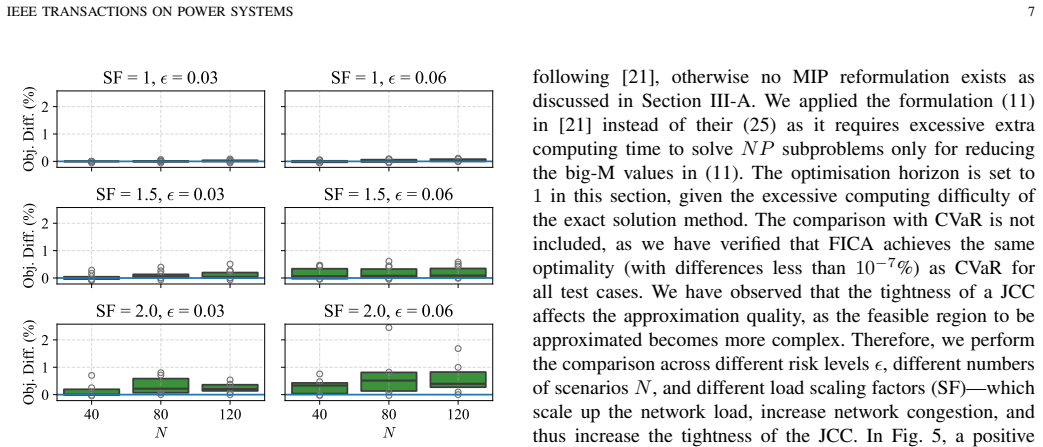
- [Section V-D] The comparison with the 'exact reformulation method (MIP)' is made after adding artificial degeneracy to enforce the homogeneity condition, and Section III-A states that this device 'often introduces extra conservativeness'. The reported below-1% Obj. Diff is therefore not necessarily the gap to the true LHS-WJCC optimum; it may be the gap to a conservative benchmark. Please qualify the abstract and Section VII claims about approximation quality, or demonstrate for these instances that the artificial degeneracy does not affect the optimal value.
- [Section III-C, Eq. (5)-(7)] The order-statistic formulas assume a strict ordering of the samples, and the parameter k is never defined. The paper should state that k=⌊εN⌋ and either assume no ties or specify a tie-breaking rule; otherwise the cardinality of the index set and the min-formula in (5) are not well-defined for data with equal values. This is relevant to the proof of Theorem 2 because the middle-set argument depends on the exact composition of [N]_p.
minor comments (5)
- [Section IV, Theorem 1] The statement 'there exists (r,s)' should be 'there exists (r,s) with r≥0 and s≥0', matching constraints (9a).
- [Appendix B, Lemma 1 proof] The word 'emperical' should be 'empirical'.
- [Section V-C] The phrase 'unclocking the value of WJCC' should be 'unlocking the value of WJCC'.
- [Appendix A] The ordering assumption on the sums of e_{t,w} is stated to be equivalent to (6), but (6) is an ordering of the scalar products with b_p−A_p^T 1; the equivalence holds only up to the sign of that scalar. Please clarify the relationship.
- [Section VI] The statement that FICA 'imposes no restriction on the convexity of the original problem' refers only to the chance-constraint approximation; the FICA formulation itself is convex only when the base feasible set X is convex. The wording could be sharpened.
Circularity Check
No circularity found: FICA–CVaR equivalence is proven directly; the only self-citation (to SFLA Lemma 2) is not load-bearing.
full rationale
I find no circular reduction in the claimed derivation chain. The central claim—that FICA's projected x-feasible region equals that of the uniform-weight CVaR approximation—is established by Theorems 1 and 2, each proved by explicit construction from the CVaR primal-dual representation in Appendix B. FICA's constraints (9) are written out in the paper, and the equivalence is not imported as an assumption; no parameter is fitted to force the equivalence, and the numerical claims are benchmarked against CVaR and the exact MIP reformulation. The only self-reference in the proof chain is 'Similar to Lemma 2 of our previous work [5]' in the proof of Lemma 1; that step is merely the standard choice of the minimizer s' in the empirical CVaR operator, and the rest of Lemma 1 is proved in the appendix, so the citation is not carrying the equivalence. One non-circular rigor note: Theorem 2's proof says '(9f) implies' q_p(x)+d_p-a_p^T x ≥ s, but q_p(x) is the minimum of the two order-statistic terms and (9e) is also needed for that lower bound. This is a proof gap as written, not a definitional circularity; the equivalence itself is supported by the surrounding algebra.
Assumptions & free parameters
free parameters (2)
- kappa (SFLA/FICA hyperparameter) =
1 (vector of ones)
- CVaR constraint weights w_p =
1/P for all p
assumptions (5)
- standard math Strong LP duality for the CVaR operator reformulation
- standard math Wasserstein DRCC CVaR-type inner approximation is valid
- domain assumption One-dimensional structure: AGC adjustment depends on total imbalance only
- ad hoc to paper Sample values are strictly ordered (no ties) in the sorted sequences
- ad hoc to paper Artificial degeneracy in the MIP benchmark preserves exactness
Cite this review
Pith. "Pith review of FICA: Faster Inner Convex Approximation of Chance Constrained Grid Dispatch with Decision-Coupled Uncertainty." pith.science (2026). https://pith.science/paper/DLKYCFUT
@misc{pith2026250618806,
  author       = {Pith},
  title        = {Pith review of: FICA: Faster Inner Convex Approximation of Chance Constrained Grid Dispatch with Decision-Coupled Uncertainty},
  year         = {2026},
  howpublished = {\url{https://pith.science/paper/DLKYCFUT}},
  note         = {Machine review of arXiv:2506.18806}
}
read the original abstract
This paper proposes a Faster Inner Convex Approximation (FICA) method for solving power system dispatch problems with Wasserstein distributionally robust joint chance constraints (WJCC) and incorporating the modelling of the automatic generation control factors. The problem studied belongs to the computationally challenging class of WJCC with left-hand-side uncertainty (LHS-WJCC). By exploiting the special one-dimensional structure (even if only partially present) of the problem, the proposed FICA incorporates a set of strong valid inequalities to accelerate the solution process. We prove that FICA achieves the same optimality as the well-known conditional value-at-risk (CVaR) inner convex approximation method. Our numerical experiments demonstrate that the proposed FICA can yield 40x computational speedup compared to CVaR, and can even reach up to 500x speedup when the optimisation horizon exceeds 16 time steps. This speedup is achieved when only 50% of constraints in a WJCC have the one-dimensional structure. The approximation quality is numerically verified to be the same as CVaR, and the quality gap is below 1% when compared to the computationally demanding exact reformulation of the LHS-WJCC in most cases. We also discuss the applications of FICA in optimisation problems from other domains that (partially) exhibit the one-dimensional structure.
Figures


Figures from the paper (1 more)
Forward citations
Cited by 1 Pith paper
-
Decision-Focused Scenario Generation and Selection for Efficient and Robust Grid Dispatch
A unified decision-focused framework trains VAE, GAN, and diffusion models to generate correlated scenarios for distributionally robust grid dispatch, reducing operational cost by 0.80–2.02% over accuracy-oriented methods.
Reference graph
Works this paper leans on
-
[1]
A. J. Conejo and L. Baringo,Power system operations. Springer, 2018, vol. 11
2018
-
[2]
Optimization in modern power systems,
S. Chatzivasileiadis, “Optimization in modern power systems,”Lec- ture Notes. Tech. Univ. of Denmark. Available online: https://arxiv. org/pdf/1811.00943. pdf, 2018
arXiv 2018
-
[3]
Probabilistic energy forecasting: Global energy forecasting competition 2014 and beyond,
T. Hong, P. Pinson, S. Fan, H. Zareipour, A. Troccoli, and R. J. Hyndman, “Probabilistic energy forecasting: Global energy forecasting competition 2014 and beyond,”International Journal of forecasting, vol. 32, no. 3, pp. 896–913, 2016
work page 2014
-
[4]
Energy and reserve dispatch with distributionally robust joint chance constraints,
C. Ordoudis, V . A. Nguyen, D. Kuhn, and P. Pinson, “Energy and reserve dispatch with distributionally robust joint chance constraints,” Operations Research Letters, vol. 49, no. 3, pp. 291–299, 2021
work page 2021
-
[5]
Strengthened and Faster Linear Approximation to Joint Chance Constraints with Wasserstein Ambiguity
Y . Zhou, Y . Xia, H. Yang, and T. Morstyn, “Strengthened and faster linear approximation to joint chance constraints with wasserstein ambi- guity,”arXiv preprint arXiv:2412.12992, 2024
work page Pith review arXiv 2024
-
[6]
Scenario-based economic dispatch with uncertain demand response,
H. Ming, L. Xie, M. C. Campi, S. Garatti, and P. Kumar, “Scenario-based economic dispatch with uncertain demand response,”IEEE Transactions on Smart Grid, vol. 10, no. 2, pp. 1858–1868, 2017
work page 2017
-
[7]
Tutorials on advanced optimization methods,
W. Wei, “Tutorials on advanced optimization methods,”arXiv preprint arXiv:2007.13545, 2020
arXiv 2007
-
[8]
A tutorial on stochastic programming,
A. Shapiro and A. Philpott, “A tutorial on stochastic programming,” Manuscript. Available at www2. isye. gatech. edu/ashapiro/publications. html, vol. 17, 2007
work page 2007
Show all 34 references
-
[9]
Distributionally robust optimization,
D. Kuhn, S. Shafiee, and W. Wiesemann, “Distributionally robust optimization,” 2024, https://arxiv.org/abs/2411.02549
2024 arXiv
-
[10]
A solution to the chance- constrained two-stage stochastic program for unit commitment with wind energy integration,
Z. Wu, P. Zeng, X.-P. Zhang, and Q. Zhou, “A solution to the chance- constrained two-stage stochastic program for unit commitment with wind energy integration,”IEEE Transactions on Power Systems, 2016
2016
-
[11]
Analytical reformulation for stochastic unit commitment considering wind power uncertainty with gaussian mixture model,
Y . Yang, W. Wu, B. Wang, and M. Li, “Analytical reformulation for stochastic unit commitment considering wind power uncertainty with gaussian mixture model,”IEEE Transactions on Power Systems, 2019
2019
-
[12]
Data-driven distributionally robust optimization using the wasserstein metric: Performance guarantees and tractable reformulations,
P. Mohajerin Esfahani and D. Kuhn, “Data-driven distributionally robust optimization using the wasserstein metric: Performance guarantees and tractable reformulations,”Mathematical Programming, 2018
2018
-
[13]
Distributionally robust optimization under mo- ment uncertainty with application to data-driven problems,
E. Delage and Y . Ye, “Distributionally robust optimization under mo- ment uncertainty with application to data-driven problems,”Operations research, vol. 58, no. 3, pp. 595–612, 2010
2010
-
[14]
Distributionally robust stochastic optimiza- tion with wasserstein distance,
R. Gao and A. Kleywegt, “Distributionally robust stochastic optimiza- tion with wasserstein distance,”Mathematics of Operations Research, vol. 48, no. 2, pp. 603–655, 2023
2023
-
[15]
Fast wasserstein-distance- based distributionally robust chance-constrained power dispatch for multi-zone hvac systems,
G. Chen, H. Zhang, H. Hui, and Y . Song, “Fast wasserstein-distance- based distributionally robust chance-constrained power dispatch for multi-zone hvac systems,”IEEE Transactions on Smart Grid, 2021
2021
-
[16]
Wasserstein distributionally robust chance-constrained optimization for energy and reserve dispatch: An exact and physically- bounded formulation,
A. Arrigoet al., “Wasserstein distributionally robust chance-constrained optimization for energy and reserve dispatch: An exact and physically- bounded formulation,”European Journal of Operational Research, 2022
2022
-
[17]
Aggregated feasible active power region for distributed energy resources with a distributionally robust joint probabilistic guarantee,
Y . Zhou, C. Essayeh, and T. Morstyn, “Aggregated feasible active power region for distributed energy resources with a distributionally robust joint probabilistic guarantee,”IEEE Transactions on Power Systems, vol. 40, no. 1, pp. 556–571, 2025
2025
-
[18]
Distributionally robust joint chance-constrained optimization for networked microgrids considering contingencies and renewable uncertainty,
Y . Ding, T. Morstyn, and M. D. McCulloch, “Distributionally robust joint chance-constrained optimization for networked microgrids considering contingencies and renewable uncertainty,”IEEE Trans. on Smart Grid, vol. 13, no. 3, pp. 2467–2478, 2022
2022
-
[19]
Dis- tributionally robust chance-constrained programs with right-hand side uncertainty under wasserstein ambiguity,
N. Ho-Nguyen, F. Kılınc ¸-Karzan, S. K ¨uc ¸¨ukyavuz, and D. Lee, “Dis- tributionally robust chance-constrained programs with right-hand side uncertainty under wasserstein ambiguity,”Mathematical Programming, pp. 1–32, 2022
2022
-
[20]
Data-driven chance constrained programs over wasserstein balls,
Z. Chen, D. Kuhn, and W. Wiesemann, “Data-driven chance constrained programs over wasserstein balls,”Operations Research, vol. 72, no. 1, pp. 410–424, 2024
2024
-
[21]
Strong formulations for distributionally robust chance-constrained programs with left-hand side uncertainty under wasserstein ambiguity,
N. Ho-Nguyen, F. Kilinc ¸-Karzan, S. K ¨uc ¸¨ukyavuz, and D. Lee, “Strong formulations for distributionally robust chance-constrained programs with left-hand side uncertainty under wasserstein ambiguity,”INFORMS Journal on Optimization, vol. 5, no. 2, pp. 211–232, 2023
2023
-
[22]
On the viability of stochastic economic dispatch for real-time energy market clearing,
H. Zhao, M. Tanneau, and P. Van Hentenryck, “On the viability of stochastic economic dispatch for real-time energy market clearing,” arXiv preprint arXiv:2308.06386, 2023
2023 arXiv
-
[23]
On approximations of data- driven chance constrained programs over wasserstein balls,
Z. Chen, D. Kuhn, and W. Wiesemann, “On approximations of data- driven chance constrained programs over wasserstein balls,”Operations Research Letters, vol. 51, no. 3, pp. 226–233, 2023
2023
-
[24]
Also-x and also-x+: Better convex approximations for chance constrained programs,
N. Jiang and W. Xie, “Also-x and also-x+: Better convex approximations for chance constrained programs,”Operations Research, 2022
2022
-
[25]
Multiple joint chance constraints approximation for uncertainty modeling in dispatch problems,
Y . Wen, Y . Guo, Z. Hu, and G. Hug, “Multiple joint chance constraints approximation for uncertainty modeling in dispatch problems,”IEEE Transactions on Power Systems, 2024
2024
-
[26]
Also-x#: Better convex approximations for distributionally robust chance constrained programs,
N. Jiang and W. Xie, “Also-x#: Better convex approximations for distributionally robust chance constrained programs,”Mathematical Pro- gramming, 2024
2024
-
[27]
Balancing the great british electricity sys- tem—bulk dispatch optimisation,
W. Bukhsh and A. Bejan, “Balancing the great british electricity sys- tem—bulk dispatch optimisation,”Electric Power Systems Research, vol. 234, p. 110714, 2024
2024
-
[28]
Deep learning based distributionally robust joint chance constrained economic dispatch under wind power uncertainty,
C. Ning and F. You, “Deep learning based distributionally robust joint chance constrained economic dispatch under wind power uncertainty,” IEEE Transactions on Power Systems, vol. 37, no. 1, pp. 191–203, 2021
2021
-
[29]
Data-driven decision making in power sys- tems with probabilistic guarantees: Theory and applications of chance- constrained optimization,
X. Geng and L. Xie, “Data-driven decision making in power sys- tems with probabilistic guarantees: Theory and applications of chance- constrained optimization,”Annual reviews in control, 2019
2019
-
[30]
IEEE 24-bus system,
Illinois Center for a Smarter Electric Grid (ICSEG), “IEEE 24-bus system,” https://icseg.iti.illinois.edu/ieee-24-bus-system/, 1979
1979
-
[31]
Application of large-scale synthetic power system models for energy economic studies,
T. Xu, A. B. Birchfield, K. M. Gegner, K. S. Shetye, and T. J. Overbye, “Application of large-scale synthetic power system models for energy economic studies,” 2017
2017
-
[32]
Global Energy Forecasting Com- petition 2012 - Wind Forecasting,
T. Hong, Glider, and P. Pinson, “Global Energy Forecasting Com- petition 2012 - Wind Forecasting,” https://kaggle.com/competitions/ GEF2012-wind-forecasting, 2012, accessed: 2024-10-11
2012
-
[33]
Pr ´ekopa,Stochastic programming
A. Pr ´ekopa,Stochastic programming. Springer Science & Business Media, 2013, vol. 324
2013
-
[34]
The terminator: An integration of inner and outer approximations for solving wasserstein distributionally robust chance constrained programs via variable fixing,
N. Jiang and W. Xie, “The terminator: An integration of inner and outer approximations for solving wasserstein distributionally robust chance constrained programs via variable fixing,”INFORMS Journal on Computing, vol. 37, no. 2, pp. 381–412, 2025
2025
Reviewed August 15, 2026 · model on record in the stance chip above.
Discussion (0). Continue with ORCID to comment.