Turquoise Magic Wavelength of the {}⁸⁷Sr Clock Transition
Pith reviewed 2026-05-19 07:42 UTC · model grok-4.3
The pith
Strontium-87 clock transition has a second magic wavelength measured at 497.4363(3) nm.
A machine-rendered reading of the paper's core claim, the machinery that carries it, and where it could break.
Core claim
The authors measure the magic wavelength of the strontium-87 clock transition to be 497.4363(3) nm. At this wavelength the differential AC Stark shift between the two clock states vanishes, so atoms trapped in a lattice experience no first-order position- or intensity-dependent frequency shift. Relative to the established 813 nm magic wavelength, the 497 nm wavelength sits closer to the strong 461 nm dipolar transition and therefore produces an order-of-magnitude larger polarizability, permitting deeper traps at reduced optical power.
What carries the argument
The magic wavelength, the laser frequency at which the AC Stark shifts of the ground and excited clock states become equal and the differential light shift disappears.
If this is right
- Deeper optical traps become possible with the same or lower laser power.
- The clock frequency acquires a wavelength sensitivity of 334(10) Hz per nm per recoil energy unit.
- Alternative lattice geometries can be explored without increasing the required optical intensity.
Where Pith is reading between the lines
- Compact, lower-power lattice clocks may become feasible for portable or space-based applications.
- The higher polarizability could be used to strengthen atom-atom interactions in quantum-simulation experiments at this wavelength.
- Systematic studies of lattice-induced scattering rates at shorter wavelengths could be compared directly with the 813 nm case.
Load-bearing premise
Observed frequency shifts are produced only by differential Stark shifts of the two clock states, with negligible contributions from heating, scattering, or magnetic gradients.
What would settle it
An independent measurement of the wavelength at which the differential light shift of the clock transition crosses zero that falls outside the interval 497.4360 nm to 497.4366 nm.
Figures



read the original abstract
Optical lattice clocks of fermionic strontium offer a versatile platform for probing fundamental physics and developing quantum technologies. The bivalent electronic structure of strontium gives rise to a doubly-forbidden atomic transition that is accessible due to hyperfine mixing in fermionic strontium-87, thus resulting in a sub-millihertz natural linewidth. Currently, the most accurate optical lattice clocks operate on this narrow transition by tightly trapping strontium-87 atoms in a {\em magic} optical lattice at 813~nm. {\em Magic} wavelengths occur where the Stark shifts of both the ground and excited states are equivalent, thus eliminating any position and intensity-dependent broadening of the corresponding transition. Theoretical calculations of the electronic structure of strontium-87 have also predicted another {\em magic} wavelength of the clock transition at 497.01(57)~nm. In this work, we experimentally measure the novel {\em magic} wavelength to be $497.4363(3)$~nm. Compared to the 813~nm {\em magic} wavelength, 497~nm is closer to the strong 461~nm dipolar transition of strontium, resulting in larger atomic polarizability by an order of magnitude, providing deeper traps with less optical power. The proximity to the 461~transition also leads to an enhanced sensitivity of 334(10)~Hz/(nm\,$E_{R}$) at the {\em magic} wavelength.
Editorial analysis
A structured set of objections, weighed in public.
Referee Report
Summary. The paper reports an experimental measurement of a previously predicted but unmeasured magic wavelength for the 87Sr clock transition, determining its value as 497.4363(3) nm. This wavelength lies near the strong 461 nm transition, yielding an order-of-magnitude larger differential polarizability than the conventional 813 nm magic wavelength and enabling deeper traps at lower optical power, together with a quoted sensitivity of 334(10) Hz/(nm E_R).
Significance. If the central measurement holds, the result supplies a practical alternative lattice wavelength for 87Sr optical clocks that reduces required laser power while increasing trap depth and wavelength sensitivity. Such a wavelength could improve lattice clock performance in metrology and fundamental-physics applications and provides a new experimental benchmark for ab initio calculations of strontium polarizabilities.
major comments (2)
- [Results] Results section (measurement of the zero-crossing): the quoted uncertainty of 0.0003 nm on the magic wavelength requires explicit demonstration that lattice-induced heating, photon scattering, and residual magnetic gradients contribute shifts below a few hertz across the scanned intensity range. The order-of-magnitude increase in polarizability relative to 813 nm makes these systematics potentially larger; without a quantitative bound or data showing their suppression, the zero-crossing location cannot be guaranteed to reflect only the differential AC Stark shift.
- [Methods] Methods or supplementary material on data acquisition: the manuscript must include the raw clock-frequency versus lattice-wavelength data sets, the fitting procedure used to extract the zero-crossing, and the full uncertainty budget (including intensity-dependent and position-dependent terms) so that the 3 fm precision can be independently assessed.
minor comments (2)
- [Abstract] The abstract states the theoretical prediction as 497.01(57) nm while the measured value is 497.4363(3) nm; a brief discussion of the 0.42 nm offset (well within the theoretical uncertainty) would clarify consistency.
- [Introduction] Notation for the sensitivity unit Hz/(nm E_R) should be defined on first use and checked for consistency with the polarizability units employed elsewhere.
Simulated Author's Rebuttal
We thank the referee for their careful reading of our manuscript and for the constructive comments, which have helped us identify areas where additional detail will strengthen the presentation of our results. We address each major comment below.
read point-by-point responses
-
Referee: [Results] Results section (measurement of the zero-crossing): the quoted uncertainty of 0.0003 nm on the magic wavelength requires explicit demonstration that lattice-induced heating, photon scattering, and residual magnetic gradients contribute shifts below a few hertz across the scanned intensity range. The order-of-magnitude increase in polarizability relative to 813 nm makes these systematics potentially larger; without a quantitative bound or data showing their suppression, the zero-crossing location cannot be guaranteed to reflect only the differential AC Stark shift.
Authors: We agree that explicit quantitative bounds on these systematics are required to substantiate the reported precision, given the larger polarizability at 497 nm. In the revised manuscript we will add a dedicated subsection (and corresponding supplementary figures) that reports auxiliary measurements of lattice-induced heating rates, photon-scattering rates, and residual magnetic-field gradients. These data demonstrate that the combined frequency shifts from all three effects remain below 2 Hz across the full intensity range used for the zero-crossing determination. The observed linearity of the clock-frequency shift versus lattice intensity already provides supporting evidence, but the new quantitative bounds will be presented explicitly. revision: yes
-
Referee: [Methods] Methods or supplementary material on data acquisition: the manuscript must include the raw clock-frequency versus lattice-wavelength data sets, the fitting procedure used to extract the zero-crossing, and the full uncertainty budget (including intensity-dependent and position-dependent terms) so that the 3 fm precision can be independently assessed.
Authors: We concur that full transparency on the raw data, fitting procedure, and uncertainty budget is essential for independent assessment of the result. In the revision we will (i) deposit the complete raw clock-frequency versus lattice-wavelength datasets as supplementary material, (ii) expand the Methods section with a detailed description of the fitting model and zero-crossing extraction procedure, and (iii) provide an expanded uncertainty budget that explicitly tabulates all intensity-dependent and position-dependent contributions. These additions will allow direct verification of the quoted 0.0003 nm uncertainty. revision: yes
Circularity Check
No circularity: central result is direct experimental measurement
full rationale
The paper's primary claim is an experimental measurement of the magic wavelength at 497.4363(3) nm obtained by scanning the lattice wavelength and locating the zero-crossing of the differential clock shift. This process relies on observed frequency data and control of systematics rather than any derivation that reduces by construction to a fitted parameter, self-citation, or ansatz imported from prior work by the same authors. The cited theoretical prediction (497.01(57) nm) is independent input and is not used to force the measured value. No load-bearing step equates the reported result to its own inputs via definition or renaming.
Axiom & Free-Parameter Ledger
axioms (1)
- domain assumption Standard assumptions of two-level atomic response to off-resonant laser light and negligible higher-order effects at the intensities used
Lean theorems connected to this paper
-
IndisputableMonolith/Cost/FunctionalEquation.leanwashburn_uniqueness_aczel unclear?
unclearRelation between the paper passage and the cited Recognition theorem.
We calculate the 1S0 and 3P0 polarizabilities using an approach that combines configuration interaction (CI) and coupled cluster methods... α(ω) = αv(ω) + αc(ω) + αvc(ω)
What do these tags mean?
- matches
- The paper's claim is directly supported by a theorem in the formal canon.
- supports
- The theorem supports part of the paper's argument, but the paper may add assumptions or extra steps.
- extends
- The paper goes beyond the formal theorem; the theorem is a base layer rather than the whole result.
- uses
- The paper appears to rely on the theorem as machinery.
- contradicts
- The paper's claim conflicts with a theorem or certificate in the canon.
- unclear
- Pith found a possible connection, but the passage is too broad, indirect, or ambiguous to say the theorem truly supports the claim.
Reference graph
Works this paper leans on
-
[1]
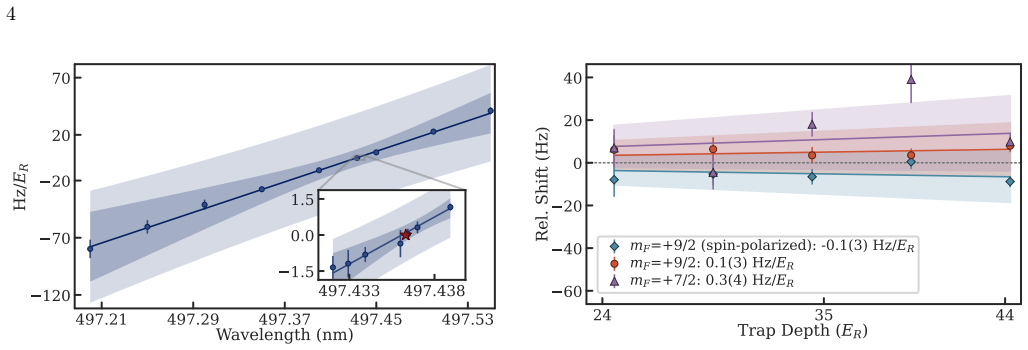
Broad Scans Since each experimental run is≈10 seconds, a single data point in Fig. 4 takes≈4 hours. Long-term frequency drift in the laser frequency can cause a systematic er- ror in the spectroscopy measurements. We measure a drift in the ultrastable cavity on the order of 3 kHz per day or 23 mHz/s and implement feed-forward stability by adjusting the la...
-
[2]
Narrow Scans For the narrower scans used for the inset of Fig. 4, we spin-polarize to the mF = +9 /2 substate and measure three cycles through trap depths of 44ER, 32ER, 20ER, 26ER, and 38ER. Each individual trap depth then has three data points to determine the cavity drift correction, whichareaveragedforamoreprecise magicmeasurement of 497.4363(3) nm. T...
-
[3]
Y.-J. Wang, D. Z. Anderson, V. M. Bright, E. A. Cornell, Q. Diot, T. Kishimoto, M. Prentiss, R. A. Saravanan, S. R. Segal, and S. Wu, Atom michelson interferometer on a chip using a Bose–Einstein condensate, Phys. Rev. Lett. 94, 090405 (2005)
work page 2005
-
[4]
E. R. Moan, R. A. Horne, T. Arpornthip, Z. Luo, A. J. Fallon, S. J. Berl, and C. A. Sackett, Quantum rotation sensing with dual Sagnac interferometers in an atom- optical waveguide, Phys. Rev. Lett.124, 120403 (2020)
work page 2020
-
[5]
J. Nemirovsky, R. Weill, I. Meltzer, and Y. Sagi, Atomic interferometer based on optical tweezers, Phys. Rev. Res. 5, 10.1103/physrevresearch.5.043300 (2023)
-
[6]
M.Saffman,Quantumcomputingwithatomicqubitsand Rydberg interactions: progress and challenges, J. Phys. B: At., Mol. Opt. Phys.49, 202001 (2016)
work page 2016
-
[7]
D. S. Weiss and M. Saffman, Quantum computing with neutral atoms, Phys. Today70, 44 (2017)
work page 2017
-
[8]
M. Takamoto, F.-L. Hong, R. Higashi, and H. Katori, An optical lattice clock, Nature435, 321 (2005)
work page 2005
-
[9]
M. M. Boyd, A. D. Ludlow, S. Blatt, S. M. Foreman, T. Ido, T. Zelevinsky, and J. Ye,87Sr lattice clock with inaccuracy below 10−15, Phys. Rev. Lett. 98, 083002 (2007)
work page 2007
-
[10]
B. J.Bloom, T. L.Nicholson, J.R. Williams, S.L.Camp- bell, M. Bishof, X. Zhang, W. Zhang, S. L. Bromley, and J. Ye, An optical lattice clock with accuracy and stability at the 10−18 level, Nature 506, 71 (2014)
work page 2014
-
[11]
A. Aeppli, K. Kim, W. Warfield, M. S. Safronova, and J.Ye,Clockwith 8 × 10⁻¹⁹ systematicuncertainty,Phys. Rev. Lett. 133, 10.1103/physrevlett.133.023401 (2024)
-
[12]
G. Kestler, K. Ton, D. Filin, M. S. Safronova, and J. T. Barreiro, Magic wavelengths of the Sr (5s2 1S0 −5s5p 3P1) intercombination transition near the 5s5p 3P1 − 5p2 3P2 transition, Phys. Rev. A105, 012821 (2022)
work page 2022
-
[13]
R. P. del Aguila, T. Mazzoni, L. Hu, L. Salvi, G. M. Tino, and N. Poli, Bragg gravity-gradiometer using the1S0 − 3P1 intercombination transition of88Sr, New J. Phys.20, 043002 (2018)
work page 2018
-
[14]
G. Kestler,Toward Ultracold Strontium on Nanophoton- ics, Master’s thesis, University of California San Diego (2019)
work page 2019
-
[15]
Martin, Development of a strontium magneto-optical trap for probing Casimir-Polder potentials , Ph.D
P. Martin, Development of a strontium magneto-optical trap for probing Casimir-Polder potentials , Ph.D. thesis, University of Oregon (2017)
work page 2017
-
[16]
E. C. Cook,Laser cooling and trapping of neutral stron- tium for spectroscopic measurements of Casimir-Polder potentials, Ph.D. thesis, University of Oregon (2017)
work page 2017
-
[17]
J. P. Covey, I. S. Madjarov, A. Cooper, and M. En- dres, 2000-times repeated imaging of strontium atoms in clock-magic tweezer arrays, Phys. Rev. Lett.122, 173201 (2019)
work page 2000
-
[18]
P. Lauria, W.-T. Kuo, N. R. Cooper, and J. T. Barreiro, Experimental realization of a fermionic spin-momentum lattice, Phys. Rev. Lett.128, 245301 (2022)
work page 2022
-
[19]
D. González-Cuadra, D. Bluvstein, M. Kalinowski, R. Kaubruegger, N. Maskara, P. Naldesi, T. V. Zache, A. M. Kaufman, M. D. Lukin, H. Pichler, B. Vermer- sch, J. Ye, and P. Zoller, Fermionic quantum process- ing with programmable neutral atom arrays, PNAS120, 10.1073/pnas.2304294120 (2023)
-
[20]
J. Trautmann, D. Yankelev, V. Klüsener, A. J. Park, I. Bloch, and S. Blatt, 1S0 − 3P2 magnetic quadrupole transition in neutral strontium, Phys. Rev. Res. 5, 10.1103/physrevresearch.5.013219 (2023)
-
[21]
A.Taichenachev, V.Yudin, C.Oates, C.Hoyt, Z.Barber, and L. Hollberg, Magnetic field-induced spectroscopy of forbidden optical transitions with application to lattice-based optical atomic clocks, Phys. Rev. Lett.96, 10.1103/physrevlett.96.083001 (2006)
- [22]
-
[23]
T. Bothwell, C. J. Kennedy, A. Aeppli, D. Kedar, J. M. Robinson, E. Oelker, A. Staron, and J. Ye, Resolving the gravitational redshift across a millimetre-scale atomic sample, Nature 602, 420 (2022)
work page 2022
-
[24]
M. S. Safronova, M. G. Kozlov, W. R. Johnson, and D.Jiang,Developmentofaconfiguration-interactionplus all-order method for atomic calculations, Phys. Rev. A 80, 012516 (2009)
work page 2009
-
[25]
M. S. Safronova, S. G. Porsev, U. I. Safronova, M. G. Kozlov, and C. W. Clark, Blackbody-radiation shift in the sr optical atomic clock, Phys. Rev. A 87, 012509 (2013)
work page 2013
- [26]
-
[27]
C. Cheung, M. G. Kozlov, S. G. Porsev, M. S. Safronova, I. I. Tupitsyn, and A. I. Bondarev, pCI: A parallel configuration interaction software package for high-precision atomic structure calculations, Com- puter Physics Communications 308, 109463 (2025), arXiv:2410.06680 [physics.atom-ph]
-
[28]
S. G. Porsev, Y. G. Rakhlina, and M. G. Kozlov, Electric- dipole amplitudes, lifetimes, and polarizabilities of the low-lying levels of atomic ytterbium, Phys. Rev. A60, 2781 (1999)
work page 1999
-
[29]
A. Kramida, Yu. Ralchenko, J. Reader, and the NIST ASD Team (2019). NIST Atomic Spectra Database (ver- sion 5.7.1). Available at http://physics.nist.gov/asd. Na- tional Institute of Standards and Technology, Gaithers- burg, MD
work page 2019
- [30]
-
[31]
S. Stellmer, F. Schreck, and T. C. Killian, DEGENER- ATE QUANTUM GASES OF STRONTIUM, inAnnual Review of Cold Atoms and Molecules (WORLD SCIEN- TIFIC, 2014) pp. 1–80
work page 2014
-
[32]
Campbell, A Fermi-degenerate three-dimensional op- tical lattice clock , Ph.D
S. Campbell, A Fermi-degenerate three-dimensional op- tical lattice clock , Ph.D. thesis, University of Colorado Boulder (2017)
work page 2017
-
[34]
M. A. Norcia, M. N. Winchester, J. R. K. Cline, and J. K. Thompson, Superradiance on the millihertz linewidth strontium clock tran- sition, Science Advances 2, e1601231 (2016), https://www.science.org/doi/pdf/10.1126/sciadv.1601231
-
[35]
L. Viverit, S. Giorgini, L. P. Pitaevskii, and S. Stringari, Adiabatic compression of a trapped fermi gas, Phys. Rev. A 63, 10.1103/physreva.63.033603 (2001)
-
[36]
M. Bishof, M. J. Martin, M. D. Swallows, C. Benko, Y. Lin, G. Quéméner, A. M. Rey, and J. Ye, Inelastic col- lisions and density-dependent excitation suppression in a 87Sr optical lattice clock, Phys. Rev. A84, 10.1103/phys- reva.84.052716 (2011)
discussion (0)
Sign in with ORCID, Apple, or X to comment. Anyone can read and Pith papers without signing in.