REVIEW 2 major objections 4 minor 60 references
A Fog Over the Cosmological SGWB: Unresolved Massive Black Hole Binaries in the LISA Band
T0 review · 2 major / 4 minor · reviewed 2026-08-15 · deepseek-v4-flash
Pith's one-line read Unresolved massive black hole binaries could raise the minimum detectable cosmological gravitational-wave amplitude for LISA by up to a factor of ~40.
desk verdict Solid, well-validated forecast that unresolved MBHBs are a serious LISA foreground, lifting the minimum detectable cosmological SGWB amplitude by an order of magnitude to a factor of ~40, though the exact numbers rest on a Gaussian approximation the authors themselves flag. read the letter →
The pith
A machine-rendered reading of the paper's core claim, the machinery that carries it, and where it could break.
The reading
What carries the argument
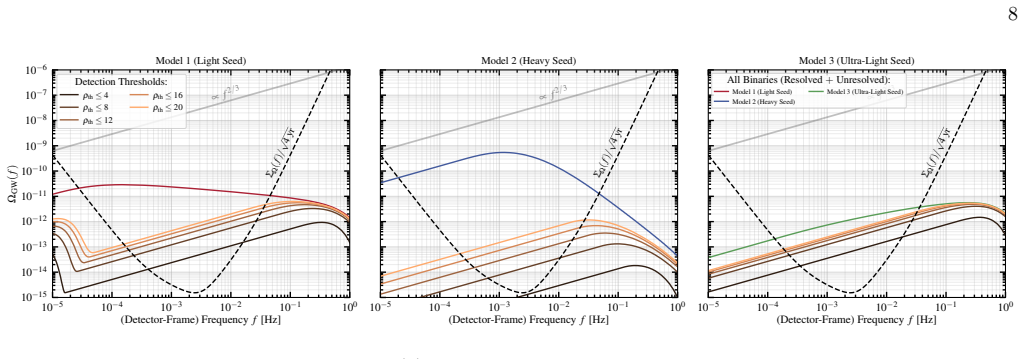
The argument is carried by an analytic spectral-energy-density integral, $$\Omega_{\rm GW}(f) = \frac{1}{\rho_c $c^{2}$}\int \frac{dz}{1+z}\int d\log_{10}M\, \frac{dn}{dz\,d\log_{10}M}\left.\frac{dE_{\rm GW}}{d\ln f_r}\right|_{f_r=f(1+z)},$$ combined with a per-binary emission law $$\frac{dE_{\rm GW}}{d\ln f_r} \simeq \frac{1}{3G}(GM)^{5/3}(\pi f_r)^{2/3}\,\Theta[f_{r,\rm ISCO}-f(1+z)],$$ where $M$ is the source-frame chirp mass, the mass combination that sets the inspiral frequency evolution; the Heaviside function truncates each inspiral at the innermost stable circular orbit, so in-band mergers are handled by a cutoff rather than by full merger-ringdown waveforms. This is paired with a five-parameter, factorized merger-rate model in chirp mass and redshift, calibrated to three seeding scenarios (Light, Heavy, and Ultra-Light Seed), with individual resolvability set by sky-averaged signal-to-noise contours computed from full inspiral-merger-ringdown waveforms. The decisive mechanism is the Fisher information matrix, the standard forecast tool that converts parameter sensitivities into expected measurement uncertainties: $$F_{\$\alpha$\$\beta$} = \frac{T_{\rm obs}}{2}\int df\,\frac{\partial_\$\alpha$\Omega_{\rm GW}\,\partial_\$\beta$\Omega_{\rm GW}}{[\Sigma_\$\Omega$(f)+\$\Omega$^{\rm astro}_{\rm GW}(f)/\sqrt{2}]^2},$$ in which the unresolved astrophysical background enters as an irreducible confusion-noise term. The matrix turns the near-degeneracy between a cosmological power law and the $f^{2/3}$ astrophysical slope near $\gamma = 2/3$ into sharply inflated parameter uncertainties. The analytic spectrum is validated against Monte Carlo realizations of the population using full waveforms, and the degradation is shown to be nearly independent of the assumed merger rate.
What would settle it
With real LISA data, measure the spectral energy density of the unresolved MBHB background and compare it with the analytic predictions: a measured spectrum more than an order of magnitude below the Light Seed prediction at $10^{-3}$–$10^{-2}$ Hz would shrink the forecast degradation factors accordingly. Conversely, a robust $3\sigma$ detection of a flat ($\gamma = 0$) cosmological background at $A \simeq 5\times10^{-13}$, a level the paper forecasts to be masked by the foreground, would directly contradict the central claim.
Extended reading notes
Core claim
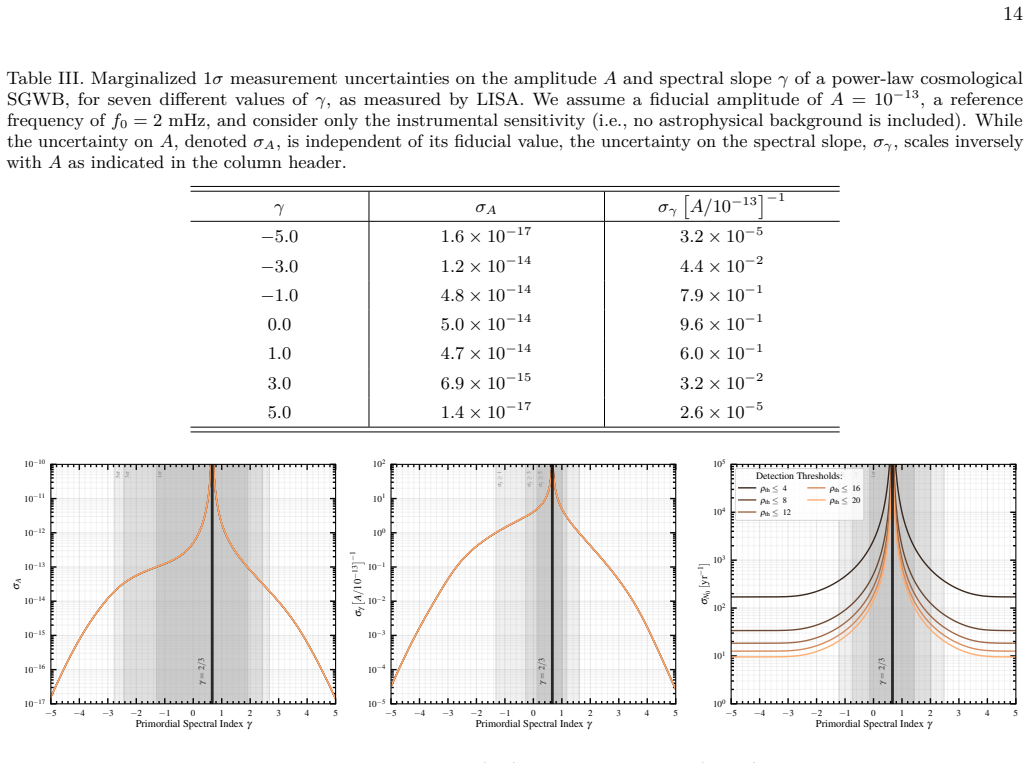
The paper's central claim is that unresolved massive black hole binaries constitute a substantial stochastic foreground in the LISA band that degrades the detectability of a primordial gravitational-wave background by multiple orders of magnitude, depending on the spectral shape of the cosmological signal. Modeling the unresolved component as the population of binaries whose individual signal-to-noise ratio falls below a threshold $\rho_{\rm th}$, the authors compute its spectral energy density analytically and insert it into a three-parameter information-matrix forecast for the cosmological amplitude $A$, the spectral index $\gamma$ (the power with which amplitude scales with frequency), and the local merger rate $N_0$. They find that the minimum detectable cosmological amplitude at $3\sigma$ rises from $1.5\times10^{-13}$ to $1.5\times10^{-12}$ for a flat ($\gamma = 0$) spectrum and to $5.4\times10^{-12}$ near $\gamma = 1$, a factor of about 40; the degradation peaks where the cosmological power law crosses the $f^{2/3}$ inspiral slope of the astrophysical background ($\gamma \simeq 2/3$) and becomes negligible for $|\gamma| \gtrsim 3$. Because the astrophysical contribution enters as an additional noise term in the analysis, the foreground cannot be ignored even under optimistic subtraction thresholds.
Load-bearing premise
The load-bearing premise is that the unresolved black-hole-binary signal can be treated as smooth, stationary, Gaussian noise in the Fisher-matrix analysis, even though the paper itself notes that these merging binaries produce an intermittent, 'popcorn'-like signal; if that non-Gaussianity is strong, the exact degradation factors could shift, though the qualitative conclusion would likely survive.
Editorial extensions
If this is right
- Even optimistic subtraction thresholds ($\rho_{\rm th} \le 4$–8) leave substantial residual power: for a Light Seed population the unresolved background alone would be detected with SNR $\approx 27$ at $\rho_{\rm th} = 12$, so the foreground is likely present in LISA data regardless of how well individual binaries are removed.
- Foreground-free sensitivity forecasts are misleading for plausible cosmological spectra: at $\gamma = 0$ the required amplitude for a $3\sigma$ detection grows from $1.5\times10^{-13}$ to $1.5\times10^{-12}$, and near $\gamma = 1$ it grows to $5.4\times10^{-12}$.
- The degradation is set by spectral shape, not amplitude: varying the merger rate $N_0$ by two orders of magnitude changes the uncertainty on $A$ by less than 10 percent, so the $\gamma \simeq 2/3$ degeneracy is the binding constraint.
- The unresolved background is itself a detectable messenger: in Light Seed-like populations it is measurable on its own and probes the demographics of massive black holes too faint to be individually resolved, including systems beyond the reach of pulsar timing arrays and LIGO-style detectors.
- Joint component separation works only in part: for steep spectra ($|\gamma| \gtrsim 3$) the astrophysical and cosmological components are easily disentangled, while for roughly $-0.5 \lesssim \gamma \lesssim 2$ the two are strongly correlated and must be modeled and marginalized over together.
Reading between the lines
- Because the Fisher treatment models the foreground as stationary Gaussian noise, the paper's quantitative degradation factors may shift once the true 'popcorn'-like, non-Gaussian character of unresolved mergers is included; higher-order statistics such as the bispectrum could then become the tool that actually breaks the $\gamma \simeq 2/3$ degeneracy, a route the paper flags but leaves open.
- Stellar-mass binary black holes and extreme-mass-ratio inspirals also produce $f^{2/3}$-shaped backgrounds in the LISA band, so a multi-component joint analysis would likely find the total astrophysical fog even more confining than any single-population forecast.
- If the pulsar-timing-array signal is confirmed as massive-black-hole binaries, its extrapolation to mHz frequencies could pin down the foreground amplitude and convert the main nuisance into a calibration for LISA's cosmological sensitivity.
- The predicted minimum-detectable-amplitude curve $A_{\min}(\gamma)$ is a sharp, testable forecast: a robust detection of a flat cosmological background below the predicted $3\sigma$ threshold would force either a much sparser low-mass MBHB population than the Light Seed scenario or a foreground whose non-Gaussian statistics behave differently from the Gaussian-noise treatment.
Signed reviews
Editorial analysis
A structured set of objections, weighed in public.
Referee Report
Summary. The paper develops an analytical framework for the stochastic gravitational-wave background (SGWB) produced by unresolved massive black hole binaries (MBHBs) in the LISA band. The authors introduce a five-parameter factorized population model, calibrated to the semi-analytical predictions of Ref. [25], and compute the spectral energy density of the unresolved background by truncating inspiral waveforms at the ISCO and removing individually resolvable binaries above SNR thresholds rho_th. The analytic SED is validated against Monte Carlo realizations of the population using IMRPhenomX waveforms. Using a Fisher information-matrix analysis over the parameters {A, gamma, N0}, they forecast the minimum detectable amplitude of a power-law cosmological SGWB in the presence of the MBHB foreground. They report that foreground-free sensitivity is degraded by a factor of about 10 for a flat spectrum (gamma = 0) and by about 40 near gamma = 1, with the largest degradation near the degenerate slope gamma = 2/3, and they conclude that accurate modeling of the unresolved MBHB background is essential for LISA cosmology.
Significance. If the quantitative forecast holds, this is an important result for LISA data-analysis planning: it identifies a foreground that has received comparatively little attention and quantifies its impact on cosmological SGWB searches. The paper's strengths include a transparent analytical population model, explicit derivatives and information-matrix expressions, a forward model anchored to externally calibrated population parameters rather than fitted to the target signal, and a Monte Carlo validation of the ISCO-truncated analytic approximation against full IMR waveforms. The robustness checks over redshift-distribution parameters and merger-rate normalization are also valuable. The main quantitative claim is, however, sensitive to the Gaussianity assumption for the popcorn-like foreground, and the abstract's 'multiple orders of magnitude' wording overstates the reported factors of about 10 and 40.
major comments (2)
- [Sec. VIC, Eq. (24); Sec. II (footnote 3); Sec. VII] The quantitative forecast of the smallest detectable cosmological amplitude is built on Eq. (24), which treats the unresolved MBHB foreground as an additional stationary Gaussian noise term with diagonal covariance in frequency. The manuscript itself states in several places (footnote 3, Sec. VIF, Sec. VII) that the unresolved MBHB signal is intermittent, popcorn-like, and non-Gaussian. For a non-Gaussian foreground, the variance of a measured Omega_GW(f) estimator acquires a connected four-point (trispectrum) contribution, and the optimal estimator for separating a Gaussian cosmological component from a popcorn foreground is not the simple matched filter implied by Eq. (24); higher-order statistics can in principle change the separation prospects. The qualitative conclusion that the foreground matters is robust, but the specific factors (about 10 at gamma = 0 and about 40 near gamma = 1) and the minimum amplitudes quoted in Sec. VII are Fisher forecasts under a Gaussianity assumption. I ask that this be stated explicitly as a caveat attached to the headline numbers, and ideally tested by a simple variance-inflation model or a non-Gaussian likelihood in a toy setting.
- [Abstract and Sec. VII] The abstract states that unresolved MBHBs 'can degrade the detectability of a cosmological signal by multiple orders of magnitude', but the quantitative results reported in Sec. VII and Fig. 6 are a factor of about 10 at gamma = 0 and a factor of about 40 near gamma = 1, i.e., one to about 1.6 orders of magnitude. Unless there is a regime not shown in the paper where the degradation exceeds about a factor of 100, the wording overstates the headline result. Please revise to 'one to two orders of magnitude' or 'an order of magnitude or more, depending on spectral shape', so that the abstract matches the actual forecasts.
minor comments (4)
- [Sec. VIA, Eq. (14)] The expression for the optical-metrology noise spectrum S_s appears to reuse the acceleration-noise amplitude sqrt((delta a)^2) from Eq. (12); it should presumably be the path-length fluctuation sqrt((delta x)^2). Please check and correct the typo.
- [Sec. VIF, Fig. 7 and Table IV] The numerical validation is presented for Model 2 (Heavy Seed) only, whereas the headline degradation factors in Fig. 5 and Sec. VII are obtained for Model 1 (Light Seed). The text states that Models 1 and 3 show 'even closer correspondence', but no quantitative comparison is shown for the model driving the main forecast. Please add the corresponding validation for Model 1 or state this as an explicit limitation.
- [Sec. VIB] The sentence saying the T channel is used 'to entirely characterize the noise spectra associated with the A and E modes' is ambiguous: Eq. (15) is an analytical noise model, not a measured noise calibration. Please clarify whether this is an assumed noise prescription or a data-driven estimate.
- [Sec. VIF] The numerical Monte Carlo only tracks binaries that merge within the 4-year observation window, producing a low-frequency downturn below about 1e-3 Hz. This is acknowledged in the text, but it means the validation of the analytic model below 1e-3 Hz is indirect. Please state this limitation more prominently in the validation discussion.
Circularity Check
No significant circularity: the forecast is a forward model from externally calibrated population inputs, and the cosmological amplitude is scanned, not fitted.
full rationale
The paper's derivation chain is not circular. Eq. (1) is the standard Phinney-type integral for the spectral energy density; Eq. (2) is an explicit inspiral-only SED approximation, validated against IMRPhenomX Monte Carlo realizations in Sec. VIF (Fig. 7 and Table IV). The MBHB population parameters are calibrated to the external semi-analytic model Ref. [25]: the text states 'we choose to calibrate the model parameters to match semi-analytical predictions from Ref. [25]' (Sec. III). The cosmological amplitude A is an independent free parameter scanned over [1e-16, 1e-10] (Sec. V), and the minimum detectable amplitude in Eq. (28) is n sigma_A with sigma_A from the inverse Fisher matrix of Eq. (24); thus no fitted parameter is renamed as a prediction and no equation reabsorbs the target result as an input. The only authorship overlap is the parametric form of Eq. (3), attributed jointly to the independent Ref. [44] and to Ref. [33] by one of the present authors; it is a flexible fitting function, not a load-bearing uniqueness claim, and the substantive amplitudes come from external Ref. [25]. The manuscript's own limitation passages (Sec. VIF: 'Omega_GW(f), as a two-point correlation function in frequency space, is intrinsically insensitive to higher-order structure'; Sec. VII: 'it remains blind to higher-order statistics') flag the Gaussian/two-point assumption behind the Fisher forecast; that is a modeling approximation that could shift the quantitative degradation factors, but it is not a circular step. The central claim is therefore self-contained given its stated external population inputs.
Assumptions & free parameters
free parameters (5)
- alpha (chirp-mass power-law slope) =
0.8 (Light Seed), -0.85 (Heavy Seed), 1.6 (Ultra-Light Seed)
- M* (characteristic chirp mass) =
5e6, 7e4, 5e5 solar masses
- beta (redshift power-law slope) =
7.2, 4.8, 7.2
- z0 (redshift exponential cutoff) =
1.5, 3.3, 1.5
- N0 (total merger rate) =
200 yr^-1 (fiducial)
assumptions (6)
- ad hoc to paper The MBHB population number density factorizes as in Eq. (3) with the stated analytical form in chirp mass and redshift.
- domain assumption All binaries are equal-mass (q=1) and nonspinning; Eq. (2) uses the equal-mass ISCO frequency, which maximizes radiated GW energy at fixed chirp mass.
- domain assumption The unresolved MBHB background is stationary, isotropic, and Gaussian, so its effect can be modeled by adding Omega_astro/sqrt(2) to the noise in the Fisher matrix (Eq. 24).
- domain assumption Individual binary resolvability is determined solely by the sky-averaged SNR threshold rho_th with no confusion noise (Sec. IVA).
- domain assumption LISA noise and response are described by the Smith and Caldwell (2019) model with fixed spacecraft positions (Sec. VIA).
- standard math The standard SGWB energy density integral (Eq. 1) and the inspiral-only energy spectrum (Eq. 2) from the quadrupole formula, truncated at ISCO, are valid.
Cite this review
Pith. "Pith review of A Fog Over the Cosmological SGWB: Unresolved Massive Black Hole Binaries in the LISA Band." pith.science (2026). https://pith.science/paper/7XYROQKY
@misc{pith2026250618965,
  author       = {Pith},
  title        = {Pith review of: A Fog Over the Cosmological SGWB: Unresolved Massive Black Hole Binaries in the LISA Band},
  year         = {2026},
  howpublished = {\url{https://pith.science/paper/7XYROQKY}},
  note         = {Machine review of arXiv:2506.18965}
}
read the original abstract
Disentangling the rich astrophysical structure of the stochastic gravitational-wave background (SGWB) from its cosmological component is essential for the Laser Interferometer Space Antenna (LISA) to access the physics of the early Universe beyond the reach of any other probe. In this work, we develop an analytical framework to compute the astrophysical contribution to the SGWB arising from an unresolved ensemble of inspiraling and merging black hole binaries. Accounting for various resolvability thresholds, we leverage this framework to predict the amplitude, spectral shape, and detection signal-to-noise ratio of the unresolved background from massive black hole binaries (MBHBs), capturing the possible diversity of its SGWB imprint across a range of astrophysically motivated populations. Through a joint analysis of astrophysical and primordial contributions to the SGWB, we determine the minimum detectable amplitude of the cosmological background across a range of spectral shapes. We demonstrate that, even under optimistic subtraction thresholds, unresolved MBHBs can degrade the detectability of a cosmological signal by multiple orders of magnitude, depending on the spectral shape of the primordial component. Ultimately, the MBHB-induced astrophysical SGWB acts both as a veil and a lens: it imposes a fundamental limit on cosmological sensitivity, yet simultaneously reveals the hidden population of massive black holes beyond the reach of individual detections. Accurate modeling of this late-Universe background is therefore a prerequisite for robust component separation and for realizing LISA's full scientific potential.
Figures


Figures from the paper (7 more)


Reference graph
Works this paper leans on
-
[25]
E. Barausse, K. Dey, M. Crisostomi, A. Panayada, S. Marsat, and S. Basak, Implications of the pulsar timing array detections for massive black hole mergers in the LISA band, Phys. Rev. D108, 103034 (2023), arXiv:2307.12245 [astro-ph.GA]
arXiv 2023
-
[1]
European Space Agency,LISA L3 Submission , Technical Report (European Space Agency, 2017) accessed: 2025- 03-04
work page 2017
-
[2]
M. Colpi et al. (LISA), LISA Definition Study Report, (2024), arXiv:2402.07571 [astro-ph.CO]
arXiv 2024
-
[3]
L. P. Grishchuk, Amplification of gravitational waves in an istropic universe, Zh. Eksp. Teor. Fiz.67, 825 (1974)
work page 1974
-
[4]
N. Barnaby, E. Pajer, and M. Peloso, Gauge Field Pro- duction in Axion Inflation: Consequences for Monodromy, non-Gaussianity in the CMB, and Gravitational Waves at Interferometers, Phys. Rev. D 85, 023525 (2012), arXiv:1110.3327 [astro-ph.CO]
arXiv 2012
-
[5]
M. Kamionkowski, A. Kosowsky, and M. S. Turner, Gravi- tational radiation from first order phase transitions, Phys. Rev. D49, 2837 (1994), arXiv:astro-ph/9310044
arXiv 1994
-
[6]
T. Damour and A. Vilenkin, Gravitational radiation from cosmic (super)strings: Bursts, stochastic background, and observational windows, Phys. Rev. D71, 063510 (2005), arXiv:hep-th/0410222
arXiv 2005
-
[7]
X. Siemens, V. Mandic, and J. Creighton, Gravitational wave stochastic background from cosmic (super)strings, Phys. Rev. Lett. 98, 111101 (2007), arXiv:astro- ph/0610920
arXiv 2007
Show all 60 references
-
[8]
Olmez, V
S. Olmez, V. Mandic, and X. Siemens, Gravitational-Wave Stochastic Background from Kinks and Cusps on Cosmic Strings, Phys. Rev. D81, 104028 (2010), arXiv:1004.0890 [astro-ph.CO]
2010 arXiv
-
[9]
Regimbau, S
T. Regimbau, S. Giampanis, X. Siemens, and V. Mandic, The stochastic background from cosmic (super)strings: popcorn and (Gaussian) continuous regimes, Phys. Rev. D 85, 066001 (2012), arXiv:1111.6638 [astro-ph.CO]
2012 arXiv
-
[10]
S. D. Odintsov and V. K. Oikonomou, Pre-inflationary bounce effects on primordial gravitational waves of f(R) gravity, Phys. Lett. B 824, 136817 (2022), arXiv:2112.02584 [gr-qc]
2022 arXiv
-
[11]
Auclairet al
P. Auclairet al. (LISA Cosmology Working Group), Cos- mology with the Laser Interferometer Space Antenna, Living Rev. Rel.26, 5 (2023), arXiv:2204.05434 [astro- ph.CO]
2023 arXiv
-
[12]
T. L. Smith, M. Kamionkowski, and A. Cooray, Direct de- tection of the inflationary gravitational wave background, Phys. Rev. D73, 023504 (2006), arXiv:astro-ph/0506422
2006 arXiv
-
[13]
L. A. Boyle and A. Buonanno, Relating gravitational wave constraints from primordial nucleosynthesis, pulsar timing, laser interferometers, and the CMB: Implications for the early Universe, Phys. Rev. D78, 043531 (2008), arXiv:0708.2279 [astro-ph]
2008 arXiv
-
[14]
T. L. Smith, M. Kamionkowski, and A. Cooray, The infla- tionary gravitational-wave background and measurements of the scalar spectral index, Phys. Rev. D78, 083525 (2008), arXiv:0802.1530 [astro-ph]
2008 arXiv
-
[15]
Nelemans, L
G. Nelemans, L. R. Yungelson, and S. F. Portegies Zwart, The gravitational wave signal from the galactic disk popu- lation of binaries containing two compact objects, Astron. Astrophys. 375, 890 (2001), arXiv:astro-ph/0105221
2001 arXiv
-
[16]
Sesana, Prospects for Multiband Gravitational-Wave Astronomy after GW150914, Phys
A. Sesana, Prospects for Multiband Gravitational-Wave Astronomy after GW150914, Phys. Rev. Lett.116, 231102 (2016), arXiv:1602.06951 [gr-qc]
2016 arXiv
-
[17]
Bonetti and A
M. Bonetti and A. Sesana, Gravitational wave background from extreme mass ratio inspirals, Phys. Rev. D102, 103023 (2020), arXiv:2007.14403 [astro-ph.GA]
2020 arXiv
-
[18]
R. J. E. Smith, C. Talbot, F. Hernandez Vivanco, and E. Thrane, Inferring the population properties of binary black holes from unresolved gravitational waves, Mon. Not. Roy. Astron. Soc.496, 3281 (2020), arXiv:2004.09700 [astro-ph.HE]
2020 arXiv
-
[19]
Babak, C
S. Babak, C. Caprini, D. G. Figueroa, N. Karnesis, P. Mar- coccia, G. Nardini, M. Pieroni, A. Ricciardone, A. Sesana, and J. Torrado, Stochastic gravitational wave background from stellar origin binary black holes in LISA, JCAP08, 034, arXiv:2304.06368 [astro-ph.CO]
-
[20]
Biscoveanu, C
S. Biscoveanu, C. Talbot, E. Thrane, and R. Smith, Mea- suring the primordial gravitational-wave background in the presence of astrophysical foregrounds, Phys. Rev. Lett. 125, 241101 (2020), arXiv:2009.04418 [astro-ph.HE]
2020 arXiv
-
[21]
Sesana, F
A. Sesana, F. Haardt, P. Madau, and M. Volonteri, Low - frequency gravitational radiation from coalescing massive black hole binaries in hierarchical cosmologies, Astrophys. J. 611, 623 (2004), arXiv:astro-ph/0401543
2004 arXiv
-
[22]
Barausse, The evolution of massive black holes and their spins in their galactic hosts, Mon
E. Barausse, The evolution of massive black holes and their spins in their galactic hosts, Mon. Not. Roy. Astron. Soc. 423, 2533 (2012), arXiv:1201.5888 [astro-ph.CO]
2012 arXiv
-
[23]
Klein et al., Science with the space-based interferome- ter eLISA: Supermassive black hole binaries, Phys
A. Klein et al., Science with the space-based interferome- ter eLISA: Supermassive black hole binaries, Phys. Rev. D 93, 024003 (2016), arXiv:1511.05581 [gr-qc]
2016 arXiv
-
[24]
Volonteri, Y
M. Volonteri, Y. Dubois, C. Pichon, and J. Devriendt, The cosmic evolution of massive black holes in the Horizon- AGN simulation, Mon. Not. Roy. Astron. Soc.460, 2979 (2016), arXiv:1602.01941 [astro-ph.GA]
2016 arXiv
-
[26]
Lallo, Experience with the Hubble Space Telescope: 20 years of an archetype, Opt
M. Lallo, Experience with the Hubble Space Telescope: 20 years of an archetype, Opt. Eng.51, 011011 (2012), 24 arXiv:1203.0002 [astro-ph.IM]
2012 arXiv
-
[27]
J. P. Gardneret al., The James Webb Space Telescope, Space Sci. Rev.123, 485 (2006), arXiv:astro-ph/0606175
2006 arXiv
-
[28]
Agazie et al
G. Agazie et al. (NANOGrav), The NANOGrav 15 yr Data Set: Evidence for a Gravitational-wave Background, Astrophys. J. Lett. 951, L8 (2023), arXiv:2306.16213 [astro-ph.HE]
2023 arXiv
-
[29]
Antoniadis et al
J. Antoniadis et al. (EPTA, InPTA:), The second data release from the European Pulsar Timing Array - III. Search for gravitational wave signals, Astron. Astrophys. 678, A50 (2023), arXiv:2306.16214 [astro-ph.HE]
2023 arXiv
-
[30]
D. J. Reardonet al., Search for an Isotropic Gravitational- wave Background with the Parkes Pulsar Timing Array, Astrophys. J. Lett. 951, L6 (2023), arXiv:2306.16215 [astro-ph.HE]
2023 arXiv
-
[31]
Xu et al., Searching for the Nano-Hertz Stochastic Gravitational Wave Background with the Chinese Pulsar Timing Array Data Release I, Res
H. Xu et al., Searching for the Nano-Hertz Stochastic Gravitational Wave Background with the Chinese Pulsar Timing Array Data Release I, Res. Astron. Astrophys.23, 075024 (2023), arXiv:2306.16216 [astro-ph.HE]
2023 arXiv
-
[32]
E. R. Liepold and C.-P. Ma, Big Galaxies and Big Black Holes: The Massive Ends of the Local Stellar and Black Hole Mass Functions and the Implications for Nanohertz Gravitational Waves, Astrophys. J. Lett.971, L29 (2024), arXiv:2407.14595 [astro-ph.GA]
2024 arXiv
-
[33]
Sato-Polito and M
G. Sato-Polito and M. Kamionkowski, Exploring the spec- trum of stochastic gravitational-wave anisotropies with pulsar timing arrays, Phys. Rev. D109, 123544 (2024), arXiv:2305.05690 [astro-ph.CO]
2024 arXiv
-
[34]
Sato-Polito, M
G. Sato-Polito, M. Zaldarriaga, and E. Quataert, Where are the supermassive black holes measured by PTAs?, Phys. Rev. D110, 063020 (2024), arXiv:2312.06756 [astro- ph.CO]
2024 arXiv
-
[35]
Marsat, Observability of lensing of gravitational waves from massive black hole binaries with LISA, Phys
M.Çalışkan, L.Ji, R.Cotesta, E.Berti, M.Kamionkowski, and S. Marsat, Observability of lensing of gravitational waves from massive black hole binaries with LISA, Phys. Rev. D 107, 043029 (2023), arXiv:2206.02803 [astro- ph.CO]
2023 arXiv
-
[36]
Çalışkan, N
M. Çalışkan, N. Anil Kumar, L. Ji, J. M. Ezquiaga, R. Cotesta, E. Berti, and M. Kamionkowski, Probing wave-optics effects and low-mass dark matter halos with lensing of gravitational waves from massive black holes, Phys. Rev. D108, 123543 (2023), arXiv:2307.06990 [astro- ph.CO]
2023 arXiv
-
[37]
Langen, N
V. Langen, N. Tamanini, S. Marsat, and E. Bortolas, Hierarchical Bayesian inference on an analytical toy model of the LISA MBHB population, Mon. Not. Roy. Astron. Soc. 536, 3366 (2025), arXiv:2409.06527 [astro-ph.CO]
2025 arXiv
-
[38]
C. R. Melo-Carneiro, T. E. Collett, L. J. Oldham, W. J. R. Enzi, C. Furlanetto, and A. L. Chies-Santos, Unveil- ing a 36 Billion Solar Mass Black Hole at the Centre of the Cosmic Horseshoe Gravitational Lens, (2025), arXiv:2502.13788 [astro-ph.GA]
2025 arXiv
-
[39]
K. A. Grishin, I. V. Chilingarian, F. Combes, F. E. Bauer, V. A. Toptun, I. Y. Katkov, and D. Fabricant, NGC 3259: A Signal for an Untapped Population of Slowly Accreting Intermediate-Mass Black Holes, (2025), arXiv:2502.13202 [astro-ph.GA]
2025
-
[40]
Aghanim et al
N. Aghanim et al. (Planck), Planck 2018 results. VI. Cosmological parameters, Astron. Astrophys.641, A6 (2020), [Erratum: Astron.Astrophys. 652, C4 (2021)], arXiv:1807.06209 [astro-ph.CO]
2020 arXiv
-
[41]
Marsat, J
S. Marsat, J. G. Baker, and T. Dal Canton, Exploring the Bayesian parameter estimation of binary black holes with LISA, Phys. Rev. D103, 083011 (2021), arXiv:2003.00357 [gr-qc]
2021 arXiv
-
[42]
C. O. Lousto and J. Healy, Study of the intermediate mass ratio black hole binary merger up to 1000:1 with nu- merical relativity, Class. Quant. Grav.40, 09LT01 (2023), arXiv:2203.08831 [gr-qc]
2023 arXiv
-
[43]
Maggiore, Gravitational Waves
M. Maggiore, Gravitational Waves. Vol. 2: Astrophysics and Cosmology (Oxford University Press, 2018)
2018
-
[44]
Middleton, W
H. Middleton, W. Del Pozzo, W. M. Farr, A. Sesana, and A. Vecchio, Astrophysical constraints on massive black hole binary evolution from Pulsar Timing Arrays, Mon. Not. Roy. Astron. Soc.455, L72 (2016), arXiv:1507.00992 [astro-ph.CO]
2016 arXiv
-
[45]
Sesana, A
A. Sesana, A. Vecchio, and C. N. Colacino, The stochastic gravitational-wave background from massive black hole binary systems: implications for observations with Pulsar Timing Arrays, Mon. Not. Roy. Astron. Soc.390, 192 (2008), arXiv:0804.4476 [astro-ph]
2008 arXiv
-
[46]
M. L. Katz, L. Z. Kelley, F. Dosopoulou, S. Berry, L. Blecha, and S. L. Larson, Probing Massive Black Hole Binary Populations with LISA, Mon. Not. Roy. Astron. Soc. 491, 2301 (2020), arXiv:1908.05779 [astro-ph.HE]
2020 arXiv
-
[47]
Sesana, M
A. Sesana, M. Volonteri, and F. Haardt, The imprint of massive black hole formation models on the LISA data stream, Mon. Not. Roy. Astron. Soc.377, 1711 (2007), arXiv:astro-ph/0701556
2007 arXiv
-
[48]
Pratten, S
G. Pratten, S. Husa, C. Garcia-Quiros, M. Colleoni, A. Ramos-Buades, H. Estelles, and R. Jaume, Setting the cornerstone for a family of models for gravitational waves from compact binaries: The dominant harmonic for nonprecessing quasicircular black holes, Phys. Rev. D 102, 06...
2020 arXiv
-
[49]
Marsat and J
S. Marsat and J. G. Baker, Fourier-domain modula- tions and delays of gravitational-wave signals, (2018), arXiv:1806.10734 [gr-qc]
2018 arXiv
-
[50]
M. L. Katz, N. Karnesis, N. Korsakova, J. R. Gair, and N. Stergioulas, Efficient GPU-accelerated multisource global fit pipeline for LISA data analysis, Phys. Rev. D 111, 024060 (2025), arXiv:2405.04690 [gr-qc]
2025 arXiv
-
[51]
A. A. Starobinsky, Spectrum of relict gravitational radia- tion and the early state of the universe, JETP Lett.30, 682 (1979)
1979
-
[52]
M. C. Guzzetti, N. Bartolo, M. Liguori, and S. Matarrese, Gravitational waves from inflation, Riv. Nuovo Cim.39, 399 (2016), arXiv:1605.01615 [astro-ph.CO]
2016 arXiv
-
[53]
Auclair et al., Probing the gravitational wave back- ground from cosmic strings with LISA, JCAP04, 034, arXiv:1909.00819 [astro-ph.CO]
P. Auclair et al., Probing the gravitational wave back- ground from cosmic strings with LISA, JCAP04, 034, arXiv:1909.00819 [astro-ph.CO]
1909 arXiv
-
[54]
J. J. Blanco-Pillado, Y. Cui, S. Kuroyanagi, M. Lewicki, G. Nardini, M. Pieroni, I. Y. Rybak, L. Sousa, and J. M. Wachter (LISA Cosmology Working Group), Gravita- tional waves from cosmic strings in LISA: reconstruc- tion pipeline and physics interpretation, JCAP05, 006, arXiv...
-
[55]
Caprini et al
C. Caprini et al. , Detecting gravitational waves from cosmological phase transitions with LISA: an update, JCAP 03, 024, arXiv:1910.13125 [astro-ph.CO]
1910 arXiv
-
[56]
Caprini et al., Science with the space-based interfer- ometer eLISA
C. Caprini et al., Science with the space-based interfer- ometer eLISA. II: Gravitational waves from cosmological phase transitions, JCAP04, 001, arXiv:1512.06239 [astro- ph.CO]
-
[57]
P. A. Seoaneet al. (LISA), Astrophysics with the Laser Interferometer Space Antenna, Living Rev. Rel.26, 2 (2023), arXiv:2203.06016 [gr-qc]
2023 arXiv
-
[58]
T. L. Smith and R. R. Caldwell, LISA for Cosmolo- 25 gists: Calculating the Signal-to-Noise Ratio for Stochastic and Deterministic Sources, Phys. Rev. D100, 104055 (2019), [Erratum: Phys.Rev.D 105, 029902 (2022)], arXiv:1908.00546 [astro-ph.CO]
2019 arXiv
-
[59]
Maggiore, Gravitational Waves
M. Maggiore, Gravitational Waves. Vol. 1: Theory and Experiments (Oxford University Press, 2007)
2007
-
[60]
E. S. Phinney, A Practical theorem on gravitational wave backgrounds, (2001), arXiv:astro-ph/0108028
2001 arXiv
Reviewed August 15, 2026 · model on record in the stance chip above.
Discussion (0). Continue with ORCID to comment.