REVIEW 4 major objections 5 minor 2 cited by
Experimental Determination of BSM Triple Higgs Couplings at the HL-LHC with Neural Networks
T0 review · 4 major / 5 minor · reviewed 2026-08-15 · deepseek-v4-flash
Pith's one-line read The paper claims that a small neural network can read the product of a heavy Higgs boson's top-Yukawa coupling and its trilinear coupling to two light Higgses from the HL-LHC di-Higgs mass spectrum, reaching 10--20% precision with…
desk verdict A solid simulation-based sensitivity study showing a small NN beats a grid MLE for extracting a BSM triple-Higgs coupling, but the title's 'experimental determination' overstates what a statistical-only projection can support. read the letter →
The pith
A machine-rendered reading of the paper's core claim, the machinery that carries it, and where it could break.
The reading
What carries the argument
The machinery is the resonant interference structure in the di-Higgs invariant-mass distribution $m_{hh}$: the $s$-channel exchange of a heavy CP-even scalar $H$ interferes with the continuum box and light-Higgs diagrams, producing a dip-peak or peak-dip feature at $m_{hh}\approx m_H$ whose orientation encodes the sign of $\xi_H^t\times\lambda_{hhH}$. The paper converts that shape into a regression problem for a small neural network: batch normalization, one hidden layer of 64 ReLU neurons, a linear output, Adam optimization, and mean-squared-error loss, trained on 16-bin histograms (50 GeV bins) after 15% Gaussian smearing in $m_{hh}$ and Poisson resampling of event counts. The 95% confidence interval of the absolute error, $AE_{95}$, is the metric used to compare methods and training sets. This construction is what lets the network learn the coupling product from the spectrum, including the sign, without bin aggregation.
What would settle it
Compute the network's $AE_{95}$ on pseudo-experiments generated with a full detector simulation that adds correlated per-bin systematic shifts of a few percent to the $b\bar b\, b\bar b$ event counts at 3000 fb$^{-1}$; if the 95% confidence interval for $\xi_H^t\times\lambda_{hhH}$ widens beyond roughly 0.045 for the $1\sigma$-trained network, or beyond the reported 10--20% at improved efficiencies, the central projection is contradicted.
Extended reading notes
Core claim
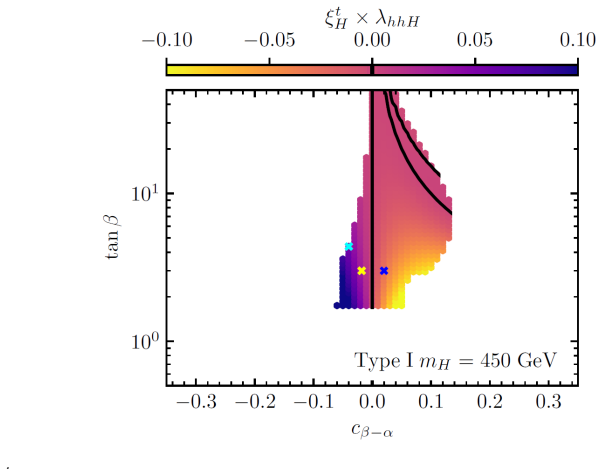
The central claim is that a deliberately simple one-hidden-layer neural network can infer $\xi_H^t \times \lambda_{hhH}$ from the shape of the $m_{hh}$ distribution in $gg\to hh$ production, in a Type I 2HDM benchmark with $m_H=450$ GeV that satisfies theoretical and experimental constraints. The network takes as input the 16 bins of a smeared and binned $m_{hh}$ histogram and outputs the coupling product; during training each input is re-sampled with Poisson noise matching the expected event counts in the $b\bar b\, b\bar b$ channel at 3000 fb$^{-1}$. Compared with maximum-likelihood estimation, the NN gives smaller 95% CL errors, resolves the sign of the product, and can serve simultaneously for hypothesis testing and parameter estimation. The paper reports sensitivity ranges of about $0.045$ for the NN versus about $0.076$--$0.080$ for MLE, and finds that training on additional Poisson smearing of about $2\sigma$ improves robustness. With a hypothetical factor-of-four improvement in experimental efficiencies, the projected precision reaches 10--20%; only statistical uncertainties are included, with systematics left out as beyond the scope.
Load-bearing premise
The load-bearing premise is that systematic uncertainties in the measured invariant-mass spectrum are smaller than the statistical fluctuations; the analysis includes only Poisson statistics and explicitly leaves systematics out because they are harder to estimate, so if real systematics are comparable the 10--20% claim does not follow.
Editorial extensions
If this is right
- If the projection holds, $\xi_H^t\times\lambda_{hhH}$ becomes a measurable target of HL-LHC Higgs-pair programs, not just a model parameter, with 10--20% precision when efficiencies improve by a factor of four.
- The neural network outperforms maximum-likelihood estimation for parameter estimation and matches the classical $p$-value test for hypothesis testing, so a single trained network can replace both steps.
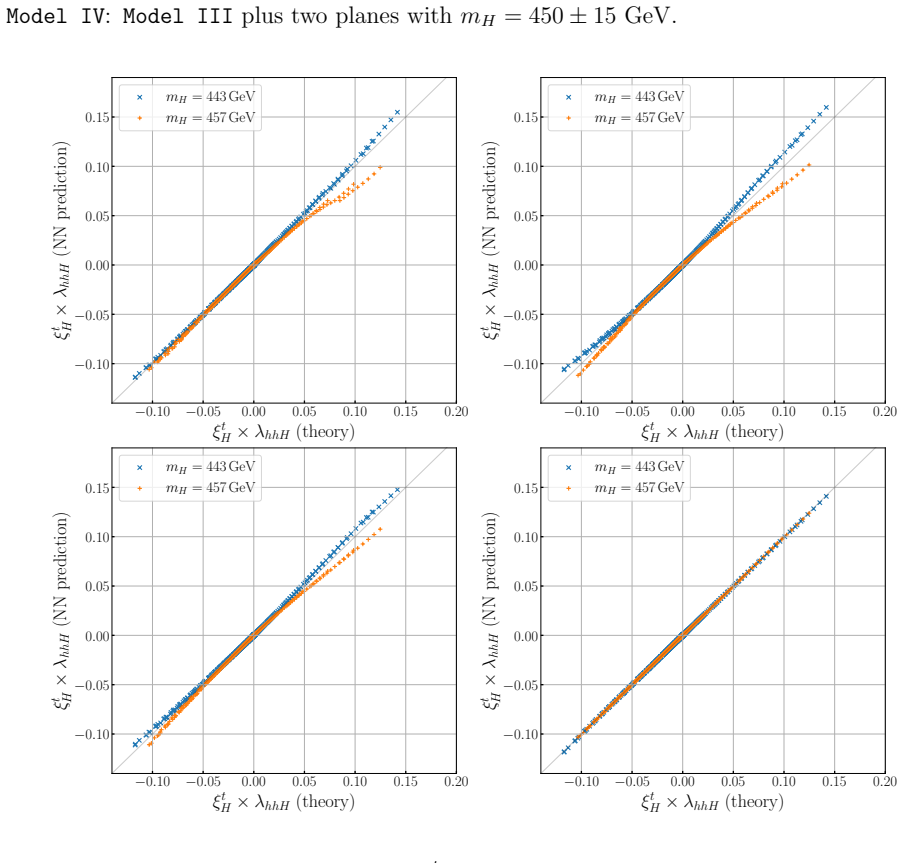
- Uncertainties in $m_H$ and $m_{12}^2$ can be absorbed by training: including $m_H$ values spanning twice the expected measurement uncertainty keeps the prediction accurate, and freeing $m_{12}^2$ can even improve performance.
- The method transfers to any model with a heavy CP-even scalar resonance in $gg\to hh$, since the trained quantity and the mass shape are defined model-independently once the resonance is present.
- Training on data smeared to about $2\sigma$ Poisson fluctuations yields better predictions at 95% CL than training at $1\sigma$, indicating a dedicated noise-augmentation strategy improves the extraction.
Reading between the lines
- A multi-channel extension the paper leaves implicit would feed NN inputs from $b\bar b\gamma\gamma$ and $b\bar b\tau^+\tau^-$ alongside $b\bar b\, b\bar b$; the per-channel statistical dilution suggests a combined network could reach the low end of the 10--20% band or better.
- Because the network resolves the sign of the coupling product, the same regression could be adapted to measure the CP properties of the heavy scalar, since a CP-violating admixture would reshape the interference pattern in $m_{hh}$ in a way a binned likelihood fit would miss.
- A testable generalization is to regress jointly on $m_H$ and $\xi_H^t\times\lambda_{hhH}$ rather than fixing $m_H=450$ GeV, letting the position of the dip-peak structure and its distortion be learned together; this would turn the method into a resonance search and parameter measurement in one step.
Signed reviews
Editorial analysis
A structured set of objections, weighed in public.
Referee Report
Summary. The manuscript presents a machine-learning-based sensitivity study for extracting the product of the heavy-Higgs top-Yukawa coupling modifier and the BSM trilinear coupling, ξ_H^t × λ_hhH, from the invariant mass distribution of gg→hh at the HL-LHC. The study is set in the Type I 2HDM with m_H = 450 GeV, using HPAIR predictions, with 15% Gaussian smearing and 50 GeV binning, and Poisson fluctuations derived from expected b bbar b bbar event counts with ATLAS efficiencies at 3000 fb^-1. A single-hidden-layer neural network is trained on simulated m_hh histograms and compared with maximum-likelihood template estimation and a likelihood-ratio goodness-of-fit test. The authors report that the NN outperforms the classical methods and claim that a 10-20% determination of the coupling product may be achievable by the end of the HL-LHC if efficiencies improve.
Significance. The paper is a useful proof-of-principle: it gives a fully specified benchmark plane with public tools, cross-validated interpolation checks, an explicit comparison metric (AE95), and appendices quantifying grid-size and architecture effects. It is, however, an idealized simulation study rather than a validated experimental projection. The central quantitative claim depends on assumptions—statistical-only uncertainties, specific efficiencies, known m_H, and a single underlying model—that are not tested against independent data. The main value is in demonstrating that a small NN can perform regression on binned m_hh spectra more precisely than a discrete template maximum-likelihood fit, provided the training and test data are generated from the same model.
major comments (4)
- [Sec. 2.6 and Sec. 6] The headline claim of a 10-20% 'experimental determination' is conditional on an uncertainty model that includes only Poisson statistics. Section 2.6 explicitly defers theoretical and systematic uncertainties ('harder to estimate', 'optimistic scenario'), and Section 6 repeats that systematics are beyond scope. The manuscript does not quantify b-tagging efficiency uncertainties, m_hh scale/calibration uncertainties, background contamination, or theory uncertainties on the m_hh template. The precision in Sec. 5.5 therefore follows only if all of these are subdominant, which is an unvalidated external assumption. The title and abstract should be revised to present this as an idealized sensitivity study with explicit caveats, or the systematics must be incorporated.
- [Sec. 4, Sec. 5.1, Sec. 5.3] Training and evaluation are performed on Poisson-smeared distributions generated from the same 2HDM parameter plane (e.g., the 4-fold split in Sec. 5.1 and the 256 test histograms in Sec. 5.3). This is an in-model interpolation check, not a validation against independent data. The paper acknowledges model dependence in Sec. 6, but the abstract's 'Experimental Determination' claim is much stronger than what the setup can establish. A closure test with out-of-model distributions (e.g., an EFT parameterization or a different scalar sector) or a clear statement that the result is only an internal consistency check is needed before the experimental claim can be sustained.
- [Sec. 5.4 and Sec. 5.5] The '10-20% level' precision is never defined quantitatively. The only precision metric, AE95, is an absolute error at 95% CL, and the quoted sensitivity ranges in Eqs. (11)-(13) are absolute thresholds on ξ_H^t × λ_hhH. No relative-error distribution or AE95 divided by |ξ_true| is shown. For the example in Sec. 5.3, the AE95 near ξ ≈ ±0.03-0.05 is comparable to the value itself, which would correspond to 60-100% relative error rather than 10-20%. The improved-efficiency results in Fig. 20 are shown only as scatter/density plots. Please state precisely which interval (e.g., 68% or 95% CL on |pred-θ|/|θ| over a specified θ range) supports the 10-20% claim and give the corresponding numbers.
- [Appendix A] The grid-size check in Table 2 reports deviations Δ of 12%, 8%, and 6% for three points with small ξ, yet the text concludes that the effect is at the 'few percent level'. These deviations are comparable to or larger than the claimed 10-20% precision, and the coarser grid is used throughout. Since the authors themselves interpret the grid coarseness as a source of theoretical uncertainty, this internal check actually weakens the precision claim unless the grid-induced error is included in the reported uncertainty budget.
minor comments (5)
- [Sec. 3, Eq. (8)] The text states that H1 is the full 2HDM prediction including the resonance, but the expression for L(H1) uses the observed counts n_i as the mean (the saturated model). Please reconcile the wording with the formula and justify the number of degrees of freedom used in the χ² approximation.
- [Sec. 2.6, Eq. (7)] The notation σ_i is described as the differential cross section times bin size; please make this explicit in the equation and in the units of N_i.
- [Sec. 3, Fig. 8] The claim that MLE 'manages to determine if ξ ≠ 0' while being unable to predict the sign is not evident from the X-shaped scatter plot; please clarify what property of the plot supports the first part of this statement.
- [Sec. 5.4, Fig. 18] The contours and color coding are difficult to compare; consider adding a legend that lists the AE95 thresholds for each contour line.
- [Throughout] There are minor typos, including 'the a χ2-distributed variable' in Sec. 3, 'T able 2' in the Appendix A header, and inconsistent spacing in reference [29].
Circularity Check
No significant circularity: the NN sensitivity study is an internally validated simulation projection; self-citations are contextual and the 10-20% claim is explicitly conditional on a statistical-only uncertainty model.
full rationale
The NN-analysis chain is not circular. The m_hh templates are produced by HPAIR (external), the allowed parameter plane by thdmTools/HiggsTools (external), and the efficiencies entering Eq. (7) are taken from the ATLAS bbbb analysis [59]. The network is trained on a subset of simulated histograms labeled with xi_H^t * lambda_hhH and evaluated on held-out histograms drawn with fresh Poisson noise; the test performance thus measures the learnability/invertibility of the forward simulation, which is the standard design of a collider sensitivity projection rather than a reduction of the output to the input. The paper does not claim to have used real data, and the '10-20% determination' is explicitly conditional: Sec. 2.6 keeps only statistical uncertainties because theoretical and systematic uncertainties are 'harder to estimate' and 'in an optimistic scenario should be subdominant', and Sec. 6 repeats that systematics are beyond the scope. That is an external-validity caveat, not a circular step. The self-citations [29,35] (overlapping authors) motivate the dip-peak structure and the smearing/binning choices, but the distributions are recomputed in Figs. 3-4, the smearing/binning values are independently attributed to the LHC Higgs working group, and the efficiencies come from ATLAS; hence the self-citations are contextual rather than load-bearing. Overall, no derivation step reduces to its own input by construction, so the correct finding is no significant circularity (band 0-2). The modest score of 2 reflects the presence of minor non-load-bearing self-citations, not a circular reduction.
Assumptions & free parameters
free parameters (7)
- m_H (heavy CP-even Higgs mass) =
450 GeV
- t_beta and c_beta-alpha =
scanned over the allowed benchmark plane
- m2_12 fixing relation =
m2_12 = m_H^2 cos^2(alpha) / t_beta (Eq. 6)
- Detector smearing width =
15%
- Binning size =
50 GeV
- Detector efficiencies =
epsilon_TOT = 17.3%, epsilon_SR = 1%
- NN architecture and training choices =
1 hidden layer, 64 neurons, Adam lr=1e-4, 2^15 epochs
assumptions (5)
- domain assumption The CP-conserving 2HDM Type I with softly broken Z2 symmetry is the correct framework for BSM di-Higgs production at the HL-LHC.
- domain assumption NLO QCD corrections in the heavy-top limit implemented in HPAIR are sufficiently accurate for the m_hh shape.
- standard math Wilks' theorem applies to the Poisson likelihood ratio with the aggregated bins.
- domain assumption Event counts in each m_hh bin follow a Poisson distribution around the theory mean.
- ad hoc to paper The m_hh detector resolution is a Gaussian with 15% width and the bin size is 50 GeV.
Cite this review
Pith. "Pith review of Experimental Determination of BSM Triple Higgs Couplings at the HL-LHC with Neural Networks." pith.science (2026). https://pith.science/paper/DOEN2AYI
@misc{pith2026250618981,
  author       = {Pith},
  title        = {Pith review of: Experimental Determination of BSM Triple Higgs Couplings at the HL-LHC with Neural Networks},
  year         = {2026},
  howpublished = {\url{https://pith.science/paper/DOEN2AYI}},
  note         = {Machine review of arXiv:2506.18981}
}
abstract
The shape of the Higgs potential is modified by the presence of additional scalar fields, as predicted in many Beyond-Standard-Model (BSM) scenarios. In such cases, deviations in the Higgs self-interactions, in particular the trilinear Higgs couplings, could serve to disentangle the physics beyond the Standard Model (SM). While the SM predicts only one trilinear Higgs coupling, extended scalar sectors allow for additional self-interactions that can manifest themselves in Higgs pair production, via the $s$-channel contribution of a heavy $\mathcal{CP}$-even scalar $H$. We present the first sensitivity study to such a BSM trilinear scalar coupling using machine learning. Specifically, we train a neural network on the invariant mass distributions of Higgs pair production at the HL-LHC to extract $\xi_H^t \times \lambda_{hhH}$, i.e. the product of the resonant $H$ top-Yukawa coupling and the trilinear coupling of $H$ to the two SM-like Higgses in the final state, $hh$. Assuming a hypothetical $H$ mass of 450 GeV, we show that, depending on future experimental efficiencies and uncertainties, a determination of $\xi_H^t \times \lambda_{hhH}$ at the 10-20% level may be achievable by the end of the HL-LHC. We present a simple and more efficient alternative to classical statistical methods, proving the efficiency of neural networks for both hypothesis testing and parameter estimation, which outperforms conventional maximum likelihood methods in this context.
Figures


Figures from the paper (19 more)




Forward citations
Cited by 2 Pith papers
-
An analytic result for the $0 \to ggHHH$ amplitude
The authors present the complete leading-order one-loop amplitude for gg to HHH in closed analytic form, with full top and bottom quark mass dependence, validated against two independent numerical programs.
-
Complementarity of gravitational wave analyses and di-Higgs production in the exploration of the Electroweak Phase Transition dynamics in the RxSM
In the real singlet extension of the SM, strong first-order electroweak phase transitions split into singlet-driven transitions (loud in gravitational waves, quiet at colliders) and doublet-driven transitions (visible...
Reference graph
Works this paper leans on
-
[29]
F. Arco, S. Heinemeyer, M. M¨ uhlleitner and K. Radchenko,Sensitivity to triple Higgs couplings via di-Higgs production in the 2HDM at the (HL-)LHC,Eur. Phys. J. C83(2023) 1019 [2212.11242]
arXiv 2023
-
[1]
ATLAScollaboration,Observation of a new particle in the search for the Standard Model Higgs boson with the ATLAS detector at the LHC,Phys. Lett. B716(2012) 1 [1207.7214]. [2]CMScollaboration,Observation of a New Boson at a Mass of 125 GeV with the CMS Experiment at the LHC,Phys. Lett. B716(2012) 30 [1207.7235]. [3]ATLAS, CMScollaboration,Measurements of t...
arXiv 2012
-
[4]
de Blas et al.,Higgs Boson Studies at Future Particle Colliders,JHEP01(2020) 139 [1905.03764]
J. de Blas et al.,Higgs Boson Studies at Future Particle Colliders,JHEP01(2020) 139 [1905.03764]
arXiv 2020
-
[5]
ATLAScollaboration,A detailed map of Higgs boson interactions by the ATLAS experiment ten years after the discovery,Nature607(2022) 52 [2207.00092]
arXiv 2022
-
[6]
CMScollaboration,A portrait of the Higgs boson by the CMS experiment ten years after the discovery., Nature607(2022) 60 [2207.00043]
arXiv 2022
-
[7]
H. Abouabid, A. Arhrib, D. Azevedo, J.E. Falaki, P.M. Ferreira, M. M¨ uhlleitner et al.,Benchmarking di-Higgs production in various extended Higgs sector models,JHEP09(2022) 011 [2112.12515]
arXiv 2022
-
[8]
J.M. Cline and P.-A. Lemieux,Electroweak phase transition in two Higgs doublet models,Phys. Rev. D 55(1997) 3873 [hep-ph/9609240]
arXiv 1997
-
[9]
L. Fromme, S.J. Huber and M. Seniuch,Baryogenesis in the two-Higgs doublet model,JHEP11(2006) 038 [hep-ph/0605242]
arXiv 2006
Show all 59 references
-
[10]
Cline, K
J.M. Cline, K. Kainulainen and M. Trott,Electroweak Baryogenesis in Two Higgs Doublet Models and B meson anomalies,JHEP11(2011) 089 [1107.3559]
2011 arXiv
-
[11]
Dorsch, S.J
G.C. Dorsch, S.J. Huber, T. Konstandin and J.M. No,A Second Higgs Doublet in the Early Universe: Baryogenesis and Gravitational Waves,JCAP05(2017) 052 [1611.05874]
2017 arXiv
-
[12]
Kajantie, M
K. Kajantie, M. Laine, K. Rummukainen and M.E. Shaposhnikov,Is there a hot electroweak phase transition atm H ≳m W ?,Phys. Rev. Lett.77(1996) 2887 [hep-ph/9605288]
1996 arXiv
-
[13]
Dorsch, S.J
G.C. Dorsch, S.J. Huber and J.M. No,A strong electroweak phase transition in the 2HDM after LHC8, JHEP10(2013) 029 [1305.6610]
2013 arXiv
-
[14]
Dorsch, S.J
G.C. Dorsch, S.J. Huber, K. Mimasu and J.M. No,Echoes of the Electroweak Phase Transition: 30 Discovering a second Higgs doublet throughA 0→ZH 0,Phys. Rev. Lett.113(2014) 211802 [1405.5537]
2014 arXiv
-
[15]
Basler, M
P. Basler, M. Krause, M. Muhlleitner, J. Wittbrodt and A. Wlotzka,Strong First Order Electroweak Phase Transition in the CP-Conserving 2HDM Revisited,JHEP02(2017) 121 [1612.04086]
2017 arXiv
-
[16]
Dorsch, S.J
G.C. Dorsch, S.J. Huber, K. Mimasu and J.M. No,The Higgs Vacuum Uplifted: Revisiting the Electroweak Phase Transition with a Second Higgs Doublet,JHEP12(2017) 086 [1705.09186]
2017 arXiv
-
[17]
Basler, M
P. Basler, M. M¨ uhlleitner and J. Wittbrodt,The CP-Violating 2HDM in Light of a Strong First Order Electroweak Phase Transition and Implications for Higgs Pair Production,JHEP03(2018) 061 [1711.04097]
2018 arXiv
-
[18]
Gon¸ calves, A
D. Gon¸ calves, A. Kaladharan and Y. Wu,Electroweak phase transition in the 2HDM: Collider and gravitational wave complementarity,Phys. Rev. D105(2022) 095041 [2108.05356]
2022 arXiv
-
[19]
Biek¨ otter, S
T. Biek¨ otter, S. Heinemeyer, J.M. No, M.O. Olea-Romacho and G. Weiglein,The trap in the early Universe: impact on the interplay between gravitational waves and LHC physics in the 2HDM,JCAP03 (2023) 031 [2208.14466]
2023 arXiv
-
[20]
Caprini et al.,Science with the space-based interferometer eLISA
C. Caprini et al.,Science with the space-based interferometer eLISA. II: Gravitational waves from cosmological phase transitions,JCAP04(2016) 001 [1512.06239]
2016 arXiv
-
[21]
Caprini et al.,Detecting gravitational waves from cosmological phase transitions with LISA: an update,JCAP03(2020) 024 [1910.13125]
C. Caprini et al.,Detecting gravitational waves from cosmological phase transitions with LISA: an update,JCAP03(2020) 024 [1910.13125]. [22]LISA Cosmology Working Groupcollaboration,Gravitational waves from first-order phase transitions in LISA: reconstruction pipeline and phy...
2020 arXiv
-
[23]
Lee,A theory of spontaneous t violation,Phys
T. Lee,A theory of spontaneous t violation,Phys. Rev. D8(1973) 1226
1973
-
[24]
Gunion, H.E
J.F. Gunion, H.E. Haber, G.L. Kane and S. Dawson,The Higgs Hunter’s Guide, vol. 80 (2000)
2000
-
[25]
M. Aoki, S. Kanemura, K. Tsumura and K. Yagyu,Models of Yukawa interaction in the two Higgs doublet model, and their collider phenomenology,Phys. Rev. D80(2009) 015017 [0902.4665]
2009 arXiv
-
[26]
Branco, P.M
G.C. Branco, P.M. Ferreira, L. Lavoura, M.N. Rebelo, M. Sher and J.P. Silva,Theory and phenomenology of two-Higgs-doublet models,Phys. Rept.516(2012) 1 [1106.0034]
2012 arXiv
-
[27]
Plehn, A
T. Plehn, A. Butter, B. Dillon, T. Heimel, C. Krause and R. Winterhalder,Modern Machine Learning for LHC Physicists,2211.01421
-
[28]
Feickert and B
M. Feickert and B. Nachman,A Living Review of Machine Learning for Particle Physics, 2102.02770
-
[30]
Gunion and H.E
J.F. Gunion and H.E. Haber,The CP conserving two Higgs doublet model: The Approach to the decoupling limit,Phys. Rev. D67(2003) 075019 [hep-ph/0207010]
2003 arXiv
-
[31]
Kanemura, S
S. Kanemura, S. Kiyoura, Y. Okada, E. Senaha and C.P. Yuan,New physics effect on the Higgs selfcoupling,Phys. Lett. B558(2003) 157 [hep-ph/0211308]
2003 arXiv
-
[32]
Kanemura, Y
S. Kanemura, Y. Okada, E. Senaha and C.P. Yuan,Higgs coupling constants as a probe of new physics, Phys. Rev. D70(2004) 115002 [hep-ph/0408364]
2004 arXiv
-
[33]
Nhung, M
D.T. Nhung, M. Muhlleitner, J. Streicher and K. Walz,Higher Order Corrections to the Trilinear Higgs Self-Couplings in the Real NMSSM,JHEP11(2013) 181 [1306.3926]
2013 arXiv
-
[34]
Borschensky, T.N
C. Borschensky, T.N. Dao, M. Gabelmann, M. M¨ uhlleitner and H. Rzehak,The trilinear Higgs self-couplings atO(α 2 t )in the CP-violating NMSSM,Eur. Phys. J. C83(2023) 118 [2210.02104]
2023 arXiv
-
[35]
Heinemeyer, M
S. Heinemeyer, M. M¨ uhlleitner, K. Radchenko and G. Weiglein,Higgs Pair Production in the 2HDM: Impact of Loop Corrections to the Trilinear Higgs Couplings and Interference Effects on Experimental Limits,2403.14776
-
[36]
Plehn, M
T. Plehn, M. Spira and P.M. Zerwas,Pair production of neutral Higgs particles in gluon-gluon collisions, Nucl. Phys. B479(1996) 46 [hep-ph/9603205]. 31
1996 arXiv
-
[37]
Dawson, S
S. Dawson, S. Dittmaier and M. Spira,Neutral Higgs boson pair production at hadron colliders: QCD corrections,Phys. Rev. D58(1998) 115012 [hep-ph/9805244]
1998 arXiv
-
[38]
Djouadi, W
A. Djouadi, W. Kilian, M. Muhlleitner and P.M. Zerwas,Production of neutral Higgs boson pairs at LHC,Eur. Phys. J. C10(1999) 45 [hep-ph/9904287]
1999 arXiv
-
[39]
Arhrib, R
A. Arhrib, R. Benbrik, C.-H. Chen, R. Guedes and R. Santos,Double Neutral Higgs production in the Two-Higgs doublet model at the LHC,JHEP08(2009) 035 [0906.0387]
2009 arXiv
-
[40]
Asakawa, D
E. Asakawa, D. Harada, S. Kanemura, Y. Okada and K. Tsumura,Higgs boson pair production in new physics models at hadron, lepton, and photon colliders,Phys. Rev. D82(2010) 115002 [1009.4670]
2010 arXiv
-
[41]
Grober, M
R. Grober, M. Muhlleitner and M. Spira,Higgs Pair Production at NLO QCD for CP-violating Higgs Sectors,Nucl. Phys. B925(2017) 1 [1705.05314]
2017 arXiv
-
[42]
Basler, S
P. Basler, S. Dawson, C. Englert and M. M¨ uhlleitner,Di-Higgs boson peaks and top valleys: Interference effects in Higgs sector extensions,Phys. Rev. D101(2020) 015019 [1909.09987]
2020 arXiv
-
[43]
Baglio, F
J. Baglio, F. Campanario, S. Glaus, M. M¨ uhlleitner, J. Ronca and M. Spira,Full NLO QCD predictions for Higgs-pair production in the 2-Higgs-doublet model,Eur. Phys. J. C83(2023) 826 [2303.05409]
2023 arXiv
-
[44]
Biek¨ otter, S
T. Biek¨ otter, S. Heinemeyer, J.M. No, K. Radchenko, M.O.O. Romacho and G. Weiglein,First shot of the smoking gun: probing the electroweak phase transition in the 2HDM with novel searches for A→ZH inℓ +ℓ−ttandννb bfinal states,JHEP01(2024) 107 [2309.17431]
2024 arXiv
-
[45]
H. Bahl, T. Biek¨ otter, S. Heinemeyer, C. Li, S. Paasch, G. Weiglein et al.,HiggsTools: BSM scalar phenomenology with new versions of HiggsBounds and HiggsSignals,Comput. Phys. Commun.291 (2023) 108803 [2210.09332]
2023 arXiv
-
[46]
Bechtle, O
P. Bechtle, O. Brein, S. Heinemeyer, G. Weiglein and K.E. Williams,HiggsBounds: Confronting Arbitrary Higgs Sectors with Exclusion Bounds from LEP and the Tevatron,Comput. Phys. Commun. 181(2010) 138 [0811.4169]
2010 arXiv
-
[47]
Bechtle, O
P. Bechtle, O. Brein, S. Heinemeyer, G. Weiglein and K.E. Williams,HiggsBounds 2.0.0: Confronting Neutral and Charged Higgs Sector Predictions with Exclusion Bounds from LEP and the Tevatron, Comput. Phys. Commun.182(2011) 2605 [1102.1898]
2011 arXiv
-
[48]
Bechtle, O
P. Bechtle, O. Brein, S. Heinemeyer, O. St˚ al, T. Stefaniak, G. Weiglein et al.,HiggsBounds−4: Improved Tests of Extended Higgs Sectors against Exclusion Bounds from LEP, the Tevatron and the LHC,Eur. Phys. J. C74(2014) 2693 [1311.0055]
2014 arXiv
-
[49]
Bechtle, S
P. Bechtle, S. Heinemeyer, O. Stal, T. Stefaniak and G. Weiglein,Applying Exclusion Likelihoods from LHC Searches to Extended Higgs Sectors,Eur. Phys. J. C75(2015) 421 [1507.06706]
2015 arXiv
-
[50]
Bechtle, D
P. Bechtle, D. Dercks, S. Heinemeyer, T. Klingl, T. Stefaniak, G. Weiglein et al.,HiggsBounds-5: Testing Higgs Sectors in the LHC 13 TeV Era,Eur. Phys. J. C80(2020) 1211 [2006.06007]
2020 arXiv
-
[51]
Bechtle, S
P. Bechtle, S. Heinemeyer, O. St˚ al, T. Stefaniak and G. Weiglein,HiggsSignals : Confronting arbitrary Higgs sectors with measurements at the Tevatron and the LHC,Eur. Phys. J. C74(2014) 2711 [1305.1933]
2014 arXiv
-
[52]
Bechtle, S
P. Bechtle, S. Heinemeyer, O. St˚ al, T. Stefaniak and G. Weiglein,Probing the Standard Model with Higgs signal rates from the Tevatron, the LHC and a future ILC,JHEP11(2014) 039 [1403.1582]
2014 arXiv
-
[53]
Bechtle, S
P. Bechtle, S. Heinemeyer, T. Klingl, T. Stefaniak, G. Weiglein and J. Wittbrodt,HiggsSignals-2: Probing new physics with precision Higgs measurements in the LHC 13 TeV era,Eur. Phys. J. C81 (2021) 145 [2012.09197]
2021 arXiv
-
[54]
F. Arco, S. Heinemeyer and M.J. Herrero,Sensitivity and constraints to the 2HDM soft-breakingZ 2 parameterm 12,Phys. Lett. B835(2022) 137548 [2207.13501]
2022 arXiv
-
[55]
Capozi and G
M. Capozi and G. Heinrich,Exploring anomalous couplings in Higgs boson pair production through shape analysis,JHEP03(2020) 091 [1908.08923]
2020 arXiv
-
[56]
F. Arco, S. Heinemeyer and M.J. Herrero,Sensitivity to triple Higgs couplings via di-Higgs production in the 2HDM ate +e− colliders,Eur. Phys. J. C81(2021) 913 [2106.11105]. 32
2021 arXiv
-
[57]
F. Arco, S. Heinemeyer, M. M¨ uhlleitner, A.P. Arnay, N.R. Gonz´ alez and A.V. Schaeidt,Sensitivity to Triple Higgs Couplings via Di-Higgs Production in the RxSM at the (HL-)LHC and futuree +e− Colliders,2502.03878
-
[58]
F. Arco, S. Heinemeyer and M. M¨ uhlleitner,Large One-Loop Effects of BSM Triple Higgs Couplings on Double Higgs Production ate +e− Colliders,2505.02947
-
[59]
ATLAScollaboration,Search for resonant pair production of Higgs bosons in the b¯bb¯b final state using pp collisions at√s = 13 TeV with the ATLAS detector,Phys. Rev. D105(2022) 092002 [ 2202.07288]
2022 arXiv
-
[60]
H. Bahl, A. Carnelli, F. D´ eliot, E. Fuchs, A. Kotsokechagia, T.L. Marsault et al.,CP -sensitive simplified template cross-sections fort tH,JHEP10(2024) 214 [2406.03950]
2024 arXiv
-
[61]
Paszke, S
A. Paszke, S. Gross, F. Massa, A. Lerer, J. Bradbury, G. Chanan et al.,Pytorch: An imperative style, high-performance deep learning library, 2019
2019
-
[62]
Gennai, S
S. Gennai, S. Heinemeyer, A. Kalinowski, R. Kinnunen, S. Lehti, A. Nikitenko et al.,Search for heavy neutral MSSM Higgs bosons with CMS: Reach and Higgs-mass precision,Eur. Phys. J. C52(2007) 383 [0704.0619]. 33
2007 arXiv
Reviewed August 15, 2026 · model on record in the stance chip above.
Discussion (0). Continue with ORCID to comment.