REVIEW 4 major objections 7 minor 58 references
Spiritual-LLM : Gita Inspired Mental Health Therapy In the Era of LLMs
T0 review · 4 major / 7 minor · reviewed 2026-08-06 · deepseek-v4-flash
Pith's one-line read Fine-tuning a small LLM on Gita-based therapy dialogues substantially improves its fluency, spiritual insight, and relevance scores.
desk verdict The GITes dataset is a genuine new resource for spiritually grounded mental-health dialogue, but the headline spiritual-quality gains are likely an artifact of judges scoring similarity to the very GPT-4o responses the SFT models were trained to imitate. read the letter →
The pith
A machine-rendered reading of the paper's core claim, the machinery that carries it, and where it could break.
The reading
What carries the argument
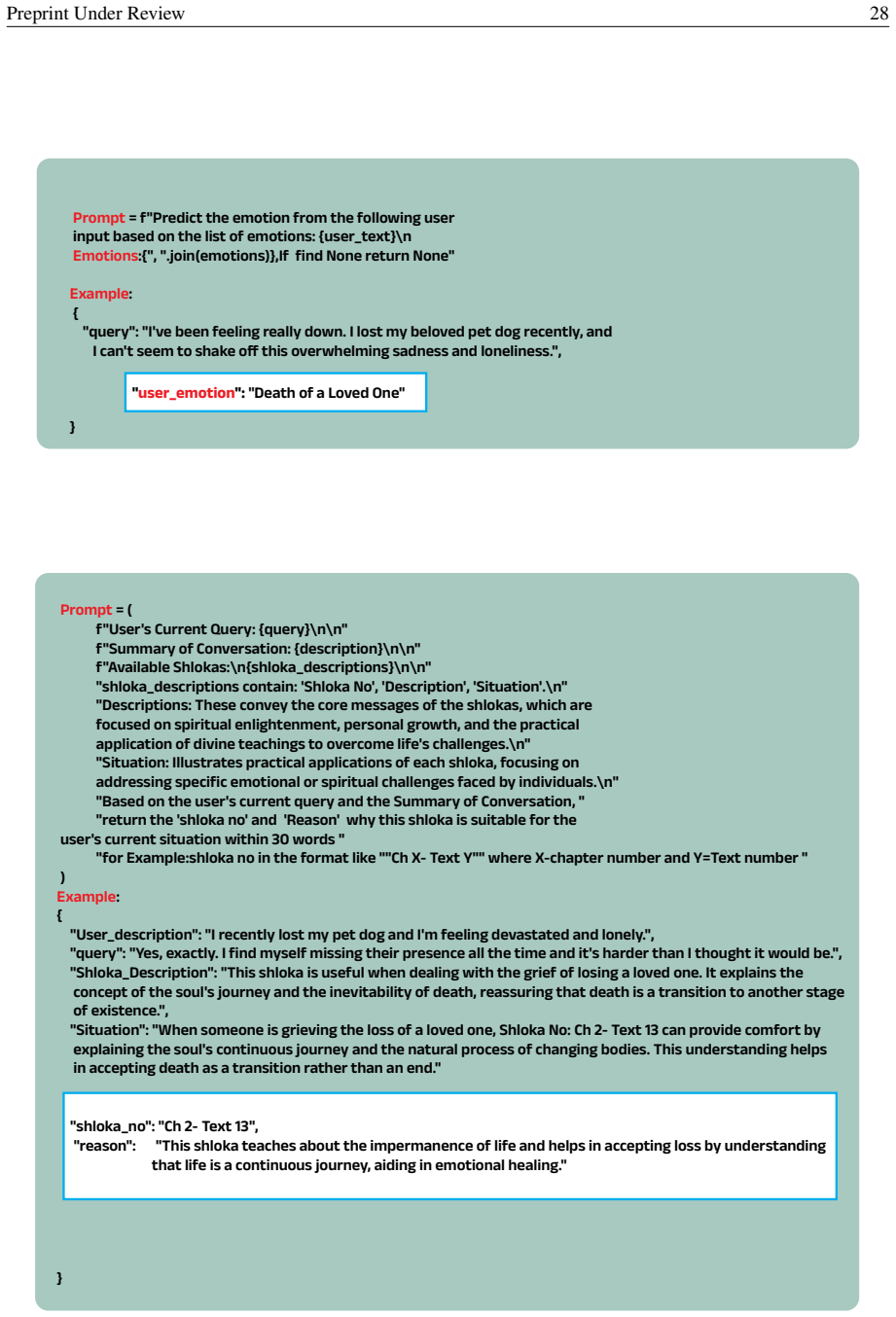
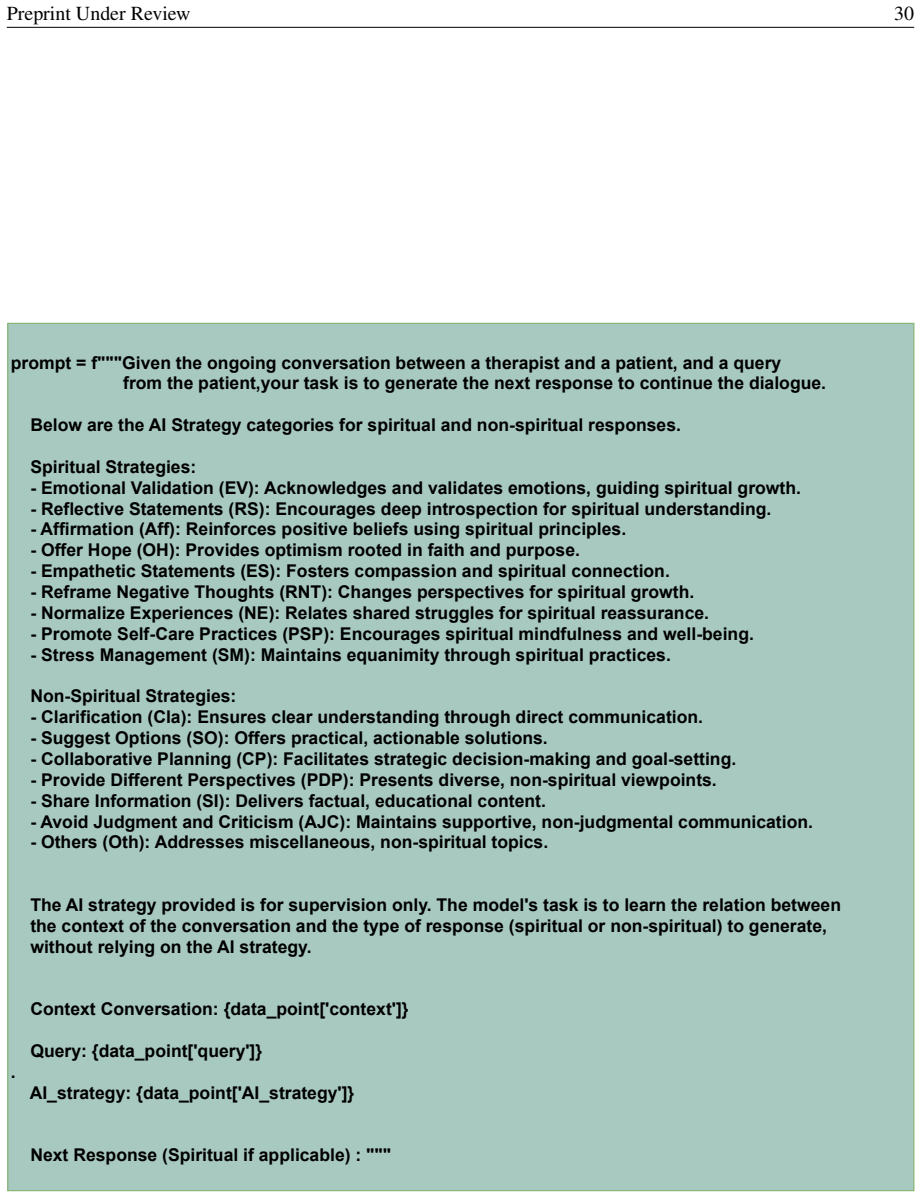
The load-bearing objects are the GITes dataset and the strategy-based spirituality-aware fine-tuning framework. GITes augments the ExTES emotional-support dataset with 10,729 GPT-4o-generated spiritual responses, each built from a Bhagavad Gita shloka and its purport mapped to a user emotion; a preference bit in the training prompt tells the model whether a response should be spiritual or non-spiritual based on the AI strategy, so emotional validation tends to be spiritual while collaborative planning does not. The evaluation machinery is the Spiritual Insight metric and the LLM-as-Jury framework, which averages chain-of-thought ratings from three judge models for insight, sufficiency, and relevance. This machinery is doing the work of turning 'sounds spiritual' into a numeric quantity that can be optimized.
What would settle it
Give a blinded panel of clinicians or trained raters a larger set, say 200 paired zero-shot and fine-tuned responses, and ask them to score spiritual depth and therapeutic quality without knowing which is which. If human scores do not rank the fine-tuned responses higher than chance, or do not correlate with the LLM jury's ratings, then the reported improvements would not be evidence of better therapy.
Extended reading notes
Core claim
The central claim is that spiritual grounding can be treated as a trainable component of mental-health dialogue generation rather than a stylistic afterthought. Using the GITes dataset, the authors show that supervised fine-tuning with a preference signal for spiritual versus non-spiritual responses consistently improves automated spiritual metrics across all 12 models, and that the largest gains appear in a compact instruction-tuned model. The paper proposes Spiritual Insight as a rating for how deeply a response incorporates key Gita teachings, and automates it by averaging chain-of-thought ratings from three judge LLMs. It reports that fine-tuning improves every spiritual metric for the best model and that mental-health-specific models also gain, although Relevance improves for only 5 of 13 models. The paper claims these results indicate strong potential for AI systems enriched with spiritual guidance to improve user satisfaction, while stating that clinical validation in real patient populations remains necessary.
Load-bearing premise
The result depends on the LLM-as-jury ratings being a valid measure of spiritual therapy quality, since the judges come from the same model families being fine-tuned and the only human check used just 10 samples.
Editorial extensions
If this is right
- Compact models can carry the spiritual enhancement: Phi3-Mini's gains show that a 3B-class instruction-tuned model can lead on spiritual metrics after GITes fine-tuning.
- Fine-tuning on GITes yields statistically robust gains over zero-shot prompting across most NLP and spiritual metrics, with bootstrap and permutation tests at the 5% and 1% confidence levels.
- The Spiritual Insight metric extends evaluation beyond n-gram overlap and can be applied automatically at scale through the LLM-as-jury framework.
- Because the dataset includes non-spiritual strategies, models also learn when not to invoke scripture, preserving practical guidance for interview, planning, and other solution-oriented scenarios.
- The dataset pipeline cost roughly $250 in API usage, which suggests the approach is affordable to reproduce.
Reading between the lines
- The authors do not test this, but the same pipeline of authoritative verses, emotion mapping, LLM-generated responses, and expert checks could transfer to other scriptural or contemplative traditions such as the Bible, the Quran, or Buddhist sutras.
- A testable extension is to treat the preference signal as continuous rather than binary, letting a future model match the strength of a user's spiritual orientation instead of always maximizing spirituality.
- Because relevance improved for only 5 of 13 models, spiritual fluency and direct answering may be partly separate skills; a router that decides when a user wants spiritual framing could outperform a single always-spiritual policy.
- A clinical randomized trial comparing GITes-fine-tuned and standard empathetic chatbots on user-reported alliance and retention would be the decisive deployment test for this approach.
Editorial analysis
A structured set of objections, weighed in public.
Referee Report
Summary. The manuscript introduces GITes, a dataset built by augmenting the ExTES emotional-support dialogues with 10,729 GPT-4o-generated responses that draw on Bhagavad Gita shlokas and purport-based guidance, along with 4,849 non-spiritual responses. The authors fine-tune 12 mental-health and general-purpose LLMs on GITes, compare them to zero-shot baselines, and evaluate outputs with standard NLP metrics plus three spiritual metrics (Spiritual Insight, Sufficiency, Relevance) scored by an LLM-as-Jury of LLaMA, Mistral, and DeepSeek judges. They report large gains for Phi3.5-Mini (e.g., 122.71% ROUGE-L, 15.92% Spiritual Insight) and interpret these as evidence that spiritual guidance enhances AI mental-health support. The paper also includes bootstrap/permutation testing, a small human-jury validation, and an explicit limitations section.
Significance. If the reported spiritual-metric gains were valid, the paper would make a useful contribution: a reusable spiritual-support dialogue dataset, a low-cost pipeline (~$250), a demonstration that small instruction-tuned models can be adapted to a culturally specific support domain, and a careful standard-NLP evaluation with bootstrap CIs and permutation tests. Credit is due for the planned release of code/data and for the candid discussion of limitations in Section 9. However, the load-bearing evidence for the spiritual-quality claim is reference-anchored LLM judging with judge-candidate overlap, and the 10-sample human check cannot resolve this. The standard NLP improvements remain credible, but the paper's headline spiritual improvements should not be read as evidence of better spiritual therapy until the evaluation is repaired.
major comments (4)
- [§5.4, Figs. 15–17, Eq. (3)–(5)] The central claim that GITes fine-tuning improves spiritual support quality is not supported by the LLM-as-Jury results as designed. In the Spiritual Insight, Sufficiency, and Relevance prompts (Figures 15–17), the rating anchors for 4 and 5 explicitly define high scores as 'aligns well with the Ground Truth Response' or 'highly aligned with the Ground Truth Response,' and the Ground Truth responses were produced by GPT-4o in Phase 4 (Section 3.4) and used as the SFT training targets in Eq. (3). A model fine-tuned to imitate GPT-4o is therefore rewarded by construction for textual and stylistic proximity to the reference, independent of therapeutic or spiritual merit. Consequently, the abstract's headline spiritual improvements (15.92%, 18.61%, 13.22%) and the spiritual columns of Table 2 are not established as improvements in spiritual quality. A concrete remedy is to re-score with reference-free rubrics, for example by rating the predicted response alone against the Key Teachings List, and to validate against blinded human ratings with per-item agreement.
- [§5.4, §6.2, Table 2] The judge set (LLaMA 3.1 8B, Mistral 7B, DeepSeek-R1-Distill-LLaMA-8B) overlaps with the candidate pool that is fine-tuned and compared in Table 2. This judge–candidate family overlap can inflate scores for fine-tuned instances of the same families; the paper reports only aggregated ratings (Eq. 4) and does not test whether each judge favors its own family. Please either use a held-out judge family or report per-judge ZS-vs-SFT scores and show that the improvements are not driven by self-family bias; Figure 10 currently provides the per-judge data visually but does not analyze this confound. Without this check, the uniform SFT improvement on Spiritual Insight reported in Section 7.2 is exactly the pattern one would expect from imitation of the GPT-4o references.
- [§7.3, Table 3] The human validation is too small and too weakly reported to arbitrate the LLM-as-Jury scores: 10 randomly selected samples, no per-item human–jury correlation, no confidence intervals, and no blinded comparison of SFT versus zero-shot responses. As a result it cannot rule out the reference-anchoring artifact described above. Expanding this study to a few hundred items with item-level agreement and a blinded SFT-vs-ZS preference test is necessary before the spiritual metric gains can be taken at face value. Table 3 also lists 'LLaMA3-3.2B Chat' and 'Phi3-Mini 2.7B Chat' names that do not match the models in Table 2.
- [§3.4, §5.3, abstract] The abstract states that the 10,729 spiritual responses were 'evaluated by domain experts,' but Section 5.3 reports expert evaluation of only 50 randomly sampled ground-truth responses (and 100 shloka mappings), with Cohen's kappa of 0.261 and 0.245, described as fair agreement. The dataset-level claim should be qualified accordingly, and the low kappa values temper the reliability of the GPT-4o ground truth on which both the training targets and the jury evaluation depend.
minor comments (7)
- [§7.1, Table 2] The text says Phi 3.5 Mini achieves a BERT score of 55.938%, while Table 2 reports 88.93%; the text is inconsistent and should be corrected.
- [Table 8] Several confidence intervals are implausible as printed: Mental T5 Relevance has mean difference 0.72 with CI [-0.76, -0.59], and Mental LLaMA Relevance has CI [0.29, -0.13]; please verify the signs and ordering of the interval bounds.
- [Figure 5] The figure labels a metric as 'BLUE' instead of BLEU; this should be fixed.
- [Abstract, §6.2, Tables 2–3] Model naming is inconsistent across the abstract, Section 6.2, Table 2, and Table 3 (e.g., Phi3-Mini 3.2B versus Phi 3.5 Mini 3.82B and 'Phi3-Mini 2.7B'); please standardize the names so results can be reproduced.
- [Eq. (3), §5.4] Equation (3) uses i to index tokens while Section 5.4 uses i to index test samples; different symbols would avoid the collision.
- [§5.2] The claim that cosine similarity over embeddings yields 'uniformly high scores' is stated without supporting numbers; including the failed diagnostic would strengthen the motivation for the LLM-as-Jury framework.
- [Table 2] The superscripts α and β are not fully explained: please clarify whether β is a subset of α and how the 1% versus 5% confidence intervals were computed for the permutation tests.
Circularity Check
Spiritual-metric gains are reference-anchored: SFT models trained on GPT-4o ground truths are rated by judges instructed to reward alignment with those same ground truths.
-
self definitional
[Section 5.4, Figure 15 (Spiritual Insight prompt), with Section 3.4 Phase 4 and Eq. (3)]
"Compare the Predicted Response with the Ground Truth Response to assess alignment and completeness in addressing the spiritual dimension of the User Query. ... -5 (Excellent Insight): The Predicted Response deeply integrates multiple key teachings, is highly aligned with the Ground Truth Response and provides profound spiritual guidance relevant to the User Query."
The Ground Truth Response supplied to the judges is the GPT-4o output generated in Phase 4, and Eq. (3) trains every SFT model to minimize cross-entropy against exactly these R_true_P responses. The rating scale defines the top Spiritual Insight scores as 'highly aligned' or 'aligns well' with that same Ground Truth. A fine-tuned model that imitates its training target therefore receives higher spiritual-metric ratings by construction, regardless of whether the response is therapeutically or spiritually superior. The claimed ZS-vs-SFT gains (15.92% Spiritual Insight, 18.61% Sufficiency, 13.22% Relevance for Phi3-Mini) thus measure reference imitation, not an external spiritual-quality improvement.
-
fitted input called prediction
[Section 4.1, Eq. (3); Section 7.2]
"The training objective is to minimize the cross-entropy loss L between the generated response and the ground truth response. On Spiritual Insight, all models performed better with SFT, underscoring the critical role of the GITes dataset in providing meaningful spiritual context."
The 'spiritual dimensions' learned during SFT are the GPT-4o ground-truth responses from GITes, since Eq. (3) fits the model to the ground truth response. The spiritual evaluation then asks the LLM judges to compare each prediction to that same ground-truth response and reserves the highest ratings for close alignment. Consequently, the observation that all models improve on Spiritual Insight after SFT is a near-tautological outcome of fitting models to the reference the judge uses as its alignment anchor; it does not by itself show that GITes improves spiritual support quality.
full rationale
The dataset construction and standard NLP benchmarks are not circular: GITes is a new resource, and ROUGE/METEOR/BERTScore comparisons follow the usual reference-based protocol. The circularity is concentrated in the paper's novel spiritual-metric evaluation loop. GPT-4o generates the Ground Truth responses in Phase 4; Eq. (3) fine-tunes candidate models to reproduce those exact responses; the LLM-as-Jury prompts (Figures 15-17) then instruct judges to 'Compare the Predicted Response with the Ground Truth Response' and assign top ratings to responses 'highly aligned' or 'aligns well' with that same Ground Truth. Supervised fine-tuning therefore raises Spiritual Insight, Sufficiency, and Relevance by construction: the metric rewards imitation of the training reference. The only human check (Table 3, Section 7.3) uses 10 samples with no per-item human-jury correlation or confidence intervals, so it cannot validate the automated loop. The judge-candidate family overlap (LLaMA 3.1 8B, Mistral 7B, and DeepSeek-R1-Distill-LLaMA-8B serve as judges while the same families are among the 12 fine-tuned models) is an additional confound, though it is not itself a formal identity. No load-bearing self-citation chain was found. Because the paper is transparent about its prompts and explicitly discloses that no patient-facing evaluation was performed, the central derivation is partially circular rather than wholly fabricated: the abstract's headline spiritual improvements should not be read as established evidence of better spiritual support.
Assumptions & free parameters
free parameters (4)
- Spiritual/non-spiritual strategy assignment =
9 spiritual + 7 non-spiritual categories
- Emotion-to-shloka mapping =
20 emotion labels, e.g., Anger -> Ch 2 Text 63; Losing Hope -> 4 shlokas
- LLM-as-Jury judge composition =
LLaMA 3.1 8B, Mistral 7B, DeepSeek-R1-Distill-LLaMA-8B, equal weights
- GPT-4o generation prompts =
4 hand-crafted prompts (Emotion, Mapping, Response, Finetuning)
assumptions (6)
- domain assumption Bhagavad Gita, as interpreted by ISKCON's Prabhupada, offers culturally appropriate and clinically safe mental-health guidance
- domain assumption LLM-as-Jury ratings approximate human judgments of spiritual quality
- ad hoc to paper GPT-4o can reliably map user emotions to shlokas and generate psychotherapy-compatible responses
- domain assumption ExTES dialogues are a valid base for mental-health emotional support
- domain assumption Fine-tuning loss (Eq 3) on imitation targets improves therapeutic quality
- ad hoc to paper Spiritual vs non-spiritual strategy categories are separable and exhaustive
invented entities (1)
-
Spiritual Insight rating rubric
Cite this review
Pith. "Pith review of Spiritual-LLM : Gita Inspired Mental Health Therapy In the Era of LLMs." pith.science (2026). https://pith.science/paper/OVVY6KTM
@misc{pith2026250619185,
  author       = {Pith},
  title        = {Pith review of: Spiritual-LLM : Gita Inspired Mental Health Therapy In the Era of LLMs},
  year         = {2026},
  howpublished = {\url{https://pith.science/paper/OVVY6KTM}},
  note         = {Machine review of arXiv:2506.19185}
}
read the original abstract
Traditional mental health support systems often generate responses based solely on the user's current emotion and situations, resulting in superficial interventions that fail to address deeper emotional needs. This study introduces a novel framework by integrating spiritual wisdom from the Bhagavad Gita with advanced large language model GPT-4o to enhance emotional well-being. We present the GITes (Gita Integrated Therapy for Emotional Support) dataset, which enhances the existing ExTES mental health dataset by including 10,729 spiritually guided responses generated by GPT-4o and evaluated by domain experts. We benchmark GITes against 12 state-of-the-art LLMs, including both mental health specific and general purpose models. To evaluate spiritual relevance in generated responses beyond what conventional n-gram based metrics capture, we propose a novel Spiritual Insight metric and automate assessment via an LLM as jury framework using chain-of-thought prompting. Integrating spiritual guidance into AI driven support enhances both NLP and spiritual metrics for the best performing LLM Phi3-Mini 3.2B Instruct, achieving improvements of 122.71% in ROUGE, 126.53% in METEOR, 8.15% in BERT score, 15.92% in Spiritual Insight, 18.61% in Sufficiency and 13.22% in Relevance compared to its zero-shot counterpart. While these results reflect substantial improvements across automated empathy and spirituality metrics, further validation in real world patient populations remains a necessary step. Our findings indicate a strong potential for AI systems enriched with spiritual guidance to enhance user satisfaction and perceived support outcomes. The code and dataset will be publicly available to advance further research in this emerging area.
Figures


Figures from the paper (18 more)




Reference graph
Works this paper leans on
-
[1]
Alaa A Abd-Alrazaq, Mohannad Alajlani, Nashva Ali, Kerstin Denecke, Bridgette M Bewick, and Mowafa Househ. 2021. Perceptions and opinions of patients about mental health chatbots: scoping review. Journal of medical Internet research, 23(1):e17828
work page 2021
-
[2]
Marah Abdin, Jyoti Aneja, Hany Awadalla, Ahmed Awadallah, Ammar Ahmad Awan, Nguyen Bach, Amit Bahree, Arash Bakhtiari, Jianmin Bao, Harkirat Behl, et al. 2024. Phi-3 technical report: A highly capable language model locally on your phone. arXiv preprint arXiv:2404.14219
arXiv 2024
-
[3]
Josh Achiam, Steven Adler, Sandhini Agarwal, Lama Ahmad, Ilge Akkaya, Florencia Leoni Aleman, Diogo Almeida, Janko Altenschmidt, Sam Altman, Shyamal Anadkat, et al. 2023. Gpt-4 technical report. arXiv preprint arXiv:2303.08774
arXiv 2023
-
[4]
Satanjeev Banerjee and Alon Lavie. 2005. Meteor: An automatic metric for mt evaluation with improved correlation with human judgments. In Proceedings of the acl workshop on intrinsic and extrinsic evaluation measures for machine translation and/or summarization, pages 65--72
2005
-
[5]
Annette J Bouwhuis-Van Keulen, Jurrijn Koelen, Liesbeth Eurelings-Bontekoe, Christien Hoekstra-Oomen, and Gerrit Glas. 2024. The evaluation of religious and spirituality-based therapy compared to standard treatment in mental health care: A multi-level meta-analysis of randomized controlled trials. Psychotherapy Research, 34(3):339--352
work page 2024
-
[6]
Yi Cheng, Wenge Liu, Wenjie Li, Jiashuo Wang, Ruihui Zhao, Bang Liu, Xiaodan Liang, and Yefeng Zheng. 2022. Improving multi-turn emotional support dialogue generation with lookahead strategy planning. arXiv preprint arXiv:2210.04242
arXiv 2022
-
[7]
Avishek Choudhury and Hamid Shamszare. 2023. Investigating the impact of user trust on the adoption and use of chatgpt: survey analysis. Journal of Medical Internet Research, 25:e47184
work page 2023
-
[8]
Yang Deng, Lizi Liao, Liang Chen, Hongru Wang, Wenqiang Lei, and Tat-Seng Chua. 2023. Prompting and evaluating large language models for proactive dialogues: Clarification, target-guided, and non-collaboration. arXiv preprint arXiv:2305.13626
arXiv 2023
Show all 58 references
-
[9]
Megha Dhillon. 2023. Weaving together the ancient and the contemporary: Intersections of the bhagavad gita with modern psychology. Pastoral psychology, 72(4):525--537
2023
-
[11]
Kawin Ethayarajh. 2019. How contextual are contextualized word representations? comparing the geometry of bert, elmo, and gpt-2 embeddings. arXiv preprint arXiv:1909.00512
2019 arXiv
-
[12]
Yu Fil and M Karpitsky. 2021. Vaishnavas of iskcon and the protection of their own identity in the context of the discussions on hinduism. World, (1):103
2021
-
[13]
Tira Nur Fitria. 2023. Artificial intelligence (ai) technology in openai chatgpt application: A review of chatgpt in writing english essay. In ELT Forum: Journal of English Language Teaching, volume 12, pages 44--58
2023
-
[14]
Aaron Grattafiori, Abhimanyu Dubey, Abhinav Jauhri, Abhinav Pandey, Abhishek Kadian, Ahmad Al-Dahle, Aiesha Letman, Akhil Mathur, Alan Schelten, Alex Vaughan, et al. 2024. The llama 3 herd of models. arXiv preprint arXiv:2407.21783
2024 arXiv
-
[15]
MD Romael Haque and Sabirat Rubya. 2023. An overview of chatbot-based mobile mental health apps: insights from app description and user reviews. JMIR mHealth and uHealth, 11(1):e44838
2023
-
[16]
Mahshid Hosseini and Cornelia Caragea. 2021. It takes two to empathize: One to seek and one to provide. In Proceedings of the AAAI conference on artificial intelligence, volume 35, pages 13018--13026
2021
-
[17]
Aaron Hurst, Adam Lerer, Adam P Goucher, Adam Perelman, Aditya Ramesh, Aidan Clark, AJ Ostrow, Akila Welihinda, Alan Hayes, Alec Radford, et al. 2024. Gpt-4o system card. arXiv preprint arXiv:2410.21276
2024 arXiv
-
[18]
Becky Inkster, Shubhankar Sarda, Vinod Subramanian, et al. 2018. An empathy-driven, conversational artificial intelligence agent (wysa) for digital mental well-being: real-world data evaluation mixed-methods study. JMIR mHealth and uHealth, 6(11):e12106
2018
-
[19]
Albert Q Jiang, Alexandre Sablayrolles, Arthur Mensch, Chris Bamford, Devendra Singh Chaplot, Diego de las Casas, Florian Bressand, Gianna Lengyel, Guillaume Lample, Lucile Saulnier, et al. 2023. Mistral 7b. arXiv preprint arXiv:2310.06825
2023 arXiv
-
[20]
Albert Q Jiang, Alexandre Sablayrolles, Antoine Roux, Arthur Mensch, Blanche Savary, Chris Bamford, Devendra Singh Chaplot, Diego de las Casas, Emma Bou Hanna, Florian Bressand, et al. 2024. Mixtral of experts. arXiv preprint arXiv:2401.04088
2024 arXiv
-
[21]
Kim Knott. 2004. Healing the heart of iskcon. Bryant and Ekstrand, eds., The Hare Krishna Movement, 305
2004
-
[22]
Haitao Li, Qian Dong, Junjie Chen, Huixue Su, Yujia Zhou, Qingyao Ai, Ziyi Ye, and Yiqun Liu. 2024. Llms-as-judges: a comprehensive survey on llm-based evaluation methods. arXiv preprint arXiv:2412.05579
2024 arXiv
-
[23]
Lizi Liao, Grace Hui Yang, and Chirag Shah. 2023. Proactive conversational agents in the post-chatgpt world. In Proceedings of the 46th International ACM SIGIR Conference on Research and Development in Information Retrieval, pages 3452--3455
2023
-
[24]
Chin-Yew Lin. 2004. Rouge: A package for automatic evaluation of summaries. In Text summarization branches out, pages 74--81
2004
-
[25]
Aixin Liu, Bei Feng, Bing Xue, Bingxuan Wang, Bochao Wu, Chengda Lu, Chenggang Zhao, Chengqi Deng, Chenyu Zhang, Chong Ruan, et al. 2024. Deepseek-v3 technical report. arXiv preprint arXiv:2412.19437
2024 arXiv
-
[26]
Pengfei Liu, Weizhe Yuan, Jinlan Fu, Zhengbao Jiang, Hiroaki Hayashi, and Graham Neubig. 2023. Pre-train, prompt, and predict: A systematic survey of prompting methods in natural language processing. ACM computing surveys, 55(9):1--35
2023
-
[27]
Siyang Liu, Chujie Zheng, Orianna Demasi, Sahand Sabour, Yu Li, Zhou Yu, Yong Jiang, and Minlie Huang. 2021. Towards emotional support dialog systems. arXiv preprint arXiv:2106.01144
2021 arXiv
-
[28]
Giancarlo Lucchetti, Leonardo Garcia G \'o es, Stefani Garbulio Amaral, Gabriela Terzian Ganadjian, Isabelle Andrade, Paulo Oth \'a vio de Ara \'u jo Almeida, Victor Mendes Do Carmo, and Maria Elisa Gonzalez Manso. 2021. Spirituality, religiosity and the mental health conseque...
2021
-
[29]
Ben Mann, N Ryder, M Subbiah, J Kaplan, P Dhariwal, A Neelakantan, P Shyam, G Sastry, A Askell, S Agarwal, et al. 2020. Language models are few-shot learners. arXiv preprint arXiv:2005.14165, 1
2020 arXiv
-
[30]
Lenin Medeiros and Tibor Bosse. 2018. Using crowdsourcing for the development of online emotional support agents. In Highlights of Practical Applications of Agents, Multi-Agent Systems, and Complexity: The PAAMS Collection: International Workshops of PAAMS 2018, Toledo, Spain,...
2018
-
[31]
Karolína Mladá. 2024. Long-term outcomes in patients with mental illness
2024
-
[32]
Kishore Papineni, Salim Roukos, Todd Ward, and Wei-Jing Zhu. 2002. https://doi.org/10.3115/1073083.1073135 B leu: a method for automatic evaluation of machine translation . In Proceedings of the 40th Annual Meeting of the Association for Computational Linguistics, pages 311--3...
2002
-
[33]
Jaechan Park Jr. 2013. Spritual Growth and Healing Through Monastic Experience: A South Korean Benedictine Exploration of the Monastery Stay Experience. Ph.D. thesis
2013
-
[34]
AC Bhaktivedanta Swami Prabhupada and Bhaktivedanta Swami. 1972. Bhagavad-Gita as it is. Bhaktivedanta Book Trust Los Angeles
1972
-
[35]
Haotong Qin, Xudong Ma, Xingyu Zheng, Xiaoyang Li, Yang Zhang, Shouda Liu, Jie Luo, Xianglong Liu, and Michele Magno. 2024. Accurate lora-finetuning quantization of llms via information retention. arXiv preprint arXiv:2402.05445
2024 arXiv
-
[36]
Nils Reimers and Iryna Gurevych. 2019. Sentence-bert: Sentence embeddings using siamese bert-networks. arXiv preprint arXiv:1908.10084
2019 arXiv
-
[37]
Jonathan Rottenberg and James J Gross. 2007. Emotion and emotion regulation: A map for psychotherapy researchers
2007
-
[38]
Ashish Sharma, Adam S Miner, David C Atkins, and Tim Althoff. 2020. A computational approach to understanding empathy expressed in text-based mental health support. arXiv preprint arXiv:2009.08441
2020 arXiv
-
[39]
Siqi Shen, Charles Welch, Rada Mihalcea, and Ver \'o nica P \'e rez-Rosas. 2020. Counseling-style reflection generation using generative pretrained transformers with augmented context. In Proceedings of the 21th Annual Meeting of the Special Interest Group on Discourse and Dia...
2020
-
[40]
Annalisa Szymanski, Noah Ziems, Heather A Eicher-Miller, Toby Jia-Jun Li, Meng Jiang, and Ronald A Metoyer. 2024. Limitations of the llm-as-a-judge approach for evaluating llm outputs in expert knowledge tasks. arXiv preprint arXiv:2410.20266
2024 arXiv
-
[41]
Aman Singh Thakur, Kartik Choudhary, Venkat Srinik Ramayapally, Sankaran Vaidyanathan, and Dieuwke Hupkes. 2024. Judging the judges: Evaluating alignment and vulnerabilities in llms-as-judges. arXiv preprint arXiv:2406.12624
2024 arXiv
-
[42]
Ithamar Theodor. 2000. A philosophy of social development for iskcon: Perspectives from bhagavad-gita. ISKCON Communications Journal, 8
2000
-
[43]
John Torous, Sandra Bucci, Imogen H Bell, Lars V Kessing, Maria Faurholt-Jepsen, Pauline Whelan, Andre F Carvalho, Matcheri Keshavan, Jake Linardon, and Joseph Firth. 2021. The growing field of digital psychiatry: current evidence and the future of apps, social media, chatbots...
2021
-
[44]
Hugo Touvron, Louis Martin, Kevin Stone, Peter Albert, Amjad Almahairi, Yasmine Babaei, Nikolay Bashlykov, Soumya Batra, Prajjwal Bhargava, Shruti Bhosale, et al. 2023. Llama 2: Open foundation and fine-tuned chat models. arXiv preprint arXiv:2307.09288
2023 arXiv
-
[45]
Aditya Nrusimha Vaidyam, Hannah Wisniewski, John David Halamka, Matcheri S Kashavan, and John Blake Torous. 2019. Chatbots and conversational agents in mental health: a review of the psychiatric landscape. The Canadian Journal of Psychiatry, 64(7):456--464
2019
-
[46]
Cassandra Vieten, Holly K Oxhandler, Michelle Pearce, Nina Fry, Chloe Tanega, and Kenneth Pargament. 2023. Mental health professionals’ perspectives on the relevance of religion and spirituality to mental health care. BMC psychology, 11(1):439
2023
-
[47]
Cassandra Vieten, Shelley Scammell, Ron Pilato, Ingrid Ammondson, Kenneth I Pargament, and David Lukoff. 2013. Spiritual and religious competencies for psychologists. Psychology of Religion and Spirituality, 5(3):129
2013
-
[48]
i'm like a wise little person
Evelyn Wan. 2021. " i'm like a wise little person": Notes on the metal performance of woebot the mental health chatbot. Theatre Journal, 73(3):E--21
2021
-
[49]
Ruiqi Wang, Jiyu Guo, Cuiyun Gao, Guodong Fan, Chun Yong Chong, and Xin Xia. 2025. Can llms replace human evaluators? an empirical study of llm-as-a-judge in software engineering. arXiv preprint arXiv:2502.06193
2025 arXiv
-
[50]
Canwen Xu, Daya Guo, Nan Duan, and Julian McAuley. 2023. Baize: An open-source chat model with parameter-efficient tuning on self-chat data. arXiv preprint arXiv:2304.01196
2023 arXiv
-
[51]
An Yang, Baosong Yang, Binyuan Hui, Bo Zheng, Bowen Yu, Chang Zhou, Chengpeng Li, Chengyuan Li, Dayiheng Liu, Fei Huang, et al. 2024 a . Qwen2 technical report. arXiv preprint arXiv:2407.10671
2024 arXiv
-
[52]
Jingfeng Yang, Hongye Jin, Ruixiang Tang, Xiaotian Han, Qizhang Feng, Haoming Jiang, Shaochen Zhong, Bing Yin, and Xia Hu. 2024 b . Harnessing the power of llms in practice: A survey on chatgpt and beyond. ACM Transactions on Knowledge Discovery from Data, 18(6):1--32
2024
-
[53]
Kailai Yang, Tianlin Zhang, Ziyan Kuang, Qianqian Xie, and Sophia Ananiadou. 2023. Mentalllama: Interpretable mental health analysis on social media with large language models. arXiv preprint arXiv:2309.13567
2023 arXiv
-
[54]
Tianyi Zhang, Varsha Kishore, Felix Wu, Kilian Q Weinberger, and Yoav Artzi. 2019. Bertscore: Evaluating text generation with bert. arXiv preprint arXiv:1904.09675
2019 arXiv
-
[55]
Wayne Xin Zhao, Kun Zhou, Junyi Li, Tianyi Tang, Xiaolei Wang, Yupeng Hou, Yingqian Min, Beichen Zhang, Junjie Zhang, Zican Dong, et al. 2023. A survey of large language models. arXiv preprint arXiv:2303.18223
2023 arXiv
-
[56]
Zhonghua Zheng, Lizi Liao, Yang Deng, and Liqiang Nie. 2023. Building emotional support chatbots in the era of llms. arXiv preprint arXiv:2308.11584
2023 arXiv
-
[57]
Kaitlyn Zhou, Kawin Ethayarajh, Dallas Card, and Dan Jurafsky. 2022. Problems with cosine as a measure of embedding similarity for high frequency words. arXiv preprint arXiv:2205.05092
2022 arXiv
-
[58]
online" 'onlinestring :=
ENTRY address archivePrefix author booktitle chapter edition editor eid eprint eprinttype howpublished institution journal key month note number organization pages publisher school series title type volume year doi pubmed url lastchecked label extra.label sort.label short.list...
-
[59]
write newline
" write newline "" before.all 'output.state := FUNCTION n.dashify 't := "" t empty not t #1 #1 substring "-" = t #1 #2 substring "--" = not "--" * t #2 global.max substring 't := t #1 #1 substring "-" = "-" * t #2 global.max substring 't := while if t #1 #1 substring * t #2 gl...
Reviewed August 6, 2026 · model on record in the stance chip above.
Discussion (0). Sign in to comment.