REVIEW 5 major objections 6 minor 1 cited by
Low-Complexity Semantic Packet Aggregation for Token Communication via Lookahead Search
T0 review · 5 major / 6 minor · reviewed 2026-08-06 · deepseek-v4-flash
Pith's one-line read A lookahead packetizer groups tokens to preserve meaning under erasures, matching brute-force quality at linear cost.
desk verdict Incremental but honest algorithmic contribution; the near-optimality claim is only tested in the easy N=2 regime, so the paper needs a stronger baseline before the headline holds. read the letter →
The pith
A machine-rendered reading of the paper's core claim, the machinery that carries it, and where it could break.
The reading
What carries the argument
The mechanism that carries the argument is the pair (RSS, lookahead search). RSS, $\psi(C,W)=\varphi(W\setminus C,W)$, is a token-level surrogate for the message-level ATS: it requires one text-encoding step per packet rather than $2^N$ per packet group. The lookahead search then prevents greedy early choices by evaluating each candidate packet together with $k$ randomly sampled disjoint packets from the remaining tokens, using the average RSS $\Psi(\tilde{C}_i^{(\ell)},W)$ of candidate plus lookahead packets as the selection score. Sampling candidates with replacement explores diversity; sampling lookahead packets without replacement respects the constraint that packets must form a disjoint partition. The algorithm proceeds level by level until all tokens are assigned, giving linear complexity in the number of packets.
What would settle it
Enumerate every feasible packet group for short captions (e.g., K=8 tokens in M=4 packets), compute the exact ATS of each, and check whether SemPA-Look's chosen group lands in the top decile of the exact-ATS ranking; if a large fraction of captions miss this bar, the surrogate is not faithful to the objective it replaces.
Extended reading notes
Core claim
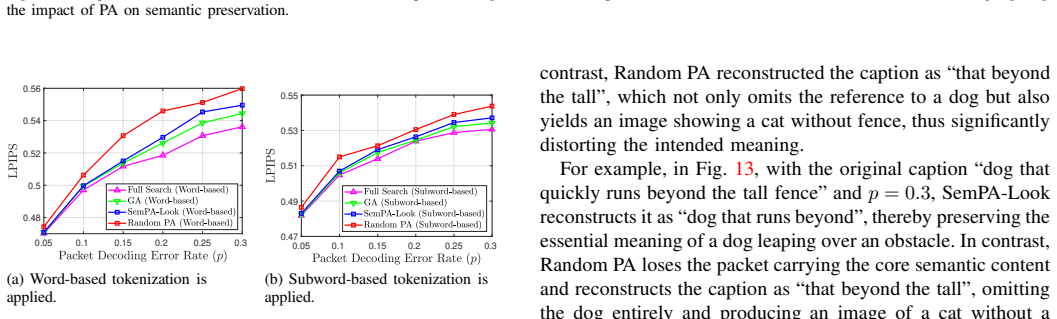
On the paper's own terms, the central discovery is that packet loss resilience in token communication can be cast as a per-packet scoring problem. The residual semantic score $\psi(C,W)=\varphi(W\setminus C,W)$ measures how much of the original message's meaning survives when packet $C$ is erased, and maximizing the average of these scores over the packet group is shown empirically to track the true message-level average token similarity (ATS). Combining this surrogate with a level-wise lookahead search — sample $P$ candidate packets, sample $k$ disjoint future packets from the leftover tokens, average their RSS, pick the best candidate, and repeat — gives a packetization that is near-optimal in ATS and in LPIPS on reconstructed images, while needing only $(N-1)P(k+1)$ text-encoding steps instead of the exponential count of full search.
Load-bearing premise
The argument rests on the premise that the leftover-token similarity score, averaged over a few randomly sampled future packets, faithfully predicts which packet grouping will best preserve meaning under erasures; the paper gives no bound for this approximation.
Editorial extensions
If this is right
- If SemPA-Look is correct, a practical transmitter can packetize text with near-optimal semantic preservation under packet erasure without exhaustive search, making semantic token communication feasible for longer messages.
- The reported 40x complexity reduction over full search and 10x over GA at comparable ATS means the gap between optimality and tractability is much smaller than the exponential worst case suggests.
- RSS-based grouping dominates top-token and random grouping for outage probabilities below roughly 0.6, with an intermediate packet length (M=2 in the experiments) balancing packet loss against semantic loss.
- The caption-to-image experiments imply that packetization choices directly shape downstream generative quality: preserving the RSS-relevant tokens keeps the generated image semantically aligned with the intended caption.
Reading between the lines
- Editorial inference: Because both the search surrogate and the reported ATS use the same CLIP-based similarity function, the method's semantic fidelity is only as good as that encoder's notion of meaning; re-evaluating with an independent text similarity measure or human ratings would test whether the gains generalize.
- Editorial inference: The same candidate-plus-lookahead scoring could be applied to other token-arrangement problems where a combinatorial search is prohibitive, such as ordering tokens under a fixed output budget or choosing which tokens to drop under truncation.
- Editorial inference: The convergence of ATS as lookahead depth k grows suggests an adaptive rule that stops increasing k when the average RSS stabilizes, which could cut the constant factor in the linear complexity further.
Editorial analysis
A structured set of objections, weighed in public.
Referee Report
Summary. The paper studies packetization of text tokens for transmission over a packet erasure channel, aiming to maximize the average token similarity (ATS) between the original and reconstructed token sequences. It formulates an ATS maximization problem P1, replaces it with a surrogate problem P2 based on a residual semantic score ψ(C,W)=φ(W\C,W), and proposes SemPA-Look, a greedy lookahead algorithm that at each level samples candidate packets and k random disjoint future packets, scores them by their average RSS, and selects the best. The paper claims near-optimal ATS and LPIPS relative to exhaustive search at linear complexity, with experiments on MS-COCO and WikiHow, including a text-to-image downstream evaluation.
Significance. If the central claim were established, the work would offer a practical, low-complexity packetizer for semantic token communication, with a transparent complexity metric (number of text-encoding steps) and a channel-aware objective. The paper also includes useful ablations of lookahead depth k, population size P, packet size M, and message length K, and it evaluates downstream AIGC quality with LPIPS. However, the current evidence does not support the headline claim in the N≥3 regime, and the surrogate/lookahead approximations lack formal guarantees and lack systematic validation against an optimal baseline exactly where the heuristic matters. The significance is therefore conditional on closing these gaps.
major comments (5)
- [Section V, Figs. 5 and 14] The only comparisons against Full Search are for K=8, M=4, hence N=2 packets. For N=2, with G={C,W\C}, the ATS is (1−p)^2 φ(W,W) + (1−p)p[ψ(C,W)+ψ(W\C,W)] + p^2 φ(∅,W), so the average RSS objective in P2 is exactly affine in ATS, and the lookahead step has only one feasible future packet. These experiments therefore cannot support the abstract's claim that SemPA-Look is 'comparable to exhaustive search' in the regime where the lookahead heuristic is nontrivial. No optimal or near-optimal reference is provided for the N≥3 experiments in Figs. 8–11, so the headline claim is unvalidated exactly where full search is infeasible.
- [Section IV-A and IV-C, Eqs. (15), (29)] The RSS surrogate ψ(C,W)=φ(W\C,W) and the lookahead average Ψ are introduced as faithful proxies for the contribution of packet C to ATS, but no approximation bound or consistency argument is given. The Taylor derivation in Section IV-B, Eqs. (21)–(25), relates the sum of all packet RSSs to ATS only in the low-p limit and only for the full group; it does not justify the greedy per-level maximization of (29) nor the use of k randomly sampled future packets. The choice of RSS over TSS is supported only by a single-sentence example (Table II) and Fig. 2. As a result, the core mechanism of the algorithm is a heuristic whose failure modes are not characterized.
- [Section III-A] The statement that P1 is NP-hard is asserted without a reduction. The enumeration count K!/((M!)^N N!) shows only that full search is expensive, not that the problem is NP-hard. Either provide a reduction from a known NP-hard problem (for example, from a clustering or partitioning problem with a suitable embedding φ) or explicitly soften the claim to 'computationally intractable by enumeration.'
- [Algorithm 1, lines 2–6, and Eq. (28)] RandomDisjoint(L_i, M, k) is specified for a fixed k, but when the leftover set L_i is too small to support k disjoint packets of size M, the sampling is infeasible. The caption of Fig. 8 acknowledges that the feasible step size decreases with level, but the pseudocode and the complexity formula do not include the cap k ← min(k, floor(|L_i|/M)). Without this cap, the algorithm as written is underspecified.
- [Table III and Fig. 12] The reported complexity of SemPA-Look is (N−1)·P·(k+1), but Algorithm 1 runs N levels, so the correct count is N·P·(k+1); the numerical speedup in Fig. 12 appears to use the N·P·(k+1) count rather than the table's formula. In addition, the 'full search' complexity of 2^K in Table III is inconsistent with Section III-A, which gives the number of feasible groups as K!/((M!)^N N!) and 2^N encodings per group; the table's 2^K understates full search for N>2 (e.g., at K=14, M=2, N=7, 2^14 versus 135,135×128). The complexity comparison underlying the speedup claims should be corrected.
minor comments (6)
- [Section I-A] The sentence beginning 'Compared to these lookahead applications, rather N (theookahead searches...' is garbled and should be rewritten.
- [Section V, Fig. 13 discussion] The paragraph 'For example, in Fig. 13...' is repeated verbatim; remove the duplicate.
- [Section II-B, Eq. (2)] φ(·,·) is defined for encoded text x and y but subsequently used with set arguments such as F(G) and W; the paper should clarify how token order is handled when computing φ on unordered sets.
- [Algorithm 1] The text says candidate packets are sampled 'with replacement' while line 3 samples from L(ℓ); clarify whether duplicate candidate packets are allowed and how this relates to the statement about 'sampling with replacement for candidate tuples generation.'
- [Table III and Section IV-C] The claimed linear complexity is in N for a fixed packet size M; since N=K/M, the dependence on K should be stated explicitly as linear in K only when M is fixed.
- [Minor typos] Please fix 'unreplacement' (should be 'without replacement') in Section IV-C and 'between between' in the caption of Fig. 14.
Circularity Check
No significant circularity: the RSS surrogate and lookahead criterion are approximations of the ATS objective, not restatements of it, and the cited prior work by the authors is used only as baselines and motivation.
full rationale
SemPA-Look's derivation chain is self-contained. The ATS objective in Eq. (6) is a distinct expectation over all received subsets, whereas the RSS surrogate in Eq. (15), ψ(Ci,W)=φ(W\Ci,W), is obtained from a Taylor expansion of ATS in the low-p regime (Eqs. (21)-(25)); the RSS is not definitionally equal to the ATS and is evaluated against the original ATS and LPIPS metrics. The lookahead criterion Ψ in Eq. (29) averages RSS values of sampled future packets, which is a heuristic approximation to P2 in Eq. (13a), not a fitted parameter presented as a prediction. The complexity count (N−1)·P·(k+1) in Table III follows directly from Algorithm 1's loop structure and is a plain count of text-encoding steps, not a circular argument. Citations [19] and [28] are prior works by the same authors, but they appear as baseline methods and motivation only; no uniqueness theorem or hidden ansatz is imported from them, and the reported comparisons against full search, GA, Random PA, and no-packetization baselines provide independent evidence. The main caveat is that the exhaustive full-search comparison is limited to K=8, M=4 (N=2), so 'comparable to exhaustive search' for larger N is not empirically established; that is a validation gap, not circularity.
Assumptions & free parameters
free parameters (3)
- lookahead depth k =
4 in most experiments; swept upward in Fig. 8
- candidate population size P =
10 in most experiments; up to 130 in Fig. 9
- packet size M =
Explored over 1, 2, 3, 4, 6, 12; peak ATS at M=2 for p=0.25
assumptions (5)
- domain assumption Packets are erased independently with probability p, and a lost packet contributes no tokens (Eq. 1).
- domain assumption Cosine similarity of CLIP text embeddings is a valid measure of semantic fidelity (Eq. 2).
- ad hoc to paper RSS psi(C,W)=phi(W\C,W) faithfully approximates a packet's contribution to the ATS objective (Eq. 15).
- ad hoc to paper Random disjoint lookahead packets drawn from leftover tokens approximate optimal future packet choices (Eqs. 28-29).
- ad hoc to paper P1 is NP-hard (Section III-A).
Cite this review
Pith. "Pith review of Low-Complexity Semantic Packet Aggregation for Token Communication via Lookahead Search." pith.science (2026). https://pith.science/paper/CFHYGM5A
@misc{pith2026250619451,
  author       = {Pith},
  title        = {Pith review of: Low-Complexity Semantic Packet Aggregation for Token Communication via Lookahead Search},
  year         = {2026},
  howpublished = {\url{https://pith.science/paper/CFHYGM5A}},
  note         = {Machine review of arXiv:2506.19451}
}
abstract
Tokens are fundamental processing units of generative AI (GenAI) and large language models (LLMs), and token communication (TC) is essential for enabling remote AI-generate content (AIGC) and wireless LLM applications. Unlike traditional bits, each of which is independently treated, the semantics of each token depends on its surrounding context tokens. This inter-token dependency makes TC vulnerable to outage channels, where the loss of a single token can significantly distort the original message semantics. Motivated by this, this paper focuses on optimizing token packetization to maximize the average token similarity (ATS) between the original and received token messages under outage channels. Due to inter-token dependency, this token grouping problem is combinatorial, with complexity growing exponentially with message length. To address this, we propose a novel framework of semantic packet aggregation with lookahead search (SemPA-Look), built on two core ideas. First, it introduces the residual semantic score (RSS) as a token-level surrogate for the message-level ATS, allowing robust semantic preservation even when a certain token packet is lost. Second, instead of full search, SemPA-Look applies a lookahead search-inspired algorithm that samples intra-packet token candidates without replacement (fixed depth), conditioned on inter-packet token candidates sampled with replacement (fixed width), thereby achieving linear complexity. Experiments on a remote AIGC task with the MS-COCO dataset (text captioned images) demonstrate that SemPA-Look achieves high ATS and LPIPS scores comparable to exhaustive search, while reducing computational complexity by up to 40$\times$. Compared to other linear-complexity algorithms such as the genetic algorithm (GA), SemPA-Look achieves 10$\times$ lower complexity, demonstrating its practicality for remote AIGC and other TC applications.
Figures


Figures from the paper (8 more)


Forward citations
Cited by 1 Pith paper
-
Geometric Cross-Modal Token Selection for Latency-Constrained Multimodal Token Communication
Selecting tokens that lie inside multiple anchor-centric semantic grain regions improves multimodal VQA/AVQA accuracy under latency and erasure constraints compared with pairwise attention-based selection.
Reference graph
Works this paper leans on
-
[1]
Beyond transmitting bits: Context, s emantics, and task-oriented communications,
D. G¨ und¨ uz, Z. Qin, I. E. Aguerri, H. S. Dhillon, Z. Y ang, A. Y ener, K. K. Wong, and C.-B. Chae, “Beyond transmitting bits: Context, s emantics, and task-oriented communications,” IEEE Journal on Selected Areas in Communications, vol. 41, no. 1, pp. 5–41, Jan. 2023
work page 2023
-
[2]
Less data, more knowledge: Building next-generation semantic c ommunication networks,
C. Chaccour, W. Saad, M. Debbah, Z. Han, and H. Vincent Poo r, “Less data, more knowledge: Building next-generation semantic c ommunication networks,” IEEE Commun. Surveys Tuts , vol. 27, no. 1, pp. 37–76, Feb. 2025
work page 2025
-
[3]
Unleashing the power of edge-cloud generative ai in mobile networks: A survey of AIGC services,
M. Xu, H. Du, D. Niyato et al. , “Unleashing the power of edge-cloud generative ai in mobile networks: A survey of AIGC services, ” IEEE Commun. Surv. Tutor ., vol. 26, no. 2, pp. 1127–1170, 2024
work page 2024
-
[4]
Uncertainty-aware hybrid inference with on-devic e small and remote large language models,
S. Oh, J. Kim, J. Park, S.-W. Ko, T. Q. S. Quek, and S.- L. Kim, “Uncertainty-aware hybrid inference with on-devic e small and remote large language models,” 2025. [Online]. Availab le: https://arxiv.org/abs/2412.12687
arXiv 2025
-
[5]
Token communications: A unified framework fo r cross-modal context-aware semantic communications,
L. Qiao, M. B. Mashhadi, Z. Gao, R. Tafazolli, M. Bennis, and D. Niyato, “Token communications: A unified framework fo r cross-modal context-aware semantic communications,” 202 5. [Online]. Available: https://arxiv.org/abs/2502.12096
-
[6]
Generative AI for semantic communication: Architecture, challenges, and outlook,
L. Xia, Y . Sun, C. Liang, L. Zhang, M. A. Imran, and D. Niyat o, “Generative AI for semantic communication: Architecture, challenges, and outlook,” IEEE Wireless Communications , vol. 32, no. 1, pp. 132– 140, Feb. 2025
work page 2025
-
[7]
Generative ai-driven semantic communication networks: A rchitecture, technologies, and applications,
C. Liang, H. Du, Y . Sun, D. Niyato, J. Kang, D. Zhao, and M. A . Imran, “Generative ai-driven semantic communication networks: A rchitecture, technologies, and applications,” IEEE Transactions on Cognitive Com- munications and Networking , vol. 11, no. 1, pp. 27–47, 2025
work page 2025
-
[8]
H. Nam, J. Park, J. Choi, M. Bennis, and S.-L. Kim, “Langua ge-oriented communication with semantic coding and knowledge distilla tion for text- to-image generation,” in ICASSP 2024 , 2024, pp. 13 506–13 510
work page 2024
Show all 36 references
-
[9]
Semantic importance -aware communications using pre-trained language models,
S. Guo, Y . Wang, S. Li, and N. Saeed, “Semantic importance -aware communications using pre-trained language models,” IEEE Commun. Lett., vol. 27, no. 9, pp. 2328–2332, 2023
2023
-
[10]
Semantic impo rtance- aware communications with semantic correction using large language models,
S. Guo, Y . Wang, J. Y e, A. Zhang, and K. Xu, “Semantic impo rtance- aware communications with semantic correction using large language models,” 2024. [Online]. Available: https://arxiv.org/abs/2405.16011
2024 arXiv
-
[11]
Language-oriented semantic latent representa tion for image transmission,
G. Cicchetti, E. Grassucci, J. Park, J. Choi, S. Barbaro ssa, and D. Com- miniello, “Language-oriented semantic latent representa tion for image transmission,” 2024
2024
-
[12]
Resource all ocation for text semantic communications,
L. Y an, Z. Qin, R. Zhang, Y . Li, and G. Y . Li, “Resource all ocation for text semantic communications,” IEEE Wireless Commun. Lett. , vol. 11, no. 7, pp. 1394–1398, 2022
2022
-
[13]
Heterogeneous s emantic and bit communications: A semi-NOMA scheme,
X. Mu, Y . Liu, L. Guo, and N. Al-Dhahir, “Heterogeneous s emantic and bit communications: A semi-NOMA scheme,” IEEE J. Sel. Areas Commun., vol. 41, no. 1, pp. 155–169, 2023
2023
-
[14]
Cove rt communications for text semantic with finite blocklength,
J. Hu, L. Y e, Y . Chen, X. Zhang, J. Wang, and Z. Chen, “Cove rt communications for text semantic with finite blocklength,” IEEE Wireless Commun. Lett. , pp. 1–1, 2024
2024
-
[15]
A robust deep learning enabled semantic communication syste m for text,
X. Peng, Z. Qin, D. Huang, X. Tao, J. Lu, G. Liu, and C. Pan, “A robust deep learning enabled semantic communication syste m for text,” in GLOBECOM 2022 - 2022 IEEE Global Communications Conference , 2022, pp. 2704–2709
2022
-
[16]
Network coding for the internet and wireless networks,
P . A. Chou and Y . Wu, “Network coding for the internet and wireless networks,” IEEE Signal Processing Magazine , vol. 24, no. 5, pp. 77–85, 2007
2007
-
[17]
Network coding meets TCP: Theory and impleme ntation,
J. K. Sundararajan, D. Shah, M. M´ edard, S. Jakubczak, M . Mitzenmacher, and J. Barros, “Network coding meets TCP: Theory and impleme ntation,” Proceedings of the IEEE , vol. 99, no. 3, pp. 490–512, 2011
2011
-
[18]
Medard and A
M. Medard and A. Sprintson, Network Coding: Fundamentals and Applications . Elsevier Science, 2012. [Online]. Available: https://books.google.com.au/books?id=yGqtA9Mv TgC
2012
-
[19]
Semantic packet ag gregation and repeated transmission for text-to-image generation,
S. Lee, J. Park, J. Choi, and H. Park, “Semantic packet ag gregation and repeated transmission for text-to-image generation,” (to be presented at ICC 2025), 2025. [Online]. Available: https://arxiv.org/abs/2503.23734
2025 arXiv
-
[20]
Scaling LLM test-t ime compute optimally can be more effective than scaling model paramete rs,
C. Snell, J. Lee, K. Xu, and A. Kumar, “Scaling LLM test-t ime compute optimally can be more effective than scaling model paramete rs,” 2024. [Online]. Available: https://arxiv.org/abs/2408.03314
2024 arXiv
-
[21]
Lookahead Strategies for Sequential Monte Carlo,
M. Lin, R. Chen, and J. S. Liu, “Lookahead Strategies for Sequential Monte Carlo,” Statistical Science , vol. 28, no. 1, pp. 69 – 94, 2013. [Online]. Available: https://doi.org/10.1214/12-STS401
2013 doi
-
[22]
Lookahead optimizer: k steps forward, 1 step back,
M. Zhang, J. Lucas, J. Ba, and G. E. Hinton, “Lookahead optimizer: k steps forward, 1 step back,” in Advances in Neural Information Processing Systems , H. Wallach, H. Larochelle, A. Beygelzimer, F. d'Alch´ e-Buc, E. Fox, and R. Garnett, Eds., vol. 32. Curran Associates, Inc.,...
2019
-
[23]
Token- domain multiple access: Exploiting semantic orthogonalit y for collision mitigation,
L. Qiao, M. B. Mashhadi, Z. Gao, and D. G¨ und¨ uz, “Token- domain multiple access: Exploiting semantic orthogonalit y for collision mitigation,” 2025. [Online]. Available: https://arxiv.org/abs/2502.06118
2025 arXiv
-
[24]
Adaptive semantic token communication for transformer-b ased edge inference,
A. Devoto, J. Pomponi, M. Merluzzi, P . D. Lorenzo, and S. Scardapane, “Adaptive semantic token communication for transformer-b ased edge inference,” 2025. [Online]. Available: https://arxiv.org/abs/2505.17604
2025 arXiv
-
[25]
Deep learning e nabled seman- tic communication systems,
H. Xie, Z. Qin, G. Y . Li, and B.-H. Juang, “Deep learning e nabled seman- tic communication systems,” IEEE Transactions on Signal Processing , vol. 69, pp. 2663–2675, 2021
2021
-
[26]
Synchronous multi- modal semantic communication system with packet-level cod ing,
Y . Tian, J. Ying, Z. Qin, Y . Jin, and X. Tao, “Synchronous multi- modal semantic communication system with packet-level cod ing,” IEEE Transactions on Wireless Communications, vol. 24, no. 5, pp. 3684–3697, May 2025
2025
-
[27]
Lightweight semantic-aw are commu- nication with packet transmission,
B. Dong, B. Cao, and Q. Zhang, “Lightweight semantic-aw are commu- nication with packet transmission,” IEEE Commun. Lett. , pp. 1–1, May 2025
2025
-
[28]
Semantic packet aggregation for token communication via genetic beam searc h,
S. Lee, J. Park, J. Choi, and H. Park, “Semantic packet aggregation for token communication via genetic beam searc h,” (to be presented at SPAWC 2025), 2025. [Online]. Available: https://arxiv.org/abs/2504.19591
2025 arXiv
-
[29]
Neural machine tr anslation of rare words with subword units,
R. Sennrich, B. Haddow, and A. Birch, “Neural machine tr anslation of rare words with subword units,” 2016. [Online]. Availabl e: https://arxiv.org/abs/1508.07909
2016 arXiv
-
[30]
BERT: Pre- training of deep bidirectional transformers for language u nderstanding,
J. Devlin, M.-W. Chang, K. Lee, and K. Toutanova, “BERT: Pre- training of deep bidirectional transformers for language u nderstanding,” in Proceedings of the 2019 conference of the North American cha pter of the association for computational linguistics: human languag e techno...
2019
-
[31]
Learning transferable visual models from natural language supervision,
A. Radford, J. W. Kim, C. Hallacy et al. , “Learning transferable visual models from natural language supervision,” in International conference on machine learning . PMLR, 2021, pp. 8748–8763
2021
-
[32]
K. R. Fall and W. R. Stevens, TCP/IP illustrated . Addison-Wesley Professional, 2012, vol. 1
2012
-
[33]
A review on genet ic algorithm: past, present, and future,
S. Katoch, S. S. Chauhan, and V . Kumar, “A review on genet ic algorithm: past, present, and future,” Multimedia tools and applications , vol. 80, pp. 8091–8126, 2021
2021
-
[34]
Microsoft COCO: Common objects in context,
T.-Y . Lin, M. Maire, S. Belongie et al. , “Microsoft COCO: Common objects in context,” in Proc. ECCV , Zurich, Switzerland, Sep. , 2014
2014
-
[35]
Wikihow: A large scale text su mmarization dataset,
M. Koupaee and W. Y . Wang, “Wikihow: A large scale text su mmarization dataset,” 2018. [Online]. Available: https://arxiv.org/abs/1810.09305
2018 arXiv
-
[36]
High- resolution image synthesis with latent diffusion models,
R. Rombach, A. Blattmann, D. Lorenz, P . Esser, and B. Omm er, “High- resolution image synthesis with latent diffusion models,” in Proceedings of the IEEE/CVF conference on computer vision and pattern re cognition, 2022, pp. 10 684–10 695
2022
Reviewed August 6, 2026 · model on record in the stance chip above.
Discussion (0). Sign in to comment.