REVIEW 4 major objections 6 minor 56 references
Training Flexible Models of Genetic Variant Effects from Functional Annotations using Accelerated Linear Algebra
T0 review · 4 major / 6 minor · reviewed 2026-08-06 · deepseek-v4-flash
Pith's one-line read DeepWAS trains large neural-network priors for variant effects by maximizing the full likelihood, and shows that bigger models improve held-out predictions only under this objective.
desk verdict Solid computational contribution held back by an overclaimed headline result that its own Figure 5 does not support. read the letter →
The pith
A machine-rendered reading of the paper's core claim, the machinery that carries it, and where it could break.
The reading
What carries the argument
Two mechanisms carry the argument. First, the genome is divided into roughly 2700 windows of one million base pairs, and the linkage disequilibrium matrix $R$ is treated as banded, so associations in different windows are approximately independent and each window becomes a mini-batch for stochastic gradient descent. Second, the Woodbury identity and the matrix determinant lemma convert the expensive inverse and log-determinant of $A^{(i)}_\theta = R^{(i),(i)+}F_\theta R^{(i)+,(i)} + \sigma_N^2 R^{(i),(i)}$ into operations on the strictly positive definite and well-conditioned matrix $B^{(i)}_\theta = I + \sigma_N^{-2} F_\theta^{(i)1/2} W^{(i)} F_\theta^{(i)1/2}$, with $W^{(i)}$ and related factors precomputed before training because they do not depend on $\theta$. The paper then uses conjugate gradients for solves and stochastic Lanczos quadrature for log-determinants, both of which converge quickly for well-conditioned matrices, and this is what makes a 52-million-parameter model trainable in about 15 to 20 hours on a single GPU.
What would settle it
Train DeepWAS on the same trait twice, once with the standard one-megabase window and once with the window doubled in size; if the held-out likelihood keeps rising and the ranking of model sizes changes, the banded window-independence assumption is doing the work and should be checked against full-LD training on a genomic region known to have long-range correlation.
Extended reading notes
Core claim
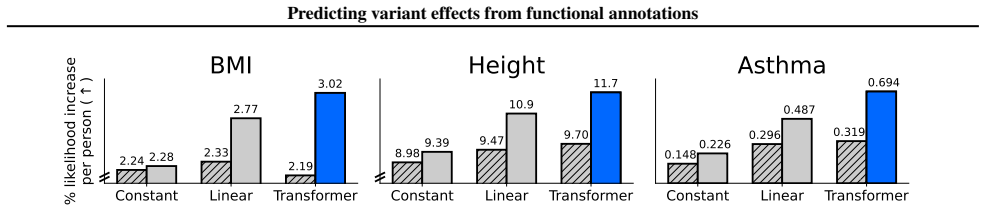
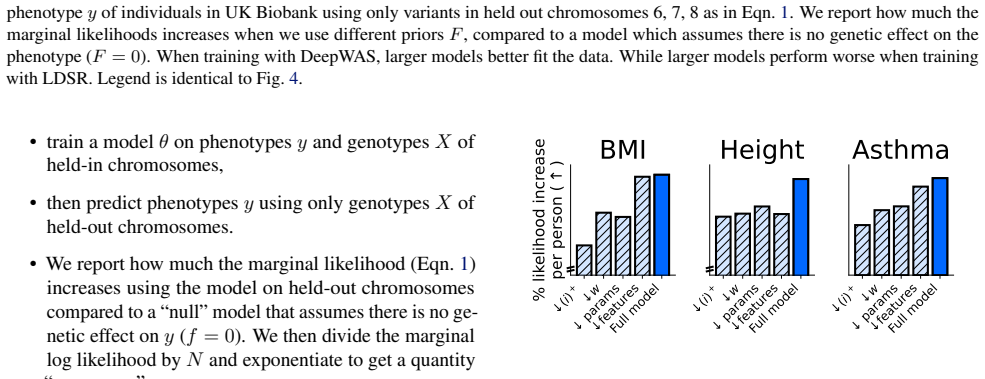
DeepWAS trains a model $f_\theta$ that maps functional annotations around a variant to its prior variance $f_{\theta,m}$, embedded in the hierarchical model $y \sim \mathcal{N}(0, X^\top F X + \sigma^2 I)$, or in public statistics $\hat\beta \sim \mathcal{N}(0, R F R + \sigma_N^2 R)$. The central finding is that larger models only improve performance when $\theta$ is learned by maximizing this marginal likelihood; when the same capacity is trained by fitting LD score regression summary statistics, larger models perform no better than small ones, and worse for BMI. On held-out chromosomes 6 through 8, the 52-million-parameter transformer prior trained with DeepWAS yields larger likelihood increases per person than constant or linear priors for all three traits, and ablations confirm that larger LD windows, more features, and more parameters each help. In semi-synthetic data with a known ground-truth prior, the full-likelihood objective recovers the true $f$ closely.
Load-bearing premise
The argument rests on the assumption that associations in different one-megabase windows are statistically independent, which holds only if variants separated by more than about a million base pairs have negligible correlation.
Editorial extensions
If this is right
- Full-likelihood training is what lets larger capacity help: under summary-statistic fitting, bigger models overfit and predict no better than small ones.
- Held-out chromosome likelihoods for BMI, height, and asthma all improve when the LD window, feature window, and hidden dimension are enlarged, so further scaling of each should continue to improve variant-effect prediction.
- In semi-synthetic experiments, the full-likelihood objective recovers a known ground-truth variant-effect function, indicating that the trained prior is identifiable and not merely a better fit to noise.
- Because the trained prior is a drop-in component, it can replace the priors used in existing fine-mapping, causal-variant, and gene-prioritization pipelines.
Reading between the lines
- An implication the paper leaves implicit: LD score regression is the window-size-one extreme of the DeepWAS objective, so comparing the two across intermediate window sizes would isolate how much of the gain comes from modelling correlation rather than from the network architecture.
- The same Woodbury-style reformulation should transfer to other Bayesian regression models with diagonal priors, including mixture or non-normal priors, so the acceleration likely outlives the specific normal-linear model tested.
- A stress test the authors do not run: train DeepWAS in an admixed or multi-ancestry cohort, where LD decays differently and the banded approximation is less safe; the current results use only a single European-ancestry cohort.
- If the banded assumption holds at larger scales, one testable consequence is that a model trained on many traits simultaneously with full likelihood should outperform per-trait training, since the prior would share functional signal across traits.
Editorial analysis
A structured set of objections, weighed in public.
Referee Report
Summary. The paper introduces DeepWAS, a method for training large and flexible neural network priors over genetic variant effects by maximizing the marginal likelihood of GWAS summary statistics. The key algorithmic contributions are (i) a banded/block-diagonal approximation of the LD matrix that turns genomic windows into minibatches, (ii) a Woodbury/pseudo-inverse reformulation that replaces the near-singular LD-block inverse with an iterative solve on a well-conditioned matrix, and (iii) the use of GPU-accelerated conjugate gradients and stochastic Lanczos quadrature via the CoLA library. The empirical sections include a semi-synthetic recovery experiment, held-out chromosome likelihood evaluations for BMI, height, and asthma in UK Biobank, and ablations on window size, feature set, and model size. The central claim is that larger models improve prediction only when trained with the full likelihood, not when trained with LDSR summary-statistic fitting.
Significance. If the central empirical claim held, this would be a substantive methodological advance: it removes a major computational bottleneck in fitting flexible functionally informed priors and demonstrates that a statistically efficient objective can be optimized at scale. The paper ships code, uses public data, and provides derivations in Appendix C that are largely plausible. The connection between LDSR and the window-size-one limit of the proposed objective is also a nice conceptual point. However, the headline claim is currently not supported by the paper's own reported point estimates and the empirical evaluation lacks uncertainty quantification, so the significance of the real-data contribution remains unestablished.
major comments (4)
- [Abstract; Sec. 6.2; Fig. 5] The central claim that "larger models only improve performance when using our full likelihood approach" is not supported by the paper's own point estimates. In Fig. 5, under any natural reading of the row groups, the LDSR transformer value exceeds the LDSR linear value for all three traits: height 9.47 vs 9.39, BMI 2.33 vs 2.28, and asthma 0.296 vs 0.226. The body text softens this to "does not significantly increase," but no error bars, confidence intervals, repeated-seed variation, or significance tests are reported, so the claim is untestable. Please add uncertainty quantification and a statistical comparison, or revise the abstract and Section 6.2 to state accurately what the point estimates show.
- [Sec. 4.1; Eq. (5)] The factorization of the likelihood into independent windows assumes that R is approximately block diagonal and that correlations between variants more than one megabase apart are negligible. This is a structural modeling assumption, not an algorithmic detail, and the paper does not quantify the resulting bias. Indeed, App. D.1 explicitly removes known long-range LD regions, suggesting that long-range LD is a real concern. Please provide a sensitivity analysis (e.g., varying the window size or comparing against an exact full-LD solve on a subset of variants) or carefully scope the claims to the banded approximation.
- [Sec. 6.1; Fig. 4; App. B.1] The semi-synthetic recovery experiment draws the ground-truth f from a randomly initialized Enformer model, which is the same architecture class as the flexible model being evaluated. This demonstrates within-class identifiability but does not establish that the full-likelihood objective is necessary for the real-data improvements claimed in Fig. 5. The misspecified ground truth in App. B.1 is a step in the right direction, but the load-bearing real-data comparison still lacks statistical support, as detailed in the first major comment.
- [Sec. 6.2; Fig. 6; Table 1] The ablation results are presented as single point estimates without error bars or repeated runs. Several differences are very small (e.g., BMI full model 3.02 vs 2.68, 2.64, and 3.01 across the ablations), so it is not possible to determine whether "ablating the number of variants, model size, or feature set often harms model performance" reflects real effects or noise. Please report variability across seeds or bootstraps for these comparisons.
minor comments (6)
- [App. C.1] The displayed determinant identity has typographical plus signs where products of determinants are intended; as printed, "|A(i)_theta| = |sigma^2_N R(i),(i)| + |F(i)_theta| ..." is not a valid equality.
- [Sec. 6.2; Fig. 5] The figure caption and legend do not clearly specify whether the two row groups are LDSR followed by DeepWAS or vice versa; please state this explicitly, since the interpretation of the central comparison depends on it.
- [Abstract; throughout] The name "DeepW AS" appears with an unwanted space in several places; please fix the formatting.
- [Sec. 2.1; Sec. 6.2] There are typos "heritibility" and "phentotype" that should be corrected to "heritability" and "phenotype."
- [Sec. 4.2.2] The claim that "sigma^{-2}_N times F_theta is approximately N/M < 1" is stated without derivation; given that F_theta is a learned function, please justify this bound or soften the statement.
- [App. D.3] The feature curation selects "a random 20 tissues" and "a randomly chosen annotation" or replicate; please clarify whether these choices were made before the experiments and whether the reported results are robust to this randomness.
Circularity Check
No significant circularity: the likelihood reformulation and held-out evaluation are derived from standard matrix identities and external fitted constants, with no prediction reducing to its input.
full rationale
The derivation chain is self-contained. The likelihood objective (Eqn. 3) is the standard marginal likelihood for the public summary statistics beta-hat (Eqn. 2), rewritten via the Woodbury identity and the matrix-determinant lemma (Appendix C.1); no fitted constants are introduced as predictions. The banded/window approximation (Sec. 4.1) is a stated modeling assumption justified by external LD-decay references, not by the paper's own results. The frequency-scaling exponent alpha is fixed at 0.7 after observing convergence, and sigma is taken from BOLT-LMM; neither is fitted to the held-out likelihoods reported as predictions. Held-out chromosomes 6-8 are not used to train theta, and Appendix C.2 derives the equivalence between individual-level and summary-statistic held-out likelihoods rather than assuming it. The semi-synthetic ground truth is generated from a random Enformer network, but this is a recoverability test and Appendix B.1 repeats it with a misspecified ground truth; it does not build the real-data conclusion. The only self-citations (CoLA, the GPyTorch lineage) are software/algorithmic implementations that are independently runnable and are not invoked as evidence for the empirical claims. The apparent contradiction between the abstract's 'only improve' phrasing and the Fig. 5 point estimates (LDSR transformer exceeds LDSR linear for BMI, height, and asthma) is an internal consistency and correctness concern, not a reduction of the claim to its inputs.
Assumptions & free parameters
free parameters (2)
- alpha (allele frequency scaling exponent) =
0.7
- sigma (residual noise variance) =
from BOLT-LMM
assumptions (6)
- domain assumption Infinitesimal linear model: y = X^T beta + epsilon with beta_m ~ N(0, f_m) independently across variants.
- domain assumption Public association statistics follow \hat\beta ~ N(0, R F R + sigma^2_N R).
- domain assumption R is approximately block diagonal with zero correlation beyond one million base pairs.
- domain assumption B(i)_theta is well-conditioned because sigma^{-2} F approx N/M < 1.
- domain assumption Population stratification is adequately controlled by using BOLT-LMM-adjusted summary statistics.
- standard math Woodbury matrix identity and matrix determinant lemma.
Cite this review
Pith. "Pith review of Training Flexible Models of Genetic Variant Effects from Functional Annotations using Accelerated Linear Algebra." pith.science (2026). https://pith.science/paper/MA2R2VNP
@misc{pith2026250619598,
  author       = {Pith},
  title        = {Pith review of: Training Flexible Models of Genetic Variant Effects from Functional Annotations using Accelerated Linear Algebra},
  year         = {2026},
  howpublished = {\url{https://pith.science/paper/MA2R2VNP}},
  note         = {Machine review of arXiv:2506.19598}
}
read the original abstract
To understand how genetic variants in human genomes manifest in phenotypes -- traits like height or diseases like asthma -- geneticists have sequenced and measured hundreds of thousands of individuals. Geneticists use this data to build models that predict how a genetic variant impacts phenotype given genomic features of the variant, like DNA accessibility or the presence of nearby DNA-bound proteins. As more data and features become available, one might expect predictive models to improve. Unfortunately, training these models is bottlenecked by the need to solve expensive linear algebra problems because variants in the genome are correlated with nearby variants, requiring inversion of large matrices. Previous methods have therefore been restricted to fitting small models, and fitting simplified summary statistics, rather than the full likelihood of the statistical model. In this paper, we leverage modern fast linear algebra techniques to develop DeepWAS (Deep genome Wide Association Studies), a method to train large and flexible neural network predictive models to optimize likelihood. Notably, we find that larger models only improve performance when using our full likelihood approach; when trained by fitting traditional summary statistics, larger models perform no better than small ones. We find larger models trained on more features make better predictions, potentially improving disease predictions and therapeutic target identification.
Figures


Figures from the paper (3 more)

Reference graph
Works this paper leans on
-
[1]
write newline
" write newline "" before.all 'output.state := FUNCTION n.dashify 't := "" t empty not t #1 #1 substring "-" = t #1 #2 substring "--" = not "--" * t #2 global.max substring 't := t #1 #1 substring "-" = "-" * t #2 global.max substring 't := while if t #1 #1 substring * t #2 global.max substring 't := if while FUNCTION format.date year duplicate empty "emp...
-
[2]
R., Grabska-Barwinska, A., Taylor, K
Avsec, Z., Agarwal, V., Visentin, D., Ledsam, J. R., Grabska-Barwinska, A., Taylor, K. R., Assael, Y., Jumper, J., Kohli, P., and Kelley, D. R. Effective gene expression prediction from sequence by integrating long-range interactions. bioRxiv, pp.\ 2021.04.07.438649, 2021
work page 2021
-
[3]
Barton, N. H., Etheridge, A. M., and Véber, A. The infinitesimal model. bioRxiv, February 2016
work page 2016
-
[4]
Berisa, T. and Pickrell, J. K. Approximately independent linkage disequilibrium blocks in human populations. Bioinformatics, 32 0 (2): 0 283--285, January 2016
work page 2016
- [5]
-
[6]
Bulik-Sullivan, B. K., Loh, P.-R., Finucane, H. K., Ripke, S., Yang, J., Schizophrenia Working Group of the Psychiatric Genomics Consortium , Patterson, N., Daly, M. J., Price, A. L., and Neale, B. M. LD score regression distinguishes confounding from polygenicity in genome-wide association studies. Nat. Genet., 47 0 (3): 0 291--295, March 2015
work page 2015
-
[7]
Panning for gold: ‘model‐x’ knockoffs for high dimensional controlled variable selection
Candès, E., Fan, Y., Janson, L., and Lv, J. Panning for gold: ‘model‐x’ knockoffs for high dimensional controlled variable selection. Journal of the Royal Statistical Society: Series B (Statistical Methodology), 80, October 2016
work page 2016
-
[8]
M., DenAdel, A., and Crawford, L
Conard, A. M., DenAdel, A., and Crawford, L. A spectrum of explainable and interpretable machine learning approaches for genomic studies. Wiley Interdiscip. Rev. Comput. Stat., May 2023
work page 2023
Show all 56 references
-
[9]
M., Stone, E
Cooper, G. M., Stone, E. A., Asimenos, G., NISC Comparative Sequencing Program , Green, E. D., Batzoglou, S., and Sidow, A. Distribution and intensity of constraint in mammalian genomic sequence. Genome Res., 15 0 (7): 0 901--913, July 2005
2005
-
[10]
M., Carranza, N
Dalla-Torre, H., Gonzalez, L., Revilla, J. M., Carranza, N. L., Grzywaczewski, A. H., Oteri, F., Dallago, C., Trop, E., Sirelkhatim, H., Richard, G., Skwark, M., Beguir, K., Lopez, M., and Pierrot, T. The nucleotide transformer: Building and evaluating robust foundation models...
2023
-
[11]
An integrated encyclopedia of DNA elements in the human genome
ENCODE Project Consortium . An integrated encyclopedia of DNA elements in the human genome. Nature, 489 0 (7414): 0 57--74, September 2012
2012
-
[12]
S., Moore, J
Fabiha, T., Evergreen, I., Kundu, S., Pampari, A., Abramov, S., Boytsov, A., Strouse, K., Dura, K., Fang, W., Kerner, G., Butts, J., Ali, T., Gschwind, A., Mualim, K. S., Moore, J. E., Weng, Z., Ulirsch, J., Ji, H. E., Vierstra, J., Reddy, T. E., Montgomery, S. B., Engreitz, J...
2024
-
[13]
K., Bulik-Sullivan, B., Gusev, A., Trynka, G., Reshef, Y., Loh, P.-R., Anttila, V., Xu, H., Zang, C., Farh, K., Ripke, S., Day, F
Finucane, H. K., Bulik-Sullivan, B., Gusev, A., Trynka, G., Reshef, Y., Loh, P.-R., Anttila, V., Xu, H., Zang, C., Farh, K., Ripke, S., Day, F. R., ReproGen Consortium , Schizophrenia Working Group of the Psychiatric Genomics Consortium , RACI Consortium , Purcell, S., Stahl, ...
2015
-
[14]
A., and Udell, M
Frangella, Z., Tropp, J. A., and Udell, M. Randomized Nystr\" o m Preconditioning . arXiv 2110.02820v2, 2021
2021 arXiv
-
[15]
R., Pleiss, G., Bindel, D., Weinberger, K
Gardner, J. R., Pleiss, G., Bindel, D., Weinberger, K. Q., and Wilson, A. G. GPyTorch : blackbox matrix-matrix gaussian process inference with GPU acceleration. In Proceedings of the 32nd International Conference on Neural Information Processing Systems, NIPS'18, pp.\ 7587--75...
2018
-
[16]
K., Furlotte, N
Gazal, S., Finucane, H. K., Furlotte, N. A., Loh, P.-R., Palamara, P. F., Liu, X., Schoech, A., Bulik-Sullivan, B., Neale, B. M., Gusev, A., and Price, A. L. Linkage disequilibrium-dependent architecture of human complex traits shows action of negative selection. Nat. Genet., ...
2017
-
[17]
Golub, G. H. and Loan, C. F. V. Matrix Computations . The Johns Hopkins University Press, 2018. Fourth Edition
2018
-
[18]
H., Trynka, G., Finucane, H., Vilhjálmsson, B
Gusev, A., Lee, S. H., Trynka, G., Finucane, H., Vilhjálmsson, B. J., Xu, H., Zang, C., Ripke, S., Bulik-Sullivan, B., Stahl, E., Schizophrenia Working Group of the Psychiatric Genomics Consortium , SWE-SCZ Consortium , Kähler, A. K., Hultman, C. M., Purcell, S. M., McCarroll,...
2014
-
[19]
V., Eggertsson, H
Halldorsson, B. V., Eggertsson, H. P., Moore, K. H. S., Hauswedell, H., Eiriksson, O., Ulfarsson, M. O., Palsson, G., Hardarson, M. T., Oddsson, A., Jensson, B. O., Kristmundsdottir, S., Sigurpalsdottir, B. D., Stefansson, O. A., Beyter, D., Holley, G., Tragante, V., Gylfason,...
2021
-
[20]
Handbook of Linear Algebra
Hogben, L. Handbook of Linear Algebra . Chapman and Hall/CRC, 2013
2013
-
[21]
Y., Pasaniuc, B., and Eskin, E
Hormozdiari, F., Kostem, E., Kang, E. Y., Pasaniuc, B., and Eskin, E. Identifying causal variants at loci with multiple signals of association. Genetics, 198 0 (2): 0 497--508, October 2014
2014
-
[22]
S., Majumdar, A., Shi, H., Mancuso, N., Wu, Y., Sankararaman, S., and Pasaniuc, B
Hou, K., Burch, K. S., Majumdar, A., Shi, H., Mancuso, N., Wu, Y., Sankararaman, S., and Pasaniuc, B. Accurate estimation of SNP -heritability from biobank-scale data irrespective of genetic architecture. Nat. Genet., 51 0 (8): 0 1244--1251, August 2019
2019
-
[23]
G., Cortes, A., Aiello, K., Branson, K., Pfenning, A., Engreitz, J
Huang, K., Zeng, T., Koc, S., Pettet, A., Zhou, J., Jain, M., Sun, D., Ruiz, C., Ren, H., Howe, L., Richardson, T. G., Cortes, A., Aiello, K., Branson, K., Pfenning, A., Engreitz, J. M., Zhang, M. J., and Leskovec, J. Small-cohort GWAS discovery with AI over massive functional...
2024
-
[24]
J., Pollard, K
Hubisz, M. J., Pollard, K. S., and Siepel, A. PHAST and RPHAST : phylogenetic analysis with space/time models. Brief. Bioinform., 12 0 (1): 0 41--51, January 2011
2011
-
[25]
K., Schoech, A., Pasaniuc, B., and Price, A
Kichaev, G., Bhatia, G., Loh, P.-R., Gazal, S., Burch, K., Freund, M. K., Schoech, A., Pasaniuc, B., and Price, A. L. Leveraging polygenic functional enrichment to improve GWAS power. Am. J. Hum. Genet., 104 0 (1): 0 65--75, January 2019
2019
-
[26]
R., Boehnke, M., and Lin, X
Lee, S., Abecasis, G. R., Boehnke, M., and Lin, X. Rare-variant association analysis: study designs and statistical tests. Am. J. Hum. Genet., 95 0 (1): 0 5--23, July 2014
2014
-
[27]
Improved heritability partitioning and enrichment analyses using summary statistics with graphREML
Li, H., Kamath, T., Mazumder, R., Lin, X., and O'Connor, L. Improved heritability partitioning and enrichment analyses using summary statistics with graphREML . Genetic and Genomic Medicine, 0 (medrxiv;2024.11.04.24316716v1), November 2024
2024
-
[28]
M., Liu, Y., Chen, H., Sun, R., Dey, R., Arnett, D
Li, X., Li, Z., Zhou, H., Gaynor, S. M., Liu, Y., Chen, H., Sun, R., Dey, R., Arnett, D. K., Aslibekyan, S., Ballantyne, C. M., Bielak, L. F., Blangero, J., Boerwinkle, E., Bowden, D. W., Broome, J. G., Conomos, M. P., Correa, A., Cupples, L. A., Curran, J. E., Freedman, B. I....
2020
-
[29]
dbNSFP v4 : a comprehensive database of transcript-specific functional predictions and annotations for human nonsynonymous and splice-site SNVs
Liu, X., Li, C., Mou, C., Dong, Y., and Tu, Y. dbNSFP v4 : a comprehensive database of transcript-specific functional predictions and annotations for human nonsynonymous and splice-site SNVs . Genome Med., 12 0 (1): 0 103, December 2020
2020
-
[30]
J., Arner, E., Baillie, J
Lizio, M., Harshbarger, J., Shimoji, H., Severin, J., Kasukawa, T., Sahin, S., Abugessaisa, I., Fukuda, S., Hori, F., Ishikawa-Kato, S., Mungall, C. J., Arner, E., Baillie, J. K., Bertin, N., Bono, H., de Hoon, M., Diehl, A. D., Dimont, E., Freeman, T. C., Fujieda, K., Hide, W...
2015
-
[31]
K., Vilhjálmsson, B
Loh, P.-R., Tucker, G., Bulik-Sullivan, B. K., Vilhjálmsson, B. J., Finucane, H. K., Salem, R. M., Chasman, D. I., Ridker, P. M., Neale, B. M., Berger, B., Patterson, N., and Price, A. L. Efficient bayesian mixed-model analysis increases association power in large cohorts. Nat...
2015
-
[32]
P., and Price, A
Loh, P.-R., Kichaev, G., Gazal, S., Schoech, A. P., and Price, A. L. Mixed-model association for biobank-scale datasets. Nat. Genet., 50 0 (7): 0 906--908, July 2018
2018
-
[33]
GenoWAP : GWAS signal prioritization through integrated analysis of genomic functional annotation
Lu, Q., Yao, X., Hu, Y., and Zhao, H. GenoWAP : GWAS signal prioritization through integrated analysis of genomic functional annotation. Bioinformatics, 32 0 (4): 0 542--548, February 2016
2016
-
[34]
A., Collins, F
Manolio, T. A., Collins, F. S., Cox, N. J., Goldstein, D. B., Hindorff, L. A., Hunter, D. J., McCarthy, M. I., Ramos, E. M., Cardon, L. R., Chakravarti, A., Cho, J. H., Guttmacher, A. E., Kong, A., Kruglyak, L., Mardis, E., Rotimi, C. N., Slatkin, M., Valle, D., Whittemore, A....
2009
-
[35]
A flexible empirical bayes approach to multivariate multiple regression, and its improved accuracy in predicting multi-tissue gene expression from genotypes
Morgante, F., Carbonetto, P., Wang, G., Zou, Y., Sarkar, A., and Stephens, M. A flexible empirical bayes approach to multivariate multiple regression, and its improved accuracy in predicting multi-tissue gene expression from genotypes. PLoS Genet., 19 0 (7): 0 e1010539, July 2023
2023
-
[36]
R., and Lee, S
Ni, G., Moser, G., Schizophrenia Working Group of the Psychiatric Genomics Consortium , Wray, N. R., and Lee, S. H. Estimation of genetic correlation via linkage disequilibrium score regression and genomic restricted maximum likelihood. Am. J. Hum. Genet., 102 0 (6): 0 1185--1...
2018
-
[37]
and Wright, S
Nocedal, J. and Wright, S. J. Numerical Optimization . Springer, 2006. Second Edition
2006
-
[38]
J., Schoech, A
O'Connor, L. J., Schoech, A. P., Hormozdiari, F., Gazal, S., Patterson, N., and Price, A. L. Extreme polygenicity of complex traits is explained by negative selection. Am. J. Hum. Genet., 105 0 (3): 0 456--476, September 2019
2019
-
[39]
PyTorch : An imperative style, high-performance deep learning library
Paszke, A., Gross, S., Massa, F., Lerer, A., Bradbury, J., Chanan, G., Killeen, T., Lin, Z., Gimelshein, N., Antiga, L., Desmaison, A., Köpf, A., Yang, E., DeVito, Z., Raison, M., Tejani, A., Chilamkurthy, S., Steiner, B., Fang, L., Bai, J., and Chintala, S. PyTorch : An imper...
2019
-
[40]
S., Hubisz, M
Pollard, K. S., Hubisz, M. J., Rosenbloom, K. R., and Siepel, A. Detection of nonneutral substitution rates on mammalian phylogenies. Genome Res., 20 0 (1): 0 110--121, January 2010
2010
-
[41]
Potapczynski, A., Finzi, M., Pleiss, G., and Wilson, A. G. CoLA: Exploiting Compositional Structure for Automatic and Efficient Numerical Linear Algebra . Advances in Neural Information Processing Systems (NeurIPS), 2023
2023
-
[42]
Iterative Methods for Sparse Linear Systems
Saad, Y. Iterative Methods for Sparse Linear Systems . SIAM, 2003
2003
-
[43]
Numerical methods for large eigenvalue problems
Saad, Y. Numerical methods for large eigenvalue problems . SIAM, 2011
2011
-
[44]
W., Ballard, J
Salehi Nowbandegani, P., Wohns, A. W., Ballard, J. L., Lander, E. S., Bloemendal, A., Neale, B. M., and O'Connor, L. J. Extremely sparse models of linkage disequilibrium in ancestrally diverse association studies. Nat. Genet., 55 0 (9): 0 1494--1502, September 2023
2023
-
[45]
E., Robinson, E
Samocha, K. E., Robinson, E. B., Sanders, S. J., Stevens, C., Sabo, A., McGrath, L. M., Kosmicki, J. A., Rehnström, K., Mallick, S., Kirby, A., Wall, D. P., MacArthur, D. G., Gabriel, S. B., DePristo, M., Purcell, S. M., Palotie, A., Boerwinkle, E., Buxbaum, J. D., Cook, Jr, E...
2014
-
[46]
Contrasting the genetic architecture of 30 complex traits from summary association data
Shi, H., Kichaev, G., and Pasaniuc, B. Contrasting the genetic architecture of 30 complex traits from summary association data. Am. J. Hum. Genet., 99 0 (1): 0 139--153, July 2016
2016
-
[47]
R., Nejentsev, S., and Balding, D
Speed, D., Cai, N., UCLEB Consortium , Johnson, M. R., Nejentsev, S., and Balding, D. J. Reevaluation of SNP heritability in complex human traits. Nat. Genet., 49 0 (7): 0 986--992, July 2017
2017
-
[48]
P., Sinnott-Armstrong, N., Assimes, T
Spence, J. P., Sinnott-Armstrong, N., Assimes, T. L., and Pritchard, J. K. A flexible modeling and inference framework for estimating variant effect sizes from GWAS summary statistics. bioRxiv, April 2022
2022
-
[49]
V., Xiao, L., Chopra, A., Chaffin, M
Theodoris, C. V., Xiao, L., Chopra, A., Chaffin, M. D., Al Sayed, Z. R., Hill, M. C., Mantineo, H., Brydon, E. M., Zeng, Z., Liu, X. S., and Ellinor, P. T. Transfer learning enables predictions in network biology. Nature, 618 0 (7965): 0 616--624, May 2023
2023
-
[50]
For high-dimensional hierarchical models, consider exchangeability of effects across covariates instead of across datasets
Trippe, B., Finucane, H., and Broderick, T. For high-dimensional hierarchical models, consider exchangeability of effects across covariates instead of across datasets. In Ranzato, M., Beygelzimer, A., Dauphin, Y., Liang, P. S., and Vaughan, J. W. (eds.), Advances in Neural Inf...
2021
-
[51]
M., Wray, N
Visscher, P. M., Wray, N. R., Zhang, Q., Sklar, P., McCarthy, M. I., Brown, M. A., and Yang, J. 10 years of GWAS discovery: Biology, function, and translation. Am. J. Hum. Genet., 101 0 (1): 0 5--22, July 2017
2017
-
[52]
M., Ulirsch, J
Weeks, E. M., Ulirsch, J. C., Cheng, N. Y., Trippe, B. L., Fine, R. S., Miao, J., Patwardhan, T. A., Kanai, M., Nasser, J., Fulco, C. P., Tashman, K. C., Aguet, F., Li, T., Ordovas-Montanes, J., Smillie, C. S., Biton, M., Shalek, A. K., Ananthakrishnan, A. N., Xavier, R. J., R...
2020
-
[53]
P., van de Geijn, B., Reshef, Y., Márquez-Luna, C., O'Connor, L., Pirinen, M., Finucane, H
Weissbrod, O., Hormozdiari, F., Benner, C., Cui, R., Ulirsch, J., Gazal, S., Schoech, A. P., van de Geijn, B., Reshef, Y., Márquez-Luna, C., O'Connor, L., Pirinen, M., Finucane, H. K., and Price, A. L. Functionally informed fine-mapping and polygenic localization of complex tr...
2020
-
[54]
P., Gordon, S., Henders, A
Yang, J., Benyamin, B., McEvoy, B. P., Gordon, S., Henders, A. K., Nyholt, D. R., Madden, P. A., Heath, A. C., Martin, N. G., Montgomery, G. W., Goddard, M. E., and Visscher, P. M. Common SNPs explain a large proportion of the heritability for human height. Nat. Genet., 42 0 (...
2010
-
[55]
Improved genetic prediction of complex traits from individual-level data or summary statistics
Zhang, Q., Privé, F., Vilhjálmsson, B., and Speed, D. Improved genetic prediction of complex traits from individual-level data or summary statistics. Nat. Commun., 12 0 (1): 0 4192, July 2021
2021
-
[56]
M., Snieder, H., LifeLines Cohort Study , Yang, J., Wray, N
Zheng, Z., Liu, S., Sidorenko, J., Wang, Y., Lin, T., Yengo, L., Turley, P., Ani, A., Wang, R., Nolte, I. M., Snieder, H., LifeLines Cohort Study , Yang, J., Wray, N. R., Goddard, M. E., Visscher, P. M., and Zeng, J. Leveraging functional genomic annotations and genome coverag...
2024
Reviewed August 6, 2026 · model on record in the stance chip above.
Discussion (0). Continue with ORCID to comment.