REVIEW 2 major objections 4 minor 54 references
Long-Range Order in a Strictly Short-Range Quasi-2D XY Model: When Critical Fluctuations Matter
T0 review · 2 major / 4 minor · reviewed 2026-08-15 · deepseek-v4-flash
Pith's one-line read The authors report that a strictly short-range quasi-2D XY model develops true long-range order along its intersection lines, with the order switching on at the BKT transition of the intersecting planes.
desk verdict A genuinely novel geometry for evading Mermin-Wagner, with thorough Monte Carlo evidence that is strongly suggestive but not quite conclusive against a log-decay critical phase. read the letter →
The pith
A machine-rendered reading of the paper's core claim, the machinery that carries it, and where it could break.
The reading
What carries the argument
The central object is the orthogonal intersection geometry: a vertical V plane crossed by $L$ parallel P planes, with coupling strength $W$ inside the V plane and $K$ on all other nearest-neighbor bonds, so each P plane touches the V plane only along a line of $L$ sites and remains macroscopically equivalent to a standard 2D XY model. The load-bearing mechanism is the BKT critical phase of the P planes—the scale-invariant quasi-long-range ordered phase of the 2D XY model—which at the transition point $K = J_{\rm BKT}$ has correlation exponent $\eta = 1/4$ and for larger $K$ has a continuously varying exponent. These critical fluctuations mediate an effective interaction along the y-lines of the V plane. The long-range order is diagnosed through the finite-size scaling forms $G_y = a + b L^{-q}$ and $\langle M_y^2 \rangle = a + b L^{-q}$, whose nonzero intercept $a$ in the thermodynamic limit is the signature of true order, together with the companion forms $\langle M_{yk}^2 \rangle = L^{-q}(a + b L^{-\omega})$ and $(\xi_y/L)^2 = L^q(a + b L^{-\omega}) + c$; all four quantities give the same universal $q \approx 0.51(2)$, the Goldstone-mode exponent of the emergent ordered direction.
What would settle it
At $K = J_{\rm BKT}$, measure the y-line correlation $G_y$ on lattice sizes well beyond $L = 384$ and test whether the intercept $a$ in $G_y = a + b L^{-q}$ extrapolates to a positive, stable value; in the same runs, check whether the BKT transition of an isolated P plane shifts when $W$ is varied. If the intercept tends to zero or the P-plane transition moves with $W$, the proposed mechanism fails.
Extended reading notes
Core claim
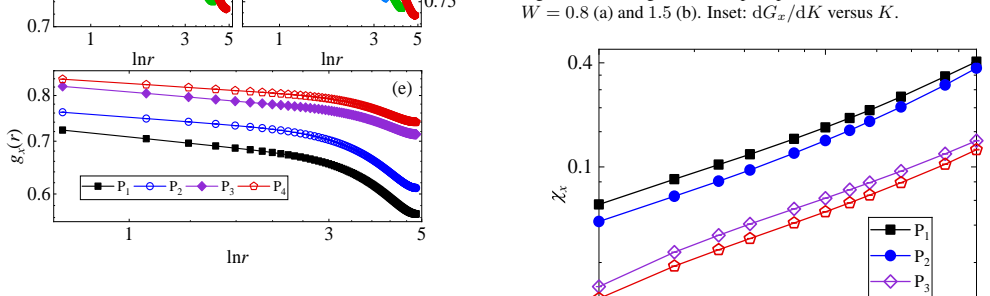
For couplings $W$ inside the vertical (V) plane below the 2D XY BKT value $J_{\rm BKT} \approx 1.11996$, the model undergoes successive transitions as the coupling $K$ within the intersecting (P) planes is increased. A first BKT transition at $K_1 \approx 0.75$ (for $W = 0.8$) takes the V plane from disorder into a quasi-long-range ordered phase. A second transition occurs at $K_2 = J_{\rm BKT}$, inherited from the simultaneous BKT transition of every P plane: the y-lines of the V plane, i.e., the intersection lines, enter a true long-range ordered phase in the thermodynamic limit, with spin correlation $G_y = a + b L^{-q}$ and $a > 0$, while the x-lines remain critical, with $G_x$ decaying as $(\ln L)^{-\hat q}$ (the data do not fully exclude a very weak power law). The long-range order is anisotropic and displays Goldstone-mode physics, with $q \approx 0.51(2)$ independent of $W$ and $K$ over the studied range. The paper interprets this as the critical fluctuations of two-dimensional P planes—which on their own cannot order at finite temperature—mediating the effective interaction that stabilizes one-dimensional long-range order along their intersection with the V plane.
Load-bearing premise
The argument hinges on each intersecting plane remaining a standard two-dimensional XY model—so that the large slow fluctuations that appear at the transition coupling $K = J_{\rm BKT}$ are unchanged—even though it is joined to the vertical plane along a line of sites; the paper checks this numerically but does not prove it.
Editorial extensions
If this is right
- The onset of the long-range ordered phase is pinned to the P-plane BKT coupling $K_2 = J_{\rm BKT}$ for all $0 < W < J_{\rm BKT}$, so the ordering is a sharply tunable transition rather than a crossover.
- In the ordered phase the system is a directional superfluid: phase coherence along the intersection lines is true long-range order, while the perpendicular direction is quasi-long-range; in a cold-atom realization this should appear as size-independent interference contrast along y and decaying contrast along x.
- The exponent $q \approx 0.51(2)$ is independent of $W$ and $K$ across the four parameter sets studied, marking the phase as a universality class of 1D order mediated by a 2D critical environment.
- Because the P planes remain ordinary 2D XY models, the critical environment is continuously tunable by $K$, which may allow experimental control of the emergent order by simply changing the lattice depth of the intersecting planes.
Reading between the lines
- If $q$ is exactly $1/2$, the effective interaction mediated along the intersection lines is likely an inverse-square ($1/r^2$) interaction in one dimension, which is marginal for $O(2)$ order; a field-theoretic derivation would presumably show how the BKT critical plane generates exactly this interaction with a universal amplitude.
- The mechanism should extend to other continuous symmetries (for example $O(3)$ Heisenberg spins) provided the environment has a critical phase rather than an isolated critical point, since the P-plane low-temperature BKT phase provides the tunable slow decay that drives the order.
- A sharper numerical test than the paper gives would be to measure the spin stiffness of the y-lines in the thermodynamic limit: it should be nonzero in the long-range ordered phase and zero along x, directly confirming the anisotropic Goldstone physics.
- The same geometry in a quantum setting—a one-dimensional bosonic chain coupled transversely to a critical two-dimensional bath—should show analogous dissipation-free long-range order, connecting this classical mechanism to impurity and comb-lattice problems.
Signed reviews
Editorial analysis
A structured set of objections, weighed in public.
Referee Report
Summary. This Letter studies a quasi-2D XY model consisting of a vertical (V) plane intersected by L parallel (P) planes, with strictly nearest-neighbor couplings. The authors perform Monte Carlo simulations up to L=384 and report a phase diagram in which, for 0<W<J_BKT, the V plane undergoes two BKT-type transitions at K1 and K2=J_BKT, while for K>=K2 the y-lines of the V plane develop true long-range order described by G_y=a+bL^{-q} with a>0 and q≈0.51(2); the x-lines are instead claimed to remain critical, with G_x~[ln(L/l0)]^{-qhat}. The proposed mechanism is that critical fluctuations of the P planes mediate effective ordering interactions along the intersection lines.
Significance. If the central claim holds, this is a striking result: a strictly short-range classical model in a quasi-2D geometry would host true long-range order along a one-dimensional subspace at finite temperature, mediated by BKT criticality of the surrounding planes, in contrast to conventional Mermin-Wagner-type expectations. The manuscript is technically careful in several respects: it uses multiple independent observables (G_y, <M_y^2>, <M_yk^2>, xi_y, R), reports chi-squared values and systematic L_min studies, and makes the data openly available. The phase-transition analysis at K1 and K2 is credible. The main weakness is that the evidence for a positive intercept in the y-line correlations is not yet decisive against a critical phase with logarithmic decay; given the counterintuitive nature of the claim, this discrimination is essential.
major comments (2)
- [Long-range Ordered Phase, Eq. (5); SM III.A, Fig. 6] The central claim that G_y tends to a>0 in the thermodynamic limit is not fully supported because the fitted form G_y=a+bL^{-q} is not discriminated from a critical logarithmic decay G_y=A[ln(L/l0)]^{-p} over the simulated range L=24-384, where ln L grows only from about 3.2 to 6.0. The x-line fits in Eq. (8) yield exponents qhat as small as 0.026-0.049, so a similarly slow logarithmic decay for the y-lines would be absorbed into an apparent constant plus a power-law correction. The SM Fig. 6 slope analysis excludes a power-law decay of g_y(r), but a pure logarithmic decay corresponds to a constant slope in that plot and is not excluded. The authors should directly fit G_y and <M_y^2> to logarithmic forms, report the resulting chi-squared and stability with L_min, and, if possible, use a discriminating scaling collapse or an effective-exponent extrapolation that separates a>0 from a=0 with logarithmic decay.
- [Abstract and Main Results] The abstract states that the perpendicular direction exhibits quasi-long-range order, but the body (Eq. (8) and End Matter) describes the x-lines as a critical phase with logarithmic decay G_x~[ln(L/l0)]^{-qhat}. In standard usage, quasi-long-range order denotes power-law decay; logarithmic decay is a different critical behavior. This terminology should be reconciled: if the x-direction is logarithmically critical for K>=K2, the abstract and the phase-diagram labels should say so, and 'QLRO' should be reserved for the K1<K<K2 regime.
minor comments (4)
- [SM Table XXVI] For G_P at K2 with W=0.8, the free-eta fit gives eta=0.2676(8) with L_min=16, which is not close to 1/4 at the quoted precision; the text says the estimates are again close to 1/4. Please comment on this deviation and on whether the fixed-eta=1/4 fit is preferred despite its larger chi-squared.
- [Successive Phase Transitions, Eq. (3)] In the K2(L) fits, the free fit returns K2=1.07(2) while the fixed fit uses K2=1.11996; the text then treats 1.11996 as the thermodynamic limit. The choice is reasonable, but the manuscript should state more explicitly that the free fit is statistically consistent with the fixed value and that the fixed-value fits are used only to reduce uncertainty.
- [Final estimate of q] The final estimate q=0.51(2) is quoted without a transparent combination of the results in Table I; a weighted average or an explicit statement of the spread across P1-P4 would make the procedure reproducible.
- [Abstract] The phrase 'complete phase diagram' is stronger than the presented data: the K1 line is determined at only five W values, and the K2 line is verified for a limited set of couplings. A phrase such as 'phase diagram for the studied parameter range' would be more accurate.
Circularity Check
No significant circularity: the claimed long-range order is a fit-based, externally benchmarked finding rather than an input to the derivation.
full rationale
The paper's central claim—that y-lines of the V plane enter long-range order for K >= K_2—is supported by Monte Carlo data for G_y, <M_y^2>, <M_yk^2>, and ξ_y, each fit to a proposed finite-size form with a free intercept a. The positivity of a is an output of the fits and could in principle have been zero; it is not defined into the model. The transition at K_2 is located through BKT-type finite-size scaling and compared with the external value J_BKT ≈ 1.11996 from Komura and Okabe [41]; free fits give values near this before it is fixed, so the identification is not a matter of definition. The P-plane criticality at K_2 is verified separately through BKT scaling of G_z and G_P. The Goldstone-mode scaling ansatz is standard textbook material (Kardar [46]) and, while Eqs. (5)-(7) are cited from prior work [6] with overlapping authorship, the load-bearing evidence is the Monte Carlo data themselves rather than the citation. The final exponent q = 0.51(2) is explicitly left for future field-theoretical derivation, so it is not presented as following from the LR-order assumption. The alternative logarithmic-decay scenario for G_y is a genuine statistical model-selection concern, because both forms can describe the simulated L range, but this is a correctness risk, not circularity: no equation is constructed from the result it is used to establish, and no fitted parameter is renamed as a prediction.
Assumptions & free parameters
free parameters (6)
- q (Goldstone decay exponent) =
0.51(2) (final estimate; per-fit values 0.500(2) to 0.537(7))
- K_1 (V-plane BKT transition) =
0.75(1) at W=0.8; 0.951(1) at W=0.4
- K_2 (P-plane BKT transition) =
1.11996 (fixed to J_BKT); free fit gives 1.07(2) at W=0.8
- l_0 (reference length in BKT fits) =
0.8(2) for K_2 at W=0.8; 1 for K_1; ranges 0.002 to 2.5 in End Matter
- q_hat (x-line logarithmic decay exponent) =
0.049(2) for P1; 0.026(2) for P4
- eta (P-plane correlation exponent for K>K_2) =
0.1339(3) at K=1.5; 0.0934(5) at K=2
assumptions (5)
- standard math BKT finite-size scaling K_n(L)=K_n+a[ln(L/l_0)]^{-2} and multiplicative log corrections G ~ L^{-1/4}(ln L)^{1/8} apply.
- domain assumption The P planes remain standard 2D XY models; the V-plane coupling is a subextensive line perturbation.
- domain assumption The Wolff cluster algorithm samples equilibrium in the thermodynamic limit.
- domain assumption The y-line correlation follows the Goldstone form g(r)=a+b r^{-q} with a>0 in the LR phase.
- ad hoc to paper The x-line correlation follows a logarithmic decay G_x = a[ln(L/l_0)]^{-q_hat}.
Cite this review
Pith. "Pith review of Long-Range Order in a Strictly Short-Range Quasi-2D XY Model: When Critical Fluctuations Matter." pith.science (2026). https://pith.science/paper/OCBZHNZE
@misc{pith2026250619637,
  author       = {Pith},
  title        = {Pith review of: Long-Range Order in a Strictly Short-Range Quasi-2D XY Model: When Critical Fluctuations Matter},
  year         = {2026},
  howpublished = {\url{https://pith.science/paper/OCBZHNZE}},
  note         = {Machine review of arXiv:2506.19637}
}
read the original abstract
The phase of spins in the quasi-two-dimensional (q2D) XY model has emerged as a topic of significant interest across multiple subfields of physics. Conventional wisdom, rooted in the Mermin-Wagner theorem and supported by existing paradigms, asserts that true long-range (LR) order is prohibited in q2D systems with continuous symmetries and short-range (SR) interactions. In this Letter, we propose a strictly SR q2D XY model defined on a plane perpendicularly intersected by a group of parallel planes, where each plane consists of XY spins coupled via nearest-neighbor interactions. Through large-scale Monte Carlo simulations complemented by finite-size scaling analysis, we establish the complete phase diagram of the setup. A LR ordered phase emerges in the q2D model when the spins on the parallel planes develop a Berezinskii-Kosterlitz-Thouless critical phase. The LR ordered phase is anisotropic: true LR correlations develop exclusively along the direction of the intersection lines, while the perpendicular direction exhibits quasi-long-range order. Furthermore, the LR order exhibits Goldstone-mode physics. Our findings reveal a mechanism for stabilizing LR order in low-dimensional systems with continuous symmetries, thereby establishing a new platform for studying exotic superfluidity.
Figures


Figures from the paper (13 more)




Reference graph
Works this paper leans on
-
[1]
J. M. Kosterlitz, Nobel lecture: Topological defects and phase transitions, Rev. Mod. Phys.89, 040501 (2017)
work page 2017
-
[2]
H. Kunz and C. E. Pfister, First order phase transition in the plane rotator ferromagnetic model in two dimensions, Comm. Math. Phys.46, 245 (1976)
work page 1976
-
[3]
Berezinskii-Kosterlitz-Thouless phase transitions with long-range couplings
G. Giachetti, N. Defenu, S. Ruffo, and A. Trombettoni, Berezinskii-kosterlitz-thouless phase transitions with long- range couplings, Phys. Rev. Lett.127, 156801 (2021), arXiv:2104.13217 [cond-mat]
work page Pith review arXiv 2021
-
[4]
$BKT$ transitions in classical and quantum long-range systems
G. Giachetti, A. Trombettoni, S. Ruffo, and N. Defenu, Berezinskii-kosterlitz-thouless transitions in classical and quan- tum long-range systems, Phys. Rev. B106, 014106 (2022), arXiv:2201.03650 [cond-mat]
work page Pith review arXiv 2022
-
[5]
T. Xiao, D. Yao, C. Zhang, Z. Fan, and Y . Deng, Two- dimensional xy ferromagnet induced by long-range interaction, Chin. Phys. Lett.42, 070002 (2025), arXiv:2404.08498 [cond- mat]
arXiv 2025
-
[6]
D. Yao, T. Xiao, C. Zhang, Y . Deng, and Z. Fan, Nonclassical regime of the two-dimensional long-range xy model: A com- prehensive monte carlo study, Phys. Rev. B112, 144429 (2025), arXiv:2411.01811 [cond-mat]
arXiv 2025
-
[7]
L. Bianchi and D. Bonomi, Conformal dispersion relations for defects and boundaries, SciPost Phys.15, 055 (2023), arXiv:2205.09775 [hep-th]
arXiv 2023
-
[8]
Tr ´epanier, Surface defects in the o(n) model, J
M. Tr ´epanier, Surface defects in the o(n) model, J. High Energ. Phys.2023, 74, arXiv:2305.10486 [hep-th]
arXiv 2023
Show all 54 references
-
[9]
Raviv-Moshe and S
A. Raviv-Moshe and S. Zhong, Phases of surface defects in scalar field theories, J. High Energ. Phys.2023, 143, arXiv:2305.11370 [hep-th]
2023 arXiv
-
[10]
Giombi and B
S. Giombi and B. Liu, Notes on a surface defect in the o(n) model, J. High Energ. Phys.2023, 4, arXiv:2305.11402 [hep- th]
2023 arXiv
-
[11]
I. C. Bolla, D. Rodriguez-Gomez, and J. G. Russo, Defects, rigid holography, andc-theorems, Phys. Rev. D108, L041701 (2023), arXiv:2306.11796 [hep-th]
2023 arXiv
-
[12]
Cuomo and S
G. Cuomo and S. Zhang, Spontaneous symmetry break- ing on surface defects, J. High Energ. Phys.2024, 22, arXiv:2306.00085 [hep-th]
2024 arXiv
-
[13]
Sun and S.-K
X. Sun and S.-K. Jian, Boundary operator expansion and ex- traordinary phase transition in the tricritical o(n) model, SciPost Phys.18, 210 (2025), arXiv:2501.06287 [cond-mat]
2025 arXiv
-
[14]
Sun and S.-K
X. Sun and S.-K. Jian, Boundary operator expansion and extraordinary-log phase in the tricritical o(n) model, APS Global Physics Summit (2025)
2025
-
[15]
M. A. Metlitski, Boundary criticality of the O(N) model in d = 3 critically revisited, SciPost Phys.12, 131 (2022), arXiv:2009.05119 [cond-mat]
2022 arXiv
-
[16]
M. Hu, Y . Deng, and J.-P. Lv, Extraordinary-log surface phase transition in the three-dimensionalxymodel, Phys. Rev. Lett. 127, 120603 (2021), arXiv:2104.05152 [cond-mat]
2021 arXiv
-
[17]
Parisen Toldin and M
F. Parisen Toldin and M. A. Metlitski, Boundary criticality of the 3d o(n) model: from normal to extraordinary, Phys. Rev. Lett.128, 215701 (2022), arXiv:2111.03613 [cond-mat]
2022 arXiv
-
[18]
Krishnan and M
A. Krishnan and M. A. Metlitski, A plane defect in the 3d O(N) model, SciPost Phys.15, 090 (2023), arXiv:2301.05728 [cond- mat]
2023 arXiv
-
[19]
Y . Sun, M. Hu, Y . Deng, and J.-P. Lv, Extraordinary-log univer- sality of critical phenomena in plane defects, Phys. Rev. Lett. 131, 207101 (2023), arXiv:2301.11720 [cond-mat]
2023 arXiv
-
[20]
Parisen Toldin, Boundary critical behavior of the three- dimensional heisenberg universality class, Phys
F. Parisen Toldin, Boundary critical behavior of the three- dimensional heisenberg universality class, Phys. Rev. Lett.126, 135701 (2021), arXiv:2012.00039 [cond-mat]. 6
2021 arXiv
-
[21]
Zhang, C
L.-R. Zhang, C. Ding, Y . Deng, and L. Zhang, Surface criti- cality of the antiferromagnetic potts model, Phys. Rev. B105, 224415 (2022), arXiv:2204.11692 [cond-mat]
2022 arXiv
-
[22]
X. Zou, S. Liu, and W. Guo, Surface critical properties of the three-dimensional clock model, Phys. Rev. B106, 064420 (2022), arXiv:2204.13612 [cond-mat]
2022 arXiv
-
[23]
Sun and J.-P
Y . Sun and J.-P. Lv, Quantum extraordinary-log universality of boundary critical behavior, Phys. Rev. B106, 224502 (2022), arXiv:2205.00878 [cond-mat]
2022 arXiv
-
[24]
Y . Sun, J. Lyu, and J.-P. Lv, Classical-quantum correspondence of special and extraordinary-log criticality: Villain’s bridge, Phys. Rev. B106, 174516 (2022), arXiv:2211.11376 [cond- mat]
2022 arXiv
-
[25]
L. R. Zhang, C. Ding, W. Zhang, and L. Zhang, Sublattice extraordinary-log phase and new special point of the antifer- romagnetic potts model, Phys. Rev. B108, 024402 (2023), arXiv:2301.08926 [cond-mat]
2023 arXiv
-
[26]
J. Y . Lee, C.-M. Jian, and C. Xu, Quantum criticality under decoherence or weak measurement, PRX Quantum4, 030317 (2023), arXiv:2301.05238 [cond-mat]
2023 arXiv
-
[27]
Baweja, D
K. Baweja, D. J. Luitz, and S. J. Garratt, Post-measurement quantum monte carlo, arXiv:2410.13844 [cond-mat]
-
[28]
Zhang, Z
Y .-H. Zhang, Z. Zhu, and A. Vishwanath, Xy* transition and ex- traordinary boundary criticality from fractional exciton conden- sation in quantum hall bilayer, Phys. Rev. X13, 031023 (2023), arXiv:2302.03703 [cond-mat]
2023 arXiv
-
[29]
Werner, M
P. Werner, M. Troyer, and S. Sachdev, Quantum spin chains with site dissipation, J. Phys. Soc. Jpn.74, 67 (2005), arXiv:cond-mat/0412529 [cond-mat]
2005 arXiv
-
[30]
M. A. Cazalilla, F. Sols, and F. Guinea, Dissipation-driven quantum phase transitions in a tomonaga-luttinger liquid elec- trostatically coupled to a metallic gate, Phys. Rev. Lett.97, 076401 (2006), arXiv:cond-mat/0603176 [cond-mat]
2006 arXiv
-
[31]
I. B. Sperstad, E. B. Stiansen, and A. Sudbø, Quantum critical- ity in spin chains with non-ohmic dissipation, Phys. Rev. B85, 214302 (2012), arXiv:1204.2538 [cond-mat]
2012 arXiv
-
[32]
Weber, D
M. Weber, D. J. Luitz, and F. F. Assaad, Dissipation-induced order: the s= 1/2 quantum spin chain coupled to an ohmic bath, Phys. Rev. Lett.129, 056402 (2022), arXiv:2112.02124 [cond- mat]
2022 arXiv
-
[33]
A. L. S. Ribeiro, P. McClarty, P. Ribeiro, and M. Weber, Dissipation-induced long-range order in the one-dimensional bose-hubbard model, Phys. Rev. B110, 115145 (2024), arXiv:2311.07683 [cond-mat]
2024 arXiv
-
[34]
Radzihovsky, A
L. Radzihovsky, A. Kuklov, N. Prokof’ev, and B. Svistunov, Superfluid edge dislocation: Transverse quantum fluid, Phys. Rev. Lett.131, 196001 (2023), arXiv:2304.03309 [cond-mat]
2023 arXiv
-
[35]
Kuklov, N
A. Kuklov, N. Prokof’ev, L. Radzihovsky, and B. Svistunov, Transverse quantum fluids, Phys. Rev. B109, L100502 (2024), arXiv:2309.02501 [cond-mat]
2024 arXiv
-
[36]
Kuklov, L
A. Kuklov, L. Pollet, N. Prokof’ev, L. Radzihovsky, and B. Svistunov, Universal correlations as fingerprints of trans- verse quantum fluids, Phys. Rev. A109, L011302 (2024), arXiv:2310.19875 [cond-mat]
2024 arXiv
-
[37]
Zhang, M
C. Zhang, M. Boninsegni, A. Kuklov, N. Prokof’ev, and B. Svistunov, Superclimbing modes in transverse quantum flu- ids: Signature statistical and dynamical features, Phys. Rev. B 109, 214519 (2024), arXiv:2404.03465 [cond-mat]
2024 arXiv
-
[38]
Kuklov, L
A. Kuklov, L. Pollet, N. Prokof’ev, and B. Svistunov, Trans- verse quantum superfluids, Annu. Rev. Condens. Matter Phys 16(2024), arXiv:2404.15480 [cond-mat]
2024 arXiv
-
[39]
Kuklov, N
A. Kuklov, N. Prokof’ev, and B. Svistunov, Autonomous dy- namics of two-dimensional insulating domain with superclimb- ing edges, Phys. Rev. Res.6, 033008 (2024), arXiv:2404.18290 [cond-mat]
2024 arXiv
-
[40]
Radzihovsky and E
L. Radzihovsky and E. Pellett, Quantum phases and transi- tions of bosons on a comb lattice, Phys. Rev. Lett.135, 016001 (2025), arXiv:2412.06915 [cond-mat]
2025 arXiv
-
[41]
Komura and Y
Y . Komura and Y . Okabe, Large-scale monte carlo simulation of two-dimensional classical xy model using multiple gpus, J. Phys. Soc. Jpn.81, 113001 (2012), arXiv:1210.6116 [cond- mat]
2012 arXiv
-
[42]
Wolff, Collective monte carlo updating for spin systems, Phys
U. Wolff, Collective monte carlo updating for spin systems, Phys. Rev. Lett.62, 361 (1989)
1989
-
[43]
Janke, Logarithmic corrections in the two-dimensional xy model, Phys
W. Janke, Logarithmic corrections in the two-dimensional xy model, Phys. Rev. B55, 3580 (1997)
1997
-
[44]
H. Chen, P. Hou, S. Fang, and Y . Deng, Monte carlo study of duality and the berezinskii-kosterlitz-thouless phase transitions of the two-dimensionalq-state clock model in flow represen- tations, Phys. Rev. E106, 024106 (2022), arXiv:2205.02642 [cond-mat]
2022 arXiv
-
[45]
Tomita and Y
Y . Tomita and Y . Okabe, Probability-changing cluster algorithm for two-dimensionalXYand clock models, Phys. Rev. B65, 184405 (2002), arXiv:cond-mat/0202161 [cond-mat]
2002 arXiv
-
[46]
Kardar,Statistical physics of fields(Cambridge University Press, 2007)
M. Kardar,Statistical physics of fields(Cambridge University Press, 2007)
2007
-
[47]
long-range order in a strictly short- range quasi-2d xy model: when critical fluctuations matter
M. Hu, Dataset for “long-range order in a strictly short- range quasi-2d xy model: when critical fluctuations matter”, 10.5281/zenodo.19901475 (2026)
2026 doi
-
[48]
Berche, Bulk and surface properties in the critical phase of the two-dimensional xy model, J
B. Berche, Bulk and surface properties in the critical phase of the two-dimensional xy model, J. Phys. A: Math. Gen.36, 585 (2003), arXiv:cond-mat/0211584 [cond-mat]
2003 arXiv
-
[49]
W. Xu, Y . Sun, J.-P. Lv, and Y . Deng, High-precision monte carlo study of several models in the three-dimensional u(1) universality class, Phys. Rev. B100, 064525 (2019), arXiv:1908.10990 [cond-mat]
2019 arXiv
-
[50]
D. M. Dantchev and S. Dietrich, Critical casimir effect: exact results, Phys. Rep.1005, 1 (2023), arXiv:2203.15050 [cond- mat]
2023 arXiv
-
[51]
M. R. Andrews, C. G. Townsend, H.-J. Miesner, D. S. Durfee, D. M. Kurn, and W. Ketterle, Observation of interference be- tween two bose condensates, Science275, 637 (1997)
1997
-
[54]
Gauthier, I
G. Gauthier, I. Lenton, N. McKay Parry, M. Baker, M. J. Davis, H. Rubinsztein-Dunlop, and T. W. Neely, Direct imaging of a digital-micromirror device for configurable microscopic optical potentials, Optica3, 1136 (2016), arXiv:1605.04928 [cond-mat]
2016 arXiv
-
[55]
W. S. Bakr, J. I. Gillen, A. Peng, S. F ¨olling, and M. Greiner, A quantum gas microscope for detecting single atoms in a hubbard- regime optical lattice, Nature462, 74 (2009), arXiv:0908.0174 [cond-mat]
2009 arXiv
-
[56]
M. R. Andrews, C. G. Townsend, H.-J. Miesner, D. S. Durfee, D. M. Kurn, and W. Ketterle, Observation of interference be- tween two bose condensates, Science275, 637 (1997). 9 Table II. Fits ofK n(L)(n= 1,2) to Eq. (1) foryandxlines withW= 0.8. Quantity n Lmin χ2/DOF Kn a l0 d(...
1997
Reviewed August 15, 2026 · model on record in the stance chip above.
Discussion (0). Continue with ORCID to comment.