REVIEW 5 minor 40 references
Narrow-line-mediated Sisyphus cooling in the $^{3}\mathrm{P}_{2}$ metastable state of strontium
T0 review · 0 major / 5 minor · reviewed 2026-08-15 · deepseek-v4-flash
Pith's one-line read A 641 nm dissipative lattice makes Sisyphus cooling of magnetically trapped strontium about ten times faster than IR Doppler cooling alone, nearly doubling the outcoupling of atoms into a moving 813 nm lattice.
desk verdict Genuine experimental advance in Sisyphus cooling for continuous Sr beams, with a robust headline result and a minor interpretive caveat. read the letter →
The pith
A machine-rendered reading of the paper's core claim, the machinery that carries it, and where it could break.
The reading
What carries the argument
The load-bearing mechanism is the dissipative optical lattice in the 3D3 state: a 641 nm standing wave that shifts the 3D3(mJ=3) level periodically in space while leaving the 3P2 level nearly unshifted. This periodic light-shift landscape gates the narrow 2.92 µm transition, so the IR laser drives atoms predominantly near the potential minima; spontaneous emission then returns them to the ground state at a lower potential-energy point, removing kinetic energy in a Sisyphus cycle. The 1D simulation in Appendix A inserts this potential into a Runge-Kutta model with recoil kicks from IR photons, and reproduces the rapid phase-space-density increase seen in the experiments. The same lattice also provides dissipation through scattering on the 3D3→3F4 transition, which is why the cycle is continuously resetting rather than merely reshaping the potential.
What would settle it
Measure the position-dependent ac-Stark shift of the 3D3 state along the 641 nm standing wave, for example by spatially resolved spectroscopy of the 3P2→3D3 transition, and check that the shift has the assumed $cos^{2}$ form with the depth U0/kB ≈ 380 µK. If the actual shift pattern differs substantially while the fast cooling persists, then the observed sub-100 ms compression would still stand but the Sisyphus label would be inaccurate; alternatively, if the cooling time does not scale with U0 under fixed detuning, that would falsify the mechanism.
Extended reading notes
Core claim
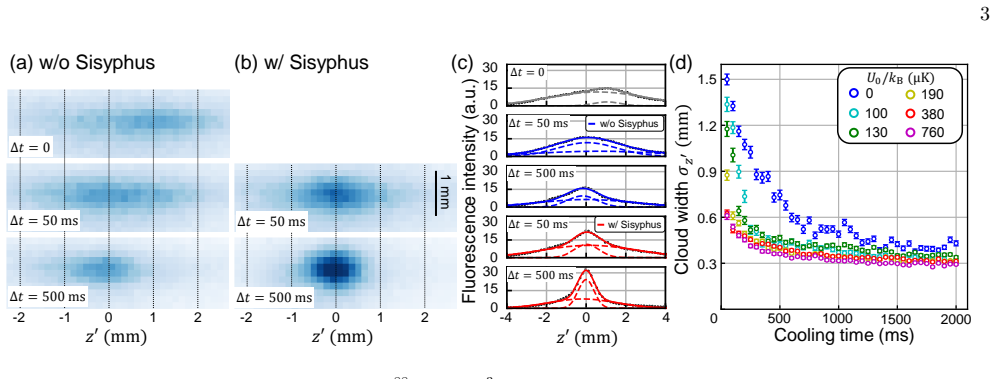
The paper claims that narrow-line-mediated Sisyphus cooling can be grafted onto Doppler cooling of magnetically trapped 88Sr in the long-lived 3P2 metastable state. A pair of counterpropagating 641 nm lasers, blue-detuned from the 3D3→3F4 transition, forms a one-dimensional lattice whose position-dependent ac-Stark shift is $$U_S(z)=U_0\$cos^{2}$(2\pi z/\lambda_{641})$$ on the 3D3(mJ=3) state. The 2.92 µm IR light, which drives the 3P2(mJ=2)→3D3(mJ=3) transition, then excites atoms mainly where the shifted excited state is low, and each absorption–emission cycle removes energy more efficiently than ordinary Doppler cooling. The observed cloud-width collapse within 50 ms, the inferred temperature near 26 µK after 1 s, and the 88(10)% improvement in moving-lattice loading are all presented as evidence for this mechanism. The paper notes in its time-of-flight appendix that the 26 µK temperature estimate may be an underestimate, especially for longer expansion times and lower temperatures.
Load-bearing premise
The argument assumes the 641 nm standing wave creates a periodic, cosine-squared change in the energy of the 3D3 state while hardly shifting the 3P2 state, so the 2.92 µm laser excites atoms mainly at the bottom of these energy corrugations; this landscape is inserted into the simulation rather than directly measured.
Editorial extensions
If this is right
- Cooling time for magnetically trapped 3P2 strontium drops by roughly an order of magnitude, from a few seconds to below 100 ms.
- The number of atoms continuously outcoupled into the moving 813 nm lattice in the 3P0 state increases by 88(10)%, nearly doubling the flux compared with the previous scheme.
- Faster cooling reduces losses from background-gas collisions and light-assisted collisions that accumulate during the multi-second IR-only cooling time.
- The lower temperature, around 26 µK, and the rapid increase in phase-space density should improve the brightness of continuous ultracold atomic beams used in optical clocks and superradiant lasers.
- Extending the one-dimensional Sisyphus lattice to three dimensions should further improve outcoupling efficiency, as the authors state.
Reading between the lines
- If the Sisyphus interpretation is correct, the same combination of a dissipative lattice on one metastable state and a narrow cooling transition linking it to another state could be adapted to other alkaline-earth-like atoms with long-lived triplet states, not just 88Sr.
- A direct position-resolved measurement of the 641 nm ac-Stark shift on the 3D3 level would convert the assumed potential US(z) into a measured quantity; the cooling curves in Fig. 3(d) provide a sensitive cross-check because their time constants should track the lattice depth U0.
- Because the outcoupling gain comes mainly from avoiding the seconds-long IR cooling, one testable prediction is that the relative improvement should grow as the vacuum-limited lifetime of the trap shortens—the slower the background-loss channel, the less the benefit from faster cooling.
- The paper's own caveat that its 26 µK temperature estimate may be an underestimate means the claimed sub-Doppler or sub-Doppler-comparable temperatures should be treated as lower bounds until a more direct thermometry method is applied.
Signed reviews
Editorial analysis
A structured set of objections, weighed in public.
Referee Report
Summary. The manuscript reports the demonstration of narrow-line-mediated Sisyphus cooling of magnetically trapped 88Sr atoms in the 5s5p 3P2 metastable state. A 641 nm standing-wave laser, blue-detuned from the 3D3-3F4 transition, is used to create a dissipative optical lattice in the 3D3 state, while a 2.92 µm laser Doppler-cools the 3P2-3D3 transition. The authors observe a rapid collapse of the in-trap atomic cloud on a timescale below 100 ms, a temperature of about 26 µK after 1 s of cooling, and an 88(10)% increase in the number of atoms loaded into a moving 813 nm optical lattice after optical pumping to 3P0. The paper includes a 1D simulation of the cooling dynamics, loss spectroscopy of the 641 nm transition, in-trap time-of-flight temperature measurements, and a table of typical experimental parameters.
Significance. The result is significant for the development of continuous ultracold atomic sources for optical clocks and atom interferometry. If correct, the scheme provides a practical way to substantially shorten the cooling time in the magnetic trap and to improve the efficiency of continuous outcoupling into a moving lattice. The main strengths are the directness of the central observables: the cloud-collapse dynamics in Fig. 3 and the measured loading enhancement of 88(10)% in Fig. 4 are straightforward experimental results, and the data availability statement is commendable. The principal caveat is that the Sisyphus light-shift landscape is inferred rather than directly measured, and the simulation in Appendix A assumes that landscape; however, the primary engineering claims do not rest on the microscopic labeling of the mechanism.
minor comments (5)
- [Appendix C] The temperature estimates of about 26 µK with Sisyphus cooling and about 74 µK for Doppler cooling are quoted without uncertainties, and the text itself notes that the in-trap TOF method may underestimate the temperature; please provide a quantitative uncertainty or explicitly label these values as approximate estimates with the stated caveat.
- [Fig. 3(d) and main text] The claim that Sisyphus cooling reduces the cooling time by an order of magnitude should be supported by a quantitative definition of cooling time (for example, the time for the cold-fraction width to reach a specified value) and by plotting the without-Sisyphus data on the same time axis as the with-Sisyphus curves; as written, the comparison partly relies on the qualitative behavior of the without-Sisyphus curve in Fig. 3(c).
- [Simulation and Appendix A] The simulation inserts the assumed potential US(z)=U0 cos^2(2πz/λ641) rather than deriving it from a directly measured light-shift landscape, so it should be described as an illustrative model of the proposed mechanism rather than as independent confirmation; the direct experimental observations in Figs. 3 and 4 are the primary evidence for the cooling improvement.
- [Abstract and Sec. 4] The abstract states a 'two fold improvement in atom number' while the results section reports an 88(10)% increase; please use consistent wording, such as 'nearly doubled,' and clarify whether the improvement refers to integrated fluorescence or to the inferred atom number in the moving lattice.
- [Fig. 5] The horizontal axis label 'Frequency - ν0(641) (MHz)' appears incomplete or incorrectly formatted; please ensure the axis label and units are printed correctly and that the zero of the frequency axis is defined unambiguously.
Circularity Check
No significant circularity: the central performance claims are direct measured observables; the Sisyphus-potential simulation is explanatory, not a fitted prediction.
full rationale
The paper's central claims are supported by direct experimental comparisons: the in-trap cloud collapses within roughly 50 ms with the 641 nm lattice on versus a much slower response without it (Fig. 3), and the moving-lattice atom number increases by 88(10)% (Fig. 4). These are externally falsifiable observables. The Sisyphus mechanism is introduced via an explicitly stated model: Appendix A inserts US(z)=U0 cos^2(2πz/lambda_641) with U0 set from laser intensity and detuning (Table I), not fitted to the cooling data; the simulation is used only to understand the observed dynamics, not to generate a prediction that is then confirmed by construction. No fitted parameter is renamed as a prediction. Self-citations [26,28] and [21,3] describe prior demonstrations and apparatus, but the present measurements do not reduce to those references; the claimed improvement is independent experimental evidence. The only caveat, that the assumed light-shift landscape is inferred rather than directly measured, is a modeling assumption and a labeling risk, not a circular derivation. Accordingly, no load-bearing circular step is identified.
Assumptions & free parameters
assumptions (4)
- domain assumption The 641 nm standing wave creates a spatially varying ac-Stark shift on the 3D3(mJ=3) state of the form U0 cos^2(2πz/λ641), while leaving the 3P2 state unshifted.
- domain assumption In the region z<0 the local magnetic field defines the quantization axis along -z, so the circularly polarized 641 nm light predominantly drives the 3D3(mJ=3) state via a σ+ transition.
- domain assumption A one-dimensional treatment along z captures the essential cooling dynamics for atoms in the elongated magnetic trap.
- domain assumption When the 641 nm laser is resonant, atoms are lost from the trap because they are optically pumped into high-field-seeking 3P2(mJ<0) states.
Cite this review
Pith. "Pith review of Narrow-line-mediated Sisyphus cooling in the $^{3}\mathrm{P}_{2}$ metastable state of strontium." pith.science (2026). https://pith.science/paper/CBSIYANH
@misc{pith2026250619701,
  author       = {Pith},
  title        = {Pith review of: Narrow-line-mediated Sisyphus cooling in the $^3\mathrmP_2$ metastable state of strontium},
  year         = {2026},
  howpublished = {\url{https://pith.science/paper/CBSIYANH}},
  note         = {Machine review of arXiv:2506.19701}
}
abstract
We demonstrate narrow-line-mediated Sisyphus cooling of magnetically trapped strontium (Sr) in the $5s5p\,^{3}\textrm{P}_{2}$ state. A 641 nm standing-wave, blue-detuned from the $5s4d\,^{3}\textrm{D}_{3}$$\,\rightarrow$ $\,5p4d\,^{3}\textrm{F}_{4}$ transition, creates a dissipative optical lattice in the $^{3}\textrm{D}_{3}$ state. By combining Doppler cooling and Sisyphus cooling on the $5s5p\,^{3}\textrm{P}_{2}$$\,\rightarrow$ $5s4d\,^{3}\textrm{D}_{3}$ transition at 2.92 ${\mu}$m, we observed efficient cooling of magnetically trapped atoms. By optically pumping the atoms to the $5s5p\,^{3}\textrm{P}_{0}$ state, we facilitate continuous outcoupling via a moving optical lattice with two fold improvement in atom number. Our scheme applies to next-generation quantum sensors using continuous ultracold atomic beams.
Figures


Figures from the paper (2 more)


Reference graph
Works this paper leans on
-
[26]
Three-stage laser cooling of sr atoms using the 5s5p3P2 metastable state below doppler temperatures,
Tomoya Akatsuka, Koji Hashiguchi, Tadahiro Taka- hashi, Noriaki Ohmae, Masao Takamoto, and Hidetoshi Katori, “Three-stage laser cooling of sr atoms using the 5s5p3P2 metastable state below doppler temperatures,” Phys. Rev. A 103, 023331 (2021)
work page 2021
-
[28]
Sub-doppler magneto-optical trap for calcium,
Jan Gr¨ unert and Andreas Hemmerich, “Sub-doppler magneto-optical trap for calcium,” Phys. Rev. A 65, 041401 (2002)
work page 2002
-
[1]
zi+1,vi+1 are updated by the Runge-Kutta method, where the acceleration a(z,v,s ) is calculated as a(z,v,s ) = ( − 3µB m d|B(z)| dz −g (s =|0⟩) − 4µB m d|B(z)| dz − 1 m dUS(z) dz −g (s =|1⟩) (1) Here,µB is the Bohr magneton,B(z) is the magnetic flux density at positionz,m is the mass of 88Sr,g is the grav- itational acceleration, and US(z) =U0 cos(2πz/λ 6...
-
[2]
The probability of photon absorption or emission p(z,v,s ) during a time interval ∆t is calculated as: p(z,v,s ) = 1− exp[−R(z,v )∆t] (s =|0⟩) 1− exp[−ΓIR∆t] ( s =|1⟩) (2) where R(z,v ) = ΓIR 2 I/I (IR) s 1 +I/I (IR) s + [2∆(z,v )/ΓIR]2 ∆(z,v ) =−δω−kIRv +µB|B(z)|/ℏ +US(z)/ℏ (3) δω is the detuning of the IR laser. We choose ∆ t = 0.1 µs, which is an order...
-
[3]
5 Frequency - 𝜈0 (641) (MHz) Fluorescence intensity (arb
When the absorption or emission happens, vi+1,si+1 are updated as follows: vi+1 = vi+1− ℏkIR/m (si =|0⟩) vi+1 +uℏkIR/m (si =|1⟩) si+1 = |1⟩ (si =|0⟩) |0⟩ (si =|1⟩) (4) u is a random value of either +1 or -1. 5 Frequency - 𝜈0 (641) (MHz) Fluorescence intensity (arb. unit) FIG. 5. Spectra of the 5 s4d 3D3→ 5p4d 3F4 transition mea- sured by atom loss spectro...
-
[4]
Continuous guided strontium beam with high phase- space density,
Chun-Chia Chen, Shayne Bennetts, Rodrigo Gonz´ alez Escudero, Benjamin Pasquiou, and Florian Schreck, “Continuous guided strontium beam with high phase- space density,” Phys. Rev. Appl. 12, 044014 (2019)
work page 2019
-
[5]
Intense continuous cold-atom source,
William Huntington, Jeremy Glick, Michael Borysow, and Daniel J. Heinzen, “Intense continuous cold-atom source,” Phys. Rev. A 107, 013302 (2023)
work page 2023
-
[6]
Continuous generation of an ultra- cold atomic beam using crossed moving optical lattices,
Shoichi Okaba, Ryoto Takeuchi, Shigenori Tsuji, and Hidetoshi Katori, “Continuous generation of an ultra- cold atomic beam using crossed moving optical lattices,” Phys. Rev. Appl. 21, 034006 (2024)
work page 2024
Show all 40 references
-
[7]
Con- tinuous collective strong coupling of strontium atoms to a high finesse ring cavity,
Julia R. K. Cline, Vera M. Sch¨ afer, Zhijing Niu, Dylan J. Young, Tai Hyun Yoon, and James K. Thompson, “Con- tinuous collective strong coupling of strontium atoms to a high finesse ring cavity,” Phys. Rev. Lett. 134, 013403 (2025)
2025
-
[8]
Local oscillator induced degradation of medium-term stability in passive atomic frequency stan- dards,
G. J. Dick, J. D. Prestage, C. A. Greenhall, and L. Maleki, “Local oscillator induced degradation of medium-term stability in passive atomic frequency stan- dards,” Proceedings of the 19th Annual Precise Time and Time Interval Systems and Applications Meeting , 133– 147 (1987)
1987
-
[9]
Frequency sta- bility of optical lattice clocks,
J´ erˆ ome Lodewyck, Philip G Westergaard, Arnaud Lecal- lier, Luca Lorini, and Pierre Lemonde, “Frequency sta- bility of optical lattice clocks,” New J. Phys. 12, 065026 (2010)
2010
-
[10]
Longitudinal Ramsey spectroscopy of atoms for continuous operation of optical clocks,
Hidetoshi Katori, “Longitudinal Ramsey spectroscopy of atoms for continuous operation of optical clocks,” Appl. Phys. Express 14, 072006 (2021)
2021
-
[11]
Entanglement on an optical atomic-clock transition,
Edwin Pedrozo-Pe˜ nafiel, Simone Colombo, Chi Shu, Al- bert F Adiyatullin, Zeyang Li, Enrique Mendez, Boris Braverman, Akio Kawasaki, Daisuke Akamatsu, Yan- hong Xiao, and Vladan Vuleti´ c, “Entanglement on an optical atomic-clock transition,” Nature 588, 414–418 (2020)
2020
-
[12]
Realizing spin squeezing with rydberg interactions in an optical clock,
William J. Eckner, Nelson Darkwah Oppong, Alec Cao, Aaron W. Young, William R. Milner, John M. Robin- son, Jun Ye, and Adam M. Kaufman, “Realizing spin squeezing with rydberg interactions in an optical clock,” Nature 621, 734–739 (2023)
2023
-
[13]
Direct comparison of two spin- squeezed optical clock ensembles at the 10 −17 level,
John M. Robinson, Maya Miklos, Yee Ming Tso, Colin J. Kennedy, Tobias Bothwell, Dhruv Kedar, James K. Thompson, and Jun Ye, “Direct comparison of two spin- squeezed optical clock ensembles at the 10 −17 level,” Nat. Phys. 20, 208–213 (2024)
2024
-
[14]
Reservoir-based deterministic loading of single-atom tweezer arrays,
Lars Pause, Tilman Preuschoff, Dominik Sch¨ affner, Malte Schlosser, and Gerhard Birkl, “Reservoir-based deterministic loading of single-atom tweezer arrays,” Phys. Rev. Res. 5, L032009 (2023)
2023
-
[15]
Continuous operation of large-scale atom arrays in optical lattices,
Flavien Gyger, Maximilian Ammenwerth, Renhao Tao, Hendrik Timme, Stepan Snigirev, Immanuel Bloch, and Johannes Zeiher, “Continuous operation of large-scale atom arrays in optical lattices,” Phys. Rev. Res. 6, 033104 (2024)
2024
-
[16]
Iterative assembly of 171Yb atom arrays with cavity-enhanced optical lat- tices,
M. A. Norcia, H. Kim, W. B. Cairncross, M. Stone, A. Ryou, M. Jaffe, M. O. Brown, K. Barnes, P. Battaglino, T. C. Bohdanowicz, A. Brown, K. Cas- sella, C.-A. Chen, R. Coxe, D. Crow, J. Epstein, C. Griger, E. Halperin, F. Hummel, A. M. W. Jones, J. M. Kindem, J. King, K. Kotru,...
2024
-
[17]
Continuous Bose–Einstein condensation,
Chun-Chia Chen, Rodrigo Gonz´ alez Escudero, Jiˇ r´ ı Min´ aˇ r, Benjamin Pasquiou, Shayne Bennetts, and Flo- rian Schreck, “Continuous Bose–Einstein condensation,” Nature 606, 683–687 (2022)
2022
-
[18]
Mid- circuit operations using the omg architecture in neutral atom arrays,
Joanna W. Lis, Aruku Senoo, William F. McGrew, Felix R¨ onchen, Alec Jenkins, and Adam M. Kaufman, “Mid- circuit operations using the omg architecture in neutral atom arrays,” Phys. Rev. X 13, 041035 (2023)
2023
-
[19]
Midcir- cuit qubit measurement and rearrangement in a 171Yb atomic array,
M. A. Norcia, W. B. Cairncross, K. Barnes, P. Battaglino, A. Brown, M. O. Brown, K. Cassella, C.-A. Chen, R. Coxe, D. Crow, J. Epstein, C. Griger, A. M. W. Jones, H. Kim, J. M. Kindem, J. King, S. S. Kondov, K. Kotru, J. Lauigan, M. Li, M. Lu, E. Megidish, J. Marjanovic, M. Mc...
2023
-
[20]
Omg blueprint for trapped ion quantum computing with metastable states,
D. T. C. Allcock, W. C. Campbell, J. Chiaverini, I. L. Chuang, E. R. Hudson, I. D. Moore, A. Ransford, C. Ro- man, J. M. Sage, and D. J. Wineland, “Omg blueprint for trapped ion quantum computing with metastable states,” Appl. Phys. Lett. 119, 214002 (2021)
2021
-
[21]
Laser cooling of strontium atoms toward quantum degeneracy,
Hidetoshi Katori, Tetsuya Ido, Yoshitomo Isoya, and Makoto Kuwata-Gonokami, “Laser cooling of strontium atoms toward quantum degeneracy,” AIP Conf. Proc. 551, 382–396 (2001)
2001
-
[22]
Continuous loading of 1S0 calcium atoms into an optical dipole trap,
C. Y. Yang, P. Halder, O. Appel, D. Hansen, and A. Hemmerich, “Continuous loading of 1S0 calcium atoms into an optical dipole trap,” Phys. Rev. A 76, 033418 (2007)
2007
-
[23]
Chapter Six - The path to continuous Bose–Einstein condensation,
Chun-Chia Chen, Shayne Bennetts, and Flo- rian Schreck, “Chapter Six - The path to continuous Bose–Einstein condensation,” in Advances In Atomic, Molecular, and Optical Physics, Vol. 72 (Academic Press, 2023) pp. 361–430
2023
-
[24]
Con- tinuous outcoupling of ultracold strontium atoms com- bining three different traps,
Ryoto Takeuchi, Hayaki Chiba, Shoichi Okaba, Masao Takamoto, Shigenori Tsuji, and Hidetoshi Katori, “Con- tinuous outcoupling of ultracold strontium atoms com- bining three different traps,” Appl. Phys. Express 16, 042003 (2023)
2023
-
[25]
Midinfrared magneto-optical trap of metastable strontium for an optical lattice clock,
R. Hobson, W. Bowden, A. Vianello, I. R. Hill, and Patrick Gill, “Midinfrared magneto-optical trap of metastable strontium for an optical lattice clock,” Phys. Rev. A 101, 013420 (2020)
2020
-
[27]
Lifetime mea- surement of the 3P2 metastable state of strontium 7 atoms,
Masami Yasuda and Hidetoshi Katori, “Lifetime mea- surement of the 3P2 metastable state of strontium 7 atoms,” Phys. Rev. Lett. 92, 153004 (2004)
2004
-
[29]
Sisyphus optical lattice decelerator,
Chun-Chia Chen, Shayne Bennetts, Rodrigo Gonz´ alez Escudero, Florian Schreck, and Benjamin Pasquiou, “Sisyphus optical lattice decelerator,” Phys. Rev. A 100, 023401 (2019)
2019
-
[30]
Alkaline-earth atoms in optical tweez- ers,
Alexandre Cooper, Jacob P. Covey, Ivaylo S. Mad- jarov, Sergey G. Porsev, Marianna S. Safronova, and Manuel Endres, “Alkaline-earth atoms in optical tweez- ers,” Phys. Rev. X 8, 041055 (2018)
2018
-
[31]
Clock-line-mediated sisyphus cooling,
Chun-Chia Chen, Jacob L. Siegel, Benjamin D. Hunt, Tanner Grogan, Youssef S. Hassan, Kyle Beloy, Kurt Gibble, Roger C. Brown, and Andrew D. Ludlow, “Clock-line-mediated sisyphus cooling,” Phys. Rev. Lett. 133, 053401 (2024)
2024
-
[32]
Obser- vation of an atomic stark–electric-quadrupole interfer- ence,
L. R. Hunter, W. A. Walker, and D. S. Weiss, “Obser- vation of an atomic stark–electric-quadrupole interfer- ence,” Phys. Rev. Lett. 56, 823–826 (1986)
1986
-
[33]
Wavelengths, Transition Probabilities, and Energy Levels for the Spectrum of Neutral Strontium (SrI),
J. E. Sansonetti and G. Nave, “Wavelengths, Transition Probabilities, and Energy Levels for the Spectrum of Neutral Strontium (SrI),” J. Phys. Chem. Ref. Data 39, 033103 (2010)
2010
-
[34]
Numerical methods for ordinary differential equations,
John Charles Butcher, “Numerical methods for ordinary differential equations,” (2008)
2008
-
[35]
Narrow-line magneto-optical cooling and trapping of strongly magnetic atoms,
Andrew J. Berglund, James L. Hanssen, and Jabez J. McClelland, “Narrow-line magneto-optical cooling and trapping of strongly magnetic atoms,” Phys. Rev. Lett. 100, 113002 (2008)
2008
-
[36]
Active optical clock,
JingBiao Chen, “Active optical clock,” Chin. Sci. Bull. 54, 348–352 (2009)
2009
-
[37]
Prospects for a millihertz-linewidth laser,
D. Meiser, Jun Ye, D. R. Carlson, and M. J. Holland, “Prospects for a millihertz-linewidth laser,” Phys. Rev. Lett. 102, 163601 (2009)
2009
-
[38]
Superradiance on the millihertz linewidth strontium clock transition,
Matthew A. Norcia, Matthew N. Winchester, Julia R. K. Cline, and James K. Thompson, “Superradiance on the millihertz linewidth strontium clock transition,” Sci. Adv. 2, e1601231 (2016)
2016
-
[39]
Subnatural linewidth superradiant lasing with cold 88Sr atoms,
Sofus Laguna Kristensen, Eliot Bohr, Julian Robinson- Tait, Tanya Zelevinsky, Jan W. Thomsen, and J¨ org Helge M¨ uller, “Subnatural linewidth superradiant lasing with cold 88Sr atoms,” Phys. Rev. Lett. 130, 223402 (2023)
2023
-
[40]
https://doi.org/10.5281/zenodo.14964616
Reviewed August 15, 2026 · model on record in the stance chip above.
Discussion (0). Continue with ORCID to comment.