REVIEW 5 major objections 5 minor 60 references
Learning Task Belief Similarity with Latent Dynamics for Meta-Reinforcement Learning
T0 review · 5 major / 5 minor · reviewed 2026-08-15 · deepseek-v4-flash
Pith's one-line read This paper claims that a bisimulation-style metric on latent task beliefs bounds value and transfer differences between tasks, and that using it speeds adaptation in sparse-reward meta-RL.
desk verdict SimBelief's empirical recipe is plausible, but the theoretical transfer claims do not hold up as written; still worth refereeing for the method. read the letter →
The pith
A machine-rendered reading of the paper's core claim, the machinery that carries it, and where it could break.
The reading
What carries the argument
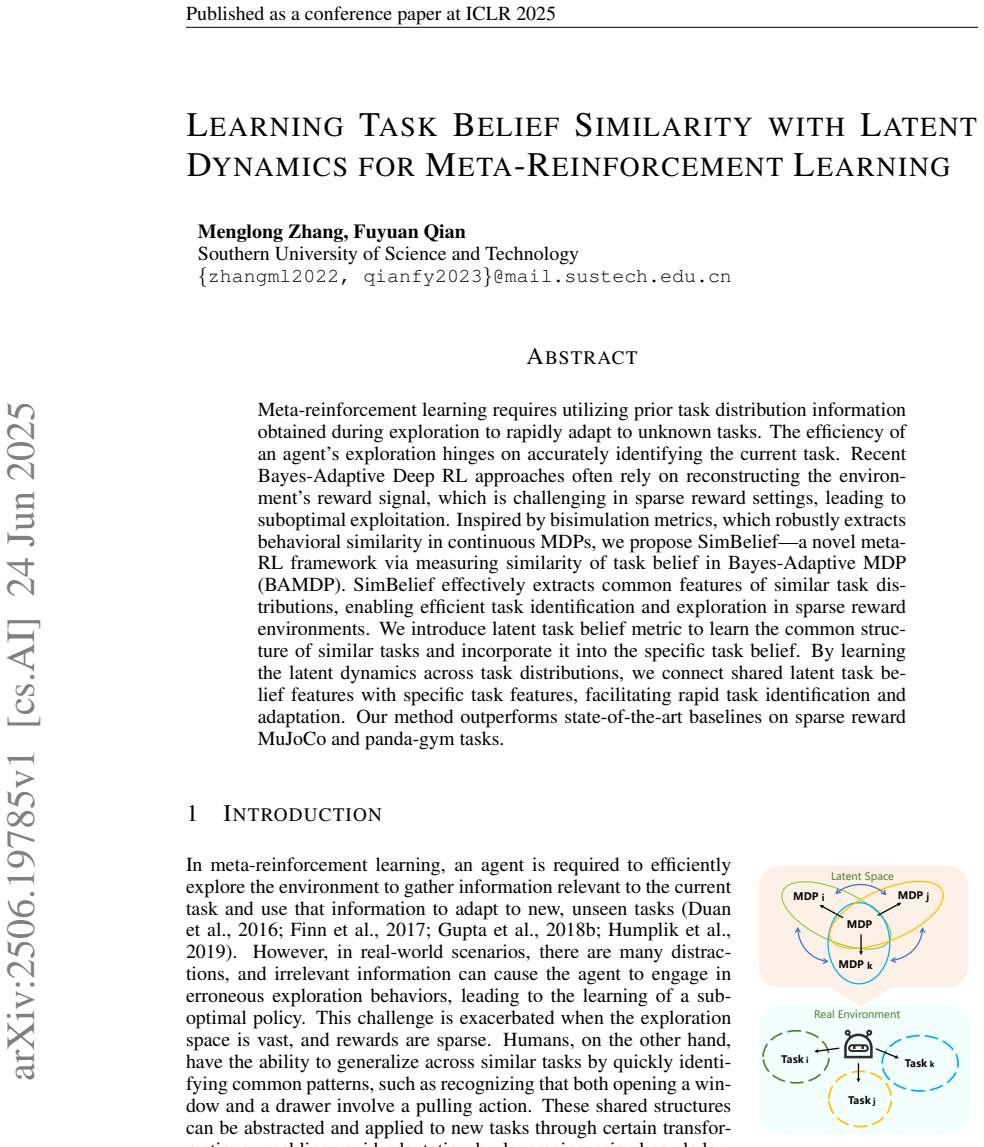
The load-bearing object is the latent task belief metric of Definition 2, $d^\pi(z_i, z_j) = |R_i^\pi(s_i^+, a_i) - R_j^\pi(s_j^+, a_j)| + W_2(d^\pi)(T_i^\pi(s_i^+, a_i), T_j^\pi(s_j^+, a_j)) + \|I_i^\pi(s_i^+, s_i'^+) - I_j^\pi(s_j^+, s_j'^+)\|_1$, evaluated on augmented states $s^+ = (g(s), z)$ in a latent space shared by all tasks. It is a bisimulation-style metric that measures behavioral similarity of task beliefs through one-step predictions of reward, transition, and inverse dynamics, with the 2-Wasserstein distance chosen for its closed-form solution. This metric serves as both the training objective for the belief similarity learner and the quantity the theorems claim bounds value and transfer differences between tasks. The companion mechanism is the Gaussian mixture $b = w_r \mathcal{N}(z_r | \mu_r, \sigma_r^2) + w_l \mathcal{N}(z_l | \mu_l, \sigma_l^2)$, which injects the latent shared-structure belief into the specific task belief so the policy sees global task structure without losing task-specific detail.
What would settle it
Take two tasks that share reward and inverse dynamics but differ only in a transition feature that affects rewards after many steps, with discount factor $\gamma = 0.99$; learn SimBelief's belief metric on them and compare the measured latent distance $d^\pi(z_i, z_j)$ with the actual long-horizon value difference $|V^\pi(s_i^+) - V^\pi(s_j^+)|$. If the value difference systematically exceeds the stated bound, the sufficiency of $z$ or the dropped discount factor is the failure point; a concrete instance would be two sparse-reach tasks whose goals are reached by routes of very different lengths with identical final rewards.
Extended reading notes
Core claim
The central claim is that task similarity in meta-RL is measurable in a shared latent space and that this measurement, not reward reconstruction, should drive task identification. Formally, the paper defines the latent task belief metric $d^\pi(z_i, z_j)$ over augmented states $s^+ = (g(s), z)$ as the sum of an absolute reward difference, a 2-Wasserstein transition difference, and an $\ell^1$ inverse-dynamics difference, and proves $|V^\pi(s_i^+) - V^\pi(s_j^+)| \leq d^\pi(z_i, z_j)$: similar latent beliefs imply similar value functions under the same policy. A second theorem bounds the suboptimality of applying a policy learned on task $M_i$ to task $M_j$ by $\epsilon_R + \gamma(\epsilon_T + \epsilon_I + \|z_i - z_j\|_1) R_{\max}/(2(1-\gamma))$. The agent learns the latent belief from a shared latent dynamics model and blends it with the specific task belief via a Gaussian mixture, so global task structure guides exploration while task-specific detail is preserved; the authors report that this yields superior online adaptation and out-of-distribution generalization compared to belief-based baselines.
Load-bearing premise
The load-bearing premise is that the latent task belief $z$ captures all task-relevant differences and that the discount factor can be set aside, so the measured similarity genuinely bounds value and transfer differences; if the belief misses task information, or if discounted long-horizon rewards matter, the bounds and the claimed adaptation advantage collapse.
Editorial extensions
If this is right
- Task identification in meta-RL can be driven by learned dynamics similarity instead of reward reconstruction, so belief-based adaptation should keep working when rewards are sparse or absent.
- Tasks with close latent beliefs share a policy with bounded value loss, so a success on one task propagates to similar unseen tasks within one or two adaptation episodes.
- Out-of-distribution tasks that land near the training distribution in latent belief space inherit the learned similarity structure, which supports the reported OOD generalization.
- Because the latent belief metric is trained jointly with the policy through SAC, adaptation speed and exploration efficiency improve together rather than being optimized separately.
Reading between the lines
- The dropped discount factor is the hidden hinge: reinserting $\gamma$ into the metric, or testing long-horizon tasks, would likely require discount-weighting the transition and inverse-dynamics terms, and a natural testable extension is to check whether the value bound survives when distant-future rewards dominate.
- Because the transfer bound is linear in $\|z_i - z_j\|_1$, deliberately shaping the belief space with contrastive or triplet losses could make transfer bounds provably smaller for desired groups of tasks, a use the paper does not explore.
- The latent dynamics $p_\theta((s'^+, r, a) | z_l)$ is effectively a task-conditioned world model, so the belief distance could double as an exploration bonus: an agent could be rewarded for visiting states that reduce uncertainty about which latent belief matches the current task.
- If the metric generalizes as claimed, the practical consequence is that similarity of latent dynamics, not reward density, is the right currency for transferring skills between tasks in robotics, matching the paper's opening intuition that pulling open a drawer and pulling open a window should transfer through shared structure.
Signed reviews
Editorial analysis
A structured set of objections, weighed in public.
Referee Report
Summary. The paper proposes SimBelief, a context-based meta-RL method within a Bayes-Adaptive MDP framework. It learns a latent task belief metric d^pi that compares reward, transition, and inverse-dynamics models in a learned latent space, then combines the resulting latent belief with a VAE-based specific-task belief via a Gaussian mixture and trains the policy with SAC. The authors claim state-of-the-art performance on sparse-reward MuJoCo and panda-gym benchmarks, improved out-of-distribution adaptation, and theoretical guarantees given by Theorem 1 (value difference bound) and Theorem 2 (latent transfer bound).
Significance. If the empirical results are reproducible, the paper addresses a relevant problem—sample-efficient adaptation in sparse-reward meta-RL—and the latent-dynamics formulation is a reasonable and potentially useful design. The paper includes ablations of the latent belief and inverse dynamics, OOD evaluations, t-SNE visualizations, and a public code link, all of which are strengths. However, the theoretical claims are not currently supported by the proofs, and the empirical evidence is too sparse (three seeds, no error bars) to substantiate the 'outperforms state-of-the-art' claim. The contribution is therefore conditional on both a repaired theoretical argument and stronger statistical reporting.
major comments (5)
- [Appendix B, Theorem 1 proof (Eq. 16)] The induction step bounds the transition contribution by gamma*W_2(...) plus an inverse-dynamics term and then asserts this equals d^pi(z_i,z_j), relying on 'we disregard the effect of the discount factor gamma'. In a discounted BAMDP this is not a harmless assumption: the fixed-point operator in Lemma 1 includes gamma on the transition term (as in Definition 1), and dropping it changes the metric. The proof also invokes 'the Lipschitz property of the value function' without stating the Lipschitz constant or proving that V^pi is Lipschitz with respect to d^pi. As written, Theorem 1 is unproven.
- [Definition 2 and Eq. (5)] The latent task belief metric d^pi is defined with an inverse-dynamics term, but the proof of Theorem 1 introduces that term only inside the transition bound, without any derivation. More importantly, Eq. (5) optimizes psi_l so that ||psi_l(h_i) - psi_l(h_j)||_1 matches exactly the reward/transition/inverse-dynamics differences appearing in d^pi. Theorem 2 is then expressed in terms of ||z_i - z_j||_1, the same quantity that was trained to equal those dynamics differences. This makes the transfer bound tautological rather than an independent generalization guarantee.
- [Theorem 2 proof, Eq. (21)] Eq. (21) asserts that the combined reward, transition, and inverse-dynamics difference is bounded by epsilon_R + epsilon_T + epsilon_I + ||z_i - z_j||_1. This is precisely the kind of transfer statement the theorem is supposed to prove, and the proof does not derive it from the metric properties established earlier. The final bound also contains an unexplained factor R_max/(2(1-gamma)), and the intermediate step involving ||V*_Mj - (R_max/(2(1-gamma)))1||_infty is not justified. Consequently, Theorem 2 does not provide a formal transfer guarantee as stated.
- [Appendix B, Lemma 1] The fixed-point argument only shows monotonicity and continuity of F; it does not address why W_2(d^pi) is a well-defined operator on the intended space of metrics (e.g., compactness or measurability conditions), nor does it show that the metric realized by the learned psi_l corresponds to the least fixed point. This matters because Eq. (3) uses d^pi inside W_2(d^pi), so the metric's existence and the fixed-point property are load-bearing for Theorem 1.
- [Section 4, Figures 3-4] The main performance claim is based on three random seeds, and no error bars, standard deviations, or per-seed results are reported anywhere in the main text or appendices. With six environments and five baselines, this is insufficient to establish that SimBelief 'consistently performed well' or 'outperforms' the baselines. Please report mean plus/minus standard deviation (or individual seeds) and, where possible, statistical significance tests.
minor comments (5)
- [Appendix A and Appendix G] There are several typos: 'Defination' should be 'Definition', 'WIEGHTS' should be 'WEIGHTS', and the figure captions in G.1/G.2 read 'SimBlief' instead of 'SimBelief'.
- [Main text and Appendix B] Equation numbering is inconsistent: Theorem 1 is Eq. (10) in the main text but Eq. (16) in Appendix B, and Theorem 2 is Eq. (11) in the main text but Eq. (17) in Appendix B. Please unify the numbering.
- [Footnote 2 and Section 3.2] The notation z_i, z_j, and z_l is used interchangeably without a precise definition; this makes Eq. (5) and the policy input in Eq. (9) difficult to parse. Please define each symbol at first use and use one consistent convention throughout.
- [Definition 2 and Appendix B] The transition model is written as T^pi_i(s^+_i, a_i) in Definition 2 but as T^pi_i(s'^+_i | s^+_i, a_i) in the proof of Theorem 1. Please use a consistent conditional-notation convention for transitions and inverse dynamics.
- [Appendix E] The code link (https://github.com/mlzhang-pr/SimBelief) could not be verified from the manuscript alone; please confirm the repository is public and include a reproducibility statement with software versions and random-seed handling.
Circularity Check
The value-difference and transfer bounds in SimBelief reduce to the definition of the latent task belief metric and to the belief-similarity training loss, respectively.
-
self definitional
[Definition 2 (Eq. 3) and Theorem 1 proof, Appendix B (Eq. 16)]
"By the definition of the latent task belief metric d π (z i ,z j ), we know: d π (z i ,z j )=|R π i (s + i ,a i )−R π j (s + j ,a j )|+W 2 (T π i (s + i ,a i ),T π j (s + j ,a j ))+||I π i (s + i ,s′ + i )−I π j (s + j ,s′ + j )|| 1 . We assume that z contains sufficient information about the task differences at the current time step, and we disregard the effect of the discount factor γ during the experiments."
The theorem's RHS is exactly Definition 2 with γ removed. The proof's upper bound is |R_i−R_j|+γW_2(T_i,T_j)+||I_i−I_j||_1; the inverse-dynamics term appears in the 'Lipschitz' step without derivation, and γ is then dropped to make the bound equal d^π. Thus Eq. 16 does not derive a new value-difference result: it states that the V-difference is bounded by the quantity that Definition 2 named as the metric, under an explicit ignore-γ assumption. The central claim that similar latent task beliefs z_i,z_j imply similar value functions is therefore built into the definition and the gamma-dropping assumption rather than established independently.
-
fitted input called prediction
[Eq. 5 (belief similarity objective) and Theorem 2 proof, Eq. 21]
"L bisim (ψ l )=∥ψ l (h i )−ψ l (h j )∥ 1 −|R̂(s + i ,a i )−R̂(s + j ,a j )|−W 2 (T̂(·|s + i ,a i ),T̂(·|s + j ,a j ))−||Î(·|s + i ,s′ + i )−Î(·|s + j ,s′ + j )|| 1 . ... ||T M i (s + i ,a i )−T M j (s + j ,a j )|| 1 +|R M i (s + i ,a i )−R M j (s + j ,a j )|+||I M i (s + i ,s′ + i )−I M j (s + j ,s′ + j )|| 1 ≤ε R +ε T +ε I +∥z i −z j ∥ 1 ."
Eq. 5 is the training objective for ψ_l: it drives the belief distance ∥ψ_l(h_i)−ψ_l(h_j)∥_1 to match exactly the reward, transition-W2, and inverse-dynamics differences, with dynamics gradients stopped. In Theorem 2's proof, Eq. 21 asserts that those same three differences are bounded by ε_R+ε_T+ε_I+∥z_i−z_j∥_1, where z_i,z_j are the learned latent beliefs. This is the zero-loss/converged form of Eq. 5 with approximation errors renamed. The transfer bound is therefore a restatement of what the network was fitted to do, not an independent theorem about transfer: the 'prediction' is forced by the training loss.
full rationale
The empirical comparisons against PEARL, MetaCURE, VariBAD, HyperX, and RL2 are external benchmarks and are not circular; I found no load-bearing self-citation chain. However, the theoretical validation claimed as a contribution in Section 3.4 is circular. Theorem 1's proof equates its upper bound with Definition 2 after adding an inverse-dynamics term and discarding the discount factor, so the value-difference bound is the metric definition under an assumption. Theorem 2's bound is obtained from Eq. 21, which is the converged form of the Eq. 5 fitting loss; the theorem thus 'predicts' a bound that was enforced during training. These reductions affect the paper's central claim that latent task belief similarity theoretically guarantees similar value and transfer behavior. Score 8: the theoretical result is forced by definition and by the fitted objective, although the experimental results retain independent content.
Assumptions & free parameters
free parameters (4)
- Mixture weights w_r and w_l (Eq. 7) =
[0.5, 0.5] chosen after ablation
- KL weight in belief similarity objective (Eq. 8) =
1.0 (Cheetah), 0.1 (others)
- Task embedding size (dimension of z) =
10 (MuJoCo), 5 (panda)
- Distribution offset (Delta_mu, Delta_sigma) =
Learned, no fixed value
assumptions (4)
- ad hoc to paper The latent task belief z_l is a sufficient statistic for task-relevant dynamics and value differences.
- ad hoc to paper The discount factor gamma can be omitted from the latent task belief metric without invalidating the value difference bound.
- domain assumption The learned reward, transition, and inverse dynamics models approximate the true task dynamics well enough that the metric d_pi is a meaningful bisimulation metric.
- ad hoc to paper The inverse dynamics model I is well-defined and its inclusion in the metric preserves the Lipschitz property needed in Theorem 1.
invented entities (3)
-
latent task belief metric d_pi
-
latent task belief b_l in latent space Z
-
specific task belief b_r (VAE posterior)
Cite this review
Pith. "Pith review of Learning Task Belief Similarity with Latent Dynamics for Meta-Reinforcement Learning." pith.science (2026). https://pith.science/paper/LF6QH5KY
@misc{pith2026250619785,
  author       = {Pith},
  title        = {Pith review of: Learning Task Belief Similarity with Latent Dynamics for Meta-Reinforcement Learning},
  year         = {2026},
  howpublished = {\url{https://pith.science/paper/LF6QH5KY}},
  note         = {Machine review of arXiv:2506.19785}
}
read the original abstract
Meta-reinforcement learning requires utilizing prior task distribution information obtained during exploration to rapidly adapt to unknown tasks. The efficiency of an agent's exploration hinges on accurately identifying the current task. Recent Bayes-Adaptive Deep RL approaches often rely on reconstructing the environment's reward signal, which is challenging in sparse reward settings, leading to suboptimal exploitation. Inspired by bisimulation metrics, which robustly extracts behavioral similarity in continuous MDPs, we propose SimBelief-a novel meta-RL framework via measuring similarity of task belief in Bayes-Adaptive MDP (BAMDP). SimBelief effectively extracts common features of similar task distributions, enabling efficient task identification and exploration in sparse reward environments. We introduce latent task belief metric to learn the common structure of similar tasks and incorporate it into the specific task belief. By learning the latent dynamics across task distributions, we connect shared latent task belief features with specific task features, facilitating rapid task identification and adaptation. Our method outperforms state-of-the-art baselines on sparse reward MuJoCo and panda-gym tasks.
Figures


Figures from the paper (13 more)


Reference graph
Works this paper leans on
-
[1]
Hindsight experience replay
Marcin Andrychowicz, Filip Wolski, Alex Ray, Jonas Schneider, Rachel Fong, Peter Welinder, Bob McGrew, Josh Tobin, OpenAI Pieter Abbeel, and Wojciech Zaremba. Hindsight experience replay. Advances in neural information processing systems, 30, 2017
2017
-
[2]
Exploration by random network distillation
Yuri Burda, Harrison Edwards, Amos Storkey, and Oleg Klimov. Exploration by random network distillation. arXiv preprint arXiv:1810.12894, 2018
arXiv 2018
-
[3]
Acting optimally in partially observable stochastic domains
Anthony R Cassandra, Leslie Pack Kaelbling, and Michael L Littman. Acting optimally in partially observable stochastic domains. In Aaai, volume 94, pp.\ 1023--1028, 1994
work page 1994
-
[4]
Scalable methods for computing state similarity in deterministic markov decision processes
Pablo Samuel Castro. Scalable methods for computing state similarity in deterministic markov decision processes. In Proceedings of the AAAI Conference on Artificial Intelligence, pp.\ 10069--10076, 2020
work page 2020
-
[5]
Contrabar: Contrastive bayes-adaptive deep rl
Era Choshen and Aviv Tamar. Contrabar: Contrastive bayes-adaptive deep rl. In International Conference on Machine Learning, pp.\ 6005--6027. PMLR, 2023
work page 2023
-
[6]
Ron Dorfman, Idan Shenfeld, and Aviv Tamar. Offline meta reinforcement learning--identifiability challenges and effective data collection strategies. Advances in Neural Information Processing Systems, 34: 0 4607--4618, 2021
work page 2021
-
[7]
Provably efficient rl with rich observations via latent state decoding
Simon Du, Akshay Krishnamurthy, Nan Jiang, Alekh Agarwal, Miroslav Dudik, and John Langford. Provably efficient rl with rich observations via latent state decoding. In International Conference on Machine Learning, pp.\ 1665--1674. PMLR, 2019
2019
-
[8]
Rl2: Fast reinforcement learning via slow reinforcement learning
Yan Duan, John Schulman, Xi Chen, Peter L Bartlett, Ilya Sutskever, and Pieter Abbeel. Rl2: Fast reinforcement learning via slow reinforcement learning. arXiv preprint arXiv:1611.02779, 2016
arXiv 2016
Show all 60 references
-
[9]
Optimal Learning: Computational procedures for Bayes-adaptive Markov decision processes
Michael O'Gordon Duff. Optimal Learning: Computational procedures for Bayes-adaptive Markov decision processes. University of Massachusetts Amherst, 2002
2002
-
[10]
Challenges of real-world reinforcement learning
Gabriel Dulac-Arnold, Daniel Mankowitz, and Todd Hester. Challenges of real-world reinforcement learning. arXiv preprint arXiv:1904.12901, 2019
1904 arXiv
-
[11]
Metrics for finite markov decision processes
Norm Ferns, Prakash Panangaden, and Doina Precup. Metrics for finite markov decision processes. In UAI, volume 4, pp.\ 162--169, 2004
2004
-
[12]
Model-agnostic meta-learning for fast adaptation of deep networks
Chelsea Finn, Pieter Abbeel, and Sergey Levine. Model-agnostic meta-learning for fast adaptation of deep networks. In International conference on machine learning, pp.\ 1126--1135. PMLR, 2017
2017
-
[13]
Meta learning shared hierarchies
Kevin Frans, Jonathan Ho, Xi Chen, Pieter Abbeel, and John Schulman. Meta learning shared hierarchies. In International Conference on Learning Representations, 2018
2018
-
[14]
panda-gym: Open-source goal-conditioned environments for robotic learning
Quentin Gallou \'e dec, Nicolas Cazin, Emmanuel Dellandr \'e a, and Liming Chen. panda-gym: Open-source goal-conditioned environments for robotic learning. In 4th Robot Learning Workshop: Self-Supervised and Lifelong Learning@ NeurIPS 2021, 2021
2021
-
[15]
Deepmdp: Learning continuous latent space models for representation learning
Carles Gelada, Saurabh Kumar, Jacob Buckman, Ofir Nachum, and Marc G Bellemare. Deepmdp: Learning continuous latent space models for representation learning. In International conference on machine learning, pp.\ 2170--2179. PMLR, 2019
2019
-
[16]
Bayesian reinforcement learning: A survey
Mohammad Ghavamzadeh, Shie Mannor, Joelle Pineau, Aviv Tamar, et al. Bayesian reinforcement learning: A survey. Foundations and Trends in Machine Learning , 8 0 (5-6): 0 359--483, 2015
2015
-
[17]
Equivalence notions and model minimization in markov decision processes
Robert Givan, Thomas Dean, and Matthew Greig. Equivalence notions and model minimization in markov decision processes. Artificial intelligence, 147 0 (1-2): 0 163--223, 2003
2003
-
[18]
Learning action translator for meta reinforcement learning on sparse-reward tasks
Yijie Guo, Qiucheng Wu, and Honglak Lee. Learning action translator for meta reinforcement learning on sparse-reward tasks. In Proceedings of the AAAI Conference on Artificial Intelligence, pp.\ 6792--6800, 2022
2022
-
[19]
Unsupervised meta-learning for reinforcement learning
Abhishek Gupta, Benjamin Eysenbach, Chelsea Finn, and Sergey Levine. Unsupervised meta-learning for reinforcement learning. arXiv preprint arXiv:1806.04640, 2018 a
2018 arXiv
-
[20]
Meta-reinforcement learning of structured exploration strategies
Abhishek Gupta, Russell Mendonca, YuXuan Liu, Pieter Abbeel, and Sergey Levine. Meta-reinforcement learning of structured exploration strategies. Advances in neural information processing systems, 31, 2018 b
2018
-
[21]
Soft actor-critic: Off-policy maximum entropy deep reinforcement learning with a stochastic actor
Tuomas Haarnoja, Aurick Zhou, Pieter Abbeel, and Sergey Levine. Soft actor-critic: Off-policy maximum entropy deep reinforcement learning with a stochastic actor. In International conference on machine learning, pp.\ 1861--1870. PMLR, 2018
2018
-
[22]
Dream to control: Learning behaviors by latent imagination
Danijar Hafner, Timothy Lillicrap, Jimmy Ba, and Mohammad Norouzi. Dream to control: Learning behaviors by latent imagination. arXiv preprint arXiv:1912.01603, 2019
1912 arXiv
-
[23]
Bisimulation makes analogies in goal-conditioned reinforcement learning
Philippe Hansen-Estruch, Amy Zhang, Ashvin Nair, Patrick Yin, and Sergey Levine. Bisimulation makes analogies in goal-conditioned reinforcement learning. In International Conference on Machine Learning, pp.\ 8407--8426. PMLR, 2022
2022
-
[24]
Learning an embedding space for transferable robot skills
Karol Hausman, Jost Tobias Springenberg, Ziyu Wang, Nicolas Heess, and Martin Riedmiller. Learning an embedding space for transferable robot skills. In International Conference on Learning Representations, 2018
2018
-
[25]
Meta reinforcement learning as task inference
Jan Humplik, Alexandre Galashov, Leonard Hasenclever, Pedro A Ortega, Yee Whye Teh, and Nicolas Heess. Meta reinforcement learning as task inference. arXiv preprint arXiv:1905.06424, 2019
1905 arXiv
-
[26]
Notes on state abstractions, 2018
Nan Jiang. Notes on state abstractions, 2018
2018
-
[27]
Towards robust bisimulation metric learning
Mete Kemertas and Tristan Aumentado-Armstrong. Towards robust bisimulation metric learning. Advances in Neural Information Processing Systems, 34: 0 4764--4777, 2021
2021
-
[28]
Auto-encoding variational bayes
Diederik P Kingma. Auto-encoding variational bayes. arXiv preprint arXiv:1312.6114, 2013
2013 arXiv
-
[29]
Meta reinforcement learning with task embedding and shared policy
Lin Lan, Zhenguo Li, Xiaohong Guan, and Pinghui Wang. Meta reinforcement learning with task embedding and shared policy. In Proceedings of the 28th International Joint Conference on Artificial Intelligence, pp.\ 2794--2800, 2019
2019
-
[30]
Parameterizing non-parametric meta-reinforcement learning tasks via subtask decomposition
Suyoung Lee, Myungsik Cho, and Youngchul Sung. Parameterizing non-parametric meta-reinforcement learning tasks via subtask decomposition. Advances in Neural Information Processing Systems, 36: 0 43356--43383, 2023
2023
-
[31]
Decoupling exploration and exploitation for meta-reinforcement learning without sacrifices
Evan Z Liu, Aditi Raghunathan, Percy Liang, and Chelsea Finn. Decoupling exploration and exploitation for meta-reinforcement learning without sacrifices. In International conference on machine learning, pp.\ 6925--6935. PMLR, 2021
2021
-
[32]
Behavior from the void: Unsupervised active pre-training
Hao Liu and Pieter Abbeel. Behavior from the void: Unsupervised active pre-training. Advances in Neural Information Processing Systems, 34: 0 18459--18473, 2021
2021
-
[33]
Policy invariance under reward transformations: Theory and application to reward shaping
Andrew Y Ng, Daishi Harada, and Stuart Russell. Policy invariance under reward transformations: Theory and application to reward shaping. In Icml, volume 99, pp.\ 278--287, 1999
1999
-
[34]
(more) efficient reinforcement learning via posterior sampling
Ian Osband, Daniel Russo, and Benjamin Van Roy. (more) efficient reinforcement learning via posterior sampling. Advances in Neural Information Processing Systems, 26, 2013
2013
-
[35]
Curiosity-driven exploration by self-supervised prediction
Deepak Pathak, Pulkit Agrawal, Alexei A Efros, and Trevor Darrell. Curiosity-driven exploration by self-supervised prediction. In International conference on machine learning, pp.\ 2778--2787. PMLR, 2017
2017
-
[36]
Ride: Rewarding impact-driven exploration for procedurally-generated environments
Roberta Raileanu and Tim Rocktäschel. Ride: Rewarding impact-driven exploration for procedurally-generated environments. In International Conference on Learning Representations, 2020. URL https://openreview.net/forum?id=rkg-TJBFPB
2020
-
[37]
Efficient off-policy meta-reinforcement learning via probabilistic context variables
Kate Rakelly, Aurick Zhou, Chelsea Finn, Sergey Levine, and Deirdre Quillen. Efficient off-policy meta-reinforcement learning via probabilistic context variables. In International conference on machine learning, pp.\ 5331--5340. PMLR, 2019
2019
-
[38]
Residual skill policies: Learning an adaptable skill-based action space for reinforcement learning for robotics
Krishan Rana, Ming Xu, Brendan Tidd, Michael Milford, and Niko S \"u nderhauf. Residual skill policies: Learning an adaptable skill-based action space for reinforcement learning for robotics. In Conference on Robot Learning, pp.\ 2095--2104. PMLR, 2023
2023
-
[39]
Planning to explore via self-supervised world models
Ramanan Sekar, Oleh Rybkin, Kostas Daniilidis, Pieter Abbeel, Danijar Hafner, and Deepak Pathak. Planning to explore via self-supervised world models. In International conference on machine learning, pp.\ 8583--8592. PMLR, 2020
2020
-
[40]
Multi-task reinforcement learning with context-based representations
Shagun Sodhani, Amy Zhang, and Joelle Pineau. Multi-task reinforcement learning with context-based representations. In International Conference on Machine Learning, pp.\ 9767--9779. PMLR, 2021
2021
-
[41]
Reinforcement learning: An introduction
Richard S Sutton. Reinforcement learning: An introduction. A Bradford Book, 2018
2018
-
[42]
Distral: Robust multitask reinforcement learning
Yee Teh, Victor Bapst, Wojciech M Czarnecki, John Quan, James Kirkpatrick, Raia Hadsell, Nicolas Heess, and Razvan Pascanu. Distral: Robust multitask reinforcement learning. Advances in neural information processing systems, 30, 2017
2017
-
[43]
On the likelihood that one unknown probability exceeds another in view of the evidence of two samples
William R Thompson. On the likelihood that one unknown probability exceeds another in view of the evidence of two samples. Biometrika, 25 0 (3-4): 0 285--294, 1933
1933
-
[44]
Visualizing data using t-sne
Laurens Van der Maaten and Geoffrey Hinton. Visualizing data using t-sne. Journal of machine learning research, 9 0 (11), 2008
2008
-
[45]
Optimal transport: old and new, volume 338
C \'e dric Villani et al. Optimal transport: old and new, volume 338. Springer, 2009
2009
-
[46]
Deir: efficient and robust exploration through discriminative-model-based episodic intrinsic rewards
Shanchuan Wan, Yujin Tang, Yingtao Tian, and Tomoyuki Kaneko. Deir: efficient and robust exploration through discriminative-model-based episodic intrinsic rewards. In Proceedings of the Thirty-Second International Joint Conference on Artificial Intelligence, pp.\ 4289--4298, 2023
2023
-
[47]
Latent skill planning for exploration and transfer
Kevin Xie, Homanga Bharadhwaj, Danijar Hafner, Animesh Garg, and Florian Shkurti. Latent skill planning for exploration and transfer. arXiv preprint arXiv:2011.13897, 2020
2011 arXiv
-
[48]
Behavior contrastive learning for unsupervised skill discovery
Rushuai Yang, Chenjia Bai, Hongyi Guo, Siyuan Li, Bin Zhao, Zhen Wang, Peng Liu, and Xuelong Li. Behavior contrastive learning for unsupervised skill discovery. In International Conference on Machine Learning, pp.\ 39183--39204. PMLR, 2023
2023
-
[49]
Improving sample efficiency in model-free reinforcement learning from images
Denis Yarats, Amy Zhang, Ilya Kostrikov, Brandon Amos, Joelle Pineau, and Rob Fergus. Improving sample efficiency in model-free reinforcement learning from images. In Proceedings of the aaai conference on artificial intelligence, pp.\ 10674--10681, 2021
2021
-
[50]
Robust task representations for offline meta-reinforcement learning via contrastive learning
Haoqi Yuan and Zongqing Lu. Robust task representations for offline meta-reinforcement learning via contrastive learning. In International Conference on Machine Learning, pp.\ 25747--25759. PMLR, 2022
2022
-
[51]
Learning invariant representations for reinforcement learning without reconstruction
Amy Zhang, Rowan Thomas McAllister, Roberto Calandra, Yarin Gal, and Sergey Levine. Learning invariant representations for reinforcement learning without reconstruction. In International Conference on Learning Representations, 2021 a
2021
-
[52]
Learning robust state abstractions for hidden-parameter block mdps
Amy Zhang, Shagun Sodhani, Khimya Khetarpal, and Joelle Pineau. Learning robust state abstractions for hidden-parameter block mdps. In International Conference on Learning Representations, 2021 b
2021
-
[53]
Metacure: Meta reinforcement learning with empowerment-driven exploration
Jin Zhang, Jianhao Wang, Hao Hu, Tong Chen, Yingfeng Chen, Changjie Fan, and Chongjie Zhang. Metacure: Meta reinforcement learning with empowerment-driven exploration. In International Conference on Machine Learning, pp.\ 12600--12610. PMLR, 2021 c
-
[54]
What can learned intrinsic rewards capture? In International Conference on Machine Learning, pp.\ 11436--11446
Zeyu Zheng, Junhyuk Oh, Matteo Hessel, Zhongwen Xu, Manuel Kroiss, Hado Van Hasselt, David Silver, and Satinder Singh. What can learned intrinsic rewards capture? In International Conference on Machine Learning, pp.\ 11436--11446. PMLR, 2020
2020
-
[55]
Varibad: A very good method for bayes-adaptive deep rl via meta-learning
Luisa Zintgraf, Kyriacos Shiarlis, Maximilian Igl, Sebastian Schulze, Yarin Gal, Katja Hofmann, and Shimon Whiteson. Varibad: A very good method for bayes-adaptive deep rl via meta-learning. arXiv preprint arXiv:1910.08348, 2019
1910 arXiv
-
[56]
Exploration in approximate hyper-state space for meta reinforcement learning
Luisa M Zintgraf, Leo Feng, Cong Lu, Maximilian Igl, Kristian Hartikainen, Katja Hofmann, and Shimon Whiteson. Exploration in approximate hyper-state space for meta reinforcement learning. In International Conference on Machine Learning, pp.\ 12991--13001. PMLR, 2021
2021
-
[57]
write newline
" write newline "" before.all 'output.state := FUNCTION n.dashify 't := "" t empty not t #1 #1 substring "-" = t #1 #2 substring "--" = not "--" * t #2 global.max substring 't := t #1 #1 substring "-" = "-" * t #2 global.max substring 't := while if t #1 #1 substring * t #2 gl...
-
[58]
@esa (Ref
\@ifxundefined[1] #1\@undefined \@firstoftwo \@secondoftwo \@ifnum[1] #1 \@firstoftwo \@secondoftwo \@ifx[1] #1 \@firstoftwo \@secondoftwo [2] @ #1 \@temptokena #2 #1 @ \@temptokena \@ifclassloaded agu2001 natbib The agu2001 class already includes natbib coding, so you should ...
-
[59]
\@lbibitem[] @bibitem@first@sw\@secondoftwo \@lbibitem[#1]#2 \@extra@b@citeb \@ifundefined br@#2\@extra@b@citeb \@namedef br@#2 \@nameuse br@#2\@extra@b@citeb \@ifundefined b@#2\@extra@b@citeb @num @parse #2 @tmp #1 NAT@b@open@#2 NAT@b@shut@#2 \@ifnum @merge>\@ne @bibitem@firs...
-
[60]
iӆVb ߛuѪZ̮' No` r tVXo+Ra 4ON i]auד/Ut a l B j*f o v1 ZM1 P' i .B e L w`CN` t 翧FS&yDĖ ]
@open @close @open @close and [1] URL: #1 \@ifundefined chapter * \@mkboth \@ifxundefined @sectionbib * \@mkboth * \@mkboth\@gobbletwo \@ifclassloaded amsart * \@ifclassloaded amsbook * \@ifxundefined @heading @heading NAT@ctr thebibliography [1] @ \@biblabel @NAT@ctr \@bibset...
2021
Reviewed August 15, 2026 · model on record in the stance chip above.
Discussion (0). Continue with ORCID to comment.