REVIEW 4 major objections 3 minor 31 references
Entangled Quantum Negative Energy Teleportation as a Probe of Semiclassical Gravity
T0 review · 4 major / 3 minor · reviewed 2026-08-06 · deepseek-v4-flash
Pith's one-line read The paper claims that quantum energy teleportation can create localized negative energy whose semiclassical gravitational effects are detectable with atomic clocks, and proposes a traveling curvature pulse as a warp-drive alternative.
desk verdict Good question, broken arithmetic: the paper's detectability claims collapse on the missing c^4 in the curvature conversion and a dimensionally invalid clock formula. read the letter →
The pith
A machine-rendered reading of the paper's core claim, the machinery that carries it, and where it could break.
The reading
What carries the argument
The load-bearing identity is the linearized semiclassical Einstein equation $\delta R(x) = -8\pi G \langle T_{00}(x)\rangle$, which turns an assumed Gaussian negative-energy pulse into a spatial curvature dip. The second piece of machinery is the parametric SNR formula $\mathrm{SNR} \sim (N/d^3)(F/\pi)G_{\mathrm{ent}}G_{\mathrm{shape}}G_{\mathrm{multi}} (1/\sqrt{f})e^{-r}G_{\mathrm{noise}}$, which translates array geometry, cavity finesse, squeezing, and repetition rate into a detection verdict against the noise floor $\sigma_R$.
What would settle it
Compute the renormalized $\langle T_{00}\rangle$ for the QET protocol with the parameters of Table 3, or measure the curvature noise floor of a clock or interferometer array; if the computed peak energy density falls below about $10^{-11}$ J/m$^3$, or the measured $\sigma_R$ exceeds about $10^{-35}$ m$^{-2}$, then no $N\sim10$–$100$ array reaches SNR $>1$ and the central detection claim fails.
Extended reading notes
Core claim
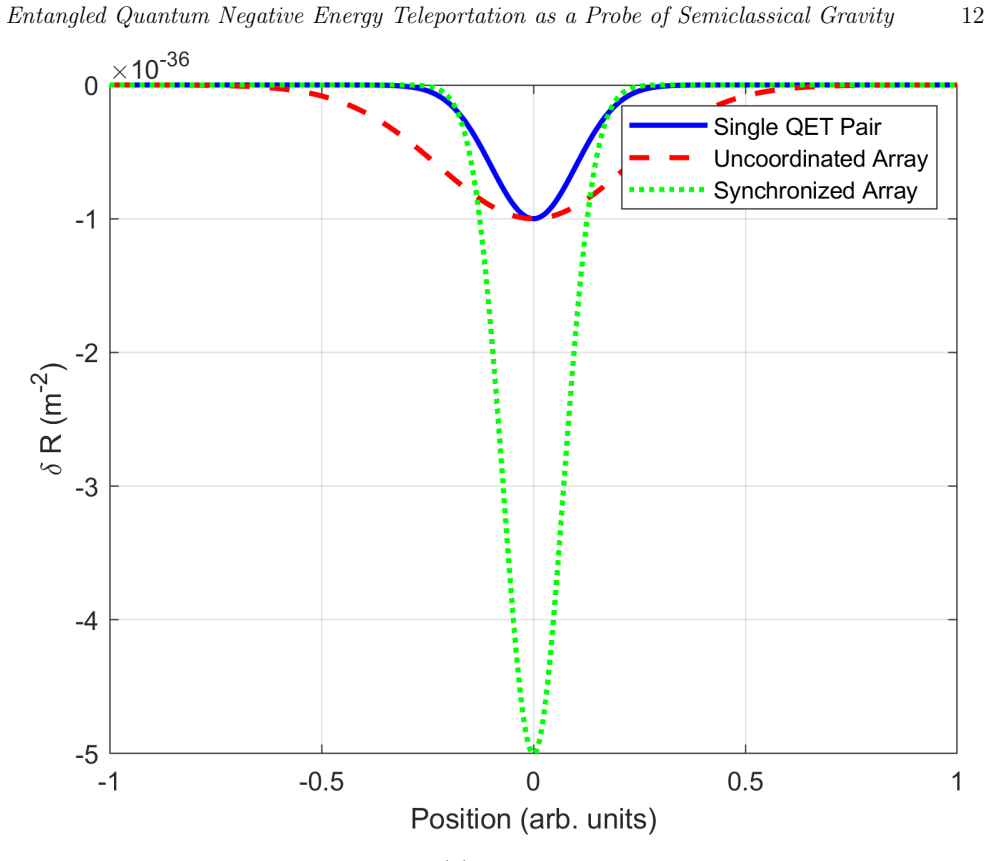
On the paper's own terms, the core discovery is that the stress-energy left behind by a QET sequence—negative energy density concentrated between the two parties—acts through the semiclassical Einstein equation as a transient source of Ricci curvature. The paper claims each entangled pair contributes a curvature dip of order $\delta R_0 \sim 10^{-36}$ m$^{-2}$, that coherent arrays of $N \sim 10$\u2013$100$ synchronized pairs accumulate this into $\delta R \sim N \delta R_0$, and that with a curvature noise floor $\sigma_R \sim 10^{-35}$ m$^{-2}$ this crosses the SNR $=1$ detection threshold. It further argues that the cleanest observable is atomic clock drift, with fractional shifts $\Delta\tau/\tau$ from $10^{-21}$ to $10^{-17}$ against a $10^{-18}$ stability floor, and that timed arrays can produce a moving, sub-luminal curvature dip (the Quantum-Curvature Compression Channel) without requiring the exotic static stress-energy of warp bubbles.
Load-bearing premise
The paper assumes, without deriving it from the QET Hamiltonian, that each quantum energy teleportation pulse produces a smooth, bell-shaped lump of negative energy about $10^{-11}$ J/m$^3$ with a spread of about a decimetre, and that the detector noise floor for curvature is about $10^{-35}$ m$^{-2}$; if either assumption is wrong, the predicted signals and the required array sizes change accordingly.
Editorial extensions
If this is right
- Atomic clock readouts would see fractional time shifts of $10^{-21}$ to $10^{-17}$, above the $10^{-18}$ stability of current optical clocks, using $N \sim 10$\u2013$100$ synchronized QET pairs.
- A synchronized QET array would produce a measurable curvature dip $\delta R \sim 10^{-35}$ m$^{-2}$ or larger, which would be the first controlled laboratory signal sourced by quantum stress-energy.
- Interferometric phase shifts $\Delta \phi \sim 2\pi \delta R L^2/\lambda$ and strain $h \sim \delta R L^2$ provide independent cross-checks, with strain detection remaining a next-generation prospect.
- The parametric model identifies concrete engineering targets: detector spacing near the smearing scale, finesse $10^2$\u2013$10^5$, squeezing $r \sim 1.5$, and repetition near $10^5$ Hz.
- Timed QET gates can form a sub-luminal traveling curvature packet (QIX-C), offering a causal laboratory analogue of warp-bubble geometry rather than a superluminal drive.
Reading between the lines
- A decisive test of the paper's forecast would be a first-principles calculation of $\langle T_{00}\rangle$ from the Unruh–DeWitt Hamiltonian (Eq. 2) to see whether the Gaussian ansatz of Eq. (3) holds at the assumed $\epsilon \sim 10^{-11}$ J/m$^3$ scale.
- If atomic clock arrays see this signal, it would be the first observed gravitational response to engineered negative energy, giving a tabletop window into energy-condition violations and the validity of semiclassical gravity.
- The QIX-C propagation mechanism, if confirmed in simulations with 3+1 dimensional retarded Green's functions, could be used to study whether synchronized entanglement operations can achieve geodesic compression without superluminality.
- Including stochastic stress-tensor fluctuations, which the paper lists as future work, would let the noise floor $\sigma_R$ be predicted rather than assumed, potentially moving the required array size up or down.
Signed reviews
Editorial analysis
A structured set of objections, weighed in public.
Referee Report
Summary. This paper proposes a tabletop experimental platform, QIX, in which quantum energy teleportation (QET) between entangled detectors creates localized negative energy densities whose semiclassical gravitational backreaction is to be observed with atomic clocks, interferometers, and strain sensors. The manuscript models the negative-energy profile as a Gaussian, converts it to Ricci curvature through a linearized semiclassical relation, defines signal-to-noise ratios and clock-drift observables, and claims that arrays of N ~ 10–100 QET units could yield SNR > 1 and clock signals at the 1e-21 to 1e-17 level. It also introduces a speculative extension, the Quantum-Curvature Compression Channel (QIX-C), as a possible testbed for engineered spacetime curvature.
Significance. If the quantitative claims were correct, the work would present a provocative laboratory route toward testing semiclassical gravity with engineered quantum states. The manuscript is transparent about its modeling assumptions and provides explicit parameter tables and simulation descriptions, which is a strength. However, the central numerical conclusions are undermined by load-bearing errors: a missing 1/c^4 prefactor in the gravitational coupling, a dimensionally inconsistent clock-drift formula, and an SNR model whose claimed derivation is not present. These errors affect the core detectability claims, so the paper in its current form does not support its advertised sensitivity.
major comments (4)
- [Appendix B.2, Eq. (B.2); Eq. (13); Eq. (A.3)] The linearized semiclassical relation is applied with the wrong SI prefactor. The Ricci-scalar response to an energy density should be δR = (8πG/c^4)|<T00>|, not δR = 8πG|<T00>|. With the fiducial value ε ~ 1e-11 J/m^3 quoted in Appendix B.4, the resulting curvature is about 2e-54 m^{-2}, roughly 18 orders of magnitude below the claimed δR0 ~ 1e-36 m^{-2}; reaching δR0 would require ε ~ 5e6 J/m^3 rather than a sub-eV-scale density. This error propagates into Eq. (8), Eq. (13), Table 4, and all SNR and clock-detectability claims in Section V.D.
- [Eq. (17) / Eq. (A.4)] The clock-drift formula δτ/τ ≈ (1/12)δR L^2 Δt is dimensionally inconsistent: δR L^2 is dimensionless, so multiplying by Δt produces a quantity with units of seconds, while the left-hand side is a dimensionless fractional shift. Inserting the paper's own values (δR ~ 1e-36 m^{-2}, L = 1 mm, Δt = 1 ms) gives about 1e-47 seconds, and restoring the missing 1/c^2 factor still leaves a dimensionless value near 1e-47, not the 1e-21 to 1e-17 signals listed in Table 6. The clock-based feasibility conclusion therefore does not follow from the stated model.
- [Section IV / Appendix A.4] The parametric SNR model, Eq. (5), is asserted rather than derived. The text states that a full derivation, including Green's function integration of the semiclassical equations, appears in Appendix A, but Appendix A.4 only restates Eq. (5) without deriving it. No Green's function solution of Eq. (4) is written, and the functional dependences on N/d^3, F/π, and e^{-r} are not obtained from any calculation. Since the SNR contours in Figures 2, 4, and 11 are all generated from Eq. (5), the numerical sensitivity conclusions lack supporting derivation.
- [Eq. (3) / Appendix B.1] The Gaussian negative-energy profile <T00(x,t)> ≈ -ε exp(...) is assumed ab initio; it is not computed from the QET interaction Hamiltonian in Eq. (2), the Unruh-DeWitt switching functions, or the detector parameters. Consequently the amplitude ε used in Appendix B.4 is an input to the analysis, not an output of a QET calculation, and every derived curvature profile, SNR contour, and detectability estimate inherits this unverified ansatz. This issue would remain even after correcting the prefactor and dimensional errors above.
minor comments (3)
- [Section I / Section IX] There are several typographical errors, including 'Section VIII provides a a speculative extension' and 'In Sections VIII' where the singular is intended.
- [Acknowledgments] The sentence 'Computations were performed using Computations and simulations were performed using MATLAB' is garbled and should be corrected.
- [References] Reference [29] is listed as 'in review' and is used as a foundation for the present framework; the manuscript should clearly flag that this prior work is not yet available for independent verification.
Circularity Check
The central detectability claim reduces to assumed inputs: δR0 is fixed by a chosen ε in App. B.4, σ_R is chosen in Sec. V.D, and SNR>1 for N~10–100 is then just arithmetic (N δR0/σ_R > 1). The promised derivation of the SNR formula in App. A.4 merely restates the formula.
-
fitted input called prediction
[Sec. V.D (Eq. 9), Sec. V.B (Eq. 8), App. B.4]
""SNR = δR(N)/σ_R" (Eq. 9); "δR(N) ∼ N·δR0" (Eq. 8); "Detection requires SNR>1, achievable with modest arrays of N∼10−100 entangled units using current or near-future technology." App. B.4: "We assume a fiducial energy scale ϵ∼10−11 J/m3, yielding curvature amplitudes δR peak ∼10−36 m−2.""
The detection threshold is computed entirely from two assumed numbers: δR0 is set by choosing ε in App. B.4, and σ_R∼10−35 m−2 is asserted as a 'representative noise floor' in Sec. V.D. With SNR=NδR0/σ_R, the condition SNR>1 becomes N>σ_R/δR0≈10. The advertised N∼10–100 detectability is therefore a restatement of the chosen inputs, not an independently derived prediction. No measurement, external benchmark, or derivation from the QET Hamiltonian fixes these values; changing the assumed ε or σ_R would change the 'prediction' linearly.
-
other
[Sec. IV Eq. (5) and App. A.4]
"Main text: "Full derivation of Eq. 5, including Gaussian modeling of the curvature response and Green’s function integration of the semiclassical Einstein equations, is provided in Appendix Appendix A." Appendix A.4: "These effects combine approximately as: SNR∼... This formula captures the leading parametric dependencies...""
The appendix that is cited as containing the full derivation does not derive the formula: it restates the same equation and adds qualitative remarks about each factor. The SNR law is thus supported by an internal reference that reduces to the formula itself. This is not a derivation from the Gaussian curvature response or Green's functions; it is an asserted ansatz presented as its own justification.
1 more flagged steps
-
self citation load bearing
[Sec. I and Ref. [29]; App. B.1]
""This study builds upon and extends theoretical models introduced in [29], incorporating new signal-to-noise analyses and experimental designs." Ref. [29]: "D. S. Zachary, 'Entanglement-Induced Signatures in Vacuum Energy: Bell, Casimir, and Squeezing Correlations,' Foundations of Physics, in review (2025).""
The theoretical model that underlies the Gaussian negative-energy profile and its magnitude is attributed to the author's own unpublished, in-review paper. No external, machine-checked, or otherwise independent derivation or benchmark is provided for that model. The central curvature amplitude therefore depends on a self-citation chain: [29] provides the model, App. B.1/B.4 supplies the numerical amplitude, Sec. V converts it into a detectability claim. Because [29] is by the same author and not yet published, it does not constitute independent evidence for the load-bearing premise.
full rationale
The paper's central numerical claims are not outputs of a first-principles derivation; they are choices. Appendix B.4 states 'We assume a fiducial energy scale ϵ∼10−11 J/m3, yielding curvature amplitudes δR_peak ∼10−36 m−2,' and Section V.D assumes a noise floor σ_R∼10−35 m−2. With SNR defined as δR(N)/σ_R and δR(N)=N δR0, the claimed N∼10–100 detectability follows by construction from these two inputs. Separately, the relation between ε and δR0 appears arithmetically unsupported even on the paper's own terms: using the stated SI constants, 8πGε is about 10−20 m−2 (and the correct linearized expression adds 1/c^4, giving about 10−54 m−2), not 10−36 m−2; this is a correctness risk that reinforces that δR0 is asserted rather than derived. The SNR formula of Eq. (5) is promised to be derived in Appendix A, but the appendix merely restates it. The self-citation [29], an unpublished in-review paper by the same author, is invoked as the basis of the theoretical model. These elements together make the advertised experimental sensitivity a restatement of assumed parameters rather than a falsifiable prediction; however, the paper does contain independent conceptual content (e.g., QET protocols from Hotta, atomic-clock noise floors, architecture suggestions), so the circularity is substantial but not total. An independent measurement or externally derived value of ε or σ_R would be needed to give the detectability claim predictive content.
Assumptions & free parameters
free parameters (5)
- epsilon (negative energy density magnitude) =
~1e-11 J/m^3
- delta_R0 (single-pair curvature) =
~1e-36 m^-2
- sigma_R (curvature noise floor) =
~1e-35 m^-2
- G_ent, G_shape, G_multi, G_noise =
2-10, 2-5, 2-3, 1
- squeezing parameter r and repetition rate f =
r = 1.5, f = 1e5 Hz
assumptions (3)
- domain assumption Semiclassical Einstein equation G_mu_nu = 8 pi G <T_mu_nu>
- ad hoc to paper Gaussian ansatz for <T00> (Eq. 3)
- ad hoc to paper Local curvature relation delta_R = -8 pi G <T00> (Eq. 13)
invented entities (1)
-
Quantum-Curvature Compression Channel (QIX-C)
Cite this review
Pith. "Pith review of Entangled Quantum Negative Energy Teleportation as a Probe of Semiclassical Gravity." pith.science (2026). https://pith.science/paper/CCDVSBEQ
@misc{pith2026250619878,
  author       = {Pith},
  title        = {Pith review of: Entangled Quantum Negative Energy Teleportation as a Probe of Semiclassical Gravity},
  year         = {2026},
  howpublished = {\url{https://pith.science/paper/CCDVSBEQ}},
  note         = {Machine review of arXiv:2506.19878}
}
read the original abstract
We investigate the generation of semiclassical spacetime curvature via localized negative energy densities created by quantum energy teleportation (QET) and Casimir-enhanced confinement. Using realistic noise models and experimental architectures, we compute signal-to-noise ratios for detecting the resulting Ricci curvature via atomic clocks, interferometry, and optomechanical strain readout. We propose synchronization and squeezing strategies to enhance detectability and simulate spatial curvature profiles from focused QET pulses. Finally, we introduce a speculative framework -- the Quantum-Curvature Compression Channel -- as an experimentally motivated alternative to warp-drive geometries, enabling apparent geodesic compression through synchronized quantum energy operations. Our results clarify the experimental path toward laboratory tests of exotic stress-energy and semiclassical gravity effects.
Figures


Figures from the paper (10 more)



Reference graph
Works this paper leans on
-
[29]
Entanglement-Induced Signatures in Vacuum Energy: Bell, Casimir, and Squeezing Correlations,
D. S. Zachary, “Entanglement-Induced Signatures in Vacuum Energy: Bell, Casimir, and Squeezing Correlations,”Foundations of Physics, in review (2025)
work page 2025
-
[1]
The warp drive: hyper-fast travel within general relativity,
M. Alcubierre, “The warp drive: hyper-fast travel within general relativity,” *Class. Quantum Grav.*11, L73–L77 (1994), doi:10.1088/0264-9381/11/5/001
-
[2]
C. Barcel´ o, S. Liberati, and M. Visser, “Analogue gravity,” Living Rev. Relativity14, 3 (2011)
work page 2011
-
[3]
A. Blais, R.-S. Huang, A. Wallraff, S. M. Girvin, and R. J. Schoelkopf, “Cavity quantum electrodynamics for superconducting electrical circuits: An architecture for quantum computation,”Phys. Rev. A69, 062320 (2004)
work page 2004
-
[4]
Circuit quantum electrodynamics,
A. Blais, A. L. Grimsmo, S. M. Girvin, and A. Wallraff, “Circuit quantum electrodynamics,” inQuantum Information Processing(Springer, 2021), pp. 1-137
work page 2021
-
[5]
N. D. Birrell and P. C. W. Davies, *Quantum Fields in Curved Space*, Cambridge University Press, 1982
work page 1982
-
[6]
A primer on energy conditions,
E. Curiel, “A primer on energy conditions,” in *The Routledge Companion to the Philosophy of Physics*, E. Knox and A. Wilson (eds.), Routledge (2022)
work page 2022
-
[7]
Quantum gravity: the new synthesis,
B. S. DeWitt, “Quantum gravity: the new synthesis,” in *General Relativity: An Einstein Centenary Survey*, S. W. Hawking and W. Israel (eds.), Cambridge University Press, 1979, pp. 680–745
work page 1979
Show all 31 references
-
[8]
Superconducting Circuits for Quantum Information: An Outlook,
M. H. Devoret and R. J. Schoelkopf, “Superconducting Circuits for Quantum Information: An Outlook,” *Science*339, 1169 (2013)
2013
-
[9]
Null energy conditions in quantum field theory,
C. J. Fewster and T. A. Roman, “Null energy conditions in quantum field theory,” Phys. Rev. D72, 044023 (2005)
2005
-
[10]
Constraints on negative-energy fluxes,
L. H. Ford, “Constraints on negative-energy fluxes,” Phys. Rev. D43, 3972 (1991)
1991
-
[11]
Quantum field theory constrains traversable wormhole geometries,
L. H. Ford, “Quantum field theory constrains traversable wormhole geometries,”Phys. Rev. D51, 1692 (1995), doi:10.1103/PhysRevD.51.1692
1995 doi
-
[12]
Restrictions on negative energy density in flat spacetime,
L. H. Ford and T. A. Roman, “Restrictions on negative energy density in flat spacetime,” *Phys. Rev. D* 41, 3662 (1990), doi:10.1103/PhysRevD.41.3662
1990 doi
-
[13]
Quantum field theory constrains traversable wormhole geometries,
L. H. Ford and T. A. Roman, “Quantum field theory constrains traversable wormhole geometries,” Phys. Rev. D53, 5496 (1996)
1996
-
[14]
Restrictions on negative energy density in flat spacetime,
L. H. Ford and T. A. Roman, “Restrictions on negative energy density in flat spacetime,”Phys. Rev. D55, 2082 (1997), doi:10.1103/PhysRevD.55.2082
1997 doi
-
[15]
Quantum energy teleportation: An introductory review,
M. Hotta, “Quantum energy teleportation: An introductory review,” Phys. Lett. A372, 5671 (2008)
2008
-
[16]
Controlled Hawking Process by Quantum Energy Teleportation,
M. Hotta, “Controlled Hawking Process by Quantum Energy Teleportation,” Phys. Rev. D79, 045006 (2009)
2009
-
[17]
Colloquium: Quantum interference of clusters and molecules,
K. Hornberger et al., “Colloquium: Quantum interference of clusters and molecules,” Rev. Mod. Phys.84, 157 (2012)
2012
-
[18]
Charge-insensitive qubit design derived from the Cooper pair box,
J. Koch et al., “Charge-insensitive qubit design derived from the Cooper pair box,” Phys. Rev. A76, 042319 (2007)
2007
-
[19]
Gravita- tional wave detection with optical lattice atomic clocks,
S. Kolkowitz, I. Pikovski, N. Langellier, M. D. Lukin, R. L. Walsworth, and J. Ye, “Gravita- tional wave detection with optical lattice atomic clocks,” *Phys. Rev. D*94, 124043 (2016), doi:10.1103/PhysRevD.94.124043
2016 doi
-
[20]
Optical atomic clocks,
A. D. Ludlow, M. M. Boyd, J. Ye, E. Peik, and P. O. Schmidt, “Optical atomic clocks,”Rev. Mod. Phys. 87, 637–701 (2015)
2015
-
[21]
Cool horizons for entangled black holes,
J. Maldacena and L. Susskind, “Cool horizons for entangled black holes,” *Fortsch. Phys.*61, 781–811 (2013), doi:10.1002/prop.201300020, arXiv:arXiv:1306.0533
2013 arXiv
-
[22]
Harvesting correlations from the quantum vacuum,
E. Mart ´ ın-Mart ´ ınez, A. Dragan, and R. B. Mann, “Harvesting correlations from the quantum vacuum,” Phys. Rev. D88, 064028 (2013)
2013
-
[23]
MATLAB, version 24.1.0 (R2024a), The MathWorks, Inc., Natick, Massachusetts, 2024
2024
-
[24]
C. W. Misner, K. S. Thorne, and J. A. Wheeler,Gravitation, W. H. Freeman, San Francisco, 1973
1973
-
[25]
Testing Born’s rule in quantum mechanics with a triple slit experiment,
U. Sinha et al., “Testing Born’s rule in quantum mechanics with a triple slit experiment,” Science329, 418 (2010)
2010
-
[26]
Visser, *Lorentzian Wormholes: From Einstein to Hawking*, (Springer, 1996)
M. Visser, *Lorentzian Wormholes: From Einstein to Hawking*, (Springer, 1996)
1996
-
[27]
Traversable wormholes with arbitrarily small energy condition violations,
M. Visser, S. Kar, and N. Dadhich, “Traversable wormholes with arbitrarily small energy condition violations,” Phys. Rev. Lett.90, 201102 (2003)
2003
-
[28]
Proving the achronal averaged null energy condition from the generalized second law,
A. C. Wall, “Proving the achronal averaged null energy condition from the generalized second law,” Phys. Rev. D81, 024038 (2010). Entangled Quantum Negative Energy Teleportation as a Probe of Semiclassical Gravity27
2010
-
[30]
ChatGPT (June 2025 version),
OpenAI, “ChatGPT (June 2025 version),”https://chat.openai.com, accessed June 2025
2025
-
[31]
GPT-4 Technical Report,
OpenAI, “GPT-4 Technical Report,” arXiv:2303.08774 (2023), arXiv:2303.08774
2023 arXiv
Reviewed August 6, 2026 · model on record in the stance chip above.
Discussion (0). Continue with ORCID to comment.