REVIEW 2 major objections 4 minor 223 references
Machine-Learning-Assisted Photonic Device Development: A Multiscale Approach from Theory to Characterization
T0 review · 2 major / 4 minor · reviewed 2026-08-06 · deepseek-v4-flash
Pith's one-line read A single Bayesian objective can unify the five steps of photonic device development, from theory to measurement, with each ML technique mapped to one factor of the objective.
desk verdict Useful five-step review of ML for photonics, but the unifying Bayesian objective optimizes measurement parameters and needs a constraint or clarification. read the letter →
The pith
A machine-rendered reading of the paper's core claim, the machinery that carries it, and where it could break.
The reading
What carries the argument
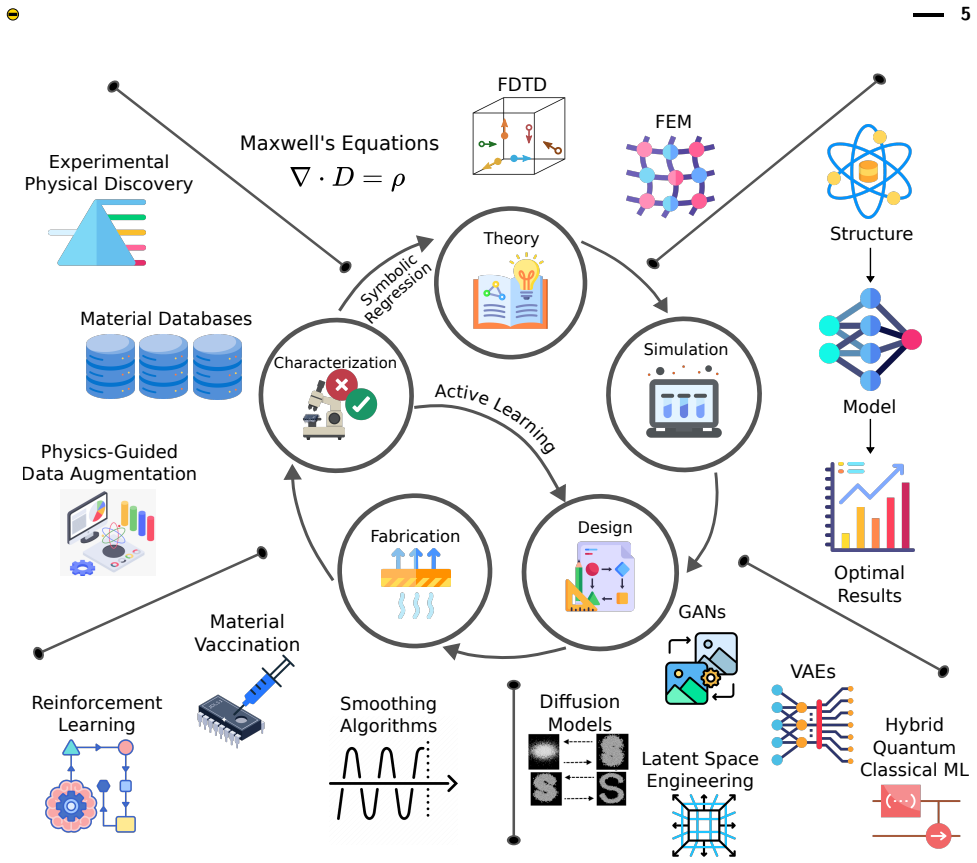
The central object is the ML-PDD objective of Eq. 3, a nested expectation that couples three probability distributions — the design generator $p_\theta(x)$, the fabrication kernel $r_\eta(\chi|x)$, and the measurement distribution $m_\rho(\upsilon|\chi)$ — with a figure of merit $\hat{f}$ evaluated on a finite noisy sample. This object does the argument's work: it states what end-to-end optimization would mean, and it supplies the paper's organizing taxonomy, in which generative models estimate the design and fabrication factors and discriminative models estimate the conditional response and measurement maps. To keep the objective tractable, the paper explicitly isolates and optimizes the five steps one at a time, treating simulated performance as ground truth in inverse design and adding fabrication and measurement factors only when moving to later sections.
What would settle it
Fabricate the same nominal design with two different fabrication processes and measure it with two different instruments, then compare a model that factorizes the pipeline as design, fabrication, and measurement against a model that lets fabrication error depend on the design; if the interactive model predicts the held-out measured figures of merit substantially better, the decoupled objective of Eq. 3 is misleading rather than helpful.
Extended reading notes
Core claim
The paper's central claim is that the entire photonic device development process reduces to a single expected-figure-of-merit maximization, written in Eq. 3 as the maximum over design parameters $\theta$, fabrication parameters $\eta$, and measurement parameters $\rho$ of the expectation $\mathbb{E}_{x \sim p_\theta(x)}[\mathbb{E}_{\chi \sim r_\eta(\chi|x)}[\mathbb{E}_{\upsilon \sim m_\rho(\upsilon|\chi)}[\hat{f}(\Upsilon)]]]$, where $x$ is an intended design, $\chi$ a fabricated device, $\upsilon$ a noisy measurement, and $\hat{f}$ a figure of merit estimated from a finite set of measurements $\Upsilon$. The five classical steps of PDD are each a factor of this chain: theory supplies the map $x \mapsto y(x)$, simulation provides or approximates the numerical response, the design step is the choice of $p_\theta$, fabrication is the kernel $r_\eta$, and characterization is the estimation of $\hat{f}$ from $m_\rho$. The review argues that every ML method it surveys — surrogate forward simulators, generative and latent-space design, reinforcement learning for fabrication, active and hypothesis learning for experiment — is best understood as a tool for estimating or optimizing one piece of this single objective.
Load-bearing premise
The framework assumes the five steps of photonic device development can be isolated and optimized one at a time, so that the error introduced during fabrication and the noise of measurement do not depend on the design in ways that a stepwise optimization would miss.
Editorial extensions
If this is right
- If Eq. 3 is the correct objective, then improving any one factor — a lower-noise measurement process, a tighter fabrication kernel, a better design generator — raises the expected figure of merit of the final device, giving a principled reason to allocate effort across the pipeline.
- Inverse design with a surrogate simulator becomes a special case of the objective in which the fabrication and measurement factors are dropped, so existing neural-network design results are recovered as the isolated $\theta$-optimization step.
- Fabrication-aware and measurement-aware design, such as designing against fabrication errors or training on noisy data, are the same operation: coupling the design generator to the corresponding kernel instead of optimizing against simulated response alone.
- The framework casts characterization as an inference problem — estimating the FOM from a finite, noisy sample — which justifies active learning and physics-informed data augmentation as components of the objective rather than external tricks.
Reading between the lines
- A testable extension of the paper's framing would be to optimize the three parameter sets $\theta$, $\eta$, $\rho$ jointly on a single device platform; the review's own isolation assumption suggests this is where the framework would break if it is going to, since it would expose couplings between design and fabrication error.
- If fabrication error depends on the design in ways that cannot be learned from the marginal fabrication data, the decoupled objective would mislead rather than help; a concrete check is to compare a factorized model against a jointly fitted model on held-out fabrication–measurement pairs.
- The framework points to a missing scientific infrastructure: community-wide datasets of fabricated and measured photonic devices, which the review identifies as a gap, would be precisely the data needed to learn the kernels $r_\eta$ and $m_\rho$ that make Eq. 3 operational.
- A natural benchmark would compare end-to-end expected-FOM optimization against the isolated stepwise baseline on a real fabrication run, quantifying the practical value of the unified objective.
Editorial analysis
A structured set of objections, weighed in public.
Referee Report
Summary. This review paper proposes a five-step decomposition of photonic device development (theory, simulation, design, fabrication, characterization) and frames machine-learning-assisted PDD (ML-PDD) through a single Bayesian objective (Eq. 3), in which a generative design distribution pθ, a fabrication process rη, and a measurement distribution mρ are jointly optimized to maximize an expected figure of merit. The subsequent sections survey ML techniques for each step: symbolic regression and explainable ML for theory, surrogate and generative models for simulation, VAEs/GANs/diffusion/RL/quantum methods for design, stochastic and RL-based fabrication corrections, and characterization via data augmentation and active learning. The paper concludes with an outlook on hybrid quantum-classical methods and community databases.
Significance. The paper is a broad and current review that provides a useful taxonomy of ML methods across the photonic device lifecycle. Its strengths include the explicit probabilistic notation, the coverage of recent generative and quantum-hybrid approaches, and the attempt to place all five steps in a common framework. If Eq. (3) were a valid objective, it would give practitioners a principled way to coordinate design, fabrication, and measurement; the review also highlights concrete open problems such as data scarcity and the lack of community datasets. No code or machine-checked proofs are involved, so the contribution is organizational and pedagogical rather than a new algorithm.
major comments (2)
- [Section 1.2, Eq. (3)] The objective is stated as arg max over θ, η, ρ of E_{x∼pθ}[E_{χ∼rη}[E_{υ∼mρ}[fhat(Υ)]]], where Υ is a finite sample from the measurement distribution mρ. Because ρ is included in the outer maximization and fhat is a function of the measured response, the objective is maximized by a measurement that reports values close to the ideal response y*, regardless of the fabricated device. For example, with mρ(υ|χ)=δ(υ−(χ+ρ)) and fhat(Υ)=−||mean(Υ)−y*||^2, the optimal choice is ρ=y*−χ, giving a perfect FOM for every device. The statement in Section 1.2 that 'assumptions are made on the fidelity of measurements' does not exclude this, and Section 6, which treats characterization as inference, never imposes a fixed or unbiased measurement model inside Eq. (3). Thus the unified objective as written is not a valid characterization of device performance; it needs either a constraint that mρ is a known, unbiased measurement model, or removal of ρ from the optimization over the FOM.
- [Section 1.2, Eq. (3) and following paragraph] The objective is introduced as a single joint optimization, but the paragraph immediately states that 'Steps are isolated and optimized.' As written, Eq. (3) optimizes θ, η, and ρ jointly, while the rest of the review treats each step separately. This tension is not merely expositional: it determines whether Eq. (3) is a literal training objective or an organizational device. The paper should state which is intended; if it is organizational, the notation 'arg max' over all three parameters is misleading.
minor comments (4)
- [Section 4.2, Eq. (4)] The notation qθ(z) is used without defining it after the encoder qθ(z|x) is introduced. Please define the latent-space distribution explicitly (e.g., as the marginal of the encoder over the data distribution) and state how it is trained or fixed during latent optimization.
- [Section 4.2.3] The sentence 'this semi-supervised learning strategy can enhance average training losses of the student classification model by up to 102.8%' is likely intended to say it reduces the loss or improves performance; as written, it describes an undesirable increase in loss. Also, 'otimization' in Section 4.3.1 should be 'optimization'.
- [Section 3.3] The phrase 'structure-characterisiticspairs' near the symmetry data-augmentation discussion is missing a space and has a typo; please correct it to 'structure-characteristics pairs'.
- [Section 4.2] The claim about the authors' recent work on Pearson correlation losses is presented without a derivation or a specific citation in the text; the reader should be told how the Pearson correlation is computed and why it better captures neighboring FOM correlations. The current reference [110] is an arXiv preprint and should be clearly labeled as such.
Circularity Check
Eq. (3) optimizes measurement parameters against the same measured FOM, so the unified objective's optimum is achievable by measurement bias by construction.
-
self definitional
[Section 1.2 (ML-PDD Framework), Eq. (3)]
"Naturally, to accommodate noisy measurements, the FOM is augmented ^f to use a finite sample of noisy measurements ϒ ={υ(i)∼mρ(υ|χ)}Mi=1. The overall objective of ML-PDD is to optimize the device performance in this noisy environment arg max_{θ,η,ρ} E_{x∼pθ(x)}[E_{χ∼rη(χ|x)}[E_{υ∼mρ(υ|χ)}[ ^f(ϒ)]]]."
Measurement parameters ρ are an argmax variable in the same expectation that defines the objective through the measurement distribution mρ. The formulation imposes no constraint that mρ be unbiased or fixed; the later caveat that 'assumptions are made on the fidelity of measurements' is never formalized. The optimizer can therefore choose mρ(υ|χ)=δ(υ−y*), making every measured sample equal the ideal response y* and giving the maximum of E[^f(ϒ)] for any fabricated device χ. The design density pθ and fabrication density rη then drop out of the optimum, so the 'optimal device performance' produced by Eq. 3 is attained by construction through the measurement choice alone, not by better design or fabrication.
full rationale
The paper is a review, and its survey sections summarize externally published, independently checkable results; the many self-citations (e.g., [40,41,110]) support specific examples and are not load-bearing for the framework's validity. The central mathematical contribution, however, is Eq. (3), and as written it is partially circular: it optimizes the measurement distribution mρ in the same objective whose value is computed from that distribution. Without an explicit unbiasedness/fixed-protocol constraint on mρ, the maximum is trivially obtained by biasing measurements to report the ideal response, so the claimed optimal device performance reduces by construction to a choice of measurement parameters. This is a genuine circularity in the core objective, though the rest of the review remains informative; hence a score of 6 rather than higher.
Assumptions & free parameters
assumptions (2)
- domain assumption The PDD process can be decomposed into five independent steps (theory, simulation, design, fabrication, characterization) that can be optimized in isolation.
- domain assumption Machine learning models can learn accurate surrogates and generative models from finite photonics datasets.
Cite this review
Pith. "Pith review of Machine-Learning-Assisted Photonic Device Development: A Multiscale Approach from Theory to Characterization." pith.science (2026). https://pith.science/paper/AG26XGWL
@misc{pith2026250620056,
  author       = {Pith},
  title        = {Pith review of: Machine-Learning-Assisted Photonic Device Development: A Multiscale Approach from Theory to Characterization},
  year         = {2026},
  howpublished = {\url{https://pith.science/paper/AG26XGWL}},
  note         = {Machine review of arXiv:2506.20056}
}
read the original abstract
Photonic device development (PDD) has achieved remarkable success in designing and implementing new devices for controlling light across various wavelengths, scales, and applications, including telecommunications, imaging, sensing, and quantum information processing. PDD is an iterative, five-step process that consists of: i) deriving device behavior from design parameters, ii) simulating device performance, iii) finding the optimal candidate designs from simulations, iv) fabricating the optimal device, and v) measuring device performance. Classically, all these steps involve Bayesian optimization, material science, control theory, and direct physics-driven numerical methods. However, many of these techniques are computationally intractable, monetarily costly, or difficult to implement at scale. In addition, PDD suffers from large optimization landscapes, uncertainties in structural or optical characterization, and difficulties in implementing robust fabrication processes. However, the advent of machine learning over the past decade has provided novel, data-driven strategies for tackling these challenges, including surrogate estimators for speeding up computations, generative modeling for noisy measurement modeling and data augmentation, reinforcement learning for fabrication, and active learning for experimental physical discovery. In this review, we present a comprehensive perspective on these methods to enable machine-learning-assisted PDD (ML-PDD) for efficient design optimization with powerful generative models, fast simulation and characterization modeling under noisy measurements, and reinforcement learning for fabrication. This review will provide researchers from diverse backgrounds with valuable insights into this emerging topic, fostering interdisciplinary efforts to accelerate the development of complex photonic devices and systems.
Figures


Figures from the paper (6 more)


Reference graph
Works this paper leans on
-
[1]
Advances in telecom and datacom optical com- ponents,
L. Eldada, “Advances in telecom and datacom optical com- ponents,”Optical Engineering, vol. 40, no. 7, p. 1165, 2001
2001
-
[2]
High-performance silicon photonics technology for telecommunications applications,
K. Yamada, T. Tsuchizawa, H. Nishi, R. Kou, T. Hiraki, K. Takeda, H. Fukuda, Y. Ishikawa, K. Wada, and T. Ya- mamoto, “High-performance silicon photonics technology for telecommunications applications,”Science and Tech- nology of Advanced Materials, vol. 15, no. 2, p. 024603, 2014
2014
-
[3]
A uni- versal 3D imaging sensor on a silicon photonics platform,
C. Rogers, A. Y. Piggott, D. J. Thomson, R. F. Wiser, I. E. Opris, S. A. Fortune, A. J. Compston, A. Gondarenko, F. Meng, X. Chen, G. T. Reed, and R. Nicolaescu, “A uni- versal 3D imaging sensor on a silicon photonics platform,” Nature, vol. 590, no. 7845, pp. 256–261, 2021
2021
-
[4]
Recent Advances in Integrated Photonic Sensors,
V. Passaro, C. Tullio, B. Troia, M. Notte, G. Giannoccaro, and F. Leonardis, “Recent Advances in Integrated Photonic Sensors,”Sensors, vol. 12, no. 11, pp. 15558–15598, 2012
2012
-
[5]
A Con- cise Review of the Progress in Photonic Sensing Devices,
M. Shahbaz, M. A. Butt, and R. Piramidowicz, “A Con- cise Review of the Progress in Photonic Sensing Devices,” Photonics, vol. 10, no. 6, p. 698, 2023
2023
-
[6]
Photonic quan- tum information processing: a review,
F. Flamini, N. Spagnolo, and F. Sciarrino, “Photonic quan- tum information processing: a review,”Reports on Progress in Physics, vol. 82, no. 1, p. 016001, 2019
2019
-
[7]
Light–matter interactions in quantum nanophotonic devices,
A. González-Tudela, A. Reiserer, J. J. García-Ripoll, and F. J. García-Vidal, “Light–matter interactions in quantum nanophotonic devices,”Nature Reviews Physics, vol. 6, no. 3, pp. 166–179, 2024
2024
-
[8]
Two-photon laser polymer- ization: from fundamentals to biomedical application in tissue engineering and regenerative medicine,
M. T. Raimondi, S. M. Eaton, M. M. Nava, M. Laganà, G. Cerullo, and R. Osellame, “Two-photon laser polymer- ization: from fundamentals to biomedical application in tissue engineering and regenerative medicine,”Journal of applied biomaterials & functional materials, vol. 10, no. 1, pp. 56–66, 2012
2012
Show all 223 references
-
[9]
Numerical solution of initial boundary value prob- lems involving maxwell’s equations in isotropic media,
K. Yee, “Numerical solution of initial boundary value prob- lems involving maxwell’s equations in isotropic media,” IEEE Transactions on antennas and propagation, vol. 14, no. 3, pp. 302–307, 1966
1966
-
[10]
The finite element in plane stress analysis,
R. W. Clough, “The finite element in plane stress analysis,” Proc. 2ˆ< nd> ASCE Confer. On Electric Computation, 1960, 1960
1960
-
[11]
Rigorous coupled-wave analysis of planar-grating diffraction,
M. Moharam and T. K. Gaylord, “Rigorous coupled-wave analysis of planar-grating diffraction,”JOSA, vol. 71, no. 7, pp. 811–818, 1981
1981
-
[12]
Machine learning–assisted global optimization of photonic devices,
Z. A. Kudyshevet al., “Machine learning–assisted global optimization of photonic devices,”Nanophotonics, vol. 10, no. 1, pp. 371–383, 2020
2020
-
[13]
Machine learning and applications in ultrafast photonics,
G. Genty, L. Salmela, J. M. Dudley, D. Brunner, A. Kokhanovskiy, S. Kobtsev, and S. K. Turitsyn, “Machine learning and applications in ultrafast photonics,”Nature Photonics, vol. 15, no. 2, pp. 91–101, 2021
2021
-
[14]
Ma- chine Learning for Integrated Quantum Photonics,
Z. A. Kudyshev, V. M. Shalaev, and A. Boltasseva, “Ma- chine Learning for Integrated Quantum Photonics,”ACS Photonics, vol. 8, no. 1, pp. 34–46, 2021
2021
-
[15]
Tackling Photonic Inverse Design with Machine Learning,
Z. Liu, D. Zhu, L. Raju, and W. Cai, “Tackling Photonic Inverse Design with Machine Learning,”Advanced Science, vol. 8, no. 5, p. 2002923, 2021
2021
-
[17]
Deep learning for the design of photonic structures,
W. Ma, Z. Liu, Z. A. Kudyshev, A. Boltasseva, W. Cai, and Y. Liu, “Deep learning for the design of photonic structures,”Nature Photonics, vol. 15, no. 2, pp. 77–90, 2021
2021
-
[18]
Software-defined nanophotonic devices and systems empowered by machine learning,
Y. Xu, B. Xiong, W. Ma, and Y. Liu, “Software-defined nanophotonic devices and systems empowered by machine learning,”Progress in Quantum Electronics, p. 100469, 2023
2023
-
[19]
C. M. Bishop and N. M. Nasrabadi,Pattern recognition and machine learning, vol. 4. Springer, 2006
2006
-
[20]
V. K. Vemuri, “The hundred-page machine learning book: by andriy burkov, quebec city, canada, 2019, 160 pp., 49.99(hardcover); 29.00 (paperback); 25.43(kindleedi- tion),(alternatively,canpurchaseatleanpub.comataminimumpriceof 20.00), isbn 978-1999579517,” 2020
2019
-
[21]
B. E. Saleh and M. C. Teich,Fundamentals of photonics. john Wiley & sons, 2019
2019
-
[22]
Novotny and B
L. Novotny and B. Hecht,Principles of nano-optics. Cam- bridge university press, 2012
2012
-
[23]
On discriminative vs. generative classifiers: A comparison of logistic regression and naive bayes,
A. Ng and M. Jordan, “On discriminative vs. generative classifiers: A comparison of logistic regression and naive bayes,”Advances in neural information processing systems, vol. 14, 2001
2001
-
[24]
Auto-encoding variational bayes,
D. P. Kingma, “Auto-encoding variational bayes,”arXiv preprint arXiv:1312.6114, 2013
2013 arXiv
-
[25]
Generative adversarial nets,
I. Goodfellow, J. Pouget-Abadie, M. Mirza, B. Xu, D. Warde-Farley, S. Ozair, A. Courville, and Y. Bengio, “Generative adversarial nets,”Advances in neural informa- tion processing systems, vol. 27, 2014
2014
-
[26]
Denoising diffusion proba- bilistic models,
J. Ho, A. Jain, and P. Abbeel, “Denoising diffusion proba- bilistic models,”Advances in neural information processing systems, vol. 33, pp. 6840–6851, 2020
2020
-
[27]
Estimating and Exploring the Product Form Design Space Using Deep Generative Models,
A. Burnap, Y. Liu, Y. Pan, H. Lee, R. Gonzalez, and P. Y. Papalambros, “Estimating and Exploring the Product Form Design Space Using Deep Generative Models,” inVolume 2A: 42nd Design Automation Conference, (Charlotte, North Carolina, USA), p. V02AT03A013, American Society of M...
2016
-
[28]
Modeling sparse devi- ations for compressed sensing using generative models,
M. Dhar, A. Grover, and S. Ermon, “Modeling sparse devi- ations for compressed sensing using generative models,” in International Conference on Machine Learning, pp. 1214– 1223, PMLR, 2018
2018
-
[29]
Style2Fab: Functionality-Aware Segmentation for Fab- ricating Personalized 3D Models with Generative AI,
F. Faruqi, A. Katary, T. Hasic, A. Abdel-Rahman, N. Rah- man, L. Tejedor, M. Leake, M. Hofmann, and S. Mueller, “Style2Fab: Functionality-Aware Segmentation for Fab- ricating Personalized 3D Models with Generative AI,” in Proceedings of the 36th Annual ACM Symposium on User In...
2023
-
[30]
Fabrication- conscious neural network based inverse design of single- material variable-index multilayer films,
O. Yesilyurt, S. Peana, V. Mkhitaryan, K. Pagadala, V. M. Shalaev, A. V. Kildishev, and A. Boltasseva, “Fabrication- conscious neural network based inverse design of single- material variable-index multilayer films,”Nanophotonics, vol. 12, no. 5, pp. 993–1006, 2023
2023
-
[31]
Inter- pretable machine learning method for modelling fatigue 31 short crack growth behaviour,
S. Zhou, B. Yang, S. Xiao, G. Yang, and T. Zhu, “Inter- pretable machine learning method for modelling fatigue 31 short crack growth behaviour,”Metals and Materials Inter- national, vol. 30, no. 7, pp. 1944–1964, 2024
1944
-
[32]
Nanophotonic particle simulation and inverse design using artificial neural networks,
J. Peurifoy, Y. Shen, L. Jing, Y. Yang, F. Cano-Renteria, B. G. DeLacy, J. D. Joannopoulos, M. Tegmark, and M. Soljačić, “Nanophotonic particle simulation and inverse design using artificial neural networks,”Science advances, vol. 4, no. 6, p. eaar4206, 2018
2018
-
[33]
Gpt-4 technical report,
J. Achiam, S. Adler, S. Agarwal, L. Ahmad, I. Akkaya, F. L. Aleman, D. Almeida, J. Altenschmidt, S. Altman, S. Anadkat,et al., “Gpt-4 technical report,”arXiv preprint arXiv:2303.08774, 2023
2023 arXiv
-
[34]
High-resolution image synthesis with la- tent diffusion models,
R. Rombach, A. Blattmann, D. Lorenz, P. Esser, and B. Ommer, “High-resolution image synthesis with la- tent diffusion models,” inProceedings of the IEEE/CVF conference on computer vision and pattern recognition, pp. 10684–10695, 2022
2022
-
[35]
Learn- ing representations by back-propagating errors,
D. E. Rumelhart, G. E. Hinton, and R. J. Williams, “Learn- ing representations by back-propagating errors,”nature, vol. 323, no. 6088, pp. 533–536, 1986
1986
-
[36]
Attention is all you need,
A. Vaswani, “Attention is all you need,”Advances in Neu- ral Information Processing Systems, 2017
2017
-
[37]
Imagenet classification with deep convolutional neural networks,
A. Krizhevsky, I. Sutskever, and G. E. Hinton, “Imagenet classification with deep convolutional neural networks,” Advances in neural information processing systems, vol. 25, 2012
2012
-
[38]
Pytorch: An impera- tive style, high-performance deep learning library,
A. Paszke, S. Gross, F. Massa, A. Lerer, J. Brad- bury, G. Chanan, T. Killeen, Z. Lin, N. Gimelshein, L. Antiga, A. Desmaison, A. Köpf, E. Z. Yang, Z. De- Vito, M. Raison, A. Tejani, S. Chilamkurthy, B. Steiner, L. Fang, J. Bai, and S. Chintala, “Pytorch: An impera- tive style...
1912 arXiv
-
[39]
Adam: A method for stochastic optimization,
D. P. Kingma and J. Ba, “Adam: A method for stochastic optimization,” 2017
2017
-
[40]
Machine Learning Framework for Quantum Sampling of Highly-Constrained, Continuous Optimization Problems,
B. A. Wilson, Z. A. Kudyshev, A. V. Kildishev, S. Kais, V. M. Shalaev, and A. Boltasseva, “Machine Learning Framework for Quantum Sampling of Highly-Constrained, Continuous Optimization Problems,”Applied Physics Re- views, vol. 8, no. 4, p. 041418, 2021
2021
-
[41]
Authentication through residual attention-based processing of tampered optical responses,
B. Wilson, Y. Chen, D. K. Singh, R. Ojha, J. Pottle, M. Bezick, A. Boltasseva, V. M. Shalaev, and A. V. Kild- ishev, “Authentication through residual attention-based processing of tampered optical responses,”Advanced Pho- tonics, vol. 6, no. 5, p. 056002, 2024
2024
-
[42]
The Power of Generative AI: A Review of Requirements, Models, Input–Output Formats, Evaluation Metrics, and Challenges,
A. Bandi, P. V. S. R. Adapa, and Y. E. V. P. K. Kuchi, “The Power of Generative AI: A Review of Requirements, Models, Input–Output Formats, Evaluation Metrics, and Challenges,”Future Internet, vol. 15, no. 8, p. 260, 2023
2023
-
[43]
Bondeson, T
A. Bondeson, T. Rylander, and P. Ingelström,Computa- tional electromagnetics. Springer, 2012
2012
-
[44]
Plasmon-enhanced light–matter interactions and applications,
H. Yu, Y. Peng, Y. Yang, and Z.-Y. Li, “Plasmon-enhanced light–matter interactions and applications,”npj Computa- tional Materials, vol. 5, no. 1, p. 45, 2019
2019
-
[45]
Photonics for artificial intelligence and neuromorphic com- puting,
B. J. Shastri, A. N. Tait, T. Ferreira de Lima, W. H. Per- nice, H. Bhaskaran, C. D. Wright, and P. R. Prucnal, “Photonics for artificial intelligence and neuromorphic com- puting,”Nature Photonics, vol. 15, no. 2, pp. 102–114, 2021
2021
-
[46]
Knowledge discovery: Methods from data mining and machine learning,
X. Shu and Y. Ye, “Knowledge discovery: Methods from data mining and machine learning,”Social Science Re- search, vol. 110, p. 102817, 2023
2023
-
[47]
Materials discovery and design using machine learning,
Y. Liu, T. Zhao, W. Ju, and S. Shi, “Materials discovery and design using machine learning,”Journal of Materi- omics, vol. 3, no. 3, pp. 159–177, 2017
2017
-
[48]
Empowering metasurfaces with inverse design: principles and applications,
Z. Li, R. Pestourie, Z. Lin, S. G. Johnson, and F. Capasso, “Empowering metasurfaces with inverse design: principles and applications,”Acs Photonics, vol. 9, no. 7, pp. 2178– 2192, 2022
2022
-
[49]
Interpretable machine learning for sci- ence with pysr and symbolicregression. jl,
M. Cranmer, “Interpretable machine learning for sci- ence with pysr and symbolicregression. jl,”arXiv preprint arXiv:2305.01582, 2023
2023 arXiv
-
[50]
Integration of neural network-based symbolic regression in deep learning for scientific discovery,
S. Kim, P. Y. Lu, S. Mukherjee, M. Gilbert, L. Jing, V. Čeperić, and M. Soljačić, “Integration of neural network-based symbolic regression in deep learning for scientific discovery,”IEEE transactions on neural networks and learning systems, vol. 32, no. 9, pp. 4166–4177, 2020
2020
-
[51]
Symbolic computation of squared ampli- tudes in high energy physics with machine learning,
A. Alnuqaydan, “Symbolic computation of squared ampli- tudes in high energy physics with machine learning,” 2023
2023
-
[52]
Deep learning mod- eling strategy for material science: from natural materials to metamaterials,
W. Li, P. Chen, B. Xiong, G. Liu, S. Dou, Y. Zhan, Z. Zhu, T. Chu, Y. Li, and W. Ma, “Deep learning mod- eling strategy for material science: from natural materials to metamaterials,”Journal of Physics: Materials, vol. 5, no. 1, p. 014003, 2022
2022
-
[53]
Learning parameters and constitutive relationships with physics informed deep neural networks,
A. M. Tartakovsky, C. O. Marrero, P. Perdikaris, G. D. Tartakovsky, and D. Barajas-Solano, “Learning parameters and constitutive relationships with physics informed deep neural networks,”arXiv preprint arXiv:1808.03398, 2018
2018 arXiv
-
[54]
Deep neural networks for the evaluation and design of photonic devices,
J. Jiang, M. Chen, and J. A. Fan, “Deep neural networks for the evaluation and design of photonic devices,”Nature Reviews Materials, vol. 6, no. 8, pp. 679–700, 2021
2021
-
[55]
Elucidating the behavior of nanophotonic structures through explainable machine learn- ing algorithms,
C. Yeung, J.-M. Tsai, B. King, Y. Kawagoe, D. Ho, M. W. Knight, and A. P. Raman, “Elucidating the behavior of nanophotonic structures through explainable machine learn- ing algorithms,”Acs Photonics, vol. 7, no. 8, pp. 2309– 2318, 2020
2020
-
[56]
Interpretable forward and inverse design of par- ticle spectral emissivity using common machine-learning models,
M. Elzouka, C. Yang, A. Albert, R. S. Prasher, and S. D. Lubner, “Interpretable forward and inverse design of par- ticle spectral emissivity using common machine-learning models,”Cell Reports Physical Science, vol. 1, no. 12, 2020
2020
-
[57]
Machine learning in short-reach optical systems: A comprehensive survey,
C. Shao, E. Giacoumidis, S. M. Billah, S. Li, J. Li, P. Sahu, A. Richter, M. Faerber, and T. Kaefer, “Machine learning in short-reach optical systems: A comprehensive survey,” in Photonics, vol. 11, p. 613, MDPI, 2024
2024
-
[58]
Graphene Twistronics: Tuning the Absorption Spectrum and Achieving Metamaterial Proper- ties,
A. Armghan, M. Alsharari, K. Aliqab, O. Alsalman, J. Par- mar, and S. K. Patel, “Graphene Twistronics: Tuning the Absorption Spectrum and Achieving Metamaterial Proper- ties,”Mathematics, vol. 11, no. 7, p. 1579, 2023
2023
-
[59]
Deep learning for topological photonics,
J. Yun, S. Kim, S. So, M. Kim, and J. Rho, “Deep learning for topological photonics,”Advances in Physics: X, vol. 7, no. 1, p. 2046156, 2022
2022
-
[60]
Recent Advances in Machine Learning for Fiber Optic Sensor Applications,
A. Venketeswaran, N. Lalam, J. Wuenschell, P. R. Ohod- nicki, M. Badar, K. P. Chen, P. Lu, Y. Duan, B. Chorpen- ing, and M. Buric, “Recent Advances in Machine Learning for Fiber Optic Sensor Applications,”Advanced Intelligent Systems, vol. 4, no. 1, p. 2100067, 2022
2022
-
[61]
Machine 32 Learning Implementation for Unambiguous Refractive Index Measurement Using a Self-Referenced Fiber Refractome- ter,
R. Martinez-Manuel, L. M. Valentin-Coronado, J. Esquivel- Hernandez, K. J.-J. Monga, and S. LaRochelle, “Machine 32 Learning Implementation for Unambiguous Refractive Index Measurement Using a Self-Referenced Fiber Refractome- ter,”IEEE Sensors Journal, vol. 22, no. 14, pp. 14...
2022
-
[62]
Designing phononic crystal with anticipated band gap through a deep learning based data-driven method,
X. Li, S. Ning, Z. Liu, Z. Yan, C. Luo, and Z. Zhuang, “Designing phononic crystal with anticipated band gap through a deep learning based data-driven method,”Com- puter Methods in Applied Mechanics and Engineering, vol. 361, p. 112737, 2020
2020
-
[63]
Deep- learning enabled photonic nanostructure discovery in arbi- trarily large shape sets via linked latent space representa- tion learning,
S. Singh, R. Kumar, S. S. Panda, and R. S. Hegde, “Deep- learning enabled photonic nanostructure discovery in arbi- trarily large shape sets via linked latent space representa- tion learning,”Digital Discovery, vol. 3, no. 8, pp. 1612– 1623, 2024
2024
-
[64]
Training deep neural networks for the inverse design of nanophotonic structures,
D. Liu, Y. Tan, E. Khoram, and Z. Yu, “Training deep neural networks for the inverse design of nanophotonic structures,”Acs Photonics, vol. 5, no. 4, pp. 1365–1369, 2018
2018
-
[65]
Simultaneous inverse design of materials and structures via deep learning: demonstration of dipole resonance engineering using core–shell nanoparti- cles,
S. So, J. Mun, and J. Rho, “Simultaneous inverse design of materials and structures via deep learning: demonstration of dipole resonance engineering using core–shell nanoparti- cles,”ACS applied materials & interfaces, vol. 11, no. 27, pp. 24264–24268, 2019
2019
-
[66]
Plasmonic nanostructure design and char- acterization via deep learning,
I. Malkiel, M. Mrejen, A. Nagler, U. Arieli, L. Wolf, and H. Suchowski, “Plasmonic nanostructure design and char- acterization via deep learning,”Light: Science & Applica- tions, vol. 7, no. 1, p. 60, 2018
2018
-
[67]
Deep-learning-enabled on-demand design of chiral metamaterials,
W. Ma, F. Cheng, and Y. Liu, “Deep-learning-enabled on-demand design of chiral metamaterials,”ACS nano, vol. 12, no. 6, pp. 6326–6334, 2018
2018
-
[68]
Deep learning modeling approach for meta- surfaces with high degrees of freedom,
S. An, B. Zheng, M. Y. Shalaginov, H. Tang, H. Li, L. Zhou, J. Ding, A. M. Agarwal, C. Rivero-Baleine, and M. Kang, “Deep learning modeling approach for meta- surfaces with high degrees of freedom,”Optics Express, vol. 28, no. 21, pp. 31932–31942, 2020
2020
-
[69]
Deep learning meets nanophotonics: a generalized accurate predictor for near fields and far fields of arbitrary 3d nanostructures,
P. R. Wiecha and O. L. Muskens, “Deep learning meets nanophotonics: a generalized accurate predictor for near fields and far fields of arbitrary 3d nanostructures,”Nano letters, vol. 20, no. 1, pp. 329–338, 2019
2019
-
[70]
Optimisation of colour generation from dielectric nanostructures using reinforce- ment learning,
I. Sajedian, T. Badloe, and J. Rho, “Optimisation of colour generation from dielectric nanostructures using reinforce- ment learning,”Optics express, vol. 27, no. 4, pp. 5874– 5883, 2019
2019
-
[71]
Neural operator: Learning maps between function spaces with applications to pdes,
N. Kovachki, Z. Li, B. Liu, K. Azizzadenesheli, K. Bhat- tacharya, A. Stuart, and A. Anandkumar, “Neural operator: Learning maps between function spaces with applications to pdes,”Journal of Machine Learning Research, vol. 24, no. 89, pp. 1–97, 2023
2023
-
[72]
Fourier neural operator for parametric partial differential equations,
Z. Li, N. Kovachki, K. Azizzadenesheli, B. Liu, K. Bhat- tacharya, A. Stuart, and A. Anandkumar, “Fourier neural operator for parametric partial differential equations,”arXiv preprint arXiv:2010.08895, 2020
2010 arXiv
-
[73]
Neural operators for accelerating scientific simulations and design,
K. Azizzadenesheli, N. Kovachki, Z. Li, M. Liu-Schiaffini, J. Kossaifi, and A. Anandkumar, “Neural operators for accelerating scientific simulations and design,”Nature Re- views Physics, vol. 6, no. 5, pp. 320–328, 2024
2024
-
[74]
Neurolight: A physics-agnostic neural opera- tor enabling parametric photonic device simulation,
J. Gu, Z. Gao, C. Feng, H. Zhu, R. Chen, D. Boning, and D. Pan, “Neurolight: A physics-agnostic neural opera- tor enabling parametric photonic device simulation,”Ad- vances in Neural Information Processing Systems, vol. 35, pp. 14623–14636, 2022
2022
-
[75]
Data augmentation using continuous conditional generative adversarial networks for regression and its application to improved spectral sens- ing,
Y. Zhu, H. Su, P. Xu, Y. Xu, Y. Wang, C.-H. Dong, J. Lu, Z. Le, X. Yang, and Q. Xuan, “Data augmentation using continuous conditional generative adversarial networks for regression and its application to improved spectral sens- ing,”Optics Express, vol. 31, no. 23, pp. 37722–3...
2023
-
[77]
Physics-informed recurrent neural network for time dy- namics in optical resonances,
Y. Tang, J. Fan, X. Li, J. Ma, M. Qi, C. Yu, and W. Gao, “Physics-informed recurrent neural network for time dy- namics in optical resonances,”Nature Computational Sci- ence, vol. 2, no. 3, pp. 169–178, 2022
2022
-
[78]
Strategical deep learning for photonic bound states in the continuum,
X. Ma, Y. Ma, P. Cunha, Q. Liu, K. Kudtarkar, D. Xu, J. Wang, Y. Chen, Z. J. Wong, and M. Liu, “Strategical deep learning for photonic bound states in the continuum,” Laser & Photonics Reviews, vol. 16, no. 10, p. 2100658, 2022
2022
-
[79]
High speed simulation and freeform optimization of nanophotonic devices with physics-augmented deep learning,
M. Chen, R. Lupoiu, C. Mao, D.-H. Huang, J. Jiang, P. Lalanne, and J. A. Fan, “High speed simulation and freeform optimization of nanophotonic devices with physics-augmented deep learning,”ACS Photonics, vol. 9, no. 9, pp. 3110–3123, 2022
2022
-
[80]
Migrat- ing knowledge between physical scenarios based on artificial neural networks,
Y. Qu, L. Jing, Y. Shen, M. Qiu, and M. Soljacic, “Migrat- ing knowledge between physical scenarios based on artificial neural networks,”ACS Photonics, vol. 6, no. 5, pp. 1168– 1174, 2019
2019
-
[81]
Efficient design of a dielectric metasurface with transfer learning and genetic algorithm,
D. Xu, Y. Luo, J. Luo, M. Pu, Y. Zhang, Y. Ha, and X. Luo, “Efficient design of a dielectric metasurface with transfer learning and genetic algorithm,”Optical Materials Express, vol. 11, no. 7, pp. 1852–1862, 2021
2021
-
[82]
Neural-network-enabled design of a chiral plasmonic nan- odimer for target-specific chirality sensing,
J. H. Han, Y.-C. Lim, R. M. Kim, J. Lv, N. H. Cho, H. Kim, S. D. Namgung, S. W. Im, and K. T. Nam, “Neural-network-enabled design of a chiral plasmonic nan- odimer for target-specific chirality sensing,”ACS nano, vol. 17, no. 3, pp. 2306–2317, 2023
2023
-
[83]
Semi-Supervised Learning Leveraging Denoising Diffusion Probabilistic Models for the Charac- terization of Nanophotonic Devices,
J. Kim, B. Neseli, J. Yoon, J.-Y. Kim, S. Hong, H.-H. Park, and H. Kurt, “Semi-Supervised Learning Leveraging Denoising Diffusion Probabilistic Models for the Charac- terization of Nanophotonic Devices,”Laser & Photonics Reviews, vol. n/a, no. n/a, 2024
2024
-
[84]
A data-efficient self-supervised deep learning model for design and characterization of nanopho- tonic structures,
W. Ma and Y. Liu, “A data-efficient self-supervised deep learning model for design and characterization of nanopho- tonic structures,”Science China Physics, Mechanics & Astronomy, vol. 63, no. 8, p. 284212, 2020
2020
-
[85]
Proba- bilistic representation and inverse design of metamaterials based on a deep generative model with semi-supervised learning strategy,
W. Ma, F. Cheng, Y. Xu, Q. Wen, and Y. Liu, “Proba- bilistic representation and inverse design of metamaterials based on a deep generative model with semi-supervised learning strategy,”Advanced Materials, vol. 31, no. 35, p. 1901111, 2019
2019
-
[86]
Physics-constrained machine learning for electrodynamics without gauge ambiguity based on fourier transformed maxwell’s equations,
C. Leon and A. Scheinker, “Physics-constrained machine learning for electrodynamics without gauge ambiguity based on fourier transformed maxwell’s equations,”Sci- entific Reports, vol. 14, no. 1, p. 14809, 2024
2024
-
[87]
Machine-learning-assisted metasurface 33 design for high-efficiency thermal emitter optimization,
Z. A. Kudyshev, A. V. Kildishev, V. M. Shalaev, and A. Boltasseva, “Machine-learning-assisted metasurface 33 design for high-efficiency thermal emitter optimization,” Applied Physics Reviews, vol. 7, no. 2, 2020
2020
-
[88]
Machine learning–assisted global optimiza- tion of photonic devices,
Z. A. Kudyshev, A. V. Kildishev, V. M. Shalaev, and A. Boltasseva, “Machine learning–assisted global optimiza- tion of photonic devices,”Nanophotonics, vol. 10, no. 1, pp. 371–383, 2020
2020
-
[89]
Generative model for the inverse design of metasurfaces,
Z. Liu, D. Zhu, S. P. Rodrigues, K.-T. Lee, and W. Cai, “Generative model for the inverse design of metasurfaces,” Nano letters, vol. 18, no. 10, pp. 6570–6576, 2018
2018
-
[90]
A hybrid strategy for the discovery and design of photonic structures,
Z. Liu, L. Raju, D. Zhu, and W. Cai, “A hybrid strategy for the discovery and design of photonic structures,”IEEE Journal on Emerging and Selected Topics in Circuits and Systems, vol. 10, no. 1, pp. 126–135, 2020
2020
-
[91]
Physics-informed machine learning for optical modes in composites,
A. Ghosh, M. Elhamod, J. Bu, W.-C. Lee, A. Karpatne, and V. A. Podolskiy, “Physics-informed machine learning for optical modes in composites,”Advanced Photonics Research, vol. 3, no. 11, p. 2200073, 2022
2022
-
[92]
Physics-informed neural networks for inverse problems in nano-optics and metamaterials,
Y. Chen, L. Lu, G. E. Karniadakis, and L. Dal Negro, “Physics-informed neural networks for inverse problems in nano-optics and metamaterials,”Optics express, vol. 28, no. 8, pp. 11618–11633, 2020
2020
-
[93]
Physics-informed neural net- works for imaging and parameter retrieval of photonic nanostructures from near-field data,
Y. Chen and L. Dal Negro, “Physics-informed neural net- works for imaging and parameter retrieval of photonic nanostructures from near-field data,”APL Photonics, vol. 7, no. 1, 2022
2022
-
[94]
Large area op- timization of meta-lens via data-free machine learning,
M. Zhelyeznyakov, J. Fröch, A. Wirth-Singh, J. Noh, J. Rho, S. Brunton, and A. Majumdar, “Large area op- timization of meta-lens via data-free machine learning,” Communications Engineering, vol. 2, no. 1, p. 60, 2023
2023
-
[95]
Maxwellnet: Physics-driven deep neural network training based on maxwell’s equations,
J. Lim and D. Psaltis, “Maxwellnet: Physics-driven deep neural network training based on maxwell’s equations,”Apl Photonics, vol. 7, no. 1, 2022
2022
-
[97]
Multiobjective and categorical global optimization of photonic structures based on resnet generative neural networks,
J. Jiang and J. A. Fan, “Multiobjective and categorical global optimization of photonic structures based on resnet generative neural networks,”Nanophotonics, vol. 10, no. 1, pp. 361–369, 2020
2020
-
[98]
Enhancing Adjoint Optimization-Based Photonic Inverse Design with Explain- able Machine Learning,
C. Yeung, D. Ho, B. Pham, K. T. Fountaine, Z. Zhang, K. Levy, and A. P. Raman, “Enhancing Adjoint Optimization-Based Photonic Inverse Design with Explain- able Machine Learning,”ACS Photonics, vol. 9, no. 5, pp. 1577–1585, 2022
2022
-
[99]
Adjoint Method and Inverse Design for Nonlin- ear Nanophotonic Devices,
T. W. Hughes, M. Minkov, I. A. D. Williamson, and S. Fan, “Adjoint Method and Inverse Design for Nonlin- ear Nanophotonic Devices,”ACS Photonics, vol. 5, no. 12, pp. 4781–4787, 2018
2018
-
[100]
Deep in- verse photonic design: A tutorial,
Y. Deng, S. Ren, J. Malof, and W. J. Padilla, “Deep in- verse photonic design: A tutorial,”Photonics and Nanos- tructures - Fundamentals and Applications, vol. 52, p. 101070, 2022
2022
-
[101]
Topological encoding method for data-driven photonics inverse design,
Z. Liu, Z. Zhu, and W. Cai, “Topological encoding method for data-driven photonics inverse design,”Optics express, vol. 28, no. 4, pp. 4825–4835, 2020
2020
-
[102]
Empowering Quantum 2.0 Devices and Ap- proaches with Machine Learning,
B. Wilson, Y. Chen, S. Kais, A. Kildishev, V. Shalaev, and A. Boltasseva, “Empowering Quantum 2.0 Devices and Ap- proaches with Machine Learning,” inQuantum 2.0 Confer- ence and Exhibition, (Boston, MA), p. QTu2A.13, Optica Publishing Group, 2022
2022
-
[103]
A generative meta-atom model for metasurface-based absorber designs,
W. Ding, J. Chen, and R.-x. Wu, “A generative meta-atom model for metasurface-based absorber designs,”Advanced Optical Materials, vol. 11, no. 2, p. 2201959, 2023
2023
-
[104]
Advancing pho- tonic design with topological latent diffusion generative model,
Y. Chen, M. Bezick, B. Wilson, O. Yesilyurt, A. V. Kildi- shev, A. Boltasseva, and V. M. Shalaev, “Advancing pho- tonic design with topological latent diffusion generative model,” inFrontiers in Optics + Laser Science 2024 (FiO, LS), (Denver, Colorado), p. JW5A.58, Optica Publ...
2024
-
[105]
Machine-learning-assisted metasurface design for high-efficiency thermal emitter optimization,
Z. A. Kudyshev, A. V. Kildishev, V. M. Shalaev, and A. Boltasseva, “Machine-learning-assisted metasurface design for high-efficiency thermal emitter optimization,” Applied Physics Reviews, vol. 7, no. 2, p. 021407, 2020
2020
-
[106]
Designing Meta- surfaces for Efficient Solar Energy Conversion,
L. Mascaretti, Y. Chen, O. Henrotte, O. Yesilyurt, V. M. Shalaev, A. Naldoni, and A. Boltasseva, “Designing Meta- surfaces for Efficient Solar Energy Conversion,”ACS Pho- tonics, vol. 10, no. 12, pp. 4079–4103, 2023
2023
-
[107]
Multi-solution inverse design in photon- ics using generative modeling,
P. Kumaret al., “Multi-solution inverse design in photon- ics using generative modeling,”JOSA B, vol. 41, no. 2, pp. A152–A160, 2024
2024
-
[108]
Engineering of multiple bound states in the continuum by latent representation of freeform structures,
R. Lin, Z. Alnakhli, and X. Li, “Engineering of multiple bound states in the continuum by latent representation of freeform structures,”Photonics Research, vol. 9, no. 4, pp. B96–B103, 2021
2021
-
[109]
Deep generative modeling for mechanistic-based learning and design of metamaterial systems,
L. Wang, Y.-C. Chan, F. Ahmed, Z. Liu, P. Zhu, and W. Chen, “Deep generative modeling for mechanistic-based learning and design of metamaterial systems,”Computer Methods in Applied Mechanics and Engineering, vol. 372, p. 113377, 2020
2020
-
[110]
Pearsan: A machine learning method for inverse design us- ing pearson correlated surrogate annealing,
M. Bezick, B. A. Wilson, V. Iyer, Y. Chen, V. M. Shalaev, S. Kais, A. V. Kildishev, A. Boltasseva, and B. Lackey, “Pearsan: A machine learning method for inverse design us- ing pearson correlated surrogate annealing,”arXiv preprint arXiv:2412.19284, 2024
2024
-
[111]
A Hybrid Strat- egy for the Discovery and Design of Photonic Structures,
Z. Liu, L. Raju, D. Zhu, and W. Cai, “A Hybrid Strat- egy for the Discovery and Design of Photonic Structures,” IEEE Journal on Emerging and Selected Topics in Circuits and Systems, vol. 10, no. 1, pp. 126–135, 2020
2020
-
[112]
Multisensor Tasking Using Analytical Rényi Divergence in Labeled Multi-Bernoulli Filtering,
H. Cai, S. Gehly, Y. Yang, R. Hoseinnezhad, R. Norman, and K. Zhang, “Multisensor Tasking Using Analytical Rényi Divergence in Labeled Multi-Bernoulli Filtering,”Journal of Guidance, Control, and Dynamics, vol. 42, no. 9, pp. 2078– 2085, 2019
2019
-
[113]
Identifying the Digital Camera from Natural Images Using Residual Noise and the Jensen–Shannon Divergence,
F. Rodríguez-Santos, A. L. Quintanar-Reséndiz, G. Delgado-Gutiérrez, L. Palacios-Luengas, O. Jiménez- Ramírez, and R. Vázquez-Medina, “Identifying the Digital Camera from Natural Images Using Residual Noise and the Jensen–Shannon Divergence,”Journal of Electrical and Computer ...
2022
-
[114]
Non- native quantum generative optimization with adversarial autoencoders,
B. A. Wilson, J. Wurtz, V. Mkhitaryan, M. Bezick, S.-T. Wang, S. Kais, V. M. Shalaev, and A. Boltasseva, “Non- native quantum generative optimization with adversarial autoencoders,”arXiv preprint arXiv:2407.13830, 2024
2024 arXiv
-
[115]
Disen- tangled Representation Learning,
X. Wang, H. Chen, S. Tang, Z. Wu, and W. Zhu, “Disen- tangled Representation Learning,”IEEE Transactions on Pattern Analysis and Machine Intelligence, vol. 46, no. 12, pp. 9677–9696, 2024
2024
-
[116]
Diagnosing and enhancing vae mod- els,
B. Dai and D. Wipf, “Diagnosing and enhancing vae mod- els,”arXiv preprint arXiv:1903.05789, 2019. 34
1903 arXiv
-
[117]
Maximized frequency doubling through the inverse design of nonlinear metamaterials,
L. Rajuet al., “Maximized frequency doubling through the inverse design of nonlinear metamaterials,”ACS Nano, vol. 16, no. 3, pp. 3926–3933, 2022
2022
-
[118]
Machine learn- ing for nanoplasmonics,
J.-F. Masson, J. S. Biggins, and E. Ringe, “Machine learn- ing for nanoplasmonics,”Nature Nanotechnology, vol. 18, no. 2, pp. 111–123, 2023
2023
-
[119]
Optimizing startshot lightsail design: A generative network-based approach,
Z. A. Kudyshev, A. V. Kildishev, V. M. Shalaev, and A. Boltasseva, “Optimizing startshot lightsail design: A generative network-based approach,”ACS Photonics, vol. 9, no. 1, pp. 190–196, 2021
2021
-
[120]
Transformers in Material Science: Roles, Chal- lenges, and Future Scope,
N. Rane, “Transformers in Material Science: Roles, Chal- lenges, and Future Scope,”SSRN Electronic Journal, 2023
2023
-
[121]
GAN review: Models and medical image fusion applications,
T. Zhou, Q. Li, H. Lu, Q. Cheng, and X. Zhang, “GAN review: Models and medical image fusion applications,” Information Fusion, vol. 91, pp. 134–148, 2023
2023
-
[122]
Global optimization of dielectric metasurfaces using a physics-driven neural network,
J. Jiang and J. A. Fan, “Global optimization of dielectric metasurfaces using a physics-driven neural network,”Nano letters, vol. 19, no. 8, pp. 5366–5372, 2019
2019
-
[123]
Conditional gener- ative adversarial networks for inverse design of multifunc- tional metasurfaces,
M. Kiani, J. Kiani, and M. Zolfaghari, “Conditional gener- ative adversarial networks for inverse design of multifunc- tional metasurfaces,”Advanced Photonics Research, vol. 3, no. 11, p. 2200110, 2022
2022
-
[124]
An adaptive artificial neural network-based generative design method for layout designs,
C. Qian, R. K. Tan, and W. Ye, “An adaptive artificial neural network-based generative design method for layout designs,”International Journal of Heat and Mass Transfer, vol. 184, p. 122313, 2022
2022
-
[125]
CT Super-Resolution GAN Constrained by the Identical, Residual, and Cycle Learning Ensemble (GAN-CIRCLE),
C. You, W. Cong, M. W. Vannier, P. K. Saha, E. A. Hoff- man, G. Wang, G. Li, Y. Zhang, X. Zhang, H. Shan, M. Li, S. Ju, Z. Zhao, and Z. Zhang, “CT Super-Resolution GAN Constrained by the Identical, Residual, and Cycle Learning Ensemble (GAN-CIRCLE),”IEEE Transactions on Medica...
2020
-
[126]
Predictive and generative machine learning mod- els for photonic crystals,
T. Christensen, C. Loh, S. Picek, D. Jakobović, L. Jing, S. Fisher, V. Ceperic, J. D. Joannopoulos, and M. Sol- jačić, “Predictive and generative machine learning mod- els for photonic crystals,”Nanophotonics, vol. 9, no. 13, pp. 4183–4192, 2020
2020
-
[127]
Designing nanophotonic structures using conditional deep convolutional generative adversarial networks,
S. So and J. Rho, “Designing nanophotonic structures using conditional deep convolutional generative adversarial networks,”Nanophotonics, vol. 8, no. 7, pp. 1255–1261, 2019
2019
-
[128]
Intelligent coding metasurface holograms by physics-assisted unsuper- vised generative adversarial network,
C. Liu, W. M. Yu, Q. Ma, L. Li, and T. J. Cui, “Intelligent coding metasurface holograms by physics-assisted unsuper- vised generative adversarial network,”Photonics Research, vol. 9, no. 4, pp. B159–B167, 2021
2021
-
[129]
Simulator-based training of gen- erative neural networks for the inverse design of metasur- faces,
J. Jiang and J. A. Fan, “Simulator-based training of gen- erative neural networks for the inverse design of metasur- faces,”Nanophotonics, vol. 9, no. 5, pp. 1059–1069, 2020
2020
-
[130]
Design of tunable metasurface using deep neural networks for field localized wireless power transfer,
H. N. Bui, J.-S. Kim, and J.-W. Lee, “Design of tunable metasurface using deep neural networks for field localized wireless power transfer,”IEEE Access, vol. 8, pp. 194868– 194878, 2020
2020
-
[131]
Generative Adversarial Networks (GANs): Challenges, Solutions, and Future Directions,
D. Saxena and J. Cao, “Generative Adversarial Networks (GANs): Challenges, Solutions, and Future Directions,” ACM Computing Surveys, vol. 54, no. 3, pp. 1–42, 2022
2022
-
[132]
Stabilizing Generative Adversarial Networks: A Survey,
M. Wiatrak, S. V. Albrecht, and A. Nystrom, “Stabilizing Generative Adversarial Networks: A Survey,” 2020
2020
-
[133]
Max- Sliced Wasserstein Distance and Its Use for GANs,
I. Deshpande, Y.-T. Hu, R. Sun, A. Pyrros, N. Siddiqui, S. Koyejo, Z. Zhao, D. Forsyth, and A. G. Schwing, “Max- Sliced Wasserstein Distance and Its Use for GANs,” in 2019 IEEE/CVF Conference on Computer Vision and Pattern Recognition (CVPR), (Long Beach, CA, USA), pp. 10640–1...
2019
-
[134]
Improved training of wasserstein gans,
I. Gulrajani, F. Ahmed, M. Arjovsky, V. Dumoulin, and A. C. Courville, “Improved training of wasserstein gans,” Advances in neural information processing systems, vol. 30, 2017
2017
-
[135]
High-resolution image synthesis and seman- tic manipulation with conditional gans,
T.-C. Wang, M.-Y. Liu, J.-Y. Zhu, A. Tao, J. Kautz, and B. Catanzaro, “High-resolution image synthesis and seman- tic manipulation with conditional gans,” inProceedings of the IEEE conference on computer vision and pattern recognition, pp. 8798–8807, 2018
2018
-
[136]
Generating multivariate load states using a conditional variational autoencoder,
C. Wang, E. Sharifnia, Z. Gao, S. H. Tindemans, and P. Palensky, “Generating multivariate load states using a conditional variational autoencoder,”Electric Power Sys- tems Research, vol. 213, p. 108603, 2022
2022
-
[137]
Diffusion-gan: Training gans with diffusion,
Z. Wang, H. Zheng, P. He, W. Chen, and M. Zhou, “Diffusion-gan: Training gans with diffusion,”arXiv preprint arXiv:2206.02262, 2022
2022 arXiv
-
[138]
Diffusion models beat gans on image synthesis,
P. Dhariwal and A. Nichol, “Diffusion models beat gans on image synthesis,”Advances in neural information process- ing systems, vol. 34, pp. 8780–8794, 2021
2021
-
[139]
Diffusion Models: A Comprehensive Survey of Methods and Applications,
L. Yang, Z. Zhang, Y. Song, S. Hong, R. Xu, Y. Zhao, W. Zhang, B. Cui, and M.-H. Yang, “Diffusion Models: A Comprehensive Survey of Methods and Applications,”ACM Computing Surveys, vol. 56, no. 4, pp. 105:1–105:39, 2023
2023
-
[140]
A Survey on Generative Diffusion Models,
H. Cao, C. Tan, Z. Gao, Y. Xu, G. Chen, P.-A. Heng, and S. Z. Li, “A Survey on Generative Diffusion Models,” IEEE Transactions on Knowledge and Data Engineering, vol. 36, no. 7, pp. 2814–2830, 2024. Conference Name: IEEE Transactions on Knowledge and Data Engineering
2024
-
[141]
Deep unsupervised learning using nonequi- librium thermodynamics,
J. Sohl-Dickstein, E. Weiss, N. Maheswaranathan, and S. Ganguli, “Deep unsupervised learning using nonequi- librium thermodynamics,” inInternational conference on machine learning, pp. 2256–2265, PMLR, 2015
2015
-
[142]
Tutorial on diffusion models for imaging and vision,
S. Chanet al., “Tutorial on diffusion models for imaging and vision,”Foundations and Trends®in Computer Graph- ics and Vision, vol. 16, no. 4, pp. 322–471, 2024
2024
-
[143]
Understanding diffusion models: A unified per- spective,
C. Luo, “Understanding diffusion models: A unified per- spective,”arXiv preprint arXiv:2208.11970, 2022
2022 arXiv
-
[144]
An overview of diffusion models: Applications, guided generation, statistical rates and optimization,
M. Chen, S. Mei, J. Fan, and M. Wang, “An overview of diffusion models: Applications, guided generation, statistical rates and optimization,”arXiv preprint arXiv:2404.07771, 2024
2024 arXiv
-
[145]
U-Net: Convo- lutional Networks for Biomedical Image Segmentation,
O. Ronneberger, P. Fischer, and T. Brox, “U-Net: Convo- lutional Networks for Biomedical Image Segmentation,” in Medical Image Computing and Computer-Assisted Inter- vention – MICCAI 2015(N. Navab, J. Hornegger, W. M. Wells, and A. F. Frangi, eds.), (Cham), pp. 234–241, Spring...
2015
-
[146]
Diffusion probabilistic model based accurate and high- degree-of-freedom metasurface inverse design,
Z. Zhang, C. Yang, Y. Qin, H. Feng, J. Feng, and H. Li, “Diffusion probabilistic model based accurate and high- degree-of-freedom metasurface inverse design,”Nanopho- tonics, vol. 12, no. 20, pp. 3871–3881, 2023. Publisher: De Gruyter
2023
-
[147]
Thin On- Sensor Nanophotonic Array Cameras,
P. Chakravarthula, J. Sun, X. Li, C. Lei, G. Chou, M. Bi- jelic, J. Froesch, A. Majumdar, and F. Heide, “Thin On- Sensor Nanophotonic Array Cameras,”ACM Transactions on Graphics, vol. 42, no. 6, pp. 249:1–249:18, 2023. 35
2023
-
[148]
Rapid inverse de- sign of high degree of freedom meta-atoms based on the image-parameter diffusion model,
L. Zhu, W. Hua, C. Lv, and Y. Liu, “Rapid inverse de- sign of high degree of freedom meta-atoms based on the image-parameter diffusion model,”Journal of Lightwave Technology, 2024
2024
-
[149]
Pho- tonic modes prediction via multi-modal diffusion model,
J. Sun, X. Chen, X. Wang, D. Zhu, and X. Zhou, “Pho- tonic modes prediction via multi-modal diffusion model,” arXiv preprint arXiv:2401.08199, 2024
2024 arXiv
-
[150]
A general reinforcement learning algorithm that masters chess, shogi, and go through self-play,
D. Silver, T. Hubert, J. Schrittwieser, I. Antonoglou, M. Lai, A. Guez, M. Lanctot, L. Sifre, D. Kumaran, and T. Graepel, “A general reinforcement learning algorithm that masters chess, shogi, and go through self-play,”Sci- ence, vol. 362, no. 6419, pp. 1140–1144, 2018
2018
-
[151]
R. S. Sutton and A. G. Barto,Reinforcement learning: An introduction. A Bradford Book, 2018
2018
-
[152]
Double-deep q-learning to increase the efficiency of metasurface holograms,
I. Sajedian, H. Lee, and J. Rho, “Double-deep q-learning to increase the efficiency of metasurface holograms,”Scientific Reports, vol. 9, no. 1, p. 10899, 2019
2019
-
[153]
Deep learning enabled inverse design in nanophotonics,
S. So, T. Badloe, J. Noh, J. Bravo-Abad, and J. Rho, “Deep learning enabled inverse design in nanophotonics,” Nanophotonics, vol. 9, no. 5, pp. 1041–1057, 2020
2020
-
[154]
Automated multi-layer optical design via deep reinforcement learning,
H. Wang, Z. Zheng, C. Ji, and L. J. Guo, “Automated multi-layer optical design via deep reinforcement learning,” Machine Learning: Science and Technology, vol. 2, no. 2, p. 025013, 2021
2021
-
[155]
Inverse design of grating couplers using the policy gradi- ent method from reinforcement learning,
S. Hooten, R. G. Beausoleil, and T. Van Vaerenbergh, “Inverse design of grating couplers using the policy gradi- ent method from reinforcement learning,”Nanophotonics, vol. 10, no. 15, pp. 3843–3856, 2021
2021
-
[156]
Playing atari with deep reinforcement learning,
V. Mnih, “Playing atari with deep reinforcement learning,” arXiv preprint arXiv:1312.5602, 2013
2013 arXiv
-
[157]
Biomimetic ultra- broadband perfect absorbers optimised with reinforcement learning,
T. Badloe, I. Kim, and J. Rho, “Biomimetic ultra- broadband perfect absorbers optimised with reinforcement learning,”Physical Chemistry Chemical Physics, vol. 22, no. 4, pp. 2337–2342, 2020
2020
-
[158]
Deep reinforcement learn- ing empowers automated inverse design and optimization of photonic crystals for nanoscale laser cavities,
R. Li, C. Zhang, W. Xie, Y. Gong, F. Ding, H. Dai, Z. Chen, F. Yin, and Z. Zhang, “Deep reinforcement learn- ing empowers automated inverse design and optimization of photonic crystals for nanoscale laser cavities,”Nanopho- tonics, vol. 12, no. 2, pp. 319–334, 2023
2023
-
[159]
Reinforcement learning for photonic component design,
D. Witt, J. Young, and L. Chrostowski, “Reinforcement learning for photonic component design,”APL Photonics, vol. 8, no. 10, 2023
2023
-
[160]
Sample-efficient in- verse design of freeform nanophotonic devices with physics- informed reinforcement learning,
C. Park, S. Kim, A. W. Jung, J. Park, D. Seo, Y. Kim, C. Park, C. Y. Park, and M. S. Jang, “Sample-efficient in- verse design of freeform nanophotonic devices with physics- informed reinforcement learning,”Nanophotonics, vol. 13, no. 8, pp. 1483–1492, 2024
2024
-
[161]
Quantum error correction below the surface code threshold,
R. Acharya, D. A. Abanin, L. Aghababaie-Beni, I. Aleiner, T. I. Andersen, M. Ansmann, F. Arute, K. Arya, A. As- faw, N. Astrakhantsev, J. Atalaya, R. Babbush, D. Ba- con, B. Ballard, J. C. Bardin, J. Bausch, A. Bengts- son, A. Bilmes, S. Blackwell, S. Boixo, G. Bortoli, A. Bou...
2024
-
[162]
High-threshold and low-overhead fault-tolerant quantum memory,
S. Bravyi, A. W. Cross, J. M. Gambetta, D. Maslov, P. Rall, and T. J. Yoder, “High-threshold and low-overhead fault-tolerant quantum memory,”Nature, vol. 627, no. 8005, pp. 778–782, 2024
2024
-
[163]
A quantum approximate optimization algorithm,
E. Farhi, J. Goldstone, and S. Gutmann, “A quantum approximate optimization algorithm,”arXiv preprint arXiv:1411.4028, 2014
2014 arXiv
-
[164]
Computational supremacy in quantum simulation,
A. D. King, A. Nocera, M. M. Rams, J. Dziarmaga, R. Wiersema, W. Bernoudy, J. Raymond, N. Kaushal, N. Heinsdorf, R. Harris, K. Boothby, F. Altomare, A. J. Berkley, M. Boschnak, K. Chern, H. Christiani, S. Cibere, J. Connor, M. H. Dehn, R. Deshpande, S. Ejtemaee, P. Farré, K. H...
2024
-
[165]
Accessed: 2025-01-27
IBM Quantum, “Qiskit,” 2025. Accessed: 2025-01-27
2025
-
[166]
tket: The quantum software development kit,
Quantinuum, “tket: The quantum software development kit,” 2025. Accessed: 2025-01-27
2025
-
[167]
Quantum- enhanced Markov chain Monte Carlo,
D. Layden, G. Mazzola, R. V. Mishmash, M. Motta, P. Wocjan, J.-S. Kim, and S. Sheldon, “Quantum- enhanced Markov chain Monte Carlo,”Nature, vol. 619, no. 7969, pp. 282–287, 2023
2023
-
[168]
Towards optimization of photonic-crystal surface-emitting lasers via quantum annealing,
T. Inoue, Y. Seki, S. Tanaka, N. Togawa, K. Ishizaki, and S. Noda, “Towards optimization of photonic-crystal surface-emitting lasers via quantum annealing,”Optics Express, vol. 30, no. 24, p. 43503, 2022
2022
-
[169]
An investigation of optimal non-uniform locally res- onant piezoelectric metamaterials,
R. Lima Thomes, J. A. Mosquera-Sánchez, and C. De Mar- qui, “An investigation of optimal non-uniform locally res- onant piezoelectric metamaterials,” inActive and Passive Smart Structures and Integrated Systems IX(J.-H. Han, S. Shahab, and G. Wang, eds.), p. 37, SPIE, 2020
2020
-
[170]
Designing metamaterials with quantum annealing and factorization machines,
K. Kitai, J. Guo, S. Ju, S. Tanaka, K. Tsuda, J. Shiomi, and R. Tamura, “Designing metamaterials with quantum annealing and factorization machines,”Physical Review Research, vol. 2, no. 1, p. 013319, 2020
2020
-
[171]
Nocedal and S
J. Nocedal and S. J. Wright,Numerical optimization. Springer series in operations research and financial engi- neering, New York, NY: Springer, second edition ed., 2006
2006
-
[172]
Generalized Benders’ Decom- position for topology optimization problems,
E. Muñoz and M. Stolpe, “Generalized Benders’ Decom- position for topology optimization problems,”Journal of Global Optimization, vol. 51, no. 1, pp. 149–183, 2011
2011
-
[173]
Topology optimization via se- quential integer programming and Canonical relaxation algorithm,
Y. Liang and G. Cheng, “Topology optimization via se- quential integer programming and Canonical relaxation algorithm,”Computer Methods in Applied Mechanics and Engineering, vol. 348, pp. 64–96, 2019
2019
-
[174]
Quantum Topology Opti- mization via Quantum Annealing,
Z. Ye, X. Qian, and W. Pan, “Quantum Topology Opti- mization via Quantum Annealing,”IEEE Transactions on Quantum Engineering, vol. 4, pp. 1–15, 2023
2023
-
[175]
Keras documentation: Adam
K. Team, “Keras documentation: Adam.”
-
[176]
Solving nonnative combinatorial optimization problems using hybrid quan- tum–classical algorithms,
J. Wurtz, S. H. Sack, and S.-T. Wang, “Solving nonnative combinatorial optimization problems using hybrid quan- tum–classical algorithms,”IEEE Transactions on Quantum Engineering, vol. 5, pp. 1–14, 2024
2024
-
[177]
Al- gorithms for hyper-parameter optimization,
J. Bergstra, R. Bardenet, Y. Bengio, and B. Kégl, “Al- gorithms for hyper-parameter optimization,”Advances in neural information processing systems, vol. 24, 2011
2011
-
[178]
Nanophotonic computational de- sign,
J. Lu and J. Vučković, “Nanophotonic computational de- sign,”Optics express, vol. 21, no. 11, pp. 13351–13367, 2013
2013
-
[179]
Inverse design in nanophotonics,
S. Molesky, Z. Lin, A. Y. Piggott, W. Jin, J. Vucković, and A. W. Rodriguez, “Inverse design in nanophotonics,” Nature Photonics, vol. 12, no. 11, pp. 659–670, 2018
2018
-
[180]
Deep learning in nano-photonics: inverse design and be- yond,
P. R. Wiecha, A. Arbouet, C. Girard, and O. L. Muskens, “Deep learning in nano-photonics: inverse design and be- yond,”Photonics Research, vol. 9, no. 5, pp. B182–B200, 2021
2021
-
[181]
M. P. Bendsoe and O. Sigmund,Topology optimization: theory, methods, and applications. Springer Science & Business Media, 2013
2013
-
[182]
Robust topology optimization of three- dimensional photonic-crystal band-gap structures,
H. Men, K. Y. Lee, R. M. Freund, J. Peraire, and S. G. Johnson, “Robust topology optimization of three- dimensional photonic-crystal band-gap structures,”Optics express, vol. 22, no. 19, pp. 22632–22648, 2014
2014
-
[183]
Robust topology optimization of photonic crystal waveguides with tailored dispersion properties,
F. Wang, J. S. Jensen, and O. Sigmund, “Robust topology optimization of photonic crystal waveguides with tailored dispersion properties,”JOSA B, vol. 28, no. 3, pp. 387– 397, 2011
2011
-
[184]
Fabrication-aware inverse design for shape optimization,
S. Khan, M. Hammood, N. A. Jaeger, and L. Chrostowski, “Fabrication-aware inverse design for shape optimization,” arXiv preprint arXiv:2410.07353, 2024
2024 arXiv
-
[185]
Misalignment resilient diffractive op- tical networks,
D. Mengu, Y. Zhao, N. T. Yardimci, Y. Rivenson, M. Jar- rahi, and A. Ozcan, “Misalignment resilient diffractive op- tical networks,”Nanophotonics, vol. 9, no. 13, pp. 4207– 4219, 2020
2020
-
[186]
Fundamentals and recent developments of free- space optical neural networks,
A. Montes McNeil, Y. Li, A. Zhang, M. Moebius, and Y. Liu, “Fundamentals and recent developments of free- space optical neural networks,”Journal of Applied Physics, vol. 136, no. 3, 2024
2024
-
[187]
Deep learning-based prediction of fabrication- process-induced structural variations in nanophotonic de- vices,
D. Gostimirovic, D.-X. Xu, O. Liboiron-Ladouceur, and Y. Grinberg, “Deep learning-based prediction of fabrication- process-induced structural variations in nanophotonic de- vices,”ACS Photonics, vol. 9, no. 8, pp. 2623–2633, 2022
2022
-
[188]
Improving fabrication fidelity of integrated nanophotonic devices using deep learning,
D. Gostimirovic, Y. Grinberg, D.-X. Xu, and O. Liboiron- Ladouceur, “Improving fabrication fidelity of integrated nanophotonic devices using deep learning,”ACS Photonics, vol. 10, no. 6, pp. 1953–1961, 2023
1953
-
[189]
Inverse design in photonics by topology optimization: tutorial,
R. E. Christiansen and O. Sigmund, “Inverse design in photonics by topology optimization: tutorial,”J. Opt. Soc. Am. B, vol. 38, no. 2, pp. 496–509, 2021
2021
-
[190]
Refractive index prediction models for polymers using machine learning,
J. P. Lightstone, L. Chen, C. Kim, R. Batra, and R. Ram- prasad, “Refractive index prediction models for polymers using machine learning,”Journal of Applied Physics, vol. 127, p. 215105, 06 2020
2020
-
[191]
Electron transfer rules of minerals under pressure informed by ma- chine learning,
Y. Li, H. Wang, Y. Li, H. Ye, Y. Zhang, R. Yin, H. Jia, B. Hou, C. Wang, H. Ding, X. Bai, and A. Lu, “Electron transfer rules of minerals under pressure informed by ma- chine learning,”Nature Communications, vol. 14, no. 1, p. 1815, 2023
2023
-
[192]
Metasurface-based solar absorber with absorption prediction using machine learning,
S. K. Patel, J. Parmar, and V. Katkar, “Metasurface-based solar absorber with absorption prediction using machine learning,”Optical Materials, vol. 124, p. 112049, 2022
2022
-
[193]
Expanding the horizons of machine learning in nanomaterials to chiral nanostruc- tures,
V. Kuznetsova, A. Coogan, D. Botov, Y. Gromova, E. V. Ushakova, and Y. K. Gun’ko, “Expanding the horizons of machine learning in nanomaterials to chiral nanostruc- tures,”Advanced Materials, vol. 36, no. 18, p. 2308912, 2024
2024
-
[194]
Machine learning based de-noising of electron back scatter patterns of various crystallographic metallic materials fabricated using laser directed energy deposition,
K. V. M. Krishna, R. Madhavan, M. V. Pantawane, R. Banerjee, and N. B. Dahotre, “Machine learning based de-noising of electron back scatter patterns of various crystallographic metallic materials fabricated using laser directed energy deposition,”Ultramicroscopy, vol. 247, p. ...
2023
-
[195]
Demonstration of an ai-driven workflow for autonomous 37 high-resolution scanning microscopy,
S. Kandel, T. Zhou, A. V. Babu, Z. Di, X. Li, X. Ma, M. Holt, A. Miceli, C. Phatak, and M. J. Cherukara, “Demonstration of an ai-driven workflow for autonomous 37 high-resolution scanning microscopy,”Nature Communica- tions, vol. 14, no. 1, p. 5501, 2023
2023
-
[196]
Screening out- standing mechanical properties and low lattice thermal conductivity using global attention graph neural network,
J. Ojih, A. Rodriguez, J. Hu, and M. Hu, “Screening out- standing mechanical properties and low lattice thermal conductivity using global attention graph neural network,” Energy and AI, vol. 14, p. 100286, 2023
2023
-
[197]
Electrochemical measurements used for assess- ment of corrosion and protection of metallic materials in the field: A critical review,
D.-H. Xia, C.-M. Deng, D. Macdonald, S. Jamali, D. Mills, J.-L. Luo, M. G. Strebl, M. Amiri, W. Jin, S. Song, and W. Hu, “Electrochemical measurements used for assess- ment of corrosion and protection of metallic materials in the field: A critical review,”Journal of Materials ...
2022
-
[198]
A review of deep learning in the study of materials degradation,
W. Nash, T. Drummond, and N. Birbilis, “A review of deep learning in the study of materials degradation,”npj Materials Degradation, vol. 2, no. 1, p. 37, 2018
2018
-
[199]
Reviewing machine learning of corrosion prediction in a data-oriented perspec- tive,
L. B. Coelho, D. Zhang, Y. Van Ingelgem, D. Steckel- macher, A. Nowé, and H. Terryn, “Reviewing machine learning of corrosion prediction in a data-oriented perspec- tive,”npj Materials Degradation, vol. 6, no. 1, p. 8, 2022
2022
-
[200]
Machine learning assisted quan- tum super-resolution microscopy,
Z. A. Kudyshev, D. Sychev, Z. Martin, O. Yesilyurt, S. I. Bogdanov, X. Xu, P.-G. Chen, A. V. Kildishev, A. Boltas- seva, and V. M. Shalaev, “Machine learning assisted quan- tum super-resolution microscopy,”Nature communications, vol. 14, no. 1, p. 4828, 2023
2023
-
[201]
Generative adversarial networks assisted machine learning based automated quantification of grain size from scan- ning electron microscope back scatter images,
A. Anantatamukala, K. M. Krishna, and N. B. Dahotre, “Generative adversarial networks assisted machine learning based automated quantification of grain size from scan- ning electron microscope back scatter images,”Materials Characterization, vol. 206, p. 113396, 2023
2023
-
[202]
Machine learn- ing: Supervised algorithms to determine the defect in high- precision foundry operation,
BramahHazela, J. Hymavathi, T. R. Kumar, S. Kavitha, D. Deepa, S. Lalar, and P. Karunakaran, “Machine learn- ing: Supervised algorithms to determine the defect in high- precision foundry operation,”Journal of Nanomaterials, vol. 2022, no. 1, p. 1732441, 2022
2022
-
[203]
Crack growth rate model derived from domain knowledge-guided symbolic regression,
S. Zhou, B. Yang, S. Xiao, G. Yang, and T. Zhu, “Crack growth rate model derived from domain knowledge-guided symbolic regression,”Chinese Journal of Mechanical Engi- neering, vol. 36, no. 1, p. 40, 2023
2023
-
[204]
Rapid classifica- tion of quantum sources enabled by machine learning,
Z. A. Kudyshev, S. I. Bogdanov, T. Isacsson, A. V. Kildi- shev, A. Boltasseva, and V. M. Shalaev, “Rapid classifica- tion of quantum sources enabled by machine learning,”Ad- vanced Quantum Technologies, vol. 3, no. 10, p. 2000067, 2020
2020
-
[205]
Promises and perils of computational materials databases,
M. K. Horton, S. Dwaraknath, and K. A. Persson, “Promises and perils of computational materials databases,”Nature Computational Science, vol. 1, no. 1, pp. 3–5, 2021
2021
-
[206]
Hypothesis learning in automated experiment: Application to combi- natorial materials libraries,
M. A. Ziatdinov, Y. Liu, A. N. Morozovska, E. A. Eliseev, X. Zhang, I. Takeuchi, and S. V. Kalinin, “Hypothesis learning in automated experiment: Application to combi- natorial materials libraries,”Advanced Materials, vol. 34, no. 20, p. 2201345, 2022
2022
-
[207]
Bayesian optimization with experimental failure for high-throughput materials growth,
Y. K. Wakabayashi, T. Otsuka, Y. Krockenberger, H. Sawada, Y. Taniyasu, and H. Yamamoto, “Bayesian optimization with experimental failure for high-throughput materials growth,”npj Computational Materials, vol. 8, no. 1, p. 180, 2022
2022
-
[208]
Au- tonomous scanning probe microscopy with hypothesis learning: Exploring the physics of domain switching in fer- roelectric materials,
Y. Liu, A. N. Morozovska, E. A. Eliseev, K. P. Kelley, R. Vasudevan, M. Ziatdinov, and S. V. Kalinin, “Au- tonomous scanning probe microscopy with hypothesis learning: Exploring the physics of domain switching in fer- roelectric materials,”Patterns, vol. 4, no. 3, p. 100704, 2023
2023
-
[209]
Co-orchestration of multiple instruments to uncover struc- ture–property relationships in combinatorial libraries,
B. N. Slautin, U. Pratiush, I. N. Ivanov, Y. Liu, R. Pant, X. Zhang, I. Takeuchi, M. A. Ziatdinov, and S. V. Kalinin, “Co-orchestration of multiple instruments to uncover struc- ture–property relationships in combinatorial libraries,”Digi- tal Discovery, vol. 3, pp. 1602–1611, 2024
2024
-
[210]
Combinatorial and high- throughput screening of materials libraries: Review of state of the art,
R. Potyrailo, K. Rajan, K. Stoewe, I. Takeuchi, B. Chisholm, and H. Lam, “Combinatorial and high- throughput screening of materials libraries: Review of state of the art,”ACS Combinatorial Science, vol. 13, no. 6, pp. 579–633, 2011. PMID: 21644562
2011
-
[211]
Toward au- tonomous laboratories: Convergence of artificial intelligence and experimental automation,
Y. Xie, K. Sattari, C. Zhang, and J. Lin, “Toward au- tonomous laboratories: Convergence of artificial intelligence and experimental automation,”Progress in Materials Sci- ence, vol. 132, p. 101043, 2023
2023
-
[212]
Discovery of new materials using combinato- rial synthesis and high-throughput characterization of thin- film materials libraries combined with computational meth- ods,
A. Ludwig, “Discovery of new materials using combinato- rial synthesis and high-throughput characterization of thin- film materials libraries combined with computational meth- ods,”npj Computational Materials, vol. 5, no. 1, p. 70, 2019
2019
-
[213]
Measurements with noise: Bayesian optimization for co-optimizing noise and property discovery in automated experiments,
B. N. Slautin, Y. Liu, J. Dec, V. V. Shvartsman, D. C. Lupascu, M. Ziatdinov, and S. V. Kalinin, “Measurements with noise: Bayesian optimization for co-optimizing noise and property discovery in automated experiments,”arXiv preprint arXiv:2410.02717, 2024
-
[214]
Designing workflows for materials characterization,
S. V. Kalinin, M. Ziatdinov, M. Ahmadi, A. Ghosh, K. Roccapriore, Y. Liu, and R. K. Vasudevan, “Designing workflows for materials characterization,”Applied Physics Reviews, vol. 11, p. 011314, 03 2024
2024
-
[215]
Struc- tural mode coupling in perovskite oxides using hypothesis- driven active learning,
A. Ghosh, P. Gayathri, M. Shaikh, and S. Ghosh, “Struc- tural mode coupling in perovskite oxides using hypothesis- driven active learning,”Journal of Physics: Materials, vol. 7, no. 2, p. 025014, 2024
2024
-
[216]
Mate- rials discovery with extreme properties via reinforcement learning-guided combinatorial chemistry,
H. Kim, H. Choi, D. Kang, W. B. Lee, and J. Na, “Mate- rials discovery with extreme properties via reinforcement learning-guided combinatorial chemistry,”Chem. Sci., vol. 15, pp. 7908–7925, 2024
2024
-
[217]
Data augmentation: A com- prehensive survey of modern approaches,
A. Mumuni and F. Mumuni, “Data augmentation: A com- prehensive survey of modern approaches,”Array, vol. 16, p. 100258, 2022
2022
-
[218]
Acceler- ated discovery of perovskite solid solutions through auto- mated materials synthesis and characterization,
M. Omidvar, H. Zhang, A. A. Ihalage, T. G. Saunders, H. Giddens, M. Forrester, S. Haq, and Y. Hao, “Acceler- ated discovery of perovskite solid solutions through auto- mated materials synthesis and characterization,”Nature Communications, vol. 15, no. 1, p. 6554, 2024
2024
-
[219]
Artificial in- telligence in physical sciences: Symbolic regression trends and perspectives,
D. Angelis, F. Sofos, and T. E. Karakasidis, “Artificial in- telligence in physical sciences: Symbolic regression trends and perspectives,”Archives of Computational Methods in Engineering, vol. 30, no. 6, pp. 3845–3865, 2023
2023
-
[220]
Heat transfer correlations by symbolic regression,
W. Cai, A. Pacheco-Vega, M. Sen, and K.-T. Yang, “Heat transfer correlations by symbolic regression,”International Journal of Heat and Mass Transfer, vol. 49, no. 23-24, pp. 4352–4359, 2006
2006
-
[221]
Kim,Novel Approaches to Discovery and Optimization in Physics: Symbolic Regression, Bayesian Optimization, and Topological Photonics
S. Kim,Novel Approaches to Discovery and Optimization in Physics: Symbolic Regression, Bayesian Optimization, and Topological Photonics. PhD thesis, Massachusetts Institute of Technology, 2023. 38
2023
-
[222]
Modeling the optical prop- erties of transparent and absorbing dielectrics by means of symbolic regression,
Q. Li, D. Macias, and A. Vial, “Modeling the optical prop- erties of transparent and absorbing dielectrics by means of symbolic regression,”Optics Express, vol. 30, no. 23, pp. 41862–41873, 2022
2022
-
[223]
Read the fine print,
S. Aaronson, “Read the fine print,”Nature Physics, vol. 11, pp. 291–293, Apr. 2015
2015
-
[224]
Commentary: The materials project: A materials genome approach to accelerating materials inno- vation,
A. Jain, S. P. Ong, G. Hautier, W. Chen, W. D. Richards, S. Dacek, S. Cholia, D. Gunter, D. Skinner, G. Ceder, and K. A. Persson, “Commentary: The materials project: A materials genome approach to accelerating materials inno- vation,”APL Materials, vol. 1, p. 011002, 07 2013
2013
-
[225]
Material- satlas.org: a materials informatics web app platform for materials discovery and survey of state-of-the-art,
J. Hu, S. Stefanov, Y. Song, S. S. Omee, S.-Y. Louis, E. M. D. Siriwardane, Y. Zhao, and L. Wei, “Material- satlas.org: a materials informatics web app platform for materials discovery and survey of state-of-the-art,”npj Computational Materials, vol. 8, no. 1, p. 65, 2022
2022
-
[226]
Metaset: Exploring shape and property spaces for data-driven meta- materials design,
Y.-C. Chan, F. Ahmed, L. Wang, and W. Chen, “Metaset: Exploring shape and property spaces for data-driven meta- materials design,”Journal of Mechanical Design, vol. 143, p. 031707, 11 2020
2020
Reviewed August 6, 2026 · model on record in the stance chip above.
Discussion (0). Sign in to comment.