REVIEW 3 major objections 5 minor 1 cited by
DiaLLMs: EHR Enhanced Clinical Conversational System for Clinical Test Recommendation and Diagnosis Prediction
T0 review · 3 major / 5 minor · reviewed 2026-08-06 · deepseek-v4-flash
Pith's one-line read DiaLLM claims that grounding an LLM in real EHR data lets it recommend clinical tests and predict diagnoses better than existing medical and general-purpose conversational models.
desk verdict A plausible and useful EHR-to-dialogue transformation for test recommendation, but the rejection sampling as written uses the future test result and can't be implemented, so the RL attribution is unverifiable. read the letter →
The pith
A machine-rendered reading of the paper's core claim, the machinery that carries it, and where it could break.
The reading
What carries the argument
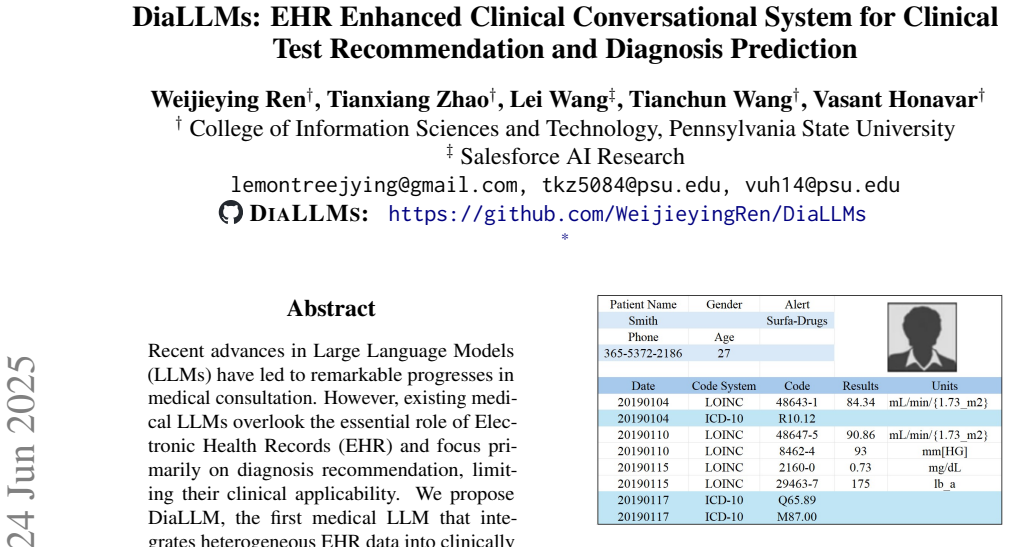
The load-bearing mechanism is the Clinical Test Reference (CTR), a manually built lookup that converts ICD-9/10 and LOINC codes into common-sense text and assigns age- and gender-conditioned normal ranges and critical values, so the LLM sees 'creatinine in serum or plasma is normal' rather than a raw code and number. On top of that, a PPO-trained policy $\pi_\theta(a_t|s_t)$ decides at each turn whether to order a test or stop; a rejection-sampling acceptance probability proportional to entropy reduction $H(y|s_t)-H(y|s_t,v_t)$, with a redundancy filter, prunes the large action space; and two rewards, a potential-shaped confirmation reward and an inverse-class-frequency diagnosis reward, supply the learning signal. The CTR does the work of grounding, while the rewards and rejection sampling make the reinforcement learning tractable and class-imbalance-aware.
What would settle it
Have a panel of independent clinicians review a random sample of DiaLLM's recommended test sequences and final diagnoses, marking each test as indicated, optional, or unnecessary. If the favorable Recall@5 against historical orders does not survive comparison with this expert-appropriateness standard, the central claim that the system recommends the right clinical tests would be refuted.
Extended reading notes
Core claim
On its own terms, DiaLLM is a two-stage recipe. First, a manually curated Clinical Test Reference translates ICD and LOINC codes into plain clinical language and labels test values as normal or abnormal using age- and sex-specific reference ranges, producing single- and multi-turn dialogues from patient visit timelines. Second, the LLM is tuned as a policy in a Markov decision process: at each turn it either proposes a test or stops to make a diagnosis, with rejection sampling pruning redundant tests and two rewards—a confirmation reward and an inverse-frequency class-sensitive reward—guiding accurate prediction. On three real-world EHR cohorts, the paper reports consistent gains over zero-shot general LLMs, medical LLMs, and embedding-plus-MLP baselines, with the largest margin on multi-turn diagnosis F1 and smaller gains on lab-test Recall@5.
Load-bearing premise
The load-bearing premise is that the tests historically ordered and recorded in each patient's EHR are the right answer for what an ideal conversational system should recommend; if those orders reflect billing incentives, defensive medicine, or practice variation, both the PPO training signal and the lab-test Recall@5 metric are biased.
Editorial extensions
If this is right
- If DiaLLM's gains hold, medical conversational systems no longer need to rely on synthetic symptom-diagnosis data; real EHR records can supply both the training dialogues and the evaluation targets.
- The Clinical Test Reference makes structured lab codes and values legible to text-trained LLMs, so other clinical tasks such as summarization, triage, or discharge planning could adopt the same transformation.
- The rejection-sampling scheme demonstrates a way to make PPO practical when the action space is thousands of possible tests, a bottleneck for reinforcement learning in clinical settings.
- The combined confirmation and inverse-frequency rewards reward the path of evidence acquisition as well as final accuracy, so systems trained this way should order fewer redundant tests and still reach early diagnoses.
- The evaluation framework, with separate single-turn and multi-turn metrics and early-prediction MRR, gives a reusable template for assessing conversational systems that must both gather evidence and predict outcomes.
Reading between the lines
- The CTR database, described as covering 735 test descriptions and 1,163 reference-range annotations, is itself a reusable artifact; releasing it separately could serve other EHR-to-text tasks beyond the dialogue system.
- A natural stress test beyond the paper's evaluation is comparing recommended tests against clinical guidelines rather than against whatever was historically ordered; that would reveal how much of the reported advantage is real appropriateness versus fitting to practice patterns.
- The inverse-frequency class reward is a general recipe for imbalanced sequential decision tasks, so it could transfer to triage, screening, or other settings where rare outcomes must not be neglected.
- Because the transformation turns arbitrary ICD and LOINC codes into text, the same two-stage pipeline could be rebuilt on other EHR systems and languages once a comparable clinical reference is curated.
Editorial analysis
A structured set of objections, weighed in public.
Referee Report
Summary. The paper proposes DiaLLM, a conversational clinical system that converts heterogeneous EHR data into single- and multi-turn dialogues via a Clinical Test Reference (CTR) strategy, and then fine-tunes an LLM with PPO for clinical test recommendation and diagnosis prediction. The method includes a rejection-sampling mechanism for the large test-action space, a confirmation reward, and a class-sensitive diagnosis reward. Experiments on NHANES and three TriNetX disease cohorts report that DiaLLM outperforms general-purpose and medical LLM baselines, with ablations indicating contributions from CTR and the PPO rewards. The authors release code and a manually curated clinical reference database.
Significance. If the implementation concerns are resolved, the paper would be a useful contribution: it addresses a real gap by grounding clinical dialogues in EHR data rather than synthetic QA or knowledge-graph dialogues, and it proposes a concrete transformation pipeline plus RL objectives for evidence acquisition. The evaluation framework covering single-turn and multi-turn dialogues with test-order and diagnosis metrics is practical, and the public code release supports reproducibility. However, the headline gains rest on comparisons that do not isolate the proposed components, and the central rejection-sampling equation is underspecified in a way that currently prevents verification of the method's claimed advantages.
major comments (3)
- [§3.3, Eq. (2)] Equation (2) defines p_accept(c_t|s_t) using H(y|s_t, v_t), where v_t is the result of the candidate test c_t. At the moment the policy must decide whether to order c_t, v_t is unobserved, so the acceptance probability cannot be computed from the state s_t alone. The denominator requires v_t for every candidate test, which is also unavailable. The paper does not describe a patient simulator, a learned outcome model, or an expected-information-gain approximation, and the appendix does not provide implementation details for PPO-RJ. Because the ablation 'w/o PPO-RJ' (Figure 4) is used to attribute performance to this mechanism, the central claim that the proposed reject-sampling strategy drives the reported gains is not verifiable. The authors should specify an implementable equivalent (e.g., estimating H(y|s_t, v_t) under a predictive distribution p(v_t|s_t, c_t) trained on the EHR) or remove this component from the claims.
- [§4.4, Tables 2 and 3] The 'MLP' baselines in Tables 2 and 3 are formed by freezing the LLM backbone and training an MLP on its embeddings, while DiaLLM fine-tunes Llama3.1-8B with LoRA, an additional task head, and PPO. The large reported gains (e.g., F1 73.59 vs 56.03 on TriNetX-Metabolic in Table 3) therefore conflate the contribution of the proposed CTR and reward design with the effect of fine-tuning the LLM itself. A fair baseline should include standard supervised fine-tuning (SFT) of the same backbone on the same transformed dialogues, with and without the proposed rewards, or at least LoRA fine-tuning without PPO. As it stands, the abstract's claim that the proposed combination outperforms baselines in test recommendation and diagnosis is not supported by an appropriately isolated comparison.
- [§4.5 and Appendix Figures 3–5] The ablation results are reported only in appendix figures without numerical values or variance estimates, even though the paper states that each experiment was run twice (Section 4.3). The main-text discussion of 'w/o PPO-Conf' and 'w/o PPO-Imb' (Section 4.5.2) reports single numbers for one dataset, which is insufficient to establish that each PPO component contributes meaningfully. Since the paper's central attribution rests on these ablations, the authors should provide a table with mean and standard deviation for all ablations and baselines, or at least report the underlying values for the figures.
minor comments (5)
- [§3.1] The sentence 'Each dialogue consists of at most T turns...' is duplicated in the problem formulation paragraph; please remove the duplicate.
- [§3.3, Eq. (3)] The notation CE(\hat{y}_i, y_i) is not defined. If CE denotes cross-entropy, the reward appears to be negative quality (lower CE is better), yet the text says the reward is used to 'guide accurate diagnosis prediction'; please clarify the sign convention and how the reward is maximized.
- [§3.2] The episode segmentation interval (visits within one week) is an arbitrary free parameter that affects the number of turns in each dialogue; please justify this choice or discuss its sensitivity.
- [§4.4 and Limitations] There are typos: 'hightlighting' should be 'highlighting' in Section 4.4, and 'Clincial' should be 'Clinical' in the Limitations section.
- [§4.5.2] The text refers to 'Figure 4 and Figure 5 in Appendix', but Figure 4 appears in the main body and Figure 5 in the appendix; please correct the cross-references.
Circularity Check
No significant circularity: DiaLLM's predictions are trained against external EHR labels and evaluated on held-out splits; self-citations are not load-bearing.
full rationale
The derivation chain in DiaLLM is not circular. The EHR-to-dialogue transformation (Section 3.2) maps ICD/LOINC codes to text and classifies test results using manually curated reference ranges from medical guidelines, i.e., external knowledge, not the model's own outputs. The PPO training (Section 3.3) uses ground-truth diagnosis labels y and recorded test orders from EHR to define the confirmation reward and class-sensitive diagnosis reward; these are standard supervised reward signals, and the held-out train/eval/test split (8:1:1, Section 4.3) means the reported Recall@5, F1, and MRR are not fitted to the test set. The only self-citations (Qin et al. 2023; Ren et al. 2024) appear in general related-work attributions and are not load-bearing. The main methodological concern, Eq. (2), uses the future test result v_t in the acceptance probability, which is an underspecification/implementability problem (e.g., how v_t is obtained for candidate tests at decision time) rather than a circularity: at training time one could in principle use the historical v_t from the EHR, and there is no equation in the paper that makes a reported prediction equal to a fitted input by construction. Consequently, no circular step meeting the required evidence standard can be identified.
Assumptions & free parameters
free parameters (1)
- Episode segmentation interval =
1 week
assumptions (3)
- domain assumption The test orders recorded in the historical EHR are an appropriate gold standard for training and evaluating lab-test recommendation (Recall@5).
- domain assumption The manually curated Clinical Test Reference (735 code descriptions, 262 tests, 1,163 range/unit annotations) is accurate and sufficiently comprehensive.
- domain assumption Diagnosis is predictable from the included EHR features (demographics, labs, vitals) alone for the selected disease subsets.
Cite this review
Pith. "Pith review of DiaLLMs: EHR Enhanced Clinical Conversational System for Clinical Test Recommendation and Diagnosis Prediction." pith.science (2026). https://pith.science/paper/R4ADODBK
@misc{pith2026250620059,
  author       = {Pith},
  title        = {Pith review of: DiaLLMs: EHR Enhanced Clinical Conversational System for Clinical Test Recommendation and Diagnosis Prediction},
  year         = {2026},
  howpublished = {\url{https://pith.science/paper/R4ADODBK}},
  note         = {Machine review of arXiv:2506.20059}
}
read the original abstract
Recent advances in Large Language Models (LLMs) have led to remarkable progresses in medical consultation. However, existing medical LLMs overlook the essential role of Electronic Health Records (EHR) and focus primarily on diagnosis recommendation, limiting their clinical applicability. We propose DiaLLM, the first medical LLM that integrates heterogeneous EHR data into clinically grounded dialogues, enabling clinical test recommendation, result interpretation, and diagnosis prediction to better align with real-world medical practice. To construct clinically grounded dialogues from EHR, we design a Clinical Test Reference (CTR) strategy that maps each clinical code to its corresponding description and classifies test results as "normal" or "abnormal". Additionally, DiaLLM employs a reinforcement learning framework for evidence acquisition and automated diagnosis. To handle the large action space, we introduce a reject sampling strategy to reduce redundancy and improve exploration efficiency. Furthermore, a confirmation reward and a class-sensitive diagnosis reward are designed to guide accurate diagnosis prediction. Extensive experimental results demonstrate that DiaLLM outperforms baselines in clinical test recommendation and diagnosis prediction.
Figures


Figures from the paper (2 more)


Forward citations
Cited by 1 Pith paper
-
A Comprehensive Survey of Electronic Health Record Modeling: From Deep Learning Approaches to Large Language Models
A survey that taxonomizes EHR modeling research into data-centric, architectural, learning-focused, multimodal, and LLM-based categories, with datasets and metrics.
Reference graph
Works this paper leans on
-
[1]
online" 'onlinestring :=
ENTRY address archivePrefix author booktitle chapter edition editor eid eprint eprinttype howpublished institution journal key month note number organization pages publisher school series title type volume year doi pubmed url lastchecked label extra.label sort.label short.list INTEGERS output.state before.all mid.sentence after.sentence after.block STRING...
-
[2]
write newline
" write newline "" before.all 'output.state := FUNCTION n.dashify 't := "" t empty not t #1 #1 substring "-" = t #1 #2 substring "--" = not "--" * t #2 global.max substring 't := t #1 #1 substring "-" = "-" * t #2 global.max substring 't := while if t #1 #1 substring * t #2 global.max substring 't := if while FUNCTION word.in bbl.in capitalize " " * FUNCT...
-
[3]
R \'e mi Bardenet, Arnaud Doucet, and Chris Holmes. 2014. Towards scaling up markov chain monte carlo: an adaptive subsampling approach. In International conference on machine learning, pages 405--413. PMLR
work page 2014
-
[4]
Som S Biswas. 2023. Role of chat gpt in public health. Annals of biomedical engineering, 51(5):868--869
work page 2023
-
[5]
Derun Cai, Chenxi Sun, Moxian Song, Baofeng Zhang, Shenda Hong, and Hongyan Li. 2022. Hypergraph contrastive learning for electronic health records. In Proceedings of the 2022 SIAM International Conference on Data Mining (SDM), pages 127--135. SIAM
work page 2022
-
[6]
Tianqi Chen and Carlos Guestrin. 2016. Xgboost: A scalable tree boosting system. In Proceedings of the 22nd acm sigkdd international conference on knowledge discovery and data mining, pages 785--794
2016
-
[7]
Zeming Chen, Alejandro Hern \'a ndez Cano, Angelika Romanou, Antoine Bonnet, Kyle Matoba, Francesco Salvi, Matteo Pagliardini, Simin Fan, Andreas K \"o pf, Amirkeivan Mohtashami, et al. 2023. Meditron-70b: Scaling medical pretraining for large language models. arXiv preprint arXiv:2311.16079
arXiv 2023
-
[8]
Zeming Chen, Angelika Romanou, Antoine Bonnet, Alejandro Hern \'a ndez-Cano, Badr Alkhamissi, Kyle Matoba, Francesco Salvi, Matteo Pagliardini, Simin Fan, Andreas K \"o pf, et al. 2024. Meditron: Open medical foundation models adapted for clinical practice
work page 2024
Show all 52 references
-
[9]
Edward Choi, Mohammad Taha Bahadori, Le Song, Walter F Stewart, and Jimeng Sun. 2017. Gram: graph-based attention model for healthcare representation learning. In Proceedings of the 23rd ACM SIGKDD international conference on knowledge discovery and data mining, pages 787--795
2017
-
[10]
Abhimanyu Dubey, Abhinav Jauhri, Abhinav Pandey, Abhishek Kadian, Ahmad Al-Dahle, Aiesha Letman, Akhil Mathur, Alan Schelten, Amy Yang, Angela Fan, et al. 2024. The llama 3 herd of models. arXiv preprint arXiv:2407.21783
2024 arXiv
-
[11]
Charles Elkan. 2001. The foundations of cost-sensitive learning. In International joint conference on artificial intelligence, volume 17, pages 973--978. Lawrence Erlbaum Associates Ltd
2001
-
[12]
Ying Fan, Olivia Watkins, Yuqing Du, Hao Liu, Moonkyung Ryu, Craig Boutilier, Pieter Abbeel, Mohammad Ghavamzadeh, Kangwook Lee, and Kimin Lee. 2023. Dpok: Reinforcement learning for fine-tuning text-to-image diffusion models. Advances in Neural Information Processing Systems,...
2023
-
[13]
Arsene Fansi Tchango, Rishab Goel, Julien Martel, Zhi Wen, Gaetan Marceau Caron, and Joumana Ghosn. 2022. Towards trustworthy automatic diagnosis systems by emulating doctors' reasoning with deep reinforcement learning. Advances in Neural Information Processing Systems, 35:245...
2022
-
[14]
Tianyu Han, Lisa C Adams, Jens-Michalis Papaioannou, Paul Grundmann, Tom Oberhauser, Alexander L \"o ser, Daniel Truhn, and Keno K Bressem. 2023. Medalpaca--an open-source collection of medical conversational ai models and training data. arXiv preprint arXiv:2304.08247
2023 arXiv
-
[15]
Trevor J Hastie. 2017. Generalized additive models. In Statistical models in S, pages 249--307. Routledge
2017
-
[16]
Weijie He and Ting Chen. 2022. Scalable online disease diagnosis via multi-model-fused actor-critic reinforcement learning. In Proceedings of the 28th ACM SIGKDD Conference on Knowledge Discovery and Data Mining, pages 4695--4703
2022
-
[17]
Edward J Hu, Yelong Shen, Phillip Wallis, Zeyuan Allen-Zhu, Yuanzhi Li, Shean Wang, Lu Wang, and Weizhu Chen. 2021. Lora: Low-rank adaptation of large language models. arXiv preprint arXiv:2106.09685
2021 arXiv
-
[18]
Yujing Hu, Weixun Wang, Hangtian Jia, Yixiang Wang, Yingfeng Chen, Jianye Hao, Feng Wu, and Changjie Fan. 2020. Learning to utilize shaping rewards: A new approach of reward shaping. Advances in Neural Information Processing Systems, 33:15931--15941
2020
-
[19]
Albert Q Jiang, Alexandre Sablayrolles, Arthur Mensch, Chris Bamford, Devendra Singh Chaplot, Diego de las Casas, Florian Bressand, Gianna Lengyel, Guillaume Lample, Lucile Saulnier, et al. 2023 a . Mistral 7b. arXiv preprint arXiv:2310.06825
2023 arXiv
-
[20]
Pengcheng Jiang, Cao Xiao, Adam Cross, and Jimeng Sun. 2023 b . Graphcare: Enhancing healthcare predictions with personalized knowledge graphs. arXiv preprint arXiv:2305.12788
2023 arXiv
-
[21]
Mohammad Kachuee, Orpaz Goldstein, Kimmo Karkkainen, Sajad Darabi, and Majid Sarrafzadeh. 2019. Opportunistic learning: Budgeted cost-sensitive learning from data streams. arXiv preprint arXiv:1901.00243
2019 arXiv
-
[22]
William La Cava, Christopher Bauer, Jason H Moore, and Sarah A Pendergrass. 2019. Interpretation of machine learning predictions for patient outcomes in electronic health records. In AMIA Annual Symposium Proceedings, volume 2019, page 572. American Medical Informatics Association
2019
-
[23]
Yanis Labrak, Adrien Bazoge, Emmanuel Morin, Pierre-Antoine Gourraud, Mickael Rouvier, and Richard Dufour. 2024. Biomistral: A collection of open-source pretrained large language models for medical domains. arXiv preprint arXiv:2402.10373
2024 arXiv
-
[24]
Lingyao Li, Jiayan Zhou, Zhenxiang Gao, Wenyue Hua, Lizhou Fan, Huizi Yu, Loni Hagen, Yongfeng Zhang, Themistocles L Assimes, Libby Hemphill, et al. 2024. A scoping review of using large language models (llms) to investigate electronic health records (ehrs). arXiv preprint arX...
2024 arXiv
-
[25]
Yunxiang Li, Zihan Li, Kai Zhang, Ruilong Dan, Steve Jiang, and You Zhang. 2023. Chatdoctor: A medical chat model fine-tuned on a large language model meta-ai (llama) using medical domain knowledge. Cureus, 15(6)
2023
-
[26]
Yuxuan Liang, Haomin Wen, Yuqi Nie, Yushan Jiang, Ming Jin, Dongjin Song, Shirui Pan, and Qingsong Wen. 2024. Foundation models for time series analysis: A tutorial and survey. In Proceedings of the 30th ACM SIGKDD conference on knowledge discovery and data mining, pages 6555--6565
2024
-
[27]
Lei Liu, Xiaoyan Yang, Junchi Lei, Xiaoyang Liu, Yue Shen, Zhiqiang Zhang, Peng Wei, Jinjie Gu, Zhixuan Chu, Zhan Qin, et al. 2024. A survey on medical large language models: Technology, application, trustworthiness, and future directions. arXiv preprint arXiv:2406.03712
2024 arXiv
-
[28]
Mingyu Derek Ma, Chenchen Ye, Yu Yan, Xiaoxuan Wang, Peipei Ping, Timothy Chang, and Wei Wang. 2024. Clibench: A multifaceted and multigranular evaluation of large language models for clinical decision making. arXiv preprint arXiv:2406.09923
2024 arXiv
-
[29]
Travis Mandel, Yun-En Liu, Emma Brunskill, and Zoran Popovi \'c . 2016. Offline evaluation of online reinforcement learning algorithms. In Proceedings of the AAAI Conference on Artificial Intelligence, volume 30
2016
-
[30]
Jonathan Montomoli, Luca Romeo, Sara Moccia, Michele Bernardini, Lucia Migliorelli, Daniele Berardini, Abele Donati, Andrea Carsetti, Maria Grazia Bocci, Pedro David Wendel Garcia, et al. 2021. Machine learning using the extreme gradient boosting (xgboost) algorithm predicts 5...
2021
-
[31]
Cecilia Panigutti, Alan Perotti, and Dino Pedreschi. 2020. Doctor xai: an ontology-based approach to black-box sequential data classification explanations. In Proceedings of the 2020 conference on fairness, accountability, and transparency, pages 629--639
2020
-
[32]
Shameem Puthiya Parambath, Nicolas Usunier, and Yves Grandvalet. 2014. Optimizing f-measures by cost-sensitive classification. Advances in neural information processing systems, 27
2014
-
[33]
Wei Qin, Zetong Chen, Lei Wang, Yunshi Lan, Weijieying Ren, and Richang Hong. 2023. Read, diagnose and chat: Towards explainable and interactive llms-augmented depression detection in social media. arXiv preprint arXiv:2305.05138
2023 arXiv
-
[34]
Yuchao Qin, Mihaela van der Schaar, and Changhee Lee. 2024. Risk-averse active sensing for timely outcome prediction under cost pressure. Advances in Neural Information Processing Systems, 36
2024
-
[35]
Weijieying Ren, Xiaoting Li, Huiyuan Chen, Vineeth Rakesh, Zhuoyi Wang, Mahashweta Das, and Vasant G Honavar. 2024. Tablog: Test-time adaptation for tabular data using logic rules. In Forty-first International Conference on Machine Learning
2024
-
[36]
Savyasachi V Shah. 2024. Accuracy, consistency, and hallucination of large language models when analyzing unstructured clinical notes in electronic medical records. JAMA Network Open, 7(8):e2425953--e2425953
2024
-
[37]
Yuqi Si, Jingcheng Du, Zhao Li, Xiaoqian Jiang, Timothy Miller, Fei Wang, W Jim Zheng, and Kirk Roberts. 2021. Deep representation learning of patient data from electronic health records (ehr): A systematic review. Journal of biomedical informatics, 115:103671
2021
-
[38]
Yuan Sui, Mengyu Zhou, Mingjie Zhou, Shi Han, and Dongmei Zhang. 2024. Table meets llm: Can large language models understand structured table data? a benchmark and empirical study. In Proceedings of the 17th ACM International Conference on Web Search and Data Mining, pages 645--654
2024
-
[39]
Kai-Fu Tang, Hao-Cheng Kao, Chun-Nan Chou, and Edward Y Chang. 2016. Inquire and diagnose: Neural symptom checking ensemble using deep reinforcement learning. In In Proceedings of NIPS Workshop on Deep Reinforcement Learning
2016
-
[40]
Augustin Toma, Patrick R Lawler, Jimmy Ba, Rahul G Krishnan, Barry B Rubin, and Bo Wang. 2023. Clinical camel: An open-source expert-level medical language model with dialogue-based knowledge encoding. CoRR
2023
-
[41]
Hugo Touvron, Louis Martin, Kevin Stone, Peter Albert, Amjad Almahairi, Yasmine Babaei, Nikolay Bashlykov, Soumya Batra, Prajjwal Bhargava, Shruti Bhosale, et al. 2023. Llama 2: Open foundation and fine-tuned chat models. arXiv preprint arXiv:2307.09288
2023 arXiv
-
[42]
Haochun Wang, Chi Liu, Nuwa Xi, Zewen Qiang, Sendong Zhao, Bing Qin, and Ting Liu. 2023 a . Huatuo: Tuning llama model with chinese medical knowledge. arXiv preprint arXiv:2304.06975
2023 arXiv
-
[43]
Zifeng Wang, Zichen Wang, Balasubramaniam Srinivasan, Vassilis N Ioannidis, Huzefa Rangwala, and Rishita Anubhai. 2023 b . Biobridge: Bridging biomedical foundation models via knowledge graph. arXiv preprint arXiv:2310.03320
2023 arXiv
-
[44]
Tianyu Wu, Shizhu He, Jingping Liu, Siqi Sun, Kang Liu, Qing-Long Han, and Yang Tang. 2023. A brief overview of chatgpt: The history, status quo and potential future development. IEEE/CAA Journal of Automatica Sinica, 10(5):1122--1136
2023
-
[45]
Honglin Xiong, Sheng Wang, Yitao Zhu, Zihao Zhao, Yuxiao Liu, Linlin Huang, Qian Wang, and Dinggang Shen. 2023. Doctorglm: Fine-tuning your chinese doctor is not a herculean task. arXiv preprint arXiv:2304.01097
2023 arXiv
-
[46]
An Yang, Baosong Yang, Beichen Zhang, Binyuan Hui, Bo Zheng, Bowen Yu, Chengyuan Li, Dayiheng Liu, Fei Huang, Haoran Wei, et al. 2024 a . Qwen2. 5 technical report. arXiv preprint arXiv:2412.15115
2024 arXiv
-
[47]
Songhua Yang, Hanjie Zhao, Senbin Zhu, Guangyu Zhou, Hongfei Xu, Yuxiang Jia, and Hongying Zan. 2024 b . Zhongjing: Enhancing the chinese medical capabilities of large language model through expert feedback and real-world multi-turn dialogue. In Proceedings of the AAAI Confere...
2024
-
[48]
Hao-Ren Yao, Nairen Cao, Katina Russell, Der-Chen Chang, Ophir Frieder, and Jeremy T Fineman. 2024. Self-supervised representation learning on electronic health records with graph kernel infomax. ACM Transactions on Computing for Healthcare, 5(2):1--28
2024
-
[49]
Muchao Ye, Suhan Cui, Yaqing Wang, Junyu Luo, Cao Xiao, and Fenglong Ma. 2021. Medretriever: Target-driven interpretable health risk prediction via retrieving unstructured medical text. In Proceedings of the 30th ACM International Conference on Information & Knowledge Manageme...
2021
-
[50]
Jinsung Yoon, James Jordon, and Mihaela Schaar. 2019. Asac: Active sensing using actor-critic models. In Machine Learning for Healthcare Conference, pages 451--473. PMLR
2019
-
[51]
Wayne Xin Zhao, Kun Zhou, Junyi Li, Tianyi Tang, Xiaolei Wang, Yupeng Hou, Yingqian Min, Beichen Zhang, Junjie Zhang, Zican Dong, et al. 2023. A survey of large language models. arXiv preprint arXiv:2303.18223
2023 arXiv
-
[52]
Hongjian Zhou, Fenglin Liu, Boyang Gu, Xinyu Zou, Jinfa Huang, Jinge Wu, Yiru Li, Sam S Chen, Peilin Zhou, Junling Liu, et al. 2023. A survey of large language models in medicine: Progress, application, and challenge. arXiv preprint arXiv:2311.05112
2023 arXiv
Reviewed August 6, 2026 · model on record in the stance chip above.
Discussion (0). Sign in to comment.