REVIEW 2 major objections 6 minor 86 references
JsDeObsBench: Measuring and Benchmarking LLMs for JavaScript Deobfuscation
T0 review · 2 major / 6 minor · reviewed 2026-08-06 · deepseek-v4-flash
Pith's one-line read JsDeObsBench demonstrates that, on 36,260 execution-verifiable obfuscated JavaScript programs, LLMs deobfuscate more readably than rule-based tools yet fail to preserve executable semantics in 37.40% of outputs.
desk verdict A solid first benchmark for LLM JS deobfuscation, but the headline simplification advantage is inflated because it includes semantically broken outputs. read the letter →
The pith
A machine-rendered reading of the paper's core claim, the machinery that carries it, and where it could break.
The reading
What carries the argument
The load-bearing machinery is a four-stage evaluation pipeline. Stage one parses each deobfuscation output with a standard ECMAScript parser; stage two runs syntactically valid outputs against the program's input/output test cases inside an isolated container; stage three measures simplification as the relative reduction in a complexity measure derived from counts of operators and operands, from obfuscated to deobfuscated code; stage four scores readability with CodeBLEU, a code-aware similarity metric that compares abstract syntax trees and data-flow graphs between the output and the original program. The dataset is built by taking 1,298 filtered, execution-verified coding-challenge solutions and applying seven transformation types—code compacting, name obfuscation, string obfuscation, dead code injection, control-flow flattening, debug protection, and self-defending—singly and in combination, yielding 36,260 unique obfuscated programs. A one-shot in-context prompt supplies one obfuscated/deobfuscated example to guide each LLM, and for malware an instrumented behavior-tracing sandbox substitutes for test cases when checking semantic preservation.
What would settle it
Take a fresh sample of 1,000 obfuscated scripts collected from live websites whose unobfuscated behavior can be independently recovered, run the same six LLMs and two rule-based deobfuscators through the paper's four evaluators, and check whether the roughly 1.72x simplification advantage and the 37.40% execution-failure rate reproduce; if they do not, the benchmark's representativeness claim is refuted.
Extended reading notes
Core claim
The paper's central claim is that, measured on this benchmark, LLMs are strong at the human-facing half of deobfuscation and weak at the machine-facing half. The best LLM, GPT-4o, achieves 93.42% execution correctness, a 0.3825 simplification score, and a 0.6702 similarity score, while the best open-weights code model, Codestral, reaches 84.16% execution correctness. Rule-based baselines pass syntax 100% of the time and execution about 84% of the time but simplify poorly, with a best simplification score of 0.2214. Averaged across six LLMs, outputs are syntactically valid 97.23% of the time, execute correctly 60.93% of the time, and score 12.13 percentage points higher on simplification and 1.6 points higher on similarity than the baselines. The paper further claims that string obfuscation is the hardest transformation, with 46.63% average execution correctness, code compacting is the easiest at 79.18%, combining more than six transformations defeats all tested methods, and on the 4,515 obfuscated malware samples LLMs keep their simplification lead, averaging 28.85% higher simplification than baselines, while execution correctness drops sharply and GPT-4o refuses many requests for safety reasons.
Load-bearing premise
The benchmark's results transfer to real-world obfuscated JavaScript only if coding-challenge programs obfuscated with one popular obfuscator's seven transformation types are representative of the obfuscated scripts, including malware, that security analysts actually encounter.
Editorial extensions
If this is right
- Security analysts can use LLM-based deobfuscation to make obfuscated scripts substantially more readable: the best LLM simplification score is 1.72 times the best baseline score, and LLM outputs are closer to the original code on CodeBLEU.
- LLM deobfuscation is not yet safe to run unattended: 37.40% of LLM outputs fail execution checks even after passing syntax checks, so any practical deployment must verify behavior before relying on the result.
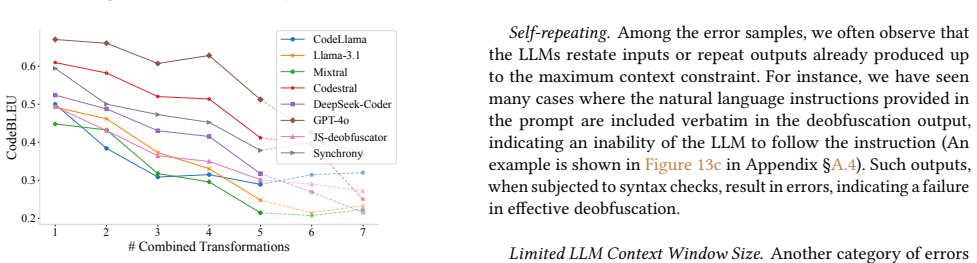
- The benchmark shows a performance cliff with combined transformations: execution pass rates collapse for every method as the number of transformations grows, and six or more transformations mark near-total failure for most LLMs.
- The released dataset, evaluation pipeline, and leaderboard give future LLM releases a reusable, execution-verifiable yardstick for JavaScript deobfuscation, so progress on syntax and semantic correctness can be tracked directly.
Reading between the lines
- If the simplification advantage survives on live obfuscated web scripts, a practical hybrid could pair an LLM with a rule-based verifier: accept the LLM's output only when syntax and behavioral checks pass, which would filter out much of the 37.40% execution-failure rate before the code reaches an analyst.
- The malware results hint that CodeBLEU similarity penalizes LLMs for legitimately rewriting obfuscated originals; the paper's own case example, with low similarity but identical behavior, suggests similarity should not be read as semantic fidelity for malware.
- The single-obfuscator, seven-transformation design leaves open how LLMs fare against newer obfuscation ideas, so extending the pipeline to additional transformation types is the most direct test of the paper's generalizability claim.
- A natural follow-up measurement is human-analyst readability: if analyst comprehension time tracks the simplification score, the readability claim is strengthened, and if it does not, the score needs recalibration.
Editorial analysis
A structured set of objections, weighed in public.
Referee Report
Summary. The paper introduces JsDeObsBench, a benchmark for LLM-based JavaScript deobfuscation. The authors construct 36,260 obfuscated general JS programs from 1,298 filtered CodeNet solutions by applying seven JavaScript-Obfuscator transformations and their combinations, plus 4,515 obfuscated malware samples. They propose a chain of four evaluators: syntax correctness, execution correctness, simplification (Halstead-length reduction), and similarity (CodeBLEU). The study evaluates six LLMs and two rule-based deobfuscators, reporting that LLMs outperform baselines on simplification and similarity but have higher syntax and execution failure rates (2.76% and 37.40% on average), and that GPT-4o leads overall while Codestral is the best open-weight model.
Significance. If the measurements are valid, JsDeObsBench would fill a genuine gap: it provides an execution-verifiable deobfuscation dataset with ground truth, a multi-faceted automated evaluation pipeline, and a public leaderboard. The use of external CodeNet test cases for semantic verification is a real strength, as is the release of the dataset and code. However, the headline simplification result is computed on a subset that includes semantically broken outputs, and the public CodeNet source raises contamination concerns that are not addressed. The significance of the empirical claims therefore depends on the follow-up analyses requested below; the benchmark artifact itself is a useful contribution.
major comments (2)
- [§4.3, Eq. (1), Tables 4 and 5] The simplification and similarity evaluators are applied to every deobfuscated program that passes the syntax check, regardless of whether it passes the execution check. Since the LLMs have an average execution failure rate of 37.40% versus 16.25% for the baselines (RQ2 answer, §5.3), and since Eq. (1) rewards aggressive shortening, the central RQ3 claim of superior simplification (e.g., GPT-4o 0.3825 vs Synchrony 0.2214 in Table 4, quoted as 1.72x in the abstract) is confounded: part of the advantage may come from syntactically valid but semantically altered, truncated, or otherwise broken code. The paper should report simplification and CodeBLEU scores conditioned on execution success, alongside the current unconditional numbers, and should state explicitly whether any outputs that fail the execution check are excluded from the RQ3 headline.
- [§3.1, §4.1, and §7.2] The dataset is built from public CodeNet solutions, and the one-shot demonstration is drawn from the same coding-challenge distribution as the test samples, while §3.1 itself notes that LLM memorization prevents the use of publicly accessible obfuscated programs. This creates a contamination risk that is not addressed: the LLMs may, in part, be recalling original solutions from pretraining, which would inflate simplification and similarity scores and undermine the abstract's 'real-world scenarios' claim. The paper should add a contamination analysis (for example, token n-gram overlap between the test programs and public training corpora, or a holdout evaluation on programs from a different source), and disclose whether the one-shot example is disjoint from the test set.
minor comments (6)
- [§5.1] The inference settings say 'we set both top_p and top_n to 1'; this appears to be a typo for top_k, and the temperature of 0.1 should be clarified as a greedy or near-greedy decoding choice rather than a deterministic one.
- [Table 2] The row labeled 'Mixtral 7B' lists the model ID 'Mistral-7B-Instruct-v0.3', which is not a Mixtral model; either correct the family name or the model ID.
- [Abstract and §5.2] The abstract's '1.72x better code simplification score' and the text's '16.11% lead' refer to different quantities (a ratio versus a percentage-point difference); the paper should disambiguate these to avoid confusion.
- [Appendix §A.5] The appendix says the example is 'taken from the Mixtral deobfuscation' while Figure 17(c) labels the output as produced by Codestral; this inconsistency should be fixed.
- [Figure 10] The caption refers to zero-shot (Left) and one-shot (Right) panels, but the figure itself does not visually label the two groups; adding explicit labels would help the reader.
- [References] Reference [28] contains the typo 'Antcoder developers'; it should be 'AtCoder developers'.
Circularity Check
No significant circularity: the benchmark's correctness labels come from external CodeNet test cases and original programs, and the simplification-metric caveat is a validity issue, not a circular derivation.
full rationale
JsDeObsBench does not fit parameters to the quantities it later reports as results. Ground-truth labels are the original CodeNet programs and their external test cases (Section 4.1), and malware behavior traces are checked with Box-js; all four evaluators are applied to LLM outputs after the fact. The simplification score S = 1 - HLoC_deobf/HLoC_obf is an independent operationalization, not an input to the LLM or the baselines. Self-citations ([41], [42], [43], [78], [79]) appear only as background or as motivation for in-context learning; none carries a uniqueness claim or supplies a load-bearing premise. The one-shot example and the test instances both come from coding-challenge programs, which is a distribution-familiarity and generalizability concern, not circularity. Finally, the fact that simplification and similarity scores are computed on syntax-passing outputs before the execution filter (Section 4.3) is a real measurement-validity caveat for the 'superior simplification' headline, but it does not make the measured scores equal to the benchmark inputs by construction. Hence no circular step can be exhibited.
Assumptions & free parameters
assumptions (5)
- domain assumption JavaScript-Obfuscator and its seven transformation types are representative of real-world JS obfuscation.
- domain assumption CodeNet coding-challenge solutions with passing tests are a valid proxy for real-world JS programs.
- domain assumption Halstead length reduction measures deobfuscation quality and readability.
- domain assumption CodeBLEU similarity to the original code approximates readability.
- ad hoc to paper Public CodeNet programs are not memorized by the tested LLMs in a way that inflates deobfuscation scores.
Cite this review
Pith. "Pith review of JsDeObsBench: Measuring and Benchmarking LLMs for JavaScript Deobfuscation." pith.science (2026). https://pith.science/paper/INAEXU7D
@misc{pith2026250620170,
  author       = {Pith},
  title        = {Pith review of: JsDeObsBench: Measuring and Benchmarking LLMs for JavaScript Deobfuscation},
  year         = {2026},
  howpublished = {\url{https://pith.science/paper/INAEXU7D}},
  note         = {Machine review of arXiv:2506.20170}
}
read the original abstract
Deobfuscating JavaScript (JS) code poses a significant challenge in web security, particularly as obfuscation techniques are frequently used to conceal malicious activities within scripts. While Large Language Models (LLMs) have recently shown promise in automating the deobfuscation process, transforming detection and mitigation strategies against these obfuscated threats, a systematic benchmark to quantify their effectiveness and limitations has been notably absent. To address this gap, we present JsDeObsBench, a dedicated benchmark designed to rigorously evaluate the effectiveness of LLMs in the context of JS deobfuscation. We detail our benchmarking methodology, which includes a wide range of obfuscation techniques ranging from basic variable renaming to sophisticated structure transformations, providing a robust framework for assessing LLM performance in real-world scenarios. Our extensive experimental analysis investigates the proficiency of cutting-edge LLMs, e.g., GPT-4o, Mixtral, Llama, and DeepSeek-Coder, revealing superior performance in code simplification despite challenges in maintaining syntax accuracy and execution reliability compared to baseline methods. We further evaluate the deobfuscation of JS malware to exhibit the potential of LLMs in security scenarios. The findings highlight the utility of LLMs in deobfuscation applications and pinpoint crucial areas for further improvement.
Figures


Figures from the paper (15 more)




Reference graph
Works this paper leans on
-
[1]
Collection of almost 40.000 javascript malware samples
2024. Collection of almost 40.000 javascript malware samples. https://github. com/HynekPetrak/javascript-malware-collection
2024
-
[2]
DeepSpeed
2024. DeepSpeed. https://github.com/microsoft/DeepSpeed
2024
-
[3]
A deobfuscator for scripts obfuscated by Obfuscator.io
2024. A deobfuscator for scripts obfuscated by Obfuscator.io. https://github.com/ ben-sb/obfuscator-io-deobfuscator
2024
-
[4]
Docker Official Image, Node.js is a JavaScript-based platform for server-side and networking applications
2024. Docker Official Image, Node.js is a JavaScript-based platform for server-side and networking applications. https://hub.docker.com/_/node
2024
-
[5]
EvalPlus Leaderboard
2024. EvalPlus Leaderboard. https://evalplus.github.io/leaderboard.html
2024
-
[6]
General purpose JavaScript deobfuscator
2024. General purpose JavaScript deobfuscator. https://github.com/ben-sb/ javascript-deobfuscator
2024
- [7]
-
[8]
A JavaScript checker and optimizer
2024. A JavaScript checker and optimizer. https://github.com/google/closure- compiler
work page 2024
Show all 86 references
-
[9]
javascript cleaner & deobfuscator
2024. javascript cleaner & deobfuscator. https://github.com/relative/synchrony
2024
-
[10]
JavaScript Deobfuscator and Unpacker
2024. JavaScript Deobfuscator and Unpacker. https://github.com/lelinhtinh/de4js
2024
-
[11]
JavaScript Minifier is an easy-to-use tool for minifying JavaScript code
2024. JavaScript Minifier is an easy-to-use tool for minifying JavaScript code. https://www.toptal.com/developers/javascript-minifier
2024
-
[12]
JavaScript parser / mangler / compressor / beautifier toolkit
2024. JavaScript parser / mangler / compressor / beautifier toolkit. https://github. com/mishoo/UglifyJS
2024
-
[13]
JS reverse minifier based on statistical machine translation
2024. JS reverse minifier based on statistical machine translation. https://github. com/bvasiles/jsNaughty
2024
-
[14]
Node.js ® is a free, open-source, cross-platform JavaScript runtime envi- ronment that lets developers create servers, web apps, command line tools and scripts
2024. Node.js ® is a free, open-source, cross-platform JavaScript runtime envi- ronment that lets developers create servers, web apps, command line tools and scripts. https://nodejs.org/
2024
-
[15]
Obfuscate JavaScript (beyond repair) with Ruby
2024. Obfuscate JavaScript (beyond repair) with Ruby. https://github.com/rapid7/ jsobfu
2024
-
[16]
Obfuscate string literals in JavaScript code
2024. Obfuscate string literals in JavaScript code. https://github.com/anseki/ gnirts
2024
-
[17]
A powerful obfuscator for JavaScript and Node.js
2024. A powerful obfuscator for JavaScript and Node.js. https://github.com/ javascript-obfuscator/javascript-obfuscator
2024
-
[18]
2024. PyTorch. https://pytorch.org/
2024
-
[19]
STATISTICAL RENAMING, TYPE INFERENCE AND DEOBFUSCATION
2024. STATISTICAL RENAMING, TYPE INFERENCE AND DEOBFUSCATION. http://jsnice.org/
2024
-
[20]
This repository contains a list of pseudo-sorted malicious JavaScripts collected from time to time
2024. This repository contains a list of pseudo-sorted malicious JavaScripts collected from time to time. https://github.com/geeksonsecurity/js-malicious- dataset
2024
-
[21]
Transformers
2024. Transformers. https://huggingface.co/
2024
-
[22]
A utility to analyze malicious JavaScript
2024. A utility to analyze malicious JavaScript. https://github.com/CapacitorSet/ box-js
2024
- [23]
-
[24]
Tom Brown, Benjamin Mann, Nick Ryder, Melanie Subbiah, Jared D Kaplan, Prafulla Dhariwal, Arvind Neelakantan, Pranav Shyam, Girish Sastry, Amanda Askell, et al. 2020. Language models are few-shot learners. Advances in neural information processing systems 33 (2020), 1877–1901
2020
-
[25]
Nicholas Carlini, Florian Tramer, Eric Wallace, Matthew Jagielski, Ariel Herbert- Voss, Katherine Lee, Adam Roberts, Tom Brown, Dawn Song, Ulfar Erlingsson, et al. 2021. Extracting training data from large language models. In 30th USENIX Security Symposium (USENIX Security 21)...
2021
-
[26]
Mark Chen, Jerry Tworek, Heewoo Jun, Qiming Yuan, Henrique Ponde de Oliveira Pinto, Jared Kaplan, Harri Edwards, Yuri Burda, Nicholas Joseph, Greg Brockman, et al. 2021. Evaluating large language models trained on code. arXiv preprint arXiv:2107.03374 (2021)
2021 arXiv
-
[27]
Charlie Curtsinger, Benjamin Livshits, Benjamin Zorn, and Christian Seifert
-
[28]
Antcoder developers. [n. d.]. Atcoder. https://atcoder.jp/ Accessed on 11-29-2024
2024
-
[29]
Jacob Devlin, Ming-Wei Chang, Kenton Lee, and Kristina Toutanova. 2018. Bert: Pre-training of deep bidirectional transformers for language understanding.arXiv preprint arXiv:1810.04805 (2018)
2018 arXiv
-
[30]
Yangruibo Ding, Zijian Wang, Wasi Ahmad, Hantian Ding, Ming Tan, Nihal Jain, Murali Krishna Ramanathan, Ramesh Nallapati, Parminder Bhatia, Dan Roth, et al. 2024. Crosscodeeval: A diverse and multilingual benchmark for cross-file code completion. Advances in Neural Information...
2024
-
[31]
ECMA International. 2017. ECMA-262: ECMAScript Language Specifica- tion. https://ecma-international.org/publications-and-standards/standards/ ecma-262/
2017
-
[32]
Aurore Fass, Michael Backes, and Ben Stock. 2019. Hidenoseek: Camouflaging malicious javascript in benign asts. In Proceedings of the 2019 ACM SIGSAC Conference on Computer and Communications Security . 1899–1913
2019
-
[33]
Aurore Fass, Robert P Krawczyk, Michael Backes, and Ben Stock. 2018. Jast: Fully syntactic detection of malicious (obfuscated) javascript. In Detection of Intrusions and Malware, and Vulnerability Assessment: 15th International Conference, DIMV A 2018, Saclay, France, June 28–...
2018
-
[34]
Daya Guo, Qihao Zhu, Dejian Yang, Zhenda Xie, Kai Dong, Wentao Zhang, Guant- ing Chen, Xiao Bi, Y. Wu, Y. K. Li, Fuli Luo, Yingfei Xiong, and Wenfeng Liang
-
[35]
Maurice H Halstead. 1977. Elements of Software Science (Operating and program- ming systems series). Elsevier Science Inc
1977
- [36]
-
[37]
Ariya Hidayat. 2024. ECMAScript parsing infrastructure for multipurpose analy- sis. https://esprima.org
2024
-
[38]
Peiwei Hu, Ruigang Liang, and Kai Chen. 2024. DeGPT: Optimizing Decompiler Output with LLM. In Proceedings 2024 Network and Distributed System Security Symposium (2024). https://api. semanticscholar. org/CorpusID , Vol. 267622140
2024
-
[39]
Grégoire Jacob, Hervé Debar, and Eric Filiol. 2008. Behavioral detection of malware: from a survey towards an established taxonomy. Journal in computer Virology 4 (2008), 251–266
2008
-
[40]
Albert Q. Jiang, Alexandre Sablayrolles, Antoine Roux, Arthur Mensch, Blanche Savary, Chris Bamford, Devendra Singh Chaplot, Diego de las Casas, Emma Bou Hanna, Florian Bressand, Gianna Lengyel, Guillaume Bour, Guillaume Lample, Lélio Renard Lavaud, Lucile Saulnier, Marie-Anne...
2024 arXiv
-
[41]
Linxi Jiang, Xin Jin, and Zhiqiang Lin. [n. d.]. Beyond Classification: Inferring Function Names in Stripped Binaries via Domain Adapted LLMs. In Proceedings 2025 Network and Distributed System Security Symposium . San Diego, CA, USA
2025
-
[42]
Xin Jin, Jonathan Larson, Weiwei Yang, and Zhiqiang Lin. 2023. Binary code summarization: Benchmarking chatgpt/gpt-4 and other large language models. arXiv preprint arXiv:2312.09601 (2023)
2023 arXiv
-
[43]
Xin Jin, Kexin Pei, Jun Yeon Won, and Zhiqiang Lin. 2022. Symlm: Predicting function names in stripped binaries via context-sensitive execution-aware code embeddings. In Proceedings of the 2022 ACM SIGSAC Conference on Computer and Communications Security. 1631–1645
2022
-
[44]
Mehran Jodavi, Mahdi Abadi, and Elham Parhizkar. 2015. JSObfusDetector: A binary PSO-based one-class classifier ensemble to detect obfuscated JavaScript code. In 2015 The International Symposium on Artificial Intelligence and Signal Processing (AISP). IEEE, 322–327
2015
-
[45]
Song Li, Mingqing Kang, Jianwei Hou, and Yinzhi Cao. 2022. Mining node. js vulnerabilities via object dependence graph and query. In 31st USENIX Security Symposium (USENIX Security 22) . 143–160
2022
-
[46]
Yi Li, Aashish Yadavally, Jiaxing Zhang, Shaohua Wang, and Tien N Nguyen. 2023. DeMinify: Neural Variable Name Recovery and Type Inference. In Proceedings of the 31st ACM Joint European Software Engineering Conference and Symposium on the Foundations of Software Engineering . ...
2023
-
[47]
Han Liu, Chengnian Sun, Zhendong Su, Yu Jiang, Ming Gu, and Jiaguang Sun
-
[48]
Pengfei Liu, Weizhe Yuan, Jinlan Fu, Zhengbao Jiang, Hiroaki Hayashi, and Graham Neubig. 2023. Pre-train, prompt, and predict: A systematic survey of prompting methods in natural language processing. Comput. Surveys 55, 9 (2023), 1–35
2023
-
[49]
Meta AI. 2025. Introducing Llama 3.1: Our most capable models to date. https: //ai.meta.com/blog/meta-llama-3-1/. Accessed: 2025-01-01
2025
-
[50]
Mistral AI. 2025. Codestral: Hello, World! Empowering developers and democratising coding with Mistral AI. https://mistral.ai/news/codestral/. Ac- cessed: 2025-01-01
2025
-
[51]
Marvin Moog, Markus Demmel, Michael Backes, and Aurore Fass. 2021. Statically Detecting JavaScript Obfuscation and Minification Techniques in the Wild. In 2021 51st Annual IEEE/IFIP International Conference on Dependable Systems and Networks (DSN) (DSN 2021) . 569–580. doi:10....
2021
-
[52]
OpenAI. 2025. Hello GPT-4 Turbo. https://openai.com/index/hello-gpt-4o/. Accessed: 2025-01-08
2025
-
[53]
OpenAI. 2025. OpenAI API. https://openai.com/api/. Accessed: 2025-01-07
2025
-
[54]
Rangeet Pan, Ali Reza Ibrahimzada, Rahul Krishna, Divya Sankar, Lam- bert Pouguem Wassi, Michele Merler, Boris Sobolev, Raju Pavuluri, Saurabh Sinha, and Reyhaneh Jabbarvand. 2023. Understanding the effectiveness of large language models in code translation. arXiv preprint arX...
2023 arXiv
-
[55]
Ruchir Puri, David Kung, Geert Janssen, Wei Zhang, Giacomo Domeniconi, Vladmir Zolotov, Julian Dolby, Jie Chen, Mihir Choudhury, Lindsey Decker, Veronika Thost, Luca Buratti, Saurabh Pujar, Shyam Ramji, Ulrich Finkler, Susan Malaika, and Frederick Reiss. 2021. CodeNet: A Large...
2021
-
[56]
Alec Radford, Karthik Narasimhan, Tim Salimans, Ilya Sutskever, et al . 2018. Improving language understanding by generative pre-training. (2018)
2018
-
[57]
Sampsa Rauti and Ville Leppänen. 2018. A Comparison of Online JavaScript Obfuscators. In 2018 International Conference on Software Security and Assurance (ICSSA) (ICSSA 2018). 7–12. doi:10.1109/ICSSA45270.2018.00012
2018
-
[58]
big code
Veselin Raychev, Martin Vechev, and Andreas Krause. 2015. Predicting program properties from" big code". ACM SIGPLAN Notices 50, 1 (2015), 111–124
2015
-
[59]
Kunlun Ren, Weizhong Qiang, Yueming Wu, Yi Zhou, Deqing Zou, and Hai Jin. 2023. An Empirical Study on the Effects of Obfuscation on Static Machine Learning-Based Malicious JavaScript Detectors. In Proceedings of the 32nd ACM SIGSOFT International Symposium on Software Testing ...
2023
-
[60]
Kunlun Ren, Weizhong Qiang, Yueming Wu, Yi Zhou, Deqing Zou, and Hai Jin. 2023. An Empirical Study on the Effects of Obfuscation on Static Machine Learning-Based Malicious JavaScript Detectors. In Proceedings of the 32nd ACM SIGSOFT International Symposium on Software Testing ...
2023
-
[61]
Zhou, Ambrosio Blanco, and Shuai Ma
Shuo Ren, Daya Guo, Shuai Lu, Long Zhou, Shujie Liu, Duyu Tang, M. Zhou, Ambrosio Blanco, and Shuai Ma. 2020. CodeBLEU: a Method for Automatic Evaluation of Code Synthesis. ArXiv abs/2009.10297 (2020). https://arxiv.org/ abs/2009.10297
2020 arXiv
-
[62]
Alan Romano, Daniel Lehmann, Michael Pradel, and Weihang Wang. 2022. Wob- fuscator: Obfuscating javascript malware via opportunistic translation to we- bassembly. In2022 IEEE Symposium on Security and Privacy (SP). IEEE, 1574–1589
2022
-
[63]
Alan Romano, Daniel Lehmann, Michael Pradel, and Weihang Wang. 2022. Wob- fuscator: Obfuscating JavaScript Malware via Opportunistic Translation to We- bAssembly. In 2022 IEEE Symposium on Security and Privacy (SP) (SP 2022) . 1574–
2022
-
[64]
Alan Romano, Yunhui Zheng, and Weihang Wang. 2020. Minerray: Semantics- aware analysis for ever-evolving cryptojacking detection. In Proceedings of the 35th IEEE/ACM International Conference on Automated Software Engineering . 1129–1140
2020
-
[65]
Baptiste Rozière, Jonas Gehring, Fabian Gloeckle, Sten Sootla, Itai Gat, Xiao- qing Ellen Tan, Yossi Adi, Jingyu Liu, Romain Sauvestre, Tal Remez, Jérémy Rapin, Artyom Kozhevnikov, Ivan Evtimov, Joanna Bitton, Manish Bhatt, Cris- tian Canton Ferrer, Aaron Grattafiori, Wenhan X...
2024 arXiv
-
[66]
Andrea Saracino, Daniele Sgandurra, Gianluca Dini, and Fabio Martinelli. 2016. Madam: Effective and efficient behavior-based android malware detection and prevention. IEEE Transactions on Dependable and Secure Computing 15, 1 (2016), 83–97
2016
-
[67]
Shaown Sarker, Jordan Jueckstock, and Alexandros Kapravelos. 2020. Hiding in plain site: Detecting javascript obfuscation through concealed browser api usage. In Proceedings of the ACM Internet Measurement Conference . 648–661
2020
-
[68]
Mikhail Shcherbakov, Musard Balliu, and Cristian-Alexandru Staicu. 2023. Silent spring: Prototype pollution leads to remote code execution in Node. js. In 32nd USENIX Security Symposium (USENIX Security 23) . 5521–5538
2023
-
[69]
Philippe Skolka, Cristian-Alexandru Staicu, and Michael Pradel. 2019. Anything to hide? studying minified and obfuscated code in the web. In The world wide web conference. 1735–1746
2019
-
[70]
Philippe Skolka, Cristian-Alexandru Staicu, and Michael Pradel. 2019. Anything to Hide? Studying Minified and Obfuscated Code in the Web. In The World Wide Web Conference (WWW ’19) . Association for Computing Machinery, New York, NY, USA, 1735–1746. doi:10.1145/3308558.3313752
2019
-
[71]
Kwangwon Sun and Sukyoung Ryu. 2017. Analysis of JavaScript programs: Challenges and research trends. ACM Computing Surveys (CSUR) 50, 4 (2017), 1–34
2017
-
[72]
Hieu Tran, Ngoc Tran, Son Nguyen, Hoan Nguyen, and Tien N Nguyen. 2019. Re- covering variable names for minified code with usage contexts. In2019 IEEE/ACM 41st International Conference on Software Engineering (ICSE) . IEEE, 1165–1175
2019
-
[73]
Alessio Trivisonno. [n. d.]. Reverse engineering : Code Deobfuscation in the age of AI. https://infosecwriteups.com/the-cybersecurity-revolution-at-the-age-of- ai-openai-and-code-deobfuscation-3f9dd278b900
-
[74]
Bogdan Vasilescu, Casey Casalnuovo, and Premkumar Devanbu. 2017. Recovering clear, natural identifiers from obfuscated JS names. InProceedings of the 2017 11th joint meeting on foundations of software engineering . 683–693
2017
-
[75]
Yutaka Watanobe. [n. d.]. Aizu online judge. https://onlinejudge.u-aizu.ac.jp
-
[76]
Jason Wei, Yi Tay, Rishi Bommasani, Colin Raffel, Barret Zoph, Sebastian Borgeaud, Dani Yogatama, Maarten Bosma, Denny Zhou, Donald Metzler, et al
-
[77]
Jason Wei, Xuezhi Wang, Dale Schuurmans, Maarten Bosma, Fei Xia, Ed Chi, Quoc V Le, Denny Zhou, et al. 2022. Chain-of-thought prompting elicits reasoning in large language models. Advances in neural information processing systems 35 (2022), 24824–24837
2022
-
[78]
Yuqing Yang, Yue Zhang, and Zhiqiang Lin. 2025. Understanding Miniapp Mal- ware: Identification, Dissection, and Characterization. InProceedings 2025 Network and Distributed System Security Symposium . San Diego, CA, USA
2025
-
[79]
Yue Zhang, Bayan Turkistani, Allen Yuqing Yang, Chaoshun Zuo, and Zhiqiang Lin. 2021. A Measurement Study of Wechat Mini-Apps. Proc. ACM Meas. Anal. Comput. Syst. 5, 2, Article 14 (June 2021), 25 pages. doi:10.1145/3460081
2021 doi
-
[80]
Zibin Zheng, Kaiwen Ning, Yanlin Wang, Jingwen Zhang, Dewu Zheng, Mingxi Ye, and Jiachi Chen. 2023. A survey of large language models for code: Evolution, benchmarking, and future trends. arXiv preprint arXiv:2311.10372 (2023)
2023 arXiv
-
[81]
"); 3 w=w-0; 4 h=h-0; 5 var ans=[]; 6 ans.push(
Joe Zimmerman. 2015. How to obfuscate programs directly. In Annual Interna- tional Conference on the Theory and Applications of Cryptographic Techniques . Springer, 439–467. JsDeObsBench: Measuring and Benchmarking LLMs for JavaScript Deobfuscation CCS ’25, October 13–17, 2025...
2015
-
[1589]
doi:10.1109/SP46214.2022.9833626 ISSN: 2375-1207
2022
-
[2011]
In 20th USENIX Security Symposium (USENIX Security 11)
ZOZZLE: Fast and precise In-Browser JavaScript malware detection. In 20th USENIX Security Symposium (USENIX Security 11)
-
[2017]
In 2017 IEEE/ACM 39th International Conference on Software Engineering (ICSE)
Stochastic optimization of program obfuscation. In 2017 IEEE/ACM 39th International Conference on Software Engineering (ICSE) . IEEE, 221–231
2017
-
[2022]
Emergent abilities of large language models.arXiv preprint arXiv:2206.07682 (2022)
2022 arXiv
-
[2024]
arXiv:2401.14196 [cs.SE]
DeepSeek-Coder: When the Large Language Model Meets Programming – The Rise of Code Intelligence. arXiv:2401.14196 [cs.SE]
Reviewed August 6, 2026 · model on record in the stance chip above.
Discussion (0). Sign in to comment.