REVIEW 4 major objections 4 minor 2 cited by
Breaking the Boundaries of Long-Context LLM Inference: Adaptive KV Management on a Single Commodity GPU
T0 review · 4 major / 4 minor · reviewed 2026-08-06 · deepseek-v4-flash
Pith's one-line read LeoAM claims that long-context LLM inference on a single commodity GPU can be accelerated 3.46x on average by adaptive, importance-aware KV cache management that ranks disk-resident chunks from tiny abstracts instead of loading full…
desk verdict Useful systems paper with a genuinely new adaptive chunking and KV-abstract design, but the core bound on chunk importance is unproven and the speedup claim rests on unaudited baselines. read the letter →
The pith
A machine-rendered reading of the paper's core claim, the machinery that carries it, and where it could break.
The reading
What carries the argument
The load-bearing mechanism is the chunk-tree plus the lightweight KV abstract. For each chunk of key-value data stored on disk, LeoAM keeps only the element-wise maximum and minimum key vectors (two vectors per chunk, roughly $2/n'$ of the chunk's data) and treats the query's dot product with those extremes as upper and lower bounds on any token's contribution inside the chunk. The importance-aware adaptive manager maintains chunks in a priority queue ordered by these bounds, splitting high-importance chunks and merging runs of unimportant chunks, so the number of importance evaluations scales with the density of important tokens rather than with context length. The dynamic three-tier pipeline then schedules disk-to-CPU abstract loads, CPU-side importance ranking, and GPU attention computation across layers so that transfer latency is hidden under compute, with a compression ratio $\theta$ chosen so the inequality $T_0 + D(1-\theta) + D\theta\delta/B \le T_c + t(D\theta)$ holds. Together these pieces replace load-all-KV-and-score-it with load-a-tiny-summary, score it, then fetch only the chunks that matter.
What would settle it
Take a long-context prompt from a benchmark such as the paper's evaluation suite, run full-cache inference to record the true per-token attention weights, then run the same prompt through LeoAM and check whether any tokens in the true top 10% of attention lie in chunks the abstract left on disk; if that mismatch is non-negligible on prompts where output quality matters, the central recall claim would fail.
Extended reading notes
Core claim
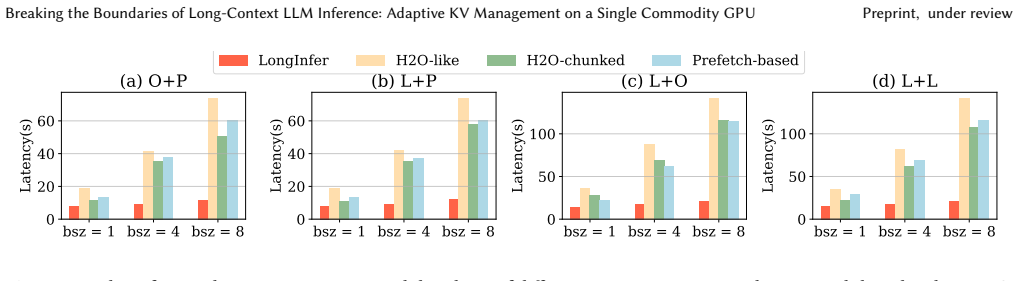
LeoAM's central claim is that the disk bottleneck in importance-aware long-context inference can be broken by moving importance evaluation onto compact summaries while making chunk granularity follow the attention landscape. The paper observes an attention desert: at any decoding step, most consecutive chunks of past tokens have near-zero attention weight, and the desert density varies by layer and decoding step. On that basis LeoAM builds tree-structured chunks that split near important tokens and merge across deserts, then stores for each disk-resident chunk only its element-wise maximum and minimum key vectors; with the current query these give upper and lower bounds on the chunk's attention contribution, so the CPU can rank chunks after transferring roughly a fraction $r = \alpha + 2/n'$ of the data instead of all of it. A dynamic three-tier pipeline overlaps disk reads, CPU evaluation, and GPU compute, with compression ratio chosen so transmission hides inside compute time. The reported result is an average 3.46x latency speedup over the better token-level, chunk-level, and prefetch baselines, reaching 5.47x at batch size 8 while keeping accuracy within about 1% of full-cache inference.
Load-bearing premise
Everything rests on the assumption that the per-chunk maximum and minimum key vectors, combined with the current query, give correct upper and lower bounds on the chunk's true attention contribution, so a chunk ranked unimportant by the abstract really is unimportant.
Editorial extensions
If this is right
- With only abstracts moved from disk, disk bandwidth stops scaling with context length; the cost of importance evaluation becomes nearly independent of how many tokens are stored off-GPU.
- Because chunk granularity adapts to attention deserts, a single system can use fine chunks where attention is dense and coarse chunks where it is not, which is what lets it beat fixed-chunk and token-level policies.
- The three-tier pipeline makes larger batches cheaper per token, since transfer and evaluation work is overlapped; at batch size 8 the reported speedup rises to 5.47x.
- The quality results imply that roughly 10% of KV chunks, chosen query-aware, carry essentially all the information needed for accurate generation on the tested tasks, so long-context inference on a PC is feasible without a datacenter GPU.
Reading between the lines
- The maximum-and-minimum key bound is a heuristic rather than a proven guarantee; one testable extension is to split chunks whose keys have mixed signs before abstracting, which would restore exact bounds at a small memory cost.
- Attention-desert density could itself be predicted online from the query and recent history, letting the initial chunk size adapt per layer without offline profiling.
- The same abstract-and-rank pattern should transfer to quantized KV caches or to non-attention score functions such as retrieval-style similarity, which would broaden the method beyond transformer attention.
Editorial analysis
A structured set of objections, weighed in public.
Referee Report
Summary. The paper presents LeoAM, an importance-aware long-context LLM inference system for a single commodity GPU that manages the KV cache across GPU, CPU, and disk. The system has three components: an importance-aware adaptive KV manager (IAKM) that partitions KV data into variable-sized chunks organized in a tree and merges/splits chunks according to attention-desert statistics; a lightweight KV abstract (LKA) that stores per-chunk elementwise max/min key vectors so that importance evaluation can be done without loading full KV data from disk; and a dynamic three-tier pipeline (DTP) that overlaps transmission and computation and dynamically compresses transferred KV data. The paper reports an average inference latency speedup of 3.46x over its baselines, up to 5.47x at batch size 8, and less than a 1% accuracy drop on four short-answer tasks. The implementation is built on FlexGen.
Significance. If the claims hold, LeoAM addresses a real and timely bottleneck: making long-context LLM inference practical on personal hardware with limited GPU and CPU memory, where disk I/O becomes the dominant cost. The paper's main strengths are its system-level decomposition of the problem, the adaptive chunk-management idea, the lightweight abstract mechanism for disk-resident KV data, and the explicit latency breakdown showing that each component contributes. However, the central performance and quality claims are measured rather than derived, and the measurement layer has important gaps: no error bars, no code release, baseline implementations that are not independently validated, and quality evaluation only on short-context tasks. The correctness of the LKA bounds is also left unproved. The contribution is therefore plausible and potentially valuable, but the evidence as presented is not yet sufficient to establish the headline numbers.
major comments (4)
- [§4.3, Figure 11] The LKA mechanism claims that per-chunk elementwise maximum and minimum key vectors, combined with the current query, yield valid upper and lower bounds on the chunk's attention contribution. This is not generally true without specifying the exact formula. For a raw dot product q·k over a chunk, a valid upper bound requires a sign-aware per-dimension combination: for each dimension j, use q_j * max_k_j when q_j > 0 and q_j * min_k_j when q_j < 0. Simply taking q·max_key, or even max(q·max_key, q·min_key), underestimates the true maximum on mixed-sign queries; for example, with q=[1,-1] and chunk keys [10,-10] and [-10,10], q·max_key = 0 while the true maximum q·k is 20. The paper does not state which formula is used. Moreover, the token importance metric is defined in §4.1 as a softmax attention weight, whose denominator is global across all tokens; a per-chunk bound on q·k does not, by itself, bound the softmax attention weight or the cumulative importance used by IAKM's tree pruning in §4.2. If LKA under-bounds important chunks, IAKM can merge or discard those chunks, and the resulting quality degradation is not captured by the reported experiments. This is a load-bearing correctness gap that needs a precise statement of the bounded quantity and a proof of the bound.
- [§6.1, §6.2, Figure 14] The claim of 'maintaining comparable LLM response quality' is supported only by accuracy measurements on COPA, RTE, PIQA, and OpenBookQA, which are short-context tasks. The LongBench and PG-19 datasets are used only for latency/throughput experiments, not for quality evaluation. Since LeoAM's IAKM and LKA mechanisms specifically target disk-resident, long-context KV chunks, the key quality question is whether important KV chunks are correctly identified in long contexts; a <1% accuracy drop on four short-answer tasks does not answer that question. At minimum, the paper should report perplexity on PG-19 and/or accuracy on LongBench tasks under the same offloading configuration, with and without the LKA/IAKM mechanisms, to show that the speedup does not come from unmeasured loss of important KV data.
- [§6.2, Figure 15] The central speedup claim of 3.46x average and 5.47x at batch size 8 is based on comparisons to author-implemented baselines (H2O-like, H2O-chunked, Prefetch-based) with no error bars, no variance information, and no code release. Latency measurements on a system with disk I/O and PCIe transfers are inherently noisy, and the figure does not indicate the number of runs or the spread across runs. Without this information, and without an independent or released baseline implementation, the reader cannot assess whether the reported speedups are stable or whether they depend on specific choices in the baseline implementations. The paper should either release the code and baselines, or report mean and standard deviation over multiple runs for each configuration.
- [§4.2, §6.1, §6.4] Several key system parameters are chosen via sensitivity analysis on the same benchmark families used for the main evaluation: the default chunk size of 64 tokens (Figure 18), the importance rate of 10%, the early-layer chunk size of 8, and the 50% early-layer retention ratio. Since these parameters directly control how much KV data is transferred from disk, selecting them on the same datasets risks inflating the reported speedups. There is no held-out validation set or a clear separation between parameter exploration and final evaluation. The authors should either report results for a range of these parameters on the final benchmark sets, or justify that the selected defaults are not the result of per-dataset tuning.
minor comments (4)
- [Abstract and Conclusion] The abstract contains the sentence 'Experimental results demonstrate that LongInfer achieves...', which appears to refer to the system under a different name; the conclusion also ends with 'commodity CPU' where the context requires 'commodity GPU'.
- [§4.2, Eq. (2)] Equation (2) defines f(m) but the text refers to A(m), and the derivation of the optimal chunk count from the difference expression in Eq. (3) is informal; the symbols m, n, and rho(l) should be defined consistently, and the 'approximately determine' step should be made rigorous or explicitly stated as a heuristic.
- [§6.3, Figures 16 and 17] The text introduces the ablation order as '+LKA' then '+IAKM', but the figure bars appear to be ordered '+IAKM' then '+LKA'; the caption and legend should be harmonized so that the contribution of each component is unambiguous.
- [§6.1] The description of the LongBench sampling says 'a variety of prompts' are sampled, but no details are given about prompt lengths, number of samples per task, or which tasks are used; this information is necessary for reproducibility of the latency experiments.
Circularity Check
No significant circularity: the 3.46x/5.47x speedup and sub-1% accuracy-drop claims are measured against external baselines, not derived from the paper's own definitions; the LKA upper/lower-bound gap is a correctness concern, not a circular step.
full rationale
LeoAM's central claims are empirical. Section 6.2 reports inference latency for LeoAM versus H2O-like, H2O-chunked, and Prefetch-based baselines across LongBench/PG-19 and batch sizes, and Figure 14 reports accuracy on four external tasks against H2O-like and Full Cache. These are measurements, so there is no equation-level reduction of the speedup to the inputs. The LKA abstraction (Sec 4.3, Fig 11) stores elementwise max/min key vectors and claims they yield chunk upper/lower bounds; the paper gives no proof and, for softmax attention with mixed-sign queries, the bound is not guaranteed. That is an unverified soundness assumption that could invalidate the quality claim, but it is not circular: the bound is not defined as the attention output, nor is the quality result derived from it. Similarly, Eq (2)-(3) choose initial chunk size m from an offline density rho(l); the source of rho(l) is not disclosed, and default values (chunk 64, importance 10%, early-layer chunk 8, 50% retention) are selected by sensitivity analysis on the same benchmark families. This creates a tuning/overfitting risk for the absolute speedup, but the speedup itself is a measured comparison at those settings, not a fitted quantity renamed as a prediction. The paper contains no load-bearing self-citations: references [28], [49], [65] etc. are external prior systems, and the authors do not invoke their own prior uniqueness theorem or ansatz. No circular step meets the standard of Eq. X = Eq. Y by construction or parameter-as-prediction.
Assumptions & free parameters
free parameters (6)
- initial chunk size =
64 tokens
- importance rate =
0.1 (10%)
- early-layer chunk size =
8 tokens
- early-layer retention ratio =
0.5 (50%)
- layer-wise importance density rho(l) =
not reported
- KV compression ratio delta =
not reported
assumptions (5)
- domain assumption Attention weight sum is a valid token-importance proxy for KV selection.
- domain assumption Long-context attention sparsity forms contiguous deserts that can be merged and split without losing important tokens.
- ad hoc to paper Elementwise max/min keys give valid upper and lower bounds for chunk attention.
- domain assumption Sparsity patterns in the first layers and early decoding steps are distinct enough to justify fixed chunk sizes and 50% retention.
- domain assumption Offline density knowledge rho(l) is available and representative of the inference workload.
Cite this review
Pith. "Pith review of Breaking the Boundaries of Long-Context LLM Inference: Adaptive KV Management on a Single Commodity GPU." pith.science (2026). https://pith.science/paper/3GSK2LC3
@misc{pith2026250620187,
  author       = {Pith},
  title        = {Pith review of: Breaking the Boundaries of Long-Context LLM Inference: Adaptive KV Management on a Single Commodity GPU},
  year         = {2026},
  howpublished = {\url{https://pith.science/paper/3GSK2LC3}},
  note         = {Machine review of arXiv:2506.20187}
}
read the original abstract
Advanced Large Language Models (LLMs) have achieved impressive performance across a wide range of complex and long-context natural language tasks. However, performing long-context LLM inference locally on a commodity GPU (a PC) with privacy concerns remains challenging due to the increasing memory demands of the key-value (KV) cache. Existing systems typically identify important tokens and selectively offload their KV data to GPU and CPU memory. The KV data needs to be offloaded to disk due to the limited memory on a commodity GPU, but the process is bottlenecked by token importance evaluation overhead and the disk's low bandwidth. In this paper, we present LeoAM, the first efficient importance-aware long-context LLM inference system for a single commodity GPU with adaptive hierarchical GPU-CPU-Disk KV management. Our system employs an adaptive KV management strategy that partitions KV data into variable-sized chunks based on the skewed distribution of attention weights across different layers to reduce computational and additional transmission overheads. Moreover, we propose a lightweight KV abstract method, which minimizes transmission latency by storing and extracting the KV abstract of each chunk on disk instead of the full KV data. LeoAM also leverages the dynamic compression and pipeline techniques to further accelerate inference. Experimental results demonstrate that LongInfer achieves an average inference latency speedup of 3.46x, while maintaining comparable LLM response quality. In scenarios with larger batch sizes, it achieves up to a 5.47x speedup.
Figures


Figures from the paper (10 more)




Forward citations
Cited by 2 Pith papers
-
Agent-Assisted Side-Channel Attacks on Non-Prefix KV Cache in RAG
SpliceLeak is the first end-to-end side-channel attack on non-prefix KV cache in RAG, using Step-Wave timing leaks to fingerprint private prompt lengths and extract tokens with up to 100% success using 63 requests per...
-
Ada-KV: Optimizing KV Cache Eviction by Adaptive Budget Allocation for Efficient LLM Inference
Ada-KV is the first head-wise adaptive KV cache budget allocator for LLMs, using a theoretical loss upper bound to allocate eviction differently per attention head and yielding higher quality than uniform methods on l...
Reference graph
Works this paper leans on
-
[8]
Weijian Chen, Shuibing He, Haoyang Qu, Ruidong Zhang, Siling Yang, Ping Chen, Yi Zheng, Baoxing Huai, and Gang Chen. 2025.{IMPRESS}: An{Importance-Informed}{ Multi-Tier} Prefix{KV} Storage System for Large Language Model Inference. In 23rd USENIX Conference on File and Storage Technologies (FAST 25) . 187–201
work page 2025
-
[1]
Muhammad Adnan, Akhil Arunkumar, Gaurav Jain, Prashant Nair, Ilya Soloveychik, and Purushotham Kamath. 2024. Keyformer: Kv cache reduction through key tokens selection for efficient generative inference. Proceedings of Machine Learning and Systems 6 (2024), 114– 127
2024
-
[2]
Amey Agrawal, Junda Chen, Íñigo Goiri, Ramachandran Ramjee, Chao- jie Zhang, Alexey Tumanov, and Esha Choukse. 2024. Mnemosyne: Parallelization Strategies for Efficiently Serving Multi-Million Con- text Length LLM Inference Requests Without Approximations. arXiv preprint arXiv:2409.17264 (2024)
arXiv 2024
-
[3]
Anthropic. 2024. Claude 3 Family Announcement. https://www. anthropic.com/news/claude-3-family. Accessed: 2024-10-18
work page 2024
-
[4]
Yushi Bai, Xin Lv, Jiajie Zhang, Hongchang Lyu, Jiankai Tang, Zhidian Huang, Zhengxiao Du, Xiao Liu, Aohan Zeng, Lei Hou, et al . 2023. Longbench: A bilingual, multitask benchmark for long context under- standing. arXiv preprint arXiv:2308.14508 (2023)
arXiv 2023
-
[5]
Iz Beltagy, Matthew E Peters, and Arman Cohan. 2020. Longformer: The long-document transformer. arXiv preprint arXiv:2004.05150 (2020)
arXiv 2020
-
[6]
Tom B Brown, Benjamin Mann, Nick Ryder, Melanie Subbiah, Jared Kaplan, Prafulla Dhariwal, Arvind Neelakantan, Pranav Shyam, Girish Sastry, Amanda Askell, et al . 2020. Language models are few-shot learners. In Proceedings of the 34th International Conference on Neural Information Processing Systems. 1877–1901
work page 2020
-
[7]
CellStrat. 2023. Real-World Use Cases for Large Language Models (LLMs). Medium (2023). https://cellstrat.medium.com/real-world- use-casesfor-large-language-models-llms-d71c3a577bf2 Accessed: 2024-10-08
work page 2023
Show all 75 references
-
[9]
Yukang Chen, Shengju Qian, Haotian Tang, Xin Lai, Zhijian Liu, Song Han, and Jiaya Jia. [n. d.]. LongLoRA: Efficient Fine-tuning of Long- Context Large Language Models. In The Twelfth International Confer- ence on Learning Representations
-
[10]
Zhiyu Chen, Harini Eavani, Wenhu Chen, Yinyin Liu, and William Yang Wang. 2019. Few-shot NLG with pre-trained language model. arXiv preprint arXiv:1904.09521 (2019)
2019 arXiv
-
[11]
Minsik Cho, Mohammad Rastegari, and Devang Naik. [n. d.]. KV- Runahead: Scalable Causal LLM Inference by Parallel Key-Value Cache Generation. In Forty-first International Conference on Machine Learn- ing
-
[12]
Aakanksha Chowdhery, Sharan Narang, Jacob Devlin, Maarten Bosma, Gaurav Mishra, Adam Roberts, Paul Barham, Hyung Won Chung, Charles Sutton, Sebastian Gehrmann, et al. 2023. Palm: Scaling lan- guage modeling with pathways. Journal of Machine Learning Research 24, 240 (2023), 1–113
2023
-
[13]
Daivi. 2024. 7 Top Large Language Model Use Cases And Applica- tions. ProjectPro (March 2024). https://www.projectpro.io/article/large- language-model-use-cases-and-applications/887 Accessed: 2024-10- 08
2024
-
[14]
Harry Dong, Xinyu Yang, Zhenyu Zhang, Zhangyang Wang, Yuejie Chi, and Beidi Chen. [n. d.]. Get More with LESS: Synthesizing Re- currence with KV Cache Compression for Efficient LLM Inference. In Forty-first International Conference on Machine Learning
-
[15]
Shichen Dong, Wen Cheng, Jiayu Qin, and Wei Wang. 2024. QAQ: Quality Adaptive Quantization for LLM KV Cache. arXiv preprint arXiv:2403.04643 (2024)
2024 arXiv
-
[16]
Qichen Fu, Minsik Cho, Thomas Merth, Sachin Mehta, Mohammad Rastegari, and Mahyar Najibi. [n. d.]. LazyLLM: Dynamic Token Prun- ing for Efficient Long Context LLM Inference. In Workshop on Efficient Systems for Foundation Models II@ ICML2024
-
[17]
2024.{Cost- Efficient} large language model serving for multi-turn conversations with{CachedAttention}
Bin Gao, Zhuomin He, Puru Sharma, Qingxuan Kang, Djordje Jevdjic, Junbo Deng, Xingkun Yang, Zhou Yu, and Pengfei Zuo. 2024.{Cost- Efficient} large language model serving for multi-turn conversations with{CachedAttention}. In 2024 USENIX Annual Technical Conference (USENIX ATC ...
2024
-
[18]
Suyu Ge, Yunan Zhang, Liyuan Liu, Minjia Zhang, Jiawei Han, and Jianfeng Gao. [n. d.]. Model Tells You What to Discard: Adaptive KV Cache Compression for LLMs. In Workshop on Advancing Neural Network Training: Computational Efficiency, Scalability, and Resource Optimization (W...
2023
-
[19]
Suyu Ge, Yunan Zhang, Liyuan Liu, Minjia Zhang, Jiawei Han, and Jianfeng Gao. 2024. Model Tells You What to Discard: Adaptive KV Cache Compression for LLMs. In The Twelfth International Conference on Learning Representations
2024
-
[20]
Coleman Hooper, Sehoon Kim, Hiva Mohammadzadeh, Michael W Mahoney, Yakun Sophia Shao, Kurt Keutzer, and Amir Gholami. 2024. Kvquant: Towards 10 million context length llm inference with kv cache quantization. arXiv preprint arXiv:2401.18079 (2024)
2024 arXiv
-
[21]
Mingqiang Huang, Ao Shen, Kai Li, Haoxiang Peng, Boyu Li, and Hao Yu. 2024. Edgellm: A highly efficient cpu-fpga heterogeneous edge accelerator for large language models. arXiv preprint arXiv:2407.21325 (2024)
2024 arXiv
-
[22]
Yuxiang Huang, Binhang Yuan, Xu Han, Chaojun Xiao, and Zhiyuan Liu. 2024. Locret: Enhancing Eviction in Long-Context LLM Inference with Trained Retaining Heads. arXiv preprint arXiv:2410.01805 (2024)
2024 arXiv
-
[23]
Siddharth Jha, Lutfi Eren Erdogan, Sehoon Kim, Kurt Keutzer, and Amir Gholami. [n. d.]. Characterizing Prompt Compression Meth- ods for Long Context Inference. In Workshop on Efficient Systems for Foundation Models II@ ICML2024
-
[24]
Huiqiang Jiang, YUCHENG LI, Chengruidong Zhang, Qianhui Wu, Xufang Luo, Surin Ahn, Zhenhua Han, Amir H Abdi, Dongsheng Li, Chin-Yew Lin, et al. [n. d.]. MInference: Accelerating Pre-filling for Long-Context LLMs via Dynamic Sparse Attention. In Workshop on Efficient Systems fo...
-
[25]
Jordan Juravsky, Bradley Brown, Ryan Ehrlich, Daniel Y Fu, Christo- pher Ré, and Azalia Mirhoseini. 2024. Hydragen: High-throughput llm inference with shared prefixes. arXiv preprint arXiv:2402.05099 (2024)
2024 arXiv
-
[26]
Tim Keary. 2024. 12 Practical Large Language Model (LLM) Applica- tions. Techopedia (January 2024). https://www.techopedia.com/12- 13 Preprint, under review He Sun et al. practical-large-language-model-llm-applications Accessed: 2024-10- 08
2024
-
[27]
Woosuk Kwon, Zhuohan Li, Siyuan Zhuang, Ying Sheng, Lianmin Zheng, Cody Hao Yu, Joseph Gonzalez, Hao Zhang, and Ion Stoica
-
[28]
Wonbeom Lee, Jungi Lee, Junghwan Seo, and Jaewoong Sim. 2024. {InfiniGen}: Efficient generative inference of large language models with dynamic{KV} cache management. In 18th USENIX Symposium on Operating Systems Design and Implementation (OSDI 24) . 155–172
2024
-
[29]
Omer Levy and Yoav Goldberg. 2014. Linguistic regularities in sparse and explicit word representations. In Proceedings of the eighteenth conference on computational natural language learning . 171–180
2014
-
[30]
Dacheng Li. 2025. LongChat: An Open Framework for Long-Context Language Models. https://github.com/DachengLi1/LongChat
2025
-
[31]
Yuanchun Li, Hao Wen, Weijun Wang, Xiangyu Li, Yizhen Yuan, Guo- hong Liu, Jiacheng Liu, Wenxing Xu, Xiang Wang, Yi Sun, et al. 2024. Personal llm agents: Insights and survey about the capability, efficiency and security. arXiv preprint arXiv:2401.05459 (2024)
2024 arXiv
-
[32]
Hwijoon Lim, Juncheol Ye, Sangeetha Abdu Jyothi, and Dongsu Han
-
[33]
Bin Lin, Tao Peng, Chen Zhang, Minmin Sun, Lanbo Li, Hanyu Zhao, Wencong Xiao, Qi Xu, Xiafei Qiu, Shen Li, et al . 2024. Infinite-llm: Efficient llm service for long context with distattention and distributed kvcache. arXiv preprint arXiv:2401.02669 (2024)
2024 arXiv
-
[34]
Di Liu, Meng Chen, Baotong Lu, Huiqiang Jiang, Zhenhua Han, Qianxi Zhang, Qi Chen, Chengruidong Zhang, Bailu Ding, Kai Zhang, et al
-
[35]
Yuhan Liu, Hanchen Li, Yihua Cheng, Siddhant Ray, Yuyang Huang, Qizheng Zhang, Kuntai Du, Jiayi Yao, Shan Lu, Ganesh Anantha- narayanan, et al. 2024. CacheGen: KV Cache Compression and Stream- ing for Fast Large Language Model Serving. In Proceedings of the ACM SIGCOMM 2024 Co...
2024
-
[36]
Zichang Liu, Aditya Desai, Fangshuo Liao, Weitao Wang, Victor Xie, Zhaozhuo Xu, Anastasios Kyrillidis, and Anshumali Shrivastava. 2024. Scissorhands: Exploiting the persistence of importance hypothesis for llm kv cache compression at test time. Advances in Neural Information P...
2024
-
[37]
arXiv preprint arXiv:2409.10516 (2024)
RetrievalAttention: Accelerating Long-Context LLM Inference via Vector Retrieval. arXiv preprint arXiv:2409.10516 (2024)
2024 arXiv
-
[38]
Shi Luohe, Hongyi Zhang, Yao Yao, Zuchao Li, et al . [n. d.]. Keep the Cost Down: A Review on Methods to Optimize LLM’s KV-Cache Consumption. In First Conference on Language Modeling
-
[39]
Yubo Ma, Yuhang Zang, Liangyu Chen, Meiqi Chen, Yizhu Jiao, Xinze Li, Xinyuan Lu, Ziyu Liu, Yan Ma, Xiaoyi Dong, et al . 2024. Mmlongbench-doc: Benchmarking long-context document under- standing with visualizations. arXiv preprint arXiv:2407.01523 (2024)
2024 arXiv
-
[40]
LMSYS and Hugging Face. 2025. LongChat-7B-v1.5-32k. https:// huggingface.co/lmsys/longchat-7b-v1.5-32k
2025
-
[41]
NousResearch and Hugging Face. 2025. Yarn-Llama-2-13b-128k. https: //huggingface.co/NousResearch/Yarn-Llama-2-13b-128k . Accessed: 2025-01-13
2025
-
[42]
Xiurui Pan, Endian Li, Qiao Li, Shengwen Liang, Yizhou Shan, Ke Zhou, Yingwei Luo, Xiaolin Wang, and Jie Zhang. 2025. Instinfer: In-storage attention offloading for cost-effective long-context LLM inference. In Proceedings of the IEEE International Symposium on High-Performanc...
2025 arXiv
-
[43]
NousResearch. 2024. Yarn-Llama-2-13B-128K. https://huggingface. co/NousResearch/Yarn-Llama-2-13b-128k
2024
-
[44]
PrivateGPT. 2024. PrivateGPT. https://privategpt.io/. Accessed: 2024-10-18
2024
-
[45]
Jack W Rae, Anna Potapenko, Siddhant M Jayakumar, and Timothy P Lillicrap. 2019. Compressive transformers for long-range sequence modelling. arXiv preprint arXiv:1911.05507 (2019)
2019 arXiv
-
[46]
Reiner Pope, Sholto Douglas, Aakanksha Chowdhery, Jacob Devlin, James Bradbury, Jonathan Heek, Kefan Xiao, Shivani Agrawal, and Jeff Dean. 2023. Efficiently scaling transformer inference. Proceedings of Machine Learning and Systems 5 (2023), 606–624
2023
-
[47]
Yixin Song, Zeyu Mi, Haotong Xie, and Haibo Chen. 2024. Powerinfer: Fast large language model serving with a consumer-grade GPU. In Proceedings of the 28th ACM Symposium on Operating Systems Principles (SOSP). ACM. arXiv preprint arXiv:2312.12456
2024 arXiv
-
[48]
Yifan Tan, Haoze Wang, Chao Yan, and Yangdong Deng. 2024. AlignedKV: Reducing Memory Access of KV-Cache with Precision- Aligned Quantization. arXiv preprint arXiv:2409.16546 (2024)
2024 arXiv
-
[49]
Ying Sheng, Lianmin Zheng, Binhang Yuan, Zhuohan Li, Max Ryabinin, Beidi Chen, Percy Liang, Christopher Ré, Ion Stoica, and Ce Zhang
-
[50]
In International Conference on Machine Learning
Flexgen: High-throughput generative inference of large language models with a single gpu. In International Conference on Machine Learning. PMLR, 31094–31116
-
[51]
Hugo Touvron, Thibaut Lavril, Gautier Izacard, Xavier Martinet, Marie- Anne Lachaux, Timothée Lacroix, Baptiste Rozière, Naman Goyal, Eric Hambro, Faisal Azhar, et al. 2023. Llama: Open and efficient foundation language models. arXiv preprint arXiv:2302.13971 (2023)
2023 arXiv
-
[52]
Lukas Tuggener, Pascal Sager, Yassine Taoudi-Benchekroun, Ben- jamin F Grewe, and Thilo Stadelmann. 2024. So you want your private LLM at home?: a survey and benchmark of methods for efficient GPTs. In 11th IEEE Swiss Conference on Data Science (SDS), Zurich, Switzer- land, 30...
2024
-
[53]
Jiaming Tang, Yilong Zhao, Kan Zhu, Guangxuan Xiao, Baris Kasikci, and Song Han. [n. d.]. QUEST: Query-Aware Sparsity for Efficient Long-Context LLM Inference. In Forty-first International Conference on Machine Learning
-
[54]
TheBloke. 2024. Yarn-Llama-2-7B-128K-GGML. https://huggingface. co/TheBloke/Yarn-Llama-2-7B-128K-GGML
2024
-
[55]
Minzheng Wang, Longze Chen, Cheng Fu, Shengyi Liao, Xinghua Zhang, Bingli Wu, Haiyang Yu, Nan Xu, Lei Zhang, Run Luo, et al
-
[56]
Thomas Wolf, Lysandre Debut, Victor Sanh, Julien Chaumond, Clement Delangue, Anthony Moi, Pierric Cistac, Tim Rault, Rémi Louf, Morgan Funtowicz, et al . 2019. Huggingface’s transformers: State-of-the-art natural language processing. arXiv. arXiv preprint arXiv:1910.03771 (2019)
2019 arXiv
-
[57]
Ashish Vaswani, Noam Shazeer, Niki Parmar, Jakob Uszkoreit, Llion Jones, Aidan N Gomez, Łukasz Kaiser, and Illia Polosukhin. 2017. At- tention is all you need. In Advances in neural information processing systems. 5998–6008. http://arxiv.org/abs/1706.03762
2017 arXiv
-
[58]
Zhongwei Wan, Ziang Wu, Che Liu, Jinfa Huang, Zhihong Zhu, Peng Jin, Longyue Wang, and Li Yuan. 2024. Look-m: Look-once optimiza- tion in kv cache for efficient multimodal long-context inference. arXiv preprint arXiv:2406.18139 (2024)
2024 arXiv
-
[59]
Dongjie Yang, XiaoDong Han, Yan Gao, Yao Hu, Shilin Zhang, and Hai Zhao. 2024. PyramidInfer: Pyramid KV Cache Compression for High- throughput LLM Inference. arXiv preprint arXiv:2405.12532 (2024). 14 Breaking the Boundaries of Long-Context LLM Inference: Adaptive KV Managemen...
2024 arXiv
-
[60]
CoRR (2024)
Leave No Document Behind: Benchmarking Long-Context LLMs with Extended Multi-Doc QA. CoRR (2024)
2024
-
[61]
Lu Ye, Ze Tao, Yong Huang, and Yang Li. 2024. ChunkAttention: Efficient Self-Attention with Prefix-Aware KV Cache and Two-Phase Partition. In Proceedings of the 62nd Annual Meeting of the Association for Computational Linguistics (Volume 1: Long Papers) . 11608–11620
2024
-
[62]
Bingyang Wu, Shengyu Liu, Yinmin Zhong, Peng Sun, Xuanzhe Liu, and Xin Jin. 2024. LoongServe: Efficiently Serving Long-context Large Language Models with Elastic Sequence Parallelism. In Proceedings of the 28th ACM Symposium on Operating Systems Principles (SOSP) . USENIX Asso...
2024 arXiv
-
[63]
Yuhui Xu, Zhanming Jie, Hanze Dong, Lei Wang, Xudong Lu, Ao- jun Zhou, Amrita Saha, Caiming Xiong, and Doyen Sahoo. 2024. Think: Thinner key cache by query-driven pruning. arXiv preprint arXiv:2407.21018 (2024)
2024 arXiv
-
[64]
Shiquan Zhang, Ying Ma, Le Fang, Hong Jia, Simon D’Alfonso, and Vassilis Kostakos. 2024. Enabling on-device llms personalization with smartphone sensing. In Companion of the 2024 on ACM International Joint Conference on Pervasive and Ubiquitous Computing . 186–190
2024
-
[65]
Jiayi Yao, Hanchen Li, Yuhan Liu, Siddhant Ray, Yihua Cheng, Qizheng Zhang, Kuntai Du, Shan Lu, and Junchen Jiang. 2025. You Only Prefill Once: Combining Cached Knowledge for Large Language Model Serv- ing with CacheFuse. In Proceedings of the 20th European Conference on Compu...
2025 arXiv
-
[66]
Wayne Xin Zhao, Kun Zhou, Junyi Li, Tianyi Tang, Xiaolei Wang, Yupeng Hou, Yingqian Min, Beichen Zhang, Junjie Zhang, Zican Dong, et al. 2023. A survey of large language models. arXiv preprint arXiv:2303.18223 (2023)
2023 arXiv
-
[67]
Hailin Zhang, Xiaodong Ji, Yilin Chen, Fangcheng Fu, Xupeng Miao, Xiaonan Nie, Weipeng Chen, and Bin Cui. 2024. Pqcache: Product quantization-based kvcache for long context llm inference. arXiv preprint arXiv:2407.12820 (2024)
2024 arXiv
-
[68]
Rui Zhang, Hongwei Li, Rui Wen, Wenbo Jiang, Yuan Zhang, Michael Backes, Yun Shen, and Yang Zhang. 2024. Instruction Backdoor Attacks Against Customized{LLMs}. In 33rd USENIX Security Symposium (USENIX Security 24). 1849–1866
2024
-
[69]
Zixuan Zhou, Xuefei Ning, Ke Hong, Tianyu Fu, Jiaming Xu, Shiyao Li, Yuming Lou, Luning Wang, Zhihang Yuan, Xiuhong Li, et al. 2024. A survey on efficient inference for large language models. arXiv preprint arXiv:2404.14294 (2024)
2024 arXiv
-
[70]
Zhenyu Zhang, Ying Sheng, Tianyi Zhou, Tianlong Chen, Lianmin Zheng, Ruisi Cai, Zhao Song, Yuandong Tian, Christopher Ré, Clark Barrett, et al. 2023. H2o: Heavy-hitter oracle for efficient generative inference of large language models. Advances in Neural Information Processing...
2023
-
[72]
Youpeng Zhao, Di Wu, and Jun Wang. 2024. ALISA: Accelerating Large Language Model Inference via Sparsity-Aware KV Caching. In Proceedings of the 51st Annual International Symposium on Computer Architecture (ISCA). ACM/IEEE. arXiv preprint arXiv:2403.17312
2024 arXiv
-
[73]
Lianmin Zheng, Liangsheng Yin, Zhiqiang Xie, Chuyue Livia Sun, Jeff Huang, Cody Hao Yu, Shiyi Cao, Christos Kozyrakis, Ion Stoica, Joseph E Gonzalez, et al. 2024. Sglang: Efficient execution of structured language model programs. Advances in Neural Information Processing Syste...
2024
-
[75]
Qianchao Zhu, Jiangfei Duan, Chang Chen, Siran Liu, Xiuhong Li, Guanyu Feng, Xin Lv, Huanqi Cao, Xiao Chuanfu, Xingcheng Zhang, et al. 2024. Near-Lossless Acceleration of Long Context LLM In- ference with Adaptive Structured Sparse Attention. arXiv preprint arXiv:2406.15486 (2024). 15
2024 arXiv
-
[2023]
InProceedings of the 29th Symposium on Operating Systems Principles
Efficient memory management for large language model serving with pagedattention. InProceedings of the 29th Symposium on Operating Systems Principles. 611–626
-
[2024]
In Proceedings of the ACM SIGCOMM 2024 Conference
Accelerating Model Training in Multi-cluster Environments with Consumer-grade GPUs. In Proceedings of the ACM SIGCOMM 2024 Conference. 707–720
2024
Reviewed August 6, 2026 · model on record in the stance chip above.
Discussion (0). Sign in to comment.