REVIEW 1 major objections 4 minor 32 references
The circular disc made of linear elastic incompressible material and the 'bathyscaphe lesson'
T0 review · 1 major / 4 minor · reviewed 2026-08-15 · deepseek-v4-flash
Pith's one-line read A doubly constrained disc still deforms in linear theory, but nonlinearity locks it rigid.
desk verdict Worth refereeing, but the admissibility condition and explicit fields in Eqs. (78)-(80) are mutually inconsistent for complex Fourier data; the printed 'general' solution only works for real coefficients. read the letter →
The pith
A machine-rendered reading of the paper's core claim, the machinery that carries it, and where it could break.
The reading
What carries the argument
The argument is carried by the complex-variable representation of the incompressible plane problem, whose equations coincide with those of slow viscous (Stokes) flow. A stream function $\psi$ is expressed through a Goursat representation $\psi=\mathrm{Re}[z f(z)+g(z)]$, the pressure enters as a harmonic Lagrangian multiplier, and boundary tractions are expanded in Fourier series. Enforcing the boundary inextensibility condition $\mathrm{Re}(\partial u/\partial\tau)=0$ and using Fourier orthogonality yields the admissibility conditions $D_1=0$, $D_{-k}=\overline{D_k}$, which reduce the load to a purely normal distribution. The load-bearing step is the linearization of the exact isoperimetric constraint: dropping the quadratic terms in the exact perimeter condition is what permits non-trivial strain to survive.
What would settle it
Run a geometrically exact finite-element simulation with the constraint $\det(\mathbf{I}+\nabla\mathbf{u})=1$ inside the disc and exact perimeter inextensibility on the boundary for the load of Eq. (71): if any component of displacement at the loaded point remains nonzero as the mesh is refined and the constraint enforcement is tightened, the paper's claim of rigid locking is wrong.
Extended reading notes
Core claim
The central discovery is that imposing both incompressibility ($\mathrm{div}\,\mathbf{u}=0$) and boundary inextensibility ($\mathrm{Re}(\partial u/\partial\tau)=0$) does not eliminate all linear plane-strain solutions for the disc. For loadings satisfying $D_1=0$ and $D_{-k}=\overline{D_k}$, the fields in Eq. (80) give nonzero strain inside the disc, while strain and deviatoric stress vanish at the boundary and only the mean pressure remains. The apparent paradox is resolved because both constraints are enforced only to first order; the exact nonlinear isoperimetric condition would force rigidity, as the finite-element simulations confirm. Nevertheless, the paper claims the linear solution has real value as a candidate stress state for a rigid body and as an indicator of critical design conditions near, but not at, the incompressible limit.
Load-bearing premise
Everything rests on replacing the exact incompressibility and perimeter-inextensibility constraints by their first-order linearizations; if the exact isoperimetric condition is retained, the disc is forced to be rigid and the non-trivial solutions disappear.
Editorial extensions
If this is right
- For near-incompressible discs with stiff but not perfectly rigid coatings, the linear fields provide accurate predictions away from $\nu=1/2$, with discrepancies confined to a narrow neighbourhood of the incompressible limit.
- A finite buckling pressure at $\nu=1/2$ is a linearization artifact; the true bifurcation load jumps to infinity, so designs should treat the linear critical load as a warning threshold rather than an actual instability.
- The admissibility conditions identify which self-equilibrated boundary loads can produce non-trivial linear stress fields: purely normal traction with no shear component at any Fourier order.
- The linear solution can serve as a well-defined stress distribution inside a body that nonlinear analysis treats as rigid, supporting the idea of a rigid-body stress as a limit of elastic states.
Reading between the lines
- The paradox is likely generic: any constraint enforced only through its first-order linearization can admit spurious deformation modes, so engineers should check whether computed modes survive a geometrically exact version of the constraint.
- Because the admissibility conditions require a purely normal traction, a shear component at any Fourier order would make the doubly constrained linear problem unsolvable; testing this prediction is a straightforward extension of the present series solution.
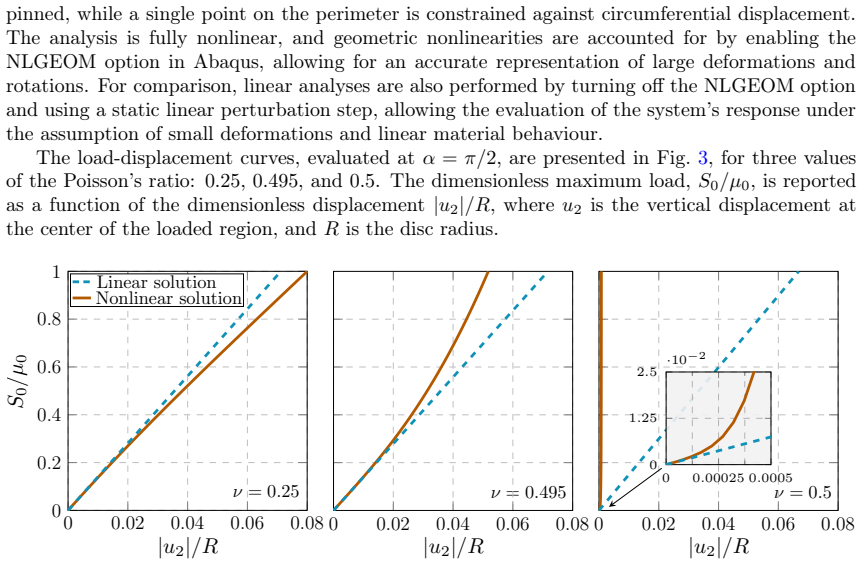
- A fully nonlinear calculation with an exactly inextensible coating and exact incompressibility should drive the displacement exactly to zero; the paper's finite-element results already approach this limit, making the prediction sharp.
- The bathyscaphe lesson suggests that acoustic or other symptoms during loading of a nearly rigid system could be interpreted as attempts to reach a linear bifurcation that cannot fully develop, a hypothesis that could be tested in instrumented pressure experiments.
Signed reviews
Editorial analysis
A structured set of objections, weighed in public.
Referee Report
Summary. The paper treats the plane-strain problem of a circular linear elastic disc under self-equilibrated boundary tractions. It first derives a general complex-variable solution for an incompressible disc using a stream function and Wirtinger calculus (Sections 2-4), then imposes an additional isoperimetric (boundary inextensibility) constraint (Section 5). The central mathematical claim is that, despite the naive expectation that the doubly constrained disc must be rigid, non-trivial linearized solutions exist for admissible loads, with explicit fields displayed in Eq. (80) and admissibility conditions in Eq. (78). The paper then shows by nonlinear finite element simulations that the exact nonlinear problem locks rigidly in the incompressible limit, whereas the linearized solution remains compliant and predicts a finite buckling load for a coated disc. The discrepancy is attributed to the linearization of the constraints, and the authors argue that the linear solution retains value as an approximate stress state and as a design warning (the 'bathyscaphe lesson').
Significance. If the central claim is correct, the paper is a valuable contribution to the mechanics of constrained elastic bodies: it provides a clean example in which two linearized constraints do not imply rigidity in the linear theory, while the exact nonlinear theory does, and it quantifies the discrepancy with a careful FEM study. The complex-variable derivation is self-contained, the analysis is not fitted to the target result, and the nonlinear locking is an independent numerical check. The practical lesson, that linearized analyses can under-predict stiffness and predict spurious bifurcations in nearly rigid-constrained systems, is useful for design. The paper builds on the authors' earlier analytical work [4,16], which strengthens confidence in the method. However, the displayed general solution in Section 5.1 is incomplete for complex Fourier coefficients, so the claim of generality needs correction before the paper can be accepted.
major comments (1)
- [§5.1, Eqs. (78)-(80)] The admissibility condition and the explicit solution in Eq. (80) are mutually inconsistent for complex Fourier data. Orthogonality in Eq. (77) gives D_1 = 0 and D_{-k} = \overline{D_k} for k ≥ 2; a literal reading of Eq. (78) as D_{-k} = D_k is not implied by the preceding derivation unless the D_k are additionally required to be real. If the intended condition is D_{-k} = \overline{D_k} (which is what makes Eq. (79) represent a real normal traction), then Eq. (80) is incomplete: substituting D_{-k} = \overline{D_k} into the general strain expression, Eq. (59), leaves an extra boundary term μ^{-1} Σ_{k≥2} (D_k - \overline{D_k}) z^{k-2}/R^{k-2} that is missing from Eq. (80)3 and from Eq. (80)5; the displacement in Eq. (80)1 is similarly missing the term Σ_{k≥2} (\overline{D_k} - D_k) z^{k-1}/((k-1)R^{k-1}). For the admissible real load σ(τ) = -2 sin 2α, with D_2 = i and D_{-2} = -i, the printed Eq. (80) predicts zero boundary deviatoric strain, whereas Eq. (59) gives ε22-ε11-2iε12 = 2i/μ at the boundary. The statement following Eq. (80) that deviatoric stress and all strain components vanish at the boundary is therefore valid only when Im D_k = 0 (real, even loads). The authors should either restore the missing terms so that Eq. (80) is the true general solution for the stated class, or explicitly restrict the admissible class to real coefficients; the present text overstates the generality of the result.
minor comments (4)
- [Eq. (62)] In the first line of Eq. (62), the boundary strain expression contains 'z/R' where the boundary variable 'τ/R' is meant; this is a typo in an otherwise boundary-only formula.
- [Eqs. (57), (62), (81)] The notation 'p(z) = −σ11(z)+σ22(z)/2' is ambiguous; it should read p(z) = −(σ11(z)+σ22(z))/2. Please add the parentheses in all occurrences.
- [Fig. 7 caption] The caption states 'Only the first mode, n = 1, is investigated,' but Eq. (86) is defined for n ≥ 2 and the first non-trivial bifurcation mode is n = 2; please correct this inconsistency.
- [Eq. (78)] If the overline in D_{-k} = \overline{D_k} is intended, it should be restored explicitly; the current printed form D_{-k}=D_k contradicts Eq. (77) and would unduly restrict the admissible loads to even distributions with real coefficients.
Circularity Check
No significant circularity: the linearized doubly constrained disc solution is derived from first principles, and the nonlinear locking result is an independent check.
full rationale
The non-trivial linear solutions for the doubly constrained disc are obtained by substituting the linearized inextensibility condition Re(du/dτ)=0 into the independently derived general incompressible-disc solution, Eqs. (58)-(60), yielding admissibility conditions in Eq. (78) and explicit fields in Eq. (80). No parameter is fitted to the target result; the existence of non-trivial linear fields is the direct algebraic output of the stated assumptions. The nonlinear finite-element locking simulations provide an independent check rather than an input to the derivation. Citations to the authors' prior works, [4] and [16], are used for rod-coating models and for the ν→1/2 comparison, but Section 3.1 re-derives the relevant limit and the isoperimetric boundary constraint is derived in the Appendix rather than imported as an unexamined premise. The reported inconsistency between Eqs. (78) and (80) is a possible mathematical correctness issue in the printed solution, not a circular reduction of the claim to its inputs. Therefore no circularity is found.
Assumptions & free parameters
assumptions (6)
- ad hoc to paper The exact constraints of incompressibility and boundary inextensibility may be linearized to div u = 0 and Re(du/d tau) = 0 for the purpose of solving the problem.
- domain assumption Plane strain applies, so incompressibility preserves area and the circle maximizes area for a given perimeter.
- standard math A stream function exists for 2D incompressible displacement fields, and the resulting biharmonic equation permits the Goursat representation psi = Re[z-bar f(z) + g(z)].
- standard math Boundary tractions and fields inside the disc admit convergent complex Fourier and Taylor series, and term-by-term differentiation and orthogonality are valid.
- domain assumption The rod-coating model of [16] (Euler rod with bending stiffness) remains valid for the incompressible disc in the limit nu to 1/2.
- domain assumption The Mooney-Rivlin hyperelastic law with C10 = mu/2, C01 = 0, and D1 = 3(1-2nu)/(mu(1+nu)) correctly represents the nearly incompressible nonlinear response in the FEM simulations.
Cite this review
Pith. "Pith review of The circular disc made of linear elastic incompressible material and the 'bathyscaphe lesson'." pith.science (2026). https://pith.science/paper/5FIFAJQR
@misc{pith2026250620247,
  author       = {Pith},
  title        = {Pith review of: The circular disc made of linear elastic incompressible material and the 'bathyscaphe lesson'},
  year         = {2026},
  howpublished = {\url{https://pith.science/paper/5FIFAJQR}},
  note         = {Machine review of arXiv:2506.20247}
}
read the original abstract
A linear elastic circular disc is analyzed under a self-equilibrated system of loads applied along its boundary. A distinctive feature of the investigation, conducted using complex variable analysis, is the assumption that the material is incompressible (in its linearized approximation), rendering the governing equations formally identical to those of Stokes flow in viscous fluids. After deriving a general solution to the problem, an isoperimetric constraint is introduced at the boundary to enforce inextensibility. This effect can be physically realized, for example, by attaching an inextensible elastic rod with negligible bending stiffness to the perimeter. Although the combined imposition of material incompressibility and boundary inextensibility theoretically prevents any deformation of the disc, it is shown that the problem still admits non-trivial solutions. This apparent paradox is resolved by recognizing the approximations inherent in the linearized theory, as confirmed by a geometrically nonlinear numerical analysis. Nonetheless, the linear solution retains significance: it may represent a valid stress distribution within a rigid system and can identify critical conditions of interest for design applications.
Figures


Figures from the paper (6 more)


Reference graph
Works this paper leans on
-
[16]
Elastic disk with isoperimetric Cosserat coating
M. Gaibotti, D. Bigoni, and S. G. Mogilevskaya. “Elastic disk with isoperimetric Cosserat coating”. In: European Journal of Mechanics-A/Solids100 (2023), p. 104568. doi: https: //doi.org/10.1016/j.euromechsol.2022.104568
arXiv 2023
-
[4]
Bifurcations of an elastic disc coated with an elastic inextensible rod
M. Gaibotti, S. Mogilevskaya, A. Piccolroaz, and D. Bigoni. “Bifurcations of an elastic disc coated with an elastic inextensible rod”. In:Proceedings of the Royal Society A480.2281 (2024), p. 20230491.doi: https://doi.org/10.1098/rspa.2023.0491
-
[1]
Some annular disk inclusion problems in elasticity
A. Selvadurai and B. Singh. “Some annular disk inclusion problems in elasticity”. In:Inter- national Journal of Solids and Structures20.2 (1984), pp. 129–139.doi: https://doi.org/ 10.1016/0020-7683(84)90004-0
-
[2]
Mechanics of a rigid circular disc bonded to a cracked elastic half-space
A. Selvadurai. “Mechanics of a rigid circular disc bonded to a cracked elastic half-space”. In: International Journal of Solids and Structures39.24 (2002), pp. 6035–6053.doi: https: //doi.org/10.1016/S0020-7683(02)00473-0
-
[3]
A. Selvadurai. “On certain bounds for the in-plane translational stiffness of a disc inclusion at abi-materialelasticinterface”.In: Mechanics Research Communications30.3(2003),pp.227–
work page 2003
-
[5]
The constraint of local injectivity in linear elasticity theory
R. Fosdick and G. Royer-Carfagni. “The constraint of local injectivity in linear elasticity theory”. In:Proceedings of the Royal Society A457.2013 (2001), pp. 2167–2187
work page 2001
-
[6]
Bifurcation Instability in Linear Elasticity with the Constraint of Local Injectivity
R. Fosdick, F. Freddi, and G. Royer-Carfagni. “Bifurcation Instability in Linear Elasticity with the Constraint of Local Injectivity”. In:Journal of Elasticity90.1 (2008), pp. 99–126. doi: https://doi.org/10.1007/s10659-007-9134-0
-
[7]
From Non-Linear Elasticity to Linearized Theory: Exam- ples Defying Intuition
F. Freddi and G. Royer-Carfagni. “From Non-Linear Elasticity to Linearized Theory: Exam- ples Defying Intuition”. In:Journal of Elasticity96 (2009), pp. 1–26
work page 2009
Show all 32 references
-
[8]
On the stress in rigid bodies
G. Grioli. “On the stress in rigid bodies”. In:Meccanica18 (1983), pp. 3–7
1983
-
[9]
Stressasaconstraintreactioninrigidbodies
R.FosdickandG.Royer-Carfagni.“Stressasaconstraintreactioninrigidbodies”.In: Journal of Elasticity 74 (2004), pp. 265–276
2004
-
[10]
Variational characterization of a quasi-rigid body
R. Fosdick and G. Royer-Carfagni. “Variational characterization of a quasi-rigid body”. In: Journal of Elasticity87 (2007), pp. 211–238
2007
-
[11]
L. M. Milne-Thomson. Theoretical hydrodynamics. London: Macmillan & Co ltd, 1960
1960
-
[12]
K. Koor, Y. Qiu, L. C. Kwek, and P. Rebentrost.A short tutorial on Wirtinger Calculus with applications in quantum information. 2023. arXiv:2312.04858 [quant-ph]
2023 arXiv
-
[13]
Lightning Stokes solver
P. D. Brubeck and L. N. Trefethen. “Lightning Stokes solver”. In:SIAM Journal on Scientific Computing 44.3 (2022), A1205–A1226.doi: https://doi.org/10.1137/21M1408579
2022 doi
-
[14]
AGalerkinboundaryintegralmethodformultiplecircular elastic inclusions
S.MogilevskayaandS.L.Crouch.“AGalerkinboundaryintegralmethodformultiplecircular elastic inclusions”. In: International Journal for Numerical Methods in Engineering52.10 (2001), pp. 1069–1106.doi: https://doi.org/10.1002/nme.243
2001 doi
-
[15]
Complex hypersingular BEM in plane elasticity problems
A. Linkov and S. Mogilevskaya. “Complex hypersingular BEM in plane elasticity problems”. In: Singular integrals in boundary element method(1998), pp. 299–364
1998
-
[17]
Multiple interacting circular nano- inhomogeneities with surface/interface effects
S. G. Mogilevskaya, S. L. Crouch, and H. K. Stolarski. “Multiple interacting circular nano- inhomogeneities with surface/interface effects”. In:Journal of the Mechanics and Physics of Solids 56.6 (2008), pp. 2298–2327.doi: https://doi.org/10.1016/j.jmps.2008.01.001
2008 doi
-
[18]
Muskhelishvili
N. Muskhelishvili. Some basic problems of the mathematical theory of elasticity. Springer Science & Business Media, 1959
1959
-
[19]
Effectsofprestressinthecoating of an elastic disk
M.Gaibotti,S.Mogilevskaya,A.Piccolroaz,andD.Bigoni.“Effectsofprestressinthecoating of an elastic disk”. In:International Journal of Solids and Structures295 (2024), p. 112796. doi: https://doi.org/10.1016/j.ijsolstr.2024.112796
2024
-
[20]
Stress fields in composites with coated inclusions
Y. Benveniste, G. Dvorak, and T. Chen. “Stress fields in composites with coated inclusions”. In: Mechanics of Materials7.4 (1989), pp. 305–317.doi: https://doi.org/10.1016/0167- 6636(89)90021-5. 22
1989 doi
-
[21]
Imperfect soft and stiff interfaces in two-dimensional elasticity
Y. Benveniste and T. Miloh. “Imperfect soft and stiff interfaces in two-dimensional elasticity”. In: Mechanics of materials 33.6 (2001), pp. 309–323. doi: https : / / doi . org / 10 . 1016 / S0167-6636(01)00055-2
2001
-
[22]
Circular inhomogeneity with Steigmann–Ogden interface: Local fields, neutrality, and Maxwell’s type approximation formula
A. Y. Zemlyanova and S. G. Mogilevskaya. “Circular inhomogeneity with Steigmann–Ogden interface: Local fields, neutrality, and Maxwell’s type approximation formula”. In:Interna- tional Journal of Solids and Structures135 (2018), pp. 85–98.doi: https://doi.org/10. 1016/j.ijsols...
2018
-
[23]
Fiber-and particle-reinforced com- posite materials with the Gurtin–Murdoch and Steigmann–Ogden surface energy endowed interfaces
S. G. Mogilevskaya, A. Y. Zemlyanova, and V. I. Kushch. “Fiber-and particle-reinforced com- posite materials with the Gurtin–Murdoch and Steigmann–Ogden surface energy endowed interfaces”. In:Applied Mechanics Reviews73.5 (2021), p. 050801.doi: https://doi.org/ 10.1115/1.4051880
2021 doi
-
[24]
A continuum theory of elastic material surfaces
M. E. Gurtin and I. A. Murdoch. “A continuum theory of elastic material surfaces”. In: Archive for rational mechanics and analysis57 (1975), pp. 291–323.doi: https://doi.org/ 10.1007/BF00261375
1975 doi
-
[25]
Surface stress in solids
M. E. Gurtin and A. Ian Murdoch. “Surface stress in solids”. In:International Journal of Solids and Structures 14.6 (1978), pp. 431–440. doi: https://doi.org/10.1016/0020- 7683(78)90008-2
1978 doi
-
[26]
Plane deformations of elastic solids with intrinsic boundary elasticity
D. J. Steigmann and R. Ogden. “Plane deformations of elastic solids with intrinsic boundary elasticity”. In:Proceedings of the Royal Society of London. Series A: Mathematical, Physical and Engineering Sciences453.1959 (1997), pp. 853–877.doi: https://doi.org/10.1098/ rspa.1997.0047
1997
-
[27]
Elastic surface—substrate interactions
D. J. Steigmann and R. Ogden. “Elastic surface—substrate interactions”. In:Proceedings of the Royal Society of London. Series A: Mathematical, Physical and Engineering Sciences 455.1982 (1999), pp. 437–474.doi: https://doi.org/10.1098/rspa.1999.0320
1999
-
[28]
A refinement of the theory of buckling of rings under uniform pressure
A. P. Boresi. “A refinement of the theory of buckling of rings under uniform pressure”. In: Journal of Applied Mechanics22.1 (1955), pp. 95–102.doi: https://doi.org/10.1115/1. 4010976
1955 doi
-
[29]
On the conservativeness of various distributed force systems
S. R. Bodner. “On the conservativeness of various distributed force systems”. In:Journal of the Aerospace Sciences25.2 (1958), pp. 132–133.doi: https://doi.org/10.2514/8.7531
1958 doi
-
[30]
Effects of different loading on the bifurcation of annular elastic rods: Theory vs. experiments
M. Gaibotti, D. Bigoni, A. Cutolo, M. Fraldi, and A. Piccolroaz. “Effects of different loading on the bifurcation of annular elastic rods: Theory vs. experiments”. In:International Journal of Non-Linear Mechanics 165 (2024), p. 104820. doi: https : / / doi . org / 10 . 1016 / ...
2024
-
[31]
ThebathyscaphTrieste-Technologicalandoperationalaspects,1958-196
L.T.DonWalsh.“ThebathyscaphTrieste-Technologicalandoperationalaspects,1958-196”. In: U.S. Navy Electronics Laboratory, San Diego, California1096 (1962), pp. 1–72. 23
1962
-
[234]
doi: https://doi.org/10.1016/S0093-6413(02)00314-2
Reviewed August 15, 2026 · model on record in the stance chip above.
Discussion (0). Continue with ORCID to comment.