REVIEW 3 major objections 4 minor 60 references
A direct dispersive signature of Pauli spin blockade
T0 review · 3 major / 4 minor · reviewed 2026-08-06 · deepseek-v4-flash
Pith's one-line read Pauli spin blockade is directly visible in gate-dispersive reflectometry as an on/off modulation of the reservoir charge transitions in double quantum dots.
desk verdict A solid, well-controlled observation of PSB in reservoir-transition dispersive signals across two hole platforms, with the quantitative link between phase and occupation still qualitative. read the letter →
The pith
A machine-rendered reading of the paper's core claim, the machinery that carries it, and where it could break.
The reading
What carries the argument
The carrying mechanism is the tunneling capacitance $C_{TU}$ at the reservoir transition, which the paper writes as $C_{TU} = (e\alpha)^2 \sum_i (1/2)(1+2\partial E_i/\partial\epsilon)\partial P_i/\partial\epsilon$ (with a similar term for lead transitions). This capacitance is proportional to how strongly the right dot's occupation probability $P_i$ responds to detuning; Pauli spin blockade fixes the occupation in the T(1,1) state, driving $\partial P_i/\partial\epsilon$ to zero and thereby extinguishing the dispersive signal. The complementary pattern at the two reservoir transitions follows from the direction of the transport cycle in the two bias triangles.
What would settle it
At zero source-drain bias there should be no PSB-related gap in the reservoir transition, only the ordinary charge step; if a gap appears at zero bias, the occupation-derivative model is wrong, whereas its appearance only above the triplet energy would support the paper's mechanism.
Extended reading notes
Core claim
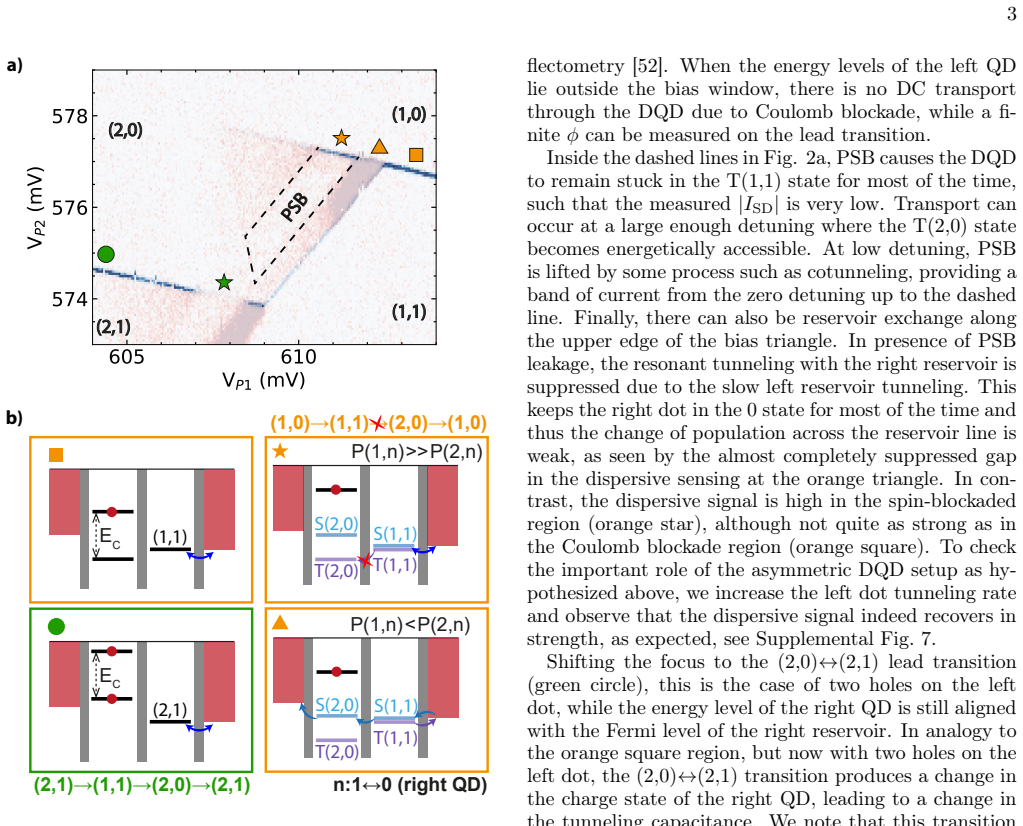
The central claim is that Pauli spin blockade leaves a direct dispersive signature at the reservoir transitions of a double quantum dot, not only at the interdot transition. When the double dot is stuck in the T(1,1) triplet state, the right dot's charge occupation is pinned, so the tunneling capacitance at the right reservoir transition nearly vanishes and the reflected phase signal drops toward background; when the blockade is lifted by leakage or magnetic field, the occupation can change again and the dispersive signal returns. The two reservoir transitions show complementary behavior, bright in the blockaded region at one and dark at the other, reflecting the asymmetric transport cycle in the bias window. The authors demonstrate the effect in a Ge/Si nanowire and in a Si FinFET, with a simple model based on the derivative of occupation probabilities reproducing the on/off modulation.
Load-bearing premise
The dispersive signal at a reservoir transition is taken to be proportional to how much the right dot's charge occupation changes with gate voltage, so that pinning that occupation in the blockaded state fully suppresses the signal.
Editorial extensions
If this is right
- The dispersive phase at the upper reservoir transition is dark in the leaking region and bright in the blockaded region, while the lower transition shows the opposite pattern, providing a two-colour map of spin blockade in a single gate sweep.
- Because the effect tracks the DC current as a function of bias and magnetic field, the same measurement can serve as a fast, minimally invasive proxy for PSB readout in spin-qubit devices.
- The signature appears in both Ge/Si nanowire and Si FinFET hole devices, suggesting it is a generic feature of gate-dispersive detection of PSB rather than a material-specific artifact.
- Larger source-drain bias enhances the modulation and magnetic field suppresses it, in line with the standard physics of PSB and its lifting by spin mixing.
Reading between the lines
- Inference: the structure of the gap, including its width and depth along detuning, could be used to quantitatively extract the imbalance of the source and drain tunnel rates, a parameter that is otherwise difficult to measure.
- Inference: if the occupation-derivative mechanism holds, time-resolved reflectometry at the reservoir transition should show telegraph-like switching correlated with the dwell time of the T(1,1) state, effectively turning the static signature into a single-shot spin readout.
- Inference: the complementary bright/dark pattern at the two reservoir transitions is a signature of the asymmetry of the transport cycle; it might be used to distinguish PSB from other blockade mechanisms in devices where spin physics is not the only source of current suppression.
Editorial analysis
A structured set of objections, weighed in public.
Referee Report
Summary. The paper reports gate-dispersive reflectometry measurements on a Ge/Si nanowire double quantum dot under finite source-drain bias, and shows that the reflected phase at the reservoir (lead) charge transitions is strongly modulated in the Pauli spin blockade regime: at the upper reservoir transition the dispersive signal is enhanced in the blockaded region and suppressed in a band where PSB is lifted, with the complementary pattern at the lower transition. The effect grows with increasing bias voltage, is restored (the gap is filled in) by an applied magnetic field, recovers when the left barrier tunneling rate is increased, and is reproduced in a Si FinFET device. The authors interpret the observations with a qualitative model based on the tunneling capacitance (Eq. 1), arguing that PSB changes the right-dot occupation derivative along the lead transitions.
Significance. If the interpretation holds, this constitutes a new, minimally invasive, all-electrical route to detect spin blockade and potentially perform fast spin readout at reservoir transitions, avoiding the backaction of adjacent-dot sensors and the need for large magnetic fields. The paper's strengths include the internal consistency of the data across multiple control parameters (bias, magnetic field, left barrier, device type), the absence of fitted parameters in the qualitative model, and the deposition of data on Zenodo. The cross-platform observation in a Si FinFET device strengthens the generality of the effect. However, the quantitative link between the measured phase and the PSB-modified population derivative at reservoir transitions is not established, which limits the strength of the claim that this is a 'direct' signature.
major comments (3)
- [Dispersive signature of PSB, Eq. (1)] The central claim that the reservoir-transition phase signal is a direct probe of PSB rests on the sentence "A similar term applies to the lead transitions." Eq. (1) is the interdot tunneling-capacitance formula, and the extension to reservoir transitions is not derived. The qualitative argument that PSB keeps the right dot in a fixed charge state, reducing the population derivative along the lead line, is plausible but does not exclude alternative bias-dependent admittance mechanisms (e.g., gate-dependent tunnel rates, dissipative contributions from leakage current, or a sign change in the phase response) that could produce the same dispersive gap. I recommend that the authors either provide a master-equation calculation of the non-equilibrium steady-state occupation derivative along the lead transitions, or explicitly qualify the claim as a phenomenological observation consistent with PSB rather than a direct quantitative probe.
- [Throughout (Figs. 2-4)] The reflected phase is displayed as |ϕ| in the key datasets. If the demodulated phase changes sign along a transition (for example, a crossover from a capacitive to a dissipative response), the modulus would produce an apparent dip or gap that does not correspond to a vanishing tunneling capacitance. The authors should present the signed phase for the key datasets or otherwise demonstrate that the observed gaps cannot be explained by a sign change in the phase response.
- [Supplemental Fig. 7 and Fig. 4] The left-barrier control and magnetic-field dependence support the PSB attribution, but they also alter transport rates and the RF environment, so they do not uniquely isolate the population-derivative mechanism as the cause of the observed on/off pattern. The paper should discuss why changes in tunnel coupling or tank-circuit parameters cannot account for the effect, or acknowledge this remaining ambiguity more explicitly.
minor comments (4)
- [Si FinFET paragraph] The word "sligthly" appears in the text describing the FinFET result; it should be "slightly."
- [Introduction] The phrase "ThisallowstoresolveanticrossingsinaDQDenergyleveldiagram..." appears to lack spaces due to a rendering issue; it should read "This allows to resolve anticrossings in a DQD energy level diagram..." If this is not an artifact of the text extraction, it needs correction.
- [Fig. 3 caption] The caption describes line cuts for bias voltages as labeled, but the main text references the panel as showing two different VSD values; please ensure the labels and descriptions are consistent.
- [Appendix B] The quantity ε_cot is used in the main text ("the width of this feature could be related to the exchange splitting J") but is only defined in the Appendix; adding a brief definition in the main text would improve readability.
Circularity Check
No significant circularity: the dispersive on/off pattern is measured, not derived from fitted inputs, and the central interpretation rests on standard capacitance formulae plus independent controls.
full rationale
The paper's central claim is an experimental observation: the dispersive phase at reservoir transitions switches on and off as the system enters and leaves the Pauli spin blockade region, with the complementary pattern at the two lead transitions. The derivation chain consists of Eq. (1), the standard tunneling capacitance formula cited to prior independent literature, an explicit statement that a similar term applies to lead transitions, and a qualitative population argument. No parameter is fitted to the data and then re-presented as a prediction; the bias-voltage and magnetic-field dependences are directly measured, and the left-barrier control in Supplemental Fig. 7 provides an independent test of the asymmetry hypothesis. The self-citations present in the paper concern the measurement setup, tank circuit, and device details, not the PSB interpretation, so they are not load-bearing for the circularity question. The unvalidated step noted by the skeptic—that the lead-transition phase follows the gate derivative of the right-dot occupation in the non-equilibrium steady state—is a modeling assumption about the observable, not a circular reduction: the assumption does not encode the measured on/off pattern and is stated before the interpretation is applied. The authors themselves acknowledge that 'more work is needed for a quantitative understanding,' indicating that no quantitative predictive derivation is being claimed. Concerns about alternative bias-induced mechanisms or the adequacy of the population-capacitance relation are correctness or robustness issues, not circularity. Therefore no circular step can be exhibited, and the score is 0.
Assumptions & free parameters
assumptions (4)
- domain assumption The reflected phase change measured in gate reflectometry is proportional to the parametric capacitance CPM = CQ + CTU, with CTU given by Eq. (1).
- domain assumption A term analogous to Eq. (1) applies to the lead (reservoir) transitions, so the dispersive signal there is governed by the derivative of the right-dot occupation probability with respect to gate voltage.
- domain assumption Inside the blockaded region the double dot is predominantly stuck in the T(1,1) triplet state, suppressing right-dot reservoir tunneling and reducing the change of occupation across the lead transition.
- domain assumption The leakage current band near zero detuning arises from spin-flip cotunneling, with width given by Eq. (2) in the Supplemental Material.
Cite this review
Pith. "Pith review of A direct dispersive signature of Pauli spin blockade." pith.science (2026). https://pith.science/paper/3WBXFFF4
@misc{pith2026250620509,
  author       = {Pith},
  title        = {Pith review of: A direct dispersive signature of Pauli spin blockade},
  year         = {2026},
  howpublished = {\url{https://pith.science/paper/3WBXFFF4}},
  note         = {Machine review of arXiv:2506.20509}
}
read the original abstract
Pauli Spin Blockade (PSB) is a key paradigm in semiconductor nanostructures and gives access to the spin physics. We report the direct observation of PSB with gate-dispersive reflectometry on double quantum dots with source-drain bias. The reservoir charge transitions are strongly modulated, turning on and off when entering and leaving the blockaded region, consistent with a simple model. Seen with holes in Ge and Si, the effects are enhanced with larger bias voltage and suppressed by magnetic field. This work lays the foundation for fast probing of spin physics and minimally invasive spin readout.
Figures


Figures from the paper (5 more)


Reference graph
Works this paper leans on
-
[1]
W. Pauli, Über den Zusammenhang des Abschlusses der Elektronengruppen im Atom mit der Komplexstruktur der Spek- tren, Zeitschrift für Physik31, 765 (1925)
work page 1925
-
[2]
K. Ono, D. G. Austing, Y. Tokura, and S. Tarucha, Current rectification by Pauli exclusion in a weakly coupled double quantum dot system., Science297, 1313 (2002)
work page 2002
-
[3]
R. Li, F. E. Hudson, A. S. Dzurak, and A. R. Hamilton, Pauli Spin Blockade of Heavy Holes in a Silicon Double Quantum Dot, Nano Lett.15, 7314 (2015)
work page 2015
-
[4]
N. W. Ashcroft and N. D. Mermin,Solid State Physics (Holt-Saunders, 1976)
1976
-
[5]
Loss and D
D. Loss and D. P. DiVincenzo, Quantum computation with quantum dots, Phys. Rev. A57, 120 (1998)
1998
-
[6]
N. W. Hendrickx, W. I. L. Lawrie, M. Russ, F. van Riggelen, S. L. de Snoo, R. N. Schouten, A. Sammak, G. Scappucci, and M. Veldhorst, A four-qubit germanium quantum processor, Nature591, 580 (2021)
work page 2021
-
[7]
S. G. J. Philips, M. T. Mądzik, S. V. Amitonov, S. L. de Snoo, M. Russ, N. Kalhor, C. Volk, W. I. L. Lawrie, D. Brousse, L. Tryputen, B. P. Wuetz, A. Sammak, M. Veldhorst, G. Scappucci, and L. M. K. Vandersypen, Universal control of a six-qubit quantum processor in silicon, Nature609, 919 (2022)
work page 2022
-
[8]
A. J. Weinstein, M. D. Reed, A. M. Jones, R. W. Andrews, D. Barnes, J. Z. Blumoff, L. E. Euliss, K. Eng, B. H. Fong, S. D. Ha, D. R. Hulbert, C. A. C. Jackson, M. Jura, T. E. Keating, J. Kerckhoff, A. A. Kiselev, J. Matten, G. Sabbir, A. Smith, J. Wright, M. T. Rakher, T. D. Ladd, and M. G. Borselli, Universal logic with encoded spin qubits in silicon, Na...
work page 2023
Show all 60 references
-
[9]
Neyens, O
S. Neyens, O. K. Zietz, T. F. Watson, F. Luthi, A. Nethwewala, H. C. George, E. Henry, M. Islam, A. J. Wagner, F. Borjans, E. J. Connors, J. Corrigan, M. J. Curry, D. Keith, R. Kotlyar, L. F. Lampert, M. T. Mądzik, K. Millard, F. A. Mohiyaddin, S. Pellerano, R. Pillarisetty, M...
2024
-
[10]
Tanttu, W
T. Tanttu, W. H. Lim, J. Y. Huang, N. Dumoulin Stuyck, W. Gilbert, R. Y. Su, M. Feng, J. D. Cifuentes, A. E. Seedhouse, S. K. Seritan, C. I. Ostrove, K. M. Rudinger, R. C. C. Leon, W. Huang, C. C. Escott, K. M. Itoh, N. V. Abrosimov, H.-J. Pohl, M. L. W. Thewalt, F. E. Hudson,...
2024
-
[11]
C. H. Yang, R. C. C. Leon, J. C. C. Hwang, A. Saraiva, T. Tanttu, W. Huang, J. C. Lemyre, K. W. Chan, K. Y. Tan, F. E. Hudson, K. M. Itoh, A. Morello, M. Pioro-Ladrière, A. Laucht, and A. S. Dzurak, Operation of a silicon quantum processor unit cell above one kelvin, Nature580...
2020
-
[12]
Petit, H
L. Petit, H. G. J. Eenink, M. Russ, W. I. L. Lawrie, N. W. Hendrickx, S. G. J. Philips, J. S. Clarke, L. M. K. Vandersypen, and M. Veldhorst, Universal quantum logic in hot silicon qubits, Nature580, 355 (2020)
2020
-
[13]
J. Y. Huang, R. Y. Su, W. H. Lim, M. Feng, B. van Straaten, B. Severin, W. Gilbert, N. Dumoulin Stuyck, T. Tanttu, S. Serrano, J. D. Cifuentes, I. Hansen, A. E. Seedhouse, E. Vahapoglu, R. C. C. Leon, N. V. Abrosimov, H.-J. Pohl, M. L. W. Thewalt, F. E. Hudson, C. C. Escott, N...
2024
-
[14]
M. J. Carballido, S. Svab, R. S. Eggli, T. Patlatiuk, P. Chevalier Kwon, J. Schuff, R. M. Kaiser, L. C. Camenzind, A. Li, N. Ares, E. P. A. M. Bakkers, S. Bosco, J. C. Egues, D. Loss, and D. M. Zumbühl, Compromise-Free Scaling of Qubit Speed and Coherence, arXiv:2402.07313 (2024)
2024 arXiv
-
[15]
L. C. Camenzind, S. Geyer, A. Fuhrer, R. J. Warburton, D. M. Zumbühl, and A. V. Kuhlmann, A hole spin qubit in a fin field-effect transistor above 4 kelvin, Nat. Electron.5, 178 (2022)
2022
-
[16]
J. I. Colless, A. C. Mahoney, J. M. Hornibrook, A. C. Doherty, H. Lu, A. C. Gossard, and D. J. Reilly, Dispersive readout of a few-electron double quantum dot with fast rf gate sensors, Phys. Rev. Lett.110, 046805 (2013)
2013
-
[17]
M. F. Gonzalez-Zalba, S. Barraud, A. J. Ferguson, and A. C. Betz, Probing the limits of gate-based charge sensing, Nat. Commun. 6, 6084 (2015)
2015
-
[18]
A. West, B. Hensen, A. Jouan, T. Tanttu, C.-H. Yang, A. Rossi, M. F. Gonzalez-Zalba, F. Hudson, A. Morello, D. J. Reilly, and A. S. Dzurak, Gate-based single-shot readout of spins in silicon, Nat. Nanotechnol.14, 437 (2019)
2019
-
[19]
Urdampilleta, D
M. Urdampilleta, D. J. Niegemann, E. Chanrion, B. Jadot, C. Spence, P.-A. Mortemousque, C. Bäuerle, L. Hutin, B. Bertrand, S. Barraud, R. Maurand, M. Sanquer, X. Jehl, S. D. Franceschi, M. Vinet, and T. Meunier, Gate-based high fidelity spin readout in a CMOS device, Nat. Nano...
2019
-
[20]
Crippa, R
A. Crippa, R. Ezzouch, A. Aprá, A. Amisse, R. Laviéville, L. Hutin, B. Bertrand, M. Vinet, M. Urdampilleta, T. Meunier, M. Sanquer, X. Jehl, R. Maurand, and S. De Franceschi, Gate-reflectometry dispersive readout and coherent control of a spin qubit in silicon, Nat. Commun.10,...
2019
-
[21]
Lundberg, J
T. Lundberg, J. Li, L. Hutin, B. Bertrand, D. J. Ibberson, C. Lee, D. J. Niegemann, M. Urdampilleta, N. Stelmashenko, T. Meunier, J. W. A. Robinson, L. Ibberson, M. Vinet, Y. Niquet, and M. F. Gonzalez-Zalba, Spin Quintet in a Silicon Double Quantum Dot: Spin Blockade and Rela...
2020
-
[22]
M. S. Ferguson, L. C. Camenzind, C. Müller, D. E. F. Biesinger, C. P. Scheller, B. Braunecker, D. M. Zumbühl, and O. Zilberberg, Measurement-induced population switching, Phys. Rev. Res.5, 023028 (2023)
2023
-
[23]
M. G. House, T. Kobayashi, B. Weber, S. J. Hile, T. F. Watson, J. van der Heijden, S. Rogge, and M. Y. Simmons, Radio frequency measurements of tunnel couplings and singlet-triplet spin states in Si:P quantum dots, Nat. Commun.6, 8848 (2015)
2015
-
[24]
Lundberg, D
T. Lundberg, D. J. Ibberson, J. Li, L. Hutin, J. C. Abadillo-Uriel, M. Filippone, B. Bertrand, A. Nunnenkamp, C.-M. Lee, 11 N. Stelmashenko, J. W. A. Robinson, M. Vinet, L. Ibberson, Y.-M. Niquet, and M. F. Gonzalez-Zalba, Non-symmetric Pauli spin blockade in a silicon double ...
2024
-
[25]
S. D. Liles, F. Martins, D. S. Miserev, A. A. Kiselev, I. D. Thorvaldson, M. J. Rendell, I. K. Jin, F. E. Hudson, M. Veldhorst, K. M. Itoh, O. P. Sushkov, T. D. Ladd, A. S. Dzurak, and A. R. Hamilton, Electrical control of the g tensor of the first hole in a silicon MOS quantu...
2021
-
[26]
Geyer, B
S. Geyer, B. Hetényi, S. Bosco, L. C. Camenzind, R. S. Eggli, A. Fuhrer, D. Loss, R. J. Warburton, D. M. Zumbühl, and A. V. Kuhlmann, Anisotropic exchange interaction of two hole-spin qubits, Nat. Phys.20, 1152 (2024)
2024
-
[27]
Jirovec, P
D. Jirovec, P. M. Mutter, A. Hofmann, A. Crippa, M. Rychetsky, D. L. Craig, J. Kukucka, F. Martins, A. Ballabio, N. Ares, D. Chrastina, G. Isella, G. Burkard, and G. Katsaros, Dynamics of Hole Singlet-Triplet Qubits with Large g-Factor Differences, Phys. Rev. Lett.128, 126803 (2022)
2022
-
[28]
F. N. M. Froning, L. C. Camenzind, O. A. H. van der Molen, A. Li, E. P. A. M. Bakkers, D. M. Zumbühl, and F. R. Braakman, Ultrafast hole spin qubit with gate-tunable spin-orbit switch functionality, Nat. Nanotechnol.16, 308 (2021)
2021
-
[29]
R. S. Eggli, S. Svab, T. Patlatiuk, D. Trüssel, M. J. Carballido, P. Chevalier Kwon, S. Geyer, A. Li, E. P. A. M. Bakkers, A. V. Kuhlmann, and D. M. Zumbühl, Cryogenic hyperabrupt strontium titanate varactors for sensitive reflectometry of quantum dots, Phys. Rev. Appl.20, 054...
2023
-
[30]
Xiang, W
J. Xiang, W. Lu, Y. Hu, Y. Wu, H. Yan, and C. M. Lieber, Ge/Si nanowire heterostructures as high-performance field-effect transistors, Nature441, 489 (2006)
2006
-
[31]
X.-J. Hao, T. Tu, G. Cao, C. Zhou, H.-O. Li, G.-C. Guo, W. Y. Fung, Z. Ji, G.-P. Guo, and W. Lu, Strong and Tunable Spin-Orbit Coupling of One-Dimensional Holes in Ge/Si Core/Shell Nanowires, Nano Lett.10, 2956 (2010)
2010
-
[32]
Conesa-Boj, A
S. Conesa-Boj, A. Li, S. Koelling, M. Brauns, J. Ridderbos, T. T. Nguyen, M. A. Verheijen, P. M. Koenraad, F. A. Zwanenburg, and E. P. A. M. Bakkers, Boosting Hole Mobility in Coherently Strained [110]-Oriented Ge-Si Core-Shell Nanowires, Nano Lett.17, 2259 (2017)
2017
-
[33]
F. N. M. Froning, M. K. Rehmann, J. Ridderbos, M. Brauns, F. A. Zwanenburg, A. Li, E. P. A. M. Bakkers, D. M. Zumbühl, and F. R. Braakman, Single, double, and triple quantum dots in Ge/Si nanowires, Appl. Phys. Lett.113, 073102 (2018)
2018
-
[34]
Higginbotham, F
A. Higginbotham, F. Kuemmeth, T. Larsen, M. Fitzpatrick, J. Yao, H. Yan, C. Lieber, and C. Marcus, Antilocalization of Coulomb Blockade in a Ge/Si Nanowire, Phys. Rev. Lett.112, 216806 (2014)
2014
-
[35]
Roddaro, A
S. Roddaro, A. Fuhrer, P. Brusheim, C. Fasth, H. Q. Xu, L. Samuelson, J. Xiang, and C. M. Lieber, Spin States of Holes in Ge/Si Nanowire Quantum Dots, Phys. Rev. Lett.101, 186802 (2008)
2008
-
[36]
Brauns, J
M. Brauns, J. Ridderbos, A. Li, E. P. A. M. Bakkers, and F. A. Zwanenburg, Electric-field dependentg-factor anisotropy in Ge-Si core-shell nanowire quantum dots, Phys. Rev. B93, 121408(R) (2016)
2016
-
[37]
Zarassi, Z
A. Zarassi, Z. Su, J. Danon, J. Schwenderling, M. Hocevar, B. M. Nguyen, J. Yoo, S. A. Dayeh, and S. M. Frolov, Magnetic field evolution of spin blockade in Ge/Si nanowire double quantum dots, Phys. Rev. B95, 155416 (2017)
2017
-
[38]
Kloeffel, M
C. Kloeffel, M. Trif, and D. Loss, Strong spin-orbit interaction and helical hole states in Ge/Si nanowires, Phys. Rev. B 84, 195314 (2011)
2011
-
[39]
Kloeffel, M
C. Kloeffel, M. J. Rančić, and D. Loss, Direct Rashba spin-orbit interaction in Si and Ge nanowires with different growth directions, Phys. Rev. B97, 235422 (2018)
2018
-
[40]
R. S. Eggli, T. Patlatiuk, E. G. Kelly, A. Orekhov, G. Salis, R. J. Warburton, D. M. Zumbühl, and A. V. Kuhlmann, Coupling a high-Q resonator to a spin qubit with all-electrical control, Phys. Rev. Res.7, 013197 (2024)
2024
-
[41]
J. H. Ungerer, P. Chevalier Kwon, T. Patlatiuk, J. Ridderbos, A. Kononov, D. Sarmah, E. P. A. M. Bakkers, D. Zum- bühl, and C. Schönenberger, Charge-sensing of a Ge/Si core/shell nanowire double quantum dot using a high-impedance superconducting resonator, Mater. Quantum. Tech...
2023
-
[42]
Apostolidis, B
P. Apostolidis, B. J. Villis, J. F. Chittock-Wood, J. M. Powell, A. Baumgartner, V. Vesterinen, S. Simbierowicz, J. Hassel, and M. R. Buitelaar, Quantum paraelectric varactors for radiofrequency measurements at millikelvin temperatures, Nat. Electron. 7, 760 (2024)
2024
-
[43]
Danon and Y
J. Danon and Y. V. Nazarov, Pauli spin blockade in the presence of strong spin-orbit coupling, Phys. Rev. B80, 041301(R) (2009)
2009
-
[44]
F. N. M. Froning, M. J. Rančić, B. Hetényi, S. Bosco, M. K. Rehmann, A. Li, E. P. A. M. Bakkers, F. A. Zwanenburg, D. Loss, D. M. Zumbühl, and F. R. Braakman, Strong spin-orbit interaction andg-factor renormalization of hole spins in Ge/Si nanowire quantum dots, Phys. Rev. Res...
2021
-
[45]
A. C. Johnson, J. R. Petta, C. M. Marcus, M. P. Hanson, and A. C. Gossard, Singlet-triplet spin blockade and charge sensing in a few-electron double quantum dot, Phys. Rev. B72, 165308 (2005)
2005
-
[46]
Shaji, C
N. Shaji, C. B. Simmons, M. Thalakulam, L. J. Klein, H. Qin, H. Luo, D. E. Savage, M. G. Lagally, A. J. Rimberg, R. Joynt, M. Friesen, R. H. Blick, S. N. Coppersmith, and M. A. Eriksson, Spin blockade and lifetime-enhanced transport in a few-electron Si/SiGe double quantum dot...
2008
-
[47]
Qassemi, W
F. Qassemi, W. A. Coish, and F. K. Wilhelm, Stationary and Transient Leakage Current in the Pauli Spin Blockade, Phys. Rev. Lett.102, 176806 (2009)
2009
-
[48]
N. S. Lai, W. H. Lim, C. H. Yang, F. A. Zwanenburg, W. A. Coish, F. Qassemi, A. Morello, and A. S. Dzurak, Pauli Spin Blockade in a Highly Tunable Silicon Double Quantum Dot, Sci. Rep.1, 110 (2011)
2011
-
[49]
W. A. Coish and F. Qassemi, Leakage-current line shapes from inelastic cotunneling in the pauli spin blockade regime, Phys. Rev. B84, 245407 (2011)
2011
-
[50]
V. N. Golovach and D. Loss, Transport through a double quantum dot in the sequential tunneling and cotunneling regimes, Phys. Rev. B69, 245327 (2004)
2004
-
[51]
Hanson, L
R. Hanson, L. P. Kouwenhoven, J. R. Petta, S. Tarucha, and L. M. K. Vandersypen, Spins in few-electron quantum dots, 12 Rev. Mod. Phys.79, 1217 (2007)
2007
-
[52]
Vigneau, F
F. Vigneau, F. Fedele, A. Chatterjee, D. Reilly, F. Kuemmeth, F. Gonzalez-Zalba, E. Laird, and N. Ares, Probing quantum devices with radio-frequency reflectometry, Appl. Phys. Rev.10, 021305 (2023)
2023
-
[53]
A. C. Betz, R. Wacquez, M. Vinet, X. Jehl, A. L. Saraiva, M. Sanquer, A. J. Ferguson, and M. F. Gonzalez-Zalba, Dispersively Detected Pauli Spin-Blockade in a Silicon Nanowire Field-Effect Transistor, Nano Lett.15, 4622 (2015)
2015
-
[54]
Mizuta, R
R. Mizuta, R. M. Otxoa, A. C. Betz, and M. F. Gonzalez-Zalba, Quantum and tunneling capacitance in charge and spin qubits, Phys. Rev. B95, 045414 (2017)
2017
-
[55]
Pakkiam, A
P. Pakkiam, A. V. Timofeev, M. G. House, M. R. Hogg, T. Kobayashi, M. Koch, S. Rogge, and M. Y. Simmons, Single-shot single-gate rf spin readout in silicon, Phys. Rev. X8, 041032 (2018)
2018
-
[56]
Russell, A
A. Russell, A. Zotov, R. Zhao, A. S. Dzurak, M. Fernando Gonzalez-Zalba, and A. Rossi, Gate-based spin readout of hole quantum dots with site-dependent g-factors, Phys. Rev. Appl.19, 044039 (2023)
2023
-
[57]
A direct dispersive signature of Pauli Spin Blockade
S. Svab, R. S. Eggli, T. Patlatiuk, M. J. Carballido, P. Chevalier Kwon, D. A. Trüssel, A. Li, E. P. A. M. Bakkers, A. V. Kuhlmann, and D. M. Zumbühl, Supporting data for "A direct dispersive signature of Pauli Spin Blockade", Zenodo, https://doi.org/10.5281/zenodo.15746571 (2025)
2025 doi
-
[58]
Geyer, L
S. Geyer, L. C. Camenzind, L. Czornomaz, V. Deshpande, A. Fuhrer, R. J. Warburton, D. M. Zumbühl, and A. V. Kuhlmann, Self-aligned gates for scalable silicon quantum computing, Appl. Phys. Lett.118, 104004 (2021)
2021
-
[59]
E. G. Kelly, A. Orekhov, N. W. Hendrickx, M. Mergenthaler, F. J. Schupp, S. Paredes, R. S. Eggli, A. V. Kuhlmann, P. Harvey-Collard, A. Fuhrer, and G. Salis, Capacitive crosstalk in gate-based dispersive sensing of spin qubits, Appl. Phys. Lett.123, 262104 (2023)
2023
-
[60]
Bosco, S
S. Bosco, S. Geyer, L. C. Camenzind, R. S. Eggli, A. Fuhrer, R. J. Warburton, D. M. Zumbühl, J. C. Egues, A. V. Kuhlmann, and D. Loss, Phase-driving hole spin qubits, Phys. Rev. Lett.131, 197001 (2023)
2023
Reviewed August 6, 2026 · model on record in the stance chip above.
Discussion (0). Continue with ORCID to comment.