REVIEW 2 major objections 4 minor 72 references
Super-resolving frequency measurement with mode-selective quantum memory
T0 review · 2 major / 4 minor · reviewed 2026-08-06 · deepseek-v4-flash
Pith's one-line read A warm-vapor Raman quantum memory filters temporal modes to estimate the separation between two spectral lines with a 34-fold precision gain over direct intensity measurement.
desk verdict New and well-executed platform demonstration for frequency superresolution, but the headline enhancement needs a check for calibration/evaluation overlap. read the letter →
The pith
A machine-rendered reading of the paper's core claim, the machinery that carries it, and where it could break.
The reading
What carries the argument
The load-bearing object is the mode-selective Raman memory treated as a single-mode quantum memory: in the low-coupling regime the storage Green's function has one dominant singular value, so the write-in control pulse selects a single temporal mode that is coherently mapped to a collective spin wave and retrieved on demand by a second control pulse. Around this, the argument uses a crosstalk matrix $M$ with parameters $\alpha$ and $\beta$ that maps ideal HG projection probabilities to measured ones, a Fisher-information formula showing how leakage $1-\alpha$ destroys precision at small separations, and maximum likelihood estimation with mean squared error and parameter-to-error ratio as figures of merit.
What would settle it
Recompute the bootstrapped MSE at $\epsilon=0.05$ after fitting $\alpha$ and $\beta$ on a separately acquired calibration run, never resampling those calibration clicks for the evaluation; if the $(34\pm4)$-fold enhancement over direct intensity does not survive, the claimed superresolution advantage is not established.
Extended reading notes
Core claim
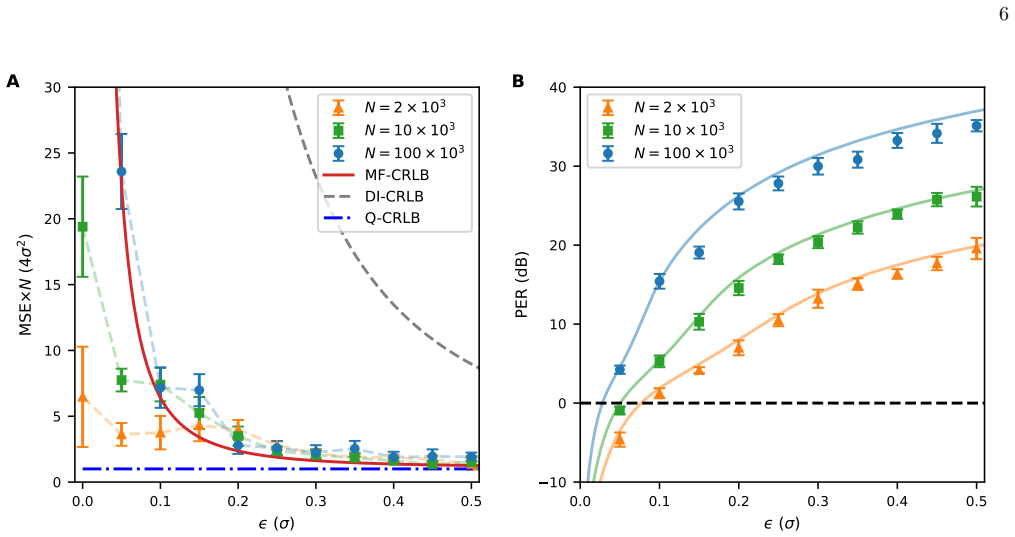
On the paper's own terms, the claim is that an atomic Raman memory operating in the low-coupling regime is a coherent temporal-mode filter, and that this filter is enough to beat direct intensity spectroscopy at sub-linewidth frequency separation estimation. The signal is prepared as an incoherent mixture of two equal-intensity Gaussian lines of known width $\sigma = 5.30$ MHz; the memory projects it onto Hermite-Gaussian temporal modes HG0 and HG1 through the shaping of the control pulse, with measured crosstalk from HG0 to HG1 of $0.34\%$. Maximum likelihood estimation on the retrieved counts $N_0$ and $N_1$ yields estimates of the normalized separation $\epsilon$, and over 50 bootstrapped resamplings at photon budgets from $2\times10^3$ to $10^5$ the mean squared error falls below the direct-intensity Cramér-Rao bound, giving a $(34\pm4)$-fold enhancement at $\epsilon=0.05$ and a $(28\pm6)$-fold enhancement at $\epsilon=0.1$. The paper further shows the estimator bias is dominated by the non-negativity constraint on $\epsilon$ and diminishes as photon number grows.
Load-bearing premise
The reported enhancement rests on the assumptions that the signal is exactly an incoherent mixture of two equal-intensity Gaussian lines of known width and that the memory's crosstalk matrix is constant and fixed by a calibration drawn from the same dataset that later seeds the bootstrapped error estimates.
Editorial extensions
If this is right
- Resolving power: separations down to $\epsilon=0.05$ (about 265 kHz on a 5.30 MHz line) can be distinguished at $10^5$ detected photons, with a parameter-to-error ratio of $4.4\pm0.5$ dB.
- Precision gain: the mode-filtered estimate outperforms direct intensity measurement at small separations, with the Fisher-information ratio approaching about 37 as $\epsilon\to0$, a value the paper benchmarks above previously reported time-frequency superresolution platforms.
- Bandwidth niche: the memory operates in the MHz-to-GHz range, filling a gap between ultrafast quantum pulse gates and gradient-echo-memory interferometry, while adding on-demand storage, retrieval, and mode conversion.
- Noise diagnostics: crosstalk and control-field leakage are the dominant error sources, so reducing crosstalk through higher-efficiency storage protocols directly raises attainable precision.
- Generality: programmable temporal mode filtering opens the route to multi-parameter estimation of more complex spectral features and to distributed quantum sensor networks.
Reading between the lines
- The calibration-aware caveat: the paper fits the crosstalk parameters $\alpha$ and $\beta$ on $1.6\times10^5$ detected counts per separation from the same click dataset that is later resampled for the 50 bootstrapped MSE evaluations; if those calibration counts are not excluded, the MLE is effectively evaluated on its training data. An independent calibration run would test how much of the $(34\pm
- Model robustness: the signal model assumes exactly two incoherent, equal-intensity Gaussian lines of known width, so for real spectral targets with unknown widths or intensities the reported enhancement is an upper bound rather than a guaranteed operating point.
- Efficiency trade-off: the paper's end-to-end efficiency is only about 0.3% because of the filtering needed to suppress the 9.2 GHz-distant control field, so the advantage per input photon is weaker than the per-detected-photon enhancement suggests.
- Architectural extension: because the filtering mode is selected by the control pulse, a cascade or loop of the same memory could sort onto more than two Hermite-Gaussian modes and extend the technique from two-line separation to fuller time-frequency characterization; the paper gestures at this extension but does not demonstrate it.
Editorial analysis
A structured set of objections, weighed in public.
Referee Report
Summary. This paper reports an experimental demonstration of frequency-domain superresolution using a warm-cesium Raman quantum memory as a coherent temporal-mode filter. The signal is prepared as an incoherent mixture of two equal-intensity Gaussian spectral lines of width σ = 5.30 MHz, the memory is used to project onto HG0 and HG1 temporal modes with measured crosstalk as low as 0.34%, and maximum-likelihood estimation from the two-mode count statistics is used to estimate the normalized separation ϵ. For 10^5 detected photons the authors report MSE×N below the direct-intensity CRLB, PER = 4.4 ± 0.5 dB at ϵ = 0.05 (corresponding to 265 kHz), and a (34 ± 4)-fold precision enhancement over direct detection at ϵ = 0.05. The paper also benchmarks an asymptotic superresolution parameter s ≈ 37 against other platforms and demonstrates robustness over storage times of 150–250 ns and with HG0/HG1 retrieval modes.
Significance. If the reported numbers survive a clean calibration/evaluation split, this is a valuable experimental advance: it demonstrates superresolved frequency-separation estimation in the MHz–GHz band with a memory platform that also offers on-demand readout, buffering, and user-defined mode conversion. The work includes substantial data (21 separations, four phases, two storage modes), bootstrapped error bars, an explicit MLE treatment including the bias induced by the non-negativity constraint on ϵ, and useful supplementary simulations of storage-efficiency crosstalk and control-field leakage. The comparison with prior QPG, GEM-based, and spectral-inversion results is informative, and the authors are candid about the low end-to-end efficiency and the crosstalk-efficiency trade-off. The main reservation is procedural: the headline enhancement may be evaluated on the same counts used to calibrate the crosstalk matrix, and the paper must demonstrate that this is not the case.
major comments (2)
- [Methods, 'Data collection and analysis' and 'System calibration'] The evaluation pipeline for the headline MSE and the (34 ± 4)-fold enhancement is not shown to be free of training/evaluation overlap. The paper states that approximately 2×10^5 clicks are recorded per separation, that α and β are calibrated with 1.6×10^5 counts per separation, and that the MSE is then computed by bootstrapping N = 2×10^3, 10^4, or 10^5 counts 'from the full click dataset.' No statement is made that the calibration counts were excluded from the evaluation samples. For N = 10^5, any bootstrap sample drawn from the full dataset overlaps the calibration set almost completely. Because the MLE boundary condition N1 ≥ (1−α)N in Eq. S6 depends sensitively on α, fitting α on the same clicks later used for evaluation can let sampling fluctuations in those clicks bias the reported MSE downward, which would inflate the reported enhancement. Please clarify the dataset partition and, if the calibration counts were not excluded, repeat the MSE evaluation on a held-out subset and report whether the (34 ± 4)-fold enhancement and the PER = 4.4 dB value at ϵ = 0.05 survive.
- [Methods, 'Signal preparation', Eq. (8)] Equation (8) is not the inverse Fourier transform of Eq. (7) as claimed. With the spectral lines centered at ω0 ± ϵσ/2 in Eq. (7), the temporal envelope should contain cos(ϵσt/2 − φ/2), not cos(ϵσt − φ/2) as printed. If the signal pulses were actually carved using Eq. (8) as written, the generated line separation would be twice the nominal value, making the experimental ϵ labels inconsistent with the model used in the MLE. The close agreement between the MLE estimates and ground truth in Fig. 2 suggests that the experiment may have used the correct form and Eq. (8) is a typographical error, but the authors should reconcile the equation with the actual pulse-carving waveform.
minor comments (4)
- [Supplementary Figs. S3 and S4] The axis label 'Nomalized intensity' is misspelled; it should read 'Normalized intensity.'
- [Eq. (4)] The variance term in MSE(ϵ, N) = Var(ϵ) + b(ϵ, N)^2 should be written as Var(ϵ̂); as printed it reads as the variance of the true parameter rather than the variance of the estimator.
- [Fig. 2 caption] Please define the vertical extent of the shaded regions (for example, ±1 standard deviation of the estimator about the true ϵ) in the caption; currently the reader must infer this from the main text.
- [Methods, 'System calibration'] The uncertainty on the calibrated crosstalk value 0.34% and on the fitted parameters α and β is not reported; since Eq. S6 is highly sensitive to 1−α, please provide these uncertainties or a sensitivity analysis showing that the reported MSE is robust to their variation.
Circularity Check
The reported (34±4)-fold precision enhancement is partly in-sample: the crosstalk model is fitted to 1.6e5 counts per separation from the same click files later bootstrapped for the MSE, so the enhancement is not a pure out-of-sample prediction.
-
fitted input called prediction
[Main text Sec. II C; Methods, 'Data collection and analysis' and 'System calibration'; SM Eq. S6]
"we first calibrated the experimental system with 1.6 × 10^5 detected counts per separation. By fitting the experimental model to this calibration data, we determined the measured crosstalk from HG0 to HG1 in the estimation experiment to be 0.34%. ... We then obtained the MSE for each separation by averaging ( ˆϵMLE − ϵ)2 over 50 bootstrapped experiments with the same N drawn from the full click dataset."
The crosstalk parameters α and β are fitted by least squares to 1.6×10^5 counts per separation from the same recorded click set (about 2×10^5 total clicks), and the reported MSE is obtained by bootstrapping N=10^5 (or 2×10^3, 10^4) counts 'drawn from the full click dataset'. The paper never states that the calibration counts were excluded. Because calibration data make up about 80% of the total, a 10^5-count evaluation sample necessarily overlaps the calibration data (minimum overlap 6×10^4 counts), so the MLE is evaluated partly on its own training set. The fitted leakage 1−α enters the MLE in SM Eq.
full rationale
Aside from the calibration/evaluation overlap, the paper's derivation is largely self-contained. The HG-mode superresolution framework is cited from external work by Tsang, Nair, and Lu; the single-mode memory Green-function analysis is cited from Nunn et al.; and the superresolution parameter s is imported from Mazelanik et al. None of these are self-citations in a load-bearing way, and the physical demonstration of mode-selective storage, retrieval, and 0.34% crosstalk is an experimental result rather than a definitional identity. The circularity concern is therefore confined to the statistical evaluation pipeline: the crosstalk parameters used in the maximum-likelihood estimator are calibrated on the same click dataset from which the bootstrapped MSE samples are drawn, with no explicit exclusion. Because the MLE's truncation behavior in SM Eq. S6 is sensitive to the fitted leakage 1−α, this overlap can bias the reported MSE downward and inflate the precision enhancement. The central physical claim remains supported by the independent mode-filtering measurements, but the headline enhancement number should not be treated as a fully out-of-sample prediction without confirmation that calibration counts were excluded.
Assumptions & free parameters
free parameters (2)
- α (diagonal crosstalk for HG0) =
≈0.9966 (from 0.34% HG0→HG1 crosstalk)
- β (diagonal crosstalk for HG1) =
not stated separately
assumptions (4)
- domain assumption The two spectral lines are equal-intensity, mutually incoherent Gaussian sources with known common width σ.
- domain assumption Only the HG0 and HG1 temporal modes contribute significant Fisher information for small separations.
- ad hoc to paper The crosstalk matrix M is constant across all separations and fully characterizes mode leakage.
- standard math Detected photon counts follow Poisson statistics and noise counts can be subtracted.
Cite this review
Pith. "Pith review of Super-resolving frequency measurement with mode-selective quantum memory." pith.science (2026). https://pith.science/paper/ZJVOC42N
@misc{pith2026250620514,
  author       = {Pith},
  title        = {Pith review of: Super-resolving frequency measurement with mode-selective quantum memory},
  year         = {2026},
  howpublished = {\url{https://pith.science/paper/ZJVOC42N}},
  note         = {Machine review of arXiv:2506.20514}
}
abstract
High-precision optical frequency measurement underpins modern science and technology, yet conventional spectroscopic techniques struggle to resolve sub-linewidth spectral features. Here, we introduce a platform for super-resolved frequency estimation based on a mode-selective atomic Raman quantum memory implemented in warm caesium vapour. By precisely engineering the light-matter interaction, the memory coherently stores the optimal temporal mode with high fidelity and retrieves it on demand, achieving mode crosstalk as low as 0.34%. To estimate the separation between two spectral lines, we experimentally measure the mean squared error of the frequency estimate, reaching a sensitivity of 1/20 of the linewidth and a ($34\pm4$)-fold enhancement in precision over direct intensity measurements. This enhanced frequency resolution, combined with on-demand storage, retrieval, and mode-conversion capabilities, establishes a pathway toward multifunctional memory-based time-frequency sensors and their integration within quantum networks.
Figures


Figures from the paper (2 more)


Reference graph
Works this paper leans on
-
[1]
J. M. Hollas, Modern Spectroscopy (Wiley & Sons, In- corporated, John, 2013)
work page 2013
-
[2]
T. Udem, R. Holzwarth, and T. W. H¨ ansch, Optical fre- quency metrology, Nature 416, 233 (2002)
work page 2002
-
[3]
A. D. Ludlow, M. M. Boyd, J. Ye, E. Peik, and P. Schmidt, Optical atomic clocks, Reviews of Modern Physics 87, 637 (2015)
work page 2015
-
[4]
I. A. Walmsley and C. Dorrer, Characterization of ultra- short electromagnetic pulses, Adv. Opt. Photon. 1, 308 (2009)
work page 2009
-
[5]
Fabre and N
C. Fabre and N. Treps, Modes and states in quantum optics, Reviews of Modern Physics 92, 035005 (2020)
2020
- [6]
-
[7]
Mukamel, M
S. Mukamel, M. Freyberger, W. Schleich, M. Bellini, A. Zavatta, G. Leuchs, C. Silberhorn, R. W. Boyd, L. L. S´ anchez-Soto, A. Stefanov, M. Barbieri, A. Paterova, L. Krivitsky, S. Shwartz, K. Tamasaku, K. Dorfman, F. Schlawin, V. Sandoghdar, M. Raymer, A. Marcus, O. Varnavski, T. Goodson, Z.-Y. Zhou, B.-S. Shi, S. As- ban, M. Scully, G. Agarwal, T. Peng, ...
2020
-
[8]
M. G. Raymer and I. A. Walmsley, Temporal modes in quantum optics: then and now, Physica Scripta 95, 064002 (2020)
work page 2020
Show all 72 references
-
[9]
Giovannetti, S
V. Giovannetti, S. Lloyd, and L. Maccone, Advances in quantum metrology, Nature Photonics 5, 222 (2011)
2011
-
[10]
Degen, F
C. Degen, F. Reinhard, and P. Cappellaro, Quantum sensing, Reviews of Modern Physics 89, 035002 (2017)
2017
-
[11]
Ye and P
J. Ye and P. Zoller, Essay: Quantum sensing with atomic, molecular, and optical platforms for fundamental physics, Physical Review Letters 132, 190001 (2024)
2024
-
[12]
investigations in optics, with special ref- erence to the spectroscope, The London, Edinburgh, and Dublin Philosophical Magazine and Journal of Science 8, 261 (1879)
Rayleigh, Xxxi. investigations in optics, with special ref- erence to the spectroscope, The London, Edinburgh, and Dublin Philosophical Magazine and Journal of Science 8, 261 (1879)
-
[13]
C. W. Helstrom, Quantum detection and estimation the- ory, Journal of Statistical Physics 1, 231 (1969)
1969
-
[14]
Tsang, R
M. Tsang, R. Nair, and X.-M. Lu, Quantum theory of superresolution for two incoherent optical point sources, Physical Review X 6, 031033 (2016)
2016
-
[15]
Pa´ ur, B
M. Pa´ ur, B. Stoklasa, Z. Hradil, L. L. S´ anchez-Soto, and J. Rehacek, Achieving the ultimate optical resolution, Optica 3, 1144 (2016)
2016
-
[16]
Rehacek, M
J. Rehacek, M. Pa´ ur, B. Stoklasa, Z. Hradil, and L. L. S´ anchez-Soto, Optimal measurements for resolution be- yond the rayleigh limit, Optics Letters 42, 231 (2017)
2017
-
[17]
W.-K. Tham, H. Ferretti, and A. M. Steinberg, Beat- ing rayleigh’s curse by imaging using phase information, Physical Review Letters 118, 070801 (2017)
2017
-
[18]
Gefen, A
T. Gefen, A. Rotem, and A. Retzker, Overcoming reso- lution limits with quantum sensing, Nature Communica- tions 10, 10.1038/s41467-019-12817-y (2019)
2019 doi
-
[19]
Pushkina, G
A. Pushkina, G. Maltese, J. Costa-Filho, P. Patel, and A. Lvovsky, Superresolution linear optical imaging in the far field, Physical Review Letters 127, 253602 (2021)
2021
-
[20]
Zanforlin, C
U. Zanforlin, C. Lupo, P. W. R. Connolly, P. Kok, G. S. Buller, and Z. Huang, Optical quantum super-resolution imaging and hypothesis testing, Nature Communications 13, 10.1038/s41467-022-32977-8 (2022)
2022 doi
-
[21]
K. A. G. Bonsma-Fisher, W.-K. Tham, H. Ferretti, and A. M. Steinberg, Realistic sub-rayleigh imaging with phase-sensitive measurements, New Journal of Physics 21, 093010 (2019). 11
2019
-
[22]
Gessner, C
M. Gessner, C. Fabre, and N. Treps, Superresolution lim- its from measurement crosstalk, Physical Review Letters 125, 100501 (2020)
2020
-
[23]
Lupo, Subwavelength quantum imaging with noisy de- tectors, Physical Review A 101, 022323 (2020)
C. Lupo, Subwavelength quantum imaging with noisy de- tectors, Physical Review A 101, 022323 (2020)
2020
-
[24]
Sorelli, M
G. Sorelli, M. Gessner, M. Walschaers, and N. Treps, Optimal observables and estimators for practical super- resolution imaging, Physical Review Letters 127, 123604 (2021)
2021
-
[25]
C. Oh, S. Zhou, Y. Wong, and L. Jiang, Quantum lim- its of superresolution in a noisy environment, Physical Review Letters 126, 120502 (2021)
2021
-
[26]
Rouvi` ere, D
C. Rouvi` ere, D. Barral, A. Grateau, I. Karuseichyk, G. Sorelli, M. Walschaers, and N. Treps, Ultra-sensitive separation estimation of optical sources, Optica 11, 166 (2024)
2024
-
[27]
M. G. Raymer and K. Banaszek, Time-frequency opti- cal filtering: efficiency vs. temporal-mode discrimination in incoherent and coherent implementations, Optics Ex- press 28, 32819 (2020)
2020
-
[28]
P. C. Humphreys, W. S. Kolthammer, J. Nunn, M. Bar- bieri, A. Datta, and I. A. Walmsley, Continuous-variable quantum computing in optical time-frequency modes us- ing quantum memories, Physical Review Letters 113, 130502 (2014)
2014
-
[29]
Awschalom, K
D. Awschalom, K. K. Berggren, H. Bernien, S. Bhave, L. D. Carr, P. Davids, S. E. Economou, D. Englund, A. Faraon, M. Fejer, S. Guha, M. V. Gustafsson, E. Hu, L. Jiang, J. Kim, B. Korzh, P. Kumar, P. G. Kwiat, M. Lonˇ car, M. D. Lukin, D. A. Miller, C. Mon- roe, S. W. Nam, P. N...
2021
-
[30]
Makino, Y
K. Makino, Y. Hashimoto, J.-i. Yoshikawa, H. Ohdan, T. Toyama, P. van Loock, and A. Furusawa, Synchroniza- tion of optical photons for quantum information process- ing, Science Advances 2, 10.1126/sciadv.1501772 (2016)
2016 doi
-
[31]
Davidson, O
O. Davidson, O. Yogev, E. Poem, and O. Firstenberg, Single-photon synchronization with a room-temperature atomic quantum memory, Physical Review Letters 131, 033601 (2023)
2023
-
[32]
Kielpinski, J
D. Kielpinski, J. F. Corney, and H. M. Wiseman, Quan- tum optical waveform conversion, Physical Review Let- ters 106, 130501 (2011)
2011
-
[33]
A. G. Radnaev, Y. O. Dudin, R. Zhao, H. H. Jen, S. D. Jenkins, A. Kuzmich, and T. A. B. Kennedy, A quan- tum memory with telecom-wavelength conversion, Na- ture Physics 6, 894 (2010)
2010
-
[34]
Karpi´ nski, M
M. Karpi´ nski, M. Jachura, L. J. Wright, and B. J. Smith, Bandwidth manipulation of quantum light by an electro- optic time lens, Nature Photonics 11, 53 (2016)
2016
-
[35]
Zhang and Q
Z. Zhang and Q. Zhuang, Distributed quantum sensing, Quantum Science and Technology 6, 043001 (2021)
2021
-
[36]
H. J. Kimble, The quantum internet, Nature 453, 1023 (2008)
2008
-
[37]
Roslund, R
J. Roslund, R. M. de Ara´ ujo, S. Jiang, C. Fabre, and N. Treps, Wavelength-multiplexed quantum networks with ultrafast frequency combs, Nature Photonics 8, 109 (2013)
2013
-
[38]
T. J. Proctor, P. A. Knott, and J. A. Dunningham, Mul- tiparameter estimation in networked quantum sensors, Physical Review Letters 120, 080501 (2018)
2018
-
[39]
Azuma, S
K. Azuma, S. E. Economou, D. Elkouss, P. Hilaire, L. Jiang, H.-K. Lo, and I. Tzitrin, Quantum repeaters: From quantum networks to the quantum internet, Re- views of Modern Physics 95, 045006 (2023)
2023
-
[40]
Donohue, V
J. Donohue, V. Ansari, J. ˇReh´ aˇ cek, Z. Hradil, B. Stok- lasa, M. Pa´ ur, L. S´ anchez-Soto, and C. Silberhorn, Quantum-limited time-frequency estimation through mode-selective photon measurement, Physical Review Letters 121, 090501 (2018)
2018
-
[41]
Ansari, B
V. Ansari, B. Brecht, J. Gil-Lopez, J. M. Donohue, J. ˇReh´ aˇ cek, Z. Hradil, L. L. S´ anchez-Soto, and C. Silber- horn, Achieving the ultimate quantum timing resolution, PRX Quantum 2, 010301 (2021)
2021
-
[42]
Serino, C
L. Serino, C. Eigner, B. Brecht, and C. Silberhorn, Pro- grammable time-frequency mode-sorting of single pho- tons with a multi-output quantum pulse gate, Optics Ex- press 33, 5577 (2025)
2025
-
[43]
Mazelanik, A
M. Mazelanik, A. Leszczy´ nski, and M. Parniak, Optical-domain spectral super-resolution via a quantum- memory-based time-frequency processor, Nature Com- munications 13, 10.1038/s41467-022-28066-5 (2022)
2022 doi
-
[44]
Shah and L
M. Shah and L. Fan, Frequency superresolution with spectrotemporal shaping of photons, Physical Review Applied 15, 034071 (2021)
2021
-
[45]
Lipka and M
M. Lipka and M. Parniak, Super-resolution of ultrafast pulses via spectral inversion, Optica 11, 1226 (2024)
2024
-
[46]
J.-L. Liu, Y. Luo, Xi-Yu, C.-Y. Wang, B. Wang, Y. Hu, J. Li, M.-Y. Zheng, B. Yao, Z. Yan, D. Teng, J.-W. Jiang, X.-B. Liu, X.-P. Xie, J. Zhang, Q.-H. Mao, X. Jiang, Q. Zhang, X.-H. Bao, and J.-W. Pan, Creation of mem- ory–memory entanglement in a metropolitan quantum network, ...
2024
-
[47]
Zhang, D.-S
W. Zhang, D.-S. Ding, Y.-B. Sheng, L. Zhou, B.-S. Shi, and G.-C. Guo, Quantum secure direct communication with quantum memory, Phys. Rev. Lett. 118, 220501 (2017)
2017
-
[48]
A. I. Lvovsky, B. C. Sanders, and W. Tittel, Optical quantum memory, Nature Photonics 3, 706 (2009)
2009
-
[49]
K. F. Reim, P. Michelberger, K. C. Lee, J. Nunn, N. K. Langford, and I. A. Walmsley, Single-photon-level quan- tum memory at room temperature, Physical Review Let- ters 107, 053603 (2011)
2011
-
[50]
Pang, A.-L
X.-L. Pang, A.-L. Yang, J.-P. Dou, H. Li, C.-N. Zhang, E. Poem, D. J. Saunders, H. Tang, J. Nunn, I. A. Walmsley, and X.-M. Jin, A hybrid quantum mem- ory–enabled network at room temperature, Science Ad- vances 6, 10.1126/sciadv.aax1425 (2020)
2020 doi
-
[51]
Bersin, M
E. Bersin, M. Sutula, Y. Q. Huan, A. Suleymanzade, D. R. Assumpcao, Y.-C. Wei, P.-J. Stas, C. M. Knaut, E. N. Knall, C. Langrock, N. Sinclair, R. Murphy, R. Riedinger, M. Yeh, C. Xin, S. Bandyopadhyay, D. D. Sukachev, B. Machielse, D. S. Levonian, M. K. Bhaskar, S. Hamilton, H...
2024
-
[52]
S. E. Thomas, L. Wagner, R. Joos, R. Sittig, C. Nawrath, P. Burdekin, I. Maillette de Buy Wenniger, M. J. Rasiah, S. Sagona-Stophel, S. H¨ ofling, M. Jetter, P. Michler, I. A. Walmsley, S. L. Portalupi, and P. M. Ledingham, De- terministic storage and retrieval of telecom ligh...
2024
-
[53]
Hervas, A
J. Hervas, A. Goldberg, A. Sanz, Z. Hradil, J. ˇReh´ aˇ cek, and L. S´ anchez-Soto, Beyond the quantum cram´ er-rao bound, Physical Review Letters 134, 010804 (2025)
2025
-
[54]
T. M. Cover and J. A. Thomas, Elements of Information Theory, second edition ed. (Wiley, 2005)
2005
-
[55]
J. Nunn, K. Reim, K. C. Lee, V. O. Lorenz, B. J. Suss- man, I. A. Walmsley, and D. Jaksch, Multimode memo- ries in atomic ensembles, Phys. Rev. Lett. 101, 260502 (2008)
2008
-
[56]
ˇRehaˇ cek, Z
J. ˇRehaˇ cek, Z. Hradil, B. Stoklasa, M. Pa´ ur, J. Grover, A. Krzic, and L. L. S´ anchez-Soto, Multiparameter quan- tum metrology of incoherent point sources: Towards re- alistic superresolution, Physical Review A 96, 062107 (2017)
2017
-
[57]
Napoli, S
C. Napoli, S. Piano, R. Leach, G. Adesso, and T. Tufarelli, Towards superresolution surface metrology: Quantum estimation of angular and axial separations, Physical Review Letters 122, 140505 (2019)
2019
-
[58]
J. Liu, H. Yuan, X.-M. Lu, and X. Wang, Quantum fisher information matrix and multiparameter estima- tion, Journal of Physics A: Mathematical and Theoretical 53, 023001 (2019)
2019
-
[59]
Shao and X.-M
J. Shao and X.-M. Lu, Performance-tradeoff relation for locating two incoherent optical point sources, Physical Review A 105, 062416 (2022)
2022
-
[60]
P. M. Burdekin, I. Maillette de Buy Wenniger, S. Sagona- Stophel, J. Szuniewicz, A. Zhang, S. E. Thomas, and I. A. Walmsley, Enhancing quantum memories with light- matter interference (2024), arXiv:2411.17365 [quant-ph]
2024 arXiv
-
[61]
J. Nunn, J. H. D. Munns, S. Thomas, K. T. Kaczmarek, C. Qiu, A. Feizpour, E. Poem, B. Brecht, D. J. Saunders, P. M. Ledingham, D. V. Reddy, M. G. Raymer, and I. A. Walmsley, Theory of noise suppression in Λ-type quan- tum memories by means of a cavity, Phys. Rev. A 96, 012338 (2017)
2017
-
[62]
D. J. Saunders, J. H. D. Munns, T. F. M. Champion, C. Qiu, K. T. Kaczmarek, E. Poem, P. M. Ledingham, I. A. Walmsley, and J. Nunn, Cavity-enhanced room- temperature broadband raman memory, Phys. Rev. Lett. 116, 090501 (2016)
2016
-
[63]
A. V. Gorshkov, T. Calarco, M. D. Lukin, and A. S. Sørensen, Photon storage in Λ-type optically dense atomic media. iv. optimal control using gradient ascent, Phys. Rev. A 77, 043806 (2008)
2008
-
[64]
J. Guo, X. Feng, P. Yang, Z. Yu, L. Q. Chen, C.-H. Yuan, and W. Zhang, High-performance raman quantum mem- ory with optimal control in room temperature atoms, Nature Communications 10, 10.1038/s41467-018-08118- 5 (2019)
2019 doi
-
[65]
Davidson, O
O. Davidson, O. Yogev, E. Poem, and O. Firsten- berg, Fast, noise-free atomic optical memory with 35- percent end-to-end efficiency, Communications Physics , 131 (2023)
2023
-
[66]
K. T. Kaczmarek, P. M. Ledingham, B. Brecht, S. E. Thomas, G. S. Thekkadath, O. Lazo-Arjona, J. H. D. Munns, E. Poem, A. Feizpour, D. J. Saunders, J. Nunn, and I. A. Walmsley, High-speed noise-free optical quan- tum memory, Phys. Rev. A 97, 042316 (2018)
2018
-
[67]
Thomas, S
S. Thomas, S. Sagona-Stophel, Z. Schofield, I. Walm- sley, and P. Ledingham, Single-photon-compatible telecommunications-band quantum memory in a hot atomic gas, Phys. Rev. Appl. 19, L031005 (2023)
2023
-
[68]
R. K. Gosalia and R. Malaney, Quantum-enhanced clock synchronization using prior statistical information, Quantum Science and Technology 10, 025022 (2025)
2025
-
[69]
Giovannetti, S
V. Giovannetti, S. Lloyd, and L. Maccone, Quantum- enhanced positioning and clock synchronization, Nature 412, 417 (2001)
2001
-
[70]
Lamine, C
B. Lamine, C. Fabre, and N. Treps, Quantum improve- ment of time transfer between remote clocks, Physical Review Letters 101, 123601 (2008)
2008
-
[71]
S. E. Thomas, T. M. Hird, J. H. D. Munns, B. Brecht, D. J. Saunders, J. Nunn, I. A. Walmsley, and P. M. Led- ingham, Raman quantum memory with built-in suppres- sion of four-wave-mixing noise, Phys. Rev. A100, 033801 (2019)
2019
-
[72]
Klein, M
M. Klein, M. Hohensee, A. Nemiroski, Y. Xiao, D. F. Phillips, and R. L. Walsworth, Slow light in narrow paraffin-coated vapor cells, Applied Physics Letters 95, 091102 (2009). 13 SUPPLEMENT AR Y INFORMA TION: SUPER-RESOL VING FREQUENCY MEASUREMENT WITH MODE-SELECTIVE QUANTUM M...
2009
Reviewed August 6, 2026 · model on record in the stance chip above.
Discussion (0). Continue with ORCID to comment.