REVIEW 1 major objections 6 minor 37 references
WallStreetFeds: Client-Specific Tokens as Investment Vehicles in Federated Learning
T0 review · 1 major / 6 minor · reviewed 2026-08-06 · deepseek-v4-flash
Pith's one-line read The paper proposes a decentralized platform in which each federated learning client issues tradeable tokens that pay out a share of that client's future rewards, opening the federation's closed capital flow to outside investors.
desk verdict Novel tokenized FL incentive framework, but the core economic claim collapses without commitment mechanisms to keep clients' incentives after selling their tokens. read the letter →
The pith
A machine-rendered reading of the paper's core claim, the machinery that carries it, and where it could break.
The reading
What carries the argument
The load-bearing mechanism is the tripartite smart-contract layer: an Orchestrator that logs federations and creates Scenarios, a per-federation Scenario that manages client onboarding and distributes per-round rewards pro rata to token holders, and a constant mean market maker (CMMM) that pools client tokens with a numeraire currency so any party can buy or sell them. The CMMM's trading function, a geometric mean of pooled asset amounts, sets prices algorithmically from supply and demand, so token prices reflect the market's view of a client's future reward stream. The entire system rests on reward payouts being public on chain, since investors need them to value tokens, while the privacy-sensitive model updates remain the server's private side of the protocol.
What would settle it
A concrete test would be to build a two-client federation on a test blockchain, publish per-round reward payouts exactly as the Scenario would, and run membership-inference or gradient-inversion attacks against the public reward time series and the public model; if such attacks succeed in inferring client data, the framework's public-payout requirement is incompatible with its privacy premise.
Extended reading notes
Core claim
The central proposal is a tokenized reward-sharing architecture added to a federated learning system. A Federator registers a Scenario on an Orchestrator smart contract; each client who joins creates a fixed number of client-specific tokens; and the Scenario holds ownership records. Each round, the server computes each client's contribution and sends the round's reward to the Scenario, which splits it proportionally among token holders. Clients may sell tokens on a constant mean market maker, giving third parties a way to invest in a client's expected future contributions while clients monetize those expected rewards without giving up control or selling data. The authors argue that this simple change, redirecting reward payouts from client accounts to token holders, opens the closed incentive loop, mitigates entry costs, and enables price discovery on the quality of participants' data.
Load-bearing premise
The whole scheme depends on reward payouts per client being published on a public blockchain, so that investors can value the tokens, without those public reward numbers revealing anything about clients' private data or model updates.
Editorial extensions
If this is right
- If a client sells part of its tokens up front, it can finance participation costs without borrowing from the server or surrendering model control.
- Third parties can assemble portfolios of tokens across clients, federations, and use cases, gaining exposure to data quality without direct funding agreements.
- The framework is independent of the contribution-allocation scheme, so Shapley-based, accuracy-based, linear, or equal payouts can all be routed through the Scenario.
- Public token prices create a continuous signal about the market's assessment of a client's data, which the authors suggest could reveal internal data quality.
- For open-ended federations with variable per-round rewards, expected reward formulas give way to market-based valuations such as federation-adapted price-to-earnings ratios.
Reading between the lines
- One implication the paper leaves implicit: if token prices and reward payouts are both public, the token price itself becomes an aggregate privacy signal, and an adversary with reward histories could potentially infer the timing and magnitude of a client's data changes, so the framework's privacy boundary may need formal treatment.
- The authors propose no mechanism preventing a client from selling tokens and then reducing participation quality; a testable extension would be staking or slashing contracts that tie token payouts to verified contributions, in the spirit of reputational collateral.
- The framework's viability depends on the AMM attracting liquidity for low-volume client tokens; a natural experiment would compare the proposed constant mean market maker with a constant-product pool to see which gives stable prices.
- If adopted broadly, the reputational signal from token prices could also serve as a screening device: federators could use token valuation as an underwriting metric when selecting clients, something the paper only mentions in passing.
Editorial analysis
A structured set of objections, weighed in public.
Referee Report
Summary. The paper proposes "WallStreetFeds," a framework that augments federated learning (FL) with client-specific tokens traded on an automated market maker (AMM). Clients issue tokens representing claims on their future FL rewards; third parties buy these tokens to invest in a client's participation, and the paper argues this opens the closed capital flow of current incentive schemes, mitigates clients' upfront costs, and creates a more flexible reward-distribution system. The manuscript describes an architecture (Orchestrator, Scenario, AMM), a user journey, claimed advantages, and a brief pricing discussion. It contains no experiments, simulations, or formal game-theoretic analysis; the quantitative content is limited to an elementary expected-reward formula in Section 5.4.
Significance. If the incentive and privacy concerns were adequately resolved, tokenizing future FL rewards would be a genuinely novel direction for the understudied reward-distribution side of FL incentives. The paper correctly identifies a real gap: existing incentive schemes are closed systems with limited third-party capital inflow, and clients face upfront participation costs. The architectural description is clear and the paper draws on relevant related work, including Shapley-value-based contribution assessment and AMM mechanisms. However, the central economic claims are not supported: the mechanism as designed is not incentive-compatible, and the required privacy analysis is absent. The paper is best read as an early system proposal rather than a completed research contribution.
major comments (1)
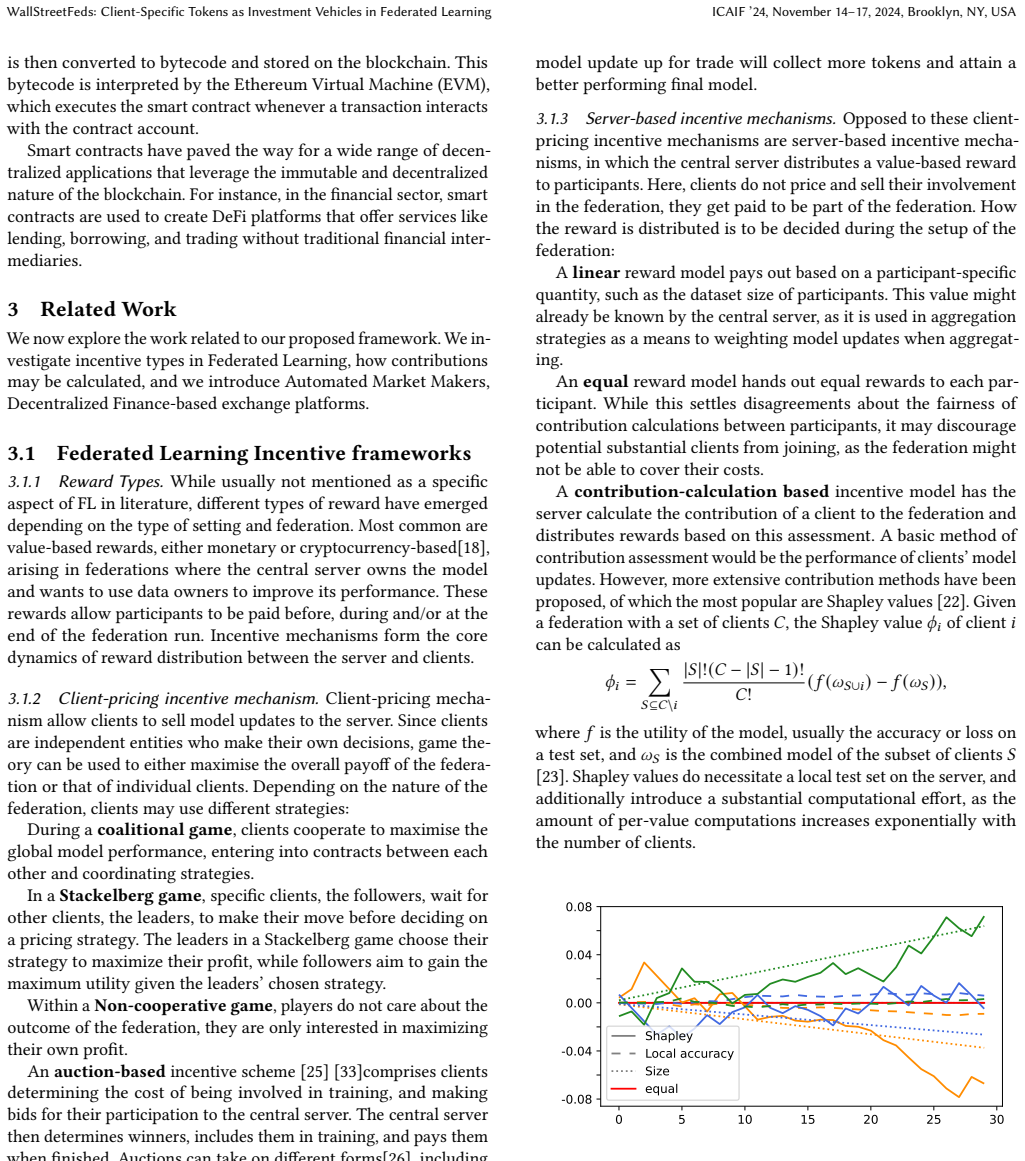
- [§5.2, §5.3] The paper makes causal claims that are not backed by any evaluation. For instance, Section 4.2 asserts that opening capital flow 'leads to a more efficient federation in general,' and Section 6 repeats that the framework 'mitigat[es] upfront costs' and 'enhanc[es] the effectiveness of the overall federated learning process.' No experiments, simulations, or formal analysis are provided. The only quantitative statement is the expected per-round reward formula in Section 5.4, E_t^R = R/(T×n), which assumes equal reward splits across rounds and clients, contradicting the contribution-based reward variation highlighted in Figure 1; it is a definitional placeholder rather than a result. Section 6 defers implementation, proof of concept, and economic-viability analysis to future work, so the manuscript's main asserted benefits are currently unverified.
minor comments (6)
- [§2.1.1] Typo: 'hospitals, banks and and similar organizations' should read 'hospitals, banks, and similar organizations.'
- [§2.1.2] Typo: 'a wide are of domains' should be 'a wide array of domains.'
- [§2.2] Typo: 'adressed' should be 'addressed.'
- [§5.3] The phrase 'clients have the option of buying other participants’ tokens... they can expose their own exposure by buying competitors’ tokens' appears to be a typo; 'expose their own exposure' likely should be 'offset their exposure' or 'increase their exposure.'
- [§3.2] The sentence 'It follows that demand drives prices, as an increase in buyers leads to an increase in availability of a token, which results in a higher exchange rate' is unclear: in a constant-product AMM, an increase in buying typically increases the price, but the stated mechanism ('increase in availability') is not accurate and should be rephrased.
- [Figure 3] The figure caption and labels ('Contacts', 'Creates', 'Offer tokens') are hard to interpret without deeper reading; consider clarifying the flow of tokens, rewards, and information.
Circularity Check
No significant circularity: the expected-reward formula is definitional arithmetic, and the framework is presented as a design with economic viability explicitly deferred.
full rationale
The paper does not fit parameters to data and then re-predict them. Section 5.4's expected-reward formula E_t^R = R/(T*n) is a direct consequence of the stated definition of R as a pre-established reward amount split among n clients over T rounds; it is not a prediction from empirical data or from a fitted model, and it is not used to validate the framework against observations. The framework's components (Orchestrator, Scenario, CMMM, tokens) are introduced as a design; no derivation claims that a unique token price or client value emerges from the mechanism. The only identifiable self-citation is reference [21] (FLAIRS, by the present authors) in the introduction as an example of a compliance-related FL application; this is not load-bearing for the tokenized reward architecture or for any stated result. The conclusion explicitly defers 'a more detailed analysis of the economic viability' to future work, so the paper is not claiming a fully derived economic equilibrium. While a skeptical reader could challenge incentive compatibility (a client may sell all tokens and then have no marginal stake), that is an open design question and a correctness/viability risk, not a circular step: the paper's claims do not reduce by definition to their inputs. Under the scoring rules, no significant circularity is present, so the score is 0.
Assumptions & free parameters
assumptions (4)
- domain assumption Per-client reward payouts can be made public without leaking sensitive information about model updates or datasets.
- domain assumption There exists a pre-existing flow of capital from the federator to clients according to some incentive scheme.
- domain assumption An automated market maker provides sufficient liquidity and price discovery for client tokens.
- domain assumption Clients continue to contribute high-quality updates after selling their tokens.
invented entities (3)
-
Orchestrator
-
Scenario
-
Client-specific tokens
Cite this review
Pith. "Pith review of WallStreetFeds: Client-Specific Tokens as Investment Vehicles in Federated Learning." pith.science (2026). https://pith.science/paper/32QFERWQ
@misc{pith2026250620518,
  author       = {Pith},
  title        = {Pith review of: WallStreetFeds: Client-Specific Tokens as Investment Vehicles in Federated Learning},
  year         = {2026},
  howpublished = {\url{https://pith.science/paper/32QFERWQ}},
  note         = {Machine review of arXiv:2506.20518}
}
read the original abstract
Federated Learning (FL) is a collaborative machine learning paradigm which allows participants to collectively train a model while training data remains private. This paradigm is especially beneficial for sectors like finance, where data privacy, security and model performance are paramount. FL has been extensively studied in the years following its introduction, leading to, among others, better performing collaboration techniques, ways to defend against other clients trying to attack the model, and contribution assessment methods. An important element in for-profit Federated Learning is the development of incentive methods to determine the allocation and distribution of rewards for participants. While numerous methods for allocation have been proposed and thoroughly explored, distribution frameworks remain relatively understudied. In this paper, we propose a novel framework which introduces client-specific tokens as investment vehicles within the FL ecosystem. Our framework aims to address the limitations of existing incentive schemes by leveraging a decentralized finance (DeFi) platform and automated market makers (AMMs) to create a more flexible and scalable reward distribution system for participants, and a mechanism for third parties to invest in the federation learning process.
Figures


Figures from the paper (2 more)


Reference graph
Works this paper leans on
-
[1]
Guillermo Angeris, Akshay Agrawal, Alex Evans, Tarun Chitra, and Stephen Boyd. 2022. Constant function market makers: Multi-asset trades via convex optimization. InHandbook on Blockchain. Springer, 415–444
work page 2022
-
[2]
Xuan Bi, Alok Gupta, and Mochen Yang. 2023. Understanding partnership forma- tion and repeated contributions in federated learning: An analytical investigation. Management Science(2023)
work page 2023
-
[3]
Bren- dan McMahan, Sarvar Patel, Daniel Ramage, Aaron Segal, and Karn Seth
Keith Bonawitz, Vladimir Ivanov, Ben Kreuter, Antonio Marcedone, H. Bren- dan McMahan, Sarvar Patel, Daniel Ramage, Aaron Segal, and Karn Seth
-
[4]
Vitalik Buterin et al. 2013. Ethereum white paper.GitHub repository1 (2013), 22–23
work page 2013
-
[5]
Wenlin Chen, Samuel Horváth, and Peter Richtárik. 2020. Optimal Client Sam- pling for Federated Learning.CoRRabs/2010.13723 (2020). arXiv:2010.13723 https://arxiv.org/abs/2010.13723
arXiv 2020
-
[6]
Jonas Geiping, Hartmut Bauermeister, Hannah Dröge, and Michael Moeller
-
[7]
Tzu-Ming Harry Hsu, Hang Qi, and Matthew Brown. 2019. Measuring the effects of non-identical data distribution for federated visual classification.arXiv preprint arXiv:1909.06335(2019)
arXiv 2019
-
[8]
Wenke Huang, Mang Ye, Zekun Shi, Guancheng Wan, He Li, Bo Du, and Qiang Yang. 2023. Federated Learning for Generalization, Robustness, Fairness: A Survey and Benchmark. arXiv:2311.06750 [cs.LG] https://arxiv.org/abs/2311.06750
work page Pith review arXiv 2023
Show all 37 references
-
[9]
Peter Kairouz, H Brendan McMahan, Brendan Avent, Aurélien Bellet, Mehdi Ben- nis, Arjun Nitin Bhagoji, Kallista Bonawitz, Zachary Charles, Graham Cormode, Rachel Cummings, et al. 2021. Advances and open problems in federated learning. Foundations and trends®in machine learning...
2021
-
[10]
Jiawen Kang, Zehui Xiong, Dusit Niyato, Shengli Xie, and Junshan Zhang. 2019. Incentive mechanism for reliable federated learning: A joint optimization ap- proach to combining reputation and contract theory.IEEE Internet of Things Journal6, 6 (2019), 10700–10714
2019
-
[11]
Chul Min Lee, Joaquín Delgado Fernández, Sergio Potenciano Menci, Alexander Rieger, and Gilbert Fridgen. 2023. Federated Learning for Credit Risk Assessment.. InHICSS. 386–395
2023
-
[12]
Yang Liu, Tao Fan, Tianjian Chen, Qian Xu, and Qiang Yang. 2021. Fate: An industrial grade platform for collaborative learning with data protection.Journal of Machine Learning Research22, 226 (2021), 1–6
2021
-
[13]
Lingjuan Lyu, Jiangshan Yu, Karthik Nandakumar, Yitong Li, Xingjun Ma, and Jiong Jin. 2019. Towards Fair and Decentralized Privacy-Preserving Deep Learning with Blockchain.CoRRabs/1906.01167 (2019). arXiv:1906.01167 http://arxiv.org/abs/1906.01167
2019 arXiv
-
[14]
Bho Matthiesen, Nasrin Razmi, Israel Leyva-Mayorga, Armin Dekorsy, and Petar Popovski. 2023. Federated learning in satellite constellations.IEEE Network (2023)
2023
-
[15]
Brendan McMahan, Eider Moore, Daniel Ramage, Seth Hampson, and Blaise Aguera y Arcas. 2017. Communication-efficient learning of deep net- works from decentralized data. InArtificial intelligence and statistics. PMLR, 1273–1282
2017
-
[16]
Vijay Mohan. 2022. Automated market makers and decentralized exchanges: a DeFi primer.Financial Innovation8, 1 (2022), 20
2022
-
[17]
Dinh C Nguyen, Ming Ding, Pubudu N Pathirana, Aruna Seneviratne, Jun Li, and H Vincent Poor. 2021. Federated learning for internet of things: A comprehensive survey.IEEE Communications Surveys & Tutorials23, 3 (2021), 1622–1658
2021
-
[18]
Shashi Raj Pandey, Lam Duc Nguyen, and Petar Popovski. 2022. Fedtoken: Tokenized incentives for data contribution in federated learning.arXiv preprint arXiv:2209.09775(2022)
2022 arXiv
-
[19]
Konstantin D Pandl, Florian Leiser, Scott Thiebes, and Ali Sunyaev. 2022. Re- ward systems for trustworthy medical federated learning.arXiv preprint arXiv:2205.00470(2022)
2022 arXiv
-
[20]
Sashank Reddi, Zachary Charles, Manzil Zaheer, Zachary Garrett, Keith Rush, Jakub Konečn`y, Sanjiv Kumar, and H Brendan McMahan. 2020. Adaptive feder- ated optimization.arXiv preprint arXiv:2003.00295(2020)
2020 arXiv
-
[21]
18 September 2023
Mary ROSZEL, Beltran FIZ PONTIVEROS, and Radu STATE. 18 September 2023. FLAIRS: Federated Learning AI Regulatory Sandbox. InECML PKDD 2023 Work- shops. Springer Nature
2023
-
[22]
Lloyd S Shapley et al. 1953. A value for n-person games. (1953)
1953
-
[23]
Tianshu Song, Yongxin Tong, and Shuyue Wei. 2019. Profit allocation for feder- ated learning. In2019 IEEE International Conference on Big Data (Big Data). IEEE, 2577–2586
2019
-
[24]
Afaf Taïk and Soumaya Cherkaoui. 2020. Electrical load forecasting using edge computing and federated learning. InICC 2020-2020 IEEE international conference on communications (ICC). IEEE, 1–6
2020
-
[25]
Tran, Yan Kyaw Tun, Minh N
Tra Huong Thi Le, Nguyen H. Tran, Yan Kyaw Tun, Minh N. H. Nguyen, Shashi Raj Pandey, Zhu Han, and Choong Seon Hong. 2021. An Incentive Mechanism for Federated Learning in Wireless Cellular Networks: An Auction Approach. IEEE Transactions on Wireless Communications20, 8 (2021)...
2021
-
[26]
Xuezhen Tu, Kun Zhu, Nguyen Cong Luong, Dusit Niyato, Yang Zhang, and Juan Li. 2022. Incentive mechanisms for federated learning: From economic and game theoretic perspective.IEEE transactions on cognitive communications and networking8, 3 (2022), 1566–1593
2022
-
[27]
Yang, Farhad Farokhi, Shi Jin, Tony Q
Kang Wei, Jun Li, Ming Ding, Chuan Ma, Howard H. Yang, Farhad Farokhi, Shi Jin, Tony Q. S. Quek, and H. Vincent Poor. 2019. Federated Learning with Differential Privacy: Algorithms and Performance Analysis.CoRRabs/1911.00222 (2019). arXiv:1911.00222 http://arxiv.org/abs/1911.00222
2019 arXiv
-
[28]
Jiahua Xu, Krzysztof Paruch, Simon Cousaert, and Yebo Feng. 2023. Sok: Decen- tralized exchanges (dex) with automated market maker (amm) protocols.Comput. Surveys55, 11 (2023), 1–50
2023
-
[29]
Mengwei Yang, Linqi Song, Jie Xu, Congduan Li, and Guozhen Tan. 2019. The tradeoff between privacy and accuracy in anomaly detection using federated xgboost.arXiv preprint arXiv:1907.07157(2019)
2019 arXiv
-
[30]
Shuo Yang, Fan Wu, Shaojie Tang, Xiaofeng Gao, Bo Yang, and Guihai Chen. 2017. On designing data quality-aware truth estimation and surplus sharing method for mobile crowdsensing.IEEE Journal on Selected Areas in Communications35, 4 (2017), 832–847
2017
-
[31]
Dong Yin, Yudong Chen, Ramchandran Kannan, and Peter Bartlett. 2018. Byzantine-robust distributed learning: Towards optimal statistical rates. InInter- national conference on machine learning. Pmlr, 5650–5659
2018
-
[32]
Han Yu, Zelei Liu, Yang Liu, Tianjian Chen, Mingshu Cong, Xi Weng, Dusit Niyato, and Qiang Yang. 2020. A sustainable incentive scheme for federated learning.IEEE Intelligent Systems35, 4 (2020), 58–69
2020
-
[33]
Rongfei Zeng, Shixun Zhang, Jiaqi Wang, and Xiaowen Chu. 2020. Fmore: An incentive scheme of multi-dimensional auction for federated learning in mec. In 2020 IEEE 40th international conference on distributed computing systems (ICDCS). IEEE, 278–288
2020
-
[34]
Chengliang Zhang, Suyi Li, Junzhe Xia, Wei Wang, Feng Yan, and Yang Liu. 2020. {BatchCrypt}: Efficient homomorphic encryption for{Cross-Silo} federated learning. In2020 USENIX annual technical conference (USENIX ATC 20). 493–506
2020
-
[35]
Wenbo Zheng, Lan Yan, Chao Gou, and Fei-Yue Wang. 2020. Federated Meta- Learning for Fraudulent Credit Card Detection. InProceedings of the Twenty- Ninth International Joint Conference on Artificial Intelligence, IJCAI-20, Christian Bessiere (Ed.). International Joint Conferen...
2020 doi
-
[2016]
arXiv:1611.04482 [cs.CR] https://arxiv.org/abs/1611.04482
Practical Secure Aggregation for Federated Learning on User-Held Data. arXiv:1611.04482 [cs.CR] https://arxiv.org/abs/1611.04482
-
[2020]
Inverting gradients-how easy is it to break privacy in federated learning? Advances in neural information processing systems33 (2020), 16937–16947
2020
Reviewed August 6, 2026 · model on record in the stance chip above.
Discussion (0). Sign in to comment.