REVIEW 3 major objections 7 minor 30 references
Communication-Aware Map Compression for Online Path-Planning: A Rate-Distortion Approach
T0 review · 3 major / 7 minor · reviewed 2026-08-06 · deepseek-v4-flash
Pith's one-line read Two-robot map sharing under bandwidth limits reduces to a convex rate-distortion problem with a closed-form reverse water-filling solution.
desk verdict Correct rate-distortion math and a useful closed-form solution, but the simulated algorithm is a heuristic variant of the advertised optimum; worth reviewing with requests for an ablation and softer claims. read the letter →
The pith
A machine-rendered reading of the paper's core claim, the machinery that carries it, and where it could break.
The reading
What carries the argument
The carrying object is the reverse water-filling solution of the Gaussian rate-distortion problem, obtained after Theorem 1 reduces the original policy search to a determinant maximization over the posterior covariance $P_{BB,t+1}$ of the Supporter-observed cells. With $U_t^\top D_t U_t$ the eigen-decomposition of $\tilde{W}_{BB,t}^{1/2} P^+_{BB,t} \tilde{W}_{BB,t}^{1/2}$, the optimizer is $P^\ast_{BB,t+1} = \tilde{W}_{BB,t}^{-1/2} U_t^\top \mathrm{diag}(\min\{\alpha/2,\sigma_{i,t}^2\}) U_t \tilde{W}_{BB,t}^{-1/2}$, and the compression pair $(\Theta^\ast_t, (N^\ast_t)^{-1})$ is recovered by the reduced singular-decomposition operator $\mathrm{RSD}$, which keeps only positive-eigenvalue components, from the matrix $M_t$ in (24). This is the classic reverse water-filling allocation: information is poured into the eigen-directions of the weighted Fisher information until the marginal gain drops below $\alpha/2$, which is why the method decides both the number of features and their quantization precision.
What would settle it
On a small fixed grid map, compare the Seeker's realized traversal cost (4) under the water-filling compression with the best compression found by exhaustive search over the same linear and quantized families that directly minimizes expected traversal cost under the same bit budget; if the water-filling policy is worse, the covariance-utility premise fails.
Extended reading notes
Core claim
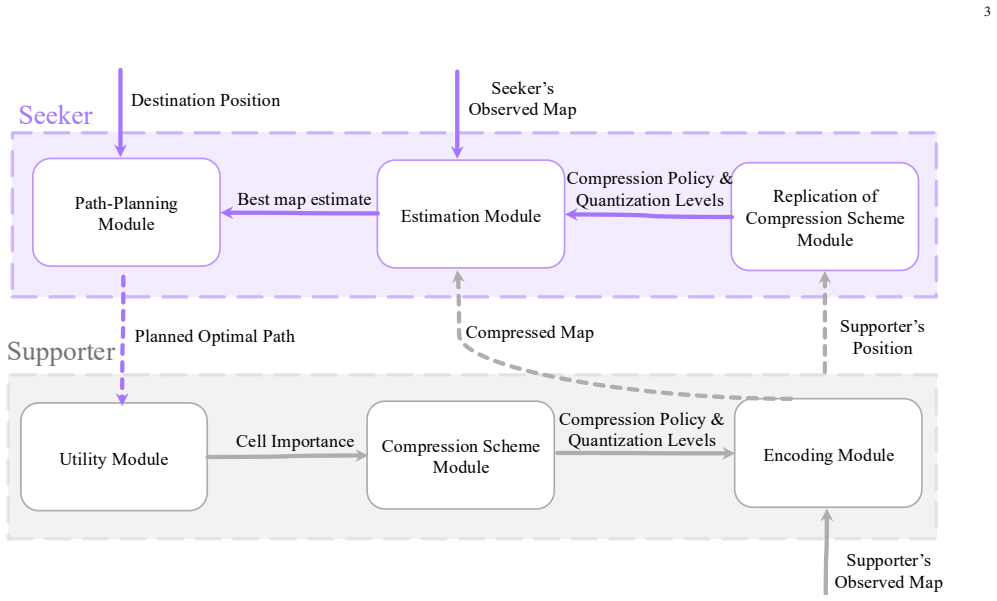
On the paper's own terms, the central discovery is an equivalence with a closed form. Problem (16), which jointly chooses the linear compression matrix $\Theta_t$, its dimension $d_{\Theta_t}$, and the quantization covariance $N_t$, is non-convex and mixed-integer; Theorem 1 rewrites the objective and covariance update in terms of the Supporter-observed block $P_{BB,t+1}$, and the equality constraint is relaxed to $P_{BB,t+1} \preceq P^+_{BB,t}$, giving the convex determinant-maximization problem (21). Because (21) is the standard Gaussian rate-distortion problem, Theorem 2 provides the closed-form optimal posterior covariance and the compression/quantization pair via (23)-(26), with the dimension of the compression automatically equal to the number of eigenvalues of the weighted Fisher-information difference that are positive (or above the threshold $\tau$). The paper further establishes that both agents can compute the optimal decision independently from trajectories, so only the compressed content and the Supporter's position need to be transmitted.
Load-bearing premise
The load-bearing assumption is that reducing the Seeker's weighted posterior covariance around the planned path, as in (6), is what actually improves path planning; that link is adopted from earlier work rather than derived from the traversal cost (3)-(4).
Editorial extensions
If this is right
- The optimal compression and quantization are available in closed form, so the Supporter can re-solve the design problem at every time step without an iterative solver.
- Because the Seeker replicates the compression logic from the planned path and prior covariance, the Supporter never needs to transmit $\Theta_t$ or $N_t$, saving bandwidth for map content itself.
- The same design automatically decides when not to communicate: when no eigenvalue of the weighted Fisher information exceeds $\alpha/2$, the optimal compression is empty.
- Raising the bit-rate weight $\alpha$ monotonically shrinks the compression dimension $d^\ast_{\Theta_t}$, so $\alpha$ acts as a direct knob trading communication cost against map reconstruction quality.
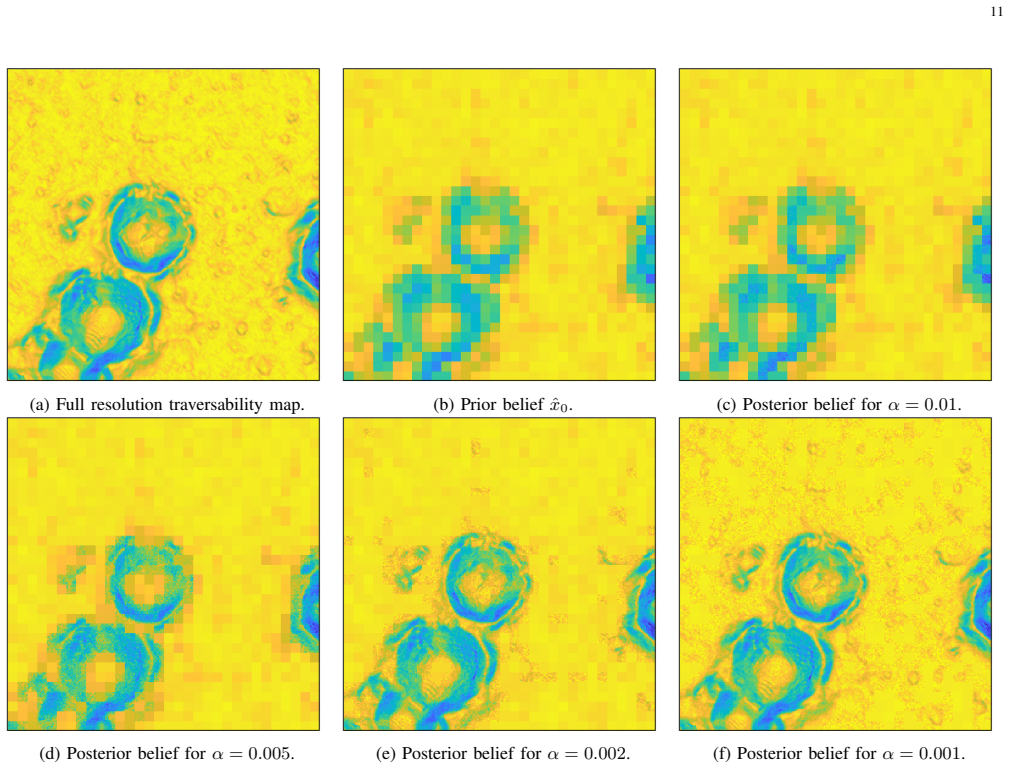
- In the paper's grid-world simulations, small $\alpha$ values reproduce the fully-informed path quality while sending far fewer bits, and large $\alpha$ values suppress transmission entirely.
Reading between the lines
- The paper leaves implicit that the same reverse water-filling machinery applies to any linear-Gaussian estimation task with a weighted quadratic utility; only the weighting matrix $W_t$ needs to be redefined by the task.
- An unmodeled risk is that the bit-rate is the mutual information of a Gaussian surrogate; on strongly non-Gaussian traversability maps, condition (12) may fail, and the actual entropy-coded codeword length could exceed the reported bit-rate.
- A testable extension would be to tune the path-proximity width $\sigma$ in (5) jointly with $\alpha$, since the relevance region is chosen by hand and likely interacts with the optimal quantization allocation.
- The replication argument assumes both robots run the same estimator, same planner, and share the same prior; in a heterogeneous team where the Seeker's planner is not known to the Supporter, the overhead saving would require a synchronization or broadcast mechanism the paper does not discuss.
Editorial analysis
A structured set of objections, weighed in public.
Referee Report
Summary. This paper addresses collaborative navigation in which a Supporter robot sends a compressed, quantized version of its local traversability map to a Seeker robot that plans a path to a destination. The compression matrix and per-component quantization levels are chosen by minimizing a weighted sum of the Seeker's posterior covariance and a Gaussian mutual-information proxy for the bit-rate. The authors reformulate the original mixed-integer nonconvex problem as a convex determinant-maximization problem, derive a reverse water-filling closed-form solution, and argue that the Seeker can replicate the Supporter's compression policy from shared trajectory data without receiving the policy itself. Simulations on Mars and Earth traversability maps illustrate the trade-off between communication cost and navigation performance.
Significance. The mathematical core is an elegant and largely correct application of Gaussian rate-distortion theory to map compression. The convex reformulation in Theorem 1, the reverse water-filling solution in Theorem 2, and the policy-replication argument are genuine strengths: they are clearly presented, the derivations are checkable, and the closed-form nature is practically appealing. If the result holds as stated, it provides a fast, online method for joint compression and quantization design in multi-robot navigation. However, the experimental implementation replaces the proven RSD operator with a thresholded MRSD heuristic, so the evaluated system is not the optimizer of the problem whose closed-form solution is claimed. In addition, the mission-level utility is defined by a path-proximity heuristic that is not formally connected to the actual path cost and is not even used in the Mars experiment. These gaps mean the paper currently demonstrates a plausible heuristic with a rate-distortion interpretation, rather than a validated optimal compressor.
major comments (3)
- [Section V-B, Algorithm 1, Eq. (26)] The algorithm actually evaluated in Sections VII-A and VII-B replaces the RSD operator in Eq. (26) with the MRSD operator, using tau=1 in the Mars experiment and tau=1.4 in the Earth experiment. Because MRSD discards positive eigenvalues below tau, the resulting (Theta, N) is not the minimizer of Problem (20)/(21), and no theorem or numerical study in the paper quantifies the induced suboptimality. The abstract's claim that the optimization problem is convex and admits a closed-form solution therefore describes the unpruned problem, while all reported simulations use the heuristic variant. Please either implement the exact RSD solution, prove that MRSD solves a well-defined modified optimization problem, or provide an ablation over tau reporting the gap in utility and bit-rate relative to the true optimizer.
- [Section IV-A, Eqs. (5)-(6), and Section VII-A] The objective minimizes -tr(W_t P_{t+1}) with W_t defined by Gaussian path-proximity weights in Eq. (5), but no formal link is established between this surrogate and the actual path cost in Eqs. (3)-(4) or the arrival time. The paper's claim that the compression 'guides the Seeker's planning decisions' is therefore only as strong as this heuristic. Moreover, the Mars experiment defines W from the initial belief rather than from Eq. (5), so that experiment does not exercise the path-proximity weighting analyzed in Section IV. A concrete test would compare weights from Eq. (5) against uniform or cost-to-go-based weights and report the resulting path cost and arrival time; until then, the mission-level optimality claim is not supported.
- [Section IV-B, Propositions 1-2, Eq. (14)] The adopted bit-rate I(o^G; y^G) differs from the true expected codeword length E[l_t] in Eq. (7) by an additive gap of up to (d_Theta/2) log(2*pi*e/12) bits, plus an additional unknown gap when condition (12) is not satisfied. Since E[l_t] is the actual communication cost, optimizing the Gaussian surrogate in Eq. (15) does not exactly model the bandwidth cost that the paper claims to quantify. Table I and Fig. 9 report the surrogate value I(o^G; y^G) rather than transmitted bits, so the reported bit-rates may be optimistic or pessimistic by a non-negligible amount at the operating values of d_Theta. Please quantify this gap empirically in the simulated settings or justify that it is negligible.
minor comments (7)
- [Fig. 2 caption] The caption says the Supporter 'sends the compressed map and its own location to the Supporter'; this should clearly be 'to the Seeker'.
- [Section V-B, Algorithm 1, Fig. 4(d)] The modified operator is referred to as MRSD in the text and MRSV in Algorithm 1, while Fig. 4(d) uses MSRD; please unify the nomenclature.
- [Section V, discussion after Eq. (21)] The inequality constraint is written as 'P_BB,t <= P+_BB,t-1', which appears to be a typo; it should presumably be 'P_BB,t+1 <= P+_BB,t'.
- [Fig. 4 and Section V-B] The initial belief is reported as 0.5136 in the text and 0.5149 in the Fig. 4(b) caption; these values should be reconciled.
- [Section IV-B, supp(q_t)] The alphabet for quantized values is written as 'A = {0,1,00,11,01,01,000,...}', where '01' appears twice; this is likely a typographical error.
- [Appendix B, proof of Theorem 1] In the derivation of P_BB,t+1, the text says 'in the last inequality we have used the Woodbury matrix inversion Lemma'; this should be 'last equality'.
- [Eq. (14) and Fig. 9] The base of the logarithm in the bit-rate expression is unspecified; the numerical bit-rate values depend on whether log is base 2 or natural log.
Circularity Check
No significant circularity; the reverse water-filling solution is imported from an external standard result, and the self-cited path-importance weights are an openly adopted modeling assumption rather than a fitted prediction.
full rationale
The central derivation chain runs from the declared utility (6) and bit-rate (14) to the equivalent determinant-maximization problem (21), whose closed-form optimizer (23)-(26) is taken from the external rate-distortion result [26] (Tanaka et al.), not from the present authors' prior work. The paper explicitly states that the reformulation follows the method proposed in [26] and that Theorem 2's proof is provided in [26, Subsection IV.D], so the main mathematical content is independently supported. The only prominent self-citations are [23] and [12], both by overlapping authors, supplying the Gaussian path-proximity weights (5) and the prior compression framework; however, these enter as openly declared modeling choices, and Theorem 2 holds for any positive-definite weight matrix, so the adoption of these weights does not make the derivation circular. The bit-rate is an approximation to codeword length via Propositions 1-2, not a constant fitted to the simulation outcomes. A separate non-circular consistency concern is that Section V-B and Algorithm 1 replace the RSD operator of (26) with a thresholded MRSD/MRSV operator, so the implemented compressor is a heuristic variant of the claimed optimum; this affects the optimality claims but does not reduce the derivation to its inputs. Overall, the self-citations are real prior modeling inputs but are not load-bearing in the mathematical equivalence, giving a low circularity score of 2.
Assumptions & free parameters
free parameters (5)
- alpha (bit-rate weight) =
0.0005 to 0.9 across experiments
- sigma (path-importance width) =
10 in Earth experiment
- tau (MRSD pruning threshold) =
1 in Mars, 1.4 in Earth
- a and epsilon (path cost constants) =
a = 0.025, epsilon = 0.501
- initial covariance P0 =
0.001I (Mars), I (Earth)
assumptions (9)
- standard math Matrix determinant lemma, Woodbury identity, Hadamard inequality, and convexity of -log det are valid and used in the proofs of Theorems 1 and 2.
- standard math The Gaussian rate-distortion solution and reverse water-filling result from Tanaka et al. [26] and Cover & Thomas [19] apply to problem (21).
- domain assumption The traversability map is a grid vector with linear observation models x_A = C_A x and x_B = C_B x.
- domain assumption The Supporter's observations are noise-free (Remark 1); the noisy case is treated only under a sufficient condition in Section V-A.
- domain assumption Dithered quantization with a shared random dither makes the quantization error uniform and independent of the signal.
- domain assumption The Gaussian mutual information I(o^G; y^G) is an acceptable proxy for the expected codeword length; condition (12) is assumed for the lower bound and the gap in (11) is accepted.
- domain assumption The utility of a compression equals -tr(W_t P_{t+1}) with path-proximity weights (5), so reducing weighted covariance improves path planning.
- domain assumption Both agents know the environment size, goal, each other's positions, and can compute the same belief covariance and the same compression algorithm.
- ad hoc to paper The MRSD pruning threshold tau can be applied to the optimal solution without destroying the benefits.
Cite this review
Pith. "Pith review of Communication-Aware Map Compression for Online Path-Planning: A Rate-Distortion Approach." pith.science (2026). https://pith.science/paper/HIKEY5RL
@misc{pith2026250620579,
  author       = {Pith},
  title        = {Pith review of: Communication-Aware Map Compression for Online Path-Planning: A Rate-Distortion Approach},
  year         = {2026},
  howpublished = {\url{https://pith.science/paper/HIKEY5RL}},
  note         = {Machine review of arXiv:2506.20579}
}
read the original abstract
This paper addresses the problem of collaborative navigation in an unknown environment, where two robots, referred to in the sequel as the Seeker and the Supporter, traverse the space simultaneously. The Supporter assists the Seeker by transmitting a compressed representation of its local map under bandwidth constraints to support the Seeker's path-planning task. We introduce a bit-rate metric based on the expected binary codeword length to quantify communication cost. Using this metric, we formulate the compression design problem as a rate-distortion optimization problem that determines when to communicate, which regions of the map should be included in the compressed representation, and at what resolution (i.e., quantization level) they should be encoded. Our formulation allows different map regions to be encoded at varying quantization levels based on their relevance to the Seeker's path-planning task. We demonstrate that the resulting optimization problem is convex, and admits a closed-form solution known in the information theory literature as reverse water-filling, enabling efficient, low-computation, and real-time implementation. Additionally, we show that the Seeker can infer the compression decisions of the Supporter independently, requiring only the encoded map content and not the encoding policy itself to be transmitted, thereby reducing communication overhead. Simulation results indicate that our method effectively constructs compressed, task-relevant map representations, both in content and resolution, that guide the Seeker's planning decisions even under tight bandwidth limitations.
Figures


Figures from the paper (5 more)



Reference graph
Works this paper leans on
-
[26]
Semidefinite programming approach to Gaussian sequential rate-distortion trade-offs,
T. Tanaka, K.-K. K. Kim, P. A. Parrilo, and S. K. Mitter, “Semidefinite programming approach to Gaussian sequential rate-distortion trade-offs,” IEEE Transactions on Automatic Control, vol. 62, no. 4, pp. 1896–1910, 2016
work page 1910
-
[23]
Communication-aware map compression for online path-planning,
E. Psomiadis, D. Maity, and P. Tsiotras, “Communication-aware map compression for online path-planning,” in IEEE International Confer- ence on Robotics and Automation , (Yokohama, Japan, May 13–17), pp. 12368–12374, May 13–17 2024
work page 2024
-
[12]
Communication- aware iterative map compression for online path-planning,
E. Psomiadis, A. R. Pedram, D. Maity, and P. Tsiotras, “Communication- aware iterative map compression for online path-planning,” in IEEE International Conference on Robotics and Automation , (Atlanta, GA, May 19–23), May 19–23, 2025
work page 2025
-
[1]
Collaborative multi-robot search and rescue: Planning, coordination, perception, and active vision,
J. P. Queralta, J. Taipalmaa, B. C. Pullinen, V . K. Sarker, T. N. Gia, H. Tenhunen, M. Gabbouj, J. Raitoharju, and T. Westerlund, “Collaborative multi-robot search and rescue: Planning, coordination, perception, and active vision,” IEEE Access, vol. 8, pp. 191617–191643, 2020
work page 2020
-
[2]
Traversing Mars: Cooperative informative path planning to efficiently navigate unknown scenes,
F. M. Rockenbauer, J. Lim, M. G. M ¨uller, R. Siegwart, and L. Schmid, “Traversing Mars: Cooperative informative path planning to efficiently navigate unknown scenes,” IEEE Robotics and Automation Letters , vol. 10, no. 2, pp. 1776–1783, 2025
work page 2025
-
[3]
Where to map? Iterative rover-copter path planning for Mars explo- ration,
T. Sasaki, K. Otsu, R. Thakker, S. Haesaert, and A. Agha-mohammadi, “Where to map? Iterative rover-copter path planning for Mars explo- ration,” IEEE Robotics and Automation Letters , vol. 5, no. 2, pp. 2123– 2130, 2020
work page 2020
-
[4]
Multi-agent task-driven ex- ploration via intelligent map compression and sharing,
E. Psomiadis, D. Maity, and P. Tsiotras, “Multi-agent task-driven ex- ploration via intelligent map compression and sharing,” in International Symposium on Distributed Autonomous Robotic Systems , (New York, NY , Oct 28–30), Oct 28–30 2024
work page 2024
-
[5]
Cooperative air and ground surveillance,
B. Grocholsky, J. Keller, V . Kumar, and G. Pappas, “Cooperative air and ground surveillance,” IEEE Robotics & Automation Magazine , vol. 13, no. 3, pp. 16–25, 2006
2006
Show all 30 references
-
[6]
Challenges and opportunities for large- scale exploration with air-ground teams using semantics,
F. Cladera, I. D. Miller, Z. Ravichandran, V . Murali, J. Hughes, M. A. Hsieh, C. Taylor, and V . Kumar, “Challenges and opportunities for large- scale exploration with air-ground teams using semantics,” arXiv preprint arXiv:2405.07169, 2024
2024 arXiv
-
[7]
An information gain formulation for active volumetric 3D reconstruction,
S. Isler, R. Sabzevari, J. Delmerico, and D. Scaramuzza, “An information gain formulation for active volumetric 3D reconstruction,” in Interna- tional Conference on Robotics and Automation , (Stockholm, Sweden, May 16–20), pp. 3477–3484, May 16–20, 2016
2016
-
[8]
Collabo- rative semantic understanding and mapping framework for autonomous systems,
Y . Yue, C. Zhao, Z. Wu, C. Yang, Y . Wang, and D. Wang, “Collabo- rative semantic understanding and mapping framework for autonomous systems,” IEEE/ASME Transactions on Mechatronics , vol. 26, no. 2, pp. 978–989, 2020
2020
-
[9]
DDF-SAM 2.0: Consis- tent distributed smoothing and mapping,
A. Cunningham, V . Indelman, and F. Dellaert, “DDF-SAM 2.0: Consis- tent distributed smoothing and mapping,” in International Conference on Robotics and Automation , (Karlsruhe, Germany, May 6–10), pp. 5220– 5227, May 6–10 2013
2013
-
[10]
D-lite: Navigation-oriented compression of 3D scene graphs for multi-robot collaboration,
Y . Chang, L. Ballotta, and L. Carlone, “D-lite: Navigation-oriented compression of 3D scene graphs for multi-robot collaboration,” IEEE Robotics and Automation Letters , vol. 8, no. 11, pp. 7527–7534, 2023
2023
-
[11]
Communication-aware control of large data transmissions via centralized cognition and 5G networks for multi-robot map merging,
G. Damigos, N. Stathoulopoulos, A. Koval, T. Lindgren, and G. Niko- lakopoulos, “Communication-aware control of large data transmissions via centralized cognition and 5G networks for multi-robot map merging,” Journal of Intelligent & Robotic Systems , vol. 110, no. 1, p. 22, 2024
2024
-
[13]
The information bottleneck method,
N. Tishby, F. C. Pereira, and W. Bialek, “The information bottleneck method,” in The 37th Annual Allerton Conference on Communication, Control and Computing , (Monticello, IL, Sep 22–24), pp. 368–377, September 1999
1999
-
[14]
Optimal controller synthesis and dynamic quantizer switching for linear-quadratic-Gaussian systems,
D. Maity and P. Tsiotras, “Optimal controller synthesis and dynamic quantizer switching for linear-quadratic-Gaussian systems,” IEEE Trans- actions on Automatic Control , vol. 67, no. 1, pp. 382–389, 2021
2021
-
[15]
Optimal quantizer scheduling and controller synthesis for partially observable linear systems,
D. Maity and P. Tsiotras, “Optimal quantizer scheduling and controller synthesis for partially observable linear systems,” SIAM Journal on Control and Optimization , vol. 61, no. 4, pp. 2682–2707, 2023
2023
-
[16]
Gaussian belief space path planning for minimum sensing navigation,
A. R. Pedram, R. Funada, and T. Tanaka, “Gaussian belief space path planning for minimum sensing navigation,” IEEE Transactions on Robotics, vol. 39, no. 3, pp. 2040–2059, 2022
2022
-
[17]
Simultaneous perception–action design via invariant finite belief sets,
M. Hibbard, T. Tanaka, and U. Topcu, “Simultaneous perception–action design via invariant finite belief sets,” Automatica, vol. 155, p. 111140, 2023
2023
-
[18]
Improved upper bounds to the causal quadratic rate-distortion function for Gaussian stationary sources,
M. S. Derpich and J. Ostergaard, “Improved upper bounds to the causal quadratic rate-distortion function for Gaussian stationary sources,” IEEE Transactions on Information Theory , vol. 58, no. 5, pp. 3131–3152, 2012
2012
-
[19]
T. M. Cover, Elements of Information Theory. John Wiley & Sons, 1999
1999
-
[20]
Rate of prefix-free codes in LQG control systems,
T. Tanaka, K. H. Johansson, T. Oechtering, H. Sandberg, and M. Skoglund, “Rate of prefix-free codes in LQG control systems,” in International Symposium on Information Theory, (Barcelona, Spain, July 10-15), pp. 2399–2403, July 10-15 2016
2016
-
[21]
Tanaka, K
T. Tanaka, K. H. Johansson, T. Oechtering, H. Sandberg, and M. Skoglund, Rate of prefix-free codes in LQG control systems (Ex- tended version). 2016. Available at https://arxiv.org/abs/1604.01227
2016 arXiv
-
[22]
Optimal and efficient path planning for partially-known environments,
A. Stentz, “Optimal and efficient path planning for partially-known environments,” inInternational Conference on Robotics and Automation, (Leuven, Belgium, May 16-21), pp. 3310–3317, May 16-21 1994
1994
-
[24]
E. I. Silva, A unified framework for the analysis and design of networked control systems . PhD thesis, University of Newcastle, Callaghan, Australia, 2009
2009
-
[25]
Optimized data rate allocation for dynamic sensor fusion over resource constrained com- munication networks,
H. Jung, A. R. Pedram, T. C. Cuvelier, and T. Tanaka, “Optimized data rate allocation for dynamic sensor fusion over resource constrained com- munication networks,” International Journal of Robust and Nonlinear Control, vol. 33, no. 1, pp. 237–263, 2023
2023
-
[27]
Determinant maximization with linear matrix inequality constraints,
L. Vandenberghe, S. Boyd, and S.-P. Wu, “Determinant maximization with linear matrix inequality constraints,” SIAM journal on matrix analysis and applications , vol. 19, no. 2, pp. 499–533, 1998
1998
-
[28]
M. A. Woodbury, Inverting modified matrices. Department of Statistics, Princeton University, 1950
1950
-
[29]
Digital Terrain Models (DTMs), Map: DTEEC 041277 2115 040776 2115 A01,
HiRISE, “Digital Terrain Models (DTMs), Map: DTEEC 041277 2115 040776 2115 A01,” 2024. Available at https://www.uahirise.org/dtm/ESP 041277 2115 (accessed Sep. 1, 2024)
2024
-
[30]
D. A. Harville, Matrix algebra from a statistician’s perspective . Taylor & Francis, 1998
1998
Reviewed August 6, 2026 · model on record in the stance chip above.
Discussion (0). Sign in to comment.