REVIEW 4 major objections 5 minor 21 references
CogGen: A Learner-Centered Generative AI Architecture for Intelligent Tutoring with Programming Video
T0 review · 4 major / 5 minor · reviewed 2026-08-06 · deepseek-v4-flash
Pith's one-line read CogGen is an architecture that converts programming videos into step-by-step tutoring conversations by segmenting them by learning goal, extracting declarative and procedural knowledge, and steering a large language model with Cognitive…
desk verdict Promising DSL-based tutoring architecture undermined by circular controllability and an unvalidated student model; deserves a serious but demanding review. read the letter →
The pith
A machine-rendered reading of the paper's core claim, the machinery that carries it, and where it could break.
The reading
What carries the argument
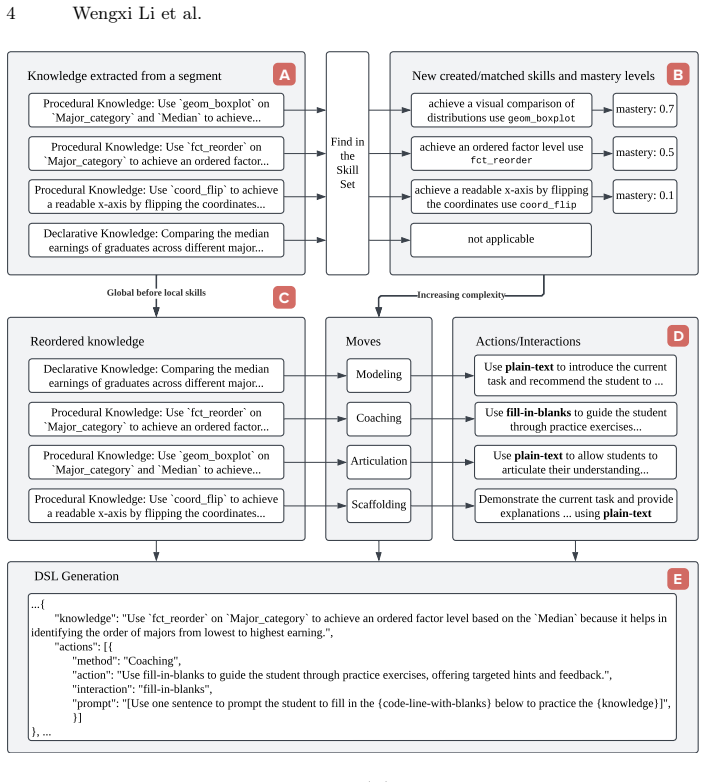
The load-bearing mechanism is a three-stage prompt pipeline whose output is a domain-specific language (DSL), a structured representation that bundles knowledge summaries, pedagogical moves, actions, and interaction types into a prompt queue that generates the next tutor message. The DSL is what makes the LLM's output controllable: rather than generating freely from a video transcript, the system generates from an explicit teaching plan. Two other components carry the argument: the learning-goal segmentation step (summarize, retrieve, reorder by timestamps) determines what content the tutoring is about, and the Bayesian Knowledge Tracing student model assigns each extracted knowledge component a skill and updates mastery estimates so teaching-move selection can, in principle, scale scaffolding to low-mastery skills and articulation to high-mastery ones. The DSL is the connective tissue that lets knowledge, pedagogy, and student state all flow into one next utterance.
What would settle it
Run a controlled study in which real learners watch the same videos under the full CogGen system versus the knowledge-only condition; if post-test programming performance does not differ, the claim that the student model and method planning add learning value beyond content extraction would be falsified. A simpler check is to compare the student model's predicted mastery against actual performance on follow-up exercises; if predictions do not track outcomes, the adaptivity mechanism is not doing the work claimed.
Extended reading notes
Core claim
The central claim is that a prompt-chained generative pipeline can impose pedagogical structure on LLM-based tutoring, and that each stage of that structure is necessary. Concretely, CogGen first summarizes each learning goal in a video transcript, retrieves the transcript sentences that belong to that goal, and reassembles them into timestamped segments; it then converts each segment into standardized declarative and procedural knowledge templates, applies Cognitive Apprenticeship principles to order that knowledge and select teaching moves, and compiles the result into a domain-specific language (DSL) that drives the LLM's next utterance. The student model maps each knowledge component to a skill, initializes mastery at 0.1, and updates Bayesian Knowledge Tracing parameters as the learner practices, using semantic similarity to connect new practice to old skills. The paper evaluates this on three video topics and reports strong precision, recall, and F1 across the knowledge, method, action, and interaction layers, with the full pipeline receiving the top TrueSkill rating in an expert-ranked ablation. The intended upshot is that generative tutors can be both controlled (following a specified pedagogical script) and personalized (responding to estimated mastery), which addresses the verbosity and focus problems of unconstrained LLM tutoring.
Load-bearing premise
The adaptive part depends on the assumption that the built-in student tracker, started with an initial mastery of 0.1 and default parameters and then updated by semantic text matching, accurately represents how a real student learns, and no real student interaction data were used to fit or check this.
Editorial extensions
If this is right
- Existing programming videos can be converted into interactive tutoring conversations without manual authoring of lessons, because segmentation and knowledge extraction are automated.
- Because every generated message traces back to a specified knowledge component and teaching move, instructors and researchers can inspect and debug what the tutor says instead of treating it as an opaque black box.
- The same video can serve learners at different levels: the student model is designed to give low-mastery skills more scaffolding and high-mastery skills more articulation prompts.
- If segmentation accuracy drops on longer videos, as the paper observed, content producers should pre-chunk videos into roughly 10 to 12 minute segments to keep the tutoring reliable.
- Errors at the knowledge-extraction stage propagate to the method, action, and interaction layers, so improving knowledge extraction is the highest-leverage improvement to overall controllability.
Reading between the lines
- The pipeline is not tied to programming: the knowledge templates reference concrete coding operations, but the DSL and Cognitive Apprenticeship moves are domain-agnostic, so the architecture could be tested on tutorials in statistics, engineering, or design.
- The paper's evaluation does not use real learner interactions; a natural next test is to log students' actual practice traces, re-estimate the Bayesian Knowledge Tracing parameters, and check whether adaptive move selection improves post-test performance over the knowledge-only condition.
- Because segmentation accuracy depends on modular video structure, an inferred constraint is that the architecture will underperform on tutorials with overlapping or interleaved goals; adaptive segmentation using temporal coherence or visual cues is the natural extension the authors flag.
- The reported evaluation measures generation quality and expert judgments, not learning outcomes, so a randomized study measuring post-test gains would be the decisive test of the architecture's educational value.
Signed reviews
Editorial analysis
A structured set of objections, weighed in public.
Referee Report
Summary. The paper introduces CogGen, a three-module architecture that transforms programming videos into interactive tutoring conversations: (1) a video-segmentation module that splits transcripts into learning-goal segments, (2) a DSL-driven prompt generator that maps knowledge and Cognitive Apprenticeship teaching moves into structured conversational instructions, and (3) a Bayesian Knowledge Tracing student model intended to adapt instruction to learner mastery. The evaluation reports segmentation accuracy against expert timestamps (76.9% within five seconds), controllability precision/recall/F1 across knowledge, method, action, and interaction layers (Table 2), and an ablation study in which expert raters rank four conditions using TrueSkill. The authors claim strong pedagogical alignment and that each component is necessary for effective guidance.
Significance. If the claims were fully supported, CogGen would be a useful contribution: it addresses a real gap in LLM-based tutoring by imposing structured, Cognitive-Apprenticeship-aligned control over generated dialogue, and the DSL is a plausible mechanism for achieving controllable, content-grounded tutoring messages. The paper also has clear strengths in reporting expert annotation procedures and standard evaluation metrics. However, the current evidence does not yet establish the central 'learner-centered adaptive learning' claim, because the student model is never exercised against learner data and the main pedagogical-alignment evaluation is largely circular. The architecture is interesting and the evaluation is fixable within the paper's scope, but the missing evidence is load-bearing.
major comments (4)
- [§3.2, Table 2] The controllability evaluation is circular with respect to pedagogical effectiveness. The ground-truth labels are derived from the same DSL files that the prompt pipeline generated, and the expert labeling used a 'hierarchical classification scheme based on the prompt pipeline.' High precision and recall therefore demonstrate that GPT-4 follows the DSL instructions, not that the resulting messages are pedagogically sound or aligned with learning outcomes. This conflation is load-bearing because the abstract and Section 1 claim 'strong pedagogical alignment' and 'effective and structured instruction.' To support the claim, the authors need an independent measure of pedagogical quality, such as expert coding against Cognitive Apprenticeship principles without access to the DSL, or a downstream learning-outcome evaluation.
- [§2.3 and §3] The adaptive-learning claim rests on an unvalidated student model. Section 2.3 describes Bayesian Knowledge Tracing with a fixed initial mastery of 0.1, default BKT parameters, semantic-similarity mapping to previously practiced skills, and parameter storage between sessions. Yet Section 3 contains no learner interaction data, no evaluation of whether BKT predictions correlate with actual student mastery, no parameter fitting or sensitivity analysis, and no comparison against a non-adaptive policy. The contribution statement in Section 1 and the Discussion's claim that CogGen 'adapts instruction based on student performance' therefore are not supported by the presented evidence. The authors should either add a user study or evaluate the BKT component on an existing learner-interaction dataset and show that the resulting mastery estimates change teaching moves in a way that measurably improves outcomes.
- [§3.1 and §3.2] The segmentation evaluation is under-specified. The 76.9% accuracy is reported without a baseline (e.g., random split points or a naive uniform segmentation), without per-video breakdowns, and without error bars or inter-annotator agreement for the expert timestamps. The five-second threshold is introduced without justification or sensitivity analysis. Because segmentation is the first module of the pipeline and its errors propagate to knowledge extraction and downstream tutoring, the reader needs to know whether this accuracy is meaningfully better than simple alternatives and how variable it is across videos.
- [§3.1 and §3.2, Component Importance] The ablation study measures expert-perceived credibility, validity, and interactivity of generated messages, not the 'effectiveness of guidance' in promoting learning. While these are reasonable intermediate criteria, the conclusion that 'each component contributes significantly to generating effective and coherent guidance' is stronger than the evidence. The moderate inter-rater agreement (Spearman ρ = 0.71) and the TrueSkill scores are reported, but no examples of the four conditions' outputs are shown, so the reader cannot assess what substantive differences the ablations produced. Including representative outputs and connecting the expert rankings to learning-oriented criteria would make the component-importance claim more convincing.
minor comments (5)
- [Abstract and Section 1] There are typographical errors: 'Large Langauge Models' should be 'Large Language Models', and 'Regardless,themosteffectivelearningparadigm...' is missing spaces and commas. The paper would benefit from a careful proofreading pass.
- [Table 2] Table 2 reports totals and per-topic precision, recall, and F1 but does not show the number of utterances per category per topic; the text mentions 124, 89, and 64 messages, so adding these counts to the table would help the reader calibrate the estimates.
- [§3.2, Component Importance] The sentence 'the full pipeline has the best results than other conditions' is ungrammatical, and the TrueSkill means (µ values) are not accompanied by confidence intervals or a discussion of what magnitude of difference is practically meaningful.
- [§3.1] The paper does not state whether the two segmentation annotators worked independently or resolved disagreements, nor does it report inter-annotator agreement (e.g., Cohen's kappa or timestamp-level agreement), which is needed to interpret the 76.9% figure.
- [General] No code, prompts, or data are provided as supplementary material; given that the architecture is a prompting pipeline, releasing the few-shot prompts and DSL definitions would materially improve reproducibility and allow the field to build on the work.
Circularity Check
'Pedagogical alignment' is measured against the system's own DSL, so that headline result is partly a self-consistency score; the rest of the evaluation is non-circular.
-
self definitional
[Abstract; §3.1 Controllability; §3.2 Results (Table 2)]
"Our technical evaluation demonstrates effective video segmentation accuracy and strong pedagogical alignment across knowledge, method, action, and interaction layers. ... we created a hierarchical classification scheme based on the prompt pipeline. The system-generated data were extracted from DSL files, which defined expert-specified teaching methods. ... CogGen demonstrated strong alignment between intended and generated content across all dimensions."
The 'intended' content against which generated messages are scored is the system's own DSL, produced by the same GPT-4 prompt pipeline that generates the messages, and the label taxonomy is 'based on the prompt pipeline.' High precision/recall/F1 therefore certify that the generator reproduces its own plan (controllability), not that the selected pedagogical moves are sound. The abstract renames this self-consistency check as 'strong pedagogical alignment across knowledge, method, action, and interaction layers,' building the conclusion into the measure: the ground-truth categories are the system's own DSL layers, so the alignment score is partly a self-consistency score by construction.
full rationale
The derivation chain is largely self-contained against external checks: segmentation is scored against independent expert timestamps, and component importance uses outside expert TrueSkill rankings, so those results do not reduce to the system's own outputs. The one definitional short-circuit is the abstract's 'strong pedagogical alignment across knowledge, method, action, and interaction layers.' In the controllability evaluation, the ground-truth 'intended' content is the system's own DSL, produced by the same GPT-4 pipeline that generates the messages, and the classification scheme is 'based on the prompt pipeline.' Even with independent human annotators, the label taxonomy is the system's own; the metric measures whether generated messages match the system's internal plan, not whether the plan is pedagogically effective. Recasting this controllability result as 'pedagogical alignment' makes part of the headline claim a self-consistency result by construction. The larger gap, the BKT adaptivity claim, is not circular: the paper uses no learner data to fit or validate the student model, so that contribution is unsupported rather than reducible to its inputs. The Discussion limitations list video modularity as a limitation but do not acknowledge the missing student-model validation, which is a correctness risk rather than a circularity. Overall, the score reflects one central overclaim, not a fully circular derivation.
Assumptions & free parameters
free parameters (3)
- initial skill mastery default (BKT) =
0.1
- five-second segmentation error threshold =
5 seconds
- LLM sampling temperature =
0.3
assumptions (4)
- domain assumption Cognitive Apprenticeship (CogApp) framework is an effective pedagogical model for programming instruction.
- domain assumption Videos have a modular structure where segments align with discrete learning goals.
- domain assumption Bayesian Knowledge Tracing with default parameters and semantic similarity matching accurately models student knowledge.
- ad hoc to paper The DSL intents generated by the prompt pipeline are a valid ground truth for evaluating pedagogical alignment.
Cite this review
Pith. "Pith review of CogGen: A Learner-Centered Generative AI Architecture for Intelligent Tutoring with Programming Video." pith.science (2026). https://pith.science/paper/7LSKTBZQ
@misc{pith2026250620600,
  author       = {Pith},
  title        = {Pith review of: CogGen: A Learner-Centered Generative AI Architecture for Intelligent Tutoring with Programming Video},
  year         = {2026},
  howpublished = {\url{https://pith.science/paper/7LSKTBZQ}},
  note         = {Machine review of arXiv:2506.20600}
}
read the original abstract
We introduce CogGen, a learner-centered AI architecture that transforms programming videos into interactive, adaptive learning experiences by integrating student modeling with generative AI tutoring based on the Cognitive Apprenticeship framework. The architecture consists of three components: (1) video segmentation by learning goals, (2) a conversational tutoring engine applying Cognitive Apprenticeship strategies, and (3) a student model using Bayesian Knowledge Tracing to adapt instruction. Our technical evaluation demonstrates effective video segmentation accuracy and strong pedagogical alignment across knowledge, method, action, and interaction layers. Ablation studies confirm the necessity of each component in generating effective guidance. This work advances AI-powered tutoring by bridging structured student modeling with interactive AI conversations, offering a scalable approach to enhancing video-based programming education.
Figures
Reference graph
Works this paper leans on
-
[1]
Alario-Hoyos, C., Kloos, C.D., Estévez-Ayres, I., Fernández-Panadero, C., Blasco, J., Pastrana, S., Villena-Román, J.: Interactive activities: the key to learning pro- gramming with moocs. Proceedings of the European Stakeholder Summit on Ex- periences and Best Practices in and Around MOOCs, EMOOCS319 (2016)
work page 2016
-
[2]
Anderson, L.W., Krathwohl, D.R.: A taxonomy for learning, teaching, and assess- ing: A revision of Bloom’s taxonomy of educational objectives: complete edition. Addison Wesley Longman, Inc. (2001)
work page 2001
-
[3]
International Educational Data Mining So- ciety (2021)
Badrinath, A., Wang, F., Pardos, Z.: pybkt: An accessible python library of bayesian knowledge tracing models. International Educational Data Mining So- ciety (2021)
work page 2021
-
[4]
Educational Researcher 18, 32 – 42 (1989), https://doi.org/10.3102/0013189X018001032
Brown, J.S., Collins, A.M., Duguid, P.: Situated cognition and the culture of learning. Educational Researcher 18, 32 – 42 (1989), https://doi.org/10.3102/0013189X018001032
-
[5]
In: Proceed- ings of the 2024 CHI Conference on Human Factors in Computing Systems
Cheng, A.Y., Guo, M., Ran, M., Ranasaria, A., Sharma, A., Xie, A., Le, K.N., Vinaithirthan, B., Luan, S.T., Wright, D.T.H., Cuadra, A., Pea, R., Landay, J.A.: Scientific and fantastical: Creating immersive, culturally relevant learn- ing experiences with augmented reality and large language models. In: Proceed- ings of the 2024 CHI Conference on Human Fac...
arXiv 2024
-
[6]
American educator15(3), 6–11 (1991)
Collins, A., Brown, J.S., Holum, A., et al.: Cognitive apprenticeship: Making think- ing visible. American educator15(3), 6–11 (1991)
work page 1991
-
[7]
Gagne, R.M., Wager, W.W., Golas, K.C., Keller, J.M., Russell, J.D.: Principles of instructional design (2005)
work page 2005
-
[8]
In: Advances in Neural Information Processing Systems 20
Herbrich, R., Minka, T., Graepel, T.: Trueskill(tm): A bayesian skill rating system. In: Advances in Neural Information Processing Systems 20. pp. 569–576. MIT Press (2007), https://www.microsoft.com/en-us/research/publication/trueskilltm- a-bayesian-skill-rating-system/ 8 Wengxi Li et al
work page 2007
Show all 21 references
-
[9]
Journal of Science Education and technology4, 103–126 (1995)
Linn, M.C.: Designing computer learning environments for engineering and com- puter science: The scaffolded knowledge integration framework. Journal of Science Education and technology4, 103–126 (1995)
1995
-
[10]
In: Proceedings of the 55th ACM Technical Symposium on Computer Science Ed- ucation V
Liu, R., Zenke, C., Liu, C., Holmes, A., Thornton, P., Malan, D.J.: Teaching cs50 with ai: Leveraging generative artificial intelligence in computer science education. In: Proceedings of the 55th ACM Technical Symposium on Computer Science Ed- ucation V. 1. p. 750–756. SIGCSE ...
2024
-
[11]
In: Artificial Intelligence in Education: 25th International Conference, AIED 2024, Recife, Brazil, July 8–12, 2024, Proceedings, Part I
Ma, Q., Shen, H., Koedinger, K., Wu, S.T.: How to teach programming in the ai era? using llms as a teachable agent for debugging. In: Artificial Intelligence in Education: 25th International Conference, AIED 2024, Recife, Brazil, July 8–12, 2024, Proceedings, Part I. p. 265–27...
2024 doi
-
[12]
https://github.com/netease-youdao/BCEmbedding (2023)
NetEase Youdao, I.: Bcembedding: Bilingual and crosslingual embedding for rag. https://github.com/netease-youdao/BCEmbedding (2023)
2023
-
[13]
In: Proceedings of the 2023 CHI Conference on Human Factors in Computing Systems
Pardos, Z.A., Tang, M., Anastasopoulos, I., Sheel, S.K., Zhang, E.: Oatutor: An open-source adaptive tutoring system and curated content library for learning sci- ences research. In: Proceedings of the 2023 CHI Conference on Human Factors in Computing Systems. CHI ’23, Associa...
2023
-
[14]
Journal of the Learn- ing Sciences13(3), 423–451 (2004)
Pea, R.D.: The social and technological dimensions of scaffolding and related theo- retical concepts for learning, education, and human activity. Journal of the Learn- ing Sciences13(3), 423–451 (2004). https://doi.org/10.1207/s15327809jls1303_6
2004 doi
-
[15]
CoRRabs/2403.02259 (2024)
Ren, C., Pardos, Z.A., Li, Z.: Human-ai collaboration increases skill tagging speed but degrades accuracy. CoRRabs/2403.02259 (2024)
2024 arXiv
-
[16]
In: Muresan, S., Chen, V., Casey, K., David, V., Nina, D., Koji, I., Erik, E., Stefan, U
Sheng, Z., Finzel, R., Lucke, M., Dufresne, S., Gini, M., Pakhomov, S.: A dia- logue system for assessing activities of daily living: Improving consistency with grounded knowledge. In: Muresan, S., Chen, V., Casey, K., David, V., Nina, D., Koji, I., Erik, E., Stefan, U. (eds.)...
2023 doi
-
[17]
In: Bouamor, H., Pino, J., Bali, K
Sonkar, S., Liu, N., Mallick, D., Baraniuk, R.: CLASS: A design framework for building intelligent tutoring systems based on learning science principles. In: Bouamor, H., Pino, J., Bali, K. (eds.) Findings of the Association for Compu- tational Linguistics: EMNLP 2023. pp. 194...
2023
-
[18]
In: Al-Onaizan, Y., Bansal, M., Chen, Y.N
Sreedhar, M.N., Rebedea, T., Ghosh, S., Zeng, J., Parisien, C.: CantTalkAbout- This: Aligning language models to stay on topic in dialogues. In: Al-Onaizan, Y., Bansal, M., Chen, Y.N. (eds.) Findings of the Association for Computational Linguistics: EMNLP 2024. pp. 12232–12252...
2024 doi
-
[19]
In: Encyclopedia of evolutionary psychological science, pp
Sweller, J.: Instructional design. In: Encyclopedia of evolutionary psychological science, pp. 4159–4163. Springer (2021)
2021
-
[20]
Oxford University Press, USA (2014)
Upton, G., Cook, I.: A dictionary of statistics 3e. Oxford University Press, USA (2014)
2014
-
[21]
Zhao, W.X., Zhou, K., Li, J., Tang, T., Wang, X., Hou, Y., Min, Y., Zhang, B., Zhang, J., Dong, Z., Du, Y., Yang, C., Chen, Y., Chen, Z., Jiang, J., Ren, R., Li, Y., Tang, X., Liu, Z., Liu, P., Nie, J.Y., Wen, J.R.: A survey of large language models (2024), https://arxiv.org/a...
2024 arXiv
Reviewed August 6, 2026 · model on record in the stance chip above.
Discussion (0). Continue with ORCID to comment.