REVIEW 3 major objections 4 minor 68 references
Modeling phase transformations in Mn-rich disordered rocksalt cathodes with machine learning interatomic potentials
T0 review · 3 major / 4 minor · reviewed 2026-08-06 · deepseek-v4-flash
Pith's one-line read Mn3+ migration initiates the rocksalt-to-spinel-like transformation in a Mn-rich cathode, with tetrahedral Mn2+ following the ordering, and the resulting δ-phase shows solid-solution voltage behavior.
desk verdict A solid MLIP-MD study of the DRX-to-spinel transformation with a plausible but proxy-dependent mechanistic claim; referee it, but push for DFT validation of the Mn valence assignments. read the letter →
The pith
A machine-rendered reading of the paper's core claim, the machinery that carries it, and where it could break.
The reading
What carries the argument
The load-bearing machinery is a fine-tuned CHGNet graph neural network potential, trained on 88,852 r2SCAN-DFT structures covering stable and partially disordered Li–Mn–Ti–O–F configurations and TM migration pathways. CHGNet outputs per-atom magnetic moments, which the paper bins into Mn$^{2+}$/Mn$^{3+}$/Mn$^{4+}$ valence labels (4.1–5.0, 3.25–4.1, and 2.5–3.25 $\mu_B$, respectively), making the molecular dynamics 'charge-informed' even though the model does not compute long-range Coulombic interactions explicitly. A cluster expansion supplies the initial disordered structures, and the 0-TM-site enumeration scheme converts the relaxed lithiation states into intercalation voltage profiles.
What would settle it
Run the same transformation with an interatomic potential that includes explicit long-range electrostatics (or with DFT-based molecular dynamics on a smaller cell) and check whether tetrahedral Mn$^{3+}$ still dominates before spinel ordering peaks appear; alternatively, operando X-ray absorption spectroscopy during the first cycles could determine whether tetrahedral Mn$^{2+}$ appears before or after spinel ordering is observed.
Extended reading notes
Core claim
The central discovery is that in the delithiated structure Li$_{0.6}$Mn$_{0.8}$Ti$_{0.1}$O$_{1.9}$F$_{0.1}$ at 1273 K, transition-metal migration proceeds by Mn$^{3+}$ moving through the octahedral–tetrahedral–octahedral pathway during the first ~0.6 ns, before any substantial tetrahedral Mn$^{2+}$ population appears. The concentration of tetrahedral Mn$^{2+}$ rises only as spinel characteristic XRD peaks and 16$c$/16$d$ site ordering develop, which the paper interprets as Mn$^{2+}$ being stabilized by the emerging spinel-like local environment rather than enabling the migration. The transformed $\delta$-phase contains more 0-TM tetrahedral channels than the initial disordered structure, and its computed voltage profile shows a nearly solid-solution intercalation in the high-Li region, with no sharp two-phase step, giving a higher accessible Li capacity from the 0-TM-to-tetrahedral-Li conversion than the DRX parent.
Load-bearing premise
The entire mechanistic conclusion rests on the assumption that the magnetic moments predicted by the machine learning potential are a faithful proxy for manganese valence states in hot, partially ordered, delithiated structures; if that proxy is biased, the observed order of Mn$^{3+}$ and Mn$^{2+}$ migration could be a model artifact rather than the physical mechanism.
Editorial extensions
If this is right
- If Mn$^{3+}$ migration initiates the transformation, increasing the population of mobile Mn$^{3+}$ (for example by the right delithiation depth) should accelerate δ-phase formation, and Mn$^{2+}$ need not be introduced beforehand.
- The δ-phase's higher 0-TM channel concentration directly supports the experimentally observed rate improvement after cycling, because percolating 0-TM channels are the known route for facile Li transport in the FCC anion framework.
- Partial cation disorder is sufficient to remove the two-phase reaction that plagues ordered spinel LiMn$_2$O$_4$ at high Li content, predicting smoother voltage and less mechanical degradation.
- The 0-TM-to-Li$_{tet}$ conversion delivers more capacity in the δ-phase than in either the DRX or the ordered spinel, identifying the δ-phase as the active phase responsible for the high capacity of cycled Mn-rich cathodes.
Reading between the lines
- A testable corollary the paper leaves implicit: the transformation should require a threshold delithiation level to create enough Mn$^{3+}$ and vacancies; cycling to shallow depths might suppress δ-phase formation, which could be checked by comparing capacity evolution for different voltage windows.
- The magnetic-moment-to-valence assignment could be checked directly by recomputing the same trajectories with an interatomic potential that adds explicit long-range electrostatics or by comparing time-resolved Mn valence from XANES on an operating cell; a systematic bias would change the ordering of the Mn$^{3+}$ and Mn$^{2+}$ events.
- Because the paper keeps the transition-metal and anion sublattices fixed when computing voltage profiles, the predicted solid-solution behavior could change if further TM rearrangement or anion motion occurs during slow (de)lithiation; that is a modeling choice, not a result of the paper.
- The same sampling pipeline could be applied to other Mn-rich compositions, such as the Ti/F variants listed in the methods, to map the composition window over which the δ-phase transformation occurs.
Editorial analysis
A structured set of objections, weighed in public.
Referee Report
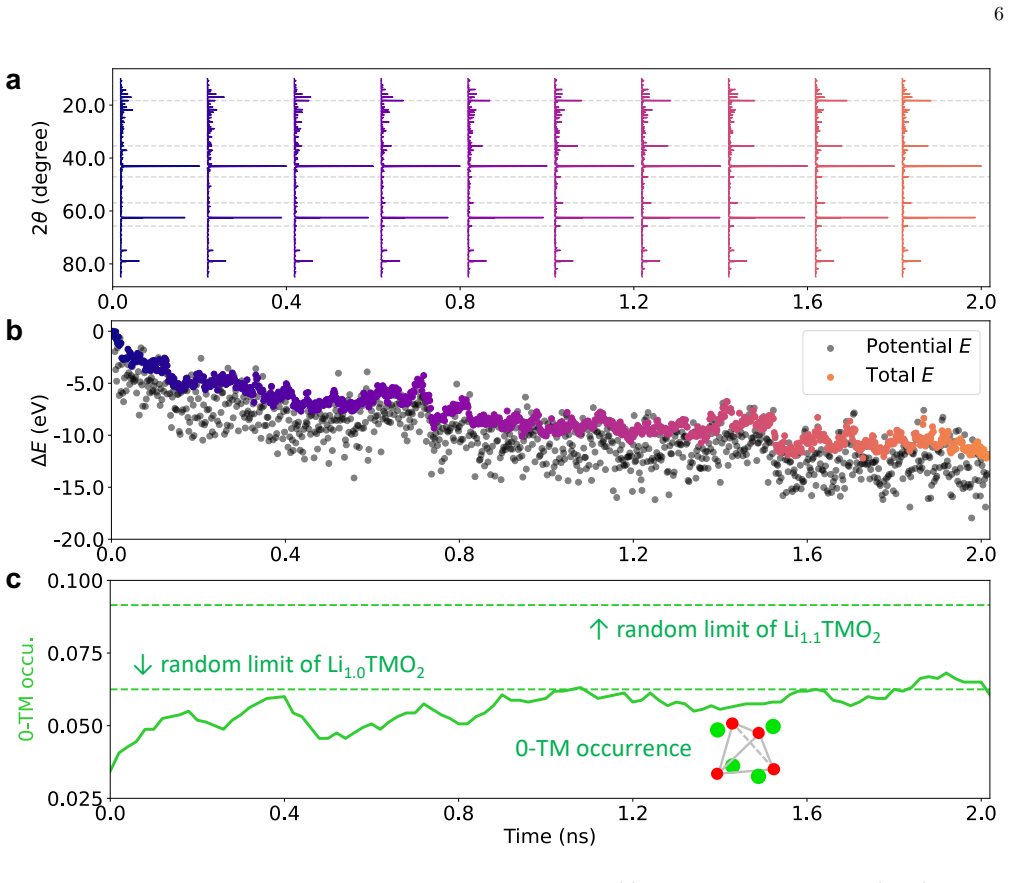
Summary. The manuscript reports a machine-learning-potential molecular dynamics study of the transformation from a disordered rocksalt to a partially disordered spinel-like (δ) phase in Li0.6Mn0.8Ti0.1O1.9F0.1. The authors fine-tune the CHGNet interatomic potential on a large r2SCAN-DFT dataset (88,852 structures), run NVT MD at 1273 K from a delithiated disordered configuration, and observe growth of spinel XRD peaks, an energy drop of about 60 meV per anion, and an increase in the occurrence of 0-TM tetrahedra. From CHGNet-predicted magnetic moments, they classify Mn valence states and infer that tetrahedral Mn3+ appears before tetrahedral Mn2+, concluding that Mn3+ migration initiates the ordering while Mn2+ is a consequence of spinel-like ordering. They then compute topotactic Li-vacancy intercalation voltage profiles for the MD-derived δ-phase and compare them with DRX and ordered spinel structures, reporting solid-solution low-voltage behavior and a higher accessible capacity in the δ-phase.
Significance. If the conclusions hold, the paper provides an atomic-scale mechanistic explanation of the DRX-to-δ phase transformation and demonstrates that a fine-tuned, charge-informed MLIP can capture coupled cation migration and cation ordering in a complex oxide. The work has notable strengths: a large and composition-aware training set with reported test errors of 2 meV/atom in energy, 68 meV/Å in force, and 0.019 μB in magnetic moment; a forward simulation that starts from a disordered configuration and produces spinel-like order without fitting the transformation itself; clear definition of the 0-TM to Li-tet conversion processes used to interpret voltage profiles; and publicly available data and code. The central temporal-ordering claim, however, rests entirely on magnetic-moment-based valence assignments whose transferability across octahedral-to-tetrahedral coordination changes is not validated. The electrochemical conclusions also depend on a restricted Li-vacancy configurational search. These issues are fixable within the scope of the manuscript, so the significance is conditional on the additional validation and analysis requested below.
major comments (3)
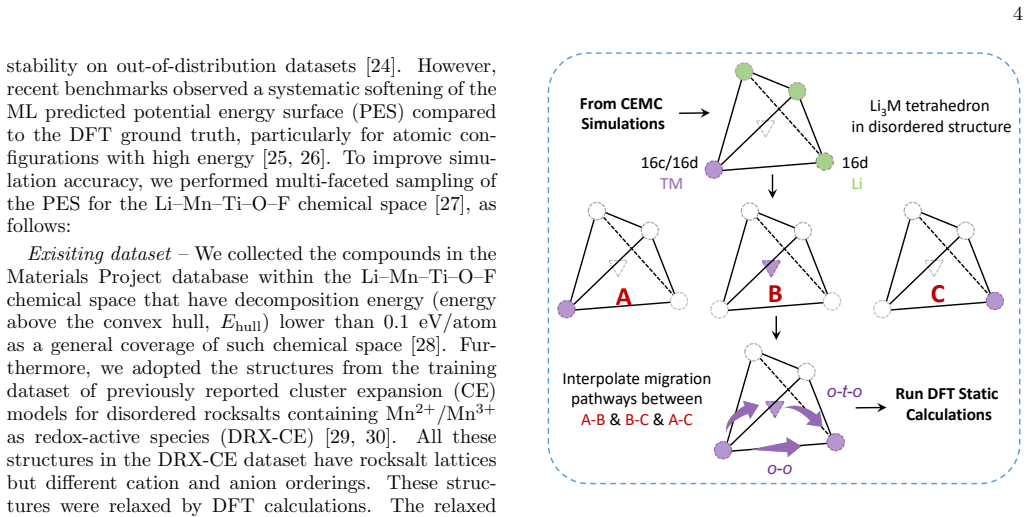
- [III.B, Fig. 5; Methods II.A; Discussion, final paragraph] The conclusion that tetrahedral Mn3+ migration initiates the transformation and that tetrahedral Mn2+ appears only after spinel-like ordering is based entirely on classifying Mn valence from CHGNet-predicted magnetic moments using fixed bins (Mn2+: 4.1–5.0 μB, Mn3+: 3.25–4.1 μB). The bins are calibrated for equilibrium local environments, but the quantity under study is precisely the octahedral-to-tetrahedral coordination change during migration in high-temperature, delithiated, partially ordered structures. A coordination-dependent shift in the predicted local moment—for example, a tetrahedral Mn3+ with a moment above 4.1 μB or a tetrahedral Mn2+ with a moment below 4.1 μB—would make the observed sequence a proxy artifact rather than a physical mechanism. The paper's own Discussion acknowledges that the model does not include explicit long-range electrostatics and uses magnetic moments as a charge proxy, and no DFT recomputation of moments or oxidation states on nonequilibrium MD snapshots is reported. I request a validation step: recompute r2SCAN (or r2SCAN+U) magnetic moments and, if possible, oxidation-state indicators on representative tetrahedral and octahedral Mn environments from the early and late MD trajectories, and show that the bin assignments are stable across coordination. Without this, the central mechanistic claim that Mn3+ migrates before Mn2+ is not established.
- [III.A–III.B, Figs. 4–5] The temporal-ordering narrative appears to be drawn from a single 2 ns MD trajectory at 1273 K starting from one randomly delithiated configuration. The onset of spinel ordering and the delayed rise of tetrahedral Mn2+ at approximately 0.6 ns are presented without replicate simulations or any statistical measure, so the sequence could reflect the particular initial configuration rather than a robust mechanistic ordering. I ask the authors to state explicitly how many independent trajectories were used and, if only one, to add several independent starting configurations or otherwise quantify run-to-run variability in the onset times of Mn3+_tet and Mn2+_tet. This is load-bearing because the paper's central claim is a temporal-ordering claim.
- [III.C and Appendix C] The claim that the δ-phase exhibits solid-solution intercalation with no two-phase reaction is based on a convex hull built from a greedy sequential enumeration of only 20 Li-vacancy configurations per delithiation step, with the TM and anion sublattices fixed to a single MD-derived structure. Given the large configurational space of a partially disordered phase, this restricted sampling may miss low-energy Li-vacancy orderings, and the absence of a flat voltage plateau could be an artifact of incomplete enumeration rather than a physical property of the δ-phase. Please provide a convergence check with respect to the number of configurations per step (or a more systematic enumeration) for at least one composition, so the solid-solution conclusion can be separated from sampling limitations.
minor comments (4)
- [Abstract vs. Section III] The abstract states the simulated composition as Li0.6Mn0.8Ti0.1O1.9F0.1, while the Results section describes the delithiated structure as Li0.5□0.6Mn0.8Ti0.1O1.9F0.1; please reconcile the Li content and the vacancy notation.
- [Methods II.B] In the migration-pathway sampling description, the intermediate tetrahedral site is called the 'T h site' several times; this should be 'Td site' to match the earlier definition and standard notation.
- [Fig. 5b] The caption and text refer to 'Mn3+tet' and 'Mn2+tet' but the plot axis is described only as occupancy per formula unit; please label the ordinate explicitly so the reader can distinguish tetrahedral occupancy from total Mn content.
- [Introduction, first use of 'charge-informed MD'] Because the model uses magnetic moments as a proxy for charge and does not explicitly include long-range Coulombic interactions, a brief clarification at the first use of 'charge-informed' would help avoid overstating what the potential computes; the Discussion already provides this caveat.
Circularity Check
No significant circularity: the MD simulation is forward, and valence assignments are post-hoc outputs, not fitted constraints.
full rationale
The central mechanistic claim—that Mn3+ migration initiates the disordered-to-delta transformation and tetrahedral Mn2+ emerges only as spinel-like ordering forms—is read off from a 2 ns NVT MD trajectory started from a disordered rocksalt configuration. This trajectory was not constrained to produce spinel-like ordering or any particular Mn valence sequence; the structural evolution and the time-resolved magnetic moments are outputs of the fine-tuned Product-CHGNet, which was trained on r2SCAN-DFT energies, forces, stresses, and magnetic moments. The valence bins (Mn2+: 4.1–5.0 mu_B, Mn3+: 3.25–4.1 mu_B, Mn4+: 2.5–3.25 mu_B) are fixed post-hoc thresholds applied to predicted moments, not parameters fitted to the observed temporal sequence. Therefore, the observed ordering (Mn3+_tet before Mn2+_tet) is an emergent simulation result rather than a restatement of training labels or a fitted constraint. The paper's use of CHGNet [Ref 21] and its consistency check against the earlier CHGNet-based simulation are self-citations, but they are not load-bearing: the new fine-tuned model, the new Li-Mn-Ti-O-F composition, and the new production MD are presented, and the mechanism is inferred from the new trajectory. The acknowledged limitation that magnetic moments are only a proxy for charge and that long-range electrostatics are not explicitly computed is a model-accuracy concern, not a circularity; it does not make the prediction equivalent to an input by construction. No equation in the paper reduces the claimed result to a fitted parameter or to a definition.
Assumptions & free parameters
free parameters (3)
- Magnetic moment cutoffs for Mn valence bins (Mn2+: 4.1-5.0 mu_B, Mn3+: 3.25-4.1, Mn4+: 2.5-3.25)
- Selection criteria for delithiated structures in voltage profile (minimum/maximum voltage step)
- Number of structures sampled per MD trajectory (200) and delithiation levels (0.2/0.4/0.6 Li per f.u.)
assumptions (4)
- domain assumption CHGNet magnetic moments are a valid proxy for transition metal valence states.
- domain assumption The cluster expansion Hamiltonian (83 ECIs fitted to 322 structures) accurately represents configurational thermodynamics of the Li-Mn-Ti-O-F rocksalt system at 1273 K.
- domain assumption The fine-tuned MLIP accurately predicts energies, forces, and magnetic moments for nonequilibrium, partially ordered, delithiated configurations at 1273 K within the 2 ns timescale.
- domain assumption The 0-TM to Li_tet conversion reaction (Eq. 3) is the dominant low-voltage intercalation mechanism in the delta-phase.
invented entities (2)
-
The delta-phase (partially disordered spinel-like phase) in Li-Mn-Ti-O-F
independent evidence
-
Product-CHGNet, the fine-tuned CHGNet MLIP
Cite this review
Pith. "Pith review of Modeling phase transformations in Mn-rich disordered rocksalt cathodes with machine learning interatomic potentials." pith.science (2026). https://pith.science/paper/CHYP5SS4
@misc{pith2026250620605,
  author       = {Pith},
  title        = {Pith review of: Modeling phase transformations in Mn-rich disordered rocksalt cathodes with machine learning interatomic potentials},
  year         = {2026},
  howpublished = {\url{https://pith.science/paper/CHYP5SS4}},
  note         = {Machine review of arXiv:2506.20605}
}
abstract
Mn-rich disordered rocksalt (DRX) cathode materials exhibit a phase transformation from a disordered to a partially disordered spinel-like structure ($\delta$-phase) during electrochemical cycling. In this computational study, we used charge-informed molecular dynamics with a fine-tuned CHGNet foundation potential to investigate the phase transformation in Li$_{x}$Mn$_{0.8}$Ti$_{0.1}$O$_{1.9}$F$_{0.1}$. Our results indicate that transition metal migration occurs and reorders to form the spinel-like ordering in an FCC anion framework. The transformed structure contains a higher concentration of non-transition metal (0-TM) face-sharing channels, which are known to improve Li transport kinetics. Analysis of the Mn valence distribution suggests that the appearance of tetrahedral Mn$^{2+}$ is a consequence of spinel-like ordering, rather than the trigger for cation migration as previously suggested. Calculated equilibrium intercalation voltage profiles demonstrate that the $\delta$-phase, unlike the ordered spinel, exhibits solid-solution signatures at low voltage. A higher Li capacity is obtained than in the DRX phase. This study provides atomic insights into solid-state phase transformation and its relation to experimental electrochemistry, highlighting the potential of machine learning interatomic potentials for understanding complex oxide materials.
Figures


Figures from the paper (4 more)


Reference graph
Works this paper leans on
-
[1]
E. A. Olivetti, G. Ceder, G. G. Gaustad, and X. Fu, Lithium-Ion Battery Supply Chain Considera- tions: Analysis of Potential Bottlenecks in Critical Met- als, Joule1, 229 (2017)
work page 2017
-
[2]
L. Xie, C. Singh, S. K. Mitter, M. A. Dahleh, and S. S. Oren, Toward carbon-neutral electricity and mobility: Is 12 the grid infrastructure ready?, Joule5, 1908 (2021)
work page 2021
-
[3]
Y. Tian, G. Zeng, A. Rutt, T. Shi, H. Kim, J. Wang, J. Koettgen, Y. Sun, B. Ouyang, T. Chen, Z. Lun, Z. Rong, K. Persson, and G. Ceder, Promises and Chal- lenges of Next-Generation “Beyond Li-ion” Batteries for Electric Vehicles and Grid Decarbonization, Chemical Reviews121, 1623 (2021)
work page 2021
-
[4]
R. J. Cl´ ement, Z. Lun, and G. Ceder, Cation-disordered rocksalt transition metal oxides and oxyfluorides for high energy lithium-ion cathodes, Energy & Environmental Science13, 345 (2020)
work page 2020
-
[5]
D.-H. Kwon, J. Lee, N. Artrith, H. Kim, L. Wu, Z. Lun, Y. Tian, Y. Zhu, and G. Ceder, The Impact of Sur- face Structure Transformations on the Performance of Li-Excess Cation-Disordered Rocksalt Cathodes, Cell Re- ports Physical Science1, 100187 (2020)
work page 2020
-
[6]
L. Li, Z. Lun, D. Chen, Y. Yue, W. Tong, G. Chen, G. Ceder, and C. Wang, Fluorination-Enhanced Sur- face Stability of Cation-Disordered Rocksalt Cathodes for Li-Ion Batteries, Advanced Functional Materials31, 2101888 (2021)
work page 2021
-
[7]
K. Zhou, Y. Li, S. Zheng, M. Zhang, C. Zhang, C. Battaglia, H. Liu, K. Wang, P. Yan, J. Liu, and Y. Yang, Tailoring the redox-active transition metal con- tent to enhance cycling stability in cation-disordered rock-salt oxides, Energy Storage Materials43, 275 (2021)
work page 2021
-
[8]
J. Ahn, R. Giovine, V. C. Wu, K. P. Koirala, C. Wang, R. J. Cl´ ement, and G. Chen, Ultrahigh-Capacity Rock- salt Cathodes Enabled by Cycling-Activated Structural Changes, Advanced Energy Materials13, 1 (2023)
work page 2023
Show all 68 references
-
[9]
Z. Cai, B. Ouyang, H.-M. Hau, T. Chen, R. Giovine, K. P. Koirala, L. Li, H. Ji, Y. Ha, Y. Sun, J. Huang, Y. Chen, V. Wu, W. Yang, C. Wang, R. J. Cl´ ement, Z. Lun, and G. Ceder, In situ formed partially disordered phases as earth-abundant Mn-rich cathode materials, Na- ture En...
2023
-
[10]
Urban, J
A. Urban, J. Lee, and G. Ceder, The configurational space of rocksalt-type oxides for high-capacity lithium battery electrodes, Advanced Energy Materials4, 1 (2014)
2014
-
[11]
J. Reed, G. Ceder, and A. Van Der Ven, Layered-to- Spinel Phase Transition in Li xMnO2, Electrochemical and Solid-State Letters4, A78 (2001)
2001
-
[12]
Y.-I. Jang, F. Chou, B. Huang, D. R. Sadoway, and Y.-M. Chiang, Magnetic characterization of orthorhom- bic LiMnO 2 and electrochemically transformed spinel LixMnO2 (x <1), Journal of Physics and Chemistry of Solids64, 2525–2533 (2003)
2003
-
[13]
M. R. Jo, Y. Kim, J. Yang, M. Jeong, K. Song, Y.-I. Kim, J.-M. Lim, M. Cho, J.-H. Shim, Y.-M. Kim, W.-S. Yoon, and Y.-M. Kang, Triggered reversible phase transforma- tion between layered and spinel structure in manganese- based layered compounds, Nature Communications10, 3385 (2019)
2019
-
[14]
M. D. Radin, J. Vinckeviciute, R. Seshadri, and A. Van der Ven, Manganese oxidation as the origin of the anoma- lous capacity of Mn-containing Li-excess cathode mate- rials, Nature Energy4, 639 (2019)
2019
-
[15]
A. G. Squires and D. O. Scanlon, Understanding the lim- its to short-range order suppression in many-component disordered rock salt lithium-ion cathode materials, Jour- nal of Materials Chemistry A11, 13765 (2023)
2023
-
[16]
Puchala, J
B. Puchala, J. C. Thomas, A. R. Natarajan, J. G. Goiri, S. S. Behara, J. L. Kaufman, and A. Van der Ven, CASM – A software package for first-principles based study of multicomponent crystalline solids, Computational Mate- rials Science217, 111897 (2023)
2023
-
[17]
Zhong, F
P. Zhong, F. Xie, L. Barroso-Luque, L. Huang, and G. Ceder, Modeling intercalation chemistry with multi- redox reactions by sparse lattice models in disordered rocksalt cathodes, PRX Energy2, 043005 (2023)
2023
-
[18]
T. Chen, J. Yang, L. Barroso-Luque, and G. Ceder, Re- moving the Two-Phase Transition in Spinel LiMn 2O4 through Cation Disorder, ACS Energy Letters8, 314 (2023)
2023
-
[19]
Batzner, A
S. Batzner, A. Musaelian, L. Sun, M. Geiger, J. P. Mailoa, M. Kornbluth, N. Molinari, T. E. Smidt, and B. Kozinsky, E(3)-equivariant graph neural networks for data-efficient and accurate interatomic potentials, Nature Communications13, 2453 (2022)
2022
-
[20]
Chen and S
C. Chen and S. P. Ong, A universal graph deep learn- ing interatomic potential for the periodic table, Nature Computational Science2, 718 (2022)
2022
-
[21]
using the GGA+U-based MLIP. C. Intercalation voltage profile ofδ-phase To evaluate the effect of partial disorder on electro- chemical performance, we computed the intercalation voltage profiles of the transformedδ-phase structure us- ing Product-CHGNet. Specifically, we focus...
-
[22]
B. Deng, P. Zhong, K. Jun, J. Riebesell, K. Han, C. J. Bartel, and G. Ceder, CHGNet as a pretrained universal neural network potential for charge-informed atomistic modelling, Nature Machine Intelligence5, 1031 (2023)
2023
-
[23]
Gilmer, S
J. Gilmer, S. S. Schoenholz, P. F. Riley, O. Vinyals, and G. E. Dahl, Neural message passing for quantum chem- istry, inInternational conference on machine learning (PMLR, 2017) pp. 1263–1272
2017
-
[24]
F. Zhou, T. Maxisch, and G. Ceder, Configurational Elec- tronic Entropy and the Phase Diagram of Mixed-Valence Oxides: The Case of Li xFePO4, Physical Review Letters 97, 155704 (2006)
2006
-
[25]
Riebesell, R
J. Riebesell, R. E. A. Goodall, P. Benner, Y. Chiang, B. Deng, G. Ceder, M. Asta, A. A. Lee, A. Jain, and K. A. Persson, A framework to evaluate machine learning crystal stability predictions, Nature Machine Intelligence 7, 836–847 (2025)
2025
-
[26]
B. Deng, Y. Choi, P. Zhong, J. Riebesell, S. Anand, Z. Li, K. Jun, K. A. Persson, and G. Ceder, Systematic soften- ing in universal machine learning interatomic potentials, npj Computational Materials11, 9 (2025)
2025
-
[27]
A. D. Kaplan, R. Liu, J. Qi, T. W. Ko, B. Deng, J. Riebe- sell, G. Ceder, K. A. Persson, and S. P. Ong, A foun- dational potential energy surface dataset for materials, arXiv preprint arXiv:2503.04070 (2025)
2025
-
[28]
M. L. H. Chandrappa, J. Qi, C. Chen, S. Banerjee, and S. P. Ong, Thermodynamics and kinetics of the cath- ode–electrolyte interface in all-solid-state li–s batteries, Journal of the American Chemical Society144, 18009 (2022)
2022
-
[29]
A. Jain, S. P. Ong, G. Hautier, W. Chen, W. D. Richards, S. Dacek, S. Cholia, D. Gunter, D. Skinner, G. Ceder, and K. A. Persson, Commentary: The Materials Project: A materials genome approach to accelerating materials innovation, APL Materials1, 011002 (2013)
2013
-
[30]
H. Ji, A. Urban, D. A. Kitchaev, D.-H. Kwon, N. Ar- trith, C. Ophus, W. Huang, Z. Cai, T. Shi, J. C. Kim, H. Kim, and G. Ceder, Hidden structural and chemical order controls lithium transport in cation-disordered ox- ides for rechargeable batteries, Nature Communications 10, 5...
2019
-
[31]
Ouyang, N
B. Ouyang, N. Artrith, Z. Lun, Z. Jadidi, D. A. Kitchaev, H. Ji, A. Urban, and G. Ceder, Effect of Flu- orination on Lithium Transport and Short-Range Order 13 in Disordered-Rocksalt-Type Lithium-Ion Battery Cath- odes, Advanced Energy Materials10, 1903240 (2020)
2020
-
[32]
Van der Ven and G
A. Van der Ven and G. Ceder, Lithium diffusion mech- anisms in layered intercalation compounds, Journal of Power Sources97-98, 529 (2001)
2001
-
[33]
Ceder and A
G. Ceder and A. Van der Ven, Phase diagrams of lithium transition metal oxides: investigations from first princi- ples, Electrochimica Acta45, 131 (1999)
1999
-
[34]
L. Wang, T. Maxisch, and G. Ceder, A first-principles ap- proach to studying the thermal stability of oxide cathode materials, Chemistry of materials19, 543 (2007)
2007
-
[35]
J. Reed, G. Ceder, and A. V. D. Ven, Layered-to- Spinel Phase Transition in Li xMnO2, Electrochemical and Solid-State Letters4, A78 (2001)
2001
-
[36]
F. Zhou, M. Cococcioni, C. A. Marianetti, D. Morgan, and G. Ceder, First-principles prediction of redox poten- tials in transition-metal compounds with LDA+U, Phys- ical Review B70, 235121 (2004), 0406382
2004
-
[37]
Swathilakshmi, R
S. Swathilakshmi, R. Devi, and G. Sai Gautam, Perfor- mance of the r2SCAN Functional in Transition Metal Ox- ides, Journal of Chemical Theory and Computation19, 4202 (2023)
2023
-
[38]
J. Sun, A. Ruzsinszky, and J. P. Perdew, Strongly Con- strained and Appropriately Normed Semilocal Density Functional, Physical Review Letters115, 036402 (2015)
2015
-
[39]
Zhong, Z
P. Zhong, Z. Cai, Y. Zhang, R. Giovine, B. Ouyang, G. Zeng, Y. Chen, R. Cl´ ement, Z. Lun, and G. Ceder, In- creasing capacity in disordered rocksalt cathodes by mg doping, Chemistry of Materials32, 10728 (2020)
2020
-
[40]
Holstun, T
T. Holstun, T. P. Mishra, L. Huang, H. Hau, S. Anand, X. Yang, C. Ophus, K. Bustillo, L. Ma, S. Ehrlich, and G. Ceder, Accelerating the Electrochemical Formation of theδPhase in Manganese-Rich Rocksalt Cathodes, Advanced Materials37, 1 (2025)
2025
-
[41]
H.-M. Hau, T. Mishra, C. Ophus, T.-Y. Huang, K. Bustilo, Y. Sun, X. Yang, T. Holstun, X. Zhao, S. Wang, Y. Ha, G.-H. Lee, C. Song, J. Turner, J. Bai, L. Ma, K. Chen, F. Wang, W. Yang, B. D. McCloskey, Z. Cai, and G. Ceder, Earth-abundant Li-ion cathode materials with nanoengin...
2024
-
[42]
T. Li, T. S. Geraci, K. P. Koirala, A. Zohar, E. N. Bassey, P. A. Chater, C. Wang, A. Navrotsky, and R. J. Cl´ ement, Structural Evolution in Disordered Rock Salt Cathodes, Journal of the American Chemical Society146, 24296 (2024)
2024
-
[43]
P. Xiao, T. Shi, W. Huang, and G. Ceder, Understand- ing surface densified phases in ni-rich layered compounds, ACS Energy Letters4, 811 (2019)
2019
-
[44]
Z. Deng, T. P. Mishra, W. Xie, D. A. Saeed, G. S. Gau- tam, and P. Canepa, kmcpy: A python package to sim- ulate transport properties in solids with kinetic monte carlo, Computational Materials Science229, 112394 (2023)
2023
-
[45]
J. H. Yang, T. Chen, L. Barroso-Luque, Z. Jadidi, and G. Ceder, Approaches for handling high-dimensional cluster expansions of ionic systems, npj Computational Materials8, 133 (2022)
2022
-
[46]
K. Han, B. Deng, A. B. Farimani, and G. Ceder, Distm- lip: A distributed inference platform for machine learning interatomic potentials, arXiv preprint arXiv:2506.02023 (2025)
2025
-
[47]
H. Zhao, H. D. Deng, A. E. Cohen, J. Lim, Y. Li, D. Fraggedakis, B. Jiang, B. D. Storey, W. C. Chueh, R. D. Braatz, and M. Z. Bazant, Learning heterogeneous reaction kinetics from x-ray videos pixel by pixel, Nature 621, 289 (2023)
2023
-
[48]
X. Fu, T. Xie, N. J. Rebello, B. D. Olsen, and T. Jaakkola, Simulate time-integrated coarse-grained molecular dynamics with geometric machine learning, Transactions on Machine Learning Research (TMLR) (2022)
2022
-
[49]
T. Hsu, B. Sadigh, V. Bulatov, and F. Zhou, Score Dy- namics: Scaling Molecular Dynamics with Picoseconds Time Steps via Conditional Diffusion Model, Journal of Chemical Theory and Computation20, 2335 (2024)
2024
-
[50]
J. Nam, S. Liu, G. Winter, K. Jun, S. Yang, and R. G´ omez-Bombarelli, Flow matching for accelerated simulation of atomic transport in materials, arXiv preprint arXiv:2410.01464 (2024)
2024
-
[51]
Y. Xie, J. Vandermause, S. Ramakers, N. H. Pro- tik, A. Johansson, and B. Kozinsky, Uncertainty-aware molecular dynamics from Bayesian active learning for phase transformations and thermal transport in SiC, npj Computational Materials9, 36 (2023)
2023
-
[52]
J. Qi, T. W. Ko, B. C. Wood, T. A. Pham, and S. P. Ong, Robust training of machine learning interatomic potentials with dimensionality reduction and stratified sampling, npj Computational Materials10, 43 (2024)
2024
-
[53]
C. Duan, Y. Du, H. Jia, and H. J. Kulik, Accurate tran- sition state generation with an object-aware equivariant elementary reaction diffusion model, Nature Computa- tional Science3, 1045 (2023)
2023
-
[54]
Q. Zhao, Y. Han, D. Zhang, J. Wang, P. Zhong, T. Cui, B. Yin, Y. Cao, H. Jia, and C. Duan, Harnessing Ma- chine Learning to Enhance Transition State Search with Interatomic Potentials and Generative Models, Advanced Science06240, 1 (2025)
2025
-
[55]
Cheng, Latent Ewald summation for machine learning of long-range interactions, npj Computational Materials 11, 80 (2025)
B. Cheng, Latent Ewald summation for machine learning of long-range interactions, npj Computational Materials 11, 80 (2025)
2025
-
[56]
Zhong, D
P. Zhong, D. Kim, D. S. King, and B. Cheng, Ma- chine learning interatomic potential can infer electrical response, arXiv preprint arXiv:2504.05169 (2025)
2025 arXiv
-
[57]
D. Kim, X. Wang, P. Zhong, D. S. King, T. J. Inizan, and B. Cheng, A universal augmentation framework for long-range electrostatics in machine learning interatomic potentials, arXiv preprint arXiv:2507.14302 (2025)
2025 arXiv
-
[58]
Kresse and J
G. Kresse and J. Furthm¨ uller, Efficiency of ab-initio total energy calculations for metals and semiconductors using a plane-wave basis set, Computational Materials Science 6, 15 (1996)
1996
-
[59]
Kresse and D
G. Kresse and D. Joubert, From ultrasoft pseudopoten- tials to the projector augmented-wave method, Physical Review B59, 1758 (1999)
1999
-
[60]
J. W. Furness, A. D. Kaplan, J. Ning, J. P. Perdew, and J. Sun, Accurate and Numerically Efficient r 2SCAN Meta-Generalized Gradient Approximation, The Journal of Physical Chemistry Letters11, 8208 (2020)
2020
-
[61]
Kingsbury, A
R. Kingsbury, A. S. Gupta, C. J. Bartel, J. M. Munro, S. Dwaraknath, M. Horton, and K. A. Persson, Perfor- mance comparison of r2SCAN and SCAN metaGGA den- sity functionals for solid materials via an automated, high-throughput computational workflow, Physical Re- view Material...
2022
-
[62]
Sanchez, F
J. Sanchez, F. Ducastelle, and D. Gratias, Generalized cluster description of multicomponent systems, Physica A: Statistical Mechanics and its Applications128, 334 14 (1984)
1984
-
[63]
Wolverton and A
C. Wolverton and A. Zunger, First-principles prediction of vacancy order-disorder and intercalation battery volt- ages in LixCoO2, Physical Review Letters81, 606 (1998)
1998
-
[64]
van de Walle, Multicomponent multisublattice alloys, nonconfigurational entropy and other additions to the Alloy Theoretic Automated Toolkit, Calphad33, 266 (2009)
A. van de Walle, Multicomponent multisublattice alloys, nonconfigurational entropy and other additions to the Alloy Theoretic Automated Toolkit, Calphad33, 266 (2009)
2009
-
[65]
Zhong, T
P. Zhong, T. Chen, L. Barroso-Luque, F. Xie, and G. Ceder, Anℓ 0ℓ2-norm regularized regression model for construction of robust cluster expansions in multicompo- nent systems, Physical Review B106, 024203 (2022)
2022
-
[66]
Barroso-Luque, P
L. Barroso-Luque, P. Zhong, J. H. Yang, F. Xie, T. Chen, B. Ouyang, and G. Ceder, Cluster expansions of multi- component ionic materials: Formalism and methodology, Physical Review B106, 144202 (2022)
2022
-
[67]
Barroso-Luque, J
L. Barroso-Luque, J. H. Yang, F. Xie, T. Chen, R. L. Kam, Z. Jadidi, P. Zhong, and G. Ceder, smol: A Python package for cluster expansions and beyond, Journal of Open Source Software7, 4504 (2022)
2022
-
[68]
S. P. Ong, W. D. Richards, A. Jain, G. Hautier, M. Kocher, S. Cholia, D. Gunter, V. L. Chevrier, K. A. Persson, and G. Ceder, Python Materials Genomics (py- matgen): A robust, open-source python library for mate- rials analysis, Computational Materials Science68, 314 (2013)
2013
Reviewed August 6, 2026 · model on record in the stance chip above.
Discussion (0). Sign in to comment.