Shape2Animal: Creative Animal Generation from Natural Silhouettes
Pith reviewed 2026-05-19 07:22 UTC · model grok-4.3
The pith
Shape2Animal automates the reinterpretation of natural silhouettes like clouds or stones as fitting animal images through segmentation and generative synthesis.
A machine-rendered reading of the paper's core claim, the machinery that carries it, and where it could break.
Core claim
The Shape2Animal framework first performs open-vocabulary segmentation to extract object silhouettes and interprets semantically appropriate animal concepts using vision-language models. It then synthesizes an animal image that conforms to the input shape, leveraging text-to-image diffusion models and seamlessly blends it into the original scene to generate visually coherent and spatially consistent compositions.
What carries the argument
The end-to-end pipeline that combines open-vocabulary segmentation for shape extraction, vision-language model concept selection, diffusion-based animal synthesis, and scene blending.
If this is right
- The framework produces visually coherent and spatially consistent animal compositions from diverse real-world inputs.
- It demonstrates robustness when applied to varied natural silhouettes such as clouds, stones, or flames.
- It supports new uses in visual storytelling, educational content, digital art, and interactive media design.
Where Pith is reading between the lines
- Similar pipelines could be adapted to reinterpret silhouettes as non-animal objects such as vehicles or plants.
- The approach suggests a route for testing how generative models handle shape constraints across different input domains.
- Integration with user-provided prompts might allow controlled variation in the chosen animal while preserving the silhouette match.
Load-bearing premise
Vision-language models can reliably pick animal concepts that match extracted silhouettes and diffusion models can generate animals whose shapes align closely enough for seamless blending.
What would settle it
Running the system on a clear silhouette such as a cloud outline and observing that the generated animal body deviates substantially from the input contour or shows obvious blending artifacts in the final image.
Figures
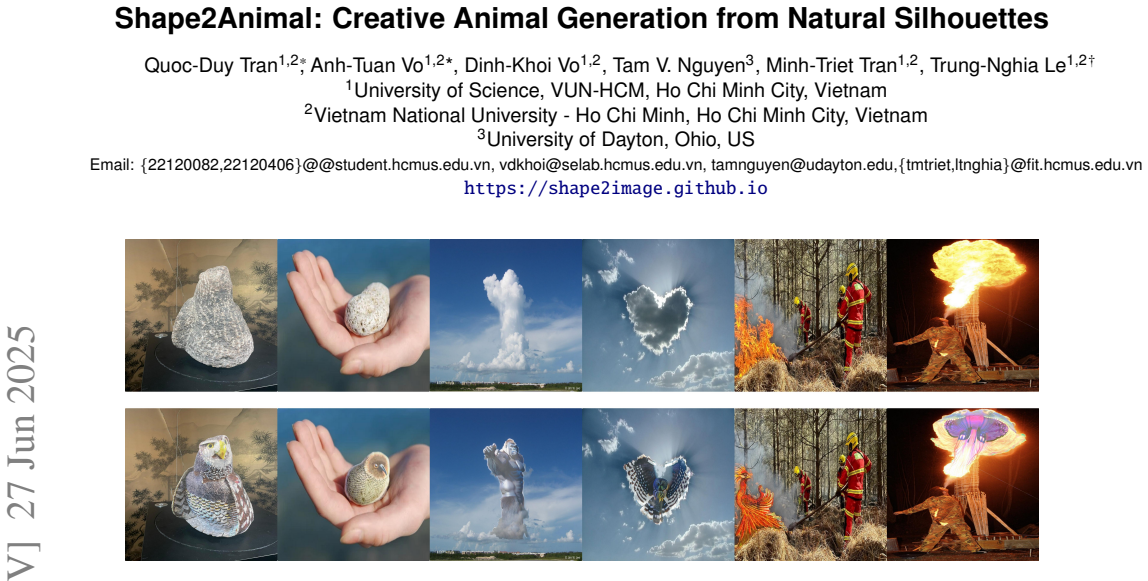


read the original abstract
Humans possess a unique ability to perceive meaningful patterns in ambiguous stimuli, a cognitive phenomenon known as pareidolia. This paper introduces Shape2Animal framework to mimics this imaginative capacity by reinterpreting natural object silhouettes, such as clouds, stones, or flames, as plausible animal forms. Our automated framework first performs open-vocabulary segmentation to extract object silhouette and interprets semantically appropriate animal concepts using vision-language models. It then synthesizes an animal image that conforms to the input shape, leveraging text-to-image diffusion model and seamlessly blends it into the original scene to generate visually coherent and spatially consistent compositions. We evaluated Shape2Animal on a diverse set of real-world inputs, demonstrating its robustness and creative potential. Our Shape2Animal can offer new opportunities for visual storytelling, educational content, digital art, and interactive media design. Our project page is here: https://shape2image.github.io
Editorial analysis
A structured set of objections, weighed in public.
Referee Report
Summary. The manuscript introduces Shape2Animal, a framework that mimics pareidolia by reinterpreting natural silhouettes (clouds, stones, flames) as animals. The pipeline extracts silhouettes via open-vocabulary segmentation, selects animal concepts with vision-language models, synthesizes shape-conforming animals using text-to-image diffusion, and blends the result back into the original scene for coherent compositions. It claims robustness and creative potential on diverse real-world inputs for applications in storytelling and digital art.
Significance. If the pipeline functions as described, it could enable accessible creative tools for visual content generation. However, the absence of quantitative metrics, ablation studies, or failure analyses in the manuscript makes it difficult to determine whether the approach advances beyond existing segmentation-plus-diffusion pipelines or delivers reliable shape conformity and blending.
major comments (2)
- [Abstract] Abstract: the claim that the framework 'demonstrates its robustness' rests on an unevaluated pipeline; no metrics, datasets, baselines, or ablation results are reported to support robustness or creative potential.
- [Method] Method (open-vocabulary segmentation stage): the framework assumes reliable silhouette extraction for amorphous inputs, yet standard open-vocabulary segmenters are known to produce fragmented or empty masks on low-contrast, non-rigid phenomena such as clouds or flames; this precondition is load-bearing for all downstream VLM selection and diffusion synthesis steps.
minor comments (1)
- [Abstract] Abstract: the project page URL is given but no code, model checkpoints, or implementation details are referenced in the text.
Simulated Author's Rebuttal
Thank you for the detailed review of our manuscript. We appreciate the referee's identification of key areas where the presentation of evaluation and methodological assumptions can be strengthened. We respond to each major comment below and outline the revisions we will incorporate.
read point-by-point responses
-
Referee: [Abstract] Abstract: the claim that the framework 'demonstrates its robustness' rests on an unevaluated pipeline; no metrics, datasets, baselines, or ablation results are reported to support robustness or creative potential.
Authors: We agree that the current manuscript supports its claims primarily through qualitative visual results on a collection of real-world silhouettes rather than quantitative metrics or controlled ablations. The evaluation section describes a diverse set of inputs (clouds, stones, flames, etc.) and shows the resulting compositions, but does not report numerical scores, baselines, or failure-rate statistics. We will revise the abstract to replace the phrase 'demonstrating its robustness' with a more precise statement such as 'illustrating its applicability to diverse real-world inputs.' We will also expand the experiments section to explicitly describe the input curation process, the qualitative assessment criteria used, and a short failure-case analysis. revision: yes
-
Referee: [Method] Method (open-vocabulary segmentation stage): the framework assumes reliable silhouette extraction for amorphous inputs, yet standard open-vocabulary segmenters are known to produce fragmented or empty masks on low-contrast, non-rigid phenomena such as clouds or flames; this precondition is load-bearing for all downstream VLM selection and diffusion synthesis steps.
Authors: This is a fair and important observation. The pipeline does depend on obtaining usable silhouettes, and open-vocabulary models can indeed return incomplete or noisy masks for low-contrast, non-rigid shapes. In our current implementation we rely on prompt engineering and simple morphological cleanup to improve mask quality, and we select demonstration examples where the extracted silhouette is sufficiently coherent. We will add a dedicated paragraph in the method section that acknowledges this assumption, describes the specific segmentation model and prompting strategy employed, and includes representative failure examples together with the downstream effects on animal synthesis. revision: yes
Circularity Check
No circularity: descriptive engineering pipeline with no derivations or fitted predictions
full rationale
The paper describes an applied framework that chains existing tools (open-vocabulary segmentation, VLMs, diffusion models, blending) to reinterpret silhouettes as animals. No equations, parameter fitting, or first-principles derivations appear in the provided text or abstract. All steps are procedural engineering choices rather than claims that reduce to their own inputs by construction. No self-citation load-bearing arguments or uniqueness theorems are invoked. The contribution is therefore self-contained against external benchmarks and receives the default non-finding of zero circularity.
Axiom & Free-Parameter Ledger
Lean theorems connected to this paper
-
IndisputableMonolith/Foundation/AbsoluteFloorClosure.leanreality_from_one_distinction unclear?
unclearRelation between the paper passage and the cited Recognition theorem.
Our automated framework first performs open-vocabulary segmentation to extract object silhouette and interprets semantically appropriate animal concepts using vision-language models. It then synthesizes an animal image that conforms to the input shape, leveraging text-to-image diffusion model
What do these tags mean?
- matches
- The paper's claim is directly supported by a theorem in the formal canon.
- supports
- The theorem supports part of the paper's argument, but the paper may add assumptions or extra steps.
- extends
- The paper goes beyond the formal theorem; the theorem is a base layer rather than the whole result.
- uses
- The paper appears to rely on the theorem as machinery.
- contradicts
- The paper's claim conflicts with a theorem or certificate in the canon.
- unclear
- Pith found a possible connection, but the passage is too broad, indirect, or ambiguous to say the theorem truly supports the claim.
Reference graph
Works this paper leans on
-
[1]
Flamingo: a Visual Language Model for Few-Shot Learning
J.-B. Alayrac, J. Donahue, P. Luc, A. Miech, I. Barr, Y . Hasson, M. Azar, A. Radford, J. Han, J. Huang, et al. Flamingo: a vi- sual language model for few-shot learning, 2022. arXiv preprint arXiv:2204.14198. 2
work page internal anchor Pith review Pith/arXiv arXiv 2022
- [2]
- [3]
-
[4]
W. Doniger. Animals and the Human Imagination: A Companion to Animal Studies. Columbia University Press, 2012. 1
work page 2012
-
[5]
W. Doniger. Animals and the Human Imagination: A Companion to Animal Studies. Columbia University Press, 2012. Accessed April
work page 2012
-
[6]
I. J. Goodfellow, J. Pouget-Abadie, M. Mirza, B. Xu, D. Warde-Farley, S. Ozair, A. Courville, and Y . Bengio. Generative adversarial net- works, 2014. 2
work page 2014
-
[7]
Gemini API: gemini-2.5-flash-preview-04-17
Google. Gemini API: gemini-2.5-flash-preview-04-17. https://ai.google.dev/gemini-api/docs/models# gemini-2.5-flash-preview , April 2025. Accessed April
work page 2025
-
[8]
ControlNet for Stable Diffusion XL: controlnet- depth-sdxl-1.0-small
Hugging Face. ControlNet for Stable Diffusion XL: controlnet- depth-sdxl-1.0-small. https://huggingface.co/diffusers/ controlnet-depth-sdxl-1.0-small , 2023. Accessed April
work page 2023
-
[9]
P. Isola, J.-Y . Zhu, T. Zhou, and A. A. Efros. Image-to-image transla- tion with conditional adversarial networks, 2018. 1
work page 2018
-
[10]
D. P. Kingma and M. Welling. Auto-encoding variational bayes, 2022. 2
work page 2022
-
[11]
A. Kirillov, E. Mintun, N. Ravi, H. Mao, C. Rolland, L. Gustafson, T. Xiao, S. Whitehead, A. C. Berg, W.-Y . Lo, P. Doll ´ar, and R. Gir- shick. Segment anything. arXiv preprint arXiv:2304.02643 , 2023. Accessed April 2025. 2, 4
work page internal anchor Pith review Pith/arXiv arXiv 2023
-
[12]
J. Liu, J. Li, L. Feng, L. Li, J. Tian, and K. Lee. Seeing jesus in toast: Neural and behavioral correlates of face pareidolia.Cortex, 53:60–77,
-
[13]
S. Martinez-Conde. The brain sees faces everywhere. Scientific Amer- ican, Sep 2015. 1
work page 2015
-
[14]
S. Martinez-Conde. The brain sees faces everywhere. Scientific Amer- ican, Sep. 2015. 2
work page 2015
- [15]
- [16]
-
[17]
A. Radford, J. W. Kim, C. Hallacy, A. Ramesh, G. Goh, S. Agarwal, G. Sastry, A. Askell, P. Mishkin, J. Clark, G. Krueger, and I. Sutskever. Learning transferable visual models from natural language supervi- sion. In Proceedings of the 38th International Conference on Machine Learning, vol. 139, pp. 8748–8763. PMLR, 2021. 2
work page 2021
-
[18]
V . S. Ramachandran and W. Hirstein. The science of art: A neurolog- ical theory of aesthetic experience. Journal of Consciousness Studies, 6(6–7):15–51, 1999. 1
work page 1999
-
[19]
Hierarchical Text-Conditional Image Generation with CLIP Latents
A. Ramesh, P. Dhariwal, A. Nichol, C. Chu, and M. Chen. Hierarchi- cal text-conditional image generation with clip latents, 2022. arXiv preprint arXiv:2204.06125. 2
work page internal anchor Pith review Pith/arXiv arXiv 2022
-
[20]
R. Rombach, A. Blattmann, D. Lorenz, P. Esser, and B. Ommer. High- resolution image synthesis with latent diffusion models. In Proceed- ings of the IEEE/CVF Conference on Computer Vision and Pattern Recognition (CVPR), pp. 10684–10695, June 2022. 2, 4
work page 2022
-
[21]
C. Saharia, W. Chan, S. Saxena, L. Li, J. Whang, E. Denton, S. K. S. Ghasemipour, B. K. Ayan, S. S. Mahdavi, R. G. Lopes, T. Salimans, J. Ho, D. J. Fleet, and M. Norouzi. Photorealistic text-to-image diffu- sion models with deep language understanding, 2022. 1, 2
work page 2022
-
[22]
A. Somaini. On the altered states of machine vision. AN-ICON. Stud- ies in Environmental Images [ISSN 2785-7433], 2022. 1
work page 2022
-
[23]
Y . Yang, T. Zhang, G. Li, T. Kim, and G. Wang. An unsupervised domain adaptation model based on dual-module adversarial training. Neurocomputing, 475:102–111, Feb. 2022. doi: 10.1016/j.neucom. 2021.12.060 1
-
[24]
Z. Yang, J. Wang, Z. Gan, L. Li, K. Lin, C. Wu, N. Duan, Z. Liu, C. Liu, M. Zeng, and L. Wang. Reco: Region-controlled text-to-image generation, 2022. 1, 2
work page 2022
- [25]
-
[26]
Grounding DINO: Marrying DINO with Grounded Pre-Training for Open-Set Object Detection
S. Zhang, X. Chen, X. Wang, Z. Liu, S. Liu, M. Li, and P. Luo. Grounding dino: Marrying dino with grounded pre-training for open- set object detection. arXiv preprint arXiv:2303.05499 , 2023. Ac- cessed April 2025. 2
work page internal anchor Pith review Pith/arXiv arXiv 2023
-
[27]
J.-Y . Zhu, T. Park, P. Isola, and A. A. Efros. Unpaired image-to-image translation using cycle-consistent adversarial networks, 2020. 1
work page 2020
discussion (0)
Sign in with ORCID, Apple, or X to comment. Anyone can read and Pith papers without signing in.