REVIEW 6 major objections 5 minor 76 references
Structural Decoupling: A Scaffold-Flow Theory of Generalization and Alignment
T0 review · 6 major / 5 minor · reviewed 2026-08-06 · deepseek-v4-flash
Pith's one-line read The paper claims that inference under uncertainty reduces to a single entropy-asymmetry law: low-entropy structured content must be established before high-entropy context is interpreted.
desk verdict Abstract and body are two different papers, and the body's formal claims don't survive contact with their own appendices. read the letter →
The pith
A machine-rendered reading of the paper's core claim, the machinery that carries it, and where it could break.
The reading
What carries the argument
The load-bearing object is the entropy decomposition under broken symmetry: H(Φ, Ψ) = H(Φ) + H(Ψ|Φ) with the assumption H(Φ) ≪ H(Ψ), which makes the conditional term dominate and gives inference a preferred direction from content to context. The paper operationalizes this through the variational free energy F[q] = E_{q(Z|Ψ)}[−log p(Ψ|Z)] + D_KL(q(Z|Ψ) ∥ p(Z|Φ)), reading the KL term as a variational preconditioner that confines the posterior to a low-entropy submanifold and bounds its entropy. The temporal claims ride on the recursive update Φ(t+1) = F(Ψ(t), Φ(t)) together with two structural assumptions: the update operator contracts KL divergence with rate 0 < γ < 1, and the entropy gap H(Ψ(t)|Φ(t)) decreases monotonically; these are what force convergence to a fixed-point schema in Theorems 5–7.
What would settle it
Measure the marginal entropies of a trained model's representations versus its raw inputs on a standard dataset: if the representation entropy is not substantially below the input entropy, the CCUP asymmetry fails. Separately, run the paper's bootstrapped update Φ(t+1) = arg min_Φ [H(Ψ|Φ) + λD_KL(Φ ∥ Φ(t))] on a benchmark task and record D_KL(p(Ψ|Φ(t+1)) ∥ p(Ψ|Φ(t))) at each step; if the ratio to the previous step is not bounded by a constant below 1, Theorem 5's convergence claim does not hold for that update rule.
Extended reading notes
Core claim
The central claim is the Context-Content Uncertainty Principle (CCUP): because structured content Φ has far lower entropy than contextual input Ψ (H(Φ) ≪ H(Ψ)), optimal inference proceeds by minimizing the conditional entropy H(Ψ|Φ) rather than treating Ψ and Φ symmetrically. Decomposing joint entropy as H(Φ, Ψ) = H(Φ) + H(Ψ|Φ) turns this asymmetry into a directional policy—structure-before-specificity: establish Φ first, then use it to constrain Ψ. From this decomposition, the paper derives that structure-before-specificity, asymmetric inference flow, cycle-consistent bootstrapping, and conditional compression form one reducible equivalence class; that precision-weighted attention, asymmetric learning rates, and memory attractors are the resulting control laws; that bootstrapped updates converge to fixed-point schemas when the update operator contracts KL divergence; and that hierarchical composition reduces conditional uncertainty level by level.
Load-bearing premise
Everything downstream rests on the claim that in real systems structured content genuinely has far less entropy than incoming context, and that repeated structure updates shrink prediction differences by a fixed factor rather than merely oscillating.
Editorial extensions
If this is right
- If CCUP is right, training should separate structural learning from specificity learning: the gradients that update the scaffold (content) and the gradients that optimize within-context flow should be distinct, because mixing them violates the entropy alignment that makes generalization efficient.
- Attention, learning rates, and memory capacity become derived quantities rather than hyperparameters, set by entropy gradients: attend to inputs whose interpretation most depends on structure, learn content slowly and specifics fast, and store traces that maximize mutual information with structure.
- A learning system built on cycle-consistent bootstrapping converges to stable fixed-point schemas, which would make continual learning and memory consolidation the same process as entropy minimization over time.
- Hierarchical composition strictly reduces conditional uncertainty at each abstraction level, giving a principled reason for deep, compositional architectures over flat ones.
- Safety failures—hallucination, reward-model boundary errors, deceptive alignment—are reinterpreted as scaffold-resolution or scaffold-preservation failures, shifting where interventions should target.
Reading between the lines
- The CCUP law suggests a design rule the paper only sketches: any system that can separate its scaffold (slow, low-entropy structure) from its flow (fast, high-entropy specifics) should be more stable under distribution shift; this is directly testable by comparing single-model versus decoupled training on a non-stationary benchmark.
- Because the four core constraints are claimed mutually reducible, the framework predicts that a system built around any one—say, conditional compression alone—should spontaneously exhibit the others, such as attention-like allocation and bootstrapped refinement; the paper's simulations all include the full CCUP objective, so a minimal-contrast experiment would isolate whether one constraint suffic
- The same entropy-alignment cycle could be applied to problems the paper does not target, such as continual task discovery or open-world agents: a new context that cannot be aligned to existing low-entropy structure would signal the need for a new scaffold, which operationalizes discovering which contexts exist.
Editorial analysis
A structured set of objections, weighed in public.
Referee Report
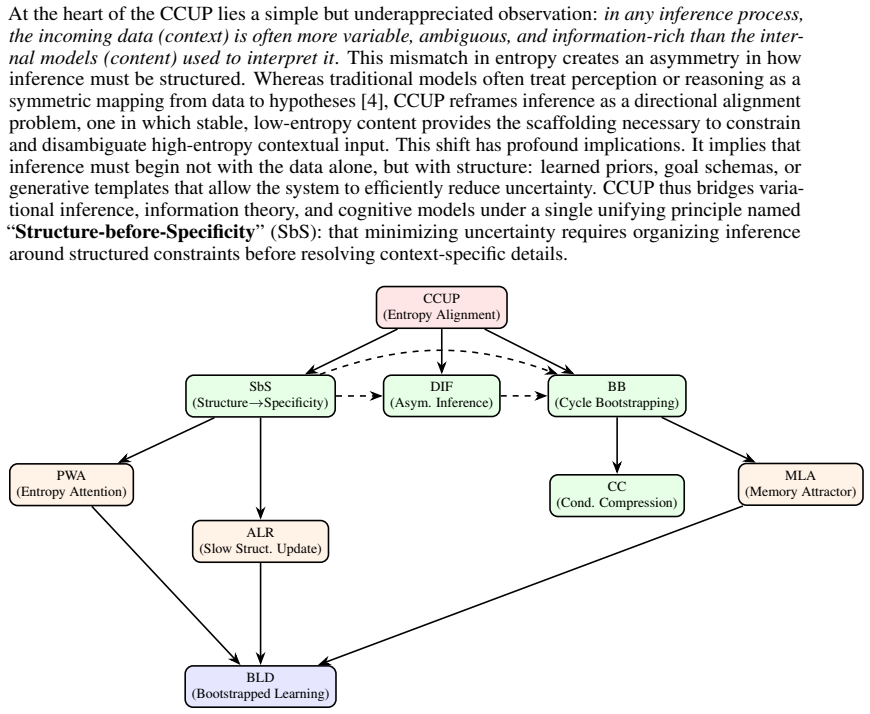
Summary. The paper introduces the Context-Content Uncertainty Principle (CCUP), the claim that inference under uncertainty is governed by an entropy asymmetry between high-entropy context and low-entropy structured content. From this principle it derives a four-layer hierarchy of operational principles: core inference constraints (structure-before-specificity, asymmetric inference flow, cycle-consistent bootstrapping, conditional compression), resource allocation mechanisms (precision-weighted attention, asymmetric learning rates, low-entropy memory attractors), temporal bootstrapping dynamics, and spatial hierarchical composition. The advertised contribution is that these principles reduce to one entropy-alignment law, with formal theorems on equivalence, convergence, and hierarchical uncertainty reduction, plus simulations in the extended version. The manuscript is organized around a dependency lattice and includes an appendix with proofs of the main results.
Significance. If the central derivation were correct, the paper would offer an impressively broad unification of information-theoretic, variational, and cognitive-science perspectives on inference, memory, attention, and hierarchical representation. The explicit attempt to reduce multiple design principles to a single entropy asymmetry is ambitious, and the layered presentation and dependency lattice are conceptually clear. However, the paper's scientific value depends entirely on the claimed theorems, and those theorems are not established: the appendix proofs of several central results prove different statements from the ones stated, the convergence theorems assume the mechanisms that they purport to prove, and the key equivalence proposition is explicitly unproved. Because these failures occur at the load-bearing joints of the derivation, the paper does not currently provide a reliable foundation for its claims, even as a theoretical framework.
major comments (6)
- [Appendix D, Theorem 1] The proof of Theorem 1 contains a sign error that reverses the central implication. The proof states that H(Ψ) ≫ H(Φ) implies H(Φ|Ψ) > H(Ψ|Φ). From the mutual-information identities H(Φ|Ψ) = H(Φ) − I(Φ;Ψ) and H(Ψ|Φ) = H(Ψ) − I(Φ;Ψ), the correct implication is H(Ψ|Φ) − H(Φ|Ψ) = H(Ψ) − H(Φ) > 0, hence H(Ψ|Φ) > H(Φ|Ψ). The claimed inequality is the opposite, and the remainder of the proof uses this reversed ordering to justify structure-before-specificity. This is not a typographical slip: the direction of the entropy ordering is the central premise of the paper, so the proof of Theorem 1 as written does not support its conclusion.
- [Section 2.3, Proposition 2] Proposition 2 is the central mutual-reducibility claim that all four Layer 1 principles are equivalent under CCUP, but its proof is explicitly skipped ('proof skipped'). Appendix H provides only a qualitative paragraph describing how each principle could be viewed from the variational objective; it does not prove equivalence, transitivity, or reparameterization. Since the paper's abstract and Section 6 rely on the mutual reducibility of SbS, DIF, BB, and CC, this missing proof is load-bearing. The subsequent 'dependency lattice' and the derivation of Layers 2–4 inherit this gap.
- [Section 4.1, Theorems 5–7] The convergence theorems assume the conclusion. Theorem 5 assumes that the update operator F is contractive in KL divergence with 0 < γ < 1 and that the entropy gap H(Ψ(t)|Φ(t)) is monotonically decreasing; these are exactly the mechanisms that force convergence to a fixed point, and they are never derived for the specific updates in Eqs. (1)–(2). Appendix J is only a proof sketch that restates these assumptions as steps. The same circularity appears in Theorems 6 and 7, whose proofs in Appendices K and L again assume convexity, boundedness, and, in Theorem 6's proof, a 'contraction of posterior distance' that is asserted rather than shown. Without independent derivation of contractivity, the theorems do not establish that CCUP-aligned bootstrapping converges.
- [Appendices K, L, M, Theorems 6–8] The appendix proofs of Theorems 6, 7, and 8 prove statements about different variables from the theorems. Theorem 6's main text updates Φ(t+1) = arg min_Φ [H(Ψ(t)|Φ) + λD_KL(Φ‖Φ(t))], but Appendix K begins with Ψ(t+1) = arg min_Ψ [H(Φ(t)|Ψ) + λD_KL(Ψ‖Ψ(t))] and proves convergence of Ψ(t). Theorem 7 similarly states convergence of Φ_l with KL terms p(Ψ_l|Φ_l), but Appendix L proves convergence of Ψ_l with KL terms p(Φ_l|Ψ_l). Theorem 8's main statement is H(Ψ_{ℓ−1}|Φ_ℓ) < H(Ψ_{ℓ−1}|Φ_{ℓ−1}), whereas Appendix M proves H(Φ_{ℓ−1}|Ψ_ℓ) < H(Φ_{ℓ−1}|Ψ_{ℓ−1}^{(i)}). These are not notational variants: they are different conditional entropies over different variables, and the stated theorems are not proved by the supplied arguments.
- [Appendix M, Theorem 8] The proof of Theorem 8 relies on the claim that conditional entropy is convex in the conditioning variable, using Jensen's inequality to conclude H(Φ_{ℓ−1}|Ψ_ℓ) ≤ Σ α_i H(Φ_{ℓ−1}|Ψ^{(i)}_{ℓ−1}). Conditional entropy is convex in the conditional distribution, not generally in the conditioning random variable or its parameterization. The appendix gives no condition under which the required convexity holds, so the inequality 'H(Φ_{ℓ−1}|Ψ_ℓ) < H(Φ_{ℓ−1}|Ψ^{(i)}_{ℓ−1})' in the proof is unsupported. This is the main step in the claim that hierarchical composition reduces conditional uncertainty.
- [Section 3, Theorem 4] The formulas for the entropy-modulated control policy are declared rather than derived. The proof in Appendix I differentiates the objective L_t(r_t) with respect to α_t, η_t, and C_t, but the resulting stationarity conditions involve only the log penalties, not the dependences stated in Theorem 4. The theorem's displayed formulas α_t ∝ |∇_{Φ_t} H(Ψ_t|Φ_t)|, η_t ∝ H(Ψ_t|Φ_t)/(H(Φ_t)+ε), and C_t ∝ I(Ψ_t;Φ_t) do not follow from the given derivatives or from the stated objective; the proof introduces each formula as an interpretation rather than deriving it from the optimization. Since Theorem 4 is the formal content of Layer 2, this is a load-bearing gap in the derivation of the resource-allocation corollaries.
minor comments (5)
- [Section 4.2, H2 variational objective] In the definition of L_multi, the first term is written H(Φ^{(t)}_ℓ | Φ^{(t)}_ℓ), which is identically zero for a fixed value of the conditioning variable; presumably the intended term is H(Ψ^{(t)}_ℓ | Φ^{(t)}_ℓ) or an analogous cross-level entropy. This makes the displayed objective undefined as written.
- [Section 4.2, Step 5] The text contains the typos 'stabibility' and 'plasciticity' for 'stability' and 'plasticity'; please correct these throughout.
- [Appendix J, Theorem 5] The appendix labels the proof of Theorem 5 as 'Proof Sketch' and states that convergence follows because KL divergence 'induces a proper topology and the space is complete.' This is not a proof of contractive convergence for the specific update F; at minimum, the domain and metric completeness need to be specified precisely.
- [Section 2.4, Theorem 3] The proof of Theorem 3 uses the inequality D_KL(q‖p) ≥ H(q) − H(p), which is not generally valid as written; the correct relation involves cross-entropy and holds with appropriate signs. While the final entropy bound may be repairable, the displayed inequality should be corrected or replaced by a proper standard identity.
- [Section 2.1, Lemma 2 and Remark] The assertion that H(Φ) ≪ H(Ψ) is 'a hallmark of natural cognitive and learning systems' is supported only by a citation to the author's own preprint [12]. This premise is central to the entire framework, and the paper would be strengthened by independent empirical or theoretical support for this ordering, or by a clear statement that the results are conditional on it.
Circularity Check
Bootstrapped convergence and resource-allocation predictions reduce to their own assumptions, while the foundational entropy asymmetry is imported from the author's own preprint.
-
self citation load bearing
[Section 2.1, 'Broken Symmetry' paragraph and Lemma 2 remark]
"Structured content (e.g., schemas, priors, goals) typically has far lower entropy than contextual specificity (e.g., sensory input, environmental conditions) [12]. This broken symmetry (H(Φ) ≪ H(Ψ)) implies a preferred direction for inference: from low-entropy content to high-entropy context."
The entire derivation pyramid is conditioned on H(Φ) ≪ H(Ψ), and this sentence asserts it as an empirical fact while citing only the author's own prior preprint [12]. No measurement, theorem, or external benchmark in this paper establishes the asymmetry. Every later 'derivation' (SbS, DIF, BB, CC, PWA, ALR, MLA, BLD, Theorems 1-8) is stated under this premise, so the root of the derivation chain is a self-citation rather than independently verified input. If [12] merely postulates the same broken symmetry, the present paper imports its foundation rather than deriving it.
-
self definitional
[Section 4.1, Theorem 5]
"Suppose further that: 1) The update operator F is contractive with respect to KL divergence: DKL(p(Ψ|Φ(t+1)) ∥ p(Ψ|Φ(t))) ≤ γDKL(p(Ψ|Φ(t)) ∥ p(Ψ|Φ(t−1))), for some 0 < γ < 1; 2) The entropy gap H(Ψ(t)|Φ(t)) is bounded below and monotonically decreasing. Then the sequence of representations {Φ(t)} converges to a fixed point Φ∗, and the generative model becomes self-consistent: limt→∞ DKL(p(Ψ|Φ(t+1)) ∥ p(Ψ|Φ(t))) = 0, and limt→∞ H(Ψ(t)|Φ(t)) = H(Ψ|Φ∗)."
The theorem's conclusions—fixed-point convergence, DKL→0, and H(Ψ|Φ(t))→H(Ψ|Φ∗)—are exactly assumptions (1) and (2) restated. Contractivity in KL divergence is itself the definition of a contraction whose iterates converge; monotone decrease bounded below is itself convergence of the entropy sequence. Appendix J's proof is a restatement: Step 1 says 'By assumption...' and Step 2 says 'The KL-divergence contraction condition ... implies...'. The specific bootstrapping updates in Eqs. (1)-(2) are never shown to satisfy either condition. Thus the convergence theorem has no content beyond its assumptions; bootstrapped convergence is not derived from CCUP.
1 more flagged steps
-
fitted input called prediction
[Section 3, Theorem 4 (Entropy-Modulated Control Policy)]
"Formally, the optimal control allocation vector rt = [ αt, ηt, Ct] solves the entropy-regularized objective: r∗t = arg min rt Et [H(Ψt|Φt) − λ1 log αt − λ2 log ηt − λ3 log Ct], subject to: H(Φt) ≤ κ, and 0 < αt, ηt, Ct ≤ 1. Each control dimension is modulated by its contribution to entropy reduction: (PWA) αt ∝ |∇Φt H(Ψt|Φt)|, (ALR) ηt ∝ H(Ψt|Φt) H(Φt) + ϵ , (MLA) Ct ∝ I(Ψt; Φt)."
The three proportionalities are the outputs the theorem claims to derive, but they are not consequences of the stated objective. Appendix I differentiates Lt with respect to αt, ηt, Ct and obtains only −λ1/αt, −λ2/ηt, −λ3/Ct, which would push each control to its upper bound; the entropy-gradient, entropy-ratio, and mutual-information expressions never appear in those first-order conditions. The theorem statement simply appends them as 'Each control dimension is modulated by...' and the proof repeats them without derivation. PWA, ALR, and MLA are therefore pre-existing design choices relabeled as predictions of CCUP, not results forced by the entropy-regularized objective.
full rationale
The derivation chain fails at three load-bearing joints, all visible in the paper's own equations. First, the root premise H(Φ) ≪ H(Ψ) is asserted as 'a hallmark of natural cognitive and learning systems' and cited to the author's own preprint [12]; every theorem inherits this premise, so the foundation is a self-citation rather than an independently established fact. Second, Theorem 5's convergence is exactly its contractivity and monotone-decrease assumptions; Appendix J merely restates them, so bootstrapped convergence is not derived from CCUP. Third, Theorem 4's PWA/ALR/MLA formulas are not implied by the stated objective; the appendix differentiates only log terms, so the formulas are inserted rather than derived. Separately, Proposition 2—the mutual reducibility of the four Layer-1 principles—is explicitly 'proof skipped,' so the central equivalence is asserted, not demonstrated; the appendix proofs of Theorems 6–8 also prove statements with Φ and Ψ swapped relative to the theorem statements and rely on a generally false Jensen/convexity step for conditional entropy in the conditioning variable. These latter issues are omitted-proof and correctness defects rather than circular reductions, but they compound the circularity findings. I assign 7 rather than 8 because the information-theoretic inequalities in Lemmas 1–3 and the variational equivalence in Lemma 3 do have independent content; however, the paper's central claim that all four layers reduce to one entropy law is substantially undermined by assumptions that are restated as theorems and by a foundation imported from the author's own prior work.
Assumptions & free parameters
free parameters (3)
- lambda (KL-regularization weights in bootstrapping updates)
- lambda1, lambda2, lambda3, kappa (Theorem 4 control objective)
- epsilon (KL-consistency tolerance) and ϵ (division guard)
assumptions (8)
- domain assumption Broken entropy symmetry H(Phi) << H(Psi): content is far lower entropy than context.
- ad hoc to paper KL-contractivity of the bootstrapping update operator F with 0 < gamma < 1.
- ad hoc to paper Monotone entropy decrease H(Psi(t)|Phi(t)) >= H(Psi(t)|Phi(t+1)) at every step.
- ad hoc to paper Mutual-information ordering I(Z;Phi) > I(Z;Psi) in early inference stages.
- ad hoc to paper Convexity of conditional entropy H(Phi(t)|Psi) in Psi and strict convexity of the KL term.
- standard math Completeness of the space of predictive distributions under KL divergence.
- standard math Expressive generative model p(Psi|Z) and tight variational posterior q(Z|Psi).
- ad hoc to paper Gaussian predictive prior p(Psi_l|Psi_{l+1}) = N(f_l(Psi_{l+1}), Sigma_l) between hierarchy levels.
invented entities (2)
-
Context-Content Uncertainty Principle (CCUP)
-
Entropy asymmetry H(Phi) << H(Psi) as a fundamental broken symmetry of cognition
Cite this review
Pith. "Pith review of Structural Decoupling: A Scaffold-Flow Theory of Generalization and Alignment." pith.science (2026). https://pith.science/paper/PKREGYVV
@misc{pith2026250620699,
  author       = {Pith},
  title        = {Pith review of: Structural Decoupling: A Scaffold-Flow Theory of Generalization and Alignment},
  year         = {2026},
  howpublished = {\url{https://pith.science/paper/PKREGYVV}},
  note         = {Machine review of arXiv:2506.20699}
}
read the original abstract
Learning in non-stationary and multi-context environments requires more than ordinary within-task generalization. A system must also discover which contexts exist, route inputs to the correct context, preserve old contexts, and revise the context library when the environment changes. This paper presents Structural Learning Theory (StrLT) as a framework of filling this missing structural gap. StrLT complements Vapnik's Statistical Learning Theory (SLT): SLT governs the \emph{funnel}, prediction or control within a fixed regime; while StrLT governs the \emph{trap}, the discovery and maintenance of structural regimes. The core StrLT object is \emph{width}, the minimum number of locally feasible contexts needed to cover a problem. We summarize three basic results: width is incomparable with VC dimension; learning exhibits a phase transition at the true width; and width can be estimated by a contractive-similarity (CS) operator that converts task-induced non-contractivity into spectral separation. Under the StrLT framework, we explain how fixed-class structural learnability leads to a \emph{structural decoupling principle}: the mechanisms that maintain the structural scaffold should not be trained by the same gradients that optimize within-context flow. This principle motivates a scaffold-flow model in which alignment and generalization separate architecturally. Finally, we argue that several safety failures, including hallucination, reward-model boundary errors, and deceptive alignment, can be interpreted as scaffold-resolution or scaffold-preservation failures rather than merely output-level prediction errors.
Figures
Reference graph
Works this paper leans on
-
[1]
The free-energy principle: a unified brain theory?,
K. Friston, “The free-energy principle: a unified brain theory?,” Nature Reviews Neuroscience, vol. 11, no. 2, pp. 127–138, 2010
work page 2010
-
[2]
P. Dayan, G. E. Hinton, R. M. Neal, and R. S. Zemel, “The helmholtz machine,” Neural computation, vol. 7, no. 5, pp. 889–904, 1995
work page 1995
-
[3]
More is different: Broken symmetry and the nature of the hierarchical structure of science.,
P. W. Anderson, “More is different: Broken symmetry and the nature of the hierarchical structure of science.,” Science, vol. 177, no. 4047, pp. 393–396, 1972
work page 1972
-
[4]
Representation learning: A review and new per- spectives,
Y . Bengio, A. Courville, and P. Vincent, “Representation learning: A review and new per- spectives,” IEEE transactions on pattern analysis and machine intelligence , vol. 35, no. 8, pp. 1798–1828, 2013
work page 2013
-
[5]
The bayesian brain: the role of uncertainty in neural coding and computation,
D. C. Knill and A. Pouget, “The bayesian brain: the role of uncertainty in neural coding and computation,” TRENDS in Neurosciences, vol. 27, no. 12, pp. 712–719, 2004
work page 2004
-
[6]
R. P. Rao and D. H. Ballard, “Predictive coding in the visual cortex: a functional interpretation of some extra-classical receptive-field effects,”Nature neuroscience, vol. 2, no. 1, pp. 79–87, 1999
work page 1999
-
[7]
Active inference: a process theory,
K. Friston, T. FitzGerald, F. Rigoli, P. Schwartenbeck, and G. Pezzulo, “Active inference: a process theory,”Neural computation, vol. 29, no. 1, pp. 1–49, 2017
work page 2017
- [8]
Show all 76 references
-
[9]
Neural networks and physical systems with emergent collective computational abilities.,
J. J. Hopfield, “Neural networks and physical systems with emergent collective computational abilities.,” Proceedings of the national academy of sciences , vol. 79, no. 8, pp. 2554–2558, 1982
1982
-
[10]
Memory, navigation and theta rhythm in the hippocampal- entorhinal system,
G. Buzsáki and E. I. Moser, “Memory, navigation and theta rhythm in the hippocampal- entorhinal system,” Nature neuroscience, vol. 16, no. 2, pp. 130–138, 2013
2013
-
[11]
Gelman, J
A. Gelman, J. B. Carlin, H. S. Stern, and D. B. Rubin, Bayesian data analysis. Chapman and Hall/CRC, 1995
1995
-
[12]
On broken symmetry in cognition,
X. Li, “On broken symmetry in cognition,” ArXiv, 2025. 2303.06047
2025 arXiv
-
[13]
Auto-encoding variational bayes
D. P. Kingma, M. Welling, et al., “Auto-encoding variational bayes.”
-
[14]
H. D. Zeh, The Physical Basis of the Direction of Time. Springer, 5th ed., 2007
2007
-
[15]
T. M. Cover, Elements of information theory. John Wiley & Sons, 1999
1999
-
[16]
Learning task-state representations,
Y . Niv, “Learning task-state representations,”Nature neuroscience, vol. 22, no. 10, pp. 1544– 1553, 2019
2019
-
[17]
Information and the accuracy attainable in the estimation of statistical parameters,
C. R. Rao, “Information and the accuracy attainable in the estimation of statistical parameters,” in Breakthroughs in Statistics: Foundations and basic theory, pp. 235–247, Springer, 1992
1992
-
[18]
Conditional expectation and unbiased sequential estimation,
D. Blackwell, “Conditional expectation and unbiased sequential estimation,” The Annals of Mathematical Statistics, pp. 105–110, 1947
1947
-
[19]
On the arrow of inference,
X. Li, “On the arrow of inference,” ArXiv, 2025. 2402.14186. 17
2025 arXiv
-
[20]
‘what’and ‘where’in the human brain,
L. G. Ungerleider and J. V . Haxby, “‘what’and ‘where’in the human brain,”Current opinion in neurobiology, vol. 4, no. 2, pp. 157–165, 1994
1994
-
[21]
Unified language model pre-training for natural language understanding and generation,
L. Dong, N. Yang, W. Wang, F. Wei, X. Liu, Y . Wang, J. Gao, M. Zhou, and H.-W. Hon, “Unified language model pre-training for natural language understanding and generation,” Advances in neural information processing systems, vol. 32, 2019
2019
-
[22]
Head-direction cells recorded from the postsubicu- lum in freely moving rats. i. description and quantitative analysis,
J. S. Taube, R. U. Muller, and J. B. Ranck, “Head-direction cells recorded from the postsubicu- lum in freely moving rats. i. description and quantitative analysis,” Journal of Neuroscience, vol. 10, no. 2, pp. 420–435, 1990
1990
-
[23]
Connecting multiple spatial scales to decode the population activity of grid cells,
M. Stemmler, A. Mathis, and A. V . Herz, “Connecting multiple spatial scales to decode the population activity of grid cells,” Science Advances, vol. 1, no. 11, p. e1500816, 2015
2015
-
[24]
Place cells, grid cells, and the brain’s spatial representation system,
E. I. Moser, E. Kropff, and M.-B. Moser, “Place cells, grid cells, and the brain’s spatial representation system,” Annu. Rev. Neurosci., vol. 31, pp. 69–89, 2008
2008
-
[25]
Internal models for motor control and trajectory planning,
M. Kawato, “Internal models for motor control and trajectory planning,” Current opinion in neurobiology, vol. 9, no. 6, pp. 718–727, 1999
1999
-
[26]
Optimal feedback control as a theory of motor coordination,
E. Todorov and M. I. Jordan, “Optimal feedback control as a theory of motor coordination,” Nature neuroscience, vol. 5, no. 11, pp. 1226–1235, 2002
2002
-
[27]
A network perspective on sensori- motor learning,
H. Sohn, N. Meirhaeghe, R. Rajalingham, and M. Jazayeri, “A network perspective on sensori- motor learning,” Trends in Neurosciences, vol. 44, no. 3, pp. 170–181, 2021
2021
-
[28]
Jeannerod, Motor cognition: What actions tell the self, vol
M. Jeannerod, Motor cognition: What actions tell the self, vol. 42. OuP Oxford, 2006
2006
-
[29]
Sentence comprehension.,
M. K. Tanenhaus and J. C. Trueswell, “Sentence comprehension.,” 1995
1995
-
[30]
J. R. Searle, Speech acts: An essay in the philosophy of language. Cambridge university press, 1969
1969
-
[31]
Synaesthesia in phantom limbs induced with mirrors,
V . S. Ramachandran and D. Rogers-Ramachandran, “Synaesthesia in phantom limbs induced with mirrors,” Proceedings of the Royal Society of London. Series B: Biological Sciences , vol. 263, no. 1369, pp. 377–386, 1996
1996
-
[32]
Mirror therapy for phantom limb pain,
B. L. Chan, R. Witt, A. P. Charrow, A. Magee, R. Howard, P. F. Pasquina, K. M. Heilman, and J. W. Tsao, “Mirror therapy for phantom limb pain,” New England Journal of Medicine, vol. 357, no. 21, pp. 2206–2207, 2007
2007
-
[33]
Pearl, Causality
J. Pearl, Causality. Cambridge university press, 2009
2009
-
[34]
Cherkaev, Variational methods for structural optimization, vol
A. Cherkaev, Variational methods for structural optimization, vol. 140. Springer Science & Business Media, 2012
2012
-
[35]
Inverted inference and recursive bootstrapping: A primal-dual theory of structured cognition,
X. Li, “Inverted inference and recursive bootstrapping: A primal-dual theory of structured cognition,” ArXiv, 2025. 2404.01183
2025 arXiv
-
[36]
A mathematical theory of communication,
C. E. Shannon, “A mathematical theory of communication,”The Bell system technical journal, vol. 27, no. 3, pp. 379–423, 1948
1948
-
[37]
Preconditioning techniques for large linear systems: a survey,
M. Benzi, “Preconditioning techniques for large linear systems: a survey,” Journal of computa- tional Physics, vol. 182, no. 2, pp. 418–477, 2002
2002
-
[38]
Uncertainty, neuromodulation, and attention,
J. Y . Angela and P. Dayan, “Uncertainty, neuromodulation, and attention,” Neuron, vol. 46, no. 4, pp. 681–692, 2005
2005
-
[39]
Working memory, attention, and salience in active inference,
T. Parr and K. J. Friston, “Working memory, attention, and salience in active inference,”Scientific reports, vol. 7, no. 1, p. 14678, 2017
2017
-
[40]
Towards biologically plausible deep learning,
Y . Bengio, D.-H. Lee, J. Bornschein, T. Mesnard, and Z. Lin, “Towards biologically plausible deep learning,” arXiv preprint arXiv:1502.04156, 2015
2015 arXiv
-
[41]
Rein- forcement learning, fast and slow,
M. Botvinick, S. Ritter, J. X. Wang, Z. Kurth-Nelson, C. Blundell, and D. Hassabis, “Rein- forcement learning, fast and slow,” Trends in cognitive sciences, vol. 23, no. 5, pp. 408–422, 2019
2019
-
[42]
Relational inductive biases, deep learning, and graph networks,
P. W. Battaglia, J. B. Hamrick, V . Bapst, A. Sanchez-Gonzalez, V . Zambaldi, M. Malinowski, A. Tacchetti, D. Raposo, A. Santoro, R. Faulkner, et al., “Relational inductive biases, deep learning, and graph networks,” arXiv preprint arXiv:1806.01261, 2018
2018 arXiv
-
[43]
Hopfield networks is all you need,
H. Ramsauer, B. Schäfl, J. Lehner, P. Seidl, M. Widrich, T. Adler, L. Gruber, M. Holzleit- ner, M. Pavlovi´c, G. K. Sandve, et al., “Hopfield networks is all you need,” arXiv preprint arXiv:2008.02217, 2020. 18
2008 arXiv
-
[44]
Gopnik, A
A. Gopnik, A. N. Meltzoff, and P. K. Kuhl,The scientist in the crib: Minds, brains, and how children learn. William Morrow & Co, 1999
1999
-
[45]
Curriculum learning,
Y . Bengio, J. Louradour, R. Collobert, and J. Weston, “Curriculum learning,” inProceedings of the 26th annual international conference on machine learning, pp. 41–48, 2009
2009
-
[46]
Theories of error back-propagation in the brain,
J. C. Whittington and R. Bogacz, “Theories of error back-propagation in the brain,” Trends in cognitive sciences, vol. 23, no. 3, pp. 235–250, 2019
2019
-
[47]
Schemas and memory consolidation,
D. Tse, R. F. Langston, M. Kakeyama, I. Bethus, P. A. Spooner, E. R. Wood, M. P. Witter, and R. G. Morris, “Schemas and memory consolidation,” Science, vol. 316, no. 5821, pp. 76–82, 2007
2007
-
[48]
Predictive coding approximates backprop along arbitrary computation graphs,
B. Millidge, A. Tschantz, and C. L. Buckley, “Predictive coding approximates backprop along arbitrary computation graphs,” Neural Computation, vol. 34, no. 6, pp. 1329–1368, 2022
2022
-
[49]
Hierarchical active inference: a theory of motivated control,
G. Pezzulo, F. Rigoli, and K. J. Friston, “Hierarchical active inference: a theory of motivated control,” Trends in cognitive sciences, vol. 22, no. 4, pp. 294–306, 2018
2018
-
[50]
The graphical brain: Belief propagation and active inference,
K. J. Friston, T. Parr, and B. de Vries, “The graphical brain: Belief propagation and active inference,” Network neuroscience, vol. 1, no. 4, pp. 381–414, 2017
2017
-
[51]
Why there are complementary learning systems in the hippocampus and neocortex: insights from the successes and failures of connectionist models of learning and memory.,
J. L. McClelland, B. L. McNaughton, and R. C. O’Reilly, “Why there are complementary learning systems in the hippocampus and neocortex: insights from the successes and failures of connectionist models of learning and memory.,”Psychological review, vol. 102, no. 3, p. 419, 1995
1995
-
[52]
Hierarchical reinforcement learning: A comprehensive survey,
S. Pateria, B. Subagdja, A.-h. Tan, and C. Quek, “Hierarchical reinforcement learning: A comprehensive survey,”ACM Computing Surveys (CSUR), vol. 54, no. 5, pp. 1–35, 2021
2021
-
[53]
Learning representations by back- propagating errors,
D. E. Rumelhart, G. E. Hinton, and R. J. Williams, “Learning representations by back- propagating errors,” nature, vol. 323, no. 6088, pp. 533–536, 1986
1986
-
[54]
The information bottleneck method,
N. Tishby, F. C. Pereira, and W. Bialek, “The information bottleneck method,”arXiv preprint physics/0004057, 2000
2000 arXiv
-
[55]
Piaget, M
J. Piaget, M. Cook,et al., The origins of intelligence in children, vol. 8. International Universities Press New York, 1952
1952
-
[56]
A comprehensive survey of continual learning: Theory, method and application,
L. Wang, X. Zhang, H. Su, and J. Zhu, “A comprehensive survey of continual learning: Theory, method and application,” IEEE Transactions on Pattern Analysis and Machine Intelligence, 2024
2024
-
[57]
Reducing bias through directed acyclic graphs,
I. Shrier and R. W. Platt, “Reducing bias through directed acyclic graphs,” BMC medical research methodology, vol. 8, pp. 1–15, 2008
2008
-
[58]
Kahneman, Thinking, fast and slow
D. Kahneman, Thinking, fast and slow. macmillan, 2011
2011
-
[59]
Is memory schematic?,
J. W. Alba and L. Hasher, “Is memory schematic?,” Psychological Bulletin, vol. 93, no. 2, p. 203, 1983
1983
-
[60]
Hierarchical process memory: memory as an integral component of information processing,
U. Hasson, J. Chen, and C. J. Honey, “Hierarchical process memory: memory as an integral component of information processing,” Trends in cognitive sciences, vol. 19, no. 6, pp. 304–313, 2015
2015
-
[61]
The now-or-never bottleneck: A fundamental constraint on language,
M. H. Christiansen and N. Chater, “The now-or-never bottleneck: A fundamental constraint on language,” Behavioral and brain sciences, vol. 39, p. e62, 2016
2016
-
[62]
How to grow a mind: Statistics, structure, and abstraction,
J. B. Tenenbaum, C. Kemp, T. L. Griffiths, and N. D. Goodman, “How to grow a mind: Statistics, structure, and abstraction,” science, vol. 331, no. 6022, pp. 1279–1285, 2011
2011
-
[63]
Hierarchical variational models,
R. Ranganath, D. Tran, and D. Blei, “Hierarchical variational models,” in International confer- ence on machine learning, pp. 324–333, PMLR, 2016
2016
-
[64]
Building machines that learn and think like people,
B. M. Lake, T. D. Ullman, J. B. Tenenbaum, and S. J. Gershman, “Building machines that learn and think like people,” Behavioral and brain sciences, vol. 40, p. e253, 2017
2017
-
[65]
Attention-based graph neural networks: a survey,
C. Sun, C. Li, X. Lin, T. Zheng, F. Meng, X. Rui, and Z. Wang, “Attention-based graph neural networks: a survey,” Artificial intelligence review, vol. 56, no. Suppl 2, pp. 2263–2310, 2023
2023
-
[66]
Latent alignment and variational attention,
Y . Deng, Y . Kim, J. Chiu, D. Guo, and A. Rush, “Latent alignment and variational attention,” Advances in neural information processing systems, vol. 31, 2018. 19
2018
-
[67]
Bayesian non-parametrics and the probabilistic approach to modelling,
Z. Ghahramani, “Bayesian non-parametrics and the probabilistic approach to modelling,” Philo- sophical Transactions of the Royal Society A: Mathematical, Physical and Engineering Sciences, vol. 371, no. 1984, p. 20110553, 2013
1984
-
[68]
What is consciousness, and could machines have it?,
S. Dehaene, H. Lau, and S. Kouider, “What is consciousness, and could machines have it?,” Robotics, AI, and humanity: Science, ethics, and policy, pp. 43–56, 2021
2021
-
[69]
Predictive coding theories of cortical function,
L. P. Jiang and R. P. Rao, “Predictive coding theories of cortical function,” arXiv preprint arXiv:2112.10048, 2021
2021 arXiv
-
[70]
How does the brain solve visual object recognition?,
J. J. DiCarlo, D. Zoccolan, and N. C. Rust, “How does the brain solve visual object recognition?,” Neuron, vol. 73, no. 3, pp. 415–434, 2012. Appendix This appendix provides supporting material for the theoretical and computational claims made in the main text. We include deta...
2012
-
[71]
The negative log penalty incentivizes maximizing αt, proportional to the usefulness of Φt in disambiguating Ψt
Precision-Weighted Attention (PWA): ∂Lt ∂αt = − λ1 αt . The negative log penalty incentivizes maximizing αt, proportional to the usefulness of Φt in disambiguating Ψt. Therefore, at optimum: αt ∝ |∇Φt H(Ψt|Φt)|, indicating that attention should flow toward those structured dim...
-
[72]
Since the learning rate governs the magnitude of update per step, the optimal learning rate should scale with the residual uncertainty
Adaptive Learning Rate (ALR): ∂Lt ∂ηt = − λ2 ηt . Since the learning rate governs the magnitude of update per step, the optimal learning rate should scale with the residual uncertainty. Thus: ηt ∝ H(Ψt|Φt) H(Φt)+ϵ , where the denominator reflects prior structure and ϵ >0 avoid...
-
[73]
Memory Load Allocation (MLA): We interpret memory allocation Ct in terms of the cost of compressing Ψt conditioned on Φt. From rate-distortion theory: E[code length(Ψt|Φt)] ≥ H(Ψt|Φt), and mutual information satisfies: I(Ψt; Φt) = H(Ψt) − H(Ψt|Φt), indicating how much contextu...
-
[74]
Assume that H(Φ(t) ℓ |Ψ) and the KL term are convex and lower bounded
Intra-scale convergence. Assume that H(Φ(t) ℓ |Ψ) and the KL term are convex and lower bounded. Then the objective is strictly convex, and the updates form a proximal descent procedure. Standard results in convex optimization guarantee convergence: Ψ(t) ℓ → Ψ∗ ℓ as t → ∞. Furt...
-
[75]
Inter-scale predictive consistency. Suppose each level ℓ is conditioned on the higher-level context via a Gaussian predictive prior: p(Ψℓ|Ψℓ+1) = N (fℓ(Ψℓ+1), Σℓ), where fℓ is a smooth mapping and Σℓ encodes the variability at scale ℓ. We then define the inter-level consistenc...
-
[76]
Joint convergence of the hierarchy. Define the total hierarchical free energy: F (t) = LX ℓ=0 h H(Φ(t) ℓ |Ψ(t) ℓ ) + λℓDKL Ψ(t) ℓ ∥ Ψ(t−1) ℓ i + L−1X ℓ=1 γℓDKL Ψ(t) ℓ ∥ Ep(Ψℓ+1)[Ψℓ|Ψℓ+1] , where γℓ are inter-scale consistency weights. Since all terms are convex and lower bound...
Reviewed August 6, 2026 · model on record in the stance chip above.
Discussion (0). Continue with ORCID to comment.