REVIEW 3 major objections 4 minor 109 references
Practical and Accurate Local Edge Differentially Private Graph Algorithms
T0 review · 3 major / 4 minor · reviewed 2026-08-06 · deepseek-v4-flash
Pith's one-line read Local edge differential privacy can support k-core numbers and triangle counts with error scaling with maximum degree and degeneracy, and the algorithms are the first LEDP graph methods evaluated in a simulated distributed setting on…
desk verdict A genuinely useful algorithm and evaluation, but the triangle-counting privacy proof doesn't add up under the paper's own definition—repairable, but load-bearing. read the letter →
The pith
A machine-rendered reading of the paper's core claim, the machinery that carries it, and where it could break.
The reading
What carries the argument
The load-bearing mechanism is a level data structure in which each node's final level is produced by noisy move-up checks, with the total number of levels capped by the node's privately noised degree. Degree thresholding is what converts the error dependence from $O(\log^3 n / \varepsilon)$ to $O(\log(D_{\max}) \log^2 n / \varepsilon)$, because thresholds scale with $\log D_{\max}$ instead of $\log n$; the bias terms keep one-sided geometric noise from stranding low-degree nodes at level zero. For triangle counting, the crucial object is the approximate low out-degree ordering produced by $\textsc{k-CoreD}$, where degeneracy $d$ (the largest $k$ such that the graph has a nonempty $k$-core) bounds every node's out-degree; a triangle is then counted by the unique node whose two incident triangle edges are outgoing, and the variance analysis is carried by the number of oriented 4-cycles, bounded by $\widetilde{O}(n^2 d^2)$.
What would settle it
Run the triangle algorithm's four component procedures on an edge-neighboring pair of graphs and compute the worst-case log-likelihood ratio of the full transcript for the edge that differs; if the ratio exceeds $e^{\varepsilon}$ for $\varepsilon = 1$, the per-edge composition in Lemma 4.2 does not hold. A second check is to measure the maximum out-degree produced by $\textsc{k-CoreD}$ on a graph with a dense core: any node whose out-degree exceeds $(2+\eta)d + O(\log(D_{\max}) \log^2 n / \varepsilon)$ would falsify the invariant behind both approximation guarantees.
Extended reading notes
Core claim
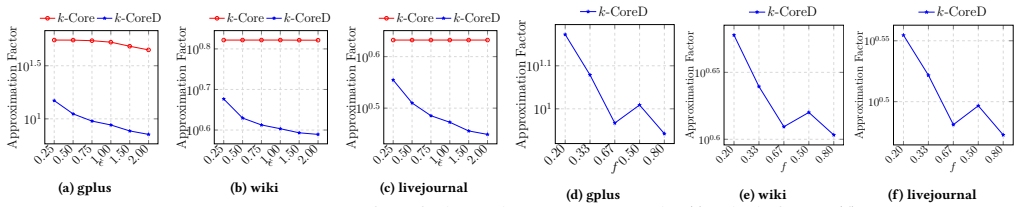
The central claim is that input-dependent private graph properties can replace the edge count as the driver of error in LEDP graph statistics. $\textsc{k-CoreD}$ achieves this by having each node draw symmetric geometric noise once to form a noisy degree, derive a maximum level threshold from that noisy degree, and then climb a level data structure only while its noisy count of same-level neighbors exceeds the current level threshold; two bias terms counter the one-sided effects of geometric noise, and the noise added at each level is scaled by the node's threshold. $\textsc{EdgeOrient}\Delta$ inherits the resulting low out-degree ordering, publishes a randomized-response version of every adjacency list, releases a noisy maximum out-degree, and counts triangles through outgoing edges with Laplace noise scaled by that maximum. The paper proves a $(2+\eta, O(\log(D_{\max}) \log^2 n / \varepsilon))$-approximation for core numbers and a $(1+\eta, O(\sqrt{n d} \log^3 n / \varepsilon^2 + \sqrt{\overrightarrow{C_4}}))$-approximation for triangle counts, both with high probability, where $d$ is the degeneracy and $\overrightarrow{C_4}$ counts oriented 4-cycles. It further reports empirical average $k$-core approximation factors near 3, triangle relative errors near $10^{-2}$, and successful runs on graphs with over a billion edges.
Load-bearing premise
The triangle-counting privacy proof assumes that for each differing edge the combined privacy loss of both endpoints is at most the sum of the four component $\varepsilon/4$ budgets rather than a larger sum that counts both endpoints' triangle-count randomizers separately; if that per-edge accounting fails, the algorithm is not proven $\varepsilon$-LEDP.
Editorial extensions
If this is right
- On graphs where the maximum degree is far smaller than the number of vertices, $k$-core estimates inherit far less noise than the earlier $\log^3(n)/\varepsilon$ bound, and the algorithm needs only $O(\log n \log D_{\max})$ communication rounds.
- The low out-degree ordering reduces triangle-count error from terms like $n^{3/2}/\varepsilon^2$ to terms like $\sqrt{n d} \log^3 n / \varepsilon^2$, an improvement of roughly $\sqrt{n}$ on bounded-degeneracy graphs.
- Because every node perturbs its own adjacency list before any central party sees it, both algorithms fit decentralized and federated deployments where no trusted curator exists.
- The distributed-simulation experiments indicate that these LEDP algorithms complete within practical time on graphs with over a billion edges, whereas the randomized-response baselines run out of memory or time out on large graphs.
Reading between the lines
- Extension: the same recipe---a private low out-degree ordering followed by local counts restricted to outgoing neighbors---should transfer to other local subgraph patterns (wedges, small cliques, stars), with variance controlled by the number of oriented copies of a slightly larger pattern, just as triangles are controlled by oriented 4-cycles.
- Extension: since the $k$-core bound is driven by $\log D_{\max}$, a graph with a handful of enormous hubs but small degeneracy could still pay a large noise price; testing a variant that truncates or per-node clips the threshold would reveal whether the bound is tight for such skewed graphs.
- Extension: a formal per-edge privacy-accounting lemma---tracking each differing edge's total privacy loss across both endpoints---would make the triangle algorithm's composition argument fully explicit and clarify how the budget split ports to other LEDP definitions.
Editorial analysis
A structured set of objections, weighed in public.
Referee Report
Summary. The manuscript introduces two local edge differentially private (LEDP) graph algorithms: k-CoreD, a k-core decomposition algorithm whose utility bounds depend on the maximum degree, and EdgeOrientΔ, a triangle-counting algorithm that uses a private low out-degree ordering plus randomized response. The paper claims that k-CoreD returns (2+η, O(log(D_max) log^2 n / ε))-approximate core numbers in O(log n log D_max) rounds, and that EdgeOrientΔ returns a (1+η, O(√(n d) log^3 n / ε^2 + √(C4^→)))-approximation of the true triangle count. It also reports the first evaluation of LEDP graph algorithms in a simulated distributed environment, with experiments on graphs up to billion-edge scale for k-core and up to dblp-scale for triangle counting.
Significance. If the proofs are repaired, the paper would be a substantial advance: it replaces purely randomized-response LEDP graph algorithms with input-dependent private mechanisms, improves the theoretical dependence from the number of edges to the maximum degree or degeneracy, and provides a reusable distributed simulation framework with an open-source artifact. The empirical accuracy gains over prior LEDP implementations are large and, for k-core, the method is demonstrated on billion-edge graphs. However, the central privacy proof for triangle counting has a composition gap under the paper's own Definition 2.4, and the k-core analysis does not match the pseudocode's threshold computation. These issues must be resolved before the theoretical guarantees can be accepted.
major comments (3)
- [§4.2, Lemma 4.2 and Definition 2.4] The privacy proof for EdgeOrientΔ is not valid under the paper's Definition 2.4. For a fixed edge {u,v}, the sum of the nominal privacy parameters of the local randomizers called by both endpoints is ε/4 (from k-CoreD) plus 2·(ε/4) for the RR round, 2·(ε/4) for the max-out-degree round, and 2·(ε/4) for the triangle-count round, totaling 7ε/4, not ε. The statement that a differing edge 'affects at most one node's out-degree' is a per-edge sensitivity observation, but Definition 2.4 does not allow excluding the other endpoint's local randomizers from the sum. The proof therefore does not establish that EdgeOrientΔ is ε-LEDP. A correct argument requires either a formal per-edge privacy-loss accounting that justifies dropping unaffected randomizers, or a revision of Definition 2.4 and the composition argument.
- [§3.1–3.2, Algorithm 3.2 vs. Lemma 3.4] The threshold computation in Algorithm 3.2 uses ⌈log_2(e_d_v)⌉·L, while Lemma 3.4's proof assumes the threshold is computed with log_{1+η/5}(e_d_u) and equates the resulting level with (1+η/5)^{⌊r/(2 log n)⌋}. With the stated L = ⌈log n⌉/4 and the paper's value η = 3.625, these expressions are not compatible: the level reached from a base-2 threshold is not the level implied by the invariant's base-(1+η/5) degree bound. Since the approximation guarantee of Theorem 3.6 rests on Invariants 1 and 2, the analysis and pseudocode must be reconciled, or a corrected derivation that accommodates the actual base-2 threshold must be supplied.
- [§4.2, Algorithm 4.2 and §5.2] The claim that the LEDP implementations 'scale to billion-edge graphs' is not supported for EdgeOrientΔ. Section 4.2 states that the RR phase publishes noisy edges for the entire upper-triangular matrix, requiring O(n^2) communication and memory, and the triangle-counting experiments in Figure 10 stop at dblp (≈317k vertices, ≈1M edges), not at billion-edge graphs. The billion-edge experiments are shown only for k-CoreD. The paper should either qualify the scalability claim to k-CoreD or explain how the quadratic RR phase is avoided at billion-edge scale.
minor comments (4)
- [§2, Definition 2.9] The density given for Lap(b) is written as 2b·exp(−|X|·b), which is not a probability density as stated; it should be (b/2)·exp(−|X|·b) (or the parameter should be defined as a scale). This makes the Laplace noise scale used in Algorithm 4.4 harder to verify.
- [§5, Parameters] The split fraction f = 0.8 and bias term b = 8 are chosen on the evaluation datasets. Since these parameters do not affect the privacy guarantee, this is not a privacy flaw, but the paper should state whether they were tuned on the test graphs and, if so, acknowledge that the reported accuracy numbers reflect that tuning.
- [§4.2 and §5.2] The notation e𝑂(·) is used without definition; please define it at first use. Also, the sentence 'Such use cases were unnecessarily in [27,44]' appears to contain a typo and should be rephrased.
- [§3.1, Algorithm 3.3] The threshold in Algorithm 3.3 is written as (1+η/5)F(r), which reads as a linear factor, while the invariants and Lemma 3.5 appear to require an exponential threshold (1+η/5)^{F(r)}. Please ensure the superscript formatting is correct and that the pseudocode matches the analysis.
Circularity Check
No circular reduction: k-CoreD and EdgeOrientΔ derive their guarantees from the LEDP definition, prior published baselines, and internal variance/expectation calculations; the apparent Lemma 4.2 privacy composition issue is a correctness gap, not circularity.
full rationale
Walking the derivation chain, no claimed output is equal by construction to an input and no fitted parameter is renamed as a prediction. For k-CoreD, Theorem 3.3 directly instantiates Definition 2.4: degree thresholding is a (ε1/2)-LR, the scaled geometric level-moving noise is (ε2/(2t_v))-LR per round and composes over t_v rounds to ε2/2, and the proof explicitly sums both endpoints' contributions to obtain ε1+ε2=ε. The approximation result imports Invariant 1, Invariant 2, and Theorem 4.1 from Dhulipala et al. (FOCS 2022). Although that paper shares authors with this one, it is a published external result with its own derivation, so this is legitimate support rather than a self-citation loop. EdgeOrientΔ's Lemmas 4.3-4.6 and Theorem 4.7 follow from the k-CoreD ordering guarantee, standard randomized-response debiasing, and a Law-of-Total-Expectation/Variance computation; none of these steps assumes the triangle bound being proved. The experimental choices f=0.8 and b=8 are hyperparameters tuned on the evaluation graphs, which is a generalizability caveat but not a fitted input called a prediction. I flag two non-circular issues: Lemma 4.2's composition may need a per-edge sensitivity argument beyond the literal Definition 2.4 sum over both endpoints' local randomizers, and Lemma 4.3 references a supplementary 'Theorem 3.4' not present in the text; both are correctness/presentation concerns, not circularity, and do not change the score. Thus the paper is self-contained against external published benchmarks and receives 0.
Assumptions & free parameters
free parameters (3)
- bias term b =
8
- privacy split fraction f =
0.8
- approximation constant (2+eta) =
5.625
assumptions (5)
- domain assumption Local edge differential privacy model with honest-but-curious curator and nodes (Definition 2.4)
- standard math Invariants 1 and 2 and Theorem 4.1 from Dhulipala et al. [19]
- domain assumption Bounded degeneracy of real-world graphs (d=O(1))
- standard math Unbiasedness of the randomized response estimator after correction
- standard math Laplace and geometric mechanism privacy from standard DP tools
Cite this review
Pith. "Pith review of Practical and Accurate Local Edge Differentially Private Graph Algorithms." pith.science (2026). https://pith.science/paper/N3XUFSRM
@misc{pith2026250620828,
  author       = {Pith},
  title        = {Pith review of: Practical and Accurate Local Edge Differentially Private Graph Algorithms},
  year         = {2026},
  howpublished = {\url{https://pith.science/paper/N3XUFSRM}},
  note         = {Machine review of arXiv:2506.20828}
}
read the original abstract
The rise of massive networks across diverse domains necessitates sophisticated graph analytics, often involving sensitive data and raising privacy concerns. This paper addresses these challenges using local differential privacy (LDP), which enforces privacy at the individual level, where no third-party entity is trusted, unlike centralized models that assume a trusted curator. We introduce novel LDP algorithms for two fundamental graph statistics: k-core decomposition and triangle counting. Our approach leverages input-dependent private graph properties, specifically the degeneracy and maximum degree of the graph, to improve theoretical utility. Unlike prior methods, our error bounds are determined by the maximum degree rather than the total number of edges, resulting in significantly tighter guarantees. For triangle counting, we improve upon the work of Imola, Murakami, and Chaudhury [USENIX Security `21, `22], which bounds error in terms of edge count. Instead, our algorithm achieves bounds based on graph degeneracy by leveraging a private out-degree orientation, a refined variant of Eden et al.'s randomized response technique [ICALP `23], and a novel analysis, yielding stronger guarantees than prior work. Beyond theoretical gains, we are the first to evaluate local DP algorithms in a distributed simulation, unlike prior work tested on a single processor. Experiments on real-world graphs show substantial accuracy gains: our k-core decomposition achieves errors within 3x of exact values, far outperforming the 131x error in the baseline of Dhulipala et al. [FOCS `22]. Our triangle counting algorithm reduces multiplicative approximation errors by up to six orders of magnitude, while maintaining competitive runtime.
Figures


Figures from the paper (8 more)




Reference graph
Works this paper leans on
-
[1]
DistributedLEDPGraphAlgos
2024. DistributedLEDPGraphAlgos. https://github.com/mundrapranay/ DistributedLEDPGraphAlgos
2024
-
[2]
John M Abowd, Robert Ashmead, Ryan Cumings-Menon, Simson Garfinkel, Micah Heineck, Christine Heiss, Robert Johns, Daniel Kifer, Philip Leclerc, Ashwin Machanavajjhala, et al. 2022. The 2020 census disclosure avoidance system topdown algorithm. Harvard Data Science Review 2 (2022)
2022
-
[3]
Jun Ai, Yayun Liu, Zhan Su, Fengyu Zhao, and Dunlu Peng. 2021. K-core decomposition in recommender systems improves accuracy of rating prediction. International Journal of Modern Physics C 32, 07 (2021), 2150087. https://doi. org/10.1142/S012918312150087X
-
[4]
Mohammad Al Hasan and Vachik S Dave. 2018. Triangle counting in large networks: a review. Wiley Interdisciplinary Reviews: Data Mining and Knowledge Discovery 8, 2 (2018), e1226
2018
-
[5]
Noga Alon, Raphael Yuster, and Uri Zwick. 1997. Finding and counting given length cycles. Algorithmica 17, 3 (1997), 209–223
1997
-
[6]
Victor Balcer and Salil P. Vadhan. 2018. Differential Privacy on Finite Computers. In 9th Innovations in Theoretical Computer Science Conference (ITCS). 43:1–43:21
2018
-
[7]
Bradley R Bebee, Daniel Choi, Ankit Gupta, Andi Gutmans, Ankesh Khandelwal, Yigit Kiran, Sainath Mallidi, Bruce McGaughy, Mike Personick, Karthik Rajan, et al. 2018. Amazon Neptune: Graph Data Management in the Cloud.. In ISWC (P&D/Industry/BlueSky). 15
2018
-
[8]
Arijit Bishnu, Debarshi Chanda, and Gopinath Mishra. 2025. Arboricity and Random Edge Queries Matter for Triangle Counting using Sublinear Queries. arXiv:2502.15379 [cs.DS] https://arxiv.org/abs/2502.15379
arXiv 2025
Show all 109 references
- [9]
-
[10]
Francesco Bonchi, Aristides Gionis, and Francesco Gullo. 2014. Core decompo- sition of uncertain graphs. In Proceedings of the 20th ACM SIGKDD International Conference on Knowledge Discovery and Data Mining . 1316–1325
2014
-
[11]
Felipe T Brito, Victor AE Farias, Cheryl Flynn, Subhabrata Majumdar, Javam C Machado, and Divesh Srivastava. 2023. Global and local differentially private release of count-weighted graphs. Proceedings of the ACM on Management of Data 1, 2 (2023), 1–25
2023
-
[12]
Mark Bun and Thomas Steinke. 2016. Concentrated Differential Privacy: Simpli- fications, Extensions, and Lower Bounds. In International Conference on Theory of Cryptography. 635–658
2016
-
[13]
Hubert Chan, Elaine Shi, and Dawn Song
T.-H. Hubert Chan, Elaine Shi, and Dawn Song. 2011. Private and Continual Release of Statistics. ACM Trans. Inf. Syst. Secur. 14, 3, Article 26 (Nov. 2011), 24 pages. https://doi.org/10.1145/2043621.2043626
2011
-
[14]
Ho-Chun Herbert Chang and Emilio Ferrara. 2022. Comparative analysis of so- cial bots and humans during the COVID-19 pandemic.Journal of Computational Social Science 5, 2 (2022), 1409–1425
2022
-
[15]
Martino Ciaperoni, Edoardo Galimberti, Francesco Bonchi, Ciro Cattuto, Francesco Gullo, and Alain Barrat. 2020. Relevance of temporal cores for epidemic spread in temporal networks. Scientific reports 10, 1 (2020), 12529
2020
-
[16]
Camil Demetrescu, Andrew V Goldberg, David S Johnson, et al. 2008. Imple- mentation challenge for shortest paths. In Encyclopedia of Algorithms. Springer US, 395–398
2008
-
[17]
Blelloch, and Julian Shun
Laxman Dhulipala, Guy E. Blelloch, and Julian Shun. 2017. Julienne: A Frame- work for Parallel Graph Algorithms Using Work-efficient Bucketing. In ACM Symposium on Parallelism in Algorithms and Architectures (SPAA) . 293–304
2017
-
[18]
Li, and Quanquan C
Laxman Dhulipala, George Z. Li, and Quanquan C. Liu. 2024. Near-Optimal Differentially Private k-Core Decomposition. arXiv:2312.07706 [cs.DS] https: //arxiv.org/abs/2312.07706
2024 arXiv
-
[19]
Liu, Sofya Raskhodnikova, Jessica Shi, Julian Shun, and Shangdi Yu
Laxman Dhulipala, Quanquan C. Liu, Sofya Raskhodnikova, Jessica Shi, Julian Shun, and Shangdi Yu. 2022. Differential Privacy from Locally Adjustable Graph Algorithms: k-Core Decomposition, Low Out-Degree Ordering, and Densest Subgraphs. In 63rd IEEE Annual Symposium on Foundat...
2022
-
[20]
Michael Dinitz, Satyen Kale, Silvio Lattanzi, and Sergei Vassilvitskii
-
[21]
Donovan and Brian W
Alan A.A. Donovan and Brian W. Kernighan. 2015. The Go Programming Language (1st ed.). Addison-Wesley Professional
2015
-
[22]
Cynthia Dwork and Jing Lei. 2009. Differential Privacy and Robust Statistics. In Proceedings of the Forty-First Annual ACM Symposium on Theory of Computing . 371–380
2009
-
[23]
Cynthia Dwork, Frank McSherry, Kobbi Nissim, and Adam Smith. 2006. Cali- brating Noise to Sensitivity in Private Data Analysis. In Proceedings of the Third Conference on Theory of Cryptography . 265–284
2006
-
[24]
Rothblum
Cynthia Dwork, Moni Naor, Toniann Pitassi, and Guy N. Rothblum. 2010. Differ- ential Privacy under Continual Observation. In Proceedings of the Forty-Second ACM Symposium on Theory of Computing . 715–724
2010
-
[25]
Rothblum, and Salil Vadhan
Cynthia Dwork, Guy N. Rothblum, and Salil Vadhan. 2010. Boosting and Differ- ential Privacy. In Proceedings of the IEEE 51st Annual Symposium on Foundations of Computer Science. 51–60
2010
-
[26]
Liu, Sofya Raskhodnikova, and Adam Smith
Talya Eden, Quanquan C. Liu, Sofya Raskhodnikova, and Adam Smith. 2023. Triangle Counting with Local Edge Differential Privacy. In 50th International Colloquium on Automata, Languages, and Programming (ICALP 2023) (Leibniz International Proceedings in Informatics (LIPIcs), Vol...
2023 doi
-
[27]
Liu, Sofya Raskhodnikova, and Adam D
Talya Eden, Quanquan C. Liu, Sofya Raskhodnikova, and Adam D. Smith. 2023. Triangle Counting with Local Edge Differential Privacy. In 50th International Colloquium on Automata, Languages, and Programming, ICALP 2023, July 10-14, 2023, Paderborn, Germany (LIPIcs, Vol. 261) , Ko...
2023 doi
-
[28]
Alexandre Evfimievski, Johannes Gehrke, and Ramakrishnan Srikant. 2003. Limiting privacy breaches in privacy preserving data mining. In Proceedings of the twenty-second ACM SIGMOD-SIGACT-SIGART symposium on Principles of database systems. 211–222
2003
-
[29]
Alireza Farhadi, MohammadTaghi Hajiaghayi, and Elaine Shi. 2021. Differ- entially Private Densest Subgraph. CoRR abs/2106.00508 (2021), 11581–11597. arXiv:2106.00508 https://arxiv.org/abs/2106.00508
2021 arXiv
-
[30]
Victor AE Farias, Felipe T Brito, Cheryl Flynn, Javam C Machado, Subhabrata Majumdar, and Divesh Srivastava. 2020. Local dampening: Differential privacy for non-numeric queries via local sensitivity. arXiv preprint arXiv:2012.04117 (2020)
2020 arXiv
-
[31]
Nan Fu, Weiwei Ni, Sen Zhang, Lihe Hou, and Dongyue Zhang. 2023. GC- NLDP: A graph clustering algorithm with local differential privacy. Computers & Security 124 (2023), 102967
2023
-
[32]
Kayo Fujimoto, Dimitrios Paraskevis, Jacky C Kuo, Camden J Hallmark, Jing Zhao, Andre Hochi, Lisa M Kuhns, Lu-Yu Hwang, Angelos Hatzakis, and John A Schneider. 2022. Integrated molecular and affiliation network analysis: Core- periphery social clustering is associated with HIV...
2022
-
[33]
Christos Giatsidis, Fragkiskos D Malliaros, Nikolaos Tziortziotis, Charanpal Dhanjal, Emmanouil Kiagias, Dimitrios M Thilikos, and Michalis Vazirgiannis
-
[34]
Taolin Guo, Shunshun Peng, Yong Li, Mingliang Zhou, and Trieu-Kien Truong
-
[35]
Yang Guo, Fatemeh Esfahani, Xiaojian Shao, Venkatesh Srinivasan, Alex Thomo, Li Xing, and Xuekui Zhang. 2022. Integrative COVID-19 biological network inference with probabilistic core decomposition. Briefings in Bioinformatics 23, 1 (2022), bbab455
2022
-
[36]
Jonathan Hehir, Aleksandra Slavković, and Xiaoyue Niu. 2022. Consistent spectral clustering of network block models under local differential privacy. The Journal of privacy and confidentiality 12, 2 (2022)
2022
- [37]
-
[38]
Seira Hidano and Takao Murakami. 2022. Degree-preserving randomized re- sponse for graph neural networks under local differential privacy.arXiv preprint arXiv:2202.10209 (2022)
2022 arXiv
-
[39]
Quentin Hillebrand, Vorapong Suppakitpaisarn, and Tetsuo Shibuya. 2023. Com- munication Cost Reduction for Subgraph Counting under Local Differential Privacy via Hash Functions. arXiv preprint arXiv:2312.07055 (2023)
2023 arXiv
-
[40]
Quentin Hillebrand, Vorapong Suppakitpaisarn, and Tetsuo Shibuya. 2023. Un- biased locally private estimator for polynomials of laplacian variables. In Pro- ceedings of the 29th ACM SIGKDD Conference on Knowledge Discovery and Data Mining. 741–751
2023
-
[41]
Petter Holme and Nelly Litvak. 2017. Cost-efficient vaccination protocols for network epidemiology. PLoS computational biology 13, 9 (2017), e1005696
2017
-
[42]
Jacob Imola, Alessandro Epasto, Mohammad Mahdian, Vincent Cohen-Addad, and Vahab Mirrokni. 2023. Differentially private hierarchical clustering with provable approximation guarantees. In International Conference on Machine Learning. PMLR, 14353–14375
2023
-
[43]
Jacob Imola, Takao Murakami, and Kamalika Chaudhuri. 2021. Locally Differen- tially Private Analysis of Graph Statistics. In 30th USENIX Security Symposium . 983–1000
2021
-
[44]
Jacob Imola, Takao Murakami, and Kamalika Chaudhuri. 2022. Communication- Efficient Triangle Counting under Local Differential Privacy. In 31st USENIX Security Symposium. 537–554
2022
-
[45]
Linyu Jiang, Yukun Yan, Zhihong Tian, Zuobin Xiong, and Qilong Han. 2023. Personalized sampling graph collection with local differential privacy for link prediction. World Wide Web 26, 5 (2023), 2669–2689
2023
-
[46]
Shiva Prasad Kasiviswanathan, Homin K Lee, Kobbi Nissim, Sofya Raskhod- nikova, and Adam Smith. 2011. What can we learn privately? SIAM J. Comput. 40, 3 (2011), 793–826
2011
-
[47]
Schaefer
Muah Kim, Onur Günlü, and Rafael F. Schaefer. 2021. Federated Learning with Local Differential Privacy: Trade-Offs Between Privacy, Utility, and Com- munication. In ICASSP 2021 - 2021 IEEE International Conference on Acoustics, Speech and Signal Processing (ICASSP) . 2650–2654...
2021
-
[48]
Gallos, Shlomo Havlin, Fredrik Liljeros, Lev Muchnik, H
Maksim Kitsak, Lazaros K. Gallos, Shlomo Havlin, Fredrik Liljeros, Lev Muchnik, H. Eugene Stanley, and Hernán A. Makse. 2010. Identification of influential spreaders in complex networks. Nature Physics 6, 11 (Nov. 2010), 888–893. https://doi.org/10.1038/nphys1746
2010 doi
-
[49]
Tejas Kulkarni. 2019. Answering Range Queries Under Local Differential Privacy. In Proceedings of the 2019 International Conference on Management of Data (Amsterdam, Netherlands)(SIGMOD ’19). Association for Computing Machinery, New York, NY, USA, 1832–1834. https://doi.org/10...
2019
-
[50]
Haewoon Kwak, Changhyun Lee, Hosung Park, and Sue Moon. 2010. What is Twitter, a Social Network or a News Media?. In www. 591–600
2010
-
[51]
Jure Leskovec and Andrej Krevl. 2014. SNAP Datasets: Stanford Large Network Dataset Collection. (2014)
2014
-
[52]
Xiaoguang Li, Ninghui Li, Wenhai Sun, Neil Zhenqiang Gong, and Hui Li. 2023. Fine-grained poisoning attack to local differential privacy protocols for mean and variance estimation. In 32nd USENIX Security Symposium (USENIX Security 16 23). 1739–1756
2023
-
[53]
Wanyu Lin, Baochun Li, and Cong Wang. 2022. Towards private learning on decentralized graphs with local differential privacy. IEEE Transactions on Information Forensics and Security 17 (2022), 2936–2946
2022
-
[54]
Fang Liu, Dong Wang, and Tian Yan. 2023. Some examples of privacy-preserving sharing of COVID-19 pandemic data with statistical utility evaluation. BMC Medical Research Methodology 23, 1 (2023), 120
2023
-
[55]
Liu, Jessica Shi, Shangdi Yu, Laxman Dhulipala, and Julian Shun
Quanquan C. Liu, Jessica Shi, Shangdi Yu, Laxman Dhulipala, and Julian Shun
-
[56]
Shang Liu, Yang Cao, Takao Murakami, Jinfei Liu, and Masatoshi Yoshikawa
-
[57]
Shang Liu, Yang Cao, Takao Murakami, and Masatoshi Yoshikawa. 2022. A crypto-assisted approach for publishing graph statistics with node local dif- ferential privacy. In 2022 IEEE International Conference on Big Data (Big Data) . IEEE, 5765–5774
2022
-
[58]
Yuhan Liu, Tianhao Wang, Yixuan Liu, Hong Chen, and Cuiping Li. 2024. Edge- Protected Triangle Count Estimation under Relationship Local Differential Privacy. IEEE Transactions on Knowledge and Data Engineering (2024)
2024
-
[59]
Yuhan Liu, Suyun Zhao, Yixuan Liu, Dan Zhao, Hong Chen, and Cuiping Li
-
[60]
Zheng, Zhou Zhao, Hongxia Yang, Kevin Chen-Chuan Chang, Minghui Wu, and Jing Ying
Zemin Liu, Vincent W. Zheng, Zhou Zhao, Hongxia Yang, Kevin Chen-Chuan Chang, Minghui Wu, and Jing Ying. 2018. Subgraph-Augmented Path Embed- ding for Semantic User Search on Heterogeneous Social Network. InProceedings of the 2018 World Wide Web Conference(Lyon, France) (WWW ’...
2018
-
[61]
arXiv preprint arXiv:2312.12938 (2023)
CARGO: Crypto-Assisted Differentially Private Triangle Counting with- out Trusted Servers. arXiv preprint arXiv:2312.12938 (2023)
2023 arXiv
-
[62]
Naoki Masuda, Michiko Sakaki, Takahiro Ezaki, and Takamitsu Watanabe. 2018. Clustering Coefficients for Correlation Networks. Frontiers in Neuroinformatics 12 (2018). https://doi.org/10.3389/fninf.2018.00007
2018
-
[63]
Gang Mei, Jingzhi Tu, Lei Xiao, and Francesco Piccialli. 2021. An efficient graph clustering algorithm by exploiting k-core decomposition and motifs. Computers & Electrical Engineering 96 (2021), 107564. https://doi.org/10.1016/j. compeleceng.2021.107564
2021
-
[64]
Tamara T Mueller, Dmitrii Usynin, Johannes C Paetzold, Daniel Rueckert, and Georgios Kaissis. 2022. SoK: Differential privacy on graph-structured data. arXiv preprint arXiv:2203.09205 (2022)
2022 arXiv
-
[65]
In 2022 IEEE 38th International Conference on Data Engineering (ICDE)
Collecting triangle counts with edge relationship local differential privacy. In 2022 IEEE 38th International Conference on Data Engineering (ICDE) . IEEE, 2008–2020
2022
-
[66]
Mohammad Naseri, Jamie Hayes, and Emiliano De Cristofaro. 2022. Local and Central Differential Privacy for Robustness and Privacy in Federated Learning. In 29th Annual Network and Distributed System Security Symposium, NDSS 2022, San Diego, California, USA, April 24-28, 2022 ....
2022
-
[67]
Pathum Chamikara Mahawaga Arachchige, Dongxi Liu, Seyit Camtepe, Surya Nepal, Marthie Grobler, Peter Bertok, and Ibrahim Khalil. 2022. Local Differential Privacy for Federated Learning. InEuropean Symposium on Research in Computer Security. Springer, 195–216
2022
-
[68]
Dung Nguyen, Mahantesh Halappanavar, Venkatesh Srinivasan, and Anil Vul- likanti. 2024. Faster approximate subgraph counts with privacy. Advances in Neural Information Processing Systems 36 (2024)
2024
-
[69]
Kobbi Nissim, Sofya Raskhodnikova, and Adam Smith. 2007. Smooth Sensitivity and Sampling in Private Data Analysis. InProceedings of the Thirty-Ninth Annual ACM Symposium on Theory of Computing . 75–84
2007
-
[70]
Gergely Palla, Imre Derényi, Illés Farkas, and Tamás Vicsek. 2005. Uncovering the overlapping community structure of complex networks in nature and society. Nature 435, 7043 (2005), 814–818
2005
-
[71]
Takao Murakami and Yuichi Sei. 2023. Automatic Tuning of Privacy Budgets in Input-Discriminative Local Differential Privacy. IEEE Internet of Things Journal (2023)
2023
-
[72]
Lei Qin, Yidan Wang, Qiang Sun, Xiaomei Zhang, Ben-Chang Shia, Chengcheng Liu, et al. 2020. Analysis of the covid-19 epidemic transmission network in mainland china: K-core decomposition study.JMIR public health and surveillance 6, 4 (2020), e24291
2020
-
[73]
Neo4j. 2012. Neo4j - The World’s Leading Graph Database. http://neo4j.org/
2012
-
[74]
Ryan Rossi and Nesreen Ahmed. 2015. The network data repository with inter- active graph analytics and visualization. In Proceedings of the AAAI conference on artificial intelligence, Vol. 29
2015
-
[75]
Edo Roth, Karan Newatia, Yiping Ma, Ke Zhong, Sebastian Angel, and Andreas Haeberlen. 2021. Mycelium: Large-scale distributed graph queries with differ- ential privacy. In Proceedings of the ACM SIGOPS 28th Symposium on Operating Systems Principles. 327–343
2021
-
[76]
Higor S Monteiro, Shaojun Luo, Saulo DS Reis, Carles Igual, Antonio S Lima Neto, Matias Travizan, Jose Soares De Andrade Jr, Hernan Makse, et al
-
[77]
Arnau Prat-Pérez, David Dominguez-Sal, Josep M Brunat, and Josep-Lluis Larriba-Pey. 2012. Shaping communities out of triangles. In Proceedings of the ACM international Conference on Information and Knowledge Management . 1677–1681
2012
-
[78]
Mohamed Seif, Dung Nguyen, Anil Vullikanti, and Ravi Tandon. 2022. Differen- tially private community detection for stochastic block models. arXiv preprint arXiv:2202.00636 (2022)
2022 arXiv
-
[79]
Zhan Qin, Ting Yu, Yin Yang, Issa Khalil, Xiaokui Xiao, and Kui Ren. 2017. Gen- erating Synthetic Decentralized Social Graphs with Local Differential Privacy. In Proceedings of the 2017 ACM SIGSAC Conference on Computer and Communi- cations Security (Dallas, Texas, USA) (CCS ’...
2017
-
[80]
Matteo Serafino, Higor S Monteiro, Shaojun Luo, Saulo DS Reis, Carles Igual, Antonio S Lima Neto, Matías Travizano, José S Andrade Jr, and Hernán A Makse
-
[81]
Hubert Chan, Eleanor Gilbert Rieffel, Richard Chow, and Dawn Song
Elaine Shi, T.-H. Hubert Chan, Eleanor Gilbert Rieffel, Richard Chow, and Dawn Song. 2011. Privacy-Preserving Aggregation of Time-Series Data. InProceedings of the Network and Distributed System Security Symposium
2011
-
[82]
Tsourakakis
Konstantinos Sotiropoulos and Charalampos E. Tsourakakis. 2021. Triangle- Aware Spectral Sparsifiers and Community Detection. In Proceedings of the 27th ACM SIGKDD Conference on Knowledge Discovery & Data Mining (Virtual Event, Singapore) (KDD ’21). Association for Computing M...
2021
-
[83]
Sriganesh Srihari and Hon Leong. 2013. A survey of computational methods for protein complex prediction from protein interaction networks. Journal of bioinformatics and computational biology 11 (04 2013), 1230002. https://doi.org/ 10.1142/S021972001230002X
2013 doi
-
[84]
Stephen B Seidman. 1983. Network structure and minimum degree. Social networks 5, 3 (1983), 269–287
1983
-
[85]
Marco Sánchez-Aguayo, Luis Urquiza-Aguiar, and José Estrada-Jiménez. 2021. Fraud Detection Using the Fraud Triangle Theory and Data Mining Tech- niques: A Literature Review. Computers 10, 10 (2021). https://doi.org/10. 3390/computers10100121
2021
-
[86]
Monteiro, Shaojun Luo, and Hernán A
Matteo Serafino, Higor S. Monteiro, Shaojun Luo, and Hernán A. Makse. 2020. Project COVID19 K-core tracker . https://github.com/makselab/COVID19
2020
-
[87]
Google Differential Privacy Team. [n. d.]. GitHub - google/differential-privacy: Google’s differential privacy libraries. — github.com. https://github.com/google/ differential-privacy. [Accessed 12-04-2024]
2024
-
[88]
PLOS Computational Biology 18, 4 (2022), e1009865
Digital contact tracing and network theory to stop the spread of COVID- 19 using big-data on human mobility geolocalization. PLOS Computational Biology 18, 4 (2022), e1009865
2022
-
[89]
Tom Tseng, Laxman Dhulipala, and Julian Shun. 2021. Parallel index-based structural graph clustering and its approximation. In Proceedings of the Interna- tional Conference on Management of Data . 1851–1864
2021
-
[90]
Songlei Wang, Yifeng Zheng, Xiaohua Jia, Qian Wang, and Cong Wang. 2023. MAGO: Maliciously Secure Subgraph Counting on Decentralized Social Graphs. IEEE Transactions on Information Forensics and Security (2023)
2023
-
[91]
Tianhao Wang, Bolin Ding, Jingren Zhou, Cheng Hong, Zhicong Huang, Ninghui Li, and Somesh Jha. 2019. Answering Multi-Dimensional Analyti- cal Queries under Local Differential Privacy. In Proceedings of the 2019 Inter- national Conference on Management of Data (Amsterdam, Nethe...
2019
-
[92]
Haipei Sun, Xiaokui Xiao, Issa Khalil, Yin Yang, Zhan Qin, Hui Wang, and Ting Yu. 2019. Analyzing subgraph statistics from extended local views with decen- tralized differential privacy. In Proceedings of the 2019 ACM SIGSAC conference on computer and communications security . 703–717
2019
-
[93]
Zhuo Wang, Zhixiong Li, Jinxing Tu, and Jianqiang Huang. 2025. DYTC:Dynamic Graph Triangle Counting on GPU. In Proceedings of the 2024 8th International Conference on Algorithms, Computing and Systems (ICACS ’24) . Association for Computing Machinery, New York, NY, USA, 83–87....
2025
-
[94]
Differential Privacy Team. 2017. Learning with Privacy at Scale — machinelearn- ing.apple.com. https://machinelearning.apple.com/research/learning-with- privacy-at-scale. [Accessed 10-04-2024]
2017
-
[95]
Zihang Xiang, Tianhao Wang, and Di Wang. 2023. Preserving Node-level Privacy in Graph Neural Networks. arXiv preprint arXiv:2311.06888 (2023)
2023
-
[96]
Emre Gursoy
Ekin Tire and M. Emre Gursoy. 2024. Answering Spatial Density Queries Under Local Differential Privacy. IEEE Internet of Things Journal 11, 10 (2024), 17419–17436. https://doi.org/10.1109/JIOT.2024.3357570
2024
-
[97]
Qingqing Ye, Haibo Hu, Man Ho Au, Xiaofeng Meng, and Xiaokui Xiao. 2020. Towards locally differentially private generic graph metric estimation. In 2020 IEEE 36th International Conference on Data Engineering (ICDE). IEEE, 1922–1925
2020
-
[98]
Wei Zeng, An Zeng, Hao Liu, Ming-Sheng Shang, and Tao Zhou. 2014. Uncov- ering the information core in recommender systems. Scientific reports 4 (August 2014), 6140. https://doi.org/10.1038/srep06140
2014 doi
-
[99]
Da Zhong, Ruotong Yu, Kun Wu, Xiuling Wang, Jun Xu, and Wendy Hui Wang
-
[100]
Yanling Wang, Qian Wang, Lingchen Zhao, and Cong Wang. 2023. Differential privacy in deep learning: Privacy and beyond. Future Generation Computer Systems (2023)
2023
-
[102]
Stanley L Warner. 1965. Randomized response: A survey technique for elimi- nating evasive answer bias. J. Amer. Statist. Assoc. 60, 309 (1965), 63–69
1965
-
[104]
Qingqing Ye, Haibo Hu, Man Ho Au, Xiaofeng Meng, and Xiaokui Xiao. 2020. LF-GDPR: A framework for estimating graph metrics with local differential privacy. IEEE Transactions on Knowledge and Data Engineering 34, 10 (2020), 4905–4920. 17
2020
-
[108]
Proceedings on Privacy Enhancing Technologies (2023)
Disparate Vulnerability in Link Inference Attacks against Graph Neural Networks. Proceedings on Privacy Enhancing Technologies (2023)
2023
-
[109]
Xiaochen Zhu, Vincent YF Tan, and Xiaokui Xiao. 2023. Blink: Link Local Differential Privacy in Graph Neural Networks via Bayesian Estimation. In Pro- ceedings of the 2023 ACM SIGSAC Conference on Computer and Communications Security. 2651–2664. 18
2023
-
[2016]
arXiv preprint arXiv:1607.02096 (2016)
A k-core decomposition framework for graph clustering. arXiv preprint arXiv:1607.02096 (2016)
2016 arXiv
-
[2021]
Bulletin of the American Physical Society 66 (2021)
Superspreading k-cores at the center of Covid-19 pandemic persistence. Bulletin of the American Physical Society 66 (2021)
2021
-
[2022]
In 34th ACM Symposium on Parallelism in Algorithms and Architectures
Parallel Batch-Dynamic Algorithms for𝑘-Core Decomposition and Re- lated Graph Problems. In 34th ACM Symposium on Parallelism in Algorithms and Architectures. 191–204
-
[2023]
Information Sciences 639 (2023), 119002
Community-based social recommendation under local differential privacy protection. Information Sciences 639 (2023), 119002
2023
-
[2024]
arXiv:2308.10316 [cs.DS]
Almost Tight Bounds for Differentially Private Densest Subgraph. arXiv:2308.10316 [cs.DS]
Reviewed August 6, 2026 · model on record in the stance chip above.
Discussion (0). Continue with ORCID to comment.