REVIEW 4 major objections 6 minor 31 references
Physics Of Eclipsing Binaries. IX. Spectroscopic module
T0 review · 4 major / 6 minor · reviewed 2026-08-06 · deepseek-v4-flash
Pith's one-line read The Phoebe code can now model stellar spectra triangle-by-triangle, including self-consistent eclipses.
desk verdict A solid, honest code paper for a new Phoebe spectroscopic module, with a real new capability in per-triangle spectral integration, but it needs observed validation and a calibration check before I'd trust absolute fluxes. read the letter →
The pith
A machine-rendered reading of the paper's core claim, the machinery that carries it, and where it could break.
The reading
What carries the argument
The load-bearing machinery is the triangular surface mesh inherited from Phoebe, which follows the Roche potential. Each triangle carries local $T_{\rm eff}$, $\log g$, metallicity $Z$, surface area $S_i$, cosine angle $\cos\theta_i$, and a visibility fraction $f_i$. A synthetic spectrum is pulled from literature grids (resampled to 0.01 Å) and Doppler-shifted per the radial velocity of the triangle, then the normalized flux is $\Phi_\lambda = (1/L_{\rm tot})\sum_i I_{{\rm pass},i} S_i \cos\theta_i f_i I''_{\lambda,i}$, with analogous expressions for absolute SEDs. Limb darkening is applied analytically via user-supplied coefficients, and rotation and gravity darkening follow von Zeipel's law; the simplified mode applies rotational broadening with an FFT-based kernel. The interpolation engine Ndpolator handles non-uniform grids with nearest-neighbor extrapolation.
What would settle it
Compute a synthetic spectrum of a well-studied eclipsing binary with the integrate mode and compare it directly to an observed high-resolution spectrum taken mid-eclipse, where asymmetric line profiles test the surface integration; a separate check is to compare the SED near a grazing transit to a model that uses the full $\mu$-dependent intensity from the same synthetic grid, which would expose any limb-darkening mismatch.
Extended reading notes
Core claim
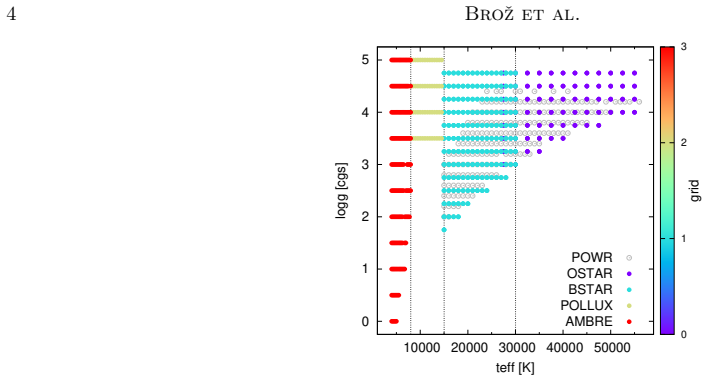
The central discovery is that a self-consistent spectroscopic model can be built on top of Phoebe's existing triangular-mesh description of stellar surfaces. For every visible triangle, a synthetic spectrum is interpolated from grids like PHOENIX, AMBRE, OSTAR, BSTAR, POLLUX, or POWR using local effective temperature, gravity, and metallicity; the spectrum is Doppler-shifted by the triangle's radial velocity; and the contributions are summed with limb-darkening and gravity-darkening weights. The same integration yields absolute fluxes (SEDs) when multiplied by surface area and divided by distance squared. The key result is that during an eclipse, the complex integrate model produces asymmetric line profiles from partially hidden surface regions, whereas a simplified per-component sum is wrong by factors up to 2. The approach extends to single stars, binaries, triples, and in principle to pulsating stars.
Load-bearing premise
The module assumes that the true limb darkening of each star is captured by a single analytical law with user-set coefficients, even though the synthetic spectra themselves encode a different limb darkening; if those coefficients are wrong or the law fits poorly, all absolute fluxes and any line profiles seen at high inclination or during eclipse will be systematically wrong.
Editorial extensions
If this is right
- Joint fitting of light curves, radial velocities, spectra, and SEDs within a single code will better constrain masses, radii, temperatures, and distances of binary components.
- Eclipse spectroscopy with the integrate mode can recover asymmetric line profiles that carry information about which parts of each star are hidden.
- The simplified mode is fast enough for parameter scans but must be replaced by the integrate mode at and near eclipse phases.
- The analytical limb-darkening approximation is presented as a workable compromise, since full $\\mu$-dependent grids would require four-dimensional data.
- The module opens a path to fitting pulsations spectroscopically by perturbing surface radial velocities.
Reading between the lines
- If the module were validated against observed spectra of an eclipsing binary, the main risk is the analytical limb-darkening assumption: any mismatch would show up as a systematic flux or line-profile error that scales with inclination and eclipse depth.
- One testable extension is to replace the analytical limb-darkening law with a precomputed function of local $\\mu$ derived from the same synthetic grids, which would remove the self-consistency gap at some memory cost.
- The same surface-integration machinery could in principle synthesize spectra of exoplanet transits or circumbinary disks, since the integration over visible elements is generic.
Editorial analysis
A structured set of objections, weighed in public.
Referee Report
Summary. This paper describes a spectroscopic module for the PHOEBE binary-modeling code. The module can produce normalized and absolute spectra of single stars, binaries, and multiples by summing synthetic spectra over the triangular surface meshes already used for light-curve and radial-velocity modeling. Two modes are implemented: a 'complex' integrate mode with per-triangle spectra (Eqs. 3–8) and a 'simplified' mode with one spectrum per component (Eqs. 9–15). Synthetic spectra are taken from literature grids (PHOENIX, OSTAR, BSTAR, AMBRE, POLLUX, POWR), with Doppler shifts, rotational broadening, gravity darkening, and eclipse visibility handled. The paper presents several examples: complex versus simplified model comparison, solar flux calibration, limb darkening, rotation, and eclipse line asymmetries. The code is available in a development branch of the PHOEBE repository.
Significance. The module fills a practical gap in binary modeling: it allows joint fitting of spectra with light curves and radial velocities using the same surface-mesh geometry. The main strengths are the reuse of established synthetic spectral grids, the integration with PHOEBE's existing mesh machinery, the explicit per-triangle Doppler treatment, and the availability of the code and Jupyter notebooks. The solar calibration experiment is a useful sanity check. However, the paper currently validates the module only on synthetic examples; no observed binary spectrum is used, and the absolute flux calibration shows a 1.7% discrepancy that is not discussed. The limb-darkening approximation is acknowledged but not quantified. These issues weaken the support for the claim that the module can be used to fit observed spectra.
major comments (4)
- [Section 3.2] The solar flux calibration reports an integrated flux of 1338 W m^-2 versus the measured solar constant of 1360.8 ± 0.5 W m^-2 (Kopp & Lean 2011), a 1.7% offset. The paper does not state the wavelength integration limits used to obtain the 1338 value, nor does it discuss whether the offset arises from missing flux outside the plotted 2000–20000 Å range, from grid interpolation, or from the limb-darkening approximation. Since Eq. (8) provides the absolute SED mode intended for distance and radius estimation, this unquantified systematic offset needs to be addressed before the absolute-flux mode can be considered validated. At minimum, the integration limits and a realistic uncertainty estimate should be given.
- [Sections 2.1, 3.3, 3.5] The module uses synthetic spectra computed only for μ = 1 (Eq. 3 and the statement in §2.1 that interpolation is not done in μ), and limb darkening is imposed a posteriori through an analytical law; §3.3 explicitly calls this 'not self-consistent.' For the normalized-spectrum mode, every triangle contributes a line profile computed at μ = 1, so wavelength-dependent center-to-limb variations in line cores and wings are absent. The eclipse asymmetries presented in Fig. 7 therefore depend entirely on geometrical weights and the chosen analytical limb-darkening coefficients. The claim that the complex model 'correctly computes asymmetries' is not yet fully supported. I request a quantitative test—for example, comparison against a μ-resolved synthetic grid or against observed time-resolved eclipse spectra—to estimate the systematic error in line-profile shapes and absolute fluxes during partial phases.
- [Section 4 and throughout] The paper demonstrates the module only on synthetic examples; no observed spectrum of a star or binary is fitted or compared. Given the well-known systematics in spectral normalization, rectification, and calibration, which the authors themselves list in the Conclusions, a methods paper presenting a fitting module should include at least one observed single-star or binary spectrum test. Without such a test, the central claim that the module is suitable for joint fitting of observed spectra remains unverified.
- [Section 2.2, Eq. (13)] The rotational broadening kernel in Eq. (13) appears to differ from the standard Díaz et al. (2011) kernel in the relative weight of the limb-darkening term: the second term, (π/2) ε arg, is larger by a factor of π compared with the usual expression when placed over the same denominator. Because the kernel normalization is performed 'ex-post' after Eq. (13), a shape error would not be caught by normalization. Please verify the formula against the cited source and add a numerical check of the kernel shape, for example, by comparing the resulting broadening profile with a direct convolution for a known rotation velocity.
minor comments (6)
- [Abstract] The abstract states that 'other effects (e.g., eclipses) are treated self-consistently,' but §3.3 acknowledges that the limb-darkening treatment is not self-consistent. Consider rewording to avoid overclaiming, e.g., 'eclipses are treated geometrically self-consistently.'
- [Section 2.1, Eq. (6)] The notation I_pass,i and I''_λ,i is confusing because both look like intensities. Please define I_pass,i explicitly as a passband weight (with units) and state that it is used only to weight the normalized spectra, not as a spectrum itself.
- [Figures 6 and 7] The captions of Figs. 6 and 7 do not label the rotation periods or the phases of the eclipse in the panels; the reader must infer the correspondence from the text. Please add explicit panel labels (e.g., 'P = 0.16 d' and 'φ = 0.02').
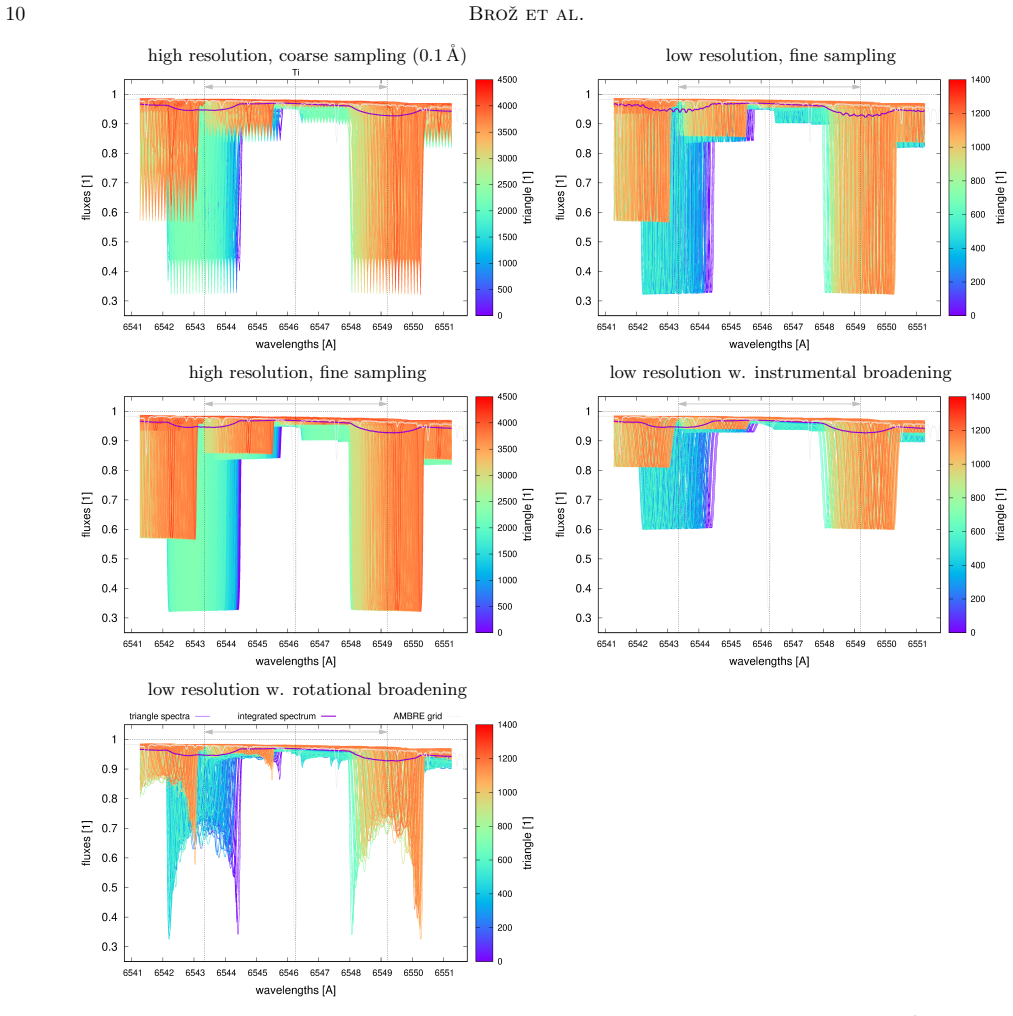
- [Figure 8] In Fig. 8, the top-right panel ('low resolution, fine sampling') and the bottom panels show wave-like artifacts, but the caption does not state the number of triangles used in each panel. Adding the triangle count and sampling step in each panel would make the convergence discussion clearer.
- [Section 2.3] Fig. 1 shows gaps in grid coverage, and the text mentions that Ndpolator uses nearest-neighbor extrapolation for safety. It would be useful to add a short warning that extrapolating to Teff or log g outside the grid boundaries is not a substitute for missing grid points and may produce unphysical spectra.
- [Section 3.2] The comparison with Gueymard (2003) is only qualitative. A residual plot or a brief statement of the rms difference over the plotted wavelength range would make the agreement more concrete.
Circularity Check
No significant circularity: the spectroscopic module is a forward model built on external literature grids, and the acknowledged limb-darkening approximation is a limitation, not a circular step.
full rationale
The paper contains no derivation chain in which a predicted quantity reduces by construction to a fitted input or to a self-citation. The complex model (Eq. 6) and the SED model (Eq. 8) integrate synthetic spectra obtained from external grids (PHOENIX, OSTAR, BSTAR, AMBRE, POLLUX, POWR) over triangular surface meshes; the spectra are parameterized by Teff, log g, and Z only, and the Doppler shifts and visibility fractions are computed geometrically. No parameter is fitted to the outputs shown in Figures 2-7. The only deliberately approximate element is the analytical limb-darkening law applied to spectra computed at mu=1. The paper explicitly concedes this is 'not self-consistent' (Section 3.3) and describes it as a compromise given the size of full mu-dependent grids. That is an acknowledged approximation and a possible source of systematic error for eclipse line profiles and absolute fluxes, but it is not circular: the analytical LD coefficients are user inputs, not quantities derived from or fitted to the spectra being predicted. The solar flux calibration in Section 3.2 is an external benchmark against measured solar irradiance and an independent synthetic solar spectrum (Gueymard 2003), not a round-trip of the module's own outputs. Citations to prior Phoebe papers (Prsa et al. 2016; Horvat et al. 2018; Conroy et al. 2020) are normal references to the underlying mesh and light-curve machinery; they do not carry the burden of proving the spectroscopic module's claims. The absence of validation against observed binary spectra is a limitation of external validity, not evidence of circularity. The central methodology is self-contained: literature spectra + geometric surface integration + Doppler shifting, with all approximations stated.
Assumptions & free parameters
assumptions (4)
- ad hoc to paper Analytical limb-darkening law with user-specified coefficients adequately represents the limb darkening of the underlying synthetic spectra.
- domain assumption The synthetic spectrum grids (OSTAR, BSTAR, AMBRE, POLLUX, PHOENIX, POWR) from the literature are accurate and complete for the parameter ranges of interest.
- domain assumption Linear interpolation (Ndpolator) between grid points yields sufficiently accurate spectra.
- standard math The Doppler shift can be applied per triangle as a simple radial velocity shift, ignoring other relativistic effects.
Cite this review
Pith. "Pith review of Physics Of Eclipsing Binaries. IX. Spectroscopic module." pith.science (2026). https://pith.science/paper/32555IF4
@misc{pith2026250620868,
  author       = {Pith},
  title        = {Pith review of: Physics Of Eclipsing Binaries. IX. Spectroscopic module},
  year         = {2026},
  howpublished = {\url{https://pith.science/paper/32555IF4}},
  note         = {Machine review of arXiv:2506.20868}
}
abstract
Spectroscopic observations constrain the fundamental properties of stellar atmospheres, in particular, the effective temperature, the gravitational acceleration, or the metallicity. In this work, we describe the spectroscopic module for Phoebe, which allows for modelling of spectra, either normalized, or in absolute units (${\rm W}\,{\rm m}^{-2}\,{\rm m}^{-1}$). The module is based on extensive grids of synthetic spectra, taken from literature, which are interpolated and integrated over the surface. As an approximation, we assume that limb darkening is given by an analytical law, while other effects (e.g., eclipses) are treated self-consistently. Our approach is suitable for single stars, binaries, or multiples, and can be further extended to systems with pulsating components. This draft refers to a development version of Phoebe, available at https://github.com/miroslavbroz/phoebe2/tree/spectroscopy2 . It is not yet included in the official Phoebe repository!
Figures


Figures from the paper (5 more)


Reference graph
Works this paper leans on
-
[1]
, " * write output.state after.block = add.period write newline
ENTRY address author booktitle chapter edition editor howpublished institution journal key month note number organization pages publisher school series title type volume year label extra.label sort.label short.list INTEGERS output.state before.all mid.sentence after.sentence after.block FUNCTION init.state.consts #0 'before.all := #1 'mid.sentence := #2 '...
-
[2]
write newline
" write newline "" before.all 'output.state := FUNCTION n.dashify 't := "" t empty not t #1 #1 substring "-" = t #1 #2 substring "--" = not "--" * t #2 global.max substring 't := t #1 #1 substring "-" = "-" * t #2 global.max substring 't := while if t #1 #1 substring * t #2 global.max substring 't := if while FUNCTION word.in bbl.in " " * FUNCTION format....
- [3]
-
[4]
E., Sundqvist , J., Pr s a , A., Kochoska , A., & Puls , J
Abdul-Masih , M., Sana , H., Conroy , K. E., Sundqvist , J., Pr s a , A., Kochoska , A., & Puls , J. 2020, , 636, A59
work page 2020
-
[5]
Aerts , C., Christensen-Dalsgaard , J., & Kurtz , D. W. 2010, Asteroseismology (Springer Science+Business Media B.V.)
work page 2010
-
[6]
2023, arXiv e-prints, arXiv:2311.08453
Aerts , C., & Tkachenko , A. 2023, arXiv e-prints, arXiv:2311.08453
arXiv 2023
- [7]
-
[8]
2017, , 230, 19
Bro z , M. 2017, , 230, 19
2017
Show all 31 references
-
[9]
E., et al
Conroy , K. E., et al. 2020, , 250, 34
2020
-
[10]
C., & Plez , B
de Laverny , P., Recio-Blanco , A., Worley , C. C., & Plez , B. 2012, , 544, A126
2012
-
[11]
G., Gonz \'a lez , J
D \' az , C. G., Gonz \'a lez , J. F., Levato , H., & Grosso , M. 2011, , 531, A143
2011
-
[12]
Gueymard , C. A. 2003, Solar Energy, 74, 355
2003
-
[13]
Hainich , R., Ramachandran , V., Shenar , T., Sander , A. A. C., Todt , H., Gruner , D., Oskinova , L. M., & Hamann , W. R. 2019, , 621, A85
2019
-
[14]
E., Pablo , H., Hambleton , K
Horvat , M., Conroy , K. E., Pablo , H., Hambleton , K. M., Kochoska , A., Giammarco , J., & Pr s a , A. 2018, , 237, 26
2018
-
[15]
O., Wende-von Berg , S., Dreizler , S., Homeier , D., Reiners , A., Barman , T., & Hauschildt , P
Husser , T. O., Wende-von Berg , S., Dreizler , S., Homeier , D., Reiners , A., Barman , T., & Hauschildt , P. H. 2013, , 553, A6
2013
-
[16]
2020, , 247, 63
Jones , D., et al. 2020, , 247, 63
2020
-
[17]
2020, , 160, 120
J \"o nsson , H., et al. 2020, , 160, 120
2020
-
[18]
1959, Close binary systems (The International Astrophysics Series, London: Chapman & Hall)
Kopal , Z. 1959, Close binary systems (The International Astrophysics Series, London: Chapman & Hall)
1959
-
[19]
Kopp , G., & Lean , J. L. 2011, , 38, L01706
2011
-
[20]
2003, , 146, 417
Lanz , T., & Huben\' y , I. 2003, , 146, 417
2003
-
[21]
2007, , 169, 83
---. 2007, , 169, 83
2007
-
[22]
Maintz , M., Rivinius , T., S tefl , S., Baade , D., Wolf , B., & Townsend , R. H. D. 2003, , 411, 181
2003
-
[23]
A., et al
Nemravov \'a , J. A., et al. 2016, , 594, A55
2016
-
[24]
2010, , 516, A13
Palacios , A., Gebran , M., Josselin , E., Martins , F., Plez , B., Belmas , M., & L \`e bre , A. 2010, , 516, A13
2010
-
[25]
2016, , 227, 29
Pr s a , A., et al. 2016, , 227, 29
2016
-
[26]
A., Venero , R., Repolust , T., Springmann , U., Jokuthy , A., & Mokiem , M
Puls , J., Urbaneja , M. A., Venero , R., Repolust , T., Springmann , U., Jokuthy , A., & Mokiem , M. R. 2005, , 435, 669
2005
-
[27]
1873, d'Essai sur la constitution et l'origine du système solaire (Montpellier: Boehm et fils)
Roche , \' E . 1873, d'Essai sur la constitution et l'origine du système solaire (Montpellier: Boehm et fils)
-
[28]
G., et al
Sacco , G. G., et al. 2014, , 565, A113
2014
-
[29]
2012, , 746, 85
Suzuki , N., et al. 2012, , 746, 85
2012
-
[30]
1924, , 84, 665
von Zeipel , H. 1924, , 84, 665
1924
-
[31]
C., de Laverny , P., Recio-Blanco , A., Hill , V., Bijaoui , A., & Ordenovic , C
Worley , C. C., de Laverny , P., Recio-Blanco , A., Hill , V., Bijaoui , A., & Ordenovic , C. 2012, , 542, A48
2012
Reviewed August 6, 2026 · model on record in the stance chip above.
Discussion (0). Continue with ORCID to comment.