REVIEW 3 major objections 6 minor 1 cited by
Learning to See in the Extremely Dark
T0 review · 3 major / 6 minor · reviewed 2026-08-06 · deepseek-v4-flash
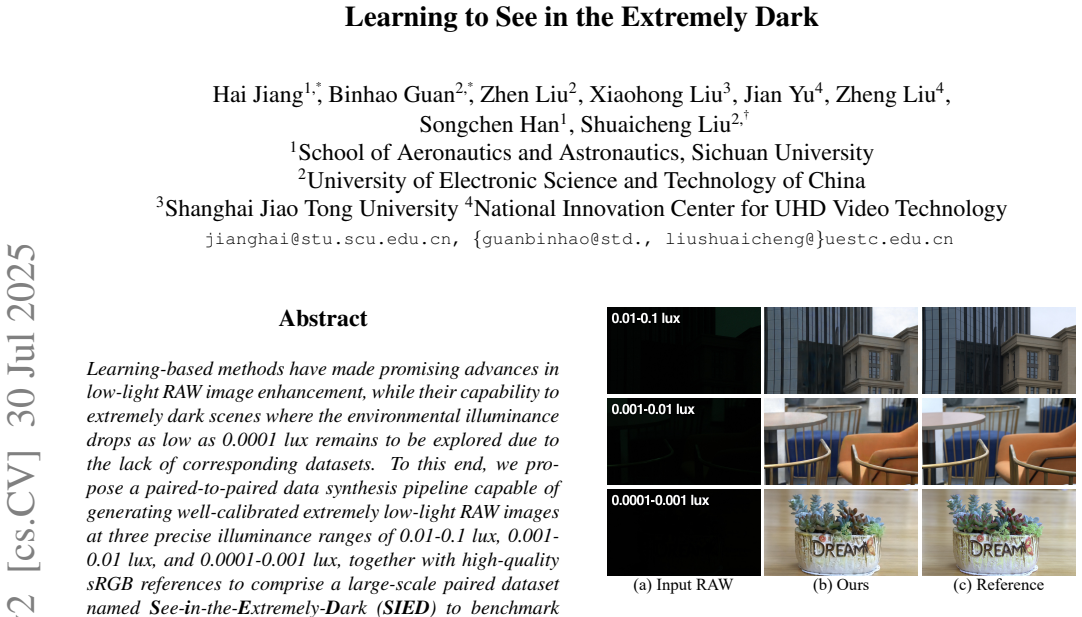
Pith's one-line read The paper claims that a synthesis pipeline can create calibrated RAW images down to 0.0001 lux and that a diffusion model with adaptive illumination correction restores them to state-of-the-art quality.
desk verdict A useful first 0.0001-lux benchmark and a solid diffusion baseline, but the dataset's 'well-calibrated' claim leans on histogram matching and a hand-fitted factor; the realism evidence needs to be much stronger before this becomes a standard testbed. read the letter →
The pith
A machine-rendered reading of the paper's core claim, the machinery that carries it, and where it could break.
The reading
What carries the argument
The load-bearing object is the paired-to-paired synthesis pipeline: illumination alignment via $I_{syn} = I_{cap}\cdot(\mathrm{Expo}(I_{st})/\mathrm{Expo}(I_{cap}) + \eta)$, where $\eta$ is hand-fitted to match illumination histograms (KL divergence below 0.06), followed by an ISO-dependent calibrated noise model that combines Gaussian, Poisson, and dark-frame components so the synthetic RAW matches real sensor statistics. The enhancement side rests on a latent-space diffusion model where an Adaptive Illumination Correction Module (AICM) estimates per-channel amplification coefficients from the RAW feature itself, and a color consistency loss aligns the color histogram of the generated sRGB feature with the reference.
What would settle it
Capture a static scene under a controlled light source metered at 0.001 lux with a Sony or Canon camera using a very long exposure to obtain a near-clean reference, then compare the noise statistics (per-channel variance versus intensity, dark-frame histograms, and illumination histograms) of a real short-exposure capture at the same lux against a SIED-synthesized image; if the variance-versus-intensity slope or the histogram KL divergence exceeds the reported tolerance of about 0.06, the calibrated synthesis premise fails.
Extended reading notes
Core claim
The paper's central claim is that extremely dark RAW images, at illuminances as low as 0.0001 lux, can be realistically synthesized from paired real captures by scaling intensities with a measured exposure ratio plus a manually fitted correction factor, then adding sensor noise calibrated in an optical laboratory, and that a diffusion model guided by an adaptive illumination-corrected RAW feature can restore such inputs to visually pleasing sRGB images. The claimed result is state-of-the-art performance on the new SIED dataset and on the existing SID dataset, with the adaptive module removing the need to know the reference image's exposure during inference.
Load-bearing premise
The synthesized extremely dark RAW images faithfully replicate what a real camera would record at 0.0001 to 0.1 lux, which depends on the exposure-ratio scaling plus a hand-fitted factor and the calibrated Gaussian, Poisson, and dark-frame noise model matching true sensor behavior.
Editorial extensions
If this is right
- Researchers gain a benchmark with three precisely calibrated illuminance ranges down to 0.0001 lux, enabling fair comparison of methods under extreme low-light conditions that previous datasets did not cover.
- The adaptive illumination correction removes the dependence on ground-truth exposure values during inference, a limitation of earlier pre-amplification approaches such as SID and DNF.
- The diffusion framework trained on SIED generalizes to real-world extremely dark scenes, as demonstrated by qualitative results on images whose illuminance is matched to laboratory standards.
- The combination of a generative diffusion prior with explicit color-histogram alignment offers a recipe for other RAW-to-sRGB tasks where both fidelity and vivid color are required.
- Multi-stage training, first for encoders/decoders and AICM then for the diffusion model, proves important for stable convergence and final quality.
Reading between the lines
- The synthesis pipeline may transfer to other sensors beyond Sony and Canon, provided the noise model can be recalibrated for each sensor's photon transfer curve and dark-frame characteristics; the paper does not report cross-camera noise calibration.
- Because the validation relies on synthetic images as ground truth, a stronger test would be capturing truly long-exposure references at the same extreme illuminance levels, something the paper argues is impractical; an indirect test would compare synthesized noise statistics against real dark-frame captures at the same ISO.
- The hand-fitted factor $\eta$ used in illumination alignment is sensor- and scene-dependent; a fully automatic estimation, perhaps from the histogram matching itself, could make the pipeline more general and remove a potential source of bias.
- The color consistency loss operates on global histograms and may not preserve spatial color fidelity; a spatial color-aware variant could further improve results in scenes with localized colored lighting.
Editorial analysis
A structured set of objections, weighed in public.
Referee Report
Summary. The paper introduces SIED, a paired dataset for extremely low-light RAW image enhancement, containing synthesized RAW images at three nominal illuminance ranges (0.01–0.1 lux, 0.001–0.01 lux, and 0.0001–0.001 lux) together with high-quality sRGB references. The synthesis pipeline first captures low-light and normal-light image pairs in real scenes, then scales the low-light RAW intensity by an exposure ratio plus a hand-fitted factor η (Eq. 1), and finally adds an ISO-dependent calibrated Gaussian-plus-Poisson-plus-dark-frame noise model. The paper also proposes a diffusion-based restoration method with an Adaptive Illumination Correction Module (AICM) and a color consistency loss. The method is evaluated on SIED and on the SID benchmark, where the authors report state-of-the-art results and show qualitative comparisons on real extremely dark scenes.
Significance. If the SIED calibration is trustworthy, the dataset would fill a real gap: no existing benchmark covers illuminance down to 0.0001 lux with paired references. The paper is commendable for retraining all comparison methods on SIED using official code, for evaluating on the independent SID benchmark, and for releasing code and dataset. The proposed diffusion method is technically sound and shows consistent gains on SID, which is independent evidence of its effectiveness. However, the central value of SIED rests on the realism of its synthetic low-light RAW images, and that premise is currently under-validated: the only quantitative calibration evidence is a Y-channel histogram KL divergence (Table 1), and the noise model is described qualitatively without reported parameters or direct validation against real captures at the target ISOs and illuminances. The real-world generalization test in Sec. 5.2 is also self-referential because it uses the same histogram-matching procedure to assign illuminance.
major comments (3)
- [§3, Illumination Alignment (Eq. 1)]
- [§3, Noise Addition]
- [§5.2, Real-world Generalization]
minor comments (6)
- [Table 3]
- [Eq. (3)]
- [§3, Illumination Alignment]
- [Fig. 2]
- [General]
- [Dataset documentation]
Circularity Check
SIED's 'well-calibrated' and real-world generalization claims are validated by the same histogram-matching procedure used to fit the synthesis; the enhancement method retains independent SID support.
-
fitted input called prediction
[Section 3, Illumination Alignment and Noise Addition (Eq. 1, Table 1)]
"To refine the illumination of generated images, we adopt a fixed ISP pipeline to transform the generated RAW image and standard images into YUV space, and manually finetune η to match the illumination histograms of the two images in the Y channel, which represents the illumination information of images [8]. As shown in Table 1, the mean KL divergence of the histogram distributions between our generated images and standard laboratory images is less than 0.06 across three illuminance levels."
The only quantitative evidence for the dataset's central 'well-calibrated ... 0.0001 lux' claim is Table 1, a KL divergence between synthesized and laboratory images. But η in Eq. (1) is the free parameter of the synthesis, and the text states it was manually finetuned to minimize exactly this Y-channel histogram mismatch. The validation metric is therefore the fitting objective, so low KL values are enforced by construction rather than discovered. This is a fitted parameter being offered as independent calibration evidence: the 'precise illuminance ranges' are not verified by direct measurement of the synthesized images, only by agreement with the images used to tune the synthesizer.
-
self definitional
[Section 5.2, Real-world Generalization]
"Real-world Generalization. To validate the generalization ability of our method, we collect several images in realistic extremely dark scenes using the Sony camera and determine their illuminance level according to the matching of the illumination histograms in the Y-channel to standard laboratory images."
The illuminance labels for the real-world test scenes are assigned by the same Y-channel histogram-matching procedure used in Sec. 3 to define and synthesize the SIED illuminance ranges (finetuning η to match the same standard lab histograms). Therefore the real-world test is not an external check: it re-applies the calibration criterion to select and label inputs. The claim that the dataset supports real-world generalization is thus supported only by consistency with the same matching rule, not by independent ground-truth illuminance or noise measurements.
full rationale
The paper contains two distinct claims: (1) the SIED dataset provides well-calibrated extremely low-light RAW images, and (2) the diffusion method achieves state-of-the-art restoration. Claim (2) is supported by supervised experiments on SIED and on the external SID benchmark, where comparison methods are retrained with official code, so the enhancement method itself is not circular. Claim (1), however, contains two circular validation steps. The illuminance alignment uses Eq. (1) with a hand-fitted η, and η is manually finetuned to minimize the Y-channel histogram KL divergence between synthesized and standard lab images; the same KL divergence is then reported in Table 1 as evidence of calibration. This is a fitted parameter being offered as validation, so the low KL values are enforced by construction. Similarly, the real-world generalization test labels real scenes by the same Y-channel histogram-matching criterion used in synthesis, making the test self-referential rather than an independent test of physical realism. The calibrated noise model and the optical-laboratory standard captures provide some independent grounding, and the SID results are external, so the circularity is partial rather than total. Score 6 reflects that the central dataset-calibration claim reduces by construction even though the enhancement method itself is not circular.
Assumptions & free parameters
free parameters (2)
- eta (illumination alignment factor) =
not explicitly reported; manually defined and finetuned per illuminance range
- Sensor noise model parameters =
not reported in the paper
assumptions (5)
- standard math Diffusion forward/reverse process with a fixed variance schedule and DDIM sampling
- domain assumption An image can be decomposed into illumination and reflectance maps
- domain assumption Extreme-low-light RAW noise is additive Gaussian plus Poisson plus dark-frame distribution
- domain assumption Scaling RAW intensities by an exposure ratio approximates changing scene illuminance
- domain assumption Matching YUV Y-channel histograms is a sufficient proxy for illumination realism
Cite this review
Pith. "Pith review of Learning to See in the Extremely Dark." pith.science (2026). https://pith.science/paper/LJHLXE6H
@misc{pith2026250621132,
  author       = {Pith},
  title        = {Pith review of: Learning to See in the Extremely Dark},
  year         = {2026},
  howpublished = {\url{https://pith.science/paper/LJHLXE6H}},
  note         = {Machine review of arXiv:2506.21132}
}
read the original abstract
Learning-based methods have made promising advances in low-light RAW image enhancement, while their capability to extremely dark scenes where the environmental illuminance drops as low as 0.0001 lux remains to be explored due to the lack of corresponding datasets. To this end, we propose a paired-to-paired data synthesis pipeline capable of generating well-calibrated extremely low-light RAW images at three precise illuminance ranges of 0.01-0.1 lux, 0.001-0.01 lux, and 0.0001-0.001 lux, together with high-quality sRGB references to comprise a large-scale paired dataset named See-in-the-Extremely-Dark (SIED) to benchmark low-light RAW image enhancement approaches. Furthermore, we propose a diffusion-based framework that leverages the generative ability and intrinsic denoising property of diffusion models to restore visually pleasing results from extremely low-SNR RAW inputs, in which an Adaptive Illumination Correction Module (AICM) and a color consistency loss are introduced to ensure accurate exposure correction and color restoration. Extensive experiments on the proposed SIED and publicly available benchmarks demonstrate the effectiveness of our method. The code and dataset are available at https://github.com/JianghaiSCU/SIED.
Figures


Figures from the paper (5 more)


Forward citations
Cited by 1 Pith paper
-
AU-IQA: A Benchmark Dataset for Perceptual Quality Assessment of AI-Enhanced User-Generated Content
AU-IQA is a new 4,800-image benchmark showing existing quality models, mainly those trained on ordinary user content, only partially predict human ratings of AI-enhanced photos.
Reference graph
Works this paper leans on
-
[1]
Retinexformer: One-stage retinex- based transformer for low-light image enhancement
Yuanhao Cai, Hao Bian, Jing Lin, Haoqian Wang, Radu Tim- ofte, and Yulun Zhang. Retinexformer: One-stage retinex- based transformer for low-light image enhancement. In ICCV, pages 12504–12513, 2023. 1
work page 2023
-
[2]
Chen Chen, Qifeng Chen, Jia Xu, and Vladlen Koltun. Learning to see in the dark. In CVPR, pages 3291–3300,
-
[3]
Chen Chen, Qifeng Chen, Minh N Do, and Vladlen Koltun. Seeing motion in the dark. InICCV, pages 3185–3194, 2019. 2, 3
work page 2019
-
[4]
Retinex-RAWMamba: Bridging Demosaicing and Denoising for Low-Light RAW Image Enhancement
Xianmin Chen, Peiliang Huang, Xiaoxu Feng, Dingwen Zhang, Longfei Han, and Junwei Han. Retinex-rawmamba: Bridging demosaicing and denoising for low-light raw image enhancement. arXiv preprint arXiv:2409.07040, 2024. 1, 2, 3, 5, 6, 7, 8
work page Pith review arXiv 2024
-
[5]
Hyungjin Chung, Byeongsu Sim, and Jong Chul Ye. Come-closer-diffuse-faster: Accelerating conditional diffu- sion models for inverse problems through stochastic contrac- tion. In CVPR, pages 12413–12422, 2022. 5
work page 2022
-
[6]
Abandoning the bayer-filter to see in the dark
Xingbo Dong, Wanyan Xu, Zhihui Miao, Lan Ma, Chao Zhang, Jiewen Yang, Zhe Jin, Andrew Beng Jin Teoh, and Jiajun Shen. Abandoning the bayer-filter to see in the dark. In CVPR, pages 17431–17440, 2022. 1, 2, 6, 7
work page 2022
-
[7]
Self-guided network for fast image denoising
Shuhang Gu, Yawei Li, Luc Van Gool, and Radu Timofte. Self-guided network for fast image denoising. In ICCV, pages 2511–2520, 2019. 1, 2, 6, 7
work page 2019
-
[8]
Low-light image enhancement via breaking down the darkness
Xiaojie Guo and Qiming Hu. Low-light image enhancement via breaking down the darkness. IJCV, 131(1):48–66, 2023. 1, 4
work page 2023
Show all 43 references
-
[9]
Lime: Low-light im- age enhancement via illumination map estimation
Xiaojie Guo, Yu Li, and Haibin Ling. Lime: Low-light im- age enhancement via illumination map estimation. IEEE TIP, 26(2):982–993, 2016. 5
2016
-
[10]
Fuzzy color histogram and its use in color image retrieval.IEEE TIP, 11(8):944–952, 2002
Ju Han and Kai-Kuang Ma. Fuzzy color histogram and its use in color image retrieval.IEEE TIP, 11(8):944–952, 2002. 5
2002
-
[11]
Denoising dif- fusion probabilistic models
Jonathan Ho, Ajay Jain, and Pieter Abbeel. Denoising dif- fusion probabilistic models. In NeurIPS, pages 6840–6851,
-
[12]
Global structure-aware diffusion pro- cess for low-light image enhancement
Jinhui Hou, Zhiyu Zhu, Junhui Hou, Hui Liu, Huanqiang Zeng, and Hui Yuan. Global structure-aware diffusion pro- cess for low-light image enhancement. In NeurIPS, pages 79734–79747, 2023. 1
2023
-
[13]
Towards low light enhancement with raw images
Haofeng Huang, Wenhan Yang, Yueyu Hu, Jiaying Liu, and Ling-Yu Duan. Towards low light enhancement with raw images. IEEE TIP, 31:1391–1405, 2022. 2
2022
-
[14]
Low-light image enhancement with wavelet-based diffusion models
Hai Jiang, Ao Luo, Songchen Han, Haoqiang Fan, and Shuaicheng Liu. Low-light image enhancement with wavelet-based diffusion models. ACM TOG , 42(6):1–14,
-
[15]
Dnf: Decouple and feedback network for seeing in the dark
Xin Jin, Ling-Hao Han, Zhen Li, Chun-Le Guo, Zhi Chai, and Chongyi Li. Dnf: Decouple and feedback network for seeing in the dark. In CVPR, pages 18135–18144, 2023. 1, 2, 3, 5, 6, 7, 8
2023
-
[16]
Adam: A method for stochastic optimization
Diederik P Kingma and Jimmy Ba. Adam: A method for stochastic optimization. arXiv preprint arXiv:1412.6980 ,
-
[17]
Restoring extremely dark images in real time
Mohit Lamba and Kaushik Mitra. Restoring extremely dark images in real time. In CVPR, pages 3487–3497, 2021. 1, 2, 6, 7
2021
-
[18]
Towards fast and light-weight restoration of dark images
Mohit Lamba, Atul Balaji, and Kaushik Mitra. Towards fast and light-weight restoration of dark images. arXiv preprint arXiv:2011.14133, 2020. 1, 2, 6, 7
2011 arXiv
-
[19]
The retinex theory of color vision
Edwin H Land. The retinex theory of color vision. Scientific American, 237(6):108–129, 1977. 5
1977
-
[20]
Embedding fourier for ultra-high-definition low-light image enhancement
Chongyi Li, Chun-Le Guo, Man Zhou, Zhexin Liang, Shangchen Zhou, Ruicheng Feng, and Chen Change Loy. Embedding fourier for ultra-high-definition low-light image enhancement. In ICLR, 2023. 1
2023
-
[21]
Dmhomo: Learning ho- mography with diffusion models
Haipeng Li, Hai Jiang, Ao Luo, Ping Tan, Haoqiang Fan, Bing Zeng, and Shuaicheng Liu. Dmhomo: Learning ho- mography with diffusion models. ACM TOG, 43(3):1–16,
-
[22]
Flowdiffuser: Advancing optical flow es- timation with diffusion models
Ao Luo, Xin Li, Fan Yang, Jiangyu Liu, Haoqiang Fan, and Shuaicheng Liu. Flowdiffuser: Advancing optical flow es- timation with diffusion models. In CVPR, pages 19167– 19176, 2024. 5
2024
-
[23]
Improving extreme low-light image denoising via residual learning
Paras Maharjan, Li Li, Zhu Li, Ning Xu, Chongyang Ma, and Yue Li. Improving extreme low-light image denoising via residual learning. In ICME, pages 916–921, 2019. 1, 2, 5, 6, 7
2019
-
[24]
Elucidating the exposure bias in diffusion models
Mang Ning, Mingxiao Li, Jianlin Su, Albert Ali Salah, and Itir Onal Ertugrul. Elucidating the exposure bias in diffusion models. In ICLR, 2024. 5
2024
-
[25]
U-net: Convolutional networks for biomedical image segmentation
Olaf Ronneberger, Philipp Fischer, and Thomas Brox. U-net: Convolutional networks for biomedical image segmentation. In MICCAI, pages 234–241, 2015. 6
2015
-
[26]
Human motion diffusion as a generative prior
Yoni Shafir, Guy Tevet, Roy Kapon, and Amit Haim Bermano. Human motion diffusion as a generative prior. In ICLR, 2022. 5
2022
-
[27]
Denois- ing diffusion implicit models
Jiaming Song, Chenlin Meng, and Stefano Ermon. Denois- ing diffusion implicit models. In ICLR, 2021. 5, 6
2021
-
[28]
Seeing dynamic scene in the dark: A high- quality video dataset with mechatronic alignment
Ruixing Wang, Xiaogang Xu, Chi-Wing Fu, Jiangbo Lu, Bei Yu, and Jiaya Jia. Seeing dynamic scene in the dark: A high- quality video dataset with mechatronic alignment. In ICCV, pages 9700–9709, 2021. 2, 3
2021
-
[29]
Practical deep raw image denoising on mobile devices
Yuzhi Wang, Haibin Huang, Qin Xu, Jiaming Liu, Yiqun Liu, and Jue Wang. Practical deep raw image denoising on mobile devices. In ECCV, pages 1–16, 2020. 4
2020
-
[30]
Low-light image enhancement with illumination-aware gamma correction and complete image modelling network
Yinglong Wang, Zhen Liu, Jianzhuang Liu, Songcen Xu, and Shuaicheng Liu. Low-light image enhancement with illumination-aware gamma correction and complete image modelling network. In ICCV, pages 13128–13137, 2023. 1
2023
-
[31]
Exposurediffusion: Learning to expose for low-light image enhancement
Yufei Wang, Yi Yu, Wenhan Yang, Lanqing Guo, Lap-Pui Chau, Alex C Kot, and Bihan Wen. Exposurediffusion: Learning to expose for low-light image enhancement. In ICCV, pages 12438–12448, 2023. 1
2023
-
[32]
Bovik, H.R
Zhou Wang, A.C. Bovik, H.R. Sheikh, and E.P. Simoncelli. Image quality assessment: from error visibility to structural similarity. IEEE TIP, 13(4):600–612, 2004. 7
2004
-
[33]
Deep retinex decomposition for low-light enhancement
Chen Wei, Wenjing Wang, Wenhan Yang, and Jiaying Liu. Deep retinex decomposition for low-light enhancement. In BMVC, 2018. 1
2018
-
[34]
Physics-based noise modeling for extreme low-light photog- raphy
Kaixuan Wei, Ying Fu, Yinqiang Zheng, and Jiaolong Yang. Physics-based noise modeling for extreme low-light photog- raphy. IEEE TPAMI, 44(11):8520–8537, 2021. 3
2021
-
[35]
Ldm-isp: Enhancing neural isp for low light with latent dif- fusion models
Qiang Wen, Yazhou Xing, Zhefan Rao, and Qifeng Chen. Ldm-isp: Enhancing neural isp for low light with latent dif- fusion models. arXiv preprint arXiv:2312.01027, 2023. 1
2023 arXiv
-
[36]
Learning to restore low-light images via decomposition-and- enhancement
Ke Xu, Xin Yang, Baocai Yin, and Rynson WH Lau. Learning to restore low-light images via decomposition-and- enhancement. In CVPR, pages 2281–2290, 2020. 2, 6, 7
2020
-
[37]
Sparse gradient regularized deep retinex network for robust low-light image enhancement
Wenhan Yang, Wenjing Wang, Haofeng Huang, Shiqi Wang, and Jiaying Liu. Sparse gradient regularized deep retinex network for robust low-light image enhancement. IEEE TIP, 30:2072–2086, 2021. 1
2021
-
[38]
Diff-retinex: Rethinking low-light image enhancement with a generative diffusion model
Xunpeng Yi, Han Xu, Hao Zhang, Linfeng Tang, and Jiayi Ma. Diff-retinex: Rethinking low-light image enhancement with a generative diffusion model. In ICCV, pages 12302– 12311, 2023. 1
2023
-
[39]
The unreasonable effectiveness of deep features as a perceptual metric
Richard Zhang, Phillip Isola, Alexei A Efros, Eli Shechtman, and Oliver Wang. The unreasonable effectiveness of deep features as a perceptual metric. In CVPR, pages 586–595,
-
[40]
Beyond brightening low-light images
Yonghua Zhang, Xiaojie Guo, Jiayi Ma, Wei Liu, and Jiawan Zhang. Beyond brightening low-light images. IJCV, 129: 1013–1037, 2021. 1
2021
-
[41]
Rethinking noise synthesis and modeling in raw denois- ing
Yi Zhang, Hongwei Qin, Xiaogang Wang, and Hongsheng Li. Rethinking noise synthesis and modeling in raw denois- ing. In ICCV, pages 4593–4601, 2021. 3, 4
2021
-
[42]
Pyramid diffusion models for low-light image enhancement
Dewei Zhou, Zongxin Yang, and Yi Yang. Pyramid diffusion models for low-light image enhancement. In IJCAI, 2023. 1
2023
-
[43]
Eemefn: Low-light image enhancement via edge-enhanced multi- exposure fusion network
Minfeng Zhu, Pingbo Pan, Wei Chen, and Yi Yang. Eemefn: Low-light image enhancement via edge-enhanced multi- exposure fusion network. In AAAI, pages 13106–13113,
Reviewed August 6, 2026 · model on record in the stance chip above.
Discussion (0). Sign in to comment.