REVIEW 3 major objections 5 minor 71 references
Confined acoustic phonons in CsPbI3 nanocrystals explored by resonant Raman scattering on excitons
T0 review · 3 major / 5 minor · reviewed 2026-08-06 · deepseek-v4-flash
Pith's one-line read Resonant Raman scattering reads the size and shape of CsPbI3 nanocrystals from the energies of their confined acoustic phonons, which rise as the crystals shrink.
desk verdict The size-dependent acoustic phonon data are solid and worth publishing; the shape inference is qualitative and needs a quantitative fit before it carries weight. read the letter →
The pith
A machine-rendered reading of the paper's core claim, the machinery that carries it, and where it could break.
The reading
What carries the argument
The central machinery is the Raman intensity formula $I(\Omega;R) \sim \frac{1}{R} I_1(\Omega R/\langle c\rangle) \sum_i \delta V_i \, \tilde{\delta}(\Omega-\Omega_i)$, where $I_1$ is the squared overlap of the phonon displacement with the confined exciton envelope, $\delta V_i$ is the volume variation of phonon mode $i$, and $\langle c\rangle$ is the average sound velocity. The model combines density-functional-theory elastic constants with numerical solution of the continuum elastic eigenproblem for cubes, spheres, and spheroids in orthorhombic and tetragonal crystal symmetries, under free boundary conditions. The selection physics is that the exciton–phonon coupling is proportional to $\nabla\cdot\mathbf{u}$, so Raman-active modes are precisely those with nonzero volume variation, and the envelope overlap restricts the observable modes to a few per size.
What would settle it
Measure low-frequency Raman spectra of the same CsPbI$_3$ nanocrystals in colloidal suspension (free surfaces) and compare against the glass-embedded values at matched exciton energies; the free-boundary model predicts equal peak positions, whereas any systematic matrix-induced shift would refute it. Alternatively, a transmission-electron-microscopy shape histogram that shows mostly cubes would directly contradict the spherical/spheroidal conclusion.
Extended reading notes
Core claim
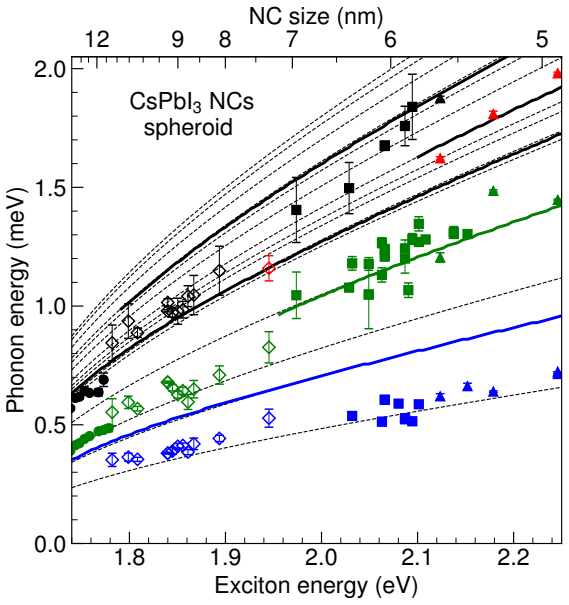
Resonant Raman scattering on excitons in CsPbI$_3$ nanocrystals reveals a series of confined acoustic phonon modes with energies between roughly 0.25 and 2.5 meV whose positions grow as the nanocrystal size decreases, while the optical phonon modes (2.7–8.3 meV) stay put. Because only phonon modes that change the crystal volume couple to the exciton through the deformation potential, and because the exciton envelope selects phonon wave vectors comparable to its own, just a few acoustic modes dominate the spectrum. Matching the measured modes against spectra computed for different shapes leads to the conclusion that the nanocrystals are predominantly spherical or spheroidal, with the lowest observed peak originating from the fundamental spheroidal ($\ell=2$) mode and the highest from the breathing ($\ell=0$) mode.
Load-bearing premise
The modeled phonon spectra assume free boundary conditions at the nanocrystal surface, but the nanocrystals are embedded in a glass matrix whose mechanical grip is unknown; if the matrix materially loads the surface, the phonon energies shift and the inferred size and shape would change.
Editorial extensions
If this is right
- Raman-derived acoustic phonon energies give the nanocrystal size in situ, with smaller crystals producing higher-energy modes across the 4–13 nm range.
- The number and splitting of low-energy Raman lines encode shape: a single strong peak marks spheres, an extra peak marks spheroids, and a smeared fine structure marks cubes.
- Optical phonon lines serve as a size-independent reference, so the acoustic shifts can be read off without an external size calibration.
- The technique works where TEM is difficult, such as glass-embedded nanocrystals that accumulate charge, and can also probe the crystal phase through the different spectra of orthorhombic versus tetragonal material.
Reading between the lines
- If the spheroidal assignment holds, the relative strength of the $\ell=2$ peak carries information about the aspect-ratio distribution, so the Raman spectrum could be inverted to map shape distributions across a sample without electron microscopy.
- The same measurement on colloidal nanocrystals of matched size would test the free-boundary assumption directly, since any matrix-induced load would shift the acoustic peaks; the paper itself anticipates a glass-versus-solution comparison.
- Because the confined acoustic phonon energies overlap the exciton fine-structure splitting, the identified modes are natural candidates for the phonons that mediate bright-to-dark exciton relaxation, which could be checked in time-resolved emission measurements.
Editorial analysis
A structured set of objections, weighed in public.
Referee Report
Summary. The manuscript reports resonant Raman spectroscopy of CsPbI3 nanocrystals embedded in fluorophosphate glass, covering excitation energies of 1.72–2.25 eV and inferred sizes of 4–13 nm. The central experimental result is that low-energy Raman lines assigned to confined acoustic phonons shift to higher energies with decreasing nanocrystal size, while optical phonon energies remain size-independent. The authors model acoustic phonons in the continuum approximation using DFT elastic constants for orthorhombic and tetragonal CsPbI3 and for nanocrystal shapes including cube, sphere, and spheroid, coupling the phonons to the exciton through a deformation potential. By comparing measured acoustic peak positions with calculated mode branches, they conclude that the nanocrystals in their samples are predominantly spherical or spheroidal in shape.
Significance. If the central claims hold, the paper is a valuable demonstration that resonant Raman scattering can probe both size and shape of embedded perovskite nanocrystals, a characterization task that is difficult for nanocrystals in glass. A clear strength is that the phonon eigenfrequencies are not fitted to the Raman data: they follow from first-principles elastic constants and continuum eigenmode calculations, so the predicted size dependence of the acoustic phonon energies is non-circular. The experimental trend that acoustic phonon energies increase with decreasing size is robust across four samples and does not depend on the finer details of the shape model. The weaker element is the shape discrimination, which is at present qualitative; the paper would be significantly strengthened by a quantitative comparison with uncertainties, including the uncertainty in the size–energy interpolation of Eq. (S10).
major comments (3)
- [Fig. 5 and Supporting Information S4] The conclusion that the nanocrystals are 'predominantly spherical or spheroidal' rests on a visual comparison of measured peak positions with calculated spheroid mode branches in Fig. 5 and Fig. S3, with no quantitative goodness-of-fit, no error bars on the measured peak positions in Fig. 2e or Fig. 5, and no treatment of the broad nanocrystal size distribution within each sample. Because Eq. (S10) is an interpolation with a claimed tolerance of about 20 meV, a spherical model with a slightly different size–energy calibration could plausibly reproduce the same peak positions. I request a quantitative comparison (for example, residuals or a chi-square-like measure for sphere, spheroid, and cube models over all four samples) together with a statement of the systematic uncertainty from the size–energy mapping before the shape claim can be accepted.
- [Main text, 'All presented simulations assume free boundary conditions'; S4] The free-boundary assumption is load-bearing for the size and shape inference, yet the authors themselves state in S4 that the mechanical contact between nanocrystal and glass matrix is undetermined and that 'additional studies are needed to determine which of the options is realized in our samples.' Figure 3b,d shows that introducing a velocity contrast (Set IV in Table 1) shifts the phonon energies relative to Sets I–III. Because the experimental peaks are assigned to specific computed modes on an absolute energy scale, the unknown boundary condition introduces a systematic uncertainty that could change the inferred size or shape. Please quantify the sensitivity of the predicted mode energies and of the sphere/spheroid discrimination to the boundary-condition parameter sets used in Table 1.
- [Supporting Information S4] The assignment of the lowest experimental peak to the fundamental spheroidal l=2 mode is undermined by the paper's own statement that in the isotropic approximation the exciton–phonon interaction with this mode is zero for simple bands and that an additional symmetry-lowering mechanism is required to make it Raman active. Since this peak is one of the main discriminators between the sphere and spheroid models, the manuscript should either identify and model the activation mechanism or present the l=2 assignment as a tentative hypothesis rather than as part of the shape conclusion.
minor comments (5)
- [Fig. 2e] The four data series are plotted without error bars; please state the uncertainty in the Gaussian peak positions, since the text says the lines were fitted with Gaussian functions.
- [Eq. (5)] The average sound velocity <c> = 1.4 x 10^5 cm/s is introduced with a reference but without a definition of how it is obtained from the DFT elastic constants; please clarify this relation.
- [Supporting Information, Eqs. (S9) and (S10)] The text explains that the interpolation is justified by the dependence of confinement energy on volume, but it does not explain why the cubic and spherical forms differ; a short clarifying sentence would help.
- [Figure 1 caption] The label 'RIPL' in the panels is not defined in the caption; please define the red symbols and the abbreviation.
- [References] The reference list jumps from Ref. 26 in the introduction to Ref. 35; references 27–34 should be cited at their first appropriate place in the text.
Circularity Check
No significant circularity: the phonon spectra are computed from DFT elastic constants and continuum elasticity, with the Raman data used only as an independent comparison.
full rationale
The central quantitative predictions—the eigenfrequencies of confined acoustic phonons, their 1/R size scaling, and the shape-dependent fine structure—are obtained by solving the continuum elastic problem with elastic constants computed ab initio by DFT, not by fitting to the measured Raman shifts. The size–exciton-energy calibration (Eq. S10) comes from independent empirical tight-binding calculations and is used only to place theoretical curves on the experimental excitation-energy axis; even the paper's own stated tolerance of about 20 meV would not alter the qualitative trend that acoustic phonon energies increase with decreasing size. The spheroid comparison uses a fixed aspect ratio (1.8) and free boundary conditions, and the paper explicitly acknowledges in Supporting Information S4 that boundary conditions at the NC/glass interface are not fully determined and may account for quantitative discrepancies. Thus the shape conclusion is a model-comparison result with stated limitations, not a quantity re-inserted from the data. Self-citations occur (e.g., Refs. 30–34, 55, S10), but they support standard continuum theory, DFT methodology, or the independent size-energy interpolation; none of these is equivalent to the paper's target claims. No equation in the derivation reduces by construction to a fitted parameter, a renamed measured quantity, or an author-imported uniqueness assertion. The main weakness—the need for an ad hoc symmetry-lowering mechanism to activate the lowest spheroidal ℓ=2 peak—is a robustness concern for the shape inference, not evidence of circularity.
Assumptions & free parameters
free parameters (4)
- Gaussian broadening sigma =
30 µeV
- Spheroid aspect ratio D_x,z/D_y =
1.8
- Average sound velocity <c> =
1.4e5 cm/s
- ETB size-energy interpolation constants in Eq. (S10): E_X = 1.652 eV, 16 eV nm^2, 3.307 nm^2 =
1.652, 16, 3.307
assumptions (7)
- domain assumption Continuum elasticity provides accurate confined acoustic phonon modes in 4-13 nm nanocrystals.
- ad hoc to paper Free boundary conditions at the nanocrystal/glass interface.
- domain assumption Exciton-phonon interaction is dominated by the isotropic deformation potential proportional to div u.
- domain assumption Strong confinement envelope: electron and hole envelopes are products of sin(pi r/R)/(sqrt(2 pi R) r).
- domain assumption PBEsol DFT elastic constants (Table S1) represent the elastic properties of the nanocrystals.
- ad hoc to paper Exciton energy maps to NC diameter via the empirical tight-binding interpolation Eq. (S10).
- standard math Only total angular momentum l=0 and l=2 acoustic modes are Raman active.
Cite this review
Pith. "Pith review of Confined acoustic phonons in CsPbI3 nanocrystals explored by resonant Raman scattering on excitons." pith.science (2026). https://pith.science/paper/DVDGVM2S
@misc{pith2026250621194,
  author       = {Pith},
  title        = {Pith review of: Confined acoustic phonons in CsPbI3 nanocrystals explored by resonant Raman scattering on excitons},
  year         = {2026},
  howpublished = {\url{https://pith.science/paper/DVDGVM2S}},
  note         = {Machine review of arXiv:2506.21194}
}
read the original abstract
Optical properties of the lead halide perovskites nanocrystals are controlled by confined excitons and rich spectrum of confined acoustic and optical phonons. We study experimentally and theoretically the exciton-phonon interaction in CsPbI3 perovskite nanocrystals embedded in a glass matrix. Energies of phonon modes allowed by selection rules are detected by resonant Raman scattering for nanocrystals with sizes of 4-13 nm, covering exciton energies of 1.72-2.25 eV. While optical phonon energies remain size-independent, the energies of confined acoustic phonons increase in smaller nanocrystals. Acoustic phonons are modeled within the continuum approximation using elastic constants computed by density functional theory. The model provides the energy spectra of confined phonons for nanocrystals of various shapes (cube, sphere, spheroid), crystal symmetries (orthorhombic and tetragonal), and sizes. Exciton confinement restricts efficient coupling to only few phonon modes observable in Raman spectra. By comparing experimental data with model predictions, we conclude that the nanocrystals in our samples predominantly have spherical or spheroidal shapes.
Figures


Figures from the paper (2 more)

Reference graph
Works this paper leans on
-
[1]
Jena, A. K.; Kulkarni, A.; Miyasaka, T. Halide perovskite photovoltaics: Background, status, and future prospects. Chemical Reviews 2019, 5, 3036--3103
work page 2019
-
[2]
Best Research - Cell Efficiency Chart, https://www.nrel.gov/pv/cell-efficiency.html (2025)
work page 2025
-
[3]
Halide Perovskites for Photonics; Vinattieri, A.; Giorgi, G., Eds.; AIP Publishing: Melville, New York, 2021
work page 2021
-
[4]
Hybrid Organic Inorganic Perovskites: Physical Properties and Applications; Vardeny, Z. V; Beard, M. C., Eds.; World Scientific, 2022
work page 2022
-
[5]
R.; Liu, X.; McGill, S.; Semenov, D.; Guo, H.; Tsuchikawa, R.; Deshpande, V
Wang, J.; Zhang, C.; Liu, H.; McLaughlin, R.; Zhai, Y.; Vardeny, S. R.; Liu, X.; McGill, S.; Semenov, D.; Guo, H.; Tsuchikawa, R.; Deshpande, V. V.; Sun, D.; Vardeny, Z. V. Spin-optoelectronic devices based on hybrid organic-inorganic trihalide perovskites. Nat. Commun. 2019, 10, 129
work page 2019
-
[6]
Ning, W.; Bao, J.; Puttisong, Y.; Moro, F.; Kobera, L.; Shimono, S.; Wang, L.; Ji, F.; Cuartero, M.; Kawaguchi, S.; Abbrent, S.; Ishibashi, H.; De Marco, R.; Bouianova, I. A.; Crespo, G. A.; Kubota, Y.; Brus, J.; Chung, D. Y.; Sun, L.; Chen, W. M.; Kanatzidis, M. G; Gao, F. Magnetizing lead free halide double perovskites. Science Advances 2020, 6, eabb5381
work page 2020
-
[7]
Kim, Y.-H.; Zhai, Y.; Lu, H.; Pan, X.; Xiao, C.; Gaulding, E. A.; Harvey, S. P.; Berry, J. J.; Vardeny, Z. V.; Luther, J. M.; Beard, M. C. Chiral-induced spin selectivity enables a room-temperature spin light-emitting diode. Science 2021, 371, 1129
work page 2021
-
[8]
V.; Protesescu, L; Bondarchuk, M
Kovalenko, M. V.; Protesescu, L; Bondarchuk, M. I. Properties and potential optoelectronic applications of lead halide perovskite nanocrystals. Science 2017, 358, 745--750
work page 2017
Show all 71 references
-
[9]
A.; Guan, X.; Han, S.; Liang, L.; Yi, Z.; Li, J.; Xie, X.; Wang, Y.; Li, Y.; Fan, D.; Teh, D
Chen, Q.; Wu, J.; Ou, X.; Huang, B.; Almutlaq, J.; Zhumekenov, A. A.; Guan, X.; Han, S.; Liang, L.; Yi, Z.; Li, J.; Xie, X.; Wang, Y.; Li, Y.; Fan, D.; Teh, D. B. L.; All, A. H.; Mohammed, O. F.; Bakr, O. M.; Wu, T.; Bettinelli, M.; Yang, H.; Huang, W.; Liu, X. All-inorganic p...
2018
-
[10]
I.; Krieg, F.; Caputo, R.; Hendon, C
Protesescu, L.; Yakunin, S.; Bodnarchuk, M. I.; Krieg, F.; Caputo, R.; Hendon, C. H.; Yang, R. X.; Walsh, A.; Kovalenko, M. V. Nanocrystals of cesium lead halide perovskites (CsPbX _3 , X = Cl, Br, and I): Novel optoelectronic materials showing bright emission with wide color ...
2015
-
[11]
A.; Rain\'o, G.; Kovalenko, M
Akkerman, Q. A.; Rain\'o, G.; Kovalenko, M. V.; Manna, L. Genesis, challenges and opportunities for colloidal lead halide perovskite nanocrystals. Nature Mater. 2018, 17, 394
2018
-
[12]
S.; Klimov, V
Park, Y.-S.; Guo, S.; Makarov, N. S.; Klimov, V. I. Room temperature single-photon emission from individual perovskite quantum dots. ACS Nano 2015, 9, 10386--10393
2015
-
[13]
Ultrafast dynamics of photoexcited carriers in perovskite semiconductor nanocrystals
Yu, B.; Zhang, C.; Chen, L.; Qin, Z.; Huang, X.; Wang X.; Xiao M. Ultrafast dynamics of photoexcited carriers in perovskite semiconductor nanocrystals. Nanophotonics 2021, 10, 1943--1965
2021
-
[14]
He; Liang, X.; Xiang, W
Li, P.; Hu, C.; Zhou, L.; Jiang, J.; Cheng, Y.;, M. He; Liang, X.; Xiang, W. Novel synthesis and optical characterization of CsPb _2 Br _5 quantum dots in borosilicate glasses, Mater. Lett. 2017, 209 , 483--485
2017
-
[15]
Novel CsPbI _3 QDs glass with chemical stability and optical properties
Liu, S.; Luo, Y.; He, M.; Liang, X.; Xiang, W. Novel CsPbI _3 QDs glass with chemical stability and optical properties. J. Eur. Ceram. Soc. 2018, 38 , 1998--2004
2018
-
[16]
He, M.; Di, X.; Li, P.; Xiang, W.; Liang, X
Liu, S. ; He, M.; Di, X.; Li, P.; Xiang, W.; Liang, X. Precipitation and tunable emission of cesium lead halide perovskites (CsPbX _3 , X = Br, I) QDs in borosilicate glass. Ceram. Int. 2018, 44 , 4496--4499
2018
-
[17]
Highly luminescent cesium lead halide perovskite nanocrystals stabilized in glasses for light-emitting applications
Ye, Y.; Zhang, W.; Zhao, Z.; Wang, J.; Liu, C.; Deng, Z.; Zhao, X.; Han, J. Highly luminescent cesium lead halide perovskite nanocrystals stabilized in glasses for light-emitting applications. Adv. Opt. Mater. 2019, 7 , 1801663
2019
-
[18]
V.; Kuznetsova, M
Kolobkova, E. V.; Kuznetsova, M. S.; Nikonorov, N. V. Perovskite CsPbX 3 (X = Cl, Br, I) nanocrystals in fluorophosphate glasses. J. Non-Crystalline Solids 2021, 563 , 120811
2021
-
[19]
V.; Skorikov, M
Belykh, V. V.; Skorikov, M. L.; Kulebyakina, E. V.; Kolobkova, E. V.; Kuznetsova, M. S.; Glazov, M. M.; Yakovlev, D. R. Submillisecond spin relaxation in CsPb(Cl,Br) _3 perovskite nanocrystals in a glass matrix. Nano Lett. 2022, 22 , 4583--4588
2022
-
[20]
I.; Onushchenko, A
Ekimov A. I.; Onushchenko, A. A. Quantum size effect in three-dimensional microscopic semiconductor crystals. Pis'ma Zh. Eksp. Teor. Fiz. 1981, 34, 363 [JETP Lett. 34, 345 (1981)]
1981
-
[21]
L.; Efros, A
Efros, Al. L.; Efros, A. L. Interband absorption of light in a semiconductor sphere. Fiz. Tekh. Poluprovodn. 1982, 16, 1209 [Sov. Phys. Semicond. 16, 772 (1982)]
1982
-
[22]
I.; Efros, Al
Ekimov, A. I.; Efros, Al. L.; Onushenko, A. A. Quantum size effect in semiconductor microcrystals. Solid State Commun. 1985, 56, 921
1985
-
[23]
B.; Norris, D
Murray, C. B.; Norris, D. J.; Bawendi, M. G. Synthesis and characterization of nearly monodisperse CdE (E = sulfur, selenium, tellurium) semiconductor nanocrystallites. J. Am. Chem. Soc. 1993, 115, 19, 8706–8715
1993
-
[24]
V.; Lee, J.-S.; Kovalenko, M
Talapin, D. V.; Lee, J.-S.; Kovalenko, M. V.; Shevchenko, E. V. Prospects of colloidal nanocrystals for electronic and optoelectronic applications. Chemical Reviews 2010, 110, 389-458
2010
-
[25]
-Y.; G\'erard, J
Marzin, J. -Y.; G\'erard, J. -M.; Izra\"el, A.; Barrier, D.; Bastard, G. Photoluminescence of single InAs quantum dots obtained by self-organized growth on GaAs. Phys. Rev. Lett. 1994, 73, 716
1994
-
[26]
ohrer, J.; Bimberg, D.; Ruvimov, S. S.; Werner, P.; Richter, U.; G\
Grundmann, M.; Christen, J.; Ledentsov, N. N.; B\"ohrer, J.; Bimberg, D.; Ruvimov, S. S.; Werner, P.; Richter, U.; G\"osele, U.; Heydenreich, J.; Ustinov, V. M.; Egorov, A. Yu.; Zhukov, A. E.; Kop'ev, P. S.; Alferov, Zh. I. Ultranarrow luminescence lines from single quantum do...
1995
-
[27]
On the vibrations of an elastic sphere
Lamb, H. On the vibrations of an elastic sphere. Proc. London Math. Soc. 1881, s1-13, 189
-
[28]
Acoustic vibrations in nanoparticles
Saviot, L.; Mermet, A.; Duval, E. Acoustic vibrations in nanoparticles. In Nanoparticles and Quantum Dots, Handbook of Nanophysics Vol. 3, Sattler, K. D. Ed.; CRC Press, Boca Raton, 2011; Chap. 11, pp. 11-1–11-16
2011
-
[29]
Classical problems in the theory of elasticity and the quantum theory of angular momentum
Goupalov, S.V. Classical problems in the theory of elasticity and the quantum theory of angular momentum. Usp. Fiz. Nauk 2020, 190, 63 [Phys.-Usp. 63, 57 (2020)]
2020
-
[30]
Far-infrared and Raman vibrational transitions of a solid sphere: Selection rules
Duval, E. Far-infrared and Raman vibrational transitions of a solid sphere: Selection rules. Phys. Rev. B. 1992, 46, 5795
1992
-
[31]
V.; Merkulov, I
Gupalov, S. V.; Merkulov, I. A. Theory of Raman light scattering by nanocrystal acoustic vibrations. Phys. Solid State 1999, 41, 1349--1358
1999
-
[32]
V.; Ekimov, A
Goupalov, S. V.; Ekimov, A. I.; Lublinskaya, O. G.; Merkulov, I. A. Raman Spectroscopy of Exciton-Acoustic Phonon Coupling in Semiconductor Nanocrystals. In: Sadowski, M. L.; Potemski, M.; Grynberg, M. (eds) Optical Properties of Semiconductor Nanostructures. NATO Science Seri...
2000
-
[33]
O.; Goupalov, S
Nestoklon, M. O.; Goupalov, S. V. Exciton interaction with acoustic phonons in PbS nanocrystals. Phys. Rev. B 2022, 106, 045306
2022
-
[34]
Saviot, L.; Murray, D. B. Acoustic vibrations of anisotropic nanoparticles. Phys. Rev. B 2009, 79, 214101--214112
2009
-
[35]
C.; Sachat, A
Ng, R. C.; Sachat, A. E.; Cespedes, F.; Poblet, M.; Madiot, G.; Jaramillo-Fernandez, J.; Florez, O.; Xiao, P.; Sledzinska, M.; Sotomayor-Torres, C. M.; Chavez-Angel, E. Excitation and detection of acoustic phonons in nanoscale systems. Nanoscale 2022, 14, 13428
2022
-
[36]
Raman scattering from acoustic phonons confined in Si nanocrystals
Fujii, M.; Kanzawa, Y.; Hayashi, S.; Yamamoto, K. Raman scattering from acoustic phonons confined in Si nanocrystals. Phys. Rev. B 1996, 54, R8373
1996
-
[37]
A.; Ekimov, A
Saviot, L.; Champagnon, B.; Duval, E.; Kudriavtsev, I. A.; Ekimov, A. I. Size dependence of acoustic and optical vibrational modes of CdSe nanocrystals in glasses. J. Non-Crystalline Solids 1996, 197, 238--246
1996
-
[38]
A.; Belitsky, V
Sirenko, A. A.; Belitsky, V. I.; Ruf, T.; Cardona, M.; Ekimov, A. I.; Trallero-Giner, C. Spin-flip and acoustic-phonon Raman scattering in CdS nanocrystals. Phys. Rev. B 1998, 58, 2077--2087
1998
-
[39]
Saviot, L.; Champagnon, B.; Duval, E.; Ekimov, A. I. Size-selective resonant Raman scattering in CdS doped glasses. Phys. Rev. B 1998, 57, 341--346
1998
-
[40]
D.; Wise, F
Krauss, T. D.; Wise, F. W. Coherent acoustic phonons in a semiconductor quantum dot. Phys. Rev. Lett. 1997, 79, 5102
1997
-
[41]
Ikezawa, M.; Okuno, T.; Masumoto, Y.; Lipovskii, A. A. Complementary detection of confined acoustic phonons in quantum dots by coherent phonon measurement and Raman scattering. Phys. Rev. B 2001, 64, 201315(R)
2001
-
[42]
Nanodiamond size from low-frequency acoustic Raman modes
Vlk, A.; Ledinsky, M.; Shiryaev, A.; Ekimov, E.; Stehlik, S. Nanodiamond size from low-frequency acoustic Raman modes. J. Phys. Chem. C 2022, 126, 6318--6324
2022
-
[43]
T.; Joshi, P
Miyata, K.; Meggiolaro, D.; Trinh, M. T.; Joshi, P. P.; Mosconi, E.; Jones, S. C.; De Angelis, F.; Zhu, X.-Y. Large polarons in lead halide perovskites. Sci. Adv. 2017, 3, e1701217
2017
-
[44]
Origin of low carrier mobilities in halide perovskites
Ponc \'e , S.; Schlipf, M.; Giustino, F. Origin of low carrier mobilities in halide perovskites. ACS Energy Lett. 2019, 4, 456
2019
-
[45]
L.; Lounis, B
Fu, M.; Tamarat, P.; Huang, H.; Even, J.; Rogach, A. L.; Lounis, B. Neutral and charged exciton fine structure in single lead halide perovskite nanocrystals revealed by magneto-optical spectroscopy. Nano Lett. 2017, 17, 2895--2901
2017
-
[46]
Luminescence fine structures in single lead halide perovskite nanocrystals: Size dependence of the exciton--phonon coupling
Cho, K.; Yamada, T.; Tahara, H.; Tadano, T.; Suzuura, H.; Saruyama, M.; Sato, R.; Teranishi, T.; Kanemitsu, Y. Luminescence fine structures in single lead halide perovskite nanocrystals: Size dependence of the exciton--phonon coupling. Nano Lett. 2021, 21, 7206
2021
-
[47]
M.; Brodu, A.; van Hoof, N
Iaru, C. M.; Brodu, A.; van Hoof, N. J. J.; ter Huurne, S. E. T.; Buhot, J.; Montanarella, F.; Buhbut, S.; Christianen, P. C. M.; Vanmaekelbergh, D.; de Mello Donega, C.; Rivas, J. G.; Koenraad, P. M.; Silov, A. Y. Fr \"o hlich interaction dominated by a single phonon mode in ...
2021
-
[48]
Spectral fingerprint of quantum confinement in single CsPbBr _3 nanocrystals
Amara, M.-R.; Said, Z.; Huo, C.; Pierret, A.; Voisin, C.; Gao, W.; Xiong, Q.; Diederichs, C. Spectral fingerprint of quantum confinement in single CsPbBr _3 nanocrystals. Nano Lett. 2023, 23, 3607
2023
-
[49]
Exciton-acoustic phonon coupling revealed by resonant excitation of single perovskite nanocrystals
Lv, Y.; Yin, C.; Zhang, C.; Wang, X.; Yu, Z.-G.; Xiao, M. Exciton-acoustic phonon coupling revealed by resonant excitation of single perovskite nanocrystals. Nature Commun. 2021, 12, 2192
2021
-
[50]
R.; Zhukov, E
Meliakov, S. R.; Zhukov, E. A.; Belykh; V. V., Nestoklon; M. O., Kolobkova, E. V.; Kuznetsova, M. S.; Bayer, M.; Yakovlev, D. R. Land\'e g -factors of electrons and holes strongly confined in CsPbI _3 perovskite nanocrystals in glass. Nanoscale 2025, 17, 6522
2025
-
[51]
O.; Kirstein, E.; Yakovlev, D
Nestoklon, M. O.; Kirstein, E.; Yakovlev, D. R.; Zhukov, E. A.; Glazov, M. M.; Semina, M. A.; Ivchenko, E. L.; Kolobkova, E. V.; Kuznetsova, M. S.; Bayer, M. Tailoring the electron and hole Land\'e factors in lead halide perovskite nanocrystals by quantum confinement and halid...
2023
-
[52]
R.; Zhukov, E
Meliakov, S. R.; Zhukov, E. A.; Belykh, V. V.; Nestoklon, M. O.; Kolobkova, E. V.; Kuznetsova, M. S.; Bayer, M.; Yakovlev, D. R. Temperature dependence of the electron and hole Land\'e g -factors in CsPbI _3 nanocrystals embedded in a glass matrix. Nanoscale 2024, 16, 21496
2024
-
[53]
N.; Kuznetsova, M
Bataev, M. N.; Kuznetsova, M. S.; Pankin, D. V.; Smirnov, M. B.; Verbin, S. Yu.; Ignatiev, I. V.; Eliseyev, I. A.; Davydov, V. Yu.; Smirnov, A. N.; Kolobkova, E. V. Electron-phonon interaction in perovskite nanocrystals in fluorophosphate glass matrix. Semiconductors 2024, 58, 103-109
2024
-
[54]
Martin, R. M. Theory of the one-phonon resonance Raman effect. Phys. Rev. B 1971, 4, 3676
1971
-
[55]
Free vibrations of anisotropic nano-objects with rounded or sharp corners
Saviot, L. Free vibrations of anisotropic nano-objects with rounded or sharp corners. Nanomaterials 2021, 11, 1838
2021
-
[56]
P.; Ruzsinszky, A.; Csonka, G
Perdew, J. P.; Ruzsinszky, A.; Csonka, G. I.; Vydrov, O. A.; Scuseria, G. E.; Constantin, L. A.; Zhou, X.; Burke, K. Restoring the density-gradient expansion for exchange in solids and surfaces. Phys. Rev. Lett. 2008, 100, 136406
2008
-
[57]
Blaha, P.; Schwarz, K.; Tran, F.; Laskowski, R.; Madsen, G. K. H.; Marks, L. D. WIEN2k: An APW+lo program for calculating the properties of solids. J. Chem. Phys. 2020, 152, 074101
2020
-
[58]
Anderson, O. L. A simplified method for calculating the debye temperature from elastic constants. J. Phys. Chem. Solids 1963, 24, 909--917
1963
-
[59]
Wherrett, B. S. Group Theory for Atoms, Molecules and Solids; Prentice Hall International: Englewood Cliffs, New Jersey, 1986
1986
-
[60]
O.; Goupalov, S
Nestoklon, M. O.; Goupalov, S. V.; Dzhioev, R. I.; Ken, O. S.; Korenev, V. L.; Kusrayev, Yu. G.; Sapega, V. F.; de Weerd, C.; Gomez, L.; Gregorkiewicz, T.; Lin, J.; Suenaga, K.; Fujiwara, Y.; Matyushkin, L. B.; Yassievich, I. N. Optical orientation and alignment of excitons in...
2018
-
[61]
Tamarat, P.; Prin, E.; Berezovska, Y.; Moskalenko, A.; Nguyen, T. P. T.; Xia, C.; Hou, L.; Trebbia, J.-B.; Zacharias, M.; Pedesseau, L.; Katan, C.; Bodnarchuk, M. I.; Kovalenko, M. V.; Even, J.; Lounis, B. Universal scaling laws for charge-carrier interactions with quantum con...
2023
-
[62]
C.; Wu, K
Han, Y.; Liang, W.; Lin, X.; Li, Y.; Sun, F.; Zhang, F.; Sercel, P. C.; Wu, K. Lattice distortion inducing exciton splitting and coherent quantum beating in CsPbI _3 perovskite quantum dots. Nature Materials 2022, 21 , 1282
2022
-
[63]
Ivchenko, E. L. Optical Spectroscopy of Semiconductor Nanostructures; Alpha Science, 2005
2005
-
[64]
Blaha, P.; Schwarz, K.; Tran, F.; Laskowski, R.; Madsen, G. K. H.; Marks, L. D. WIEN2k: An APW+lo program for calculating the properties of solids. J. Chem. Phys. 2020, 152 , 074101
2020
-
[65]
IRelast package
Jamal, M.; Bilal, M.; Ahmad, I.; Jalali-Asadabadi, S. IRelast package. J. Alloys and Compounds 2018, 735 , 569
2018
-
[66]
B.; Pitaevskii, L
Berestetskii, V. B.; Pitaevskii, L. P.; Lifshits, E. M. Quantum Electrodynamics: Volume 4; Butterworth-Heinemann, 1982
1982
-
[67]
Far-infrared and Raman vibrational transitions of a solid sphere: Selection rules
Duval, E. Far-infrared and Raman vibrational transitions of a solid sphere: Selection rules. Phys. Rev. B. 1992, 46 , 5795
1992
-
[68]
Infrared and Raman selection rules for elastic vibrations of spherical nanoparticles
Goupalov, S. V.; Saviot, L.; Duval, E. Comment on “Infrared and Raman selection rules for elastic vibrations of spherical nanoparticles”. Phys. Rev. B. 2006, 74 , 197401
2006
-
[69]
V.; Merkulov, I
Gupalov, S. V.; Merkulov, I. A. Theory of Raman light scattering by nanocrystal acoustic vibrations. Phys. Solid State 1999, 41 , 1349--1358
1999
-
[70]
O.; Kirstein, E.; Yakovlev, D
Nestoklon, M. O.; Kirstein, E.; Yakovlev, D. R.; Zhukov, E. A.; Glazov, M. M.; Semina, M. A.; Ivchenko, E. L.; Kolobkova, E. V.; Kuznetsova, M. S.; Bayer, M. Tailoring the electron and hole Land\'e factors in lead halide perovskite nanocrystals by quantum confinement and halid...
2023
-
[71]
E.; Wang, J
Galkowski, K.; Mitioglu, A.; Miyata, A.; Plochocka, P.; Portugall, O.; Eperon, G. E.; Wang, J. T.-W.; Stergiopoulos, T.; Stranks, S. D.; Snaith, H. J.; Nicholas, R. J. Determination of the exciton binding energy and effective masses for methylammonium and formamidinium lead tr...
2016
Reviewed August 6, 2026 · model on record in the stance chip above.
Discussion (0). Continue with ORCID to comment.