REVIEW 4 major objections 5 minor 2 cited by
Metal Polluted White Dwarfs with 21 {\mu}m IR excesses from JWST/MIRI: Planets or Dust?
T0 review · 4 major / 5 minor · reviewed 2026-08-06 · deepseek-v4-flash
Pith's one-line read JWST shows two polluted white dwarfs with 21-micron excesses that the paper argues are unresolved giant planets rather than dust.
desk verdict A solid new detection paper whose planet-over-dust interpretation is plausible but not uniquely supported; referee it for the data, not for the headline. read the letter →
The pith
A machine-rendered reading of the paper's core claim, the machinery that carries it, and where it could break.
The reading
What carries the argument
The argument is carried by a single measured quantity: a 5-6 sigma excess in the MIRI F2100W filter at 21 microns, with a null or weak excess at 15 microns. That spectral energy distribution shape is compared with three dust-disk models generated with the MCFOST radiative transfer code (a warm disk at the Roche limit, an intermediate disk, and a distant 3-3.3 au belt) and with substellar atmosphere models, while PSF subtraction and kernel-phase imaging rule out resolved companions that would place the flux farther out. The discriminating assumption is the Jura (2008) model that stellar evolution removes small bodies interior to about 3 au, which is what makes the better-fitting intermediate and cold disks implausible.
What would settle it
A 5-13 micron MIRI low-resolution spectrum of either target would settle the question: warm dust near the Roche limit should produce a silicate emission feature and contribute more than 6% of the flux at 10 microns, whereas a 170-280 K planet photosphere is nearly featureless there, and photometry in F1800W or F2500W, or a 3-sigma detection of the 15 micron excess, would test whether the SED follows a planet or a dust blackbody.
Extended reading notes
Core claim
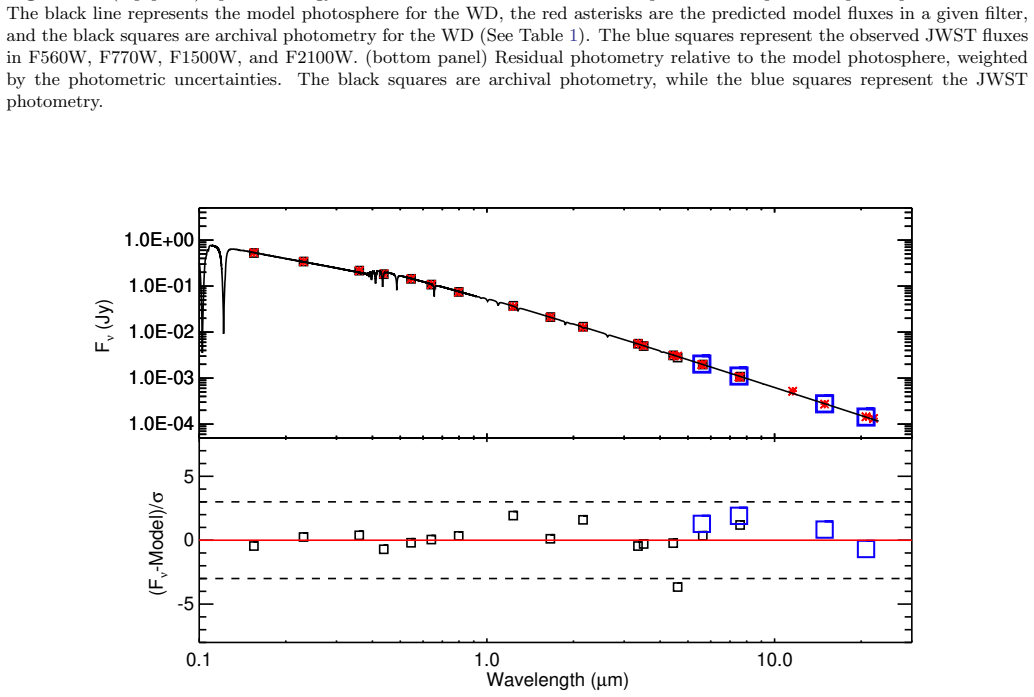
The central claim is that the excess flux at 21 microns around two of the four observed polluted white dwarfs is better explained by cool giant planets than by dust. Blackbody fits give emitting areas of roughly 0.25-0.7 Jupiter radii and temperatures below about 330 K, matching planetary radii. The standard warm dust disk at the Roche limit fits only at 2.76-3 sigma, and the intermediate and distant disks that fit better require dust at radii where the red-giant and asymptotic-giant phases should have removed small bodies. Because the excesses are unresolved and must lie within 8 au for WD 2149+021 and 4 au for WD 2105-820, the paper concludes that the most likely explanation is a jovian-mass planet of about 3 Jupiter masses at 203 K for WD 2149+021 and 1.4 Jupiter masses at 171 K for WD 2105-820.
Load-bearing premise
The argument that planets explain the excesses depends on the assumption that no physically plausible dust disk can: the favoured warm-disk model misses the 21-micron point by only 2.8-3 sigma, and the colder disks that fit better are dismissed using a model of how stellar evolution strips small bodies.
Editorial extensions
If this is right
- If the two excesses are confirmed as planets, roughly three of the four surveyed white dwarfs host at least one giant planet, an occurrence rate above 55% at 95% confidence under binomial statistics.
- WD 2105-820 would become the first white-dwarf multi-planet system, with an inner planet inside 4 au and a resolved companion at 34 au, implying dynamical interactions if both candidates are real.
- The excesses demonstrate that JWST/MIRI can detect faint debris configurations invisible to Spitzer and WISE, and a 5-13 micron MIRI/LRS spectrum can test warm-dust explanations by searching for the silicate feature.
- If the excesses are instead dust, a large fraction of polluted white dwarfs could have cool infrared excesses even at very low accretion rates, favouring lower-mass perturbers rather than giant planets.
Reading between the lines
- Because the warm-disk model is rejected at only 2.8-3 sigma and only one excess photometric point exists, the planet-versus-dust question will likely remain open until 18 or 25 micron photometry or a 10 micron silicate search is obtained; a planet spectrum peaks near 21 microns while warmer dust declines there.
- If the close-in planets are confirmed near the inferred separations, their location at or inside the survival radius predicted by red-giant engulfment models would motivate re-examining post-main-sequence tidal evolution and initially eccentric orbits.
- A volume-limited survey of all metal-polluted white dwarfs within 25 pc could turn the observed 75% candidate rate into a statistically meaningful occurrence measurement and test whether giant planets around white dwarfs are the rule rather than the exception.
Editorial analysis
A structured set of objections, weighed in public.
Referee Report
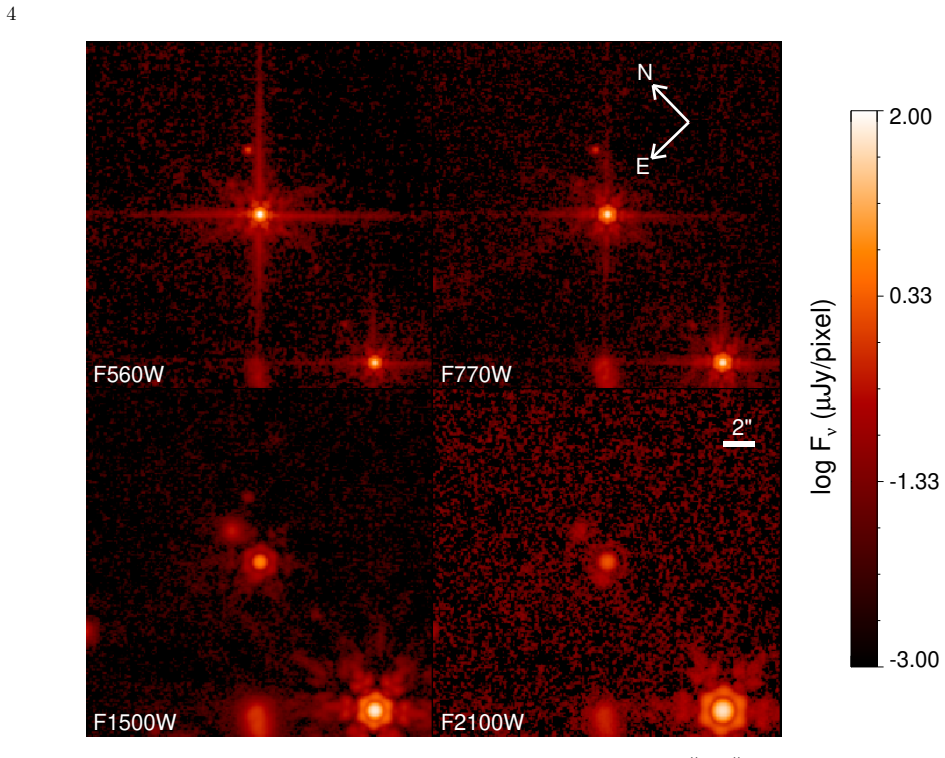
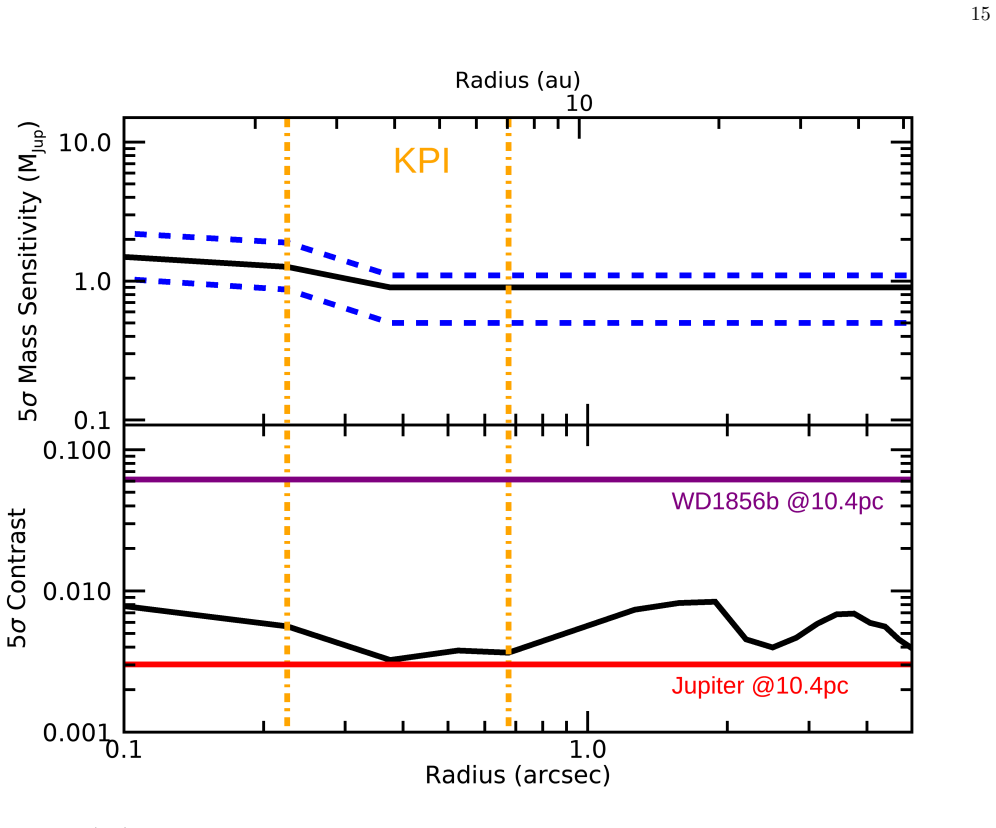
Summary. This paper presents JWST/MIRI Cycle 1 imaging of four nearby metal-polluted white dwarfs in four filters (F560W, F770W, F1500W, F2100W), reports resolved companion searches, and identifies significant 21 micron excesses around WD 2149+021 (5.1 sigma) and WD 2105-820 (5.6 sigma). The excesses are unresolved and are interpreted as candidate jovian-mass planets inside 8 au (WD 2149+021) and 4 au (WD 2105-820), with WD 2105-820 possibly hosting a second, resolved companion at 34 au. The paper argues that planets are the most likely explanation for the excesses, while conceding that no disk model can be entirely ruled out. It also reports the first MIRI F1500W kernel-phase imaging contrast limits for white dwarfs and places mass limits on unresolved companions for all four targets.
Significance. If the planet interpretation holds, this would be the first evidence for close-in giant planets around polluted white dwarfs and would bear directly on the architectures that drive white dwarf pollution. The observational excess detection is well supported: the calibration checks in Section 3.3 use 7-10 independent standards and show observed/model flux ratios of 1.00 plus or minus 0.02 in all four MIRI filters, and the relative flux comparison between similar white dwarfs independently corroborates the excess. The paper also makes a useful methodological contribution by applying kernel-phase imaging with MIRI for the first time. However, the central interpretive claim that planets are 'most likely' rests on a fragile exclusion of dust disk models, and the planet masses are inferred from the same excess used to argue for the planet. These weaknesses, discussed below, make the headline claim more model-dependent than the observationally robust excess detection itself.
major comments (4)
- [Section 6.2.1, Table 3] The rejection of the warm Roche-limit disk is too fragile to support the abstract's claim that planets are 'most likely.' The inner radius is fixed at the Roche limit (0.0055-0.006 au) rather than fitted, and the 21/15 micron flux ratio is governed primarily by the inner radius and temperature; a slightly more distant warm disk can plausibly satisfy both the F2100W excess and the F1500W upper limit. The quoted discrepancies of 2.76 sigma (WD 2149+021) and just over 3 sigma (WD 2105-820) are not stringent evidence of exclusion, especially given the 2% systematic calibration uncertainty acknowledged in Section 3.3. Since the text itself states that 'no disk model can be entirely ruled out,' the planet preference needs either a quantitative scan over the disk inner radius with propagated uncertainties or a substantially more cautious statement of what the data favor.
- [Section 6.2.3, Sections 6.1.2-6.1.3] The dismissal of the intermediate (0.05 au) and distant (3-3.3 au) disks rests on the Jura (2008) removal argument, but this is not a quantitative exclusion. The distant-disk model requires only 10^21-10^23 g of micron-sized dust (Table 3), and Jura (2008) as cited in the text leaves 1-10 km parent bodies that could collisionally replenish that dust after the RGB/AGB phases. No collisional cascade calculation or lifetime estimate is presented. The statement that intermediate and cold disks are 'not well physically motivated' is therefore a plausibility judgment, not a model comparison, and it cannot bear the weight of the 'planets more likely' conclusion.
- [Section 6.3, Table 4] The planet masses and effective temperatures are derived by fitting evolutionary atmosphere models to the same 21 micron excess that is used to argue the planet exists; the F1500W photometry is only 1.2-2.0 sigma above the model and does not provide an independent constraint. The quoted masses (3+3/-2 M_Jup and 1.4+0.4/-0.2 M_Jup) are therefore best described as a consistency check under an assumed planet interpretation, not as a characterization that breaks the planet-dust degeneracy. This circularity should be explicitly flagged, and the quoted uncertainties should include the systematic uncertainty in substellar cooling models at T_eff around 170-200 K, which the paper itself notes are 'largely untested' at those temperatures.
- [Section 7, Discussion] The occurrence-rate statement '4 detections in 4 trials' is inconsistent with the sample: only three of the four targets show a candidate (WD 2105-820, WD 2149+021, WD 1202-232), and WD 2105-820 has both a resolved candidate and an unresolved excess. Counting these as four independent detections in four trials inflates the binomial confidence behind the '>55% at 95% confidence' giant-planet occurrence estimate. The calculation should be redone with the correct number of independent stars, or explicitly presented as a scenario that assumes both excesses and both resolved candidates are confirmed.
minor comments (5)
- [Abstract, Section 2.1] The abstract refers to 'WD 2105-280', but the target is WD 2105-820 throughout the rest of the paper; this appears to be a typo.
- [Section 4, Section 6.3, Section 7] The transiting white dwarf companion is referred to inconsistently as 'WD 1858+584b', 'WD 1856+534b', and 'WD 1865+534b'; the same designation from Limbach et al. (2025) should be used everywhere.
- [Section 6.2.3] The text refers to 'G29-39' in the sentence about bright dusty white dwarfs, but the comparison source is G29-38 throughout the rest of the paper.
- [Section 6.1.3, Table 3] The text states a distant disk would require on the order of 10^25 g of material, while Table 3 lists distant-disk dust masses of 2.5 x 10^23 g and 4 x 10^21 g; since the table is explicitly for the 1-10^4 micron component only, the relationship between the two numbers should be clarified.
- [Figure 7 caption] The caption contains a typo: 'tenatative' should be 'tentative.'
Circularity Check
No significant circularity: the 21 µm excesses are measured against externally calibrated photospheric models, and the planet-over-dust preference is a stated, model-dependent comparison rather than a derivation from its own conclusion.
full rationale
The paper's central claim rests on externally anchored observations: the F2100W excesses are measured against photospheric models that were checked with independent MIRI calibration standards, yielding observed-to-model flux ratios of 1.00±0.02 in all four filters, and temporal sensitivity-systematics are ruled out using repeated observations of BD+60-1735. The planet interpretation is not assumed in the measurement; it is inferred by fitting blackbody and evolutionary-model SEDs to the same excess, which is standard parameter inference rather than a prediction forced by construction. The dust alternatives are modeled with MCFOST at three fixed inner radii, and the authors explicitly concede that 'no disk model can be entirely ruled out' and that the fits are 'by-eye,' which weakens the planet-vs-dust ranking as a matter of model uncertainty but does not make the ranking equivalent to the input data. The rejection of intermediate and cold dust disks rests on Jura (2008), an external theoretical model, not on a self-citation or an imported uniqueness theorem. Earlier candidate detections from Mullally et al. (2024) and Poulsen et al. (2024) are used as observational context, not as the logical premise for interpreting the new excesses. The admitted caveats—largely untested low-temperature atmosphere models, degenerate by-eye disk fits, and 2.76σ/just-over-3σ disk rejections—are correctness risks, not circular steps. The derivation chain is therefore self-contained: measured excess, then blackbody and evolutionary-model fits, then a quantitative model comparison with dust scenarios, then a stated preference, with no step whose premise equals its conclusion.
Assumptions & free parameters
free parameters (8)
- Photospheric Teff and logg (WD 2149+021) =
17840 K, logg 8.01
- Photospheric Teff and logg (WD 2105-820) =
9890 K, logg 8.20 (from Gentile Fusillo et al. 2018)
- Planet temperature and mass (WD 2149+021) =
203 plus or minus 16 K, 3+3/-2 MJup
- Planet temperature and mass (WD 2105-820) =
171 plus or minus 10 K, 1.4+0.4/-0.2 MJup
- Warm disk dust mass (both WDs) =
1.5e17 g each
- Intermediate disk dust mass =
3.4e18 g (WD 2105-820), 2.3e18 g (WD 2149+021)
- Distant disk dust mass =
2.5e23 g (WD 2105-820), 4e21 g (WD 2149+021)
- Geometric albedo for irradiated planet constraint =
0.3
assumptions (5)
- domain assumption WD atmosphere/cooling models (Bergeron/Bedard) accurately predict photospheric fluxes at 21 microns after scaling to UV spectra.
- domain assumption MIRI absolute flux calibration and time-dependent sensitivity correction are accurate to about 2% for F2100W.
- domain assumption Substellar evolutionary models (Sonora-Bobcat, Helios) remain valid at T about 170-250 K and ages 1.5-10 Gyr.
- domain assumption Material in the 0.05-3 AU region is removed during RGB/AGB evolution (Jura 2008), making intermediate and cold dust disks implausible.
- domain assumption RUWE less than 1.4 indicates no astrometric signal from a companion, implying planets interior to about 2 au.
invented entities (2)
-
Unresolved giant planet around WD 2149+021
-
Unresolved giant planet around WD 2105-820
Cite this review
Pith. "Pith review of Metal Polluted White Dwarfs with 21 {\mu}m IR excesses from JWST/MIRI: Planets or Dust?." pith.science (2026). https://pith.science/paper/WCW5YM62
@misc{pith2026250621224,
  author       = {Pith},
  title        = {Pith review of: Metal Polluted White Dwarfs with 21 \mum IR excesses from JWST/MIRI: Planets or Dust?},
  year         = {2026},
  howpublished = {\url{https://pith.science/paper/WCW5YM62}},
  note         = {Machine review of arXiv:2506.21224}
}
abstract
White dwarfs with metal pollution are caused by the accretion of rocky dust from tidally disrupted minor bodies and are signposts for planetary systems. These minor bodies are perturbed by planets that have survived post-main sequence evolution. Open questions exist as to the typical mass of the perturbers and the specific planetary architectures that cause metal pollution. JWST's sensitivity in the mid-IR has opened new doors to deciphering polluted white dwarfs. We present JWST Cycle 1 MIRI imaging of four nearby metal-polluted white dwarfs with the goal of detecting and characterizing planetary companions. With deep mid-IR imaging we are sensitive to cold Jupiter-mass planet analogs. In addition to finding two candidate planetary companions, for the first time we detect significant excesses above the expected photospheric emission at 21~$\mu$m for two of our targets, WD 2149+021 and WD 2105-820. WD 2105-280 has a candidate planetary companion at a projected separation of 34 au and an infrared excess--if both candidates are confirmed, it would represent the first WD multi-planet system. We investigate whether these excesses could be caused by very low luminosity warm dust disks or planets. While both are likely, we argue that the most likely explanation for the excesses is that they are the thermal emission from jovian-mass planets in orbits with semi-major axes $<$10 au, using a combination of observational constraints. If most of the candidate planets presented here are confirmed, it would suggest that metal polluted white dwarfs are frequently orbited by at least one giant planet.
Figures


Figures from the paper (14 more)






Forward citations
Cited by 2 Pith papers
-
White dwarfs within 13 pc: Insights from ultraviolet spectroscopy
UV spectroscopy of the 44 nearest white dwarfs reveals a 2–6% temperature discrepancy between UV and optical model fits, six UV-only metal detections, and a 30% planetary debris accretion rate.
-
Bounding destruction timescales of minor planets orbiting white dwarfs with the sesquinary catastrophe
Minor planets orbiting white dwarfs at 1-4 Roche radii can be destroyed by their own returning impact ejecta on timescales of 10^2 to 10^5 years.
Reference graph
Works this paper leans on
-
[1]
Bagnulo, S., & Landstreet, J. D. 2018, A&A, 618, A113, doi: 10.1051/0004-6361/201833235
-
[2]
Ballering, N. P., Levens, C. I., Su, K. Y. L., & Cleeves, L. I. 2022, ApJ, 939, 108, doi: 10.3847/1538-4357/ac9a4a B´ edard, A., Bergeron, P., Brassard, P., & Fontaine, G. 2020, ApJ, 901, 93, doi: 10.3847/1538-4357/abafbe
-
[3]
2017, ApJS, 230, 24, doi: 10.3847/1538-4365/aa7053
Bianchi, L., Shiao, B., & Thilker, D. 2017, ApJS, 230, 24, doi: 10.3847/1538-4365/aa7053
-
[4]
2000, Allen’s Astrophysical Quantities, 315, doi: 10.1007/978-1-4612-1186-0 13
Binzel, R., Hanner, M., & Steel, D. 2000, Allen’s Astrophysical Quantities, 315, doi: 10.1007/978-1-4612-1186-0 13
-
[5]
Bohlin, R. C., Gordon, K. D., & Tremblay, P. E. 2014, PASP, 126, 711, doi: 10.1086/677655
doi:10.1086/677655 2014
-
[6]
Bonsor, A., Farihi, J., Wyatt, M. C., & van Lieshout, R. 2017, MNRAS, 468, 154, doi: 10.1093/mnras/stx425 24
-
[7]
Bouchet, P., Garc ´ ıa-Mar ´ ın, M., Lagage, P. O., et al. 2015, PASP, 127, 612, doi: 10.1086/682254
doi:10.1086/682254 2015
-
[8]
Burleigh, M. R., Clarke, F. J., & Hodgkin, S. T. 2002, MNRAS, 331, L41, doi: 10.1046/j.1365-8711.2002.05417.x
arXiv 2002
Show all 67 references
-
[9]
2024, The Hubble Advanced Spectral Product (HASP) Program, Instrument Science Report COS 2024-01, 31 pages
Debes, J., Sankrit, R., Fischer, T., et al. 2024, The Hubble Advanced Spectral Product (HASP) Program, Instrument Science Report COS 2024-01, 31 pages
2024
-
[10]
H., & Sigurdsson, S
Debes, J. H., & Sigurdsson, S. 2002, ApJ, 572, 556, doi: 10.1086/340291
2002 doi
-
[11]
H., Sigurdsson, S., & Hansen, B
Debes, J. H., Sigurdsson, S., & Hansen, B. 2007, AJ, 134, 1662, doi: 10.1086/521394
2007 doi
-
[12]
H., Sigurdsson, S., & Woodgate, B
Debes, J. H., Sigurdsson, S., & Woodgate, B. E. 2005, AJ, 130, 1221, doi: 10.1086/432660
2005 doi
-
[13]
H., Walsh, K
Debes, J. H., Walsh, K. J., & Stark, C. 2012, ApJ, 747, 148, doi: 10.1088/0004-637X/747/2/148
2012 doi
-
[14]
G., Shivaei, I., et al
Dicken, D., Mar ´ ın, M. G., Shivaei, I., et al. 2024, A&A, 689, A5, doi: 10.1051/0004-6361/202449451
2024 doi
- [15]
-
[16]
1992, ApJS, 82, 505, doi: 10.1086/191728
Dupuis, J., Fontaine, G., Pelletier, C., & Wesemael, F. 1992, ApJS, 82, 505, doi: 10.1086/191728
1992 doi
-
[17]
J., & Greenstein, J
Eggen, O. J., & Greenstein, J. L. 1965, ApJ, 141, 83, doi: 10.1086/148091
1965 doi
-
[18]
C., Greaves, J
Farihi, J., Wyatt, M. C., Greaves, J. S., et al. 2014, MNRAS, 444, 1821, doi: 10.1093/mnras/stu1545
2014 doi
-
[19]
B., Mulders, G
Fernandes, R. B., Mulders, G. D., Pascucci, I., Mordasini, C., & Emsenhuber, A. 2019, ApJ, 874, 81, doi: 10.3847/1538-4357/ab0300 Gentile Fusillo, N. P., Tremblay, P. E., Jordan, S., et al. 2018, MNRAS, 473, 3693, doi: 10.1093/mnras/stx2584
2019 doi
-
[20]
D., Bohlin, R., Sloan, G
Gordon, K. D., Bohlin, R., Sloan, G. C., et al. 2022, AJ, 163, 267, doi: 10.3847/1538-3881/ac66dc
2022 doi
-
[21]
D., Sloan, G
Gordon, K. D., Sloan, G. C., Garcia Marin, M., et al. 2025, AJ, 169, 6, doi: 10.3847/1538-3881/ad8cd4
2025 doi
-
[22]
R., & Clarke, F
Hogan, E., Burleigh, M. R., & Clarke, F. J. 2009, MNRAS, 396, 2074, doi: 10.1111/j.1365-2966.2009.14565.x
2009
- [23]
-
[24]
B., Bruhweiler, F
Holberg, J. B., Bruhweiler, F. C., & Andersen, J. 1995, ApJ, 443, 753, doi: 10.1086/175565
1995 doi
-
[25]
M., & Solanki, S
Jordan, S., Aznar Cuadrado, R., Napiwotzki, R., Schmid, H. M., & Solanki, S. K. 2007, A&A, 462, 1097, doi: 10.1051/0004-6361:20066163
2007 doi
-
[26]
2003, ApJL, 584, L91, doi: 10.1086/374036 —
Jura, M. 2003, ApJL, 584, L91, doi: 10.1086/374036 —. 2008, AJ, 135, 1785, doi: 10.1088/0004-6256/135/5/1785
2003 doi
-
[27]
J., Martinache, F., & Girard, J
Kammerer, J., Ireland, M. J., Martinache, F., & Girard, J. H. 2019, MNRAS, 486, 639, doi: 10.1093/mnras/stz882
2019 doi
-
[28]
A., Vandal, T., et al
Kammerer, J., Cooper, R. A., Vandal, T., et al. 2023, PASP, 135, 014502, doi: 10.1088/1538-3873/ac9a74
2023 doi
-
[29]
D., Wickramasinghe, D
Kawka, A., Vennes, S., Schmidt, G. D., Wickramasinghe, D. T., & Koch, R. 2007, ApJ, 654, 499, doi: 10.1086/509072
2007 doi
-
[30]
J., & Bromley, B
Kenyon, S. J., & Bromley, B. C. 2017, ApJ, 850, 50, doi: 10.3847/1538-4357/aa9570
2017 doi
-
[31]
1997, MNRAS, 287, 867, doi: 10.1093/mnras/287.4.867
Chen, A. 1997, MNRAS, 287, 867, doi: 10.1093/mnras/287.4.867
1997 doi
-
[32]
T., & Farihi, J
Koester, D., G¨ ansicke, B. T., & Farihi, J. 2014, A&A, 566, A34, doi: 10.1051/0004-6361/201423691
2014 doi
-
[33]
2005, A&A, 432, 1025, doi: 10.1051/0004-6361:20041927
Koester, D., Rollenhagen, K., Napiwotzki, R., et al. 2005, A&A, 432, 1025, doi: 10.1051/0004-6361:20041927
2005 doi
-
[34]
Krishnanth, P. M. S., Douglas, E. S., Anche, R. M., et al. 2024, AJ, 168, 169, doi: 10.3847/1538-3881/ad6efe
2024 doi
-
[35]
D., Bagnulo, S., Valyavin, G
Landstreet, J. D., Bagnulo, S., Valyavin, G. G., et al. 2012, A&A, 545, A30, doi: 10.1051/0004-6361/201219829
2012 doi
-
[36]
A., Vanderburg, A., Stevenson, K
Limbach, M. A., Vanderburg, A., Stevenson, K. B., et al. 2022, MNRAS, 517, 2622, doi: 10.1093/mnras/stac2823
2022 doi
-
[37]
A., Vanderburg, A., Venner, A., et al
Limbach, M. A., Vanderburg, A., Venner, A., et al. 2024, ApJL, 973, L11, doi: 10.3847/2041-8213/ad74ed
2024 doi
-
[38]
A., Vanderburg, A., MacDonald, R
Limbach, M. A., Vanderburg, A., MacDonald, R. J., et al. 2025, ApJL, 984, L28, doi: 10.3847/2041-8213/adc9ad
2025 doi
-
[39]
F., Mordasini, C., Molli` ere, P., et al
Linder, E. F., Mordasini, C., Molli` ere, P., et al. 2019, A&A, 623, A85, doi: 10.1051/0004-6361/201833873
2019 doi
-
[40]
Luyten, W. J. 1949, ApJ, 109, 528, doi: 10.1086/145156
1949 doi
-
[41]
Ayres, T. R. 2014, ApJ, 787, 75, doi: 10.1088/0004-637X/787/1/75
2014 doi
-
[42]
J., G¨ ansicke, B
Manser, C. J., G¨ ansicke, B. T., Marsh, T. R., et al. 2016, MNRAS, 455, 4467, doi: 10.1093/mnras/stv2603
2016 doi
-
[43]
2021, Sonora Bobcat: cloud-free, substellar atmosphere models, spectra, photometry, evolution, and chemistry [Data set], Sonora Bobcat, Zenodo, doi: 10.5281/zenodo.5063476
Marley, M., Saumon, D., Morley, C., et al. 2021, Sonora Bobcat: cloud-free, substellar atmosphere models, spectra, photometry, evolution, and chemistry [Data set], Sonora Bobcat, Zenodo, doi: 10.5281/zenodo.5063476
2021 doi
-
[44]
C., Barstow, M
Marsh, M. C., Barstow, M. A., Buckley, D. A., et al. 1997, MNRAS, 287, 705, doi: 10.1093/mnras/287.4.705
1997 doi
-
[45]
2010, ApJ, 724, 464, doi: 10.1088/0004-637X/724/1/464
Martinache, F. 2010, ApJ, 724, 464, doi: 10.1088/0004-637X/724/1/464
2010 doi
-
[46]
C., Carter, A
Matthews, E. C., Carter, A. L., Pathak, P., et al. 2024, Nature, 633, 789, doi: 10.1038/s41586-024-07837-8
2024 doi
-
[47]
2004, A&A, 415, 391, doi: 10.1051/0004-6361:20034250
Mayor, M., Udry, S., Naef, D., et al. 2004, A&A, 415, 391, doi: 10.1051/0004-6361:20034250
2004 doi
-
[48]
E., Mullally, F., Albert, L., et al
Mullally, S. E., Mullally, F., Albert, L., et al. 2021, A Search for the Giant Planets that Drive White Dwarf
2021
-
[49]
Cycle 1, ID
Accretion, JWST Proposal. Cycle 1, ID. #1911
1911
-
[50]
E., Debes, J., Cracraft, M., et al
Mullally, S. E., Debes, J., Cracraft, M., et al. 2024, ApJL, 962, L32, doi: 10.3847/2041-8213/ad2348
2024 doi
-
[51]
J., & Villaver, E
Mustill, A. J., & Villaver, E. 2012, ApJ, 761, 121, doi: 10.1088/0004-637X/761/2/121 25
2012 doi
-
[52]
A., Lisker, T., et al
Napiwotzki, R., Karl, C. A., Lisker, T., et al. 2020, A&A, 638, A131, doi: 10.1051/0004-6361/201629648 O’Connor, C. E., Teyssandier, J., & Lai, D. 2022, MNRAS, 513, 4178, doi: 10.1093/mnras/stac1189
2020 doi
-
[53]
J., Min, M., et al
Pinte, C., Harries, T. J., Min, M., et al. 2009, A&A, 498, 967, doi: 10.1051/0004-6361/200811555
2009 doi
-
[54]
2006, A&A, 459, 797, doi: 10.1051/0004-6361:20053275
Pinte, C., M´ enard, F., Duchˆ ene, G., & Bastien, P. 2006, A&A, 459, 797, doi: 10.1051/0004-6361:20053275
2006 doi
-
[55]
2013, ApJ, 767, 110, doi: 10.1088/0004-637X/767/2/110
Pope, B., Martinache, F., & Tuthill, P. 2013, ApJ, 767, 110, doi: 10.1088/0004-637X/767/2/110
2013 doi
-
[56]
2024, AJ, 167, 257, doi: 10.3847/1538-3881/ad374c
Poulsen, S., Debes, J., Cracraft, M., et al. 2024, AJ, 167, 257, doi: 10.3847/1538-3881/ad374c
2024 doi
-
[57]
T., Lisse, C., von Hippel, T., & Mullally, F
Reach, W. T., Lisse, C., von Hippel, T., & Mullally, F. 2009, ApJ, 693, 697, doi: 10.1088/0004-637X/693/1/697
2009 doi
-
[58]
F., et al
Rodrigo, C., Cruz, P., Aguilar, J. F., et al. 2024, A&A, 689, A93, doi: 10.1051/0004-6361/202449998
2024 doi
-
[59]
2021, ApJ, 911, 25, doi: 10.3847/1538-4357/abc262
Steele, A., Debes, J., Xu, S., Yeh, S., & Dufour, P. 2021, ApJ, 911, 25, doi: 10.3847/1538-4357/abc262
2021 doi
-
[60]
B., Sanduleak, N., & Hoffleit, D
Stephenson, C. B., Sanduleak, N., & Hoffleit, D. 1968, PASP, 80, 92, doi: 10.1086/128591 van Maanen, A. 1919, PASP, 31, 42, doi: 10.1086/122810
1968 doi
-
[61]
2018, MNRAS, 473, 2871, doi: 10.1093/mnras/stx2141
Veras, D., Xu, S., & Rebassa-Mansergas, A. 2018, MNRAS, 473, 2871, doi: 10.1093/mnras/stx2141
2018 doi
-
[62]
2025, ApJL, 982, L38, doi: 10.3847/2041-8213/adbd46
Voyer, M., Changeat, Q., Lagage, P.-O., et al. 2025, ApJL, 982, L38, doi: 10.3847/2041-8213/adbd46
2025 doi
-
[63]
1978, MNRAS, 182, 111, doi: 10.1093/mnras/182.2.111
Wegner, G. 1978, MNRAS, 182, 111, doi: 10.1093/mnras/182.2.111
1978 doi
-
[64]
W., Koester, D., et al
Wolff, B., Kruk, J. W., Koester, D., et al. 2001, A&A, 373, 674, doi: 10.1051/0004-6361:20010612
2001 doi
-
[65]
2014, ApJ, 783, 79, doi: 10.1088/0004-637X/783/2/79
Xu, S., Jura, M., Koester, D., Klein, B., & Zuckerman, B. 2014, ApJ, 783, 79, doi: 10.1088/0004-637X/783/2/79
2014 doi
-
[66]
N., & H¨ unsch, M
Zuckerman, B., Koester, D., Reid, I. N., & H¨ unsch, M. 2003, ApJ, 596, 477, doi: 10.1086/377492
2003 doi
-
[67]
Zuckerman, B., & Reid, I. N. 1998, ApJL, 505, L143, doi: 10.1086/311608
1998 doi
Reviewed August 6, 2026 · model on record in the stance chip above.
Discussion (0). Continue with ORCID to comment.