REVIEW 5 major objections 5 minor 1 cited by
DiMPLe -- Disentangled Multi-Modal Prompt Learning: Enhancing Out-Of-Distribution Alignment with Invariant and Spurious Feature Separation
T0 review · 5 major / 5 minor · reviewed 2026-08-06 · deepseek-v4-flash
Pith's one-line read DiMPLe claims that out-of-distribution generalization in prompt-tuned CLIP requires disentangling spurious from invariant features in the text branch as well as the image branch.
desk verdict Headline gains are an artifact of a broken CoOp-OOD baseline; the real improvement over the proper control is far smaller. read the letter →
The pith
A machine-rendered reading of the paper's core claim, the machinery that carries it, and where it could break.
The reading
What carries the argument
The load-bearing object is the disentangled multi-modal feature decomposition: image features $z_i^v$ and text features $z_i^t$ are each projected by separate linear heads into an invariant part ($z_{i,u}^v$, $z_{i,u}^t$) and a spurious part ($z_{i,s}^v$, $z_{i,s}^t$), and the training loss $L = L_{ce}^u + \alpha L_{sp}^r + \beta L_{cmi}$ enforces that the two parts carry separate information and that only invariant features drive classification. The conditional-mutual-information term $L_{cmi} = I(z_{i,u}; z_{i,s} \mid Y)$ is computed per modality using a Hilbert-Schmidt independence criterion estimator, which is what gives the word 'disentangled' its operational meaning here. The coupling of vision prompts to language prompts through a learned linear map is what makes the disentanglement multi-modal rather than two independent single-modal decouplings.
What would settle it
Re-run CoOp-OOD with the official code under the paper's exact protocol (ViT-B/16, 16 shots, 5 epochs, learning rate 0.0035). If ImageNet base accuracy returns to the published range near 66 percent and average novel accuracy exceeds 60 percent, rather than the 38.7 and 29.04 reported here, the headline advantage is a baseline artifact.
Extended reading notes
Core claim
The central claim is that disentangling invariant from spurious features in both the vision and language streams, and mapping each to its counterpart in the other modality, removes the cross-modal ambiguity that makes image-only disentanglement (CoOp-OOD) collapse on novel classes. DiMPLe does this with three objectives: a conditional-mutual-information penalty, estimated with HSIC, that makes invariant and spurious features independent given the class label within each modality; a spurious-feature regularization that drives predictions based on spurious features toward a uniform distribution; and a cross-entropy alignment that matches only invariant image features to invariant text features. These are combined with deep multi-modal prompting in which vision prompts are generated as a linear projection of language prompts, following the MaPLe design. On the paper's reported numbers, the method reaches an average harmonic mean of 74.70 across 11 base-to-novel benchmarks, stays within about one point of zero-shot CLIP on four of five ImageNet shift datasets, and lifts CelebA worst-group accuracy from 31.11 to 70.0 without group labels.
Load-bearing premise
The claimed advantages are measured against the paper's own implementation of CoOp-OOD; if that implementation is weaker than the published method, the absolute gains of 15.27 and 44.31 points do not hold.
Editorial extensions
If this is right
- If the reported numbers hold, a prompt-tuned CLIP can exceed zero-shot CLIP on the source domain (69.73 vs 66.73 on ImageNet) while staying competitive on ImageNetV2, ImageNet-Sketch, and ImageNet-R.
- The 44.31-point average novel-class gain implies the disentangled invariant features transfer to classes never seen during training, which is the main failure mode CoOp-OOD was designed to fix.
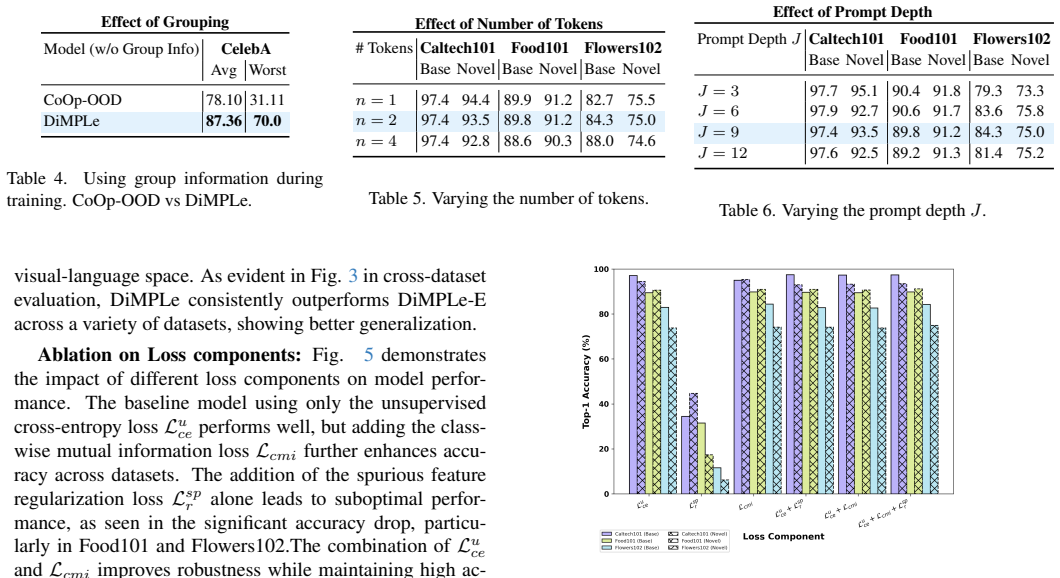
- The CelebA result suggests the method reduces reliance on spurious attributes such as gender for hair-color prediction without needing group annotations, improving worst-group accuracy by 38.9 points.
- Because only 3.28 percent of parameters are trainable and training runs just five epochs, the claimed gains are attributed to the loss design rather than model scale or long fine-tuning.
Reading between the lines
- The headline gains are relative to the paper's own CoOp-OOD numbers, and those numbers (ImageNet source accuracy 38.7, average novel accuracy 29.04) are far below published CoOp-OOD results; a faithful re-implementation would likely close most of the 44.31-point gap.
- The HSIC-based conditional mutual information estimator is used with a batch size of 4, which is small for kernel-based independence tests; a testable extension is to check whether the three losses remain balanced at larger batch sizes or under different HSIC kernel widths.
- The same cross-modal spurious alignment could be applied to other large vision-language models or to open-vocabulary detection, where the paper's central mechanism of aligning spurious text components with spurious image components is not specific to image classification.
Editorial analysis
A structured set of objections, weighed in public.
Referee Report
Summary. The paper proposes DiMPLe, a prompt-tuning method for CLIP that jointly disentangles invariant and spurious features in both vision and language branches. The method combines three objectives: conditional mutual information minimization between invariant and spurious features, spurious-feature regularization, and a contrastive alignment loss on invariant features, along with deep vision-language prompting in which vision prompts are conditioned on language prompts. The authors report experiments on base-to-novel generalization over 11 datasets, domain generalization on four ImageNet variants, and cross-dataset transfer, comparing against CLIP, CoOp-OOD, and two self-created variants of CoOp-OOD.
Significance. The idea of extending feature disentanglement to the text modality is interesting and the objective in Eq. (10) is clearly stated. The paper also provides ablations on loss components, prompt depth, token count, and a CelebA worst-group analysis, which are useful. However, the empirical validation is not reliable: the CoOp-OOD baseline appears to be a severely weakened reimplementation, the paper's own controlled baseline (CoOp-OOD†) shrinks the headline novel-class gain from 44.31 to 7.75 points, and no comparisons are made against standard prompt-tuning methods such as CoOp, Co-CoOp, MaPLe, or CLIP-OOD. The absence of error bars and code further weakens the central empirical claims. If the method were evaluated properly against strong baselines and the claims were revised accordingly, the contribution could be of interest, but as presented the headline results are not supported.
major comments (5)
- [Table 2 / Table 3a] The CoOp-OOD baseline is not a faithful implementation of the published method. On ImageNet it achieves only 38.7% accuracy versus 66.73% for CLIP (Table 2), and its average novel-class accuracy is 29.04% versus 74.22% for CLIP (Table 3a). Published CoOp-OOD results are substantially higher, and the paper's own CoOp-OOD† variant, which merely adds conditioned vision prompts to the same loss functions, jumps to 65.60% average novel accuracy. Adding vision prompts cannot plausibly yield a 36.56-point improvement if the base implementation were correct. Therefore the headline gains of 15.27 base and 44.31 novel reported in the abstract and §4.1 are computed against a broken baseline; against the paper's own controlled baseline CoOp-OOD†, the gains are 13.37 base and 7.75 novel (Table 3a).
- [Table 1] The comparison between CoOp-OOD* and DiMPLe* in Table 1 is a further red flag. With identical independent vision-language prompting, DiMPLe* improves base accuracy from 25.99% to 76.73% and novel accuracy from 29.98% to 72.36% solely by adding the disentanglement losses. A 50-point base-accuracy jump cannot credibly be attributed to the proposed losses, confirming that the CoOp-OOD implementation is undertrained or missing essential components. This makes the central empirical claim of the paper untrustworthy.
- [§4, Table 3] The paper never compares against actual prompt-tuning baselines such as CoOp, Co-CoOp, MaPLe, or CLIP-OOD, even though the deep prompting backbone in Eqs. (4)-(6) is directly based on MaPLe. Without these comparisons, it is impossible to determine whether the reported improvements come from the disentanglement losses or from adopting a stronger prompting architecture. The closest controlled comparison, CoOp-OOD†, shows only a 7.75-point novel-class gain for DiMPLe, which is not sufficient to establish the contribution of the proposed disentanglement mechanism.
- [§3.1, Eq. (3)] Equation (3) defines Lcmi_v as I(zi,s; zi,s|Y), which is identically zero by the properties of mutual information; the intended quantity is I(zi,u; zi,s|Y). Additionally, the practical estimator is not described: the paper cites [14] for HSIC but does not explain how the conditional mutual information is computed, what kernels are used, or how the class variable enters the estimator. This makes the core objective non-reproducible.
- [Implementation Details, §4] The paper states that results are averaged over 3 runs but provides no standard deviations or confidence intervals. Several reported differences are small (e.g., 61.2 vs. 60.83 on ImageNetV2 in Table 2), so without variance estimates these differences are not shown to be statistically meaningful. The paper also states that code will be released upon acceptance, but no code or seeds are provided, which precludes verification of the unusual baseline numbers and the claimed gains.
minor comments (5)
- [Abstract] The sentence 'Extensive experiments demonstrate DiMPLe demonstrates superior performance' contains a repeated verb; it should read 'Extensive experiments demonstrate that DiMPLe achieves superior performance...'.
- [Table 3(c)] The model name is spelled 'DiMPle' in the Caltech101 panel; it should be 'DiMPLe' for consistency.
- [§4 and Table 1] The capitalization of 'CoOp-OOD' is inconsistent (e.g., 'CoOP-OOD' in Table 1 versus 'CoOp-OOD' in the text).
- [§4.3] The cross-dataset evaluation refers to Fig. 3 for specific numbers such as OxfordPets 85.67%, but Fig. 3 is a radar plot and the underlying quantitative table is not provided, making these numbers difficult to verify.
- [Supplementary Eq. (11)] The equation is malformed: 'exp(sim(ztest, wc)/τ )PC' should be a fraction, presumably exp(sim(ztest, wc)/τ) divided by the sum over class similarities.
Circularity Check
No significant circularity: the benchmark claims are held-out measurements against external baselines; the only mildly self-confirming element is the t-SNE figure displaying the very cross-modal alignment that the training loss already optimizes.
-
self definitional
[Section 4.4 (Results Discussion) and Fig. 4 caption]
"This empirically shows how the textual invariant features (star) are aligned with the image invariant features (circle) whereas the textual spurious features (triangle) which are closer to the image spurious features are well separated from the invariant ones."
The alignment the figure presents as an 'empirical' demonstration (invariant text features near invariant image features) is precisely the quantity the training objective L^u_ce (Eq. 7-8) is defined to maximize: sim(z^v_i,u, z^t_i,u) between the same projected features phi_v and phi_t that are plotted. The figure therefore illustrates the optimized objective by construction and cannot independently confirm the disentanglement mechanism. This is minor and non-load-bearing: the headline claims (Table 3 gains over CoOp-OOD; Table 2 domain-generalization vs CLIP) are held-out benchmark measurements against external baselines and are not defined by DiMPLe's own equations.
full rationale
DiMPLe is an empirical combination paper: it adds a text-side disentanglement term and MaPLe-style conditioned vision prompts to the CoOp-OOD objective and measures base/novel and domain-shift accuracy on held-out data. Walking the derivation chain, no predicted quantity is defined by the method's own equations: novel-class accuracy, worst-group accuracy, and OOD accuracies are external measurements; hyperparameters (prompt depth, token count, alpha, beta) are tuned, but tuning is fitting, not circular prediction. The reference list contains no work by the present authors (Rahman, Yaqub, Mahapatra), so the self-citation patterns do not arise; the HSIC estimator [14], MaPLe coupling [15], and CoOp-OOD framework [29] are all external, and each is used as a component rather than as an unexamined premise forcing the conclusions. The only mildly self-confirming element is the Fig. 4 t-SNE, which displays the invariant-alignment that Eq. 7-8 already optimize; it is illustrative and does not carry the paper's quantitative claims. Separately, the claimed 44.31 novel-class gain is computed against a CoOp-OOD implementation whose own Table 2 score (38.7 ImageNet vs CLIP 66.73) is far below published CoOp-OOD results, and the paper-introduced CoOp-OOD-dagger baseline narrows the novel gain to 7.75; this is a baseline-fidelity and claim-attribution (correctness) concern, not circularity, since the baseline is an external method whose numbers are measured rather than derived from DiMPLe. Overall the derivation is self-contained against independent benchmarks; score 1 reflects the single non-load-bearing self-definitional illustration.
Assumptions & free parameters
free parameters (3)
- alpha (spurious loss weight) =
not reported
- beta (conditional MI weight) =
not reported
- prompt depth J and token count b =
J=9, b=2 for base-to-novel; J=3 for cross-dataset
assumptions (3)
- domain assumption CLIP's frozen encoders provide representations that can be linearly separated into invariant and spurious components.
- ad hoc to paper The HSIC-based estimator cited in [14] computes conditional mutual information as required by Eq. (3).
- domain assumption Spurious text features can be meaningfully extracted from class-name prompts and aligned with spurious visual features.
Cite this review
Pith. "Pith review of DiMPLe -- Disentangled Multi-Modal Prompt Learning: Enhancing Out-Of-Distribution Alignment with Invariant and Spurious Feature Separation." pith.science (2026). https://pith.science/paper/NS2AW5O6
@misc{pith2026250621237,
  author       = {Pith},
  title        = {Pith review of: DiMPLe -- Disentangled Multi-Modal Prompt Learning: Enhancing Out-Of-Distribution Alignment with Invariant and Spurious Feature Separation},
  year         = {2026},
  howpublished = {\url{https://pith.science/paper/NS2AW5O6}},
  note         = {Machine review of arXiv:2506.21237}
}
read the original abstract
We introduce DiMPLe (Disentangled Multi-Modal Prompt Learning), a novel approach to disentangle invariant and spurious features across vision and language modalities in multi-modal learning. Spurious correlations in visual data often hinder out-of-distribution (OOD) performance. Unlike prior methods focusing solely on image features, DiMPLe disentangles features within and across modalities while maintaining consistent alignment, enabling better generalization to novel classes and robustness to distribution shifts. Our method combines three key objectives: (1) mutual information minimization between invariant and spurious features, (2) spurious feature regularization, and (3) contrastive learning on invariant features. Extensive experiments demonstrate DiMPLe demonstrates superior performance compared to CoOp-OOD, when averaged across 11 diverse datasets, and achieves absolute gains of 15.27 in base class accuracy and 44.31 in novel class accuracy.
Figures


Figures from the paper (3 more)


Forward citations
Cited by 1 Pith paper
-
Decoupling Clinical and Class-Agnostic Features for Reliable Few-Shot Adaptation under Shift
DRiFt explicitly decouples clinical from class-agnostic features in medical vision-language models and reports improved few-shot accuracy, but robustness under domain shift is not consistently supported.
Reference graph
Works this paper leans on
-
[14]
Nystr ¨om m-hilbert- schmidt independence criterion, 2023
Florian Kalinke and Zolt ´an Szab ´o. Nystr ¨om m-hilbert- schmidt independence criterion, 2023. 4
work page 2023
-
[1]
Flamingo: a visual language model for few-shot learning
Jean-Baptiste Alayrac, Jeff Donahue, Pauline Luc, Antoine Miech, Iain Barr, Yana Hasson, Karel Lenc, Arthur Men- sch, Katherine Millican, Malcolm Reynolds, et al. Flamingo: a visual language model for few-shot learning. Advances in neural information processing systems, 35:23716–23736,
-
[2]
Food-101–mining discriminative components with random forests
Lukas Bossard, Matthieu Guillaumin, and Luc Van Gool. Food-101–mining discriminative components with random forests. In Computer vision–ECCV 2014: 13th European conference, zurich, Switzerland, September 6-12, 2014, pro- ceedings, part VI 13, pages 446–461. Springer, 2014. 5
2014
-
[3]
Describing textures in the wild
Mircea Cimpoi, Subhransu Maji, Iasonas Kokkinos, Sammy Mohamed, and Andrea Vedaldi. Describing textures in the wild. In Proceedings of the IEEE conference on computer vision and pattern recognition, pages 3606–3613, 2014. 5
2014
-
[4]
Imagenet: A large-scale hierarchical image database
Jia Deng, Wei Dong, Richard Socher, Li-Jia Li, Kai Li, and Li Fei-Fei. Imagenet: A large-scale hierarchical image database. In 2009 IEEE conference on computer vision and pattern recognition, pages 248–255. Ieee, 2009. 4
2009
-
[5]
Learning to prompt for open-vocabulary ob- ject detection with vision-language model
Yu Du, Fangyun Wei, Zihe Zhang, Miaojing Shi, Yue Gao, and Guoqi Li. Learning to prompt for open-vocabulary ob- ject detection with vision-language model. InProceedings of the IEEE/CVF Conference on Computer Vision and Pattern Recognition, pages 14084–14093, 2022. 1
work page 2022
-
[6]
Li Fei-Fei, Rob Fergus, and Pietro Perona. Learning gener- ative visual models from few training examples: An incre- mental bayesian approach tested on 101 object categories. In 2004 conference on computer vision and pattern recognition workshop, pages 178–178. IEEE, 2004. 4
work page 2004
-
[7]
Open-vocabulary object detection via vision and language knowledge distillation
Xiuye Gu, Tsung-Yi Lin, Weicheng Kuo, and Yin Cui. Open-vocabulary object detection via vision and language knowledge distillation. arXiv preprint arXiv:2104.13921 ,
Show all 32 references
-
[8]
Eurosat: A novel dataset and deep learning benchmark for land use and land cover classification
Patrick Helber, Benjamin Bischke, Andreas Dengel, and Damian Borth. Eurosat: A novel dataset and deep learning benchmark for land use and land cover classification. IEEE Journal of Selected Topics in Applied Earth Observations and Remote Sensing, 12(7):2217–2226, 2019. 5
2019
-
[9]
The many faces of robust- ness: A critical analysis of out-of-distribution generalization
Dan Hendrycks, Steven Basart, Norman Mu, Saurav Kada- vath, Frank Wang, Evan Dorundo, Rahul Desai, Tyler Zhu, Samyak Parajuli, Mike Guo, et al. The many faces of robust- ness: A critical analysis of out-of-distribution generalization. In Proceedings of the IEEE/CVF internation...
2021
-
[10]
Natural adversarial examples
Dan Hendrycks, Kevin Zhao, Steven Basart, Jacob Stein- hardt, and Dawn Song. Natural adversarial examples. In Proceedings of the IEEE/CVF conference on computer vi- sion and pattern recognition, pages 15262–15271, 2021. 5
2021
-
[11]
Scaling up visual and vision-language representa- tion learning with noisy text supervision
Chao Jia, Yinfei Yang, Ye Xia, Yi-Ting Chen, Zarana Parekh, Hieu Pham, Quoc Le, Yun-Hsuan Sung, Zhen Li, and Tom Duerig. Scaling up visual and vision-language representa- tion learning with noisy text supervision. In International conference on machine learning, pages 4904–4916. PMLR,
-
[12]
Vi- sual prompt tuning
Menglin Jia, Luming Tang, Bor-Chun Chen, Claire Cardie, Serge Belongie, Bharath Hariharan, and Ser-Nam Lim. Vi- sual prompt tuning. In European Conference on Computer Vision, pages 709–727. Springer, 2022. 2
2022
-
[13]
A good prompt is worth millions of pa- rameters: Low-resource prompt-based learning for vision- language models
Woojeong Jin, Yu Cheng, Yelong Shen, Weizhu Chen, and Xiang Ren. A good prompt is worth millions of pa- rameters: Low-resource prompt-based learning for vision- language models. arXiv preprint arXiv:2110.08484 , 2021. 2
2021 arXiv
-
[15]
Maple: Multi-modal prompt learning
Muhammad Uzair Khattak, Hanoona Rasheed, Muhammad Maaz, Salman Khan, and Fahad Shahbaz Khan. Maple: Multi-modal prompt learning. In Proceedings of the IEEE/CVF Conference on Computer Vision and Pattern Recognition, pages 19113–19122, 2023. 2, 3
2023
-
[16]
3d object representations for fine-grained categorization
Jonathan Krause, Michael Stark, Jia Deng, and Li Fei-Fei. 3d object representations for fine-grained categorization. In Proceedings of the IEEE international conference on com- puter vision workshops, pages 554–561, 2013. 4
2013
-
[17]
Blip-2: Bootstrapping language-image pre-training with frozen image encoders and large language models
Junnan Li, Dongxu Li, Silvio Savarese, and Steven Hoi. Blip-2: Bootstrapping language-image pre-training with frozen image encoders and large language models. In In- ternational conference on machine learning , pages 19730– 19742. PMLR, 2023. 1, 2
2023
-
[18]
Fine-grained visual classi- fication of aircraft
Subhransu Maji, Esa Rahtu, Juho Kannala, Matthew Blaschko, and Andrea Vedaldi. Fine-grained visual classi- fication of aircraft. arXiv preprint arXiv:1306.5151 , 2013. 5
2013 arXiv
-
[19]
Automated flower classification over a large number of classes
Maria-Elena Nilsback and Andrew Zisserman. Automated flower classification over a large number of classes. In 2008 Sixth Indian conference on computer vision, graphics & im- age processing, pages 722–729. IEEE, 2008. 4
2008
-
[20]
Cats and dogs
Omkar M Parkhi, Andrea Vedaldi, Andrew Zisserman, and CV Jawahar. Cats and dogs. In 2012 IEEE conference on computer vision and pattern recognition, pages 3498–3505. IEEE, 2012. 4
2012
-
[21]
Learning transferable visual models from natural language supervi- sion
Alec Radford, Jong Wook Kim, Chris Hallacy, Aditya Ramesh, Gabriel Goh, Sandhini Agarwal, Girish Sastry, Amanda Askell, Pamela Mishkin, Jack Clark, et al. Learning transferable visual models from natural language supervi- sion. In International conference on machine learning, ...
2021
-
[22]
Do imagenet classifiers generalize to im- agenet? In International conference on machine learning , pages 5389–5400
Benjamin Recht, Rebecca Roelofs, Ludwig Schmidt, and Vaishaal Shankar. Do imagenet classifiers generalize to im- agenet? In International conference on machine learning , pages 5389–5400. PMLR, 2019. 5
2019
-
[23]
Clipood: Generalizing clip to out-of-distributions
Yang Shu, Xingzhuo Guo, Jialong Wu, Ximei Wang, Jian- min Wang, and Mingsheng Long. Clipood: Generalizing clip to out-of-distributions. In International Conference on Machine Learning, pages 31716–31731. PMLR, 2023. 3
2023
-
[24]
Flava: A foundational language and vision alignment model
Amanpreet Singh, Ronghang Hu, Vedanuj Goswami, Guil- laume Couairon, Wojciech Galuba, Marcus Rohrbach, and Douwe Kiela. Flava: A foundational language and vision alignment model. In Proceedings of the IEEE/CVF Con- ference on Computer Vision and Pattern Recognition, pages 1563...
2022
-
[25]
Ucf101: A dataset of 101 human actions classes from videos in the wild
K Soomro. Ucf101: A dataset of 101 human actions classes from videos in the wild. arXiv preprint arXiv:1212.0402 ,
-
[26]
Learning robust global representations by penalizing local predictive power.Advances in Neural Information Pro- cessing Systems, 32, 2019
Haohan Wang, Songwei Ge, Zachary Lipton, and Eric P Xing. Learning robust global representations by penalizing local predictive power.Advances in Neural Information Pro- cessing Systems, 32, 2019. 5
2019
-
[27]
Sun database: Large-scale scene recognition from abbey to zoo
Jianxiong Xiao, James Hays, Krista A Ehinger, Aude Oliva, and Antonio Torralba. Sun database: Large-scale scene recognition from abbey to zoo. In 2010 IEEE computer so- ciety conference on computer vision and pattern recognition, pages 3485–3492. IEEE, 2010. 5
2010
-
[28]
Cpt: Colorful prompt tuning for pre-trained vision-language models
Yuan Yao, Ao Zhang, Zhengyan Zhang, Zhiyuan Liu, Tat- Seng Chua, and Maosong Sun. Cpt: Colorful prompt tuning for pre-trained vision-language models. AI Open, 5:30–38,
-
[29]
Amend to alignment: De- coupled prompt tuning for mitigating spurious correlation in vision-language models
Jie Zhang, Xiaosong Ma, Song Guo, Peng Li, Wenchao Xu, Xueyang Tang, and Zicong Hong. Amend to alignment: De- coupled prompt tuning for mitigating spurious correlation in vision-language models. In Forty-first International Confer- ence on Machine Learning. 1, 3, 5
-
[30]
Conditional prompt learning for vision-language mod- els
Kaiyang Zhou, Jingkang Yang, Chen Change Loy, and Ziwei Liu. Conditional prompt learning for vision-language mod- els. In Proceedings of the IEEE/CVF conference on com- puter vision and pattern recognition , pages 16816–16825,
-
[31]
Learning to prompt for vision-language models
Kaiyang Zhou, Jingkang Yang, Chen Change Loy, and Ziwei Liu. Learning to prompt for vision-language models. In- ternational Journal of Computer Vision, 130(9):2337–2348,
-
[32]
a photo of a [CLASS]
Beier Zhu, Yulei Niu, Yucheng Han, Yue Wu, and Han- wang Zhang. Prompt-aligned gradient for prompt tuning. In Proceedings of the IEEE/CVF International Conference on Computer Vision, pages 15659–15669, 2023. 2 DiMPLe - Disentangled Multi-Modal Prompt Learning: Enhancing Out-Of...
2023
Reviewed August 6, 2026 · model on record in the stance chip above.
Discussion (0). Continue with ORCID to comment.