REVIEW 5 major objections 6 minor 1 cited by
WordCon: Word-level Typography Control in Scene Text Rendering
T0 review · 5 major / 6 minor · reviewed 2026-08-06 · deepseek-v4-flash
Pith's one-line read The paper claims that precise word-level typography control (bold, italic, underline per word) in text-to-image generation is achieved by a hybrid PEFT method, WordCon, that reparameterizes selective attention parameters and adds…
desk verdict Real problem, plausible method, but the headline win is built on 21 GPT4o-judged prompts and the 'significantly outperforming' claim does not survive a significance check. read the letter →
The pith
A machine-rendered reading of the paper's core claim, the machinery that carries it, and where it could break.
The reading
What carries the argument
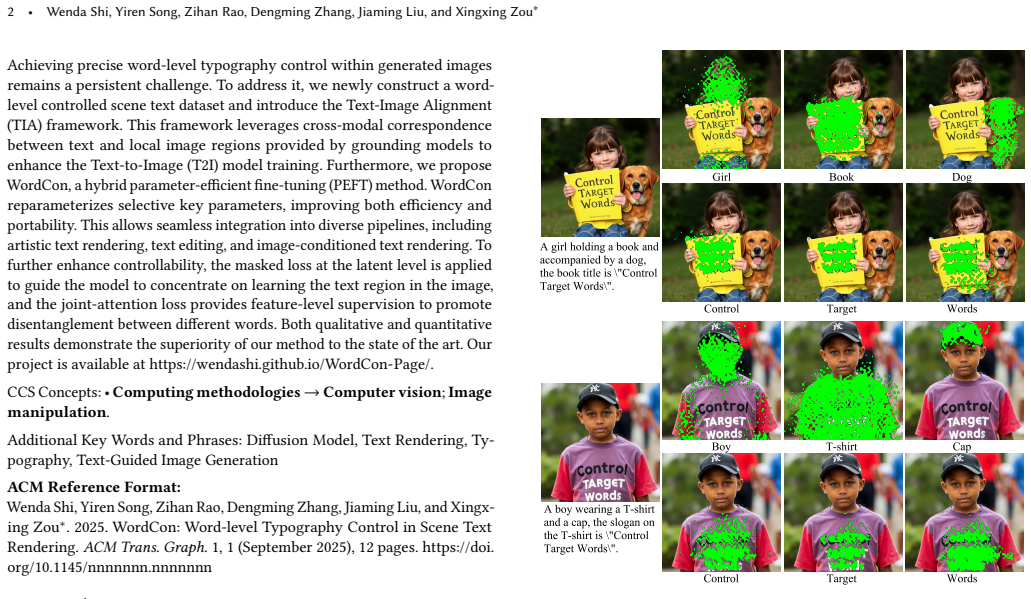
The mechanism has three components. First, the masked latent loss reweights the rectified-flow conditional flow matching objective by the union of word-level segmentation masks, forcing the model to spend capacity on the pixels that will become text. Second, the joint-attention loss extends the cross-attention loss from UNet-based diffusion to the joint attention of Double-DiT layers, using grounding-model masks as supervision so each word token attends only to its own target region. Third, WordCon reparameterizes the text-attention key and value projections inside joint attention as low-rank (LoRA-style) adapters rather than fine-tuning them directly, which the paper argues preserves parameter efficiency and makes the trained module a plug-in for other pipelines. Together these components operationalize the TIA framework's dual information flow: masks from a grounding model supervise both the latent space and the attention space of the generating model.
What would settle it
Run the identical 21-prompt word-control evaluation on real photographs (street signs, storefronts, T-shirts) rather than generated images, asking the model to restyle a specified word; if total word-control accuracy falls to near the untuned Flux level (14.29%) or far below the synthetic 71.43%, the synthetic-to-real transfer claim is falsified. A complementary check is to measure the IoU between each word's joint-attention map and its grounding-model mask on a held-out real set; if attention alignment gains vanish outside the synthetic distribution, the proposed mechanism is the likely failure point.
Extended reading notes
Core claim
WordCon's central claim is that word-level typography control in scene text rendering is achievable by aligning each word's attention region with its ground-truth pixel mask during diffusion training. The authors first demonstrate that vanilla fine-tuning of Flux on a word-level dataset leaves total accuracy far below type accuracy, meaning the model applies the right style to the wrong word. They then show that adding the joint-attention loss—an extension of cross-attention loss to the DiT joint attention that pulls each word's attention map toward its segmentation mask—raises total accuracy from 42.67% to 66.67% in their ablation, and that WordCon's selective reparameterization (LoRA-style low-rank decomposition of text-attention key/value projections) makes the module portable across image-conditioned pipelines, Flux-fill text editing, and community LoRAs. The reported final performance is 80.95% type, 71.43% word, and 71.43% total control on a 21-prompt comparison, with OCR precision 83.14% and recall 81.95%.
Load-bearing premise
The load-bearing premise is that a synthetic training set—HTML-rendered words pasted onto Flux-generated backgrounds—is representative enough of real scene text that fine-tuning on it gives word-level control on arbitrary user prompts and real-world images, with no real-photo test set provided.
Editorial extensions
If this is right
- WordCon can be dropped into image-conditioned pipelines such as OminiControl to get canny-, subject-, and depth-conditioned text rendering with word-level styling.
- Combined with Flux-fill, the same module supports text editing (regenerating erased text) and placement control in specified blank regions, at non-square output resolutions.
- The module composes with community artistic-style LoRAs, so word-level bold/italic/underline can be applied to stylized or artistic text.
- WordCon enables per-scene font selection with several font types, and this font control also works in combination with artistic LoRAs and image-conditioned pipelines.
- If the reported metrics hold, word-level controllability improves by 19.05 percentage points in total accuracy over the best commercial baseline (Ideogram) while keeping image quality and OCR accuracy near the top.
Reading between the lines
- The synthetic dataset consists of HTML-rendered text pasted onto Flux-generated backgrounds with no real photographs; if the synthetic-to-real gap is large, the same word-control accuracy may not transfer to photographs of real signs, shirts, or posters, which the paper does not test.
- The repeated-word failure the authors report (e.g., two occurrences of 'toward') suggests the joint-attention loss aligns a word type rather than an instance; a testable extension would be to add per-instance grounding masks to disambiguate repeated tokens.
- The TIA idea of reversing attention-guidance direction—using grounding-model outputs to supervise a generator's attention—could generalize beyond typography to other fine-grained controls such as object-level layout or attribute binding.
- Since both losses operate on the model's internal attention and latent spaces rather than on new conditioning inputs, the same approach may transfer to other rectified-flow DiT generators besides Flux without re-engineering the conditioning interface.
Editorial analysis
A structured set of objections, weighed in public.
Referee Report
Summary. The paper proposes WordCon, a parameter-efficient fine-tuning method for Flux that aims to control typography (bold, italic, underline) at the word level in generated scene text. It constructs a synthetic dataset by pasting HTML-rendered text onto Flux-generated backgrounds with per-word masks, and introduces a Text-Image Alignment (TIA) framework that uses grounding-model masks to define a masked flow-matching loss and a joint-attention loss. The method is evaluated against six baselines on 21 prompts, using GPT4o as judge for controllability, Q-Align for image quality, PaddleOCR for text accuracy, a 20-rater user study, and ablations on 300 samples. The paper claims significant superiority in controllability and demonstrates plug-and-play integration with community LoRAs, Flux-fill, and OmniControl-based pipelines.
Significance. The technical direction is promising: selective reparameterization of text attention combined with an attention loss is a plausible mechanism for word-level typography control, and the ablations in Table 2 show a large gain from L_attn (Total control from 27.22 to 66.67 on the 300-sample set), supporting the core hypothesis. The synthetic dataset with per-word masks, if released, is a useful resource for the community. However, the headline quantitative claim rests on a very small evaluation with no statistical testing, no error bars, and no real-image test set, so the demonstrated significance is much weaker than the text states. The reproducibility of the central loss is also limited by unspecified details about the joint-attention maps and the grounding model used to produce masks.
major comments (5)
- [Section 4.2, Table 1] The statement that WordCon is 'significantly outperforming other comparative models' is not supported by the reported evidence. The controllability comparison uses 21 prompts, so each percentage point corresponds to one image: the Type advantage over GPT4o is 3 images, the Word advantage over Ideogram is 1 image, and the Total advantage over Ideogram is 4 images. A two-proportion comparison with n=21 has a standard error on the order of 15 percentage points, so none of these gaps reaches conventional significance. The judge is also GPT4o, which is itself one of the baselines and which the table shows fails at this task (Total=47.62), yet the judge prompt, temperature, and repeated judging are not reported. Please provide per-prompt judgments, confidence intervals or significance tests, a larger prompt set, and the exact scoring definitions for Type, Word, and Total accuracy; otherwise the 'significantly outperforming' claim should be removed or softened.
- [Sections 3.4 and 4.1] Training and evaluation are both confined to the synthetic dataset constructed by pasting HTML-rendered text onto Flux-generated backgrounds. No real-photo test set or real-user prompt distribution is used, so the paper does not actually demonstrate the claimed word-level control on real scene text, which is the stated application. This matters because synthetic text has clean boundaries and no perspective, lighting, or occlusion, so OCR and typography accuracy on synthetic images may not transfer to real photographs. Please add a real-image evaluation, or explicitly characterize the expected synthetic-to-real gap and soften the corresponding claims in the abstract and conclusion.
- [Section 4.2, Figure 7] The human evaluation with 20 raters reports that WordCon 'significantly surpasses' other models, but no significance test, confidence interval, or inter-rater reliability statistic is provided. The 1.8-point overall gap over GPT4o (32.8 vs 31.0) cannot be assessed without variance information, and the overall score appears to be a sum of four 1-10 ratings, which should be stated. Please report per-rater scores and a paired comparison test; the same request applies to the 300-sample ablation in Table 2, which also lacks error bars and significance tests even though the measured effect of L_attn is large.
- [Section 3.3, Eq. (4)] The joint-attention loss is central to the method, but the paper does not specify how J_attn is computed: which DiT layers are used, how attention maps are aggregated over heads and tokens, how the text token psi_theta(c)_i is mapped to the corresponding mask M_i, and which grounding model or VLM produced the masks in the experiments. Without these details the loss is not reproducible and the reported ablation cannot be independently checked. Please provide the exact extraction and normalization procedure, the grounding model name, and the mask preprocessing used to obtain the latent-level mask in Eq. (3).
- [Section 4.1, Section 4.4] The paper claims that WordCon 'improves efficiency and portability,' but it reports no efficiency measurements: number of trainable parameters, memory footprint, training time, or inference overhead compared with full fine-tuning or standard LoRA. The plug-and-play demonstrations are useful, but the efficiency claim is currently unsupported. Please add quantitative efficiency comparisons, including a controlled comparison of the selective reparameterization against standard LoRA on the same data and loss.
minor comments (6)
- [Figure 5(b) caption] The word 'Hyridy' should be 'Hybrid' in the caption.
- [Section 2] The sentence 'produce accurate and accurate text' contains a duplicated word, and 'showing quite promise' should be 'showing quite promising'.
- [Figure 8 and Section 4.4] The panel label 'conditoned' is misspelled, and 'OminiControl' is inconsistent with the cited paper name 'OmniControl'; please unify the spelling.
- [Section 4.2] Please clarify in the text that the user-study overall score of 32.8 is the sum of the four 1-10 sub-scores, not a single 1-10 rating.
- [Eq. (3)] The union symbol over the masks is rendered as Ô, making the definition of M_k hard to read; please use a proper union notation.
- [Section 4.1] Please state the inference-time sampling steps, guidance scale, and number of generated images per prompt, as well as whether multiple seeds were used, for reproducibility.
Circularity Check
No significant circularity: the training losses are supervised by ground-truth masks, and the evaluation is performed by independent external judges on held-out prompts.
full rationale
The paper's claimed derivation is a standard supervised fine-tuning pipeline: it constructs a synthetic dataset with known word-level segmentation masks (Section 3.4), defines a masked flow-matching loss (Eq. 3) and a joint-attention loss (Eq. 4) that use those masks as supervision, and then evaluates the fine-tuned model on 21 held-out prompts using GPT4o, Q-Align, and PaddleOCR (Section 4.1-4.2). The training objectives are not the evaluation metrics: the masks are inputs to the loss, not outputs of the model, and the evaluation measures whether typographic attributes are correctly applied in the generated image. No equation reduces to its own input by construction. The use of GPT4o both as a baseline and as the judge of controllability is a benchmarking artifact, not circular reasoning, because the judge evaluates rendered images rather than the training objective. The small number of evaluation prompts makes the 'significantly outperforming' claim statistically fragile, but that is a robustness or correctness concern, not circularity. The self-citations to prior work by the same authors (e.g., Shi et al. 2024b for attention-map interpretation and selective reparameterization) are design inspirations rather than load-bearing proof; no uniqueness theorem is imported, and no alternative is declared forbidden by a self-citation. Overall, the central claim is self-contained against external evaluation, so the circularity score is low.
Assumptions & free parameters
free parameters (2)
- lambda_attn =
0.01
- LoRA rank =
16
assumptions (3)
- domain assumption Joint attention in Double-DiT layers can be treated as cross-attention for text conditioning.
- domain assumption Grounding-model word masks provide accurate spatial anchors for typography.
- domain assumption Synthetic dataset of pasted text on Flux backgrounds transfers to real scene text.
Cite this review
Pith. "Pith review of WordCon: Word-level Typography Control in Scene Text Rendering." pith.science (2026). https://pith.science/paper/GWZKJPPH
@misc{pith2026250621276,
  author       = {Pith},
  title        = {Pith review of: WordCon: Word-level Typography Control in Scene Text Rendering},
  year         = {2026},
  howpublished = {\url{https://pith.science/paper/GWZKJPPH}},
  note         = {Machine review of arXiv:2506.21276}
}
read the original abstract
Achieving precise word-level typography control within generated images remains a persistent challenge. To address it, we newly construct a word-level controlled scene text dataset and introduce the Text-Image Alignment (TIA) framework. This framework leverages cross-modal correspondence between text and local image regions provided by grounding models to enhance the Text-to-Image (T2I) model training. Furthermore, we propose WordCon, a hybrid parameter-efficient fine-tuning (PEFT) method. WordCon reparameterizes selective key parameters, improving both efficiency and portability. This allows seamless integration into diverse pipelines, including artistic text rendering, text editing, and image-conditioned text rendering. To further enhance controllability, the masked loss at the latent level is applied to guide the model to concentrate on learning the text region in the image, and the joint-attention loss provides feature-level supervision to promote disentanglement between different words. Both qualitative and quantitative results demonstrate the superiority of our method to the state of the art. The datasets and source code will be available for academic use.
Figures


Figures from the paper (8 more)


Forward citations
Cited by 1 Pith paper
-
WorldWander: Bridging Egocentric and Exocentric Worlds in Video Generation
A bidirectional egocentric-to-exocentric video translation framework trained with in-context attention on a new synthetic+real dataset, with evaluation flaws around reference leakage and missing direct baselines.
Reference graph
Works this paper leans on
-
[3]
InThe Eleventh International Confer- ence on Learning Representations
Flow Matching for Generative Modeling. InThe Eleventh International Confer- ence on Learning Representations. https://openreview.net/forum?id=PqvMRDCJT9t Rosanne Liu, Dan Garrette, Chitwan Saharia, William Chan, Adam Roberts, Sha- ran Narang, Irina Blok, Rj Mical, Mohammad Norouzi, and Noah Constant. 2023. Character-Aware Models Improve Visual Text Render...
arXiv 2024
-
[5]
InProceedings of the AAAI conference on artificial intelligence, Vol
Clipvg: Text-guided image manipulation using differentiable vector graphics. InProceedings of the AAAI conference on artificial intelligence, Vol. 37. 2312–2320. Yiren Song and Yuxuan Zhang. 2022. CLIPFont: Text Guided Vector WordArt Genera- tion.. InBMVC. 543. Zhenxiong Tan, Songhua Liu, Xingyi Yang, Qiaochu Xue, and Xinchao Wang. 2024. Ominicontrol: Min...
arXiv 2024
-
[2022]
High-resolution image synthesis with latent diffusion models. 10684–10695. Weijia Shi, Xiaochuang Han, Chunting Zhou, Weixin Liang, Xi Victoria Lin, Luke Zettlemoyer, and Lili Yu. 2024a. LlamaFusion: Adapting Pretrained Language Models for Multimodal Generation.arXiv preprint arXiv:2412.15188(2024). Wenda Shi, Yiren Song, Dengming Zhang, Jiaming Liu, and ...
arXiv 2024
-
[2023]
InProceedings of the IEEE/CVF Conference on Computer Vision and Pattern Recognition
Multi-concept customization of text-to-image diffusion. InProceedings of the IEEE/CVF Conference on Computer Vision and Pattern Recognition. 1931–1941. Ming Li, Taojiannan Yang, Huafeng Kuang, Jie Wu, Zhaoning Wang, Xuefeng Xiao, and Chen Chen. 2025. ControlNet++: Improving Conditional Controls with Efficient Consistency Feedback. InEuropean Conference on...
work page 1931
-
[2024]
Black Forest Labs - Frontier AI Lab. https://blackforestlabs.ai/. Yuval Alaluf, Omer Tov, Ron Mokady, Rinon Gal, and Amit H. Bermano. 2021. Hy- perStyle: StyleGAN Inversion with HyperNetworks for Real Image Editing.2022 IEEE/CVF Conference on Computer Vision and Pattern Recognition (CVPR)(2021), 18490–18500. https://api.semanticscholar.org/CorpusID:244729...
arXiv 2021
Reviewed August 6, 2026 · model on record in the stance chip above.
Discussion (0). Sign in to comment.