Probing Neutral Triple Gauge Couplings via ZZ Production at e^+e^- Colliders with Machine Learning
Pith reviewed 2026-05-19 07:41 UTC · model grok-4.3
The pith
Machine learning on angular distributions in ZZ production probes neutral triple gauge couplings up to multi-TeV scales at future e+e- colliders.
A machine-rendered reading of the paper's core claim, the machinery that carries it, and where it could break.
Core claim
Neutral triple gauge couplings first appear in dimension-8 operators of the SMEFT. The work formulates the corresponding form factors for ZZV* vertices that respect the spontaneous breaking of the electroweak gauge symmetry and match the broken-phase operators. Through analysis of ZZ production with machine learning techniques handling the four-body final states, it demonstrates that future e+e- colliders can achieve sensitivity to these couplings that reaches new physics scales of several TeV. A specific dimension-8 operator is identified that affects only the pure ZZZ* coupling without impacting the ZZg* coupling, and correlations between the two are explored.
What carries the argument
The machine learning classifier that uses angular distributions of final-state fermions from ZZ decays to suppress Standard Model backgrounds, applied to dimension-8 nTGC form factors for ZZV* vertices.
Load-bearing premise
The nTGC form factors are formulated to be compatible with the spontaneous breaking of the SU(2) x U(1) electroweak gauge symmetry and to match the dimension-8 operators in the broken phase.
What would settle it
A precise measurement at one of the proposed colliders showing ZZ production rates and angular distributions consistent with Standard Model expectations up to center-of-mass energies of several TeV would rule out nTGC new physics scales below the multi-TeV range.
Figures




read the original abstract
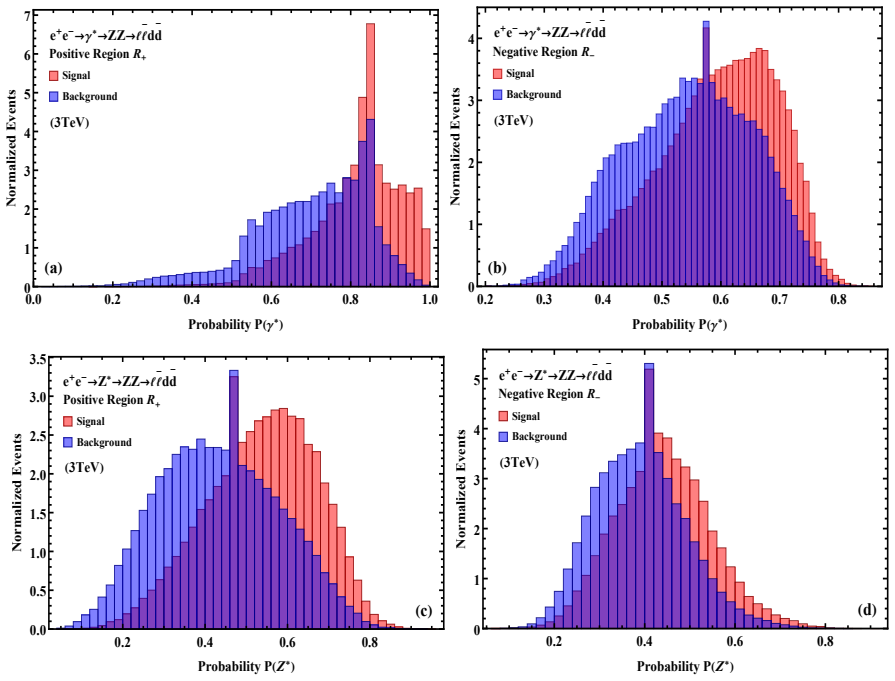
Neutral triple gauge couplings (nTGCs) first arise from the dimension-8 operators of the Standard Model Effective Field Theory (SMEFT), rather than the dimension-4 SM Lagrangian and dimension-6 SMEFT operators, opening up a unique window for probing new physics at the dimension-8 level. In this work, we formulate the nTGC form factors of $ZZV^*$ ($V\!\!=\!Z,\gamma$) that are compatible with the spontaneous breaking of the SU(2)$\otimes$U(1) electroweak gauge symmetry and consistently match the dimension-8 nTGC operators in the broken phase. We study the sensitivities for probing both the $ZZV^*$ form factors and the corresponding new physics scales through $ZZ$ production (with visible/invisible fermionic $Z$ decays) at high energy $e^+e^-$ colliders including CEPC, FCC-ee, ILC and CLIC. In particular, we identify the dimension-8 operator that contributes to the pure triple $Z$ boson coupling $ZZZ^*$ alone, but not the mixed $ZZ\gamma^*$ coupling. We further study the correlations between probes of the $ZZZ^*$ and $ZZ\gamma^*$ couplings. Using machine learning, we show that angular distributions of the final-state fermions can play key roles in suppressing the SM backgrounds. The sensitivities can be further improved by using polarized $e^\mp$ beams. We demonstrate that machine learning is advantageous for handling the 4-body final states from $ZZ$ decays and improves significantly the sensitivity reaches of probes of nTGCs in $e^+e^-$ collisions. We find that nTGC new physics scales can be probed up to the multi-TeV scale at the proposed $e^+e^-$ colliders.
Editorial analysis
A structured set of objections, weighed in public.
Referee Report
Summary. The paper claims to formulate neutral triple gauge couplings (nTGCs) from dimension-8 SMEFT operators in a manner compatible with electroweak symmetry breaking, matching the broken-phase operators for ZZV* (V=Z,γ) vertices. It then analyzes ZZ production (with visible and invisible fermionic decays) at future e+e- colliders including CEPC, FCC-ee, ILC and CLIC, using machine learning on angular distributions of final-state fermions to suppress SM backgrounds. The work identifies a dimension-8 operator contributing only to the pure ZZZ* coupling, studies correlations between ZZZ* and ZZγ* probes, incorporates beam polarization, and reports that ML improves sensitivity, allowing nTGC new physics scales to be probed up to the multi-TeV range.
Significance. If the central results hold after validation, the work would be significant as a timely phenomenological study of dimension-8 operators at proposed lepton colliders. The symmetry-consistent form-factor formulation and explicit identification of a pure ZZZ* operator provide a useful bridge between SMEFT and collider observables. The emphasis on angular distributions in 4-body final states and the multi-TeV reach claims, if substantiated, would strengthen motivation for high-energy e+e- programs and illustrate the potential of ML techniques in complex kinematics.
major comments (2)
- [Machine learning analysis and results] The central claim that machine learning is advantageous for handling 4-body final states from ZZ decays and significantly improves sensitivity reaches (abstract and results discussion) rests on the assertion of effective background suppression via angular distributions, but the manuscript provides no side-by-side comparison of the same Monte Carlo samples under the neural network classifier versus an optimized cut-based analysis or BDT using identical input variables (angles, energies, missing pT). Without this differential test, the reported improvement and multi-TeV reaches for both ZZZ* and ZZγ* operators could be an artifact of suboptimal traditional methods rather than an intrinsic ML advantage. This directly affects the headline sensitivity claims.
- [Formulation of nTGC form factors] The formulation of nTGC form factors for ZZV* that are compatible with SU(2)⊗U(1) breaking and consistently match the dimension-8 operators in the broken phase (abstract and formulation section) is load-bearing for all subsequent sensitivity projections; explicit matching equations or a table relating form-factor parameters to the operator coefficients should be provided to allow verification that no additional assumptions are introduced.
minor comments (2)
- [Results figures] The presentation of sensitivity contours for different colliders and polarization settings would benefit from more uniform axis scaling and explicit labeling of which curves correspond to visible versus invisible channels.
- [Notation and definitions] Notation for the nTGC form factors (e.g., definitions of f_{Zγ} and f_{ZZ}) should be cross-referenced to the operator basis in a single equation or table for clarity.
Simulated Author's Rebuttal
We thank the referee for the careful reading of our manuscript and the constructive comments. We address each of the major comments below and outline the revisions we will make to strengthen the paper.
read point-by-point responses
-
Referee: [Machine learning analysis and results] The central claim that machine learning is advantageous for handling 4-body final states from ZZ decays and significantly improves sensitivity reaches (abstract and results discussion) rests on the assertion of effective background suppression via angular distributions, but the manuscript provides no side-by-side comparison of the same Monte Carlo samples under the neural network classifier versus an optimized cut-based analysis or BDT using identical input variables (angles, energies, missing pT). Without this differential test, the reported improvement and multi-TeV reaches for both ZZZ* and ZZγ* operators could be an artifact of suboptimal traditional methods rather than an intrinsic ML advantage. This directly affects the headline sensitivity claims.
Authors: We acknowledge that providing a direct comparison with traditional methods would better substantiate the advantages of the machine learning approach. In the revised version of the manuscript, we will add a section or subsection that presents a side-by-side comparison of the neural network classifier against an optimized cut-based analysis and a boosted decision tree (BDT), using the same Monte Carlo samples and identical input variables including angles, energies, and missing transverse momentum. This will allow readers to assess the improvement quantitatively and confirm that the reported sensitivity reaches are not due to suboptimal traditional analyses. revision: yes
-
Referee: [Formulation of nTGC form factors] The formulation of nTGC form factors for ZZV* that are compatible with SU(2)⊗U(1) breaking and consistently match the dimension-8 operators in the broken phase (abstract and formulation section) is load-bearing for all subsequent sensitivity projections; explicit matching equations or a table relating form-factor parameters to the operator coefficients should be provided to allow verification that no additional assumptions are introduced.
Authors: We agree that explicit matching is essential for transparency and verifiability. Although the formulation section describes the compatibility with electroweak symmetry breaking and the matching to dimension-8 operators, we will enhance it by adding a dedicated table that explicitly relates each nTGC form-factor parameter to the corresponding SMEFT operator coefficients. This will include the matching equations for the ZZV* vertices and confirm consistency in the broken phase without additional assumptions. revision: yes
Circularity Check
No significant circularity; derivation relies on independent simulations and operator matching
full rationale
The paper defines nTGC form factors to match dimension-8 SMEFT operators under electroweak symmetry breaking, then computes sensitivities via Monte Carlo simulations of ZZ production at proposed colliders, applying machine learning to angular distributions for background suppression. No quoted step reduces a prediction to a fitted input by construction, nor does any central claim rest on a self-citation chain that itself assumes the target result. The ML improvement is presented as an empirical outcome from handling 4-body kinematics, not a tautological renaming or self-referential fit. External collider parameters and SMEFT operator bases supply independent content, keeping the chain self-contained.
Axiom & Free-Parameter Ledger
free parameters (1)
- nTGC operator coefficients / form factor strengths
axioms (1)
- domain assumption Form factors must be compatible with spontaneous breaking of SU(2)⊗U(1) and match dimension-8 operators in the broken phase
Reference graph
Works this paper leans on
-
[1]
Beyond Standard Model: From Theory to Experiment
For reviews, John Ellis, [arXiv:2105.14942 [hep-ph]], in the conference proceedings of “Beyond Standard Model: From Theory to Experiment” (BSM-2021), Zewail City, Egypt, March29-31, 2021; I. Brivio and M. Trott, Phys. Rept. 793 (2019) 1 [arXiv:1706.08945 [hep-ph]]; and references therein
-
[2]
Probing CP-Violating Neutral Triple Gauge Couplings at Electron-Positron Colliders
J. Ellis, H.-J. He, and R.-Q. Xiao, Science China (2025), in Press [arXiv:2504.13135 [hep-ph]]
work page internal anchor Pith review Pith/arXiv arXiv 2025
-
[3]
J. Ellis, H.-J. He, and R.-Q. Xiao, Phys. Rev. D108 (2023) L111704, no.11 [arXiv:2308.16887 [hep-ph]]
- [4]
- [5]
-
[6]
J. Ellis, H.-J. He, R.-Q. Xiao, Science China (Phys. Mech. Astron.) 64 (2021) 221062, no.2, [arXiv:2008.04298 [hep-ph]]
-
[7]
J. Ellis, S.F. Ge, H.-J. He, R.-Q. Xiao, Chin. Phys. C 44 (2020) 063106, no.6, [arXiv:1902.06631 [hep-ph]]
-
[8]
J. Ellis, H.-J. He, R.-Q. Xiao, S.-P. Zeng, and J. Zheng, Phys. Rev. D 111 (2025) 015007, no.1, [arXiv:2408.12508 [hep-ph]]
-
[9]
See also, R. Cepedello, F. Esser, M. Hirsch, and V. Sanz, JHEP 07 (2024) 275, [JHEP 12 (2024) 084 (erratum)], [arXiv:2402.04306 [hep-ph]]
-
[10]
G. J. Gounaris, J. Layssac, and F. M. Renard, Phys. Rev. D 61 (2000) 073013 [arXiv:hep-ph/ 9910395 [hep-ph]]; Phys. Rev. D 62 (2000) 073013 [arXiv:hep-ph/0003143 [hep-ph]]
work page internal anchor Pith review Pith/arXiv arXiv 2000
-
[11]
A basis of dimension-eight operators for anomalous neutral triple gauge boson interactions
C. Degrande, JHEP 1402 (2014) 101 [arXiv:1308.6323 [hep-ph]]
work page internal anchor Pith review Pith/arXiv arXiv 2014
-
[12]
Dimension-Six Terms in the Standard Model Lagrangian
W. Buchmuller and D. Wyler, Nucl. Phys. B268 (1986) 621; B. Grzadkowski, M. Iskrzynski, M. Misiak, and J. Rosiek, JHEP 10 (2010) 085 [arXiv:1008.4884 [hep-ph]]; and references therein
work page internal anchor Pith review Pith/arXiv arXiv 1986
-
[13]
Complete Higgs Sector Constraints on Dimension-6 Operators
E.g., J. Ellis, V. Sanz, and T. You, JHEP 1407 (2014) 036 [Xiv:1404.3667 [hep-ph]] and JHEP 1503 (2015) 157 [arXiv:1410.7703 [hep-ph]]; H. J. He, J. Ren, and W. Yao, Phys. Rev. D 93 (2016) 015003 [arXiv:1506.03302 [hep-ph]]; J. Ellis and T. You, JHEP 03 (2016) 089 [arXiv:1510.04561 [hep-ph]; S. F. Ge, H. J. He, and R. Q. Xiao, JHEP 10 (2016) 007 [arXiv:16...
work page internal anchor Pith review Pith/arXiv arXiv 2014
-
[14]
V. Khachatryanet al., [CMS Collaboration], “Measurement of theZγ → ν¯νγ production cross section in pp collisions at √s = 8TeV and limits on anomalousZZγ and Zγγ trilinear gauge boson couplings”, Phys. Lett. B 760 (2016) 448-468 [arXiv: 1602.07152 [hep-ex]]
work page internal anchor Pith review Pith/arXiv arXiv 2016
-
[15]
M. Aaboudet al.,[ATLAS Collaboration], “Measurement of theZ → ν¯ν production cross section in pp collisions at √s =13TeV with the ATLAS detector and limits on anomalous triple gauge- boson couplings”, JHEP 12 (2018) 010 [arXiv:1810.04995 [hep-ex]]
work page internal anchor Pith review Pith/arXiv arXiv 2018
-
[16]
ATLAS Collaboration, “Measurements of Zγ differential cross sections and search for neutral triple gauge couplings inpp collisions at √s =13 TeVwith the ATLAS detector”, ATLAS-CONF- 2025-001, April, 2025
work page 2025
-
[17]
Jahedi, JHEP (2023) 31 [arXiv:2305.11266 [hep-ph]]; S
E.g., S. Jahedi, JHEP (2023) 31 [arXiv:2305.11266 [hep-ph]]; S. Spor, E. Gurkanli and M. Köksal, arXiv:2302.08245 [hep-ph]; S. Jahedi and J. Lahiri, JHEP 04 (2023) 085 [arXiv:2212.05121 [hep- ph]]; S. Spor, Nucl. Phys. B991 (2023) 116198 [arXiv:2207.11585 [hep-ph]]; A. Senol, S. Spor, E. Gurkanli, V. Cetinkaya, H. Denizli, and M. Köksal, Eur. Phys. J. Plu...
- [18]
-
[19]
Scales of Fermion Mass Generation and Electroweak Symmetry Breaking
D.A. Dicus and H.-J. He, Phys. Rev. D 71 (2005) 093009 [arXiv:hep-ph/0409131 [hep-ph]]; Phys. Rev. Lett. 94 (2005) 221802 [arXiv:hep-ph/0502178 [hep-ph]]
work page internal anchor Pith review Pith/arXiv arXiv 2005
- [20]
-
[21]
Global Analysis for Probing Electroweak Symmetry Breaking Mechanism at High Energy Colliders
For a comprehensive review, H. J. He, Y.P.Kuang and C.P.Yuan, [arXiv:hep-ph/9704276 [hep- ph]] and DESY-97-056, in the proceedings of the workshop on “Physics at the TeV Energy Scale”, 35 vol.72, p.119, 1996. See also, H. J. He and W.B. Kilgore, Phys. Rev. D 55 (1997) 1515; H. J. He, Y.P. Kuang, C.P. Yuan, Phys. Rev. D 51 (1995) 6463; Phys. Rev. D 55 (199...
work page internal anchor Pith review Pith/arXiv arXiv 1996
-
[22]
F. Englert and R. Brout, Phys. Rev. Lett. 13 (1964) 321; P. W. Higgs, Phys. Rev. Lett. 13 (1964) 508; Phys. Lett. 12 (1964) 132; G. S. Guralnik, C. R. Hagen and T. Kibble, Phys. Rev. Lett. 13 (1964) 585; T. Kibble, Phys. Rev. 155 (1967) 1554
work page 1964
-
[23]
J. Alwall, R. Frederix, S. Frixione, V. Hirschi, F. Maltoni, O. Mattelaer, H. S. Shao, T. Stelzer, P. Torrielli and M. Zaro, JHEP07, 079 (2014) doi:10.1007/JHEP07(2014)079 [arXiv:1405.0301 [hep-ph]]
work page internal anchor Pith review Pith/arXiv arXiv doi:10.1007/jhep07(2014)079 2014
- [24]
-
[25]
K. Fujii, C. Grojean, and M. E. Peskinet al.,[arXiv:1801.02840 [hep-ph]]. 36
work page internal anchor Pith review Pith/arXiv arXiv
discussion (0)
Sign in with ORCID, Apple, or X to comment. Anyone can read and Pith papers without signing in.