REVIEW 4 major objections 6 minor 1 cited by
Rethinking Oversaturation in Classifier-Free Guidance via Low Frequency
T0 review · 4 major / 6 minor · reviewed 2026-08-06 · deepseek-v4-flash
Pith's one-line read The paper argues that oversaturation in classifier-free guidance comes from redundant low-frequency information, and shows that down-weighting those regions fixes it.
desk verdict Empirically promising CFG patch with a broken causal story: the threshold logic selects ~84% of locations, not 66.7%, and the accumulation model uses signed changes for a nonnegative metric. read the letter →
The pith
A machine-rendered reading of the paper's core claim, the machinery that carries it, and where it could break.
The reading
What carries the argument
The object that carries the argument is the per-step change-rate map $r^l_j(t)=d(v^l_j(t), v^l_j(t+1))$, computed with pixel-wise Euclidean distance on low-frequency-filtered conditional and unconditional signals. From this map the method builds a binary mask $m^l_j(t)$ that flags locations whose change rate is below an adaptive threshold $\gamma^l_j(t)=\mathrm{mean}(r^l_j(t))+\mathrm{std}(r^l_j(t))$, and then down-weights those locations by the ratio $\rho=33.3\%/66.7\%$ inside the scaled difference term of CFG. The load-bearing assumption is that $r^l_j(t)$ is approximately Gaussian, which turns the threshold into a fixed percentile and fixes the down-weighting ratio without per-model tuning. An 8$\times$ super-resolution operator serves as the linear low-frequency filter.
What would settle it
On Stable Diffusion 3 at $w=15$, compute $r^l_j(t)$ for a set of prompts and measure the fraction of spatial locations below $\mathrm{mean}+\mathrm{std}$; if that fraction is near 0.84 rather than 0.667, the stated Gaussian-percentile basis of the mask is wrong. Comparing LF-CFG with the empirical 66.7th-percentile threshold and with $\gamma=\mathrm{mean}-\mathrm{std}$ would then show whether the improvements come from the specific tail selection or from generic low-frequency attenuation.
Extended reading notes
Core claim
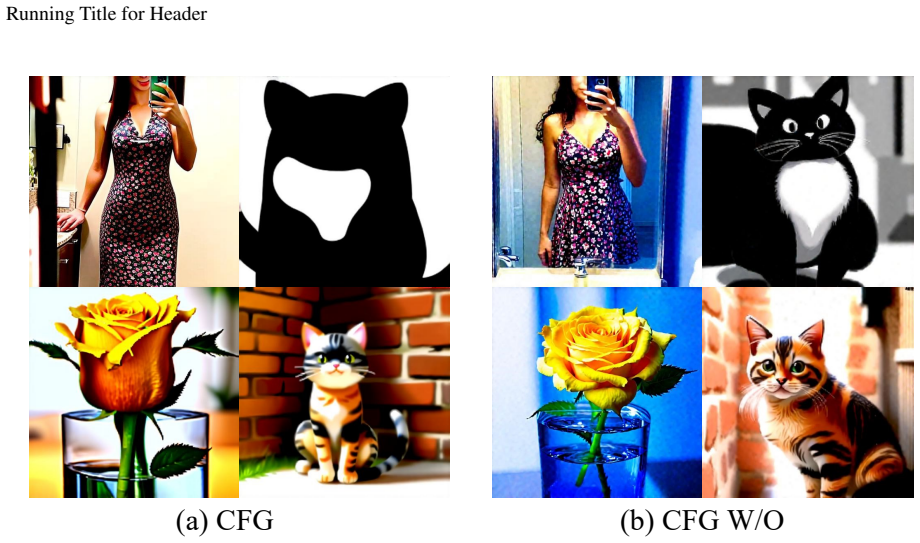
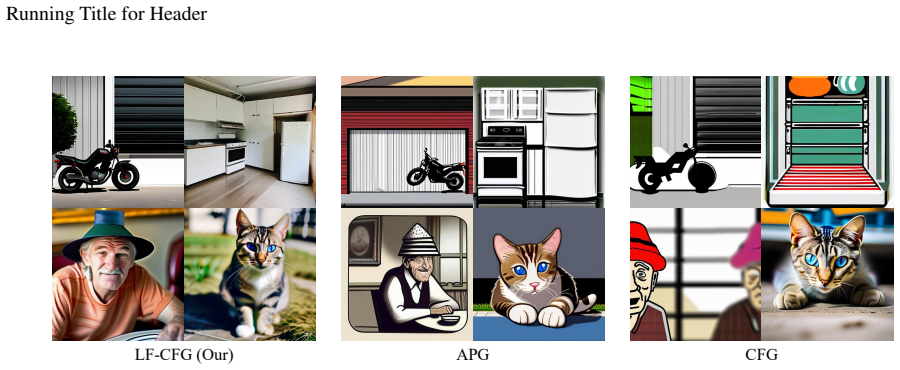
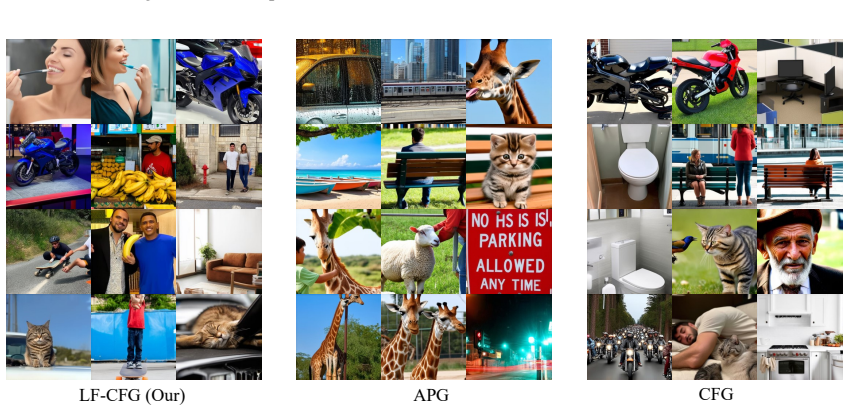
On its own terms, the paper's central discovery is that oversaturation at high guidance scales is a low-frequency phenomenon: the low-frequency components of the conditional and unconditional update signals barely change from one reverse step to the next, and those small consistent adjustments accumulate into extreme pixel values when multiplied by a large guidance scale $w$. The paper verifies this by zeroing the low-change regions of the low-frequency signal, which removes oversaturation, whereas zeroing the high-change regions does not. The proposed fix, LF-CFG, applies a down-weighting only inside the scaled difference term of CFG, leaving the unconditional term and all high-frequency signals untouched; the resulting update is given by Eq. 9. On five diffusion models, LF-CFG improves the saturation metric and FID at high $w$ relative to CFG and APG, supporting the claim that redundant low-frequency information is the root cause.
Load-bearing premise
The load-bearing premise is that the per-step change rates of low-frequency signals are approximately Gaussian, so a single threshold $\gamma=\mathrm{mean}+\mathrm{std}$ identifies the roughly 66.7% of locations whose slow change causes redundant accumulation; the paper gives no distribution fit, and its own equations disagree on whether the low-change tail is below $\mathrm{mean}-\mathrm{std}$ or below $\mathrm{mean}+\mathrm{std}$, so this premise is the point most likely to break.
Editorial extensions
If this is right
- At high guidance scales ($w=10$ and $w=15$), LF-CFG improves FID and KID over both CFG and APG on MS-COCO for Stable Diffusion 2.1, XL, 3.0, and 3.5, and improves FID, precision, and recall on ImageNet with SiT-XL.
- The correction is essentially free: generating one image costs about 1.05 seconds with LF-CFG versus 1.03 seconds for CFG and 1.06 seconds for APG on an RTX 4090, so it can replace standard CFG without retraining.
- LF-CFG composes with existing guidance enhancements: PAG plus LF-CFG beats PAG alone, CADS further improves LF-CFG, and the method also transfers to EDM2 in pixel space and to DPM-Solver, indicating it is not tied to one architecture or solver.
- The low-frequency story is complementary to gradient-based accounts such as APG: the paper identifies where redundant information accumulates rather than only decomposing the guidance direction, which gives future methods a frequency-domain handle on oversaturation.
- Because the down-weighting preserves the unconditional term and high-frequency components, images keep their global structure and fine details while the accumulated low-frequency excess is reduced.
Reading between the lines
- One extension the paper leaves implicit: the threshold could be re-estimated per model from the empirical quantiles of $r^l_j(t)$ instead of assuming a Gaussian; the ablations in Table 5 suggest nearby thresholds behave similarly, so a quantile-based version would test whether the Gaussian assumption is essential.
- The change-rate logic could be applied to full-spectrum or high-frequency signals as well; the paper's zeroing experiment shows low-frequency redundancy is dominant, but it does not rule out a smaller high-frequency contribution, so a combined mask is a natural testable variant.
- Because the mask is computed from adjacent reverse steps using only the model's own outputs, the same recipe should extend to video and 3D diffusion models that use CFG, though the paper only evaluates image generators.
Signed reviews
Editorial analysis
A structured set of objections, weighed in public.
Referee Report
Summary. The paper proposes LF-CFG, a modification of classifier-free guidance (CFG) that extracts low-frequency components of the conditional and unconditional velocity fields, identifies 'low-change' spatial locations via an adaptive threshold on per-step change rate, and down-weights those locations in the weighted difference term. The authors claim that redundant information accumulates in low-frequency low-change regions, causing oversaturation at high guidance scales, and that down-weighting these regions improves FID, KID, CLIP, precision/recall, and saturation across Stable Diffusion 2.1, XL, 3.0, 3.5, and SiT-XL at negligible compute cost.
Significance. If the causal story were established, this would be a simple, cheap, and broadly applicable fix for high-guidance oversaturation, with a testable frequency-domain explanation. The paper's strengths are its breadth of experiments across five model families, use of standard external metrics, low compute overhead (Table 4), compatibility with PAG and CADS, and ablations of filter scale and threshold. However, the central mechanism is not currently derived: the mask definition is internally inconsistent, and the accumulation model is qualitative and not connected to the measured quantity. The empirical gains at high guidance scales are plausible, but they are not yet tied to the claimed low-change-region redundancy.
major comments (4)
- [4.2, Eq. (5)-(6)] Eq. (5) defines low-change regions as r < mean - std and high-change regions as r > mean + std, but Eq. (6) thresholds at gamma = mean + std, so the mask includes every location with r < mean + std, i.e., the lower 84.1% of a Gaussian, not 'approximately 66.7% of the locations with the lowest change rate' as claimed. The derived ratio rho = 33.3%/66.7% is therefore inconsistent with the stated threshold; a 66.7% lower tail would sit near mean + 0.43 std. This is not cosmetic: the mask is the mechanism supposed to target low-change regions, and Table 5 shows that using mean - std (the Eq. (5) definition of low-change) performs substantially worse, suggesting the empirical gain comes from broad low-frequency damping rather than from specifically down-weighting low-change regions.
- [4.1, Eq. (4) and Discussion] Eq. (4) defines r^l_j(t) as a pixel-wise Euclidean distance between low-frequency signals, which is nonnegative, but the Discussion explains oversaturation through signed adjustments (+0.1 accumulating, +0.3/-0.2 self-correcting). The formula 'Final Value = 0.5 + w * sum_t r^l_j(t)' is asserted without derivation from Eq. (2) or Eq. (9), and since r is a magnitude, it cannot encode the sign needed for the self-correcting narrative. The accumulation model therefore does not follow from the quantity being measured.
- [4.1, Fig. 5 and 4.2, Eq. (6)] The zeroing experiment in Fig. 5 that supports the low-change-region mechanism uses the Eq. (5) definition (mean - std), whereas the proposed LF-CFG uses gamma = mean + std. There is no experiment showing that zeroing or down-weighting the specific locations selected by the actual mask (r < mean + std) alleviates oversaturation. Because the two definitions disagree on the central 68% of a Gaussian, the causal link between 'low-change regions' and the implemented mask is not established.
- [4.2, Adaptive measurement] The Gaussian assumption on r^l_j(t) is load-bearing and unverified. The paper states that 'the change rates tend to be a Gaussian distribution' based on the use of linear filters, but provides no histogram, normality test, or empirical quantile comparison. Since the threshold gamma and the ratio rho are both derived from this assumption, a simple empirical CDF check on one model would either support or refute the 66.7% claim; as written, the mask statistics are not connected to data.
minor comments (6)
- [5, Tables 1 and 2] Tables 1 and 2 are labeled 'Qualitative comparison' but contain quantitative metrics; they should be labeled 'Quantitative comparison'.
- [Algorithm 1] In Algorithm 1, Cachet+1 is assigned but never used, and the loop notation 'pair [(1, T-1/T), ..., (1/T, 0)]' is unclear about what t takes at each iteration; this makes the algorithm hard to follow.
- [5, Quantitative results] The reported 'best average of 18.66, 0.41, and 0.82 FID, precision, and recall' does not match the values in Table 2 (average FID is about 18.63, precision about 0.80, and recall about 0.67), suggesting a typo.
- [Fig. 4 caption] The caption 'CFG W/O' is undefined; clarify that it means the high-frequency components are removed.
- [4.2, Combination selection] The selection of Combination 3 in Eq. (9) is based only on the qualitative images in Fig. 6; include the quantitative comparison for the four combinations, since this is a central design choice.
- [Related Work and Section 5] Reference [7] is described as 'self-guided CFG', but the actual title is 'Guiding a diffusion model with a bad version of itself'; also, 'PAG 6' in Section 5 should likely be 'PAG [8]'.
Circularity Check
No circularity: the causal claim is tested against external metrics and contrasting zeroing experiments, not defined into existence.
full rationale
The paper's central chain is: low-frequency signals carry the oversaturation problem (tested by removing high-frequency content), low-change regions within those signals accumulate redundant information (tested by zeroing low-change vs high-change regions), and down-weighting those regions should improve quality (tested by FID, KID, CLIP, precision/recall, and saturation across five models). None of these claims reduces to its own definition by construction. The mask and the down-weighting directly manipulate the hypothesized cause, but the success criterion is external to the definition: the saturation metric, FID, and other image-quality scores are not produced by the mask formula itself, so the reported gains are empirical confirmation rather than a tautology. There are no load-bearing self-citations, no imported uniqueness theorems, and no ansatz smuggled in through the authors' own prior work. The internal inconsistency between Eq. 5 (mean−std), Eq. 6 (mean+std), and the claimed 66.7% Gaussian tail is a real mathematical/correctness flaw that weakens the quantitative mechanism, but it is not a circularity: even if the threshold description is wrong, the method's performance is still independently measured and falsifiable. The Discussion's accumulation model is also under-derived, but that is a support problem, not a definitional equivalence. Accordingly, no circular step meeting the specified evidentiary standard is present.
Assumptions & free parameters
free parameters (4)
- threshold gamma (mean + std) =
adaptive; chosen as mean(r)+std(r) after ablation
- down-weight ratio rho =
33.3/66.7 (approx 0.5)
- low-frequency filter scale =
8x
- integration combination =
Combination 3
assumptions (4)
- domain assumption Change rates r_l_j of low-frequency signals are approximately Gaussian because linear filters are used.
- ad hoc to paper Low-frequency, low-change regions accumulate redundant information that drives oversaturation.
- domain assumption Pixel-wise Euclidean distance between consecutive low-frequency velocity fields is a valid measure of redundant accumulation.
- domain assumption Pre-trained model outputs satisfy the flow/ODE formulation in Eq. 1 and the CFG formulation in Eq. 2.
invented entities (1)
-
Accumulated redundant low-frequency information
Cite this review
Pith. "Pith review of Rethinking Oversaturation in Classifier-Free Guidance via Low Frequency." pith.science (2026). https://pith.science/paper/PCBL6O5A
@misc{pith2026250621452,
  author       = {Pith},
  title        = {Pith review of: Rethinking Oversaturation in Classifier-Free Guidance via Low Frequency},
  year         = {2026},
  howpublished = {\url{https://pith.science/paper/PCBL6O5A}},
  note         = {Machine review of arXiv:2506.21452}
}
read the original abstract
Classifier-free guidance (CFG) succeeds in condition diffusion models that use a guidance scale to balance the influence of conditional and unconditional terms. A high guidance scale is used to enhance the performance of the conditional term. However, the high guidance scale often results in oversaturation and unrealistic artifacts. In this paper, we introduce a new perspective based on low-frequency signals, identifying the accumulation of redundant information in these signals as the key factor behind oversaturation and unrealistic artifacts. Building on this insight, we propose low-frequency improved classifier-free guidance (LF-CFG) to mitigate these issues. Specifically, we introduce an adaptive threshold-based measurement to pinpoint the locations of redundant information. We determine a reasonable threshold by analyzing the change rate of low-frequency information between prior and current steps. We then apply a down-weight strategy to reduce the impact of redundant information in the low-frequency signals. Experimental results demonstrate that LF-CFG effectively alleviates oversaturation and unrealistic artifacts across various diffusion models, including Stable Diffusion-XL, Stable Diffusion 2.1, 3.0, 3.5, and SiT-XL.
Figures


Figures from the paper (18 more)






Forward citations
Cited by 1 Pith paper
-
First-Place Solution to NeurIPS 2024 Invisible Watermark Removal Challenge
A competition-winning pipeline removes 95.7% of StegaStamp and TreeRing watermarks on the NeurIPS 2024 benchmark by combining VAE fine-tuning, diffusion purification, and translation tricks.
Reference graph
Works this paper leans on
-
[1]
High-resolution image synthesis with latent diffusion models, 2021
Robin Rombach, Andreas Blattmann, Dominik Lorenz, Patrick Esser, and Björn Ommer. High-resolution image synthesis with latent diffusion models, 2021
2021
-
[2]
Scaling rectified flow transformers for high-resolution image synthesis, 2024
Patrick Esser, Sumith Kulal, Andreas Blattmann, Rahim Entezari, Jonas Müller, Harry Saini, Yam Levi, Dominik Lorenz, Axel Sauer, Frederic Boesel, Dustin Podell, Tim Dockhorn, Zion English, Kyle Lacey, Alex Goodwin, Yannik Marek, and Robin Rombach. Scaling rectified flow transformers for high-resolution image synthesis, 2024
2024
-
[3]
Open-sora: Democratizing efficient video production for all, March 2024
Zangwei Zheng, Xiangyu Peng, Tianji Yang, Chenhui Shen, Shenggui Li, Hongxin Liu, Yukun Zhou, Tianyi Li, and Yang You. Open-sora: Democratizing efficient video production for all, March 2024
work page 2024
-
[4]
Diffusion models beat gans on image synthesis, 2021
Prafulla Dhariwal and Alex Nichol. Diffusion models beat gans on image synthesis, 2021
2021
-
[5]
Classifier-free diffusion guidance, 2022
Jonathan Ho and Tim Salimans. Classifier-free diffusion guidance, 2022
2022
-
[6]
Seyedmorteza Sadat, Otmar Hilliges, and Romann M. Weber. Eliminating oversaturation and artifacts of high guidance scales in diffusion models, 2024
work page 2024
-
[7]
Guiding a diffusion model with a bad version of itself, 2024
Tero Karras, Miika Aittala, Tuomas Kynkäänniemi, Jaakko Lehtinen, Timo Aila, and Samuli Laine. Guiding a diffusion model with a bad version of itself, 2024. 18 Running Title for Header
work page 2024
-
[8]
Self-rectifying diffusion sampling with perturbed-attention guidance, 2024
Donghoon Ahn, Hyoungwon Cho, Jaewon Min, Wooseok Jang, Jungwoo Kim, SeonHwa Kim, Hyun Hee Park, Kyong Hwan Jin, and Seungryong Kim. Self-rectifying diffusion sampling with perturbed-attention guidance, 2024
work page 2024
Show all 28 references
-
[9]
Cfg++: Manifold-constrained classifier free guidance for diffusion models, 2024
Hyungjin Chung, Jeongsol Kim, Geon Yeong Park, Hyelin Nam, and Jong Chul Ye. Cfg++: Manifold-constrained classifier free guidance for diffusion models, 2024
2024
-
[10]
Enhancing motion in text-to-video generation with decomposed encoding and conditioning, 2024
Penghui Ruan, Pichao Wang, Divya Saxena, Jiannong Cao, and Yuhui Shi. Enhancing motion in text-to-video generation with decomposed encoding and conditioning, 2024
2024
-
[11]
Tencent hunyuan3d-1.0: A unified framework for text-to-3d and image-to-3d generation, 2024
Xianghui Yang, Huiwen Shi, Bowen Zhang, Fan Yang, Jiacheng Wang, Hongxu Zhao, Xinhai Liu, Xinzhou Wang, Qingxiang Lin, Jiaao Yu, Lifu Wang, Zhuo Chen, Sicong Liu, Yuhong Liu, Yong Yang, Di Wang, Jie Jiang, and Chunchao Guo. Tencent hunyuan3d-1.0: A unified framework for text-t...
2024
-
[12]
Seyedmorteza Sadat, Jakob Buhmann, Derek Bradley, Otmar Hilliges, and Romann M. Weber. CADS: unleashing the diversity of diffusion models through condition-annealed sampling. In The Twelfth International Conference on Learning Representations, ICLR 2024, Vienna, Austria, May 7...
2024
-
[13]
Seyedmorteza Sadat, Manuel Kansy, Otmar Hilliges, and Romann M. Weber. No training, no problem: Rethinking classifier-free guidance for diffusion models, 2024
2024
-
[14]
Gans trained by a two time-scale update rule converge to a local nash equilibrium, 2018
Martin Heusel, Hubert Ramsauer, Thomas Unterthiner, Bernhard Nessler, and Sepp Hochreiter. Gans trained by a two time-scale update rule converge to a local nash equilibrium, 2018
2018
-
[15]
Flow straight and fast: Learning to generate and transfer data with rectified flow
Xingchao Liu, Chengyue Gong, and Qiang Liu. Flow straight and fast: Learning to generate and transfer data with rectified flow. arXiv preprint arXiv:2209.03003, 2022
2022 arXiv
-
[16]
Score- based generative modeling through stochastic differential equations
Yang Song, Jascha Sohl-Dickstein, Diederik P Kingma, Abhishek Kumar, Stefano Ermon, and Ben Poole. Score- based generative modeling through stochastic differential equations. In International Conference on Learning Representations, 2021
2021
-
[17]
Denoising diffusion implicit models, 2022
Jiaming Song, Chenlin Meng, and Stefano Ermon. Denoising diffusion implicit models, 2022
2022
-
[18]
Hipa: Enabling one-step text-to-image diffusion models via high-frequency- promoting adaptation, 2023
Yifan Zhang and Bryan Hooi. Hipa: Enabling one-step text-to-image diffusion models via high-frequency- promoting adaptation, 2023
2023
-
[19]
Albergo, Nicholas M
Nanye Ma, Mark Goldstein, Michael S. Albergo, Nicholas M. Boffi, Eric Vanden-Eijnden, and Saining Xie. Sit: Exploring flow and diffusion-based generative models with scalable interpolant transformers, 2024
2024
-
[20]
Sdxl: Improving latent diffusion models for high-resolution image synthesis, 2023
Dustin Podell, Zion English, Kyle Lacey, Andreas Blattmann, Tim Dockhorn, Jonas Müller, Joe Penna, and Robin Rombach. Sdxl: Improving latent diffusion models for high-resolution image synthesis, 2023
2023
-
[21]
Berg, and Li Fei-Fei
Olga Russakovsky, Jia Deng, Hao Su, Jonathan Krause, Sanjeev Satheesh, Sean Ma, Zhiheng Huang, Andrej Karpathy, Aditya Khosla, Michael Bernstein, Alexander C. Berg, and Li Fei-Fei. ImageNet Large Scale Visual Recognition Challenge. International Journal of Computer Vision (IJC...
2015
-
[22]
Improved precision and recall metric for assessing generative models, 2019
Tuomas Kynkäänniemi, Tero Karras, Samuli Laine, Jaakko Lehtinen, and Timo Aila. Improved precision and recall metric for assessing generative models, 2019
2019
-
[23]
Lawrence Zitnick, and Piotr Dollár
Tsung-Yi Lin, Michael Maire, Serge Belongie, Lubomir Bourdev, Ross Girshick, James Hays, Pietro Perona, Deva Ramanan, C. Lawrence Zitnick, and Piotr Dollár. Microsoft coco: Common objects in context, 2015
2015
-
[24]
Sutherland, Michael Arbel, and Arthur Gretton
Mikołaj Bi ´nkowski, Danica J. Sutherland, Michael Arbel, and Arthur Gretton. Demystifying mmd gans, 2021
2021
-
[25]
Learning transferable visual models from natural language supervision, 2021
Alec Radford, Jong Wook Kim, Chris Hallacy, Aditya Ramesh, Gabriel Goh, Sandhini Agarwal, Girish Sastry, Amanda Askell, Pamela Mishkin, Jack Clark, Gretchen Krueger, and Ilya Sutskever. Learning transferable visual models from natural language supervision, 2021
2021
-
[26]
Denoising diffusion probabilistic models, 2020
Jonathan Ho, Ajay Jain, and Pieter Abbeel. Denoising diffusion probabilistic models, 2020
2020
-
[27]
Dpm-solver: A fast ode solver for diffusion probabilistic model sampling in around 10 steps, 2022
Cheng Lu, Yuhao Zhou, Fan Bao, Jianfei Chen, Chongxuan Li, and Jun Zhu. Dpm-solver: A fast ode solver for diffusion probabilistic model sampling in around 10 steps, 2022
2022
-
[28]
Analyzing and improving the training dynamics of diffusion models
Tero Karras, Miika Aittala, Jaakko Lehtinen, Janne Hellsten, Timo Aila, and Samuli Laine. Analyzing and improving the training dynamics of diffusion models. arXiv preprint arXiv:2312.02696, 2023. 19
2023 arXiv
Reviewed August 6, 2026 · model on record in the stance chip above.
Discussion (0). Continue with ORCID to comment.