REVIEW 3 major objections 4 minor 99 references
The ESPRESSO transmission spectrum of HD$\,$189733$\,$b : Extracting the planetary sodium and lithium signatures amid stellar contamination
T0 review · 3 major / 4 minor · reviewed 2026-08-06 · deepseek-v4-flash
Pith's one-line read HD 189733 b's sodium signal is shallower, narrower, and 8 km/s blueshifted than earlier measurements reported.
desk verdict A careful reanalysis that likely nails the sodium but leaves the new lithium detection resting on an unverified stellar-line assumption, so it deserves a major-revision referee. read the letter →
The pith
A machine-rendered reading of the paper's core claim, the machinery that carries it, and where it could break.
The reading
What carries the argument
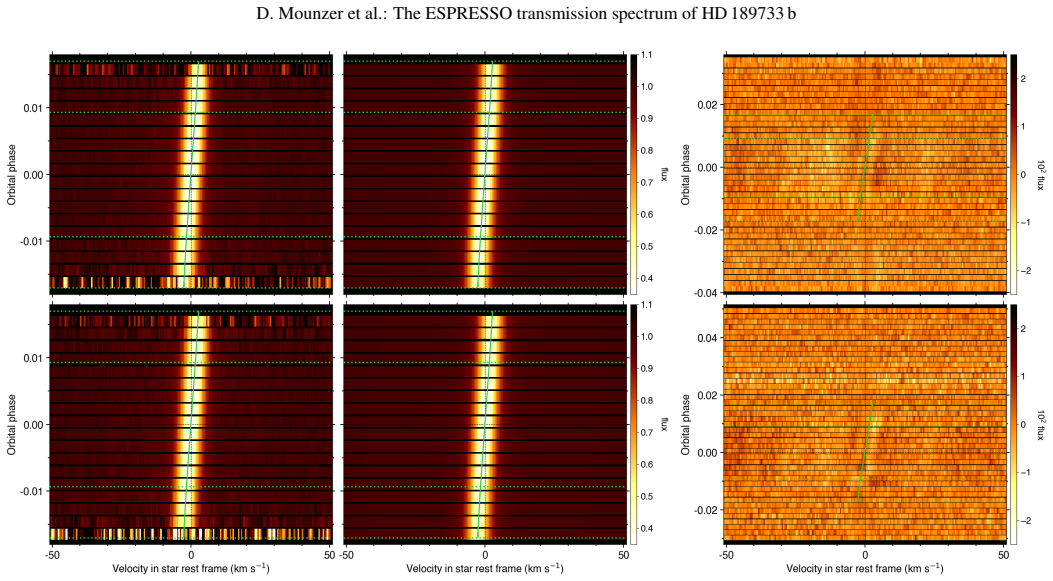
The load-bearing object is the wavelength-dependent transmission spectrum, expressed as $(R_p(\lambda)/R_\star)^2$ from the ratio of in-transit to out-of-transit flux, corrected for transit depth and limb darkening. The obstacle the paper must remove is the planet-occulted line distortion (POLD), the apparent absorption and emission pattern created when the planet blocks different rotating, limb-darkened regions of the stellar surface at different orbital phases. The separation is carried by three tools working together: masking the stellar sodium cores by $0.4$ Å to hide the POLDs, replacing the disk-averaged master-out spectrum with local spectra either shifted to the measured surface radial velocities or drawn from synthetic stellar grids, and restricting the planetary fit to the first half of transit (T2 to mid-transit), where the planetary and stellar Doppler tracks do not yet overlap. A forward code that simulates the transit of the planet plus a spherical, hydrostatic sodium atmosphere over the synthetic stellar grid is then used to show that the observed signature is reproduced with an $8\ \mathrm{km\,s^{-1}}$ day-to-night wind.
What would settle it
A transit of HD 189733 b observed at higher signal-to-noise with simultaneous high-cadence stellar activity indicators would settle the sodium claim: if the blueshifted excess absorption follows the planet's Keplerian velocity and persists after modeling a time-variable stellar line profile, the planetary interpretation stands, while a feature that tracks activity indicators or disappears when the stellar profile is allowed to vary would show it was stellar contamination. For lithium, the decisive test is whether the line is present at the same strength and velocity in an independent transit and absent from out-of-transit spectra.
Extended reading notes
Core claim
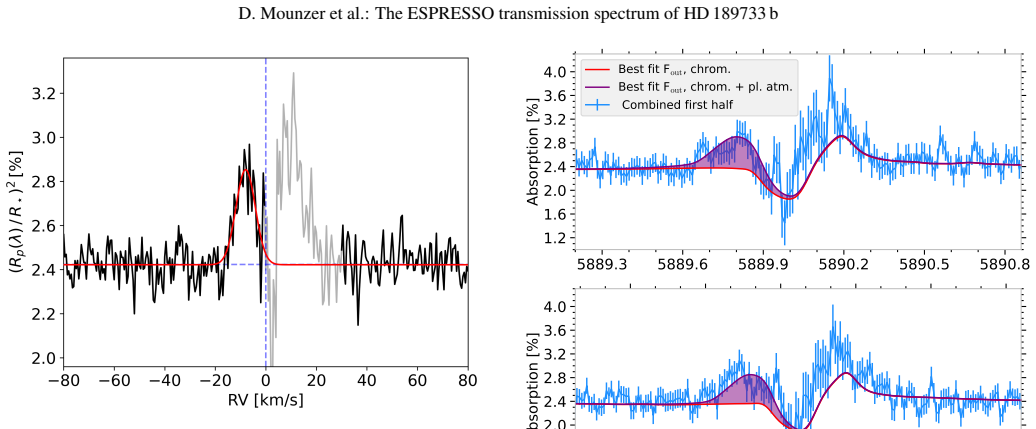
On the paper's own terms, the central discovery is that the genuine planetary sodium signal in HD 189733 b is shallower and more blueshifted than previously claimed: with the D1 and D2 lines co-added, the excess absorption is $0.432 \pm 0.027\%$, the Gaussian FWHM is $3.82 \pm 0.29\ \mathrm{km\,s^{-1}}$, and the line center sits at $-7.97 \pm 0.28\ \mathrm{km\,s^{-1}}$. The same phase-restricted, line-core-masked analysis yields a separate lithium detection at $6707.775$ Å with $0.102 \pm 0.016\%$ absorption ($6.4\sigma$), a blueshift of $-2.4 \pm 1.8\ \mathrm{km\,s^{-1}}$, and a FWHM of $9.9 \pm 1.8\ \mathrm{km\,s^{-1}}$. The authors reproduce the sodium signature with a forward model that includes an $8\ \mathrm{km\,s^{-1}}$ day-to-night wind and a thermosphere temperature of $2750$ K, and they interpret the blueshift as evidence of a strong wind at the planet's terminator. They also reinterpret earlier HARPS, HARPS-N, and PEPSI sodium measurements as biased by uncorrected planet-occulted line distortions and stellar activity, which would explain the larger amplitudes, wider lines, and weaker blueshifts in those studies.
Load-bearing premise
The load-bearing premise is that the blue-shifted excess absorption seen in the first half of the transit, after masking the stellar sodium cores and correcting for the rotation-induced distortions, is sodium in the planet's atmosphere rather than leftover stellar activity; for lithium, the analogous premise is that the star has no lithium line, so a $6.4\sigma$ signal cannot be stellar.
Editorial extensions
If this is right
- The $\sim 8\ \mathrm{km\,s^{-1}}$ sodium blueshift, if real, implies a strong day-to-night wind in the upper atmosphere rather than a static or slowly moving sodium layer.
- Previous sodium amplitudes and line widths from HARPS, HARPS-N, and PEPSI are suspect because POLD residuals and stellar activity were included in the fitted spectra; masking line cores and restricting orbital phases is the corrective step.
- The lithium detection adds HD 189733 b to the small set of exoplanets with lithium and indicates the planet preserves an element that its host star has burned.
- The paper's stated limitation is that neither synthetic stellar models nor out-of-transit masters fully remove stellar variability, so future higher-S/N instruments will need 3D stellar modeling and chromospheric treatment to characterize such aligned hot Jupiters.
- No sodium excess is seen at ingress or egress, consistent with previous studies and with either a fainter signal at the stellar limb or an inhomogeneous sodium distribution.
Reading between the lines
- If the sodium blueshift is a wind, the line centroid should shift systematically across the transit as different terminator regions are probed; a phase-resolved measurement on a single high-S/N transit would test this without stacking nights.
- Because the lithium line has no underlying stellar absorption, it is nearly immune to POLDs; comparing the lithium and sodium blueshifts ($-2.4$ vs $-7.97\ \mathrm{km\,s^{-1}}$) could constrain vertical wind shear, a test the paper does not perform.
- The reported $1\text{--}2\%$ night-to-night variation in stellar sodium and H$\alpha$ depths is comparable to planetary signals, so single-transit atmospheric measurements of active stars may need contemporaneous activity monitoring to be trustworthy.
- If the earlier wider, less blueshifted sodium profiles were indeed mixtures of planetary signal plus POLD residuals, stacked multi-transit analyses that average all phases may actually encode the same systematic bias rather than average it away.
Editorial analysis
A structured set of objections, weighed in public.
Referee Report
Summary. The paper analyzes two ESPRESSO transits of the hot Jupiter HD 189733 b with the goal of separating planetary sodium and lithium absorption signatures from planet-occulted line distortions (POLDs) and stellar activity. After a careful antaress-based reduction and a Rossiter-McLaughlin analysis, the authors compute transmission spectra and test several POLD corrections: masking the stellar Doppler track, shifting the master-out to local surface RVs, and using synthetic Turbospectrum/MARCS local spectra with an ad hoc chromospheric sodium component. In the first half of the transit, after masking the sodium line cores, they fit the blueward excess and report a co-added sodium amplitude of 0.432 ± 0.027% at a blueshift of -7.97 ± 0.28 km/s. They then use the EvE code to model the transit and, adding a hand-chosen 8 km/s day-to-night wind, reproduce the observed sodium signature. In Sect. 6 they report a new lithium detection at 6707.775 Å with amplitude 0.102 ± 0.016% (6.4σ) and a blueshift of -2.4 ± 1.8 km/s. The paper closes with a discussion of why previous sodium studies found larger amplitudes, larger widths, and smaller blueshifts, attributing the differences to incomplete POLD and activity corrections.
Significance. If the results hold, the paper provides a high-S/N benchmark for disentangling planetary sodium from POLDs in an aligned hot-Jupiter system and adds HD 189733 b to the short list of exoplanets with a lithium detection. The work has clear strengths: a detailed and reproducible reduction pipeline, a careful RM analysis with explicit parameter tables, multiple POLD-correction strategies compared on the same data, and unusually candid statements about the limitations of the stellar models and of the authors' own corrections. The sodium detection itself is qualitatively credible because sodium has been seen in this planet multiple times. However, the quantitative claims — the shallow amplitude, the -8 km/s blueshift, and especially the new lithium detection — rest on assumptions that are either unquantified or unverified. The lithium claim is the most novel result, and it currently lacks the null tests needed to exclude a stellar lithium line; the sodium error bars are purely statistical and do not include the dominant systematic choices. The paper therefore is of high interest but needs substantial additional validation before the central quantitative conclusions can be accepted.
major comments (3)
- [Section 6] The lithium detection rests on an unverified premise: that HD 189733 has no stellar Li I 6707.8 line. The text states that 'as stars burn their Li content, they show no absorption lines in their spectra' and concludes that the line is not affected by POLDs or stellar activity, but this is a general population statement, not a measurement for this specific star. The manuscript does not show the master-out spectrum around 6707 Å, does not give an equivalent-width upper limit for a stellar lithium line, does not compare pre- and post-transit master spectra at this wavelength, and does not provide a 2D phase–RV absorption map analogous to Fig. 12. Given the night-long core-depth variations of ~1–2% reported for Na I and Hα in Sect. 4.5, a weak stellar lithium line with even modest variability could produce a residual comparable to the claimed 0.102 ± 0.016% signal. The concern is compounded by the fitted FWHM of 9.9 ± 1.8 km/s, which is close to the expected width of a rotation- and activity-broadened stellar line. The authors must supply a genuine null test — for example, an observed master-out spectrum at 6707 Å with an EW upper limit, and a 2D map showing the feature is at rest in the planetary frame and absent out of transit — before the lithium claim can be accepted.
- [Section 4.6 and Table 3] The quoted sodium parameters are described as model-independent, but the Gaussian fit is applied only to a phase-selected subset (T2 to Tc) of a transmission spectrum that has been corrected using synthetic POLD models and masked at 0.4 Å around the line cores. The uncertainties in Table 3 include only the statistical errors from the Gaussian fit; they do not include the choice of phase range, the mask width, or the choice among the several POLD-correction methods in Sect. 4.3. Section 4.5 demonstrates that stellar line depths vary by ~1–2% over the night, which is larger than the 0.432% signal, so systematic errors could plausibly dominate the reported centroid and amplitude. The authors should quantify these systematics directly — for example by repeating the fit for different mask widths, different phase ranges, and both the local-RV and synthetic POLD corrections — and either report a systematic error budget or soften the precision claims in the abstract and Sect. 7.2.
- [Section 5] The EvE modeling does not independently confirm the presence of a ~8 km/s day-to-night wind. The text explicitly says the wind was added 'based on the values of the blueshift derived in Sect. 4.6,' so the model is tuned to reproduce the very quantity it is then used to support. The χ2 map in Fig. C.1 has temperature and surface density as the only displayed free parameters, and the wind speed is not fitted with an associated uncertainty. The paper should present the -7.97 ± 0.28 km/s value as a Gaussian-fit measurement from the transmission spectrum, and present the EvE wind as an interpretive consistency check rather than as independent evidence. If the authors wish to claim that the wind is constrained by the data, they need to show a likelihood or posterior for the wind speed itself, ideally with the planetary signal modeled simultaneously with the POLDs.
minor comments (4)
- [Abstract and Section 2.3] There is a typo in the abstract: 'theantaress workflow' should read 'the antaress workflow.' The same phrase is also typeset without a space in Sect. 2.3.
- [Section 6] The text reports the lithium line at 6707.775 Å but does not specify whether the fit refers to the unresolved Li I doublet or to one component; state the adopted rest wavelength and whether the doublet was co-added, as is done for sodium.
- [Figures 13 and 14] The captions do not explain what the gray regions are; the reader must infer that they are the masked regions excluded from the Gaussian fit. Please state this explicitly in the captions.
- [Section 5] It is unclear whether the 8 km/s day-to-night wind is a free parameter in the EvE fit or a fixed value inserted by hand. If it is fixed, say so and justify the choice; if it is fitted, report its uncertainty and show it in the correlation map.
Circularity Check
Partial circularity: the EvE day-to-night wind is set from the same -7.97 km/s blueshift it is then used to reproduce, so the simulation is a self-consistency check, not an independent confirmation; the sodium and lithium Gaussian measurements are direct and not circular.
-
fitted input called prediction
[Sect. 5 'Combined stellar and planetary modeling' (EvE), cf. Sect. 4.6 and Sect. 7.2]
"A day-to-nightside wind of 8 km s−1 was also added in the planetary atmosphere to help better match the observed signature. This choice was based on the values of the blueshift derived in Sect. 4.6. ... Finally, the simulations performed in this section confirm the presence of sodium in the atmosphere of HD 189733 b."
The EvE model's dynamical parameter (8 km/s wind) is set from the Gaussian blueshift measured in Sect. 4.6 (-7.97 +/- 0.28 km/s). The model's reproduction of that blueshift therefore does not independently validate the wind or the detection; it is a fit to the same data. Calling the simulations a 'confirmation' of planetary sodium overstates the evidence chain, since the model was adjusted to match the observed signature. The sodium detection itself, however, stands on the direct Gaussian measurement of the transmission spectrum, so the circularity is limited to the model-based wind interpretation.
full rationale
The core sodium and lithium detections are direct Gaussian fits to the transmission spectra (Sect. 4.6, Table 3, Fig. 18) and do not reduce to fitted parameters. The EvE modeling in Sect. 5 is partially circular: the 8 km/s day-to-night wind was explicitly chosen to match the Sect. 4.6 blueshift, and the subsequent 'confirm the presence of sodium' sentence treats a self-consistency fit as independent evidence. This fits the 'fitted input called prediction' pattern, but the affected claim is the dynamical wind interpretation, not the detection itself. The lithium result rests on the astrophysical premise that the star has no Li I 6707.8 line (Sect. 6); that premise is an untested assumption and a correctness/falsifiability concern, but it is not a circular derivation, because the 0.102% amplitude is measured, not inferred from the premise. Self-citations to antaress, RMR, and EvE are present and load-bearing as tools, but the paper does not invoke a self-citation chain or uniqueness theorem to force its interpretation; the independent content (Gaussian amplitudes/blueshifts, comparison with previous studies) remains. The paper itself flags the POLD model limitations in Sects. 7.1 and 7.2, further supporting the view that the modeling is a fit rather than an independent test. Score 4 reflects one partial fit-within-model circularity while the central claims retain independent content.
Assumptions & free parameters
free parameters (5)
- Day-to-night wind speed in EvE =
8 km/s
- Chromospheric sodium column density n_c =
7.54e11 cm^-3
- Chromospheric sodium temperature =
Not quoted explicitly
- Stellar sodium abundance A*(Na I) =
6.1484
- Photospheric temperature for Turbospectrum =
5039 ± 10 K
assumptions (5)
- standard math The transmission spectrum formula of Mounzer et al. (2022) correctly relates the observed flux ratio to (Rp/R*)^2, assuming the local occulted spectrum F_local,i is known or can be approximated.
- domain assumption The out-of-transit master spectrum, after polynomial corrections for RV, contrast, and flux trends, represents the unocculted stellar spectrum at all in-transit phases.
- ad hoc to paper MARCS/Turbospectrum 1D NLTE synthetic spectra, augmented with an ad hoc chromospheric absorption component, are accurate enough to compute local stellar spectra for POLD correction.
- domain assumption HD 189733 has no significant stellar lithium absorption line, so the Li I 6707.775 Å feature is free from POLDs and stellar activity.
- domain assumption EvE's 1D hydrostatic, spherically symmetric atmosphere with a day-to-night wind is a sufficient model for the planetary sodium signature.
invented entities (1)
-
Parametric chromospheric sodium absorption component
Cite this review
Pith. "Pith review of The ESPRESSO transmission spectrum of HD$\,$189733$\,$b : Extracting the planetary sodium and lithium signatures amid stellar contamination." pith.science (2026). https://pith.science/paper/CI4ER67H
@misc{pith2026250621459,
  author       = {Pith},
  title        = {Pith review of: The ESPRESSO transmission spectrum of HD$\,$189733$\,$b : Extracting the planetary sodium and lithium signatures amid stellar contamination},
  year         = {2026},
  howpublished = {\url{https://pith.science/paper/CI4ER67H}},
  note         = {Machine review of arXiv:2506.21459}
}
abstract
While transmission spectroscopy has allowed us to detect many atomic and molecular species in exoplanet atmospheres, the improvement in resolution and signal-to-noise ratio enabled us to become sensitive to planet-occulted line distortions (POLDs) in the spectrum that are induced by center-to-limb variations and the Rossiter-McLaughlin effect. POLDs can bias the interpretation of the transmission spectrum, and it is difficult to correct for them with stellar models. We analyzed two ESPRESSO transits (R $\sim$ 140$\,$000) of the archetypal hot Jupiter HD$\,$189733$\,$b. The transmission spectrum of this aligned system is heavily affected by POLDs, stellar activity, and instrumental effects. It is therefore a challenging study case of how to account for these effects when the planetary signal is retrieved from chemical species through transmission spectroscopy. We confirm the previous detections of the sodium doublet signature in the upper atmosphere of HD$\,$189733$\,$b. When we accounted for POLDs and isolated the planetary signal from uncorrected stellar residuals, we found a shallower (0.432 $\pm$ 0.027 %) and more strongly blueshifted (-7.97 $\pm$ 0.28 km/s) signal. We attempted to reinterpret the other high-resolution sodium studies of this system in light of our results. We suggest that the POLDs and stellar activity are insufficiently corrected for in all analyses, including ours. We also detected a planetary lithium signature of 0.102 $\pm$ 0.016 % (6.4$\sigma$) at a blueshift of -2.4 $\pm$ 1.8 km/s.
Figures


Figures from the paper (14 more)






Reference graph
Works this paper leans on
-
[1]
2022, , 666, A196
Allart , R., Lovis , C., Faria , J., et al. 2022, , 666, A196
2022
-
[2]
2020, , 644, A155
Allart , R., Pino , L., Lovis , C., et al. 2020, , 644, A155
2020
-
[3]
& Plez , B
Alvarez , R. & Plez , B. 1998, , 330, 1109
1998
-
[4]
2014, in Society of Photo-Optical Instrumentation Engineers (SPIE) Conference Series, Vol
Artigau , \'E ., Astudillo-Defru , N., Delfosse , X., et al. 2014, in Society of Photo-Optical Instrumentation Engineers (SPIE) Conference Series, Vol. 9149, Observatory Operations: Strategies, Processes, and Systems V, ed. A. B. Peck , C. R. Benn , & R. L. Seaman , 914905
2014
-
[5]
Azevedo Silva , T., Demangeon , O. D. S., Santos , N. C., et al. 2022, , 666, L10
2022
-
[6]
S., et al
Basilicata , M., Giacobbe , P., Bonomo , A. S., et al. 2024, , 686, A127
2024
-
[7]
J., Crouzet , N., Cubillos , P
Bell , T. J., Crouzet , N., Cubillos , P. E., et al. 2024, Nature Astronomy, 8, 879
2024
-
[8]
Bello-Arufe , A., Cabot , S. H. C., Mendon c a , J. M., Buchhave , L. A., & Rathcke , A. D. 2022, , 163, 96
2022
Show all 99 references
-
[9]
2021, Experimental Astronomy, 51, 109
Benz , W., Broeg , C., Fortier , A., et al. 2021, Experimental Astronomy, 51, 109
2021
-
[10]
2024, , 167, 179
Blain , D., S \'a nchez-L \'o pez , A., & Molli \`e re , P. 2024, , 167, 179
2024
-
[11]
S., Desidera , S., Benatti , S., et al
Bonomo , A. S., Desidera , S., Benatti , S., et al. 2017, , 602, A107
2017
-
[12]
2021, , 645, A24
Borsa , F., Allart , R., Casasayas-Barris , N., et al. 2021, , 645, A24
2021
-
[13]
& Zannoni , A
Borsa , F. & Zannoni , A. 2018, , 617, A134
2018
-
[14]
2005, , 444, L15
Bouchy , F., Udry , S., Mayor , M., et al. 2005, , 444, L15
2005
-
[15]
B., Lovis , C., et al
Bourrier , V., Delisle , J. B., Lovis , C., et al. 2024, , 691, A113
2024
-
[16]
2015, A&A, 582, A65
Bourrier , V., Ehrenreich , D., & Lecavelier des Etangs , A. 2015, A&A, 582, A65
2015
-
[17]
& Lecavelier des Etangs , A
Bourrier , V. & Lecavelier des Etangs , A. 2013, A&A, 557, A124
2013
-
[18]
A., & Vidotto , A
Bourrier , V., Lecavelier des Etangs , A., Ehrenreich , D., Tanaka , Y. A., & Vidotto , A. A. 2016, A&A, 591, A121
2016
-
[19]
2021, , 654, A152
Bourrier , V., Lovis , C., Cretignier , M., et al. 2021, , 654, A152
2021
-
[20]
Bruls , J. H. M. J. & Rutten , R. J. 1992, , 265, 257
1992
-
[21]
2024, , 692, A43
Canocchi , G., Morello , G., Lind , K., et al. 2024, , 692, A43
2024
-
[22]
2024, , 683, A63
Carteret , Y., Bourrier , V., & Dethier , W. 2024, , 683, A63
2024
-
[23]
2017, , 608, A135
Casasayas-Barris , N., Palle , E., Nowak , G., et al. 2017, , 608, A135
2017
-
[24]
2021, , 647, A26
Casasayas-Barris , N., Palle , E., Stangret , M., et al. 2021, , 647, A26
2021
-
[25]
2020, , 635, A206
Casasayas-Barris , N., Pall \'e , E., Yan , F., et al. 2020, , 635, A206
2020
-
[26]
W., Kuckein , C., Redfield , S., et al
Cauley , P. W., Kuckein , C., Redfield , S., et al. 2018, , 156, 189
2018
-
[27]
W., Redfield , S., & Jensen , A
Cauley , P. W., Redfield , S., & Jensen , A. G. 2017, , 153, 185
2017
-
[28]
M., Lovis , C., Bourrier , V., et al
Cegla , H. M., Lovis , C., Bourrier , V., et al. 2016, , 588, A127
2016
-
[29]
M., Latham , D
Charbonneau , D., Brown , T. M., Latham , D. W., & Mayor , M. 2000, , 529, L45
2000
-
[30]
M., Noyes , R
Charbonneau , D., Brown , T. M., Noyes , R. W., & Gilliland , R. L. 2002, , 568, 377
2002
-
[31]
2018, , 616, A145
Chen , G., Pall \'e , E., Welbanks , L., et al. 2018, , 616, A145
2018
-
[32]
2012, in Society of Photo-Optical Instrumentation Engineers (SPIE) Conference Series, Vol
Cosentino , R., Lovis , C., Pepe , F., et al. 2012, in Society of Photo-Optical Instrumentation Engineers (SPIE) Conference Series, Vol. 8446, Ground-based and Airborne Instrumentation for Astronomy IV, ed. I. S. McLean , S. K. Ramsay , & H. Takami , 84461V
2012
-
[33]
C., & Pepe , F
Cretignier , M., Dumusque , X., Hara , N. C., & Pepe , F. 2021, , 653, A43
2021
-
[34]
C., et al
Cristo , E., Esparza Borges , E., Santos , N. C., et al. 2024, , 682, A28
2024
-
[35]
Czesla , S., Klocov \'a , T., Khalafinejad , S., Wolter , U., & Schmitt , J. H. M. M. 2015, , 582, A51
2015
-
[36]
& Bourrier , V
Dethier , W. & Bourrier , V. 2023, , 674, A86
2023
-
[37]
& Tessore , B
Dethier , W. & Tessore , B. 2024, , 688, L30
2024
-
[38]
2020, , 580, 597
Ehrenreich , D., Lovis , C., Allart , R., et al. 2020, , 580, 597
2020
-
[39]
F., Moutou , C., et al
Fares , R., Donati , J. F., Moutou , C., et al. 2010, , 406, 409
2010
-
[40]
2020, , 639, A49
Guilluy , G., Andretta , V., Borsa , F., et al. 2020, , 639, A49
2020
-
[41]
C., Bonomo , A
Guilluy , G., D'Arpa , M. C., Bonomo , A. S., et al. 2024, , 686, A83
2024
-
[42]
, Eriksson, K
Gustafsson , B., Edvardsson, B. , Eriksson, K. , et al. 2008, A&A, 486, 951
2008
-
[43]
2012, , 539, A102
Hayek , W., Sing , D., Pont , F., & Asplund , M. 2012, , 539, A102
2012
-
[44]
2021, , 645, A106
Heiter , U., Lind , K., Bergemann , M., et al. 2021, , 645, A106
2021
-
[45]
W., Marcy , G
Henry , G. W., Marcy , G. W., Butler , R. P., & Vogt , S. S. 2000, , 529, L41
2000
-
[46]
M., Sing , D
Huitson , C. M., Sing , D. K., Vidal-Madjar , A., et al. 2012, , 422, 2477
2012
-
[47]
O., Wende-von Berg , S., Dreizler , S., et al
Husser , T. O., Wende-von Berg , S., Dreizler , S., et al. 2013, , 553, A6
2013
-
[48]
G., Redfield , S., Endl , M., et al
Jensen , A. G., Redfield , S., Endl , M., et al. 2011, , 743, 203
2011
-
[49]
2023, , 677, A110
Jiang , Z., Wang , W., Chen , G., et al. 2023, , 677, A110
2023
-
[50]
G., Lendl , M., Cubillos , P
Juvan , I. G., Lendl , M., Cubillos , P. E., et al. 2018, , 610, A15
2018
-
[51]
2015, , 576, A78
Kausch , W., Noll , S., Smette , A., et al. 2015, , 576, A78
2015
-
[52]
2024, , 530, 4826
Keles , E., Czesla , S., Poppenhaeger , K., et al. 2024, , 530, 4826
2024
-
[53]
Kempton , E. M. R., Bean , J. L., Louie , D. R., et al. 2018, , 130, 114401
2018
-
[54]
Y., Snellen , I
Kesseli , A. Y., Snellen , I. A. G., Casasayas-Barris , N., Molli \`e re , P., & S \'a nchez-L \'o pez , A. 2022, , 163, 107
2022
-
[55]
J., et al
Khalafinejad , S., von Essen , C., Hoeijmakers , H. J., et al. 2017, , 598, A131
2017
-
[56]
2015, , 127, 1161
Kreidberg , L. 2015, , 127, 1161
2015
-
[57]
F., Lendl , M., Patel , J
Krenn , A. F., Lendl , M., Patel , J. A., et al. 2023, , 672, A24
2023
-
[58]
B., Madhusudhan , N., Cabot , S
Langeveld , A. B., Madhusudhan , N., Cabot , S. H. C., & Hodgkin , S. T. 2021, , 502, 4392
2021
-
[59]
S., Eitner , P., Magg , E., et al
Larsen , S. S., Eitner , P., Magg , E., et al. 2022, , 660, A88
2022
-
[60]
R., Collier-Cameron , A., et al
Lendl , M., Anderson , D. R., Collier-Cameron , A., et al. 2012, , 544, A72
2012
-
[61]
& Wheatley , P
Louden , T. & Wheatley , P. J. 2015, , 814, L24
2015
-
[62]
2022, , 661, A140
Magg , E., Bergemann , M., Serenelli , A., et al. 2022, , 661, A140
2022
-
[63]
2003, The Messenger, 114, 20
Mayor , M., Pepe , F., Queloz , D., et al. 2003, The Messenger, 114, 20
2003
-
[64]
2000, , 532, L55
Mazeh , T., Naef , D., Torres , G., et al. 2000, , 532, L55
2000
-
[65]
McLaughlin , D. B. 1924, , 60, 22
1924
-
[66]
V., et al
Mounzer , D., Lovis , C., Seidel , J. V., et al. 2022, , 668, A1
2022
-
[67]
F., et al
Moutou , C., Dalal , S., Donati , J. F., et al. 2020, , 642, A72
2020
-
[68]
F., Savalle , R., et al
Moutou , C., Donati , J. F., Savalle , R., et al. 2007, , 473, 651
2007
-
[69]
C., Ehrenreich , D., et al
Oshagh , M., Santos , N. C., Ehrenreich , D., et al. 2014, , 568, A99
2014
-
[70]
2021, , 645, A96
Pepe , F., Cristiani , S., Rebolo , R., et al. 2021, , 645, A96
2021
-
[71]
2014, Astronomische Nachrichten, 335, 8
Pepe , F., Molaro , P., Cristiani , S., et al. 2014, Astronomische Nachrichten, 335, 8
2014
-
[72]
2012, Turbospectrum: Code for spectral synthesis
Plez , B. 2012, Turbospectrum: Code for spectral synthesis
2012
-
[73]
K., Gibson , N
Pont , F., Sing , D. K., Gibson , N. P., et al. 2013, , 432, 2917
2013
-
[74]
J., Morris , B
Prinoth , B., Hoeijmakers , H. J., Morris , B. M., et al. 2024, , 685, A60
2024
-
[75]
J., Caballero , J
Quirrenbach , A., Amado , P. J., Caballero , J. A., et al. 2014, in Society of Photo-Optical Instrumentation Engineers (SPIE) Conference Series, Vol. 9147, Ground-based and Airborne Instrumentation for Astronomy V, ed. S. K. Ramsay , I. S. McLean , & H. Takami , 91471F
2014
-
[76]
2024, , 962, L20
Radica , M., Coulombe , L.-P., Taylor , J., et al. 2024, , 962, L20
2024
-
[77]
D., & Koesterke , L
Redfield , S., Endl , M., Cochran , W. D., & Koesterke , L. 2008, , 673, L87
2008
-
[78]
R., Winn , J
Ricker , G. R., Winn , J. N., Vanderspek , R., et al. 2014, in Society of Photo-Optical Instrumentation Engineers (SPIE) Conference Series, Vol. 9143, Space Telescopes and Instrumentation 2014: Optical, Infrared, and Millimeter Wave, ed. J. Oschmann , Jacobus M., M. Clampin , ...
2014
-
[79]
Rossiter , R. A. 1924, , 60, 15
1924
-
[80]
K., Mukherjee , S., et al
Rustamkulov , Z., Sing , D. K., Mukherjee , S., et al. 2023, , 614, 659
2023
-
[81]
L., et al
Ryabchikova, T., Piskunov, N., Kurucz, R. L., et al. 2015, Physica Scripta, 90, 054005
2015
-
[82]
& Sasselov , D
Seager , S. & Sasselov , D. D. 2000, , 537, 916
2000
-
[83]
V., Borsa , F., Pino , L., et al
Seidel , J. V., Borsa , F., Pino , L., et al. 2023, , 673, A125
2023
-
[84]
V., Ehrenreich , D., Pino , L., et al
Seidel , J. V., Ehrenreich , D., Pino , L., et al. 2020, , 633, A86
2020
-
[85]
V., Ehrenreich , D., Wyttenbach , A., et al
Seidel , J. V., Ehrenreich , D., Wyttenbach , A., et al. 2019, , 623, A166
2019
-
[86]
V., Prinoth , B., Pino , L., et al
Seidel , J. V., Prinoth , B., Pino , L., et al. 2025, , 639, 902
2025
-
[87]
2022, , 667, A19
Sicilia , D., Malavolta , L., Pino , L., et al. 2022, , 667, A19
2022
-
[88]
2025, , 693, A316
Sicilia , D., Malavolta , L., Scandariato , G., et al. 2025, , 693, A316
2025
-
[89]
K., Fortney , J
Sing , D. K., Fortney , J. J., Nikolov , N., et al. 2016, , 529, 59
2016
-
[90]
2015, , 576, A77
Smette , A., Sana , H., Noll , S., et al. 2015, , 576, A77
2015
-
[91]
Snellen , I. A. G., de Kok , R. J., de Mooij , E. J. W., & Albrecht , S. 2010, , 465, 1049
2010
-
[92]
G., Ilyin , I., J \"a rvinen , A., et al
Strassmeier , K. G., Ilyin , I., J \"a rvinen , A., et al. 2015, Astronomische Nachrichten, 336, 324
2015
-
[93]
M., Zapatero Osorio , M
Tabernero , H. M., Zapatero Osorio , M. R., Allart , R., et al. 2021, , 646, A158
2021
-
[94]
2015, , 577, A62
Wyttenbach , A., Ehrenreich , D., Lovis , C., Udry , S., & Pepe , F. 2015, , 577, A62
2015
-
[95]
2020, , 638, A87
Wyttenbach , A., Molli \`e re , P., Ehrenreich , D., et al. 2020, , 638, A87
2020
-
[96]
& Henning , T
Yan , F. & Henning , T. 2018, Nature Astronomy, 2, 714
2018
-
[97]
Yan , F., Pall \'e , E., Fosbury , R. A. E., Petr-Gotzens , M. G., & Henning , T. 2017, , 603, A73
2017
-
[98]
, " * write output.state after.block = add.period write newline
ENTRY address archiveprefix author booktitle chapter edition editor howpublished institution eprint journal key month note number organization pages publisher school series title type volume year label extra.label sort.label short.list INTEGERS output.state before.all mid.sent...
-
[99]
write newline
" write newline "" before.all 'output.state := FUNCTION n.dashify 't := "" t empty not t #1 #1 substring "-" = t #1 #2 substring "--" = not "--" * t #2 global.max substring 't := t #1 #1 substring "-" = "-" * t #2 global.max substring 't := while if t #1 #1 substring * t #2 gl...
Reviewed August 6, 2026 · model on record in the stance chip above.
Discussion (0). Sign in to comment.