REVIEW 2 major objections 5 minor 54 references
StruMamba3D: Exploring Structural Mamba for Self-supervised Point Cloud Representation Learning
T0 review · 2 major / 5 minor · reviewed 2026-08-06 · deepseek-v4-flash
Pith's one-line read This paper claims that giving a linear-complexity state-space model 16 position-encoded spatial states and a length-adaptive update rule lets self-supervised point cloud learning preserve 3D adjacency without serialization, reaching 92.75…
desk verdict A genuinely novel Mamba variant for point clouds with convincing ablations, but the math is under-specified and the masked-pretraining leak concern doesn't survive a close reading. read the letter →
The pith
A machine-rendered reading of the paper's core claim, the machinery that carries it, and where it could break.
The reading
What carries the argument
The load-bearing object is the structural SSM block with spatial states: $M=16$ centroids $P_h$ initialized by farthest point sampling and KNN clustering, embedded as state features $F_h$. The state-wise update of Eq. (7) adds the relative offset between each input point and each state to the feature projection when generating $B$ and $C$, so each spatial state selectively absorbs points in its region and each point reads local structure from nearby states. Bidirectional forward and backward scans plus a lightweight convolution over state neighbors, Eqs. (9) and (10), break the isolation of states. The sequence length-adaptive strategy rescales $\Delta_i$ by $\tau \Delta'_i / \sum \Delta'_i$ as in Eq. (11) to keep total sampling time equal across lengths, and the pre-training loss adds a Smooth L1 consistency term between student states and an EMA teacher that sees the full input. These mechanisms preserve the hardware-aware linear scan of Mamba while carrying spatial structure through the hidden state.
What would settle it
Run the exact ShapeNet pre-training and ScanObjectNN PB-T50-RS fine-tuning protocol with $M=16$ spatial states initialized at uniformly random positions inside each object's bounding box instead of FPS/KNN centroids, holding every other hyperparameter fixed. If accuracy stays near 92.75 percent, the geometric initialization is not load-bearing and the claimed mechanism is misdiagnosed; if accuracy drops by several points toward the 88 to 91 percent range of the standard Mamba baseline, the centroid positions carry the structure.
Extended reading notes
Core claim
The paper's central discovery is that the hidden states of a selective state-space model can themselves carry 3D geometry. Instead of ordering points into a 1D sequence and hoping serialization preserves adjacency, StruMamba3D assigns positional coordinates to $M=16$ latent states, computed as centroids of FPS and KNN clusters, and makes the SSM's $B$ and $C$ parameters depend on both the point feature and the relative offset between the point and each state, written $(B_i^m, C_i^m) = \phi(x_i) + \mathrm{MLP}(\Delta P_i^m)$. The state update then selectively mixes points with the local regions they belong to, and a lightweight graph convolution lets neighboring states exchange information. To handle the pre-training versus fine-tuning length gap, the sampling interval is rescaled as $\Delta_i = \tau \Delta'_i / \sum_i \Delta'_i$ so that total sampling time stays constant, and a spatial-state consistency loss with an EMA teacher reinforces this invariance. The claim is that these three mechanisms, spatial states, state-wise update, and length-adaptive delta, are what let a linear-complexity Mamba reach the reported accuracy without any serialization strategy.
Load-bearing premise
The load-bearing premise is that $M=16$ position-encoded states, seeded by farthest point sampling and KNN clustering, represent the local structure of a point cloud accurately enough for the state-wise update to supply what serialization used to supply; if these spatial proxies are too few or misplaced, the gains over standard Mamba largely disappear.
Editorial extensions
If this is right
- Point cloud serialization strategies become unnecessary, removing space-filling-curve preprocessing and the adjacency distortion it introduces.
- The model keeps linear complexity while modeling spatial dependencies, so it can process longer point sequences than quadratic attention alternatives at comparable cost.
- Pre-trained representations transfer to longer downstream inputs, such as 2048-point scans, without the memory-retention drop the paper identifies in standard Mamba.
- The method reports higher classification accuracy than all single-modal self-supervised baselines compared in the paper on ScanObjectNN and ModelNet40, together with strong few-shot and part-segmentation results.
Reading between the lines
- Beyond the paper: the same spatial-state trick could apply to any unordered or graph-structured sequence, such as molecules, meshes, or general set data, where Mamba serialization is arbitrary; the paper does not test this.
- Beyond the paper: the length-adaptive delta scaling in Eq. (11) is a generic normalization for any SSM pre-training and fine-tuning length mismatch, so a natural check is applying it to a standard Mamba on text or audio with variable sequence lengths.
- Beyond the paper: the fixed FPS/KNN state initialization could be replaced with learned or soft assignment; if accuracy holds with randomly initialized state positions, the structural benefit would come from training rather than geometric initialization, an experiment the paper does not run.
Editorial analysis
A structured set of objections, weighed in public.
Referee Report
Summary. StruMamba3D replaces the standard Mamba block with a "structural SSM" in which M=16 latent states carry explicit 3D positions (centroids from FPS/KNN), B and C parameters are modulated by relative offsets between input points and state positions (Eq. 7), a lightweight KNN convolution replaces the causal 1D convolution, and forward/backward scans are fused. A length-adaptive strategy scales Δ by the total per-sequence sum (Eq. 11) and adds a spatial-state consistency loss during masked-point pretraining. The paper reports SOTA results on ScanObjectNN (92.75 on PB-T50-RS) and ModelNet40 (95.1 w/o voting), plus part segmentation, few-shot, and ScanNet detection, with systematic ablations.
Significance. The architecture addresses a real gap: Mamba-based point-cloud models either serialize points, distorting spatial adjacency, or suffer when pretraining and downstream sequence lengths differ. If the reported gains hold under a clean pretraining protocol, this is a significant contribution with a practical efficiency story: linear complexity, no serialization, and competitive or SOTA single-modal self-supervised accuracy. The paper also does several things well: ablations in Tabs. 4-7 and 10-12 are systematic, comparisons are made against independent external baselines including PointMAE, PointMamba and Mamba3D, and the ScanNet detection experiment and detailed supplementary support generalization. The main uncertainties are the pretraining state-initialization protocol and the precise SSM recurrence, both of which are central to the claims.
major comments (2)
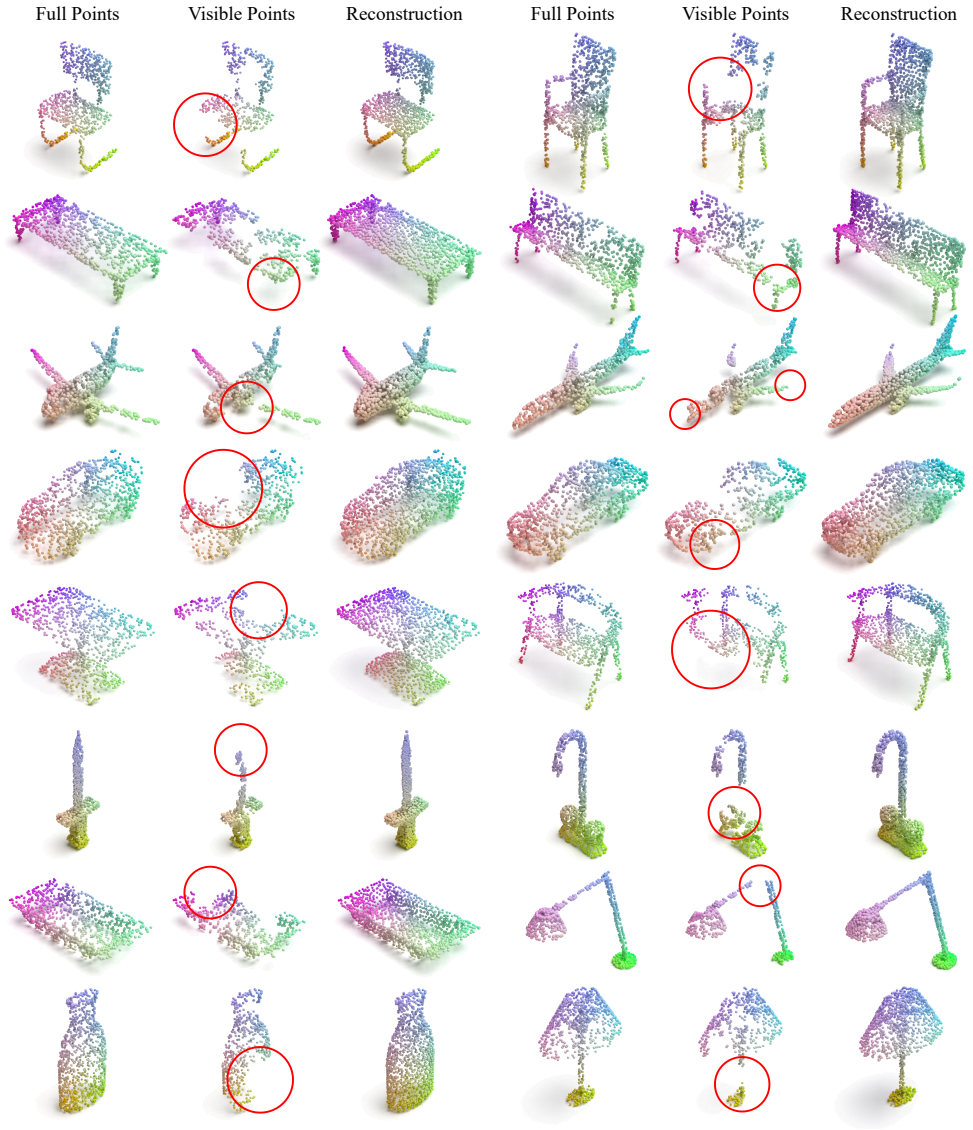
- [Sec. 3.2, Eq. (4); Sec. 4.1] The pretraining protocol may leak the masked-region layout into the student encoder. In Sec. 3.2 the spatial-state positions P_h are initialized "from the raw point cloud" P_raw (Eq. 4: centroids of FPS/KNN groups of P_raw), while Sec. 4.1 masks 60% of the 64 groups before the encoder runs. If P_h is computed on the full cloud before masking, the student receives 16 anchor positions covering the entire object, including masked groups; the masked-point reconstruction and the consistency loss L_ssc are then much easier than in PointMAE/PointMamba/Mamba3D, whose encoders only see visible tokens. The SOTA comparison in Tab. 1 is only fair if state initialization is restricted to visible groups. The paper needs an unambiguous statement of the pretraining state-initialization input, and if the implementation uses full-cloud initialization, a rerun with visible-only initialization (or evidence that the layout information does not drive the gains). Fig. 3 appears to show visible-only "State Init", which contradicts the text; this ambiguity is load-bearing.
- [Algorithm 1; Sec. 3.3] The core structural SSM recurrence is underspecified. Eq. (2)-(3) define an SSM with state h_t in R^M and scalar B,C, while Algorithm 1 states A_o,B_o in R^{B,N,M,E} and C_o in R^{B,N,M}, with initial states \hat F_h in R^{B,M,E}; the call SSM(A_o,B_o,C_o)(\hat F_x,\hat F_h) in line 17 is never defined. This is not the standard Mamba kernel scan interface (A in R^{B,L,D,N}, B,C in R^{B,L,N}), so the claims of "linear complexity" and "same hardware-aware scan algorithm" cannot be checked against the stated equations. Please provide the exact per-step update equations (how A_i^m acts on h_{i-1}^m, how B_i^m and C_i^m are contracted, how the final state \hat F_h^o is read out) and comment on the memory cost of materializing B*N*M*E tensors per layer.
minor comments (5)
- [Eq. (8) vs. Algorithm 1] Eq. (8) writes F'_x,F'_h = phi_o(SSM_f + SSM_b), while Algorithm 1 lines 20-22 apply a gated linear unit to point features, use separate output projections for point and state features, and add residual connections; please unify the notation.
- [Algorithm 1, lines 8-16] B_o is first declared as (B,N,M) and then overwritten as (B,N,M,E), and the "otimes" operation in lines 15-16 is undefined; use distinct variables and define the broadcasting/product.
- [Sec. 9.4] The text refers to "Sec. 9.7" for the M-ablation, but the results are in Table 11; the cross-reference should be corrected.
- [Tab. 8; Sec. 8.3] Tab. 8 lists "PointMAE [42]" but the PointMAE reference is [25]; also, the number of input tokens N used in downstream fine-tuning (vs. the point counts 1024/2048) should be stated explicitly, since Eq. (11) depends on N.
- [Abstract; Tab. 1] The abstract's SOTA claim for ModelNet40 should specify the without-voting column; Table 1 shows Mamba3D also reaches 95.1 with voting, while 95.4 with voting is the overall SOTA.
Circularity Check
No significant circularity: core claims are validated against external baselines and ablations; only minor tuning and a possible pretraining-layout leakage, neither of which is a derivation-equivalent loop.
full rationale
The paper's derivation chain is self-contained: the structural SSM block is a concrete architectural modification (Eqs. 4-10) whose contribution is measured by ablations against a standard Mamba block (Tabs. 4-6, 10) and by comparisons to external methods (PointMAE, PointMamba, Mamba3D). The sequence length-adaptive strategy (Eq. 11) is a normalization identity that ensures Delta_all = tau by construction, but the claimed benefit (long-sequence memory) is tested downstream and ablated (Tab. 7), so it is not a prediction reduced to its input. Self-citations ([32]-[34]) are background references and are not load-bearing. Two non-circular caveats: (i) the spatial state positions are initialized from the full raw cloud Praw (Sec. 3.2, Eq. 4), and pretraining masks 60% of groups (Sec. 4.1), so the student's state init may leak a coarse layout of masked regions; this is a pretraining-fairness confound, not a circular derivation, and the structural SSM gain also appears without pretraining (Sec. 9.7) and against the Mamba baseline; (ii) tau and lambda are tuned on the target datasets (Tab. 7), a standard hyperparameter choice rather than a fitted-prediction loop. Overall, no equation or claim reduces by construction to its own input.
Assumptions & free parameters
free parameters (4)
- lambda (weight of spatial state consistency loss) =
2
- M (number of spatial states) =
16
- tau (total sampling time scale) =
learned, initialization not reported
- k-neighbor counts for lightweight convolution =
4 for states, 8 for input points
assumptions (5)
- domain assumption M=16 centroid-based spatial states with positional attributes suffice as proxies for local point-cloud structure (FPS+KNN grouping, Eq. 4-5).
- ad hoc to paper Normalizing delta by sequence length (Eq. 11) so that the total sampling time is constant improves long-sequence memory.
- domain assumption The per-token A_o and B_o tensors in Algorithm 1 are implemented correctly by the hardware-aware scan with near-linear complexity.
- domain assumption EMA teacher state features are valid pseudo-labels for the spatial state consistency loss (Eq. 12).
- standard math SSM discretization formulas from Mamba (Eq. 2) are correct and applicable with the modified parameters.
invented entities (1)
-
Spatial states (positional latent states P_h in R^{M x 3} with features F_h)
Cite this review
Pith. "Pith review of StruMamba3D: Exploring Structural Mamba for Self-supervised Point Cloud Representation Learning." pith.science (2026). https://pith.science/paper/IUUPKD72
@misc{pith2026250621541,
  author       = {Pith},
  title        = {Pith review of: StruMamba3D: Exploring Structural Mamba for Self-supervised Point Cloud Representation Learning},
  year         = {2026},
  howpublished = {\url{https://pith.science/paper/IUUPKD72}},
  note         = {Machine review of arXiv:2506.21541}
}
read the original abstract
Recently, Mamba-based methods have demonstrated impressive performance in point cloud representation learning by leveraging State Space Model (SSM) with the efficient context modeling ability and linear complexity. However, these methods still face two key issues that limit the potential of SSM: Destroying the adjacency of 3D points during SSM processing and failing to retain long-sequence memory as the input length increases in downstream tasks. To address these issues, we propose StruMamba3D, a novel paradigm for self-supervised point cloud representation learning. It enjoys several merits. First, we design spatial states and use them as proxies to preserve spatial dependencies among points. Second, we enhance the SSM with a state-wise update strategy and incorporate a lightweight convolution to facilitate interactions between spatial states for efficient structure modeling. Third, our method reduces the sensitivity of pre-trained Mamba-based models to varying input lengths by introducing a sequence length-adaptive strategy. Experimental results across four downstream tasks showcase the superior performance of our method. In addition, our method attains the SOTA 95.1% accuracy on ModelNet40 and 92.75% accuracy on the most challenging split of ScanObjectNN without voting strategy.
Figures


Figures from the paper (5 more)



Reference graph
Works this paper leans on
-
[1]
Shapenet: An information-rich 3d model repository
Angel X Chang, Thomas Funkhouser, Leonidas Guibas, Pat Hanrahan, Qixing Huang, Zimo Li, Silvio Savarese, Manolis Savva, Shuran Song, Hao Su, et al. Shapenet: An information-rich 3d model repository. arXiv preprint arXiv:1512.03012, 2015. 6, 11
arXiv 2015
-
[2]
Decoupled local aggregation for point cloud learning, 2023
Binjie Chen, Yunzhou Xia, Yu Zang, Cheng Wang, and Jonathan Li. Decoupled local aggregation for point cloud learning, 2023. 6, 7
work page 2023
-
[3]
Pointgpt: Auto-regressively gen- erative pre-training from point clouds
Guangyan Chen, Meiling Wang, Yi Yang, Kai Yu, Li Yuan, and Yufeng Yue. Pointgpt: Auto-regressively gen- erative pre-training from point clouds. arXiv preprint arXiv:2305.11487, 2023. 3, 6, 7, 12, 13
arXiv 2023
-
[4]
Siheng Chen, Baoan Liu, Chen Feng, Carlos Vallespi- Gonzalez, and Carl Wellington. 3d point cloud processing and learning for autonomous driving: Impacting map cre- ation, localization, and perception. IEEE Signal Processing Magazine, 38(1):68–86, 2020. 1
work page 2020
-
[5]
Tri Dao and Albert Gu. Transformers are ssms: General- ized models and efficient algorithms through structured state space duality. arXiv preprint arXiv:2405.21060, 2024. 3
arXiv 2024
-
[6]
BERT: pre-training of deep bidirectional trans- formers for language understanding
Jacob Devlin, Ming-Wei Chang, Kenton Lee, and Kristina Toutanova. BERT: pre-training of deep bidirectional trans- formers for language understanding. In NAACL-HLT (1), pages 4171–4186. Association for Computational Linguis- tics, 2019. 2, 3
work page 2019
-
[7]
Runpei Dong, Zekun Qi, Linfeng Zhang, Junbo Zhang, Jian- jian Sun, Zheng Ge, Li Yi, and Kaisheng Ma. Autoencoders as cross-modal teachers: Can pretrained 2d image transform- ers help 3d representation learning? In The Eleventh Inter- national Conference on Learning Representations (ICLR) ,
-
[8]
Pranet: Parallel reverse attention network for polyp segmentation
Deng-Ping Fan, Ge-Peng Ji, Tao Zhou, Geng Chen, Huazhu Fu, Jianbing Shen, and Ling Shao. Pranet: Parallel reverse attention network for polyp segmentation. In International conference on medical image computing and computer- assisted intervention, pages 263–273. Springer, 2020. 6
work page 2020
Show all 54 references
-
[9]
Mamba: Linear-time sequence modeling with selective state spaces
Albert Gu and Tri Dao. Mamba: Linear-time sequence modeling with selective state spaces. arXiv preprint arXiv:2312.00752, 2023. 2, 3, 7, 14
2023 arXiv
-
[10]
Efficiently modeling long sequences with structured state spaces
Albert Gu, Karan Goel, and Christopher R ´e. Efficiently modeling long sequences with structured state spaces. arXiv preprint arXiv:2111.00396, 2021
2021 arXiv
-
[11]
Combining recurrent, convolutional, and continuous-time models with linear state space layers
Albert Gu, Isys Johnson, Karan Goel, Khaled Saab, Tri Dao, Atri Rudra, and Christopher R ´e. Combining recurrent, convolutional, and continuous-time models with linear state space layers. Advances in neural information processing sys- tems, 34:572–585, 2021. 3
2021
-
[12]
Pct: Point cloud transformer
Meng-Hao Guo, Jun-Xiong Cai, Zheng-Ning Liu, Tai-Jiang Mu, Ralph R Martin, and Shi-Min Hu. Pct: Point cloud transformer. Computational Visual Media, 7:187–199, 2021. 2, 3
2021
-
[13]
Deep learning for 3d point clouds: A survey
Yulan Guo, Hanyun Wang, Qingyong Hu, Hao Liu, Li Liu, and Mohammed Bennamoun. Deep learning for 3d point clouds: A survey. IEEE transactions on pattern analysis and machine intelligence, 43(12):4338–4364, 2020. 1
2020
-
[14]
Joint-mae: 2d-3d joint masked au- toencoders for 3d point cloud pre-training
Ziyu Guo, Renrui Zhang, Longtian Qiu, Xianzhi Li, and Pheng-Ann Heng. Joint-mae: 2d-3d joint masked au- toencoders for 3d point cloud pre-training. arXiv preprint arXiv:2302.14007, 2023. 6
2023 arXiv
-
[15]
Mamba3d: Enhancing local features for 3d point cloud anal- ysis via state space model
Xu Han, Yuan Tang, Zhaoxuan Wang, and Xianzhi Li. Mamba3d: Enhancing local features for 3d point cloud anal- ysis via state space model. In Proceedings of the 32nd ACM International Conference on Multimedia , page 4995–5004. Association for Computing Machinery, 2024. 2, 3, 6, 7
2024
-
[16]
Masked autoencoders are scalable vision learners
Kaiming He, Xinlei Chen, Saining Xie, Yanghao Li, Piotr Doll´ar, and Ross Girshick. Masked autoencoders are scalable vision learners. In Proceedings of the IEEE/CVF conference on computer vision and pattern recognition , pages 16000– 16009, 2022. 2, 3
2022
-
[17]
A new approach to linear filter- ing and prediction problems
Rudolph Emil Kalman. A new approach to linear filter- ing and prediction problems. Journal of Basic Engineering,
-
[18]
Adam: A method for stochastic optimization
Diederik P Kingma and Jimmy Ba. Adam: A method for stochastic optimization. arXiv preprint arXiv:1412.6980 ,
-
[19]
Pointcnn: Convolution on x-transformed points
Yangyan Li, Rui Bu, Mingchao Sun, Wei Wu, Xinhan Di, and Baoquan Chen. Pointcnn: Convolution on x-transformed points. Advances in neural information processing systems, 31, 2018. 1, 2, 3, 6
2018
-
[20]
Deep learning for lidar point clouds in autonomous driving: A review
Ying Li, Lingfei Ma, Zilong Zhong, Fei Liu, Michael A Chapman, Dongpu Cao, and Jonathan Li. Deep learning for lidar point clouds in autonomous driving: A review. IEEE Transactions on Neural Networks and Learning Systems, 32 (8):3412–3432, 2020. 1
2020
-
[21]
Pointmamba: A simple state space model for point cloud analysis
Dingkang Liang, Xin Zhou, Wei Xu, Xingkui Zhu, Zhikang Zou, Xiaoqing Ye, Xiao Tan, and Xiang Bai. Pointmamba: A simple state space model for point cloud analysis. In Ad- vances in Neural Information Processing Systems , 2024. 2, 3, 6, 7, 12, 13
2024
-
[22]
Masked dis- crimination for self-supervised learning on point clouds
Haotian Liu, Mu Cai, and Yong Jae Lee. Masked dis- crimination for self-supervised learning on point clouds. In European Conference on Computer Vision, pages 657–675. Springer, 2022. 2, 3, 6, 7, 13
2022
-
[23]
Sgdr: Stochas- tic gradient descent with warm restarts
Ilya Loshchilov and Frank Hutter. Sgdr: Stochas- tic gradient descent with warm restarts. arXiv preprint arXiv:1608.03983, 2016. 11, 12
2016 arXiv
-
[24]
Rethinking network design and local geometry in point cloud: A simple residual mlp framework
Xu Ma, Can Qin, Haoxuan You, Haoxi Ran, and Yun Fu. Rethinking network design and local geometry in point cloud: A simple residual mlp framework. arXiv preprint arXiv:2202.07123, 2022. 3, 6
2022 arXiv
-
[25]
Masked autoencoders for point cloud self-supervised learning
Yatian Pang, Wenxiao Wang, Francis EH Tay, Wei Liu, Yonghong Tian, and Li Yuan. Masked autoencoders for point cloud self-supervised learning. In European conference on computer vision, pages 604–621. Springer, 2022. 2, 3, 5, 6, 7, 8, 11
2022
-
[26]
A review of point cloud registration algorithms for mobile robotics
Franc ¸ois Pomerleau, Francis Colas, Roland Siegwart, et al. A review of point cloud registration algorithms for mobile robotics. Foundations and Trends® in Robotics, 4(1):1–104,
-
[27]
Pointnet: Deep learning on point sets for 3d classification and segmentation
Charles R Qi, Hao Su, Kaichun Mo, and Leonidas J Guibas. Pointnet: Deep learning on point sets for 3d classification and segmentation. In Proceedings of the IEEE conference on computer vision and pattern recognition, pages 652–660,
-
[28]
Pointnet++: Deep hierarchical feature learning on point sets in a metric space
Charles Ruizhongtai Qi, Li Yi, Hao Su, and Leonidas J Guibas. Pointnet++: Deep hierarchical feature learning on point sets in a metric space. Advances in neural information processing systems, 30, 2017. 1, 2, 3, 6, 7, 11
2017
-
[29]
Contrast with reconstruct: Contrastive 3d representation learning guided by generative pretraining
Zekun Qi, Runpei Dong, Guofan Fan, Zheng Ge, Xiangyu Zhang, Kaisheng Ma, and Li Yi. Contrast with reconstruct: Contrastive 3d representation learning guided by generative pretraining. In International Conference on Machine Learn- ing (ICML), 2023. 3, 6
2023
-
[30]
Pointnext: Revisiting pointnet++ with improved training and scaling strategies
Guocheng Qian, Yuchen Li, Houwen Peng, Jinjie Mai, Hasan Hammoud, Mohamed Elhoseiny, and Bernard Ghanem. Pointnext: Revisiting pointnet++ with improved training and scaling strategies. Advances in neural informa- tion processing systems, 35:23192–23204, 2022. 1, 3, 6
2022
-
[31]
Kpconv: Flexible and deformable convolution for point clouds
Hugues Thomas, Charles R Qi, Jean-Emmanuel Deschaud, Beatriz Marcotegui, Franc ¸ois Goulette, and Leonidas J Guibas. Kpconv: Flexible and deformable convolution for point clouds. In Proceedings of the IEEE/CVF international conference on computer vision, pages 6411–6420, 2019. 1, 3
2019
-
[32]
Long-short range adap- tive transformer with dynamic sampling for 3d object detec- tion
Chuxin Wang, Jiacheng Deng, Jianfeng He, Tianzhu Zhang, Zhe Zhang, and Yongdong Zhang. Long-short range adap- tive transformer with dynamic sampling for 3d object detec- tion. IEEE Transactions on Circuits and Systems for Video Technology, 33(12):7616–7629, 2023. 1
2023
-
[33]
Rethinking masked representation learning for 3d point cloud understanding
Chuxin Wang, Yixin Zha, Jianfeng He, Wenfei Yang, and Tianzhu Zhang. Rethinking masked representation learning for 3d point cloud understanding. IEEE Transactions on Im- age Processing, 2024. 3
2024
-
[34]
State space model meets transformer: A new paradigm for 3d object detection
ChuXin Wang, Wenfei Yang, Xiang Liu, and Tianzhu Zhang. State space model meets transformer: A new paradigm for 3d object detection. In The Thirteenth International Conference on Learning Representations, 2025. 3
2025
-
[35]
Dynamic graph cnn for learning on point clouds
Yue Wang, Yongbin Sun, Ziwei Liu, Sanjay E Sarma, Michael M Bronstein, and Justin M Solomon. Dynamic graph cnn for learning on point clouds. ACM Transactions on Graphics (tog), 38(5):1–12, 2019. 2, 3, 5, 6
2019
-
[36]
Attention-based point cloud edge sampling
Chengzhi Wu, Junwei Zheng, Julius Pfrommer, and J ¨urgen Beyerer. Attention-based point cloud edge sampling. InPro- ceedings of the IEEE/CVF Conference on Computer Vision and Pattern Recognition, pages 5333–5343, 2023. 7
2023
-
[37]
Point transformer v2: Grouped vector atten- tion and partition-based pooling
Xiaoyang Wu, Yixing Lao, Li Jiang, Xihui Liu, and Heng- shuang Zhao. Point transformer v2: Grouped vector atten- tion and partition-based pooling. Advances in Neural Infor- mation Processing Systems, 35:33330–33342, 2022. 3
2022
-
[38]
Point transformer v3: Simpler faster stronger
Xiaoyang Wu, Li Jiang, Peng-Shuai Wang, Zhijian Liu, Xi- hui Liu, Yu Qiao, Wanli Ouyang, Tong He, and Hengshuang Zhao. Point transformer v3: Simpler faster stronger. In Pro- ceedings of the IEEE/CVF Conference on Computer Vision and Pattern Recognition, pages 4840–4851, 2024. 3
2024
-
[39]
3d shapenets: A deep representation for volumetric shapes
Zhirong Wu, Shuran Song, Aditya Khosla, Fisher Yu, Lin- guang Zhang, Xiaoou Tang, and Jianxiong Xiao. 3d shapenets: A deep representation for volumetric shapes. In Proceedings of the IEEE conference on computer vision and pattern recognition, pages 1912–1920, 2015. 7
1912
-
[40]
Pointcontrast: Unsupervised pre- training for 3d point cloud understanding
Saining Xie, Jiatao Gu, Demi Guo, Charles R Qi, Leonidas Guibas, and Or Litany. Pointcontrast: Unsupervised pre- training for 3d point cloud understanding. In Computer Vision–ECCV 2020: 16th European Conference, Glasgow, UK, August 23–28, 2020, Proceedings, Part III 16 , pages...
2020
-
[41]
A scalable active framework for region annotation in 3d shape collections.ACM Transactions on Graphics (ToG), 35(6):1–12, 2016
Li Yi, Vladimir G Kim, Duygu Ceylan, I-Chao Shen, Mengyan Yan, Hao Su, Cewu Lu, Qixing Huang, Alla Shef- fer, and Leonidas Guibas. A scalable active framework for region annotation in 3d shape collections.ACM Transactions on Graphics (ToG), 35(6):1–12, 2016. 6, 7, 12
2016
-
[42]
Point-bert: Pre-training 3d point cloud transformers with masked point modeling
Xumin Yu, Lulu Tang, Yongming Rao, Tiejun Huang, Jie Zhou, and Jiwen Lu. Point-bert: Pre-training 3d point cloud transformers with masked point modeling. InProceedings of the IEEE/CVF Conference on Computer Vision and Pattern Recognition, pages 19313–19322, 2022. 2, 3, 6, 7, 11, 13
2022
-
[43]
Exploring semantic masked autoencoder for self- supervised point cloud understanding
Yixin Zha, Chuxin Wang, Wenfei Yang, and Tianzhu Zhang. Exploring semantic masked autoencoder for self- supervised point cloud understanding. arXiv preprint arXiv:2506.21957, 2025
2025 arXiv
-
[44]
Point-m2ae: multi-scale masked autoencoders for hierarchical point cloud pre-training
Renrui Zhang, Ziyu Guo, Peng Gao, Rongyao Fang, Bin Zhao, Dong Wang, Yu Qiao, and Hongsheng Li. Point-m2ae: multi-scale masked autoencoders for hierarchical point cloud pre-training. Advances in neural information processing sys- tems, 35:27061–27074, 2022. 2, 3, 6, 7
2022
-
[45]
Learning 3d representations from 2d pre-trained models via image-to-point masked autoencoders
Renrui Zhang, Liuhui Wang, Yu Qiao, Peng Gao, and Hong- sheng Li. Learning 3d representations from 2d pre-trained models via image-to-point masked autoencoders. In Pro- ceedings of the IEEE/CVF Conference on Computer Vision and Pattern Recognition, pages 21769–21780, 2023. 3
2023
-
[46]
Learning 3d representations from 2d pre-trained models via image-to-point masked autoencoders
Renrui Zhang, Liuhui Wang, Yu Qiao, Peng Gao, and Hong- sheng Li. Learning 3d representations from 2d pre-trained models via image-to-point masked autoencoders. In Pro- ceedings of the IEEE/CVF Conference on Computer Vision and Pattern Recognition, pages 21769–21780, 2023. 6
2023
-
[47]
Point cloud mamba: Point cloud learning via state space model
Tao Zhang, Xiangtai Li, Haobo Yuan, Shunping Ji, and Shuicheng Yan. Point cloud mamba: Point cloud learning via state space model. arXiv preprint arXiv:2403.00762, 2024. 2, 3, 6, 7
2024 arXiv
-
[48]
Self-supervised pretraining of 3d features on any point-cloud
Zaiwei Zhang, Rohit Girdhar, Armand Joulin, and Ishan Misra. Self-supervised pretraining of 3d features on any point-cloud. In Proceedings of the IEEE/CVF International Conference on Computer Vision, pages 10252–10263, 2021. 3
2021
-
[49]
Point transformer
Hengshuang Zhao, Li Jiang, Jiaya Jia, Philip HS Torr, and Vladlen Koltun. Point transformer. In Proceedings of the IEEE/CVF international conference on computer vision, pages 16259–16268, 2021. 3 10 Appendix
2021
-
[50]
Overview In this supplementary material, we first provide additional implementation details (Sec. 8). Next, we present more ex- perimental results (Sec. 9) and qualitative analysis (Sec. 10) to validate and analyze our proposed method. Finally, we discuss the limitations of ou...
-
[51]
Structural SSM Block In the state-wise update strategy and sequence-length adap- tive strategy, we modify the SSM parameter generation pro- cess to enhance its efficiency
More Implementation Details 8.1. Structural SSM Block In the state-wise update strategy and sequence-length adap- tive strategy, we modify the SSM parameter generation pro- cess to enhance its efficiency. To provide a more intuitive understanding of the structural SSM block, w...
-
[52]
Detailed Results on Part Segmentation We present per-category part segmentation results on the ShapeNetPart [41] dataset
More Experimental Results 9.1. Detailed Results on Part Segmentation We present per-category part segmentation results on the ShapeNetPart [41] dataset. The results for PointGPT-S [3] and PointMamba [21] are reproduced using their official code. As shown in Tab. 8, our method ...
-
[53]
Qualitative Analysis 10.1. Visualization of Spatial State Correlation We introduce spatial states into the SSM to capture the lo- cal structure of point clouds, thereby preserving the spatial dependencies among points. To validate the effectiveness of spatial states, we visual...
-
[54]
Our primary goal is to fully exploit the potential of Mamba for point cloud rep- resentation learning
Discussions In this section, we discuss the limitations of our work and potential directions for future research. Our primary goal is to fully exploit the potential of Mamba for point cloud rep- resentation learning. To address two key issues of Mamba: disrupting the spatial a...
Reviewed August 6, 2026 · model on record in the stance chip above.
Discussion (0). Sign in to comment.