REVIEW 3 major objections 4 minor 96 references
The sound of quintessence: analogue Kiselev acoustic black holes
T0 review · 3 major / 4 minor · reviewed 2026-08-06 · deepseek-v4-flash
Pith's one-line read A radial flow in a Bose-Einstein condensate can reproduce a Kiselev black hole, with testable sound spectra.
desk verdict The claimed GP-to-Kiselev derivation doesn't close algebraically, so the paper's central analogy is not supported as written, though the spectral calculations for the ansatz metric are competent. read the letter →
The pith
A machine-rendered reading of the paper's core claim, the machinery that carries it, and where it could break.
The reading
What carries the argument
The load-bearing mechanism is the acoustic metric $G_{\mu\nu}$ extracted from the phase-fluctuation wave equation (8). Its angular and radial pieces are fixed by the background metric, while the time-radial block is fixed by the fluid four-velocity $v^\mu$; the choices (13)-(14) make the combination $\frac{c_s^2-v_r v^r}{c_s^2-v_\mu v^\mu}g_{tt}$ equal to $-f(r)$, exactly reproducing the Kiselev function. The spectral analysis then runs on two tools: the VBK approach, which rewrites the radial Klein-Gordon equation as a Heun equation and yields closed-form quasibound frequencies, and the WKB formula (58), which converts the peak of the effective potential $V(r)$ into quasinormal frequencies.
What would settle it
Measure the dispersion of density perturbations in a condensate with the prescribed draining flow. If the effective metric is not the Kiselev one, the quasibound frequencies will not be purely imaginary with the values $\omega_n^{(q)}=-iC_q n(n+2)/(2(n+1))$, $\omega_n^{(m)}=i(n+1)/(2(D-C_m))$, and $\omega_n^{(r)}=-i(n+1)/(2D)$; a single real part in the quasibound spectrum would already falsify the prediction.
Extended reading notes
Core claim
The central claim, stated on the authors' own terms, is that the metric describing a Kiselev black hole surrounded by a fluid with equation-of-state parameter $\varpi$ is an effective geometry for sound in a Bose-Einstein condensate. The construction starts with the Gross-Pitaevskii action (1), uses the Madelung representation $\phi=\sqrt{\rho}e^{i\theta}$, and identifies the phase fluctuations $\theta_1$ with a massless scalar field. Choosing the radial four-velocity component $v_r\sim\sqrt{D/r-C_\varpi/r^{3\varpi+1}}$ and imposing $v_\mu v^\mu=-1$ in the critical-temperature limit converts the acoustic metric (11) into the Kiselev line element (15)-(16). The paper then derives the scalar-field spectrum: quasibound frequencies from Heun-function solutions (Eqs. (34), (44), (55)) and quasinormal frequencies from a sixth-order WKB approximation (Figs. 6, 9, 12), and reads stability off the sign of $\mathrm{Im}\,\omega$.
Load-bearing premise
The construction assumes a real condensate can support the stationary, irrotational radial flow $v_r\approx\sqrt{D/r-C_\varpi/r^{3\varpi+1}}$ with $v_t$ fixed by $v_\mu v^\mu=-1$, while remaining in the critical-temperature limit $m^2\to 0$; if such a flow cannot be produced, the acoustic metric is formal rather than experimental.
Editorial extensions
If this is right
- The same line element (15) reduces to previously known acoustic geometries when $C_\varpi=0$, and to a Reissner-Nordström-type acoustic metric when $\varpi=1/3$, so the construction is a unified catalogue rather than a single special case.
- All three quasibound spectra are purely imaginary, meaning every mode is overdamped; quintessence QBSs have positive imaginary part (unstable), while radiation and most dust QBSs have negative imaginary part (stable).
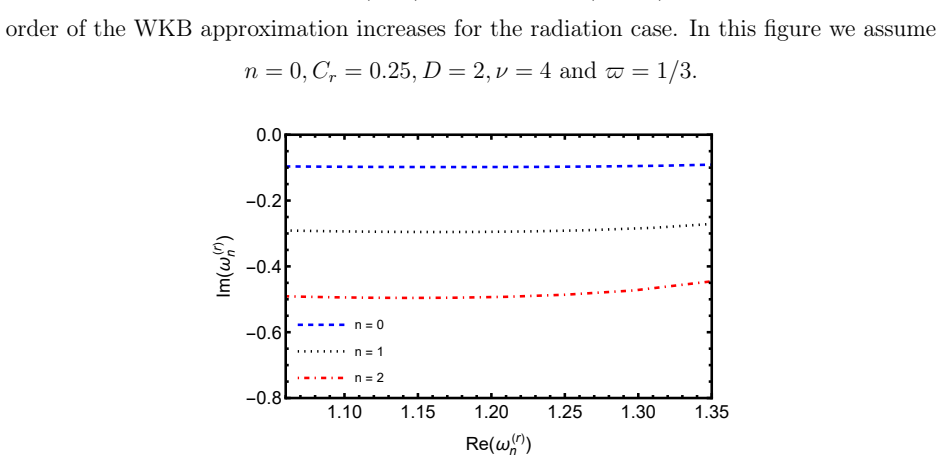
- In the WKB quasinormal spectrum, increasing $|C_q|$ (quintessence) or $C_m$ (dust) makes the modes decay faster and oscillate faster, whereas increasing $C_r$ (radiation) slows the decay while the modes remain stable.
- The horizon structure is the boundary-condition anchor: quintessence and radiation give two acoustic horizons, dust gives one, and the quasibound and quasinormal frequencies depend explicitly on those horizon radii.
Reading between the lines
- A straightforward laboratory check would impose the radial flow (13) and measure density-perturbation spectra; agreement with the predicted purely imaginary frequencies would confirm that the condensate ``hears'' the Kiselev horizon.
- The paper leaves open whether the domain of real $v_r$ covers the exterior region for all parameter choices; a reader building the experiment should first check $D/r-C_\varpi/r^{3\varpi+1}\ge 0$ for $r>r_+$, since the analogue metric is only physical where the flow is real.
- The same velocity-metric identity suggests a recipe for other static backgrounds: any desired metric function $f(r)$ can be fed into Eq. (16) and translated into a radial flow, yielding acoustic analogues of regular Kiselev black holes or modified-gravity solutions.
- Because the quasibound frequencies have zero real part, a measurement of decay rates alone could identify the effective charge parameter $C_\varpi$ without resolving oscillations.
Editorial analysis
A structured set of objections, weighed in public.
Referee Report
Summary. The paper proposes an acoustic analogue of the Kiselev (quintessence) black hole based on the Gross–Pitaevskii action. It claims to derive the line element (15) with f(r) = 1 - D/r + C_w/r^(3w+1) and then computes quasibound-state frequencies with the VBK/Heun method and quasinormal modes with sixth-order WKB for the quintessence, dust, and radiation cases. The stated goal is to provide experimentally testable signatures of an analogue spacetime with an anisotropic-fluid background.
Significance. If the construction were valid, the paper would offer a unified analogue-gravity framework for a family of Kiselev-like acoustic black holes and exact spectral predictions that could be compared with BEC experiments. The manuscript contains self-contained Heun-function solutions, detailed WKB convergence tests, and explicit spectral plots for the proposed line element. However, the central derivation connecting the Gross–Pitaevskii action to the Kiselev metric is algebraically incorrect, and the dust quasibound formula is internally inconsistent with the paper's own stability statements. As a result, the main claims are not currently established.
major comments (3)
- [II, Eqs. (11)–(15)] The line element (15) is not a consequence of substituting Eqs. (13) and (14) into Eq. (11). With the Minkowski background (12), A = c_s^2, and v_mu v^mu = -1, the angular component obtained from Eq. (11) is G_theta theta = c_s (A+1)^{-1/2} r^2, while Eq. (15) requires G_theta theta = sqrt(3A) r^2. Equality would demand 1/sqrt(A+1) = sqrt(3), i.e. A = -2/3, which no positive speed of sound satisfies. Equivalently, the ratio G_tt G_rr / G_theta theta^2 from Eq. (11) is -A/[(A+1) r^4], whereas Eq. (15) gives -1/r^4. Thus the KABH metric is an independent ansatz, not derived from the Gross–Pitaevskii action. This invalidates the central construction claim of the paper.
- [III A 2 and IV] The dust QBS formula (44) has a sign problem relative to the stability interpretation. For D > C_m, Eq. (44) gives Im omega_n^{(m)} = (n+1)/(2(D - C_m)) > 0, which Sec. IV itself classifies as unstable for the quintessence case. Yet Sec. IV states that the dust QBSs are stable for -1 <= C_m <= +1 with D = 2 and for 0 <= D <= 2 with C_m = -1, both parameter regions satisfying D > C_m. Conversely, for C_m = +1 and 0 < D < 1, Eq. (44) gives negative imaginary parts, but Sec. IV calls the system unstable. The sign in Eq. (44) must be reversed to be consistent with the stability conclusions and with Fig. 2.
- [II, Eq. (13)] The radial velocity profile in Eq. (13) and the normalization in Eq. (14) are imposed ad hoc so that the effective metric matches the Kiselev form, but the paper does not demonstrate that the Gross–Pitaevskii equation with any trapping potential or boundary condition admits a stationary, irrotational, and real flow with this v_r on the exterior of the horizon. Without such a realizability argument, the proposed experimental signatures are not tied to a concrete condensate setup.
minor comments (4)
- [Abstract and I] There are several typographical issues: 'a n experimental setup' in the abstract, 'spherical ly symmetric' in the abstract, and 'analog gravity models' in the introduction should be corrected.
- [III A] The QBS frequencies in Eqs. (34), (44), and (55) do not depend on the angular separation constant lambda; for spherically symmetric black-hole perturbation theory one would normally expect the spectrum to depend on the multipole number. The authors should explain this feature or verify the polynomial conditions used to derive these formulas.
- [IV] The sentence 'All QBSs are overdamped' is inconsistent with the positive imaginary parts of the quintessence QBSs and of the dust QBS for D > C_m; for those modes the imaginary part is positive, not damped.
- [III B, Eq. (58)] In Eq. (58), the symbol w^2 should presumably be omega^2 to match the notation used throughout the paper.
Circularity Check
No significant circularity: the Kiselev metric is the explicit target of the flow ansatz, and the QBS/QNM spectra are computed from that metric rather than fitted.
full rationale
The paper's central construction is transparently an ansatz: Eq. (13) chooses the radial velocity so that f(r)=1-D/r+C_w/r^(3w+1) appears in the acoustic line element, and the authors state that the velocity is 'intended to mimic' the Kiselev background. This is an explicit design choice, not a hidden fit or a prediction forced by data. The spectral results in Sec. III are obtained by solving the massless Klein-Gordon equation in the resulting metric with standard, independently established VBK and WKB methods; no parameter is tuned to reproduce the reported frequencies. The self-citations [76,77,85,86] are methodological references to the Heun-function/WKB formalism, not load-bearing uniqueness claims, and they do not supply the spectra themselves. Any algebraic difficulty in passing from Eq. (11) to Eq. (15) would be a derivation defect, not circularity; the conclusion that the acoustic metric has Kiselev form is true by the explicit choice of v_r, which is legitimate for a construction. Hence no circular step is identifiable.
Assumptions & free parameters
free parameters (5)
- D (draining parameter)
- C_w (charge parameter)
- w (equation-of-state parameter) =
-2/3, 0, 1/3
- c_s^2 (sound speed squared) =
1/sqrt(3)
- m^2 (GP temperature parameter) =
0 (critical temperature limit)
assumptions (5)
- domain assumption Long-wavelength limit and neglect of quantum potential terms in the Gross-Pitaevskii equation
- domain assumption Background flow is stationary, irrotational, and has only radial velocity with v_theta = v_phi = 0
- ad hoc to paper The radial velocity profile vr ~ sqrt(D/r - C_w/r^(3w+1)) is physically realizable and satisfies v_mu v^mu = -1
- standard math VBK polynomial conditions select the correct quasibound spectrum
- domain assumption Sixth-order WKB approximation accurately gives quasinormal modes for this potential
Cite this review
Pith. "Pith review of The sound of quintessence: analogue Kiselev acoustic black holes." pith.science (2026). https://pith.science/paper/LQQOI6AY
@misc{pith2026250621639,
  author       = {Pith},
  title        = {Pith review of: The sound of quintessence: analogue Kiselev acoustic black holes},
  year         = {2026},
  howpublished = {\url{https://pith.science/paper/LQQOI6AY}},
  note         = {Machine review of arXiv:2506.21639}
}
read the original abstract
In this work, we demonstrate that the geometry of a spherically symmetric black hole surrounded by a Kiselev anisotropic fluid can be effectively mimicked by an experimental setup as the ones used to investigate some physical phenomena associated with acoustic black holes. Thus, we construct the metric describing Kiselev acoustic black holes by using the Gross--Pitaevskii theory and present a general analytical solution that encompasses, as particular cases, several classes of geometries associated with black holes. This unified framework allows for the description of a wide variety of analogue spacetimes, including new analogue geometries that have not been previously explored in the literature. Then, we examine the behavior of scalar field perturbations in this background by solving the massless Klein--Gordon equation. Depending on the boundary conditions between the acoustic event horizon and infinity, we obtain the quasinormal and quasibound spectra. This study opens up avenues for experimental investigation within the context of analog gravity models, by offering new possibilities to simulate and study black hole phenomena in laboratory settings.
Figures


Figures from the paper (9 more)


Reference graph
Works this paper leans on
-
[1]
Quintessence For the quintessence component, the anisotropic fluid param eter is ̟q = −2/3. In this case, the metric function f (r) reads f (r) = 1 − D r + Cqr, (22) such that the surface equation has two roots, namely, r+ = −1 + √ 1 + 4CqD 2Cq , (23) 8 and r− = −1 − √ 1 + 4CqD 2Cq , (24) which can be identified, without loss of generality, as the ex terior...
-
[2]
Dust Matter Next, for the dust matter component, the anisotropic fluid pa rameter is ̟m = 0. In this case, the metric function f (r) reads f (r) = 1 − D − Cm r , (35) such that the surface equation has one root, namely, rh = D − Cm, (36) which can be identified, without loss of generality, as the ra dius of the acoustic event horizon. Again, by following th...
-
[3]
It is worth noticing that the acoustic event horizons depend on the choice of the anisotropic fluid parame ter ̟, as they are solutions of the surface equation given by f (r) = 0 . (17) Since the outer acoustic event horizon is the last surface fr om which sound waves could still escape the acoustic black hole, it is meaningful to stu dy the motion of mass...
-
[4]
Radiation Finally, for the radiation component, the anisotropic fluid parameter is ̟r = 1/3. In this case, the metric function f (r) reads f (r) = 1 − D r + Cr r2 , (45) such that the surface equation has two roots, namely, r+ = D + √D2 − 4Cr 2 , (46) and r− = D − √D2 − 4Cr 2 , (47) which can be identified, without loss of generality, as the ex terior and t...
-
[5]
As discussed previously, this solution features both an in ner and an outer horizon
Quintessence We now turn our attention to the study the particular case of q uintessence, corresponding to ̟ = −2/3. As discussed previously, this solution features both an in ner and an outer horizon. The effective potential is plotted in Fig. 4, where we can clearly identify the region where it reaches its maximum, around r ≈ 3. We applied the sixth-orde...
-
[6]
For the solution obtained here, which describe s analog black holes, we analyze the behavior of the analog geometry for this specific case
Dust Matter For astrophysical black holes, the value ̟ = 0 corresponds to a solution associated with dust matter. For the solution obtained here, which describe s analog black holes, we analyze the behavior of the analog geometry for this specific case. In particular, we investigate QNMs associated with the analog dust matter black hole consi dering values...
-
[7]
This solution effectively describes a metric associated wit h a charged black hole with charge Q in the astrophysical case
Radiation Assuming that ̟ = 1 /3, we recover the particular solution associated with radiat ion. This solution effectively describes a metric associated wit h a charged black hole with charge Q in the astrophysical case. In our solution, we interpret Cr as a factor that modifies the radial velocity component of the fluid. Depending on the valu e of Cr, the fl...
2023
-
[8]
Acoustic black holes: Horizons, ergosphere s, and Hawking radiation,
M. Visser, “Acoustic black holes: Horizons, ergosphere s, and Hawking radiation,” Class. Quant. Grav., vol. 15, pp. 1767–1791, 1998
1998
Show all 96 references
-
[9]
Riemannian geometry of irro tational vortex acoustics,
U. R. Fischer and M. Visser, “Riemannian geometry of irro tational vortex acoustics,” Phys. Rev. Lett., vol. 88, p. 110201, 2002
2002
-
[10]
Quasinormal modes of sta rs and black holes,
K. D. Kokkotas and B. G. Schmidt, “Quasinormal modes of sta rs and black holes,” Living Rev. Rel., vol. 2, p. 2, 1999. 21
1999
-
[11]
TOPICAL REVIEW: Quasinormal modes: the characteristic ‘sound’ of black holes and neutron stars,
H.-P. Nollert, “TOPICAL REVIEW: Quasinormal modes: the characteristic ‘sound’ of black holes and neutron stars,” Class. Quant. Grav. , vol. 16, pp. R159–R216, 1999
1999
-
[12]
Quasinormal modes of bla ck holes: From astrophysics to string theory,
R. A. Konoplya and A. Zhidenko, “Quasinormal modes of bla ck holes: From astrophysics to string theory,” Rev. Mod. Phys. , vol. 83, pp. 793–836, 2011
2011
-
[13]
Gravity wave analogs of bl ack holes,
R. Schutzhold and W. G. Unruh, “Gravity wave analogs of bl ack holes,” Phys. Rev. D , vol. 66, p. 044019, 2002
2002
-
[14]
Resonan ces of a rotating black hole analogue,
S. R. Dolan, L. A. Oliveira, and L. C. B. Crispino, “Resonan ces of a rotating black hole analogue,” Phys. Rev. D , vol. 85, p. 044031, 2012
2012
-
[15]
Quasinormal Mode Oscillations in an Analogue Black Hole Experiment,
T. Torres, S. Patrick, M. Richartz, and S. Weinfurtner, “ Quasinormal Mode Oscillations in an Analogue Black Hole Experiment,” Phys. Rev. Lett. , vol. 125, no. 1, p. 011301, 2020
2020
-
[16]
Quasinormal mode s and classical wave propagation in analogue black holes,
E. Berti, V. Cardoso, and J. P. S. Lemos, “Quasinormal mode s and classical wave propagation in analogue black holes,” Phys. Rev. D , vol. 70, p. 124006, 2004
2004
-
[17]
Quasinormal modes and stability of the rotating acoustic black hole: Numerical analysis,
V. Cardoso, J. P. S. Lemos, and S. Yoshida, “Quasinormal modes and stability of the rotating acoustic black hole: Numerical analysis,” Phys. Rev. D , vol. 70, p. 124032, 2004
2004
-
[18]
Black hole quasibound states from a draining bathtub vortex flow,
S. Patrick, A. Coutant, M. Richartz, and S. Weinfurtner , “Black hole quasibound states from a draining bathtub vortex flow,” Phys. Rev. Lett. , vol. 121, no. 6, p. 061101, 2018
2018
-
[19]
Resonant frequencies of a m assless scalar field in the canonical acoustic black hole spacetime,
H. S. Vieira and V. B. Bezerra, “Resonant frequencies of a m assless scalar field in the canonical acoustic black hole spacetime,” Gen. Rel. Grav. , vol. 52, no. 8, p. 72, 2020
2020
-
[20]
Black-Hole Spectroscopy: Qu asinormal Modes, Ringdown Sta- bility and the Pseudospectrum,
K. Destounis and F. Duque, “Black-Hole Spectroscopy: Qu asinormal Modes, Ringdown Sta- bility and the Pseudospectrum,” in Compact Objects in the Universe (E. Papantonopoulos and N. Mavromatos, eds.), pp. 155–202, Springer, 2024
2024
-
[21]
Ringdown stabi lity: Graybody factors as stable gravitational-wave observables,
R. F. Rosato, K. Destounis, and P. Pani, “Ringdown stabi lity: Graybody factors as stable gravitational-wave observables,” Phys. Rev. D , vol. 110, no. 12, p. L121501, 2024
2024
-
[22]
Quasinormal modes of black holes embedded in halos of matter,
L. Pezzella, K. Destounis, A. Maselli, and V. Cardoso, “ Quasinormal modes of black holes embedded in halos of matter,” Phys. Rev. D , vol. 111, no. 6, p. 064026, 2025
2025
-
[23]
Ps eudospectrum and Black Hole Quasinormal Mode Instability,
J. L. Jaramillo, R. Panosso Macedo, and L. Al Sheikh, “Ps eudospectrum and Black Hole Quasinormal Mode Instability,” Phys. Rev. X , vol. 11, no. 3, p. 031003, 2021
2021
-
[24]
Pseu- dospectrum of horizonless compact objects: A bootstrap ins tability mechanism,
V. Boyanov, K. Destounis, R. Panosso Macedo, V. Cardoso, and J. L. Jaramillo, “Pseu- dospectrum of horizonless compact objects: A bootstrap ins tability mechanism,” Phys. Rev. D, vol. 107, no. 6, p. 064012, 2023
2023
-
[25]
Struc- 22 tural aspects of the anti–de Sitter black hole pseudospectr um,
V. Boyanov, V. Cardoso, K. Destounis, J. L. Jaramillo, an d R. Panosso Macedo, “Struc- 22 tural aspects of the anti–de Sitter black hole pseudospectr um,” Phys. Rev. D , vol. 109, no. 6, p. 064068, 2024
2024
-
[26]
Destabilizing the Fundamental Mode of Black Holes: The Elephant and the Flea,
M. H.-Y. Cheung, K. Destounis, R. P. Macedo, E. Berti, and V. Cardoso, “Destabilizing the Fundamental Mode of Black Holes: The Elephant and the Flea,” Phys. Rev. Lett. , vol. 128, no. 11, p. 111103, 2022
2022
-
[27]
Spectral instabi lity of quasinormal modes and strong cosmic censorship,
A. Courty, K. Destounis, and P. Pani, “Spectral instabi lity of quasinormal modes and strong cosmic censorship,” Phys. Rev. D , vol. 108, no. 10, p. 104027, 2023
2023
-
[28]
On destabilising quasi-normal modes with a radially concentrated perturbation,
V. Boyanov, “On destabilising quasi-normal modes with a radially concentrated perturbation,” Front. in Phys. , vol. 12, p. 1511757, 2024
2024
-
[29]
Superradiance in dispe rsive black hole analogues,
S. Patrick and S. Weinfurtner, “Superradiance in dispe rsive black hole analogues,” Phys. Rev. D, vol. 102, no. 8, p. 084041, 2020
2020
-
[30]
Observa- tion of superradiance in a vortex flow,
T. Torres, S. Patrick, A. Coutant, M. Richartz, E. W. Ted ford, and S. Weinfurtner, “Observa- tion of superradiance in a vortex flow,” Nature Phys. , vol. 13, pp. 833–836, 2017
2017
-
[31]
Rotating black holes in a draining bathtub: superradiant scattering of gravity waves,
M. Richartz, A. Prain, S. Liberati, and S. Weinfurtner, “Rotating black holes in a draining bathtub: superradiant scattering of gravity waves,” Phys. Rev. D , vol. 91, no. 12, p. 124018, 2015
2015
-
[32]
Superradiant scattering of dispersive fields,
M. Richartz, A. Prain, S. Weinfurtner, and S. Liberati, “Superradiant scattering of dispersive fields,” Class. Quant. Grav. , vol. 30, p. 085009, 2013
2013
-
[33]
Charged b lack holes in de Sitter space: Superradiant amplification of charged scalar waves and reso nant hyperradiation,
G. Mascher, K. Destounis, and K. D. Kokkotas, “Charged b lack holes in de Sitter space: Superradiant amplification of charged scalar waves and reso nant hyperradiation,” Phys. Rev. D, vol. 105, no. 8, p. 084052, 2022
2022
-
[34]
Superradiance of charg ed black holes embedded in dark matter halos,
A. Mollicone and K. Destounis, “Superradiance of charg ed black holes embedded in dark matter halos,” Phys. Rev. D , vol. 111, no. 2, p. 024017, 2025
2025
-
[35]
Experimental black-hole evaporation?,
W. G. Unruh, “Experimental black-hole evaporation?,” Phys. Rev. Lett., vol. 46, no. 21, p. 1351, 1981
1981
-
[36]
Backreaction in an analogue black hole experiment,
S. Patrick, H. Goodhew, C. Gooding, and S. Weinfurtner, “Backreaction in an analogue black hole experiment,” Phys. Rev. Lett. , vol. 126, no. 4, p. 041105, 2021
2021
-
[37]
Analogue Black Hole Spectroscopy; or, how to listen to dumb holes,
T. Torres, S. Patrick, M. Richartz, and S. Weinfurtner, “Analogue Black Hole Spectroscopy; or, how to listen to dumb holes,” Class. Quant. Grav. , vol. 36, no. 19, p. 194002, 2019
2019
-
[38]
Non-linear Processes and Stimulated Hawking Radiation in Hydrodynamics for Decelerating Subcritical Free Surface F lows with a Subluminal Dispersion 23 Relation,
L.-P. Euvé and G. Rousseaux, “Non-linear Processes and Stimulated Hawking Radiation in Hydrodynamics for Decelerating Subcritical Free Surface F lows with a Subluminal Dispersion 23 Relation,” arXiv preprint arXiv:2112.12504 , Dec. 2021
2021 arXiv
-
[39]
Acoustic black-hole bombs and scalar clouds in a photon-fluid model,
M. Ciszak and F. Marino, “Acoustic black-hole bombs and scalar clouds in a photon-fluid model,” Phys. Rev. D , vol. 103, no. 4, p. 045004, 2021
2021
-
[40]
Experimental demonstration of the supersonic-subsonic bifurcation in the circular jum p: A hydrodynamic white hole,
G. Jannes, R. Piquet, P. Maissa, C. Mathis, and G. Rousse aux, “Experimental demonstration of the supersonic-subsonic bifurcation in the circular jum p: A hydrodynamic white hole,” Phys. Rev. E , vol. 83, p. 056312, 2011
2011
-
[41]
Event horizons and erg oregions in He-3,
T. A. Jacobson and G. E. Volovik, “Event horizons and erg oregions in He-3,” Phys. Rev. D , vol. 58, p. 064021, 1998
1998
-
[42]
Blac k holes in Bose-Einstein condensates,
L. J. Garay, J. R. Anglin, J. I. Cirac, and P. Zoller, “Blac k holes in Bose-Einstein condensates,” Phys. Rev. Lett. , vol. 85, pp. 4643–4647, 2000
2000
-
[43]
G. E. Volovik, The universe in a helium droplet , vol. 117. OUP Oxford, 2003
2003
-
[44]
Fiber-optical analogue of the event horizon,
T. G. Philbin, C. Kuklewicz, S. Robertson, S. Hill, F. Ko nig, and U. Leonhardt, “Fiber-optical analogue of the event horizon,” Science, vol. 319, pp. 1367–1370, 2008
2008
-
[45]
Hawking radiation from ultrashort las er pulse filaments,
F. Belgiorno, S. L. Cacciatori, M. Clerici, V. Gorini, G. Ortenzi, L. Rizzi, E. Rubino, V. G. Sala, and D. Faccio, “Hawking radiation from ultrashort las er pulse filaments,” Phys. Rev. Lett., vol. 105, p. 203901, 2010
2010
-
[46]
Quantum Circu it Model of Black Hole Evapo- ration,
T. Tokusumi, A. Matsumura, and Y. Nambu, “Quantum Circu it Model of Black Hole Evapo- ration,” Class. Quant. Grav. , vol. 35, no. 23, p. 235013, 2018
2018
-
[47]
Quantum-circuit black hole lasers,
H. Katayama, “Quantum-circuit black hole lasers,” Sci. Rep. , vol. 11, no. 1, p. 19137, 2021
2021
-
[48]
Quintessence and black holes,
V. Kiselev, “Quintessence and black holes,” Classical Quant. Grav. , vol. 20, no. 6, p. 1187, 2003
2003
-
[49]
Kiselev black holes in f (R, T) gravity,
L. C. N. Santos, F. M. da Silva, C. E. Mota, I. P. Lobo, and V . B. Bezerra, “Kiselev black holes in f (R, T) gravity,” Gen. Relat. Gravit. , vol. 55, no. 8, p. 94, 2023
2023
-
[50]
Revisiting black holes surrounded by c loud and fluid of strings in general relativity,
L. C. N. Santos, “Revisiting black holes surrounded by c loud and fluid of strings in general relativity,” Phys. Rev. D , vol. 111, no. 6, p. 064032, 2025
2025
-
[51]
Regular black holes from Kiselev aniso tropic fluid,
L. C. N. Santos, “Regular black holes from Kiselev aniso tropic fluid,” Eur. Phys. J. C , vol. 84, no. 12, p. 1318, 2024
2024
-
[52]
Shadow of a black hole surrounded by dar k matter,
R. A. Konoplya, “Shadow of a black hole surrounded by dar k matter,” Phys. Lett. B , vol. 795, pp. 1–6, 2019
2019
-
[53]
Influence of quintessence d ark energy on the shadow of black hole,
X.-X. Zeng and H.-Q. Zhang, “Influence of quintessence d ark energy on the shadow of black hole,” Eur. Phys. J. C , vol. 80, no. 11, pp. 1–14, 2020. 24
2020
-
[54]
Shadow of the rotating black hole with quintessential energy in the presence of plasma,
A. Abdujabbarov, B. Toshmatov, Z. Stuchlík, and B. Ahmedo v, “Shadow of the rotating black hole with quintessential energy in the presence of plasma,” Int. J. Mod. Phys. D , vol. 26, no. 06, p. 1750051, 2017
2017
-
[55]
Shadow and photon sph ere of black hole in clouds of strings and quintessence,
A. He, J. Tao, Y. Xue, and L. Zhang, “Shadow and photon sph ere of black hole in clouds of strings and quintessence,” Chinese Phys. C , 2022
2022
-
[56]
Quasinormal modes of a black hole su rrounded by quintessence,
S. Chen and J. Jing, “Quasinormal modes of a black hole su rrounded by quintessence,” Classical Quant. Grav. , vol. 22, no. 21, p. 4651, 2005
2005
-
[57]
Quasinormal modes of gravitati onal perturbation around a Schwarzschild black hole surrounded by quintessence,
Y. Zhang and Y.-X. Gui, “Quasinormal modes of gravitati onal perturbation around a Schwarzschild black hole surrounded by quintessence,” Classical Quant. Grav. , vol. 23, no. 22, p. 6141, 2006
2006
-
[58]
Quasinormal modes of R eissner–Nördstrom black hole surrounded by quintessence,
N. Varghese and V. C. Kuriakose, “Quasinormal modes of R eissner–Nördstrom black hole surrounded by quintessence,” Gen. Relat. Gravit. , vol. 41, no. 6, pp. 1249–1257, 2009
2009
-
[59]
Quasinormal modes of a Schwarzschild black hole surrounded by free static spherically symmetric quintesse nce: electromagnetic perturbations,
Y. Zhang, Y. Gui, F. Yu, and F. Li, “Quasinormal modes of a Schwarzschild black hole surrounded by free static spherically symmetric quintesse nce: electromagnetic perturbations,” Gen. Relat. Gravit. , vol. 39, no. 7, pp. 1003–1010, 2007
2007
-
[60]
Quasiperiodic oscillations, quasi- normal modes and shadows of Bardeen–Kiselev Black Holes,
J. Rayimbaev, B. Majeed, M. Jamil, K. Jusufi, and A. Wang, “ Quasiperiodic oscillations, quasi- normal modes and shadows of Bardeen–Kiselev Black Holes,” Phys. Dark Universe , vol. 35, p. 100930, 2022
2022
-
[61]
The Reissner–Nordström bl ack hole surrounded by quintessence and a cloud of strings: thermodynamics and qua sinormal modes,
J. M. Toledo and V. B. Bezerra, “The Reissner–Nordström bl ack hole surrounded by quintessence and a cloud of strings: thermodynamics and qua sinormal modes,” Int. J. Mod. Phys. D , vol. 28, no. 01, p. 1950023, 2019
2019
-
[62]
Quasinormal mod es and Hawking radiation of a Reissner-Nordström black hole surrounded by quintessence ,
M. Saleh, B. T. Bouetou, and T. C. Kofane, “Quasinormal mod es and Hawking radiation of a Reissner-Nordström black hole surrounded by quintessence ,” Astrophys. Space Sci. , vol. 333, no. 2, pp. 449–455, 2011
2011
-
[63]
Phase t ransition, quasinormal modes and Hawking radiation of Schwarzschild black hole in quintesse nce field,
R. Tharanath, N. Varghese, and V. C. Kuriakose, “Phase t ransition, quasinormal modes and Hawking radiation of Schwarzschild black hole in quintesse nce field,” Mod. Phys. Lett. A , vol. 29, no. 11, p. 1450057, 2014
2014
-
[64]
Quasinormal mode s of gravitational perturbation around regular Bardeen black hole surrounded by quintessenc e,
M. Saleh, B. B. Thomas, and T. C. Kofane, “Quasinormal mode s of gravitational perturbation around regular Bardeen black hole surrounded by quintessenc e,” Eur. Phys. J. C , vol. 78, no. 4, pp. 1–7, 2018
2018
-
[65]
Thermodynamics a nd phase transition of the 25 Reissner–Nordström black hole surrounded by quintessence ,
B. B. Thomas, M. Saleh, and T. C. Kofane, “Thermodynamics a nd phase transition of the 25 Reissner–Nordström black hole surrounded by quintessence ,” Gen. Relat. Gravit., vol. 44, no. 9, pp. 2181–2189, 2012
2012
-
[66]
Thermodynamics of the Schwarzschild and the Reissner– Nordström black holes with quintessence,
K. Ghaderi and B. Malakolkalami, “Thermodynamics of the Schwarzschild and the Reissner– Nordström black holes with quintessence,” Nucl. Phys. B , vol. 903, pp. 10–18, 2016
2016
-
[67]
Thermodynamics a nd phase transition from regular Bardeen black hole surrounded by quintessence,
M. Saleh, B. B. Thomas, and T. C. Kofane, “Thermodynamics a nd phase transition from regular Bardeen black hole surrounded by quintessence,” Int. J. Theor. Phys. , vol. 57, no. 9, pp. 2640–2647, 2018
2018
-
[68]
Some remarks on the thermod ynamics of charged ads black holes with cloud of strings and quintessence,
J. M. Toledo and V. B. Bezerra, “Some remarks on the thermod ynamics of charged ads black holes with cloud of strings and quintessence,” Eur. Phys. J. C , vol. 79, no. 2, pp. 1–11, 2019
2019
-
[69]
Thermodynamics of the Reissner- Nordström black hole with quintessence matter on the EGUP fr amework,
H. Chen, B. C. Lütfüoğlu, H. Hassanabadi, and Z.-W. Long, “Thermodynamics of the Reissner- Nordström black hole with quintessence matter on the EGUP fr amework,” Phys. Lett. B , vol. 827, p. 136994, 2022
2022
-
[70]
Thermodynamics and s pectroscopy of Schwarzschild black hole surrounded by quintessence,
R. Tharanath and V. C. Kuriakose, “Thermodynamics and s pectroscopy of Schwarzschild black hole surrounded by quintessence,” Mod. Phys. Lett. A , vol. 28, no. 04, p. 1350003, 2013
2013
-
[71]
Thermodynamic stabili ty of black holes surrounded by quintessence,
M.-S. Ma, R. Zhao, and Y.-Q. Ma, “Thermodynamic stabili ty of black holes surrounded by quintessence,” Gen. Relat. Gravit. , vol. 49, no. 6, pp. 1–20, 2017
2017
-
[72]
Thermodynamics and phase tr ansition in rotational Kiselev black hole,
Z. Xu, Y. Liao, and J. Wang, “Thermodynamics and phase tr ansition in rotational Kiselev black hole,” Int. J. Mod. Phys. A , vol. 34, no. 30, p. 1950185, 2019
2019
-
[73]
Effects of Planck-scale-modified dispersion relations on the thermod ynamics of charged black holes,
I. P. Lobo, V. B. Bezerra, J. P. Morais Graça, L. C. N. Santos , and M. Ronco, “Effects of Planck-scale-modified dispersion relations on the thermod ynamics of charged black holes,” Phys. Rev. D , vol. 101, no. 8, p. 084004, 2020
2020
-
[74]
Black hole s olutions in Rastall theory,
Y. Heydarzade, H. Moradpour, and F. Darabi, “Black hole s olutions in Rastall theory,” Can. J. Phys. , vol. 95, no. 12, pp. 1253–1256, 2017
2017
-
[75]
Kerr–Newman– NUT–Kiselev black holes in Rastall theory of gravity and Kerr/CFT correspondence,
M. F. A. R. Sakti, A. Suroso, and F. P. Zen, “Kerr–Newman– NUT–Kiselev black holes in Rastall theory of gravity and Kerr/CFT correspondence,” Ann. Phys-new. York. , vol. 413, p. 168062, Feb. 2020
2020
-
[76]
Thermodynamics and remnants of Kiselev black holes in rainbow gravity,
P. H. Morais, G. V. Silva, J. P. M. Graça, and V. B. Bezerra, “ Thermodynamics and remnants of Kiselev black holes in rainbow gravity,” Gen. Relat. Gravit. , vol. 54, p. 16, Jan. 2022
2022
-
[77]
Joule-Thomson Expansion and Optical Behaviour of Reissner-Nordström-Anti-de Sitte r Black Holes in Rastall Gravity Surrounded by a Quintessence Field,
D. J. Gogoi, Y. Sekhmani, D. Kalita, N. J. Gogoi, and J. Bor a, “Joule-Thomson Expansion and Optical Behaviour of Reissner-Nordström-Anti-de Sitte r Black Holes in Rastall Gravity Surrounded by a Quintessence Field,” Fortschr. Physik, vol. 71, no. 4-5, p. 2300010, 2023. 26
2023
-
[78]
Rotating kis elev black holes in f(R, T) gravity,
S. G. Ghosh, S. U. Islam, and S. D. Maharaj, “Rotating kis elev black holes in f(R, T) gravity,” Phys. Scripta , vol. 99, p. 065032, May 2024
2024
-
[79]
Black hole solutions surrounded by anisotropic fluid in f(T,T) gravity,
F. M. da Silva, L. C. N. Santos, and V. B. Bezerra, “Black hole solutions surrounded by anisotropic fluid in f(T,T) gravity,” Int. J. Mod. Phys. D , vol. 34, no. 02, p. 2450071, 2025
2025
-
[80]
Thin shell collapse in Kisele v geometry,
R. Saadati and F. Shojai, “Thin shell collapse in Kisele v geometry,” Classical Quant. Grav. , vol. 38, no. 13, p. 135025, 2021
2021
-
[81]
Impact of charged and quant um-correction on the dynamics of scalar shell surrounded by Kiselev black hole,
F. Javed and M. H. Alshehri, “Impact of charged and quant um-correction on the dynamics of scalar shell surrounded by Kiselev black hole,” Ann. Phys-new. York. , vol. 464, p. 169658, 2024
2024
-
[82]
Klein–gordon equation and geodesic behavior in quantum-corrected charged black hole s with quintessence,
F. Javed, S. Shaukat, A. Waseem, G. Mustafa, and B. Almuta iri, “Klein–gordon equation and geodesic behavior in quantum-corrected charged black hole s with quintessence,” Phys. Dark Universe, p. 101689, 2024
2024
-
[83]
Confluent Heun functions an d the physics of black holes: Resonant frequencies, Hawking radiation and scattering of scalar waves,
H. S. Vieira and V. B. Bezerra, “Confluent Heun functions an d the physics of black holes: Resonant frequencies, Hawking radiation and scattering of scalar waves,” Ann. Phys. (NY) , vol. 373, p. 28, 2016
2016
-
[84]
Quasibound states of Sc hwarzschild acoustic black holes,
H. S. Vieira and K. D. Kokkotas, “Quasibound states of Sc hwarzschild acoustic black holes,” Phys. Rev. D , vol. 104, no. 2, p. 024035, 2021
2021
-
[85]
Eine Verallgemeinerung der Quantenbedin gungen für die Zwecke der Wellen- mechanik,
G. Wentzel, “Eine Verallgemeinerung der Quantenbedin gungen für die Zwecke der Wellen- mechanik,” Z. Phys. , vol. 38, no. 6, pp. 518–529, 1926
1926
-
[86]
Wellenmechanik und halbzahlige Quanti sierung,
H. A. Kramers, “Wellenmechanik und halbzahlige Quanti sierung,” Z. Phys. , vol. 39, no. 10, pp. 828–840, 1926
1926
-
[87]
La mécanique ondulatoire de Schrödinger ; une méthode générale de résolution par approximations successives,
L. Brillouin, “La mécanique ondulatoire de Schrödinger ; une méthode générale de résolution par approximations successives,” CR Acad. Sci , vol. 183, no. 11, pp. 24–26, 1926
1926
-
[88]
Structure of a quantized vortex in boson sy stems,
E. P. Gross, “Structure of a quantized vortex in boson sy stems,” Nuovo Cimento , vol. 20, p. 454, 1961
1961
-
[89]
Vortex Lines in an Imperfect Bose Gas,
L. P. Pitaevskii, “Vortex Lines in an Imperfect Bose Gas, ” Sov. Phys. JETP , vol. 13, p. 451, 1961
1961
-
[90]
C. W. Misner, K. S. Thorne, and J. A. Wheeler, Gravitation. San Francisco: W. H. Freeman and Company, 1973
1973
-
[91]
Ronveaux, Heun ’s Differential Equations
A. Ronveaux, Heun ’s Differential Equations . New York: Oxford University Press, 1995
1995
-
[92]
Analog S chwarzschild black holes of Bose- 27 Einstein condensates in a cavity: Quasinormal modes and qua sibound states,
H. S. Vieira, K. Destounis, and K. D. Kokkotas, “Analog S chwarzschild black holes of Bose- 27 Einstein condensates in a cavity: Quasinormal modes and qua sibound states,” Phys. Rev. D , vol. 107, no. 10, p. 104038, 2023
2023
-
[93]
Perturb ing the vortex: Quasinormal and quasibound spectra of rotating acoustic geometries,
H. S. Vieira, K. Destounis, and K. D. Kokkotas, “Perturb ing the vortex: Quasinormal and quasibound spectra of rotating acoustic geometries,” Phys. Rev. D , vol. 111, p. 104025, 2025
2025
-
[94]
Higher order WKB formula for quasinormal modes and grey-body factors: recipes for quick and accurate calculations,
R. A. Konoplya, A. Zhidenko, and A. F. Zinhailo, “Higher order WKB formula for quasinormal modes and grey-body factors: recipes for quick and accurate calculations,” Class. Quant. Grav., vol. 36, p. 155002, 2019
2019
-
[95]
Quasinormal behavior of the d-dimensi onal Schwarzschild black hole and higher order WKB approach,
R. A. Konoplya, “Quasinormal behavior of the d-dimensi onal Schwarzschild black hole and higher order WKB approach,” Phys. Rev. D , vol. 68, p. 024018, 2003
2003
-
[96]
Black Hole Normal Modes: A WKB Appr oach. 1. Foundations and Application of a Higher Order WKB Analysis of Potential Barri er Scattering,
S. Iyer and C. M. Will, “Black Hole Normal Modes: A WKB Appr oach. 1. Foundations and Application of a Higher Order WKB Analysis of Potential Barri er Scattering,” Phys. Rev. D , vol. 35, p. 3621, 1987. 28
1987
Reviewed August 6, 2026 · model on record in the stance chip above.
Discussion (0). Continue with ORCID to comment.