REVIEW 2 major objections 6 minor 2 cited by
Intertwined Orders and the Physics of High Temperature Superconductors
T0 review · 2 major / 6 minor · reviewed 2026-08-06 · deepseek-v4-flash
Pith's one-line read This review argues that the rich phase diagrams of high-temperature superconductors reflect intertwined orders — not competing ones — with the pair-density wave as the central state connecting charge, spin, and superconducting order.
desk verdict Honest, high-quality survey of the intertwined-orders program, but it is a restatement of prior work and its flagship LBCO layer-decoupling argument rests on an asserted stacking pattern. read the letter →
The pith
A machine-rendered reading of the paper's core claim, the machinery that carries it, and where it could break.
The reading
What carries the argument
The load-bearing object is the unidirectional pair-density wave order parameter, written as two complex fields $\Delta_{Q}$ and $\Delta_{-Q}$ with wave vectors $\pm Q$. Their phase fields define a superfluid phase $\theta$ and a CDW phase $\varphi$; the gauge-invariant composite products $\Delta_{-Q}^*\Delta_Q$ and $\Delta_Q\Delta_{-Q}$ generate the daughter charge-density wave and a charge-$4e$ condensate. Topological textures of these fields — vortices, double dislocations, and half-vortices — drive the Kosterlitz–Thouless melting of the PDW and produce the vestigial phases of the phase diagram. The Landau–Ginzburg free energy built from these fields is what turns the intertwined-order idea into concrete predictions about Josephson tunneling, flux quantization, and vortex halos.
What would settle it
A local SQUID magnetometry search on clean La$_{2-x}$Ba$_x$CuO$_4$ at $x=1/8$ that finds only $\Phi_0=hc/2e$ vortices and none with $\Phi_0/2$ would falsify the PDW half-vortex prediction; alternatively, an experiment showing that interlayer Josephson coupling is not frustrated when the LTT stacking is modified would falsify the layer-decoupling explanation.
Extended reading notes
Core claim
The central claim is that the phases observed in cuprates and related materials should be understood as intertwined orders: the charge-density wave, spin-density wave, nematic, and $d$-wave superconducting states are related by symmetry to a common “mother” state, the pair-density wave, a superconductor in which the pairing amplitude modulates with a period of a few lattice constants. In the proposed Landau–Ginzburg theory, the PDW is described by two complex order parameters $\Delta_{\pm Q}$; from them the charge order $\rho_{2Q}\sim\Delta_{-Q}^*\Delta_Q$ and a charge-$4e$ condensate $\Delta_{4e}\sim\Delta_Q\Delta_{-Q}$ follow as induced composite orders. The argument explains the anomalous dynamical layer decoupling in La$_{2-x}$Ba$_x$CuO$_4$ at $x=1/8$, predicts half-vortices carrying half the usual flux quantum ($hc/4e$), and shows that in two dimensions thermal melting of the PDW produces vestigial CDW, nematic, and charge-$4e$ phases without fine-tuning. The paper concludes that many of the observed phases in these materials may arise from a common origin and from the same microscopic physics.
Load-bearing premise
The argument's load-bearing premise is that in the LTT phase of La$_{2-x}$Ba$_x$CuO$_4$ consecutive CuO$_2$ planes are pinned by the crystal structure with a 90-degree rotation and a half-period Coulomb shift, so that interlayer Josephson tunneling is frustrated; if this structural picture or the assumed smallness of the interlayer coupling is wrong, the flagship experimental evidence for the PDW weakens.
Editorial extensions
If this is right
- The charge-density-wave, spin-density-wave, and nematic phases of cuprates are vestigial or induced orders of a common PDW mother state, so their comparable critical temperatures are expected rather than accidental.
- The anomalous dynamical layer decoupling of La$_{2-x}$Ba$_x$CuO$_4$ at $x=1/8$ follows from the symmetry of the PDW on the LTT crystal structure, with Josephson tunneling frustrated while quartet tunneling survives.
- The PDW supports half-vortices carrying magnetic flux $\Phi_0/2=hc/4e$, a distinctive experimental signature accessible to local SQUID magnetometry.
- In two dimensions, thermal melting of the PDW proceeds through Kosterlitz–Thouless transitions into vestigial CDW, nematic, and charge-$4e$ superconducting phases, avoiding the fine-tuning problem of competing-order Landau theories.
- Microscopic numerics on the $t$-$J$ model place the uniform $d$-wave superconductor and the PDW at nearly equal energy, so small changes in model parameters can select between them.
Reading between the lines
- A testable extension is to search for the half-flux-quantum signature in other layered superconductors with similar stacking, not only in the lanthanum cuprates.
- If the PDW is a mother state, disorder that destroys its long-range order should preferentially leave a uniform charge-$4e$ superconductor behind; flux-quantization measurements near a disordered PDW sample could probe this.
- The Landau-theory relation $\rho_{2Q}\sim\Delta_{-Q}^*\Delta_Q$ implies that the $2Q$ charge-order amplitude should track the PDW amplitude as temperature, field, or doping is varied, providing a direct quantitative check in vortex-halo spectroscopy.
- The same intertwined-order logic could be applied to other materials with reported PDW-like states, such as kagome superconductors and UTe$_2$; comparing their half-vortex and daughter-order signatures would test whether a common microscopic origin is plausible.
Editorial analysis
A structured set of objections, weighed in public.
Referee Report
Summary. This paper is a personal review, based on the author's Feenberg Medal talk, of the intertwined-orders framework for high-temperature superconductors. It argues that the complex phase diagrams of cuprates and other quantum materials — with d-wave superconductivity, charge/spin density waves, and nematic order — should be understood not as fine-tuned competing instabilities but as manifestations of a common microscopic physics, with the pair-density wave (PDW) as the prototypical intertwined state. The paper develops the Landau-Ginzburg theory of the unidirectional PDW, its topological excitations (half-vortices, double dislocations, FF halos), the vestigial orders (charge-4e superconductivity, CDW, nematic) that arise on melting, and the thermal phase diagram in two dimensions using a Kosterlitz-Thouless treatment. It closes with a brief survey of microscopic model studies, noting that analytical and numerical treatments remain largely intractable. The paper is not a derivation of the common-origin hypothesis but a phenomenological synthesis, drawing on the author's extensive prior work.
Significance. If the intertwined-orders picture is correct, it offers a unified explanation of the cuprate phase diagram and has generated falsifiable predictions, including half-quantum flux vortices, charge-4e superconductivity, and daughter CDW order with wave vector Q or 2Q. The paper's strengths are its symmetry-based Landau-Ginzburg and KT analyses, which are parameter-free in the sense that they rely only on symmetry and topological charges, and its careful, well-cited survey of experimental evidence from LBCO transport, neutron scattering, STM, and X-ray studies. It also honestly lists the limitations: microscopic models are acknowledged to be intractable, and the common-origin claim is presented as a suggestion rather than a derived result. The quantitative plausibility of the key structural assumption underlying the flagship LBCO layer-decoupling evidence is, however, not addressed, which weakens the central example.
major comments (2)
- [Section VI.B, Figs. 10-11] The dynamical layer decoupling in La2-xBaxCuO4 is presented as the flagship experimental evidence for a bulk PDW, but the explanation rests on a specific LTT structural scenario: adjacent CuO2 planes are orthorhombic and rotated by 90 degrees, Coulomb repulsion forces a half-period shift between like-oriented planes, the unit cell becomes four layers along c, and the only symmetry-allowed Josephson couplings connect planes that are 'extremely far from each other' and hence 'essentially negligible.' No quantitative estimate of the interlayer tunneling suppression is provided, and the paper does not discuss what happens if the real crystal structure differs from this registry. Since the Josephson frustration is the core of the explanation, the review should either cite and summarize the quantitative structural and transport evidence for this stacking and for the suppression factor, or explicitly flag the assumption as a model-dependent conjecture. As written, the flagship case is supported by an unquantified assertion.
- [Section VII and Discussion] The paper's central claim, stated near the end of Section VI, is that many observed phases 'may arise from common origin and originate from the same microscopic physics.' Yet Section VII admits that microscopic models are analytically intractable and that the only known controlled PDW realizations occur in quasi-1D systems or with interactions outside the BCS regime (Refs. [136,137]). This means the common-origin hypothesis is currently a phenomenological conjecture, not a derived result. The paper would be strengthened by an explicit statement that the 'intertwined orders' framework is a symmetry-based organizing principle that is consistent with, but not proven by, the available microscopic calculations. Without such a statement, a reader may conflate the rigorous Landau/KT consequences with the unproven microscopic conjecture.
minor comments (6)
- [Abstract] The abstract contains a typo: 'Here I discus the phenomenology' should read 'Here I discuss the phenomenology.'
- [Section V, Eq. (5.1)] The text after Eq. (5.1) contains the broken reference 'Eq.eqrefeq:competing' which should be formatted as Eq. (5.1) or the appropriate label.
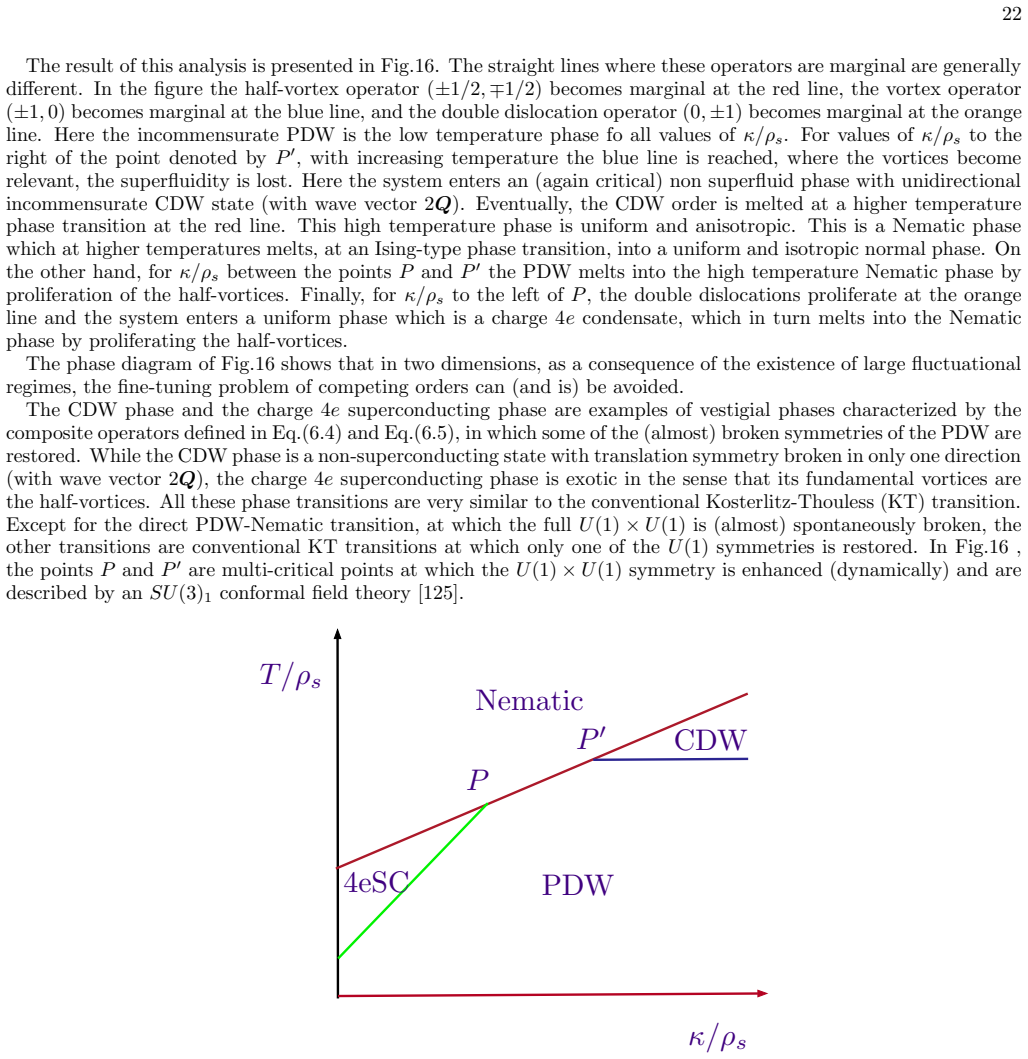
- [Figure 16 caption] The caption refers to the 'black straight line' for vortex proliferation, but the text in Section VI.E refers to the 'blue line' for the same transition; the color coding should be made consistent.
- [Section IV] There is a typo in the sentence about the Pomeranchuk nematic: 'expect at the quantum phase transition' should be 'except at the quantum phase transition.'
- [References] Several key experimental and theoretical references are cited as 'unpublished' or 'in preparation' (Refs. [100], [101], [104], [106], [145]). The paper should indicate, where possible, whether these works have been peer-reviewed or posted as preprints, so readers can assess the maturity of the evidence.
- [Section VI.D, Eq. (6.20)] The fugacity terms for the half-vortex operators are written as cos(πϑ)cos(πφ); a brief justification of this product form, rather than a sum of cosines, would help readers unfamiliar with the dual-field formulation.
Circularity Check
No significant circularity: the paper's Landau-Ginzburg and Kosterlitz-Thouless arguments are symmetry-based, and the central claims are anchored by independent experiments and numerical studies.
full rationale
This paper is a perspective/review that develops a Landau-Ginzburg theory of pair-density-wave (PDW) states and uses it to organize the cuprate phase diagram. The load-bearing derivations are parameter-free symmetry arguments: the trilinear couplings (Eqs. 6.3, 6.6, 6.7), the composite order parameters (Eqs. 6.4, 6.5), the topological charge assignments (Eqs. 6.8-6.13), and the KT scaling dimensions (Eqs. 6.18-6.22) all follow from the assumed order-parameter algebra and symmetry principles, not from values fitted to the data being 'predicted.' The paper does not fit parameters to a subset of observations and then call the result a prediction. The flagship LBCO example relies on a structural hypothesis about the LTT stacking (planes rotated by 90 degrees, half-period-shifted stripes, four-layer c-axis cell) and an assertion that the allowed interplane Josephson coupling is negligible; this is an assumption that could be wrong, and the paper does not quantify it, but it is not circular: the symmetry argument takes the stacking as input and derives the frustration. The extensive self-citations are to the author's own prior proposals and reviews, but the central claim of 'intertwined orders' is supported by independent experiments (transport, neutron scattering, STM, X-ray) and by numerical simulations of t-J and Hubbard-type models by other groups (Refs. 86, 87, 130-133, 140-143). No step in the paper reduces, by definition or by construction, to its own input, and no 'uniqueness theorem' from the authors is invoked to forbid alternatives. The paper also candidly notes limitations, such as the difficulty of microscopic models and the fact that fractional-flux predictions remain untested. Overall, there is no significant circularity; the framework is presented as an organizing hypothesis with testable consequences, not as a closed self-justifying loop.
Assumptions & free parameters
assumptions (6)
- domain assumption Landau-Ginzburg free energies of the form Eq. (6.2) with U(1)xU(1) symmetry capture the long-wavelength physics of the PDW.
- standard math Kosterlitz-Thouless energy-entropy criterion with marginality when the scaling dimension equals the spatial dimensionality, Eq. (6.22).
- standard math Mermin-Wagner theorem prevents true continuous symmetry breaking in two dimensions, so order is quasi-long-range with power-law correlations.
- standard math Imry-Ma and Efetov-Larkin random-field arguments destroy long-range CDW/SDW order below four spatial dimensions for continuous symmetries.
- domain assumption The LTT crystal structure of La2-xBaxCuO4 has consecutive CuO2 planes rotated by 90 degrees, a half-period shift from Coulomb repulsion, and a four-layer c-axis unit cell.
- ad hoc to paper Comparable critical temperatures over broad doping ranges indicate a common microscopic origin rather than proximity to a multicritical point.
invented entities (3)
-
Pair-density wave (PDW): finite-momentum, self-organized, time-reversal-invariant superconducting order.
independent evidence
-
Charge-4e superconductor (quartet condensate).
independent evidence
-
Half-vortices with half-quantum flux.
independent evidence
Cite this review
Pith. "Pith review of Intertwined Orders and the Physics of High Temperature Superconductors." pith.science (2026). https://pith.science/paper/W3JBDWKV
@misc{pith2026250621673,
  author       = {Pith},
  title        = {Pith review of: Intertwined Orders and the Physics of High Temperature Superconductors},
  year         = {2026},
  howpublished = {\url{https://pith.science/paper/W3JBDWKV}},
  note         = {Machine review of arXiv:2506.21673}
}
read the original abstract
Complex phase diagrams are generic feature of quantum materials that display high temperature superconductivity. In addition to d-wave superconductivity (or other unconventional states), these phase diagrams typically include various forms of charge-ordered phases, including charge-density-waves and/or spin-density waves, and electronic nematic states. In most cases these phases have critical temperatures comparable in magnitude to that of the superconducting state, and appear in a "pseudo-gap" regime. In these systems the high temperature state is not a good metal with well-defined quasiparticles but a "strange metal". These states typically arise from doping a strongly correlated Mott insulator. With my collaborators we have identified these behaviors as a problem with "Intertwined Orders". A Pair-density wave is a type of superconducting state which embodies the physics of intertwined orders. Here I discus the phenomenology of intertwined orders and the quantum materials that are known to display these behaviors.
Figures


Figures from the paper (13 more)



Forward citations
Cited by 2 Pith papers
-
Yamaji effect in models of underdoped cuprates
FL* theory (p/8 pockets) reproduces the observed Yamaji ADMR in HgBa2CuO4+δ, while even the best-case SDW theory (Q=(π,π,0), p/4 pockets) predicts an extra, unobserved Yamaji peak at φ=45°.
-
Lectures on insulating and conducting quantum spin liquids
The notes argue that the FL* state — small pockets plus a quantized spin-liquid anomaly — resolves the ADMR pocket and v_F >> v_Delta problems that defeated holon-metal and plain fermionic-parton theories of the cuprates.
Reference graph
Works this paper leans on
-
[1]
with mQ = m−Q = ±1), and the short- distance behavior lim r→0 ∆Q(r) = 0 and lim r→0 ∆−Q(r) = 0, and carry quantized magnetic flux ±2π
Abrikosov vortices with topological charges ( qs, qc) = ( ±1, 0) (i.e. with mQ = m−Q = ±1), and the short- distance behavior lim r→0 ∆Q(r) = 0 and lim r→0 ∆−Q(r) = 0, and carry quantized magnetic flux ±2π
-
[2]
with mQ = −m−Q = ±1)
Double dislocations with topological charges ( qs, qc) = (0 , ±1) (i.e. with mQ = −m−Q = ±1). Here too limr→0 ∆Q(r) = 0 and lim r→0 ∆−Q(r) = 0. Fig. 13 shows a double dislocation
-
[3]
with mQ = ±1 and m−Q = 0 or mQ = 0 and m−Q = ±1), and carry half-quantized magnetic flux ±π
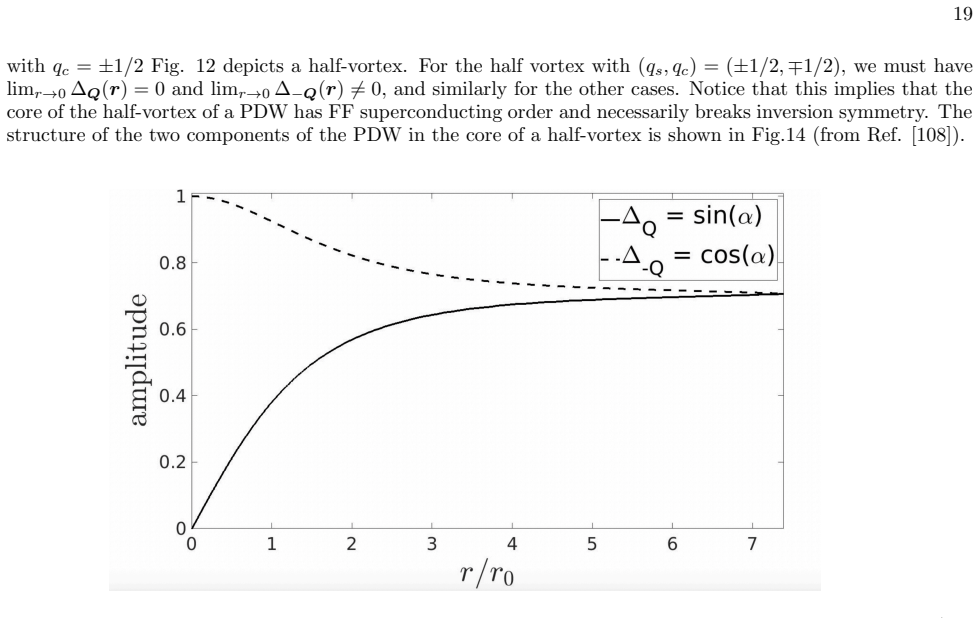
Half-vortices with topological charges ( qs, qc) = (±1/2, ±1/2) (i.e. with mQ = ±1 and m−Q = 0 or mQ = 0 and m−Q = ±1), and carry half-quantized magnetic flux ±π. Hence, half-vortices are bound to single dislocations 19 with qc = ±1/2 Fig. 12 depicts a half-vortex. For the half vortex with ( qs, qc) = ( ±1/2, ∓1/2), we must have limr→0 ∆Q(r) = 0 and lim r...
-
[4]
Baym and C
G. Baym and C. J. Pethick, Landau Fermi Liquid Theory(John Wiley & Sons, New York, NY, 1991)
1991
-
[5]
The temperature dependence of the resistivity is different for different processes
Naturally, the resistivity is finite only in the presence of momentum (and/or energy) relaxation mechanisms such as umk- lapp processes, disorder, phonons, etc. The temperature dependence of the resistivity is different for different processes. The T 2 dependence is for a Fermi liquid with some weak relaxation mechanism, see Ref. [4]
-
[6]
de Gennes, Superconductivity of metals and alloys (Advanced Book Program, Perseus Books, Reading, Mas- sachusetts, 1999)
P-G. de Gennes, Superconductivity of metals and alloys (Advanced Book Program, Perseus Books, Reading, Mas- sachusetts, 1999)
1999
-
[7]
Bardeen, L
J. Bardeen, L. N. Cooper, and J. R. Schrieffer, Theory of superconductivity, Phys. Rev. 108, 1175 (1957)
1957
-
[8]
J. R. Schrieffer, Theory of Superconductivity(Addison-Wesley, Redwood City, California, 1964)
1964
Show all 171 references
-
[9]
Nambu and G
Y. Nambu and G. Jona-Lasinio, Dynamical Model of Elementary particles Based on an Analogy with Superconductivity.I, Physical Review 122, 345 (1961)
1961
-
[10]
Fradkin, Field Theories of Condensed Matter Physics, Second Edition(Cambridge University Press, Cambridge, UK, 2013)
E. Fradkin, Field Theories of Condensed Matter Physics, Second Edition(Cambridge University Press, Cambridge, UK, 2013)
2013
-
[11]
L. D. Landau, The Theory of a Fermi Liquid, Sov. Phys. JETP 3, 920 (1957)
1957
-
[12]
Pines and P
D. Pines and P. Nozi´ eres,The Theory of Quantum Liquids : Normal Fermi Liquids(Addison-Wesley Publishing Company, Redwood City, CA, 1966)
1966
-
[13]
Susskind, Dynamics of spontaneous symmetry breaking in the Weinberg-Salam theory, Physical Review D 20, 2619 (1979)
L. Susskind, Dynamics of spontaneous symmetry breaking in the Weinberg-Salam theory, Physical Review D 20, 2619 (1979)
1979
-
[14]
Alford, J
M. Alford, J. A. Bowers, and K. Rajagopal, Crystalline color superconductivity, Phys. Rev. D 63, 074016 (2001)
2001
-
[15]
Alford, Color-Superconducting Quark Matter, Annual Review of Nuclear and particle Science 51, 131 (2001)
M. Alford, Color-Superconducting Quark Matter, Annual Review of Nuclear and particle Science 51, 131 (2001)
2001
-
[16]
A. J. Leggett, A theoretical description of the new phases of liquid 3He, Rev. Mod. Phys. 47, 331 (1975)
1975
-
[17]
J. G. Bednorz and K. A. M¨ uller, Possible highT c superconductivity in the Ba-La-Cu-O system, Zeitschrift f¨ u Physik B Condensed Matter 64, 189 (1986)
1986
-
[18]
V. J. Emery and S. A. Kivelson, Superconductivity in Bad Metals, Phys. Rev. Lett. 74, 3253 (1995)
1995
-
[19]
P. W. Higgs, Broken Symmetries and the Masses of Gauge Bosons, Physical Review Letters 13, 508 (1964)
1964
-
[20]
Steven Weinberg, A Model of Leptons, Physical Review Letters 19, 1264 (1967)
1967
-
[21]
Svartholm (Almqvist and Wiksells, Stockholm, 1968) p
Abdus Salam, Weak and Electromagnetic Interactions, in Elementary Particle Physics, edited by N. Svartholm (Almqvist and Wiksells, Stockholm, 1968) p. 367
1968
-
[22]
Abbamonte and J
P. Abbamonte and J. Fink, Collective Charge Excitations Studied by Electron Energy-Loss Spectroscopy, Annual Review of Condensed Matter Physics 16, 465 (2025)
2025
-
[23]
S. A. Hartnoll and A. P. Mackenzie, Colloquium: Planckian dissipation in metals, Reviews of Modern Physics 94, 041002 (2022)
2022
-
[24]
Esterlis and J
I. Esterlis and J. Schmalian, Quantum Critical Eliashberg Theory (2025), to appear in Annual Review of Condensed Matter Physics, arXiv:2506.11952
2025 arXiv
-
[25]
D. A. Wollman, D. J. Van Harlingen, D. M. Ginsberg, and A. J. Leggett, Experimantal determinantion of the super- conducting pairing state in YBa 2Cu3O7−δ from the phase-coherence of YBa 2Cu3O7−δ-Pb dc SQUIDS, Physical Review Letters 71, 2134 (1993)
1993
-
[26]
J. R. Kirtley and C. C. Tsuei and J. Z. Sun and C. C. Chi and Loch See Yu-Jahnes and A. Gupta and M. Rupp and M. B. Ketchen, Symmetry of the order parameter in the high- Tc superconductor YBa 2Cu3O7−δ, Nature 373, 225 (1995)
1995
-
[27]
J. E. Hoffman, E. W. Hudson, K. M. Lang, V. Madhavan, H. Eisaki, S. Uchida, and J. Davis, A Four Unit Cell Periodic Pattern of Quasi-Particle States Surrounding Vortex Cores in Bi 2Sr2CaCu2O8+y, Science 295, 466 (2002)
2002
-
[28]
S. L. Cooper, M. V. Klein, B. G. Pazol, J. P. Rice, and D. M. Ginsberg, Raman scattering from superconducting gap excitations in single-crystal YBa 2Cu3O7−δ, Phys. Rev. B 37, 5920 (1988). 25
1988
-
[29]
Damascelli, Z
A. Damascelli, Z. Hussain, and Z.-X. Shen, Angle-resolved potoemission studies of the cuprate superconductors, Reviews of Modern Physics 75, 473 (2003)
2003
-
[30]
S. Vig, A. Kogar, M. Mitrano, A. A. Husain, V. Mishra, M. S. Rak, L. Venema, P. D. Johnson, G. D. Gu, E. Fradkin, M. R. Norman, and P. Abbamonte, Measurement of the dynamic charge response of materials using low-energy, momentum- resolved electron energy-loss spectroscopy (M-E...
2017
-
[31]
S. M. Hayden and J. M. Tranquada, Charge Correlations in Cuprate Superconductors, Annual Review of Condensed Matter Physics 15, 215 (2024)
2024
-
[32]
Hinkov, D
V. Hinkov, D. Haug, B. Fauqu´ e, P. Bourges, Y. Sidis, A. Ivanov, C. Bernhard, C. T. Lin, and B. Keimer, Electronic Liquid Crystal State in the High-Temperature Superconductor YBa 2Cu3O6.45, Science 319, 597 (2008)
2008
-
[33]
Chang, N
J. Chang, N. D.-L.-F. Lalibert´ e, R. Daou, D. LeBeuf, B. J. Ramshaw, R. Liang, D. A. Bonn, W. H. Hardy, C. Proust, I. Sheikin, K. Behnia, and L. Taillefer, Nernst effect in the cuprate superconductor YBa 2Cu3O7−δ: Broken rotational and translational symmetries, Physical Revie...
2011
-
[34]
S. A. Kivelson, I. Bindloss, E. Fradkin, V. Oganesyan, J. Tranquada, A. Kapitulnik, and C. Howald, How to detect fluctuating stripes in high tempertature superconductors, Rev. Mod. Phys. 75, 1201 (2003)
2003
-
[35]
Imry and S.-k
Y. Imry and S.-k. Ma, Random-Field Instability of the Ordered State of Continuous Symmetry, Physical Review Letters 35, 1399 (1975)
1975
-
[36]
K. B. Efetov and A. I. Larkin, Charge-density wave in a random potential, Journal of Experimental and Theoretical Physics (Soviet JETP) 45, 1236 (1977)
1977
-
[37]
Aubin, K
H. Aubin, K. Behnia, M. Ribault, R. Gagnon, and L. Taillefer, Angular Position of Nodes in the Superconducting Gap of YBa2Cu3O7−δ, Physical Review Letters 78, 2624 (1997)
1997
-
[38]
J. M. Tranquada, B. J. Sternlieb, J. D. Axe, Y. Nakamura, and S. Uchida, Evidence for stripe correlations of spins and holes in copper oxide superconductors, Nature 375, 561 (1995)
1995
-
[39]
zDAc0zGuwRe0C9QMAL0hPe6U80Q=
or in my textbooks [1, 121]. The low temperature behavior of low dimensional systems can be described by an effective non-linear sigma model theory in which the magnitude of the order parameter is developed at relatively high temperatures and the phase transition involves the ...
-
[40]
Abbamonte, A
P. Abbamonte, A. Rusydi, S. S., G. Gu, S. G.A., and F. D.L., Spatially modulated ‘Mottness’ in La 2−xBaxCuO4, Nature Physics 1, 155 (2005)
2005
-
[41]
V. J. Emery and S. A. Kivelson, Frustrated electronic phase separation and high-temperature superconductors, Physica C 209, 597 (1993)
1993
-
[42]
B. I. Halperin and D. R. Nelson, Theory of Two-Dimensional Melting, Physical Review Letters 41, 121 (1978)
1978
-
[43]
A. P. Young, Melting and the vector Coulomb gas in two dimensions, Physical Review B 19, 1855 (1979)
1979
-
[44]
J. M. Kosterlitz and D. J. Thouless, Order, metastability and phase transitions in two-dimensional systems, Journal of Physics C: Solid State Physics 6, 1181 (1973)
1973
-
[45]
K. Sun, B. M. Fregoso, M. J. Lawler, and E. Fradkin, Fluctuating stripes in strongly correlated electron systems and the nematic-smectic quantum phase transition, Physical Review B 78, 085124 (2008)
2008
-
[46]
J. M. Tranquada, J. D. Axe, N. Ichikawa, A. R. Moodenbaugh, Y. Nakamura, and S. Uchida, Coexistence of, and Competition between, Superconductivity and Charge-Stripe Order in La 1.6−x Nd0.4Srx CuO4, Physical Review Letters 78, 338 (1997)
1997
-
[47]
S. A. Kivelson, E. Fradkin, and V. J. Emery, Electronic liquid-crystal phases of a doped Mott insulator, Nature 393, 550 (1998)
1998
-
[48]
P. M. Chaikin and T. C. Lubensky, Principles of Condensed Matter Physics(Cambridge University Press, Cambridge, UK, 1995)
1995
-
[49]
P. G. deGennes and J. Prost, The Physics of Liquid Crystals, 2nd ed. (Oxford University Press, Oxford, UK, 1993)
1993
-
[50]
Jungwirth, R
T. Jungwirth, R. M. Fernandes, E. Fradkin, A. H. MacDonald, J. Sinova, and L. ˇSmejkal, Altermagnetism: An uncon- ventional spin-ordered phase of matter, Newton 0, 100162 (2025)
2025
-
[51]
L. Nie, G. Tarjus, and S. A. Kivelson, Quenched disorder and vestigial nematicity in the pseudogap regime of the cuprates, Proceedings of the National Academy of Sciences 111, 7980 (2014). 26
2014
-
[52]
V. J. Emery, E. Fradkin, S. A. Kivelson, and T. C. Lubensky, Quantum Theory of the Smectic Metal State in Stripe Phases, Physical Review Letters 85, 2160 (2000)
2000
-
[53]
Granath, V
M. Granath, V. Oganesyan, S. A. Kivelson, E. Fradkin, and V. J. Emery, Nodal quasi-particles and coexisting orders in striped superconductors, Physical Review Letters 87, 167011 (2001)
2001
-
[54]
Arrigoni, E
E. Arrigoni, E. Fradkin, and S. A. Kivelson, Mechanism of High Temperature Superconductivity in a striped Hubbard Model, Physical Review B 69, 214519 (2004)
2004
-
[55]
Oganesyan, S
V. Oganesyan, S. A. Kivelson, and E. Fradkin, Quantum theory of a nematic Fermi fluid, Phys. Rev. B 64, 195109 (2001)
2001
-
[56]
S. A. Kivelson, E. Fradkin, and T. H. Geballe, Quasi-one-dimensional dynamics and nematic phases in the two-dimensional Emery model, Phys. Rev. B 69, 144505 (2004)
2004
-
[57]
C. Wu, K. Sun, E. Fradkin, and S. C. Zhang, Fermi liquid instabilities in the spin channel, Phys. Rev. B 75, 115103 (2007)
2007
-
[58]
ˇSmejkal, J
L. ˇSmejkal, J. Sinova, and T. Jungwirth, Beyond Conventional Ferromagnetism and Antiferromagnetism: A Phase with Nonrelativistic Spin and Crystal Rotation Symmetry, Physical Review X 12, 031042 (2022)
2022
-
[59]
K. A. Schreiber and G. A. Cs´ athy, Competition of Pairing and Nematicity in the Two-Dimensional Electron Gas, Annual Review of Condensed Matter Physics 11, 17 (2020)
2020
-
[60]
Fradkin and S
E. Fradkin and S. A. Kivelson, Liquid-crystal phases of quantum Hall systems, Physical Review B 59, 8065 (1999)
1999
-
[61]
R. A. Borzi, S. A. Grigera, J. Farrell, R. S. Perry, S. J. S. Lister, S. L. Lee, D. A. Tennant, Y. Maeno, and A. P. Mackenzie, Formation of a Nematic Fluid at High Fields in Sr 3Ru2O7, Science 315, 214 (2007), https://www.science.org/doi/pdf/10.1126/science.1134796
2007 doi
-
[62]
R. M. Fernandes, P. P. Orth, and J. Schmalian, Vestigial Order in Quantum Materials: Nematicity and Beyond, Annual Review of Condensed Matter Physics 10, 133 (2019)
2019
-
[63]
Fradkin, S
E. Fradkin, S. A. Kivelson, M. J. Lawler, J. P. Eisenstein, and A. P. Mackenzie, Nematic Fermi Fluids in Condensed Matter Physics, Annual Review of Condensed Matter Physics 1, 153 (2010)
2010
-
[64]
S. A. Kivelson and E. Fradkin, How optimal inhomogeneity produces high temperature superconductivity, in Handbook of High Temperature Superconductivity, edited by J. R. Schrieffer and J. Brooks (Springer-Verlag, New York, 2007) pp. 569–595
2007
-
[65]
Fradkin, S
E. Fradkin, S. A. Kivelson, and J. M. Tranquada, Colloquium: Theory of intertwined orders in high temperature super- conductors, Rev. Mod. Phys. 87, 457 (2015)
2015
-
[66]
M. P. Lilly, K. B. Cooper, J. P. Eisenstein, L. N. Pfeiffer, and K. W. West, Evidence for an anisotropic state of two- dimensional electrons in high landau levels, Physical Review Letters 82, 394 (1999)
1999
-
[67]
R. Du, D. Tsui, H. Stormer, L. Pfeiffer, K. Baldwin, and K. West, Strongly anisotropic transport in higher two-dimensional Landau levels, Solid State Communications 109, 389 (1999)
1999
-
[68]
S. A. Kivelson, D.-H. Lee, E. Fradkin, and V. Oganesyan, Competing order in the mixed state of high-temperature superconductors, Phys. Rev. B 66, 144516 (2002)
2002
-
[69]
B. Lake, H. M. Rønnow, N. B. Christensen, G. Aeppli, K. Lefmann, D. F. McMorrow, P. Vorderwisch, P. Smeibidl, N. Mangkorntong, T. Sasagawa, M. Nohara, H. Takagi, and T. E. Mason, Antiferromagnetic order induced by an applied magnetic field in a high temperature superconductor,...
2002
-
[70]
Chowdhury, E
D. Chowdhury, E. Berg, and S. Sachdev, Nematic order in the vicinity of a vortex in superconducting FeSe, Physical Review B 84, 205113 (2011)
2011
-
[71]
S. Yan, D. Iaia, E. Morosan, E. Fradkin, P. Abbamonte, and V. Madhavan, Influence of Domain Walls in the Incommen- surate Charge Density Wave State of Cu Intercalated 1 T -TiSe2, Physical Review Letters 118, 106405 (2017)
2017
-
[72]
S. Lee, J. Collini, S. X.-L. Sun, M. Mitrano, X. Guo, C. Eckberg, J. Paglione, E. Fradkin, and P. Abbamonte, Mul- tiple Charge Density Waves and Superconductivity Nucleation at Antiphase Domain Walls in the Nematic Pnictide Ba1−xSrxNi2As2, Physical Review Letters 127, 027602 (2021)
2021
-
[73]
D. G. Ravenhall, C. J. Pethick, and J. R. Wilson, Structure of Matter below Nuclear Saturation Density, Physical Review Letters 50, 2066 (1983)
1983
-
[74]
C. P. Lorenz, D. G. Ravenhall, and C. J. Pethick, Neutron star crusts, Physical Review Letters 70, 379 (1993)
1993
-
[75]
J. M. Kosterlitz, D. R. Nelson, and M. E. Fisher, Bicritical and tetracritical points in anisotropic antiferromagnetic systems, Physical Review B 13, 412 (1976)
1976
-
[76]
X. Liu, Y. X. Chong, R. Sharma, and J. C. S. Davis, Discovery of a Cooper-pair density wave state in a transition-metal dichalcogenide, Science 372, 1447 (2021)
2021
-
[77]
S. Lee, E. W. Huang, T. A. Johnson, X. Guo, A. A. Husain, M. Mitrano, K. Lu, A. V. Zakrzewski, G. A. de la Pe˜ na, Y. Peng, H. Huang, S.-J. Lee, H. Jang, J.-S. Lee, Y. I. Joe, W. B. Doriese, P. S. D. S. Swetz, S. Chi, A. A. Aczel, G. J. MacDougall, S. A. Kivelson, E. Fradkin, ...
2022 doi
-
[78]
H. Miao, R. Fumagalli, M. Rossi, J. Lorenzana, G. Seibold, F. Yakhou-Harris, K. Kummer, N. B. Brookes, G. D. Gu, L. Braicovich, G. Ghiringhelli, and M. P. M. Dean, Formation of Incommensurate Charge Density Waves in Cuprates, Physical Review X 9, 031042 (2019)
2019
-
[79]
Q. Li, M. H¨ ucker, G. D. Gu, A. M. Tsvelik, and J. M. Tranquada, Two-Dimensional Superconducting Fluctuations in Stripe-Ordered La 1.875Ba0.125CuO4, Physical Review Letters 99, 067001 (2007)
2007
-
[80]
J. M. Tranquada, G. D. Gu, M. H¨ ucker, H. J. Kang, R. Klingerer, Q. Li, J. S. Wen, G. Y. Xu, and M. v. Zimmermann, Evidence for unusual superconducting correlations coexisting with stripe order in La 1.875Ba0.125CuO4, Physical Review 27 B 78, 174529 (2008)
2008
-
[81]
Tajima, T
S. Tajima, T. Noda, H. Eisaki, and S. Uchida, c-Axis Optical Response in the Static Stripe Ordered Phase of the Cuprates, Physical Review Letters 86, 500 (2001)
2001
-
[82]
C. Chen, L. su, A. H. Castro Neto, and V. M. Pereira, Discommensuration-driven superconductivty in the charge density wave phases of transition-metal dichalcogenides, Physical Review B 99, 1211108(R) (2019)
2019
-
[83]
E. Berg, E. Fradkin, S. A. Kivelson, and J. M. Tranquada, Striped superconductors: how spin, charge and superconducting orders intertwine in the cuprates, New J. Phys. 11, 115004 (2009)
2009
-
[84]
H¨ ucker, M
M. H¨ ucker, M. v. Zimmermann, G. D. Gu, Z. J. Xu, J. S. Wen, G. Xu, H. J. Kang, A. Zheludev, and J. M. Tranquada, Stripe order in superconducting La 2−x Bax CuO4 (0.095 < x <0.155) , Phys. Rev. B 83, 104506 (2011)
2011
-
[85]
Fujita, H
M. Fujita, H. Goka, K. Yamada, J. M. Tranquada, and L. P. Regnault, Stripe order, depinning, and fluctuations in La1.875Ba0.125CuO4 and La1.875Ba0.075Sr0.050CuO4, Physical Review B 70, 104517 (2004)
2004
-
[86]
Himeda, T
A. Himeda, T. Kato, and M. Ogata, Stripe States with Spatially Oscillating d -Wave Superconductivity in the Two- Dimensional t − t ′ − J Model, Physical Review Letters 88, 117001 (2002)
2002
-
[87]
These simulations suggest that the ordering between these ground states can be affected by even small changes in the models
have found that the uniform d-wave SC, the striped SC and and the PDW are are extremely close in energy, with the uniform d-wave SC state being slightly preferred. These simulations suggest that the ordering between these ground states can be affected by even small changes in ...
-
[88]
H. Li, D. Oh, M. Kang, H. Zhao, B. R. Ortiz, Y. Oey, S. Fang, Z. Ren, C. Jozwiak, A. Bostwick, E. Rotenberg, J. G. Checkelsky, Z. Wang, S. D. Wilson, R. Comin, and I. Zeljkovic, Small Fermi Pockets Intertwined with Charge Stripes and Pair Density Wave Order in a Kagome Superco...
2023
-
[89]
Aishwarya, J
A. Aishwarya, J. May-Mann, A. Raghavan, L. Nie, M. Romanelli, S. Ran, S. R. Saha, J. Paglione, N. P. Butch, E. Fradkin, and V. Madhavan, Magnetic-field-sensitive charge density waves in the superconductor UTe 2, Nature 618, 928 (2023)
2023
-
[90]
Q. Gu, J. P. Carroll, S. Wang, S. Ran, C. Broyles, H. Siddiquee, N. P. Butch, S. R. Saha, J. Paglione, J. C. S. Davis, and X. Liu, Detection of a pair density wave state in UTe 2, Nature 618, 921 (2023)
2023
-
[91]
H¨ ucker, M
M. H¨ ucker, M. v. Zimmermann, Z. J. Xu, J. S. Wen, G. D. Gu, and J. M. Tranquada, Enhanced charge stripe order of superconducting la 2−xbaxcuo4 in a magnetic field, Phys. Rev. B 87, 014501 (2013)
2013
-
[92]
daughter
(FF) as arising in the presence of a magnetic field much in the same way as the state proposed by Larkin and Ovchinnikov. The LO and FF states are commonly referred together as the FFLO states (even though they have different symmetry) and the there is a robust literature on t...
-
[93]
A. A. Schafgans, A. D. LaForge, S. V. Dordevic, M. M. Qazilbash, W. J. Padilla, K. S. Burch, Z. Q. Li, S. Komiya, Y. Ando, and D. N. Basov, Towards two-dimensional superconductivity in La 2−xSrxCuO4 in a moderate magnetic field, Phys. Rev. Lett. 104, 157002 (2010)
2010
-
[94]
E. Berg, E. Fradkin, E.-A. Kim, S. A. Kivelson, V. Oganesyan, J. M. Tranquada, and S. C. Zhang, Dynamical Layer Decoupling in a Stripe-Ordered High- Tc Superconductor, Phys. Rev. Lett. 99, 127003 (2007)
2007
-
[95]
A. I. Larkin and Y. N. Ovchinnikov, Inhomogeneous state of superconductors, Soviet Physics JETP 20, 762 (1965), J. Exptl. Theoret. Phys. (U.S.S.R.) 47, 1136-1146 (1964)
1965
-
[96]
Corboz, T
P. Corboz, T. M. Rice, and M. Troyer, Competing states in the t-J model: uniform d-wave state versus stripe state, Physical Review Letters 113, 046402 (2014)
2014
-
[97]
D. F. Agterberg, J. S. Davis, S. D. Edkins, E. Fradkin, D. J. V. Harlingen, S. A. Kivelson, P. A. Lee, L. Radzihovsky, J. M. Tranquada, and Y. Wang, The physics of pair-density waves: Cuprate superconductors and beyond, Annual Review of Condensed Matter Physics 11, 231 (2020)
2020
-
[98]
Soto-Garrido, G
R. Soto-Garrido, G. Y. Cho, and E. Fradkin, Quasi-one-dimensional pair density wave superconducting state, Physical Review B 91, 195102 (2015)
2015
-
[99]
P. M. R. Brydon, D. F. Agterberg, H. Menke, and C. Timm, Bogoliubov fermi surfaces: General theory, magnetic order, and topology, Phys. Rev. B 98, 224509 (2018)
2018
-
[100]
H. Zhao, R. Blackwell, M. Thinel, T. Handa, S. Ishida, X. Zhu, A. Iyo, H. Eisaki, A. N. Pasupathy, and K. Fujita, Smectic pair-density-wave order in EuRbFe4As4, Nature 618, 940 (2023)
2023
-
[101]
Fulde and R
P. Fulde and R. A. Ferrell, Superconductivity in a Strong Spin-Exchange Field, Phys. Rev. 135, A550 (1964)
1964
-
[102]
Casalbuoni and G
R. Casalbuoni and G. Nardulli, Inhomogeneous superconductivity in condensed matter and QCD, Rev. Mod. Phys. 76, 263 (2004)
2004
-
[103]
D. F. Agterberg and H. Tsunetsugu, Dislocations and vortices in pair-density-wave superconductors, Nature Physics 4, 639 (2008)
2008
-
[104]
D. F. Agterberg and J. Garaud, Checkerboard order in vortex cores from pair-density-wave superconductivity, Physical Review B 91, 104512 (2015)
2015
-
[105]
E. Berg, E. Fradkin, and S. A. Kivelson, Theory of the Striped Superconductor, Phys. Rev. B 79, 064515 (2009)
2009
-
[106]
J.-S. Lee, S. A. Kivelson, T. Wang, Y. Ikeda, T. Taniguchi, M. Fujita, and C.-C. Kao, Pair-density wave signature observed by x-ray scattering in La-based high- Tc cuprates, unpublished (2023), arXiv:2310.19907
2023 arXiv
-
[107]
E. Berg, E. Fradkin, and S. A. Kivelson, Charge 4 e superconductivity from pair density wave order in certain high temperature superconductors, Nat. Phys. 5, 830 (2009)
2009
-
[108]
Rosales and E
M. Rosales and E. Fradkin, Electronic structure of topological defects in the pair density wave superconductor, Physical Review B 110, 214508 (2024)
2024
-
[109]
D. R. Hamilton, G. D. Gu, E. Fradkin, and D. J. V. Harlingen, Signatures of pair-density wave order in phase-sensitive measurements of La2−x −N bJosephson junctions and SQUIDs (2018), arXiv:1811:02048 (unpublished), arXiv:1811:02048
2018
-
[110]
Y.-M. Wu, A. V. Chubukov, Y. Wang, and S. A. Kivelson, Time-reversal symmetry breaking, collective modes, and Raman spectrum in pair-density-wave states (2025), unpublished, arXiv:2501.14139
2025 arXiv
-
[111]
M. H. Hamidian, S. D. Edkins, K. Fujita, A. Kostin, A. P. Mackenzie, H. Eisaki, S. Uchida, M. J. Lawler, E. A. Kim, S. Sachdev, and J. C. S. Davis, Magnetic-field Induced Interconversion of Cooper Pairs and Density Wave States within Cuprate Composite Order (2015), unpublished...
2015 arXiv
-
[112]
W. Chen, W. Ren, N. Kennedy, M. H. Hamidian, S. Uchida, H. Eisaki, P. D. Johnson, S. M. O’Mahony, and J. C. S. Davis, Identification of a nematic pair density wave state in Bi 2Sr2CaCu2O8+x, PNAS 119, e2206481119 (2022)
2022
-
[113]
Blackburn, O
E. Blackburn, O. Ivashko, E. Campillo, M. von Zimmermann, R. Liang, D. A. Bonn, W. N. Hardy, J. Chang, E. M. Forgan, and S. M. Hayden, Searching for the signature of a pair density wave in YBa 2Cu3O6.67 using high energy X-ray diffraction, unpublished (2023), arXiv:2310.18302
2023 arXiv
-
[114]
S. D. Edkins, A. Kostin, K. Fujita, A. P. Mackenzie, H. Eisaki, S. Uchida, M. J. Lawler, E.-A. Kim, J. Davis, and M. H. Hamidian, Magnetic-Field Induced Pair Density Wave in the Cuprate Vortex Halo, Science 364, 976 (2019)
2019
-
[115]
L. H. Santos, Y. Wang, and E. Fradkin, Pair-Density-Wave Order and Paired Fractional Quantum Hall Fluids, Physical Review X 9, 021047 (2019)
2019
-
[116]
fundamental
we considered the problem of a uniform d-wave superconductor which competes with a unidirectional PDW state with wave vector Q (with period 4 a0). Using a Landau-Ginzburg theory with my collaborators [116] we investigated the structure of a superconducting vortex. By adjusting...
-
[117]
Dai, Y.-H
Z. Dai, Y.-H. Zhang, T. Senthil, and P. A. Lee, Pair-density waves, charge-density waves, and vortices in high-Tc cuprates, Physical Review B 97, 174511 (2018)
2018
-
[118]
J. Ge, P. Wang, Y. Xing, Q. Yin, A. Wang, J. Shen, H. Lei, Z. Wang, and J. Wang, Charge-4 e and Charge-6 e Flux Quantization and Higher Charge Superconductivity in Kagome Superconductor Ring Devices, Phys. Rev. X 14, 021025 (2024). 28
2024
-
[119]
Babaev, Vortices with Fractional Flux in Two-Gap Superconductors and in Extended Faddeev Model, Physical Review Letters 89, 067001 (2002)
E. Babaev, Vortices with Fractional Flux in Two-Gap Superconductors and in Extended Faddeev Model, Physical Review Letters 89, 067001 (2002)
2002
-
[120]
D. F. Agterberg, M. Geracie, and H. Tsunetsugu, Conventional and charge-six superfluids from melting hexagonal Fulde- Ferrell-Larkin-Ovchinnikov phases in two dimensions, Physical Review B 84, 014513 (2011)
2011
-
[121]
Mukerjee, C
S. Mukerjee, C. Xu, and J. E. Moore, Topological Defects and the Superfluid Transition of the s = 1 Spinor Condensate in Two Dimensions, Physical Review Letters 97, 120406 (2006)
2006
-
[122]
Radzihovsky and A
L. Radzihovsky and A. Vishwanath, Quantum Liquid Crystals in an Imbalanced Fermi Gas: Fluctuations and Fractional Vortices in Larkin-Ovchinnikov States, Physics Review Letters 103, 010404 (2009)
2009
-
[123]
Vakaryuk and A
V. Vakaryuk and A. J. Leggett, Spin Polarization of Half-Quantum Vortex in Systems with Equal Spin Pairing, Physical Review Letters 103, 057003 (2009)
2009
-
[124]
Fradkin, Field theoretic aspects of condensed matter physics: An overview, in Encyclopedia of Condensed Matter Physics (Second Edition), edited by T
E. Fradkin, Field theoretic aspects of condensed matter physics: An overview, in Encyclopedia of Condensed Matter Physics (Second Edition), edited by T. Chakraborty (Academic Press, Oxford, 2024) second edition ed., pp. 27–131
2024
-
[125]
Y. Wang, S. D. Edkins, M. H. Hamidian, J. C. S. Davis, E. Fradkin, and S. A. Kivelson, Pair density waves in supercon- ducting vortex halos, Physical Review B 97, 174510 (2018)
2018
-
[126]
D. H. Lee and G. Grinstein, Strings in two-dimensional classical XY models, Physics Review Letters 55, 541 (1985)
1985
-
[127]
Calabrese, A
P. Calabrese, A. Pelissetto, P. Rossi, and E. Vicari, Field Theory Results for Three-Dimensional Systems with Complex Symmetries, International Journal of Modern Physics B 17, 5829 (2003), https://doi.org/10.1142/S0217979203023355
2003 doi
-
[128]
Golubovi´ c and D
L. Golubovi´ c and D. Kosti´ c, Partially ordered states in Ginzburg-Landau-Wilson models with cubic-type anisotropy, Phys. Rev. B 38, 2622 (1988)
1988
-
[129]
D. F. Mross and T. Senthil, Spin- and Pair-Density-Wave Glasses, Physical Review X 5, 031008 (2015)
2015
-
[130]
Fradkin, Quantum Field Theory: An Integrated Approach(Princeton University Press, Princeton, New Jersey, 2023)
E. Fradkin, Quantum Field Theory: An Integrated Approach(Princeton University Press, Princeton, New Jersey, 2023)
2023
-
[131]
J. V. Jos´ e, L. P. Kadanoff, S. Kirkpatrick, and D. R. Nelson, Renormalization, vortices, and symmetry-breaking pertur- bations in the two-dimensional planar model, Physical Review B 16, 1217 (1977)
1977
-
[132]
L. P. Kadanoff, Multicritical behavior at the Kosterlitz-Thouless critical point, Annals of Physics 120, 39 (1979)
1979
-
[133]
D. P. Arovas, E. Berg, S. A. Kivelson, and S. Raghu, The Hubbard Model, Annual Review of Condensed Matter Physics 13, 239 (2022)
2022
-
[134]
Kondev and C
J. Kondev and C. L. Henley, Kac-Moody symmetries of critical ground states, Nuclear Physics B 464, 540 (1996)
1996
-
[135]
Jaefari and E
A. Jaefari and E. Fradkin, Pair-density-wave superconducting order in two-leg ladders, Phys. Rev. B 85, 035104 (2012)
2012
-
[136]
D. H. Lee, G. Grinstein, and J. Toner, Commensurate and Incommensurate Vortices in Two-Dimensional XY Models, Physical Review Letters 56, 2318 (1986)
1986
-
[137]
Y. Shi, A. Lamacraft, and P. Fendley, Boson Pairing and Unusual Criticality in a Generalized XY Model, Physics Review Letters 107, 240601 (2011)
2011
-
[138]
Jaefari, S
A. Jaefari, S. Lal, and E. Fradkin, Charge-density wave and superconductor competition in stripe phases of high- temperature superconductors, Phys. Rev. B 82, 144531 (2010)
2010
-
[139]
R. M. Noack, S. R. White, and D. J. Scalapino, The Doped Two-Chain Hubbard Model, Europhysics Letters (EPL) 30, 163 (1995)
1995
-
[140]
S. R. White and D. J. Scalapino, Density Matrix Renormalization Group Study of the Striped Phase in the 2D t-J Model, Phys. Rev. Lett. 80, 1272 (1998)
1998
-
[141]
Zheng, C.-M
B.-X. Zheng, C.-M. Chung, P. Corboz, G. Ehlers, M.-P. Qin, R. M. Noack, H. Shi, S. R. White, S. Zhang, and G. K.-L. Chan, Stripe order in the underdoped region of the two-dimensional Hubbard model, Science 358, 1155 (2017)
2017
-
[142]
K. S. Huang, Z. Han, S. A. Kivelson, and H. Yao, Pair-density-wave in the Strong Coupling Limit of the Holstein-Hubbard model, npj Quantum materials 7, 17 (2022)
2022
-
[143]
E. Berg, E. Fradkin, and S. A. Kivelson, Pair-Density-Wave Correlations in the Kondo-Heisenberg Model, Physical Review Letters 105, 146403 (2010)
2010
-
[144]
Soto-Garrido and E
R. Soto-Garrido and E. Fradkin, Pair-density-wave superconducting states and electronic liquid-crystal phases, Physical Review B 89, 165126 (2014)
2014
-
[145]
Loder, A
F. Loder, A. P. Kampf, and T. Kopp, Superconducting state with a finite-momentum pairing mechanism in zero external magnetic field, Physical Review B 81, 020511 (2010)
2010
-
[146]
Loder, S
F. Loder, S. Graser, M. Schmid, A. P. Kampf, and T. Kopp, Modeling of Superconducting Stripe Phases in High- Tc Cuprates, New Journal of Physics 13, 113037 (2011)
2011
-
[147]
P. A. Lee, Amperean pairing and the pseudogap phase of cuprate superconductors, Physical Review X 4, 031017 (2014)
2014
-
[148]
W ˚ ardh and M
J. W ˚ ardh and M. Granath, Effective model for a supercurrent in a pair-density wave, Physical Review B 96, 224503 (2017)
2017
-
[149]
which inspired my subsequent work with Kivelson in which we reformulated quantum dimer models in the language of gauge theory [150, 151]. Nevertheless it soon became clear that La 2CuO4 is naturally well described by a spin-1/2 quantum antiferromagnet on square (and hence bipa...
-
[150]
Ponsioen, S
B. Ponsioen, S. S. Chung, and P. Corboz, Superconducting stripes in the hole-doped three-band Hubbard model, Physical Review B 108, 205154 (2023)
2023
-
[151]
Verstraete, V
F. Verstraete, V. Murg, and J. Cirac, Matrix product states, projected entangled pair states, and variational renormal- ization group methods for quantum spin systems, Advances in Physics 57, 143 (2008)
2008
-
[152]
Jiang, Pair density wave in the doped three-band Hubbard model on two-leg square cylinders, Physical Review B 107, 214504 (2023)
H.-C. Jiang, Pair density wave in the doped three-band Hubbard model on two-leg square cylinders, Physical Review B 107, 214504 (2023)
2023
-
[153]
Moessner, S
R. Moessner, S. L. Sondhi, and E. Fradkin, Short-Ranged Resonating Valence Bond Physics, Quantum Dimer Models, and Ising Gauge Theories, Physical Review B 65, 024504 (2001)
2001
-
[154]
X. Zou, R. M. Fernandes, and E. Fradkin, Superconducting States of Metallic Altermagnets (2025), in preparation (2025). 29
2025
-
[155]
P. W. Anderson, The Resonating Valence Bond State in La 2CuO4 and Superconductivity, Science 235, 1196 (1987)
1987
-
[156]
S. A. Kivelson, D. Rokhsar, and J. P. Sethna, Topology of the resonating valence-bond state: Solitons and high Tc superconductivity, Physical Review B 35, 8865 (1987)
1987
-
[157]
Rokhsar and S
D. Rokhsar and S. A. Kivelson, Superconductivity and the Quantum Hard-Core Dimer Gas, Physical Review Letters 61, 2376 (1988)
1988
-
[158]
Baskaran and P
G. Baskaran and P. W. Anderson, Gauge theory of high-temperature superconductors and strongly correlated Fermi systems, Physical Review B 37, 580 (1988)
1988
-
[159]
using an analogy withe the Laughlin wave function for a fractional quantum Hall state of bosons (see the recent numerical work by Huang, Gong and Sheng [160]). The large- N formulation was also suitable to include the effects of hole-doping and to a mean field theories of d-wa...
2024
-
[160]
E. Fradkin, The Spectrum of Short Range Resonating Valence Bond Theories, in Field Theories in Condensed Matter Physics, A Workshop, Proceedings of the Johns Hopkins Workshop on Field Theories in Condensed Matter Physics, Baltimore 1988, edited by Z. Teˇ sanovi´ c (Addison-Wes...
1988
-
[161]
Fradkin and S
E. Fradkin and S. Kivelson, Short Range Resonating Valence Bond Theories and Superconductivity, Modern Physics Letters B 4, 225 (1990)
1990
-
[162]
Moessner and S
R. Moessner and S. L. Sondhi, Resonating Valence Bond Phase in the Triangular Lattice Quantum Dimer Model, Physical Review Letters 86, 1881 (2001)
2001
-
[163]
Affleck and J
I. Affleck and J. B. Marston, Large- N limit of the Heisenberg-Hubbard Model: Implications for High- Tc Superconductors, Physical Review B 37, 3774 (1988)
1988
-
[164]
Read and S
N. Read and S. Sachdev, Valence Bond and Spin Singlet Ground States of Low Dimensional Quantum Antiferromagnets, Physical Review Letters 62, 1694 (1989)
1989
-
[165]
Read and S
N. Read and S. Sachdev, Large- N Expansion for Frustrated Quantum Antiferromagnets, Physical Review Letters 66, 1773 (1991)
1991
-
[166]
Sachdev and N
S. Sachdev and N. Read, Large N expansion for frustrated and doped quantum antiferromagnets, International Journal of Modern Physics B 5, 219 (1991)
1991
-
[167]
X. G. Wen, F. Wilczek, and A. Zee, Chiral spin states and superconductivity, Physical Review B 39, 11413 (1989)
1989
-
[168]
Kalmeyer and R
V. Kalmeyer and R. B. Laughlin, Equivalence of the resonating-valence-bond and fractional quantum Hall states, Physical Review Letters 59, 2095 (1987)
1987
-
[169]
Huang, S.-S
Y. Huang, S.-S. Gong, and D. N. Sheng, Quantum Phase Diagram and Spontaneously Emergent Topological Chiral Superconductivity in Doped Triangular-Lattice Mott Insulators, Phys. Rev. Lett. 130, 136003 (2023)
2023
-
[170]
P. A. Lee, N. Nagaosa, and X.-G. Wen, Doping a mott insulator: Physics of high temperature superconductivity, Reviews of Modern Physics 78, 17 (2006)
2006
-
[171]
Jiang and S
H.-C. Jiang and S. A. Kivelson, High Temperature Superconductivity in a Lightly Doped Quantum Spin Liquid, Phys. Rev. Lett. 127, 097002 (2021)
2021
Reviewed August 6, 2026 · model on record in the stance chip above.
Discussion (0). Sign in to comment.