REVIEW 4 major objections 6 minor 49 references
PhotonSplat: 3D Scene Reconstruction and Colorization from SPAD Sensors
T0 review · 4 major / 6 minor · reviewed 2026-08-06 · deepseek-v4-flash
Pith's one-line read PhotonSplat reconstructs 3D scenes directly from multi-view binary SPAD images, without frame averaging.
desk verdict Directly training 3DGS on binary SPAD frames is a real step forward, but the paper undersells its own case by skipping QRF in the benchmark and reporting no error bars. read the letter →
The pith
A machine-rendered reading of the paper's core claim, the machinery that carries it, and where it could break.
The reading
What carries the argument
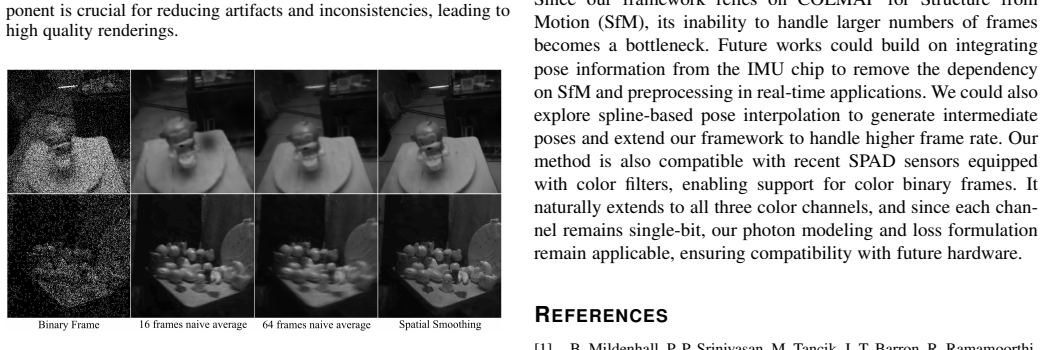
The central mechanism is the photon-aware Gaussian splat: each splat carries a nonnegative flux attribute that plays the role of $\lambda$ in the Poisson-to-Bernoulli model, the rasterizer $\alpha$-composites these fluxes into $C_{\mathrm{gray}}(x')$, and the binary cross-entropy loss against the measured frame, $1-e^{-C_{\mathrm{gray}}}$ versus $B_{\mathrm{target}}$, back-propagates into positions, opacities, and fluxes. Around it, the spatial smoothing loss, an $L_1$ distance between renders of a pose and perturbed nearby viewpoints, removes noise, and the colorization loss jointly estimates camera-motion deformations so a single blurred RGB reference can color the splats.
What would settle it
Render a calibrated static scene from SPAD captures while disabling the smoothness loss and compare the predicted $\hat{\lambda}$ against the empirical mean of thousands of averaged binary frames at the same viewpoint: a systematic mismatch would falsify the claim that $\alpha$-blended Gaussian sums equal expected photon counts. A second check would use a scene with known ground-truth depth and test whether the BCE-optimized geometry converges to the true surface rather than fitting photon noise.
Extended reading notes
Core claim
On its own terms, the paper's discovery is that raw binary SPAD frames carry enough information to drive 3D Gaussian-splat optimization. The scene is represented by splats whose per-point attribute is an expected photon count; $\alpha$-blending these counts yields a grayscale render that is mapped to a detection probability by $1-e^{-\lambda}$ and supervised with binary cross-entropy against the observed single-bit frames. A pose-perturbation smoothness term suppresses photon noise, and a second stage attaches color either from one motion-blurred RGB reference, modeling the blur as averaged spline deformations, or from a generative colorization prior. The authors report that this recovers geometry and appearance from multi-view SPAD captures in both static and dynamic scenes, and contributes a real-world multi-view SPAD dataset.
Load-bearing premise
The load-bearing premise is that the $\alpha$-blended sum of Gaussian photon attributes equals the expected photon count at a pixel, so photon statistics only enter through the final $1-e^{-\lambda}$ step; if that compositing is biased, the binary cross-entropy gradients will push the geometry in the wrong direction.
Editorial extensions
If this is right
- Fast, motion-blur-free 3D capture becomes possible: a SPAD array taking single-bit frames at about 100,000 frames per second can feed the pipeline directly, with no scene-specific choice of how many frames to average.
- The same photon-aware splat representation should support high-dynamic-range and low-light scenes, since the photon model naturally handles sparse detections and avoids saturation at high flux.
- A single motion-blurred RGB reference is enough to attach view-consistent color to the reconstructed geometry, opening the renders to segmentation, detection, and instruction-guided editing.
- Because the photon loss and colorization act at the representation level, the approach extends to dynamic scenes by swapping in a time-deformed Gaussian splatting backbone.
- Color-filtered SPAD hardware can be used directly by running the photon model per channel on single-bit color frames.
Reading between the lines
- A natural next experiment the paper does not run is to compare the predicted photon flux $\hat{\lambda}$ from the optimized splats against long-exposure averaged SPAD frames in a calibrated static scene; that would directly test whether linear Gaussian compositing is the right photon-count model.
- The same Bernoulli-supervision idea could transfer to other single-bit or quantized sensors, such as event cameras or quanta image sensors, where the measurement is also a thresholded photon count.
- The pose bottleneck may be the real limiter at extreme speed: if camera poses could be estimated directly from binary frames instead of from averaged SfM inputs, the system would be closer to real-time operation.
- The paper's view-consistency colorization uses one reference; multiple references or a learned prior over color could reduce ambiguity in textureless regions, though the paper does not test this.
Editorial analysis
A structured set of objections, weighed in public.
Referee Report
Summary. PhotonSplat extends 3D Gaussian Splatting to multi-view binary SPAD images. The key idea is to replace the RGB radiance attribute with a grayscale photon-flux attribute cgray and to supervise rendered binary predictions via a Bernoulli nonlinearity and binary cross-entropy loss (Sec. 3.1, Eqs. 6-7). A spatial smoothing regularizer perturbs camera translations and enforces L1 consistency (Eq. 8). Color is then baked into the splats either from a single motion-blurred reference image by jointly optimizing deformations (Eq. 9) or from a 2D generative prior with denoising. The authors contribute PhotonScenes, a real 9-scene SPAD dataset, and report experiments on simulated and real captures.
Significance. If the quantitative claims survive revision, this is a useful combination of a physics-based sensor model with a fast explicit scene representation, and the dataset is a tangible community contribution. The method is falsifiable: the forward model is explicit, and the code and data are promised. The main unresolved issue is the thinness of the comparative evaluation, not the internal logic of the loss.
major comments (4)
- [Sec. 4.3, Table 1] The central comparative claim is not yet established because QRF [6], the closest prior SPAD-based reconstruction method, is absent from the benchmark. The introduction and Sec. 2.3 explicitly motivate PhotonSplat by QRF's limitations (averaged frames, slow NeRF optimization), so a reader would expect QRF to be the primary baseline; instead Table 1 compares only NANeRF and Deblur-GS, both designed for ordinary RGB input. Their lower scores may reflect input modality mismatch rather than PhotonSplat's superiority. Please add QRF on the same simulated captures and on PhotonScenes, and specify its frame-averaging setting.
- [Sec. 4.3, Table 1] The quantitative results are single point estimates with no error bars, no number of seeds, and no statistical significance test. Since the margins are modest (e.g., PSNR 15.61 vs 14.50), the reported advantage cannot be assessed. Report mean and standard deviation over multiple simulation runs and random initializations, with the same evaluation protocol for all methods.
- [Secs. 4.2 and 4.3] Quantitative geometry evaluation is restricted to simulated captures that use the same Poisson-Bernoulli forward model as the training loss, while real-capture results (Fig. 4) are qualitative only. This creates a risk that the simulated gains are partly self-confirming. The situation is further confused by an internal inconsistency: Sec. 4.1 states that sharp ground-truth images were recorded, whereas Sec. 4.3 says 'We do not have access to ground truth RGB images.' Please either report quantitative metrics on PhotonScenes using the recorded ground truth, or explain why that is impossible and justify why the simulated numbers carry the central claim.
- [Sec. 3.1, Eqs. (6)-(7)] The paper identifies the alpha-blended Gaussian sum Cgray with the expected photon count λ before the Bernoulli nonlinearity, but this compositing rule is inherited from the 3DGS radiance model and is not derived from the Poisson model in Eqs. (4)-(5). Because all geometry gradients flow through the BCE loss, a biased compositing of λ would directly bias geometry. Please add a derivation or, at minimum, a synthetic test comparing Cgray against a volume-rendered photon-flux estimate with known ground-truth flux to show that the approximation does not bias geometry. If Eq. 6 is intended as a standard transmittance-weighted estimate, the manuscript should say so explicitly.
minor comments (6)
- [Sec. 4.3] The sentence 'Table. 1 qualitatively presents these results' should read 'quantitatively presents'.
- [Sec. 4.2] Reference [41] is cited for COLMAP, but the listed reference is 'Colmap-free 3D Gaussian Splatting,' which is a different method; please cite the actual COLMAP paper.
- [Eq. (8)] Equation (8) uses p both as the number of perturbed viewpoints and as a variable ranging over perturbed poses; please use distinct symbols.
- [Sec. 4.1] The pointer 'see Fig. 10' for the low-light SfM failure appears to reference the wrong figure; the failure case appears to be shown in Fig. 11.
- [Sec. 4.4] The no-reference colorization results are explicitly declared to have no quantitative metrics; this should be framed in the text as a qualitative demonstration rather than as 'outperforming' the baselines.
- [Sec. 4.6] The dynamic-scene results are qualitative only and do not include a quantitative metric or a dynamic baseline; the claim of 4D reconstruction should be phrased accordingly.
Circularity Check
No derivation-level circularity: the photon loss is the likelihood of the paper's stated Bernoulli model, optimized from multi-view consistency rather than from the predicted quantity itself.
full rationale
The paper's central derivation is coherent and non-circular. The SPAD binary formation is modeled as Bernoulli with p = 1 - exp(-lambda) (Eqs. 4-5), the Gaussian splat estimates the mean photon count lambda as an alpha-blended sum of grayscale attributes (Eq. 6), and the binary cross-entropy loss supervises 1 - exp(-Cgray) against the observed binary frames (Eq. 7). This is a maximum-likelihood construction: the binary frames are inputs, and Cgray is an unknown quantity optimized to explain them; the geometry is recovered jointly from multi-view consistency. The spatial smoothing loss (Eq. 8) is a regularizer that does not encode the target answer, and the colorization loss (Eq. 9) is supervised by a separately captured reference image or a pretrained 2D prior, so it is not fitted to the rendered output it is later used to judge. The only self-citation identified is reference [38] (GANESH, sharing authors V. Gupta and K. Mitra), but it appears in a related-work sentence about lensless imaging and carries no load in the derivation or evaluation. The simulated benchmark does generate binary frames using the same Poisson scaling and thresholding as the forward model, which makes the synthetic evaluation self-consistent by construction; however, this is an evaluation limitation rather than a circular derivation, and the paper also evaluates on real SPAD captures and against external baselines. No equation in the paper is defined in terms of its own output, and no fitted parameter is relabeled as an independent prediction.
Assumptions & free parameters
free parameters (5)
- sigma (spatial smoothing perturbation std) =
0.0005
- gamma (Lcolor weight) =
0.2
- m (number of deformation samples) =
4
- smooth_start (iteration when smoothness loss is enabled) =
15000
- p (number of nearby perturbed viewpoints) =
3
assumptions (6)
- domain assumption Poisson/Bernoulli photon observation model: binary SPAD pixel measurements follow P(b=0)=exp(-lambda) and P(b=1)=1-exp(-lambda), Eq. 4-5.
- ad hoc to paper The alpha-blended Gaussian sum in Eq. 6 represents the expected photon flux lambda at each pixel.
- ad hoc to paper Nearby viewpoints differ only by small translation noise, so rendered images of perturbed poses should match the original view (Eq. 8).
- domain assumption Structure-from-Motion on averaged binary frames provides reliable camera poses and a sparse point cloud (Sec 4.2).
- ad hoc to paper A single blurry RGB reference image plus learned per-splat deformations can supervise color (Sec 3.3, Eq. 9).
- domain assumption A linear color-to-grayscale transformation can couple the SH coefficients of the grayscale and color Gaussians (Sec 3.3).
Cite this review
Pith. "Pith review of PhotonSplat: 3D Scene Reconstruction and Colorization from SPAD Sensors." pith.science (2026). https://pith.science/paper/C6FGJW2J
@misc{pith2026250621680,
  author       = {Pith},
  title        = {Pith review of: PhotonSplat: 3D Scene Reconstruction and Colorization from SPAD Sensors},
  year         = {2026},
  howpublished = {\url{https://pith.science/paper/C6FGJW2J}},
  note         = {Machine review of arXiv:2506.21680}
}
read the original abstract
Advances in 3D reconstruction using neural rendering have enabled high-quality 3D capture. However, they often fail when the input imagery is corrupted by motion blur, due to fast motion of the camera or the objects in the scene. This work advances neural rendering techniques in such scenarios by using single-photon avalanche diode (SPAD) arrays, an emerging sensing technology capable of sensing images at extremely high speeds. However, the use of SPADs presents its own set of unique challenges in the form of binary images, that are driven by stochastic photon arrivals. To address this, we introduce PhotonSplat, a framework designed to reconstruct 3D scenes directly from SPAD binary images, effectively navigating the noise vs. blur trade-off. Our approach incorporates a novel 3D spatial filtering technique to reduce noise in the renderings. The framework also supports both no-reference using generative priors and reference-based colorization from a single blurry image, enabling downstream applications such as segmentation, object detection and appearance editing tasks. Additionally, we extend our method to incorporate dynamic scene representations, making it suitable for scenes with moving objects. We further contribute PhotonScenes, a real-world multi-view dataset captured with the SPAD sensors.
Figures


Figures from the paper (8 more)



Reference graph
Works this paper leans on
-
[6]
S. Jungerman and M. Gupta, “Radiance fields from photons,” arXiv preprint arXiv:2407.09386, 2024
-
[1]
Nerf: Representing scenes as neural radiance fields for view synthesis,
B. Mildenhall, P. P. Srinivasan, M. Tancik, J. T. Barron, R. Ramamoorthi, and R. Ng, “Nerf: Representing scenes as neural radiance fields for view synthesis,” Communications of the ACM , vol. 65, no. 1, pp. 99–106, 2021
2021
-
[2]
3d gaussian splatting for real-time radiance field rendering,
B. Kerbl, G. Kopanas, T. Leimk ¨uhler, and G. Drettakis, “3d gaussian splatting for real-time radiance field rendering,” ACM Transactions on Graphics , vol. 42, no. 4, July 2023. [Online]. Available: https://repo-sam.inria.fr/fungraph/3d-gaussian-splatting/
2023
-
[3]
A 512 × 512 spad image sensor with integrated gating for widefield flim,
A. C. Ulku, C. Bruschini, I. M. Antolovi ´c, Y . Kuo, R. Ankri, S. Weiss, X. Michalet, and E. Charbon, “A 512 × 512 spad image sensor with integrated gating for widefield flim,” IEEE Journal of Selected Topics in Quantum Electronics, vol. 25, no. 1, pp. 1–12, 2019
work page 2019
-
[4]
Single- photon camera guided extreme dynamic range imaging,
Y . Liu, F. Gutierrez-Barragan, A. Ingle, M. Gupta, and A. Velten, “Single- photon camera guided extreme dynamic range imaging,” in Proceedings of the IEEE/CVF Winter Conference on Applications of Computer Vision (WACV), January 2022, pp. 1575–1585
work page 2022
-
[5]
Single photon counting performance and noise analysis of cmos spad-based image sensors,
N. A. W. Dutton, I. Gyongy, L. Parmesan, and R. K. Henderson, “Single photon counting performance and noise analysis of cmos spad-based image sensors,” Sensors, vol. 16, no. 7, 2016. [Online]. Available: https://www.mdpi.com/1424-8220/16/7/1122
work page 2016
-
[7]
Ddcolor: Towards photo-realistic image colorization via dual decoders,
X. Kang, T. Yang, W. Ouyang, P. Ren, L. Li, and X. Xie, “Ddcolor: Towards photo-realistic image colorization via dual decoders,” in Pro- ceedings of the IEEE/CVF International Conference on Computer Vision, 2023, pp. 328–338
work page 2023
-
[8]
S. Ma, V . Sundar, P. Mos, C. Bruschini, E. Charbon, and M. Gupta, “Seeing photons in color,” ACM Transactions on Graphics (TOG) , vol. 42, no. 4, pp. 1–16, 2023
work page 2023
Show all 49 references
-
[9]
Megapixel photon-counting color imaging using quanta image sensor,
A. Gnanasambandam, O. Elgendy, J. Ma, and S. H. Chan, “Megapixel photon-counting color imaging using quanta image sensor,” Optics ex- press, vol. 27, no. 12, pp. 17 298–17 310, 2019
2019
-
[10]
Generative quanta color imaging,
V . Purohit, J. Luo, Y . Chi, Q. Guo, S. H. Chan, and Q. Qiu, “Generative quanta color imaging,” in Proceedings of the IEEE/CVF Conference on Computer Vision and Pattern Recognition, 2024, pp. 25 138–25 148
2024
-
[11]
First-photon imaging,
A. Kirmani, D. Venkatraman, D. Shin, A. Colac ¸o, F. N. C. Wong, J. H. Shapiro, and V . K. Goyal, “First-photon imaging,”Science, vol. 343, no. 6166, pp. 58–61, Jan. 2014
2014
-
[12]
Photon-efficient imaging with a single-photon camera,
D. Shin, F. Xu, D. Venkatraman, R. Lussana, F. Villa, F. Zappa, V . K. Goyal, F. N. C. Wong, and J. H. Shapiro, “Photon-efficient imaging with a single-photon camera,” Nat. Commun. , vol. 7, no. 1, p. 12046, Jun. 2016
2016
-
[13]
High flux passive imaging with single-photon sensors,
A. Ingle, A. Velten, and M. Gupta, “High flux passive imaging with single-photon sensors,” in Proceedings of the IEEE/CVF Conference on Computer Vision and Pattern Recognition, 2019, pp. 6760–6769
2019
-
[14]
Single- photon camera guided extreme dynamic range imaging,
Y . Liu, F. Gutierrez-Barragan, A. Ingle, M. Gupta, and A. Velten, “Single- photon camera guided extreme dynamic range imaging,” in Proceedings of the IEEE/CVF Winter Conference on Applications of Computer Vision, 2022, pp. 1575–1585. 10
2022
-
[15]
Photon-starved scene inference using single photon cameras,
B. Goyal and M. Gupta, “Photon-starved scene inference using single photon cameras,” in Proceedings of the IEEE/CVF International Confer- ence on Computer Vision, 2021, pp. 2512–2521
2021
-
[16]
Non-line- of-sight imaging using a time-gated single photon avalanche diode,
M. Buttafava, J. Zeman, A. Tosi, K. Eliceiri, and A. Velten, “Non-line- of-sight imaging using a time-gated single photon avalanche diode,” Opt. Express, vol. 23, no. 16, pp. 20 997–21 011, Aug 2015. [Online]. Available: https://opg.optica.org/oe/abstract.cfm?URI=oe-23-16-20997
2015
-
[17]
Confocal non-line- of-sight imaging based on the light-cone transform,
O’Toole, Matthew, Lindell, D. B, and G. Wetzstein, “Confocal non-line- of-sight imaging based on the light-cone transform,” Nature, vol. 555, no. 7696, pp. 338–341, Mar. 2018
2018
-
[18]
Low-cost spad sensing for non-line-of-sight tracking, material classification and depth imaging,
C. Callenberg, Z. Shi, F. Heide, and M. B. Hullin, “Low-cost spad sensing for non-line-of-sight tracking, material classification and depth imaging,” ACM Trans. Graph. (SIGGRAPH), vol. 40, no. 4, 2021
2021
-
[19]
Panoramas from photons,
S. Jungerman, A. Ingle, and M. Gupta, “Panoramas from photons,” arXiv preprint arXiv:2309.03811, 2023
2023 arXiv
-
[20]
Quanta burst photography,
S. Ma, S. Gupta, A. C. Ulku, C. Bruschini, E. Charbon, and M. Gupta, “Quanta burst photography,” ACM Transactions on Graphics (TOG) , vol. 39, no. 4, pp. 79–1, 2020
2020
-
[21]
Nerf: Representing scenes as neural radiance fields for view synthesis,
B. Mildenhall, P. P. Srinivasan, M. Tancik, J. T. Barron, R. Ramamoorthi, and R. Ng, “Nerf: Representing scenes as neural radiance fields for view synthesis,” in ECCV, 2020
2020
-
[22]
Deblur-nerf: Neural radiance fields from blurry images,
L. Ma, X. Li, J. Liao, Q. Zhang, X. Wang, J. Wang, and P. V . Sander, “Deblur-nerf: Neural radiance fields from blurry images,” 2022
2022
-
[23]
Bad-nerf: Bundle adjusted deblur neural radiance fields,
P. Wang, L. Zhao, R. Ma, and P. Liu, “Bad-nerf: Bundle adjusted deblur neural radiance fields,” 2023
2023
-
[24]
Pdrf: progressively deblurring radiance field for fast scene reconstruction from blurry images,
C. Peng and R. Chellappa, “Pdrf: progressively deblurring radiance field for fast scene reconstruction from blurry images,” in Proceedings of the AAAI Conference on Artificial Intelligence , vol. 37, no. 2, 2023, pp. 2029–2037
2023
-
[25]
Aleth- nerf: Illumination adaptive nerf with concealing field assumption,
Z. Cui, L. Gu, X. Sun, X. Ma, Y . Qiao, and T. Harada, “Aleth- nerf: Illumination adaptive nerf with concealing field assumption,” in Proceedings of the AAAI Conference on Artificial Intelligence , vol. 38, no. 2, 2024, pp. 1435–1444
2024
-
[26]
Lighting up nerf via unsuper- vised decomposition and enhancement,
H. Wang, X. Xu, K. Xu, and R. W. Lau, “Lighting up nerf via unsuper- vised decomposition and enhancement,” inProceedings of the IEEE/CVF International Conference on Computer Vision, 2023, pp. 12 632–12 641
2023
-
[27]
4d gaussian splatting for real-time dynamic scene rendering,
G. Wu, T. Yi, J. Fang, L. Xie, X. Zhang, W. Wei, W. Liu, Q. Tian, and X. Wang, “4d gaussian splatting for real-time dynamic scene rendering,” in Proceedings of the IEEE/CVF Conference on Computer Vision and Pattern Recognition, 2024, pp. 20 310–20 320
2024
-
[28]
4d-rotor gaussian splatting: towards efficient novel view synthesis for dynamic scenes,
Y . Duan, F. Wei, Q. Dai, Y . He, W. Chen, and B. Chen, “4d-rotor gaussian splatting: towards efficient novel view synthesis for dynamic scenes,” in ACM SIGGRAPH 2024 Conference Papers, 2024, pp. 1–11
2024
-
[29]
Sugar: Surface-aligned gaussian splatting for efficient 3d mesh reconstruction and high-quality mesh rendering,
A. Gu ´edon and V . Lepetit, “Sugar: Surface-aligned gaussian splatting for efficient 3d mesh reconstruction and high-quality mesh rendering,” in Proceedings of the IEEE/CVF Conference on Computer Vision and Pattern Recognition, 2024, pp. 5354–5363
2024
-
[30]
2d gaussian splatting for geometrically accurate radiance fields,
B. Huang, Z. Yu, A. Chen, A. Geiger, and S. Gao, “2d gaussian splatting for geometrically accurate radiance fields,” in ACM SIGGRAPH 2024 Conference Papers, 2024, pp. 1–11
2024
-
[31]
Deblur-gs: 3d gaussian splatting from camera motion blurred images,
W. Chen and L. Liu, “Deblur-gs: 3d gaussian splatting from camera motion blurred images,” Proceedings of the ACM on Computer Graphics and Interactive Techniques, vol. 7, no. 1, pp. 1–15, 2024
2024
-
[32]
Deblurring 3d gaussian splatting,
B. Lee, H. Lee, X. Sun, U. Ali, and E. Park, “Deblurring 3d gaussian splatting,” arXiv preprint arXiv:2401.00834, 2024
2024 arXiv
-
[33]
Thermal-nerf: Neural radiance fields from an infrared camera,
T. Ye, Q. Wu, J. Deng, G. Liu, L. Liu, S. Xia, L. Pang, W. Yu, and L. Pei, “Thermal-nerf: Neural radiance fields from an infrared camera,” arXiv preprint arXiv:2403.10340, 2024
2024 arXiv
-
[34]
Thermalnerf: Thermal radiance fields,
Y . Y . Lin, X.-Y . Pan, S. Fridovich-Keil, and G. Wetzstein, “Thermalnerf: Thermal radiance fields,” in 2024 IEEE International Conference on Computational Photography (ICCP). IEEE, 2024, pp. 1–12
2024
-
[35]
Thermalgaussian: Thermal 3d gaussian splatting,
R. Lu, H. Chen, Z. Zhu, Y . Qin, M. Lu, L. Zhang, C. Yan, and A. Xue, “Thermalgaussian: Thermal 3d gaussian splatting,” arXiv preprint arXiv:2409.07200, 2024
2024 arXiv
-
[36]
Event3dgs: Event-based 3d gaussian splatting for high-speed robot egomotion,
T. Xiong, J. Wu, B. He, C. Fermuller, Y . Aloimonos, H. Huang, and C. Metzler, “Event3dgs: Event-based 3d gaussian splatting for high-speed robot egomotion,” in 8th Annual Conference on Robot Learning, 2024
2024
-
[37]
E2gs: Event enhanced gaussian splatting,
H. Deguchi, M. Masuda, T. Nakabayashi, and H. Saito, “E2gs: Event enhanced gaussian splatting,” in 2024 IEEE International Conference on Image Processing (ICIP). IEEE, 2024, pp. 1676–1682
2024
-
[38]
Ganesh: Generalizable nerf for lensless imaging,
R. R. Madavan, A. Kaimal, B. KV , V . Gupta, R. Choudhary, C. Shan- muganathan, and K. Mitra, “Ganesh: Generalizable nerf for lensless imaging,” arXiv preprint arXiv:2411.04810, 2024
2024 arXiv
-
[39]
High-resolution image synthesis and semantic manipulation with condi- tional gans,
T.-C. Wang, M.-Y . Liu, J.-Y . Zhu, A. Tao, J. Kautz, and B. Catanzaro, “High-resolution image synthesis and semantic manipulation with condi- tional gans,” in Proceedings of the IEEE conference on computer vision and pattern recognition, 2018, pp. 8798–8807
2018
-
[40]
Spad camera,
SPAD Camera, “Spad camera,” https://piimaging.com/product-spad512s, 2021
2021
-
[41]
Colmap- free 3d gaussian splatting,
Y . Fu, S. Liu, A. Kulkarni, J. Kautz, A. A. Efros, and X. Wang, “Colmap- free 3d gaussian splatting,” arXiv preprint arXiv:2312.07504, 2023
2023 arXiv
-
[42]
Global Structure-from-Motion Revisited,
L. Pan, D. Barath, M. Pollefeys, and J. L. Sch ¨onberger, “Global Structure-from-Motion Revisited,” inEuropean Conference on Computer Vision (ECCV), 2024
2024
-
[43]
Nan: Noise-aware nerfs for burst- denoising,
N. Pearl, T. Treibitz, and S. Korman, “Nan: Noise-aware nerfs for burst- denoising,” in Proceedings of the IEEE/CVF Conference on Computer Vision and Pattern Recognition, 2022, pp. 12 672–12 681
2022
-
[44]
Colormnet: A memory-based deep spatial-temporal feature propagation network for video colorization,
Y . Yang, J. Dong, J. Tang, and J. Pan, “Colormnet: A memory-based deep spatial-temporal feature propagation network for video colorization,” in European Conference on Computer Vision. Springer, 2025, pp. 336–352
2025
-
[45]
Raft: Recurrent all-pairs field transforms for optical flow,
Z. Teed and J. Deng, “Raft: Recurrent all-pairs field transforms for optical flow,” in Computer Vision–ECCV 2020: 16th European Conference, Glasgow, UK, August 23–28, 2020, Proceedings, Part II 16 . Springer, 2020, pp. 402–419
2020
-
[46]
The unreasonable effectiveness of deep features as a perceptual metric,
R. Zhang, P. Isola, A. A. Efros, E. Shechtman, and O. Wang, “The unreasonable effectiveness of deep features as a perceptual metric,” in CVPR, 2018
2018
-
[47]
Deoldify: A review and implemen- tation of an automatic colorization method,
A. Salmona, L. Bouza, and J. Delon, “Deoldify: A review and implemen- tation of an automatic colorization method,” Image Processing On Line, vol. 12, pp. 347–368, 2022
2022
-
[48]
Instructpix2pix: Learning to follow image editing instructions,
T. Brooks, A. Holynski, and A. A. Efros, “Instructpix2pix: Learning to follow image editing instructions,” in Proceedings of the IEEE/CVF Conference on Computer Vision and Pattern Recognition , 2023, pp. 18 392–18 402
2023
-
[49]
Hypernerf: A higher-dimensional representation for topologically varying neural radiance fields,
K. Park, U. Sinha, P. Hedman, J. T. Barron, S. Bouaziz, D. B. Goldman, R. Martin-Brualla, and S. M. Seitz, “Hypernerf: A higher-dimensional representation for topologically varying neural radiance fields,” ACM Trans. Graph., 2021. Sai Sri Teja Kuppa is a Master’s student in El...
2009
Reviewed August 6, 2026 · model on record in the stance chip above.
Discussion (0). Sign in to comment.