REVIEW 4 major objections 5 minor 28 references
Pseudo-Complex Gravity as a Geometric Resolution of the Black Hole Information Paradox
T0 review · 4 major / 5 minor · reviewed 2026-08-06 · deepseek-v4-flash
Pith's one-line read Pseudo-complex gravity is claimed to resolve the black hole information paradox by replacing the Schwarzschild singularity with a regular core and blocking the usual interior/exterior split.
desk verdict The paper's central singularity-regularization claim fails a direct computation of the Kretschmann scalar; the rest of the quantitative results are internally inconsistent. read the letter →
The pith
A machine-rendered reading of the paper's core claim, the machinery that carries it, and where it could break.
The reading
What carries the argument
The load-bearing object is the pseudo-complex algebra, with coordinates $X^\mu = x^\mu + I y^\mu$ and $I^2 = +1$, plus the maximal-acceleration constraint on the pseudo-imaginary velocity that introduces a minimal length $\ell$. Through earlier pseudo-complex gravity work, this structure yields the modified Schwarzschild metric with the correction term $B/(6r^4)$, and that metric does the thermodynamic work: shifting the horizon, lowering the surface gravity, and generating the entropy and temperature corrections. The Hilbert-space argument is carried by the idempotent decomposition $e_\pm$, which replaces the clean interior/exterior tensor product with a direct-sum structure carrying geometric correlations between the two sectors.
What would settle it
Compute the Kretschmann scalar of the full metric in Eq. (7) without dropping the $B^2$ term; direct evaluation gives a term $13B^2/r^{12}$, which diverges as $r \to 0$, so a single calculation settles whether the claimed regularization is complete. The paper's Eq. (9) keeps only terms linear in $B$, and evaluating the full invariant is the shortest check of the central claim.
Extended reading notes
Core claim
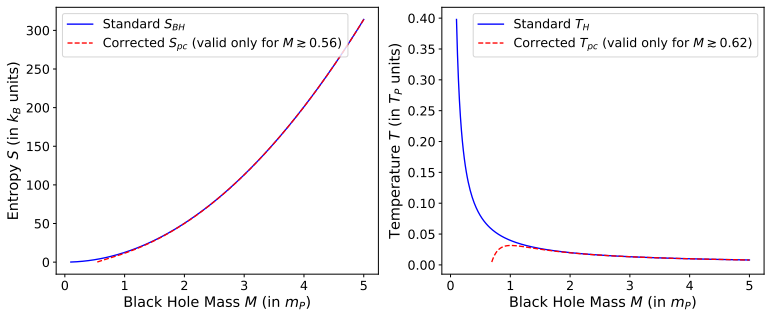
The paper claims that replacing the Schwarzschild metric with the line element $ds^2 = (1 - 2GM/(c^2 r) + B/(6r^4))\,c^2dt^2 - (1 - 2GM/(c^2 r) + B/(6r^4))^{-1}dr^2 - r^2 d\Omega^2$, where $B \propto \ell^4$ encodes the pseudo-complex minimal length, regularizes the central singularity: the Kretschmann scalar is softened from $48G^2M^2/(c^4 r^6)$ by a correction involving $B/r^4$. According to the paper, this geometry shifts the event horizon inward, lowers the surface gravity and Hawking temperature, and produces a subleading negative entropy correction that scales as $1/M^4$, suppressing the microstate count at small masses. The paper further argues that the pseudo-complex algebraic structure, with its idempotent sectors $e_\pm = (1\pm I)/2$, induces a Hilbert space of the form $\mathcal{H}_+ \oplus \mathcal{H}_-$ with nonzero geometric correlations, so the tensor-product factorization $\mathcal{H}_{\rm int} \otimes \mathcal{H}_{\rm ext}$ underlying the standard paradox is unavailable. The intended consequence is a unitary, covariant resolution of the information paradox with observable signatures in black hole shadows, ringdown frequencies, and late-time echoes.
Load-bearing premise
The whole argument stands on the premise that Eq. (7) is the pseudo-complex corrected Schwarzschild metric and that its curvature is finite at $r=0$; if that metric is not the actual pc-gravity solution, or if its curvature still diverges, the temperature and entropy corrections and the Hilbert-space argument built on them do not follow.
Editorial extensions
If this is right
- If Eq. (7) is the correct pseudo-complex geometry, the Schwarzschild singularity is replaced by a smooth core and geodesics can pass through $r=0$ instead of terminating there.
- The corrected Hawking temperature is lower than the semiclassical value for a given mass, so evaporation slows near the Planck scale and may end in a remnant rather than a naked singularity.
- The subleading negative $1/M^4$ entropy correction suppresses the microstate count at small masses, pointing toward a finite state count that is compatible with unitarity.
- The non-factorizable Hilbert space removes the assumption of exactly thermal Hawking radiation, opening a geometric route to information recovery without firewalls or holography.
- Quasi-normal mode frequency shifts scale as $(\ell^2/r_s^2)^2$ and late-time echoes from the regularized core could be searched for in gravitational-wave data.
Reading between the lines
- The paper posits Eq. (7) rather than deriving it from the pseudo-complex field equations, so a direct next test is to derive the corrected metric from the formalism; if it is not a solution, the $B/(6r^4)$ term is best treated as a phenomenological ansatz to be compared against other regular black hole metrics.
- The non-factorizable Hilbert-space claim is made at the algebraic level, but the paper's own quantization sketch doubles the field content, which gives a concrete route to compute corrections to the radiation spectrum and test the claimed deviation from thermality.
- The same $B/(6r^4)$ deformation could be applied to the Kerr and Reissner-Nordström metrics; whether the regularization survives there is not treated in the paper but is implied by the mechanism, and the question is directly checkable.
- The paper's Eq. (9) expands the Kretschmann scalar only to first order in $B$; evaluating the full invariant of the metric in Eq. (7) would be a direct check of whether the core is completely regular or merely less singular than in general relativity.
Editorial analysis
A structured set of objections, weighed in public.
Referee Report
Summary. The paper claims that pseudo-complex (pc) gravity, through a correction term B/(6r^4) added to the Schwarzschild metric (Eq. (7)), regularizes the central singularity, yielding a finite or softened Kretschmann scalar (Eq. (9)), a shifted horizon (Eq. (11)), corrected Hawking temperature and Bekenstein–Hawking entropy (Eqs. (15) and (17)), and a non-factorizable Hilbert space (Eq. (20)) that resolves the black hole information paradox. It further presents quasi-normal mode frequency shifts and gravitational-wave echoes as potential observable signatures. The analysis is built on a metric that is posited rather than derived from the pc-algebra, and the paper itself concedes that a full quantum formulation and a dynamical evaporation model are lacking (Sections 4 and 8).
Significance. If the central claims were correct, the paper would constitute a significant contribution: it would connect a covariant minimal-length framework to concrete thermodynamic and observational predictions, including testable QNM scalings and echo signatures. The paper also deserves credit for explicitly stating its limitations—no complete quantum formulation, no dynamical Page-curve calculation—and for making quantitative predictions that can be compared across frameworks. However, the central singularity-regularization claim is contradicted by the paper's own metric, and the quantitative predictions are mutually inconsistent. As it stands, the paper does not establish its principal thesis.
major comments (4)
- [§2, Eq. (7) and Eq. (9)] The central regularization claim fails under direct computation. From the metric in Eq. (7) with f(r)=1−2GM/(c^2 r)+B/(6r^4), the Kretschmann scalar is K = f''^2 + 4f'^2/r^2 + 4(1−f)^2/r^4 = 48G^2M^2/(c^4 r^6) − 40GM B/(c^2 r^9) + 13B^2/r^12. As r→0, K ~ 13B^2/r^12 for any nonzero B, which is more singular than the Schwarzschild result 48G^2M^2/(c^4 r^6), not less. Equation (9) is asserted without derivation and directly contradicts Eq. (7). Moreover, Eq. (7) is posited, not derived from the pseudo-complex algebra or the constraint (6), so the theory provides no independent support for the claimed regularization. Since singularity regularization is the foundation for the temperature, entropy, and unitarity claims, this error invalidates the paper's central thesis.
- [§3, Eq. (11) and Appendix B.1, Eq. (B4)] The horizon shift is computed incorrectly. Solving g_tt(r_+)=0 with g_tt = 1 − 2GM/(c^2 r) + B/(6r^4) gives, in natural units, r_+ ≈ 2M − B/(48M^3); the paper reports r_+ ≈ 2M − B/(24M^3), which is off by a factor of 2. The same error propagates into the corrected area (12), temperature (15), and entropy (17) through the surface-gravity expansion in Appendix B.
- [§7, Eqs. (22), (27), (28)] The QNM predictions are mutually inconsistent. Equation (22) gives δω/ω ∼ −B c^4/(6 G^2 M^6), Eq. (27) gives δω/ω ∼ −4B c^4/(27 G^2 M^2), and Eq. (28) evaluates to −(4/27)(ℓ^2/r_s^2)^2 = −B/(108 M^4) in natural units. These three expressions have different mass scalings (M^{-6}, M^{-2}, and M^{-4}), and Eqs. (22) and (27) are not dimensionless under the stated natural units unless B is assigned an unusual interpretation. Since these equations underlie the observational claims in Section 6.6 and Figure 4, the quantitative phenomenology of the paper is not reliable.
- [§4 (Hilbert Space Structure) and §8] The claimed obstruction to factorization of the Hilbert space is not derived. The paper states that the idempotent decomposition e_± implies H_pc = H_+ ⊕ H_−, and then asserts 'nontrivial correlations' and 'braided subspaces,' but a direct sum is already a factorized sector structure and does not by itself imply non-factorizability or geometric entanglement. Since the paper concedes in Sections 4 and 8 that a full quantum formulation and a dynamical evaporation model are missing, the purported resolution of the information paradox rests on an unproven assertion rather than a calculation.
minor comments (5)
- [Title page] The author list contains obvious typos ('Pter O. Hess', 'CeserA.ZenV asconcellos') that should be corrected.
- [§5 (Table 1)] The text refers to 'Table 2' for the comparison but the caption reads 'Table 1'; the table numbering is inconsistent.
- [§8 (Conclusion)] The conclusion states that entropy corrections 'scale as 1/M^2', but Eq. (17) gives a 1/M^4 correction; this inconsistency should be fixed.
- [Appendix A, Eq. (A7)] The identity in Eq. (A7) is stated without proof or reference; a derivation would aid the reader.
- [§6.6] The claim that third-generation detectors could constrain ℓ as small as 10^{-20} m appears inconsistent with the δω/ω ~ 10^{-76} estimate for stellar-mass black holes in Eq. (28); this numerical statement should be reconciled with the quoted scaling.
Circularity Check
All quantitative predictions are Taylor expansions of the B/(6r^4) term imported from the authors' prior work, and the claimed singularity softening in Eq. (9) is asserted rather than derived from Eq. (7).
-
ansatz smuggled in via citation
[Sec. 2, 'Curvature Regularization: An Explicit Example', Eq. (7) and following text]
"where B ∝ ℓ4, consistent with the dimensional scaling of the correction term. This form of the correction term B/(6r4) is motivated by previous applications of pseudo-complex gravity to regular black hole metrics and is compatible with post-Newtonian constraints at solar system scales [6]."
The B/(6r4) term is not derived in this paper from the pseudo-complex algebra or from constraint (6); it is imported from the authors' earlier work [6]. Every quantitative result that follows — Eq. (9) for the Kretschmann scalar, Eq. (11) for r+, Eqs. (12), (15)-(17) for area, temperature, and entropy, and Eqs. (22)/(27) for QNM shifts — is an expansion in this same assumed B. These 'predictions' therefore restate the input ansatz instead of independently confirming pc-gravity; the regularization is built in by hand rather than shown to follow from the theory.
-
self definitional
[Sec. 2, Eq. (9) and the paragraph after it]
"In the pseudo-complex corrected case, this becomes Kpc = 48G2M2/(c4r6) (1 − αB/r4 + O(B2)). As shown in Eq. (9), the divergence in the Kretschmann scalar is softened by the pseudo-complex correction. As r → 0, the B/r4 term dominates (with B ∼ ℓ4) and suppresses the divergence."
No derivation of Eq. (9) from Eq. (7) is given, and a direct computation from Eq. (7) gives K = 48M2/r6 − 40MB/r9 + 13B2/r12, which diverges as 13B2/r12 at r=0. The claimed softening is therefore not a consequence of the stated metric; it is the regularizing behavior that the B/(6r4) ansatz was chosen to produce, then reported as a result. The singularity-resolution premise is used to establish the singularity-resolution conclusion.
full rationale
The paper's quantitative chain is not self-contained: Eq. (7) is introduced as a 'modified Schwarzschild-like metric' with a B/(6r4) term whose form is attributed to previous pc-gravity work by the same group [6], not derived here from the pseudo-complex algebra or the maximal-acceleration constraint (6). All subsequent results — Kretschmann behavior, horizon shift, area, Hawking temperature, entropy, QNM shifts — are expansions in this same assumed B, so they restate the ansatz rather than independently test pc-gravity. The most load-bearing link, Eq. (9), is asserted without computation; direct evaluation of Eq. (7) gives K ~ 13B2/r12, so the claimed softening is not even a consequence of the stated metric. That is both a circularity in the derivation-as-presented (the regularizing effect motivates the correction term) and a separate correctness failure. The first-law/area consistency check is legitimate arithmetic, but it only re-expresses the same B-dependence. The Hilbert-space non-factorizability claim is not circular — the paper explicitly concedes that a full quantum formulation is not yet established — but it is unsupported speculation. Overall, because the central predictions reduce to the imported B-ansatz, the circularity score is 6.
Assumptions & free parameters
free parameters (1)
- B (or minimal length ℓ) =
B = ℓ^4; ℓ treated as free in QNM scan (Fig. 4)
assumptions (2)
- ad hoc to paper The pseudo-complex corrected Schwarzschild metric takes the form Eq. (7) with a positive B/(6r^4) term.
- ad hoc to paper The Hilbert space of quantum gravity fails to factorize as H_int ⊗ H_ext because of the idempotent decomposition H_+ ⊕ H_-.
invented entities (1)
-
Regularized smooth core for Schwarzschild black holes
Cite this review
Pith. "Pith review of Pseudo-Complex Gravity as a Geometric Resolution of the Black Hole Information Paradox." pith.science (2026). https://pith.science/paper/SDCWXNTX
@misc{pith2026250621761,
  author       = {Pith},
  title        = {Pith review of: Pseudo-Complex Gravity as a Geometric Resolution of the Black Hole Information Paradox},
  year         = {2026},
  howpublished = {\url{https://pith.science/paper/SDCWXNTX}},
  note         = {Machine review of arXiv:2506.21761}
}
read the original abstract
We investigate the black hole information paradox in the setting of pseudo-complex gravity, a covariant geometric extension of general relativity that introduces a minimal length scale by deforming the spacetime manifold. In this framework, curvature invariants stay finite, and the classical singularity is geometrically regularized via a smooth core. We show that the correction term B/(6r**4) alters the Schwarzschild metric, generating the regularized geometry above, yielding a finite Hawking temperature, and inducing subleading corrections to the Bekenstein-Hawking entropy. Crucially, we demonstrate that the pseudo-complex geometric structure obstructs a clean factorization of the Hilbert space into interior and exterior regions, thereby removing the key assumption behind the standard derivation of the paradox. This structural reinterpretation of entanglement flow offers a new geometric route to unitarity preservation and information recovery. We examine the resulting effects on evaporation dynamics, entropy flow, and thermodynamic behavior. Our predictions are compared with those of generalized uncertainty principles (GUP), loop quantum gravity (LQG), and island-based models, and are summarized in a comparative table. Observable signatures-such as shifts in quasi-normal mode frequencies and the appearance of gravitational wave echoes from the regularized core-suggest that pseudo-complex gravity is a testable, covariant approach to resolving the paradox without invoking firewalls, holography, or exotic quantum states.
Figures


Figures from the paper (2 more)


Reference graph
Works this paper leans on
-
[1]
Hawking S W 1975 Communications in Mathematical Physics 43 199–220
work page 1975
-
[2]
Mathur S D 2005 Fortschritte der Physik 53 793–827 ( Preprint hep-th/0502050)
arXiv 2005
-
[3]
Penington G 2020 Journal of High Energy Physics 2020 2
work page 2020
-
[4]
Almheiri A, Engelhardt N, Marolf D and Maxfield H 2019 Journal of High Energy Physics 2019 63 (Preprint 1905.08762)
arXiv 2019
-
[5]
Hess P O and Greiner W 2009 Int. J. Mod. Phys. E 18 51
work page 2009
-
[6]
Hess P O, Sch¨ afer M and Greiner W 2016Pseudo-Complex Gen- eral Relativity FIAS Interdisciplinary Science Series (Springer) ISBN 978-3-319-25060-1
-
[7]
Hess P 2020 Progress in Particle and Nu- clear Physics 114 103809 ISSN 0146-6410 URL https://www.sciencedirect.com/science/article/pii/S0146641020300569 34
work page 2020
-
[8]
Hayward S A 2006 Phys. Rev. Lett. 96 031103 ( Preprint gr-qc/0506126)
arXiv 2006
Show all 28 references
-
[9]
Barcel´ o C, Liberati S and Visser M 2009Scientific American 301 38–45
-
[10]
Frolov V P 2014 JHEP 2014 049 (Preprint 1402.5446)
2014 arXiv
-
[11]
Ashtekar A and Bojowald M 2005 Class. Quant. Grav. 22 3349– 3362 (Preprint gr-qc/0504029)
2005 arXiv
-
[12]
Giddings S B 1992 Phys. Rev. D 46(4) 1347–1352 URL https://link.aps.org/doi/10.1103/PhysRevD.46.1347
1992 doi
-
[13]
Harlow D 2017 Commun. Math. Phys. 354 865–912 ( Preprint 1607.03901)
2017 arXiv
-
[14]
Almheiri A, Marolf D, Polchinski J and Sully J 2013 Journal of High Energy Physics 2013 62 (Preprint 1207.3123)
2013 arXiv
-
[15]
GARAY L J 1995 International Journal of Modern Physics A 10 145–165 URL https://doi.org/10.1142/S0217751X95000085
1995 doi
-
[16]
Kempf A, Mangano G and Mann R B 1995 Physical Review D 52 1108–1118 (Preprint hep-th/9412167)
1995 arXiv
-
[17]
Ashtekar A, Baez J, Corichi A and Krasnov K 1998 Phys. Rev. Lett. 80 904–907 (Preprint gr-qc/9710007)
1998 arXiv
-
[18]
Nicolini P, Smailagic A and Spallucci E 2006 Physics Letters B 632 547–551 (Preprint gr-qc/0510112)
2006 arXiv
-
[19]
Rovelli C and Vidotto F 2014 Covariant Loop Quantum Gravity: An Elementary Introduction to Quantum Gravity and Spinfoam Theory (Cambridge University Press) ISBN 9781107069626
2014
-
[20]
Amelino-Camelia G 2001 Physics Let- ters B 510 255–263 ISSN 0370-2693 URL https://www.sciencedirect.com/science/article/pii/S0370269301005068
2001
-
[21]
Medved A J M and Vagenas E C 2004 Phys. Rev. D 70 124021 (Preprint hep-th/0411022)
2004 arXiv
-
[22]
Scardigli F 1999 Phys. Lett. B 452 39–44 ( Preprint hep-th/9904025)
1999 arXiv
-
[23]
Barrau A and Rovelli C 2014 Phys. Lett. B 739 405–409 (Preprint 1404.5821)
2014 arXiv
-
[24]
Abedi J, Dykaar H and Afshordi N 2017 Phys. Rev. D 96 082004 (Preprint 1612.00266) 35
2017 arXiv
-
[25]
Conklin R S, Holdom B and Ren J 2018 Phys. Rev. D 98 044021 (Preprint 1712.06517)
2018 arXiv
-
[26]
Raju S 2021 Lessons from the information paradox ( Preprint 2012.05770) URL https://arxiv.org/abs/2012.05770
2021 arXiv
-
[27]
Cardoso V, Franzin E and Pani P 2016 Phys. Rev. Lett. 116 171101 (Preprint 1602.07309)
2016 arXiv
-
[28]
Schutz B F and Will C M 1985 The Astrophysical Journal Letters 291 L33–L36 36
1985
Reviewed August 6, 2026 · model on record in the stance chip above.
Discussion (0). Sign in to comment.