REVIEW 4 major objections 6 minor 46 references
ProSAM: Enhancing the Robustness of SAM-based Visual Reference Segmentation with Probabilistic Prompts
T0 review · 4 major / 6 minor · reviewed 2026-08-06 · deepseek-v4-flash
Pith's one-line read ProSAM learns a distribution over SAM prompt embeddings and uses its mean to make visual reference segmentation more stable and accurate.
desk verdict A simple, plausible robustness trick for SAM prompt generation; the empirical gains are consistent, but the theory is overclaimed and the learned variance could collapse—still worth peer review. read the letter →
The pith
A machine-rendered reading of the paper's core claim, the machinery that carries it, and where it could break.
The reading
What carries the argument
The load-bearing machinery is the variational prompt encoder $q_\phi(z|I_r, M_r, I_t)$, which turns a visual reference and a target image into a multivariate Student-t distribution over prompt embeddings, parameterized by a mean $\hat{\mu}_z$ and a diagonal scale $\hat{\sigma}_z^2$ and sampled through the reparameterization trick. The load-bearing identity is Proposition 1: if the mask loss $L$ is twice continuously differentiable and the prompt noise $\epsilon$ has mean zero and covariance $\sigma^2 I$, then $\mathbb{E}_\epsilon[L(z+\epsilon)] = L(z) + \frac{\sigma^2}{2}\Delta L(z) + O(\sigma^3)$. This identity converts the intractable expected-loss objective into the standard mask loss plus an implicit penalty on the Laplacian (trace of the Hessian) of the loss, which is what pushes the mean prompt into flatter, more central regions of the target prompt region. Choosing a Student-t instead of a Gaussian additionally enlarges the fourth-order curvature penalty, giving an extra push toward flat regions.
What would settle it
A concrete check: compute the average trace of the Hessian of SAM's mask loss at the prompt embeddings produced by ProSAM and by the deterministic baseline on the same images; if ProSAM's prompts do not show lower curvature, the flatness mechanism is not what drives the reported gains. An even simpler check is to inject the same Gaussian noise into the deterministic baseline's prompts during training and see whether its mIoU rises by ProSAM's margin; if it does, no distributional prompt encoder is needed.
Extended reading notes
Core claim
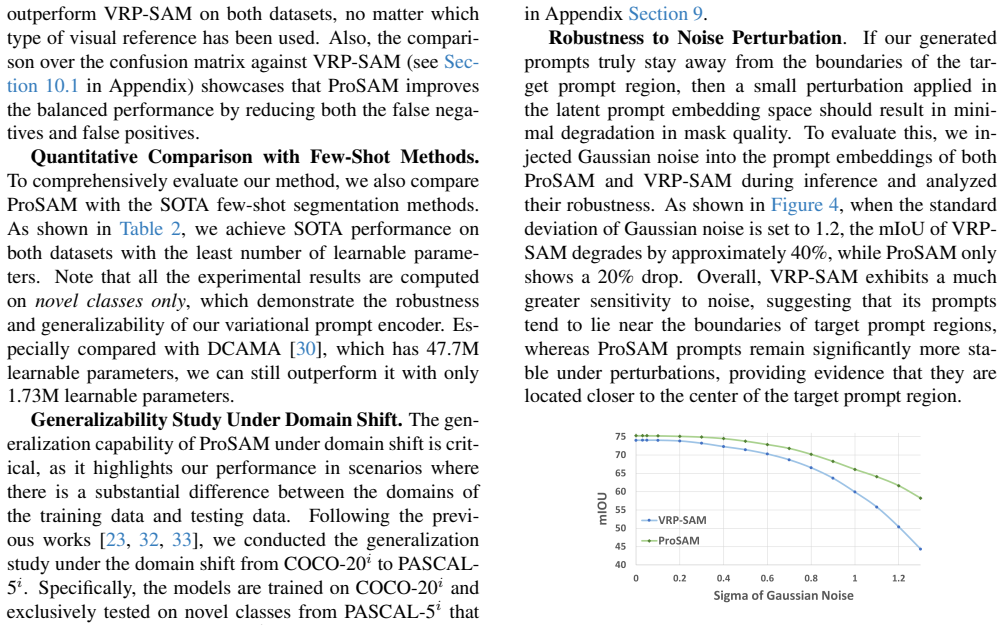
The central discovery claim is that prompt robustness, not prompt accuracy alone, is the bottleneck for SAM-based visual reference segmentation. There is a target prompt region whose prompts all produce acceptable masks, but existing trained prompt encoders tend to produce prompts near its boundary, where small perturbations cause large mask changes. ProSAM's variational prompt encoder models the full prompt distribution as a multivariate Student-t with diagonal covariance and reparameterized sampling. Because noise injection during training is mathematically equivalent to penalizing the Laplacian of the segmentation loss (Proposition 1), optimization favors flat regions of the loss landscape, which are claimed to be closer to the center of the target prompt region. The authors demonstrate that ProSAM's mean prompt is less sensitive to injected Gaussian noise, is more cosine-similar to center-point prompt embeddings, and achieves consistently higher mIoU than the deterministic baseline on Pascal-5^i and COCO-20^i across point, scribble, box, and mask references.
Load-bearing premise
The load-bearing premise is that SAM's mask-generation loss is smooth enough, and the training noise small enough, for the second-order expansion in Proposition 1 to describe what training actually does, and that flat regions of the loss landscape sit at the center of the usable prompt region; if either condition is false, noise injection would simply add training noise without delivering better prompts.
Editorial extensions
If this is right
- Mean-prompt inference costs the same as deterministic prompt inference, so the robustness gain comes without extra computation or memory at test time.
- The mIoU gains hold across point, scribble, box, and mask reference annotations on both Pascal-5^i and COCO-20^i, so the mechanism is not specific to one prompt format.
- Under COCO-to-PASCAL domain shift, the method reaches 77.65 mean mIoU against 76.44 for the deterministic baseline, supporting stronger zero-shot generalization to unseen classes.
- Swapping ResNet-50 for DINOv2 improves both methods while ProSAM keeps its advantage, indicating the robustness mechanism is compatible with stronger feature extractors.
- With only 1.73M learnable parameters, ProSAM outperforms few-shot segmentation methods that train tens of millions of parameters on the same benchmarks.
Reading between the lines
- Editorial extension: the same noise-injection-as-Laplacian-penalty argument should transfer to other prompt types (points, boxes, text) and to other frozen prompt-based segmenters, because Proposition 1 only assumes a smooth loss over embeddings.
- Editorial extension: the paper reports cosine similarity to center-point prompts as a proxy, but a direct measure of flatness — the trace of the Hessian of the mask loss at learned prompts — would test the claimed mechanism more directly.
- Editorial extension: because a Student-t's advantage appears first in the fourth-order term, heavier-tailed noise or a noise schedule with larger variance early in training could push mean prompts even deeper into flat regions; the paper does not explore this.
Signed reviews
Editorial analysis
A structured set of objections, weighed in public.
Referee Report
Summary. The paper proposes ProSAM, a modification of the SAM-based visual reference segmentation method VRP-SAM. ProSAM adds a variational prompt encoder that predicts a multivariate Student-t distribution over prompt embeddings instead of a single deterministic embedding. During training, prompts are sampled from this distribution using the reparameterization trick and the expected segmentation loss is minimized; at inference, only the predicted mean prompt is used. The authors justify the method through Proposition 1, which states that minimizing the expected loss under small zero-mean noise is equivalent to minimizing the loss plus a Laplacian regularization term, thereby encouraging flatter, more robust regions of the prompt-loss landscape. Experiments on Pascal-5^i and COCO-20^i report consistent mIoU improvements over VRP-SAM, along with ablations, a domain-shift study, and qualitative analyses.
Significance. If the proposed mechanism holds, the paper makes a simple and useful contribution: adding a learned noise distribution and using the mean at inference yields robustness gains without architectural complexity or additional inference cost. The empirical study is unusually careful in two respects: the authors re-run VRP-SAM under identical settings after failing to reproduce its published numbers, and they include a parameter-matched ablation (VRP-SAM with two linear layers) in Appendix 10.2. The theoretical result in Proposition 1 is mathematically correct as a standalone statement. However, the central claim that ProSAM's learned distribution actively pushes prompts toward flat, stable regions is not yet established because the learned noise scale can collapse, and the assumptions connecting flatness to the center of the target prompt region are unverified.
major comments (4)
- [Section 4.3, Eqs. (8)-(10), and Section 7.2] The training objective contains no KL term, prior, or constraint on the learned noise scale sigma_z. Under the paper's own local-convexity assumption in Section 7.2, the Laplacian term is nonnegative, so for a fixed mean the expected loss is locally minimized at sigma_z = 0; at that point the implicit Laplacian penalty in Eq. (12) vanishes and ProSAM degenerates to deterministic VRP-SAM with two extra linear layers. The paper never reports learned sigma_z values or any diagnostic of variance collapse, so the advertised mechanism is not empirically supported. Please report sigma_z statistics at convergence, or add a prior, KL term, or explicit lower bound that keeps the distribution nondegenerate, and ablate with a fixed nonzero sigma_z to confirm that the gains come from the noise-regularization mechanism rather than from the extra parameters or Monte Carlo gradient noise.
- [Sections 7.1-7.2 and 4.2] Proposition 1 requires f to be twice continuously differentiable and the noise variance to be small; the paper does not verify either condition for the frozen SAM mask decoder or for the Student-t noise with ν=5. More importantly, the mapping from 'flat loss region' to 'center of the target prompt region R_{Ir,Mr,It}' is assumed rather than demonstrated. A flat region need not coincide with the robust center, and the verification in Section 5.3 approximates the center using the prompt embedding of a center point in the ground-truth mask, which is not necessarily the center of R for mask, box, or scribble prompts. The reported cosine similarities between predicted prompts and those center-point embeddings are near zero (0.007 to 0.042), so this evidence does not strongly support the claim that ProSAM prompts align with the target-region center. Please either validate the flatness-to-center assumption with a direct measurement or soften the claim accordingly.
- [Section 5.1 and Tables 1-3] All experimental results are from a single random seed, while training includes stochastic Monte Carlo sampling. The margins over VRP-SAM are modest (for example, +0.90 mIoU on PASCAL-5^i mask and +1.35 on COCO-20^i mask), and without variance estimates or significance testing the claim that ProSAM 'consistently surpasses' VRP-SAM is not statistically supported. Please report mean and standard deviation over at least three seeds, or provide paired significance tests for the main tables.
- [Appendix 9] The gradient-descent verification study is presented as evidence that ProSAM's prompts cluster at the center of the target prompt region, but it analyzes a single sample image and relies on a qualitative t-SNE projection. More importantly, the 'center' in that study is defined relative to the variational distribution's own samples, so the conclusion that the samples are centered is partly circular. Please provide a quantitative, multi-image evaluation of the distance to a well-defined robust-prompt reference, or clearly state the limitations of this illustrative study.
minor comments (6)
- [Section 4.2] The phrase 'heavy-tailless' should be 'heavy-tailedness'.
- [Section 5.2 and Table 2] The evaluation metric is written inconsistently as both 'mIoU' and 'mIOU'; please standardize.
- [Table 5] The table header is duplicated ('MethodParameters PASCAL-5i' appears twice), which obscures the ablation layout.
- [References] References [42], [43], and [44] appear to be duplicates of the same paper (Few-shot segmentation via cycle-consistent transformer); please consolidate them.
- [Appendix 7.1] The statement 'ϵ ∈ Rn is an i.i.d. distributed random noise vector' is redundant; 'i.i.d.' should apply to the components, not to the vector itself.
- [Section 5.3 and Figure 4] The noise-perturbation robustness study is reported only for PASCAL-5^i F-0 with no error bars or per-image variability; please clarify whether this result is representative across folds and datasets.
Circularity Check
No significant circularity: the central derivation is a standard Taylor expansion applied to the paper's own loss, and the reported gains are evaluated on held-out novel classes.
full rationale
I walked the paper's derivation chain and found no load-bearing step that reduces by the paper's own equations or by self-citation to its own inputs. Proposition 1 in Appendix 7.1 is a standalone mathematical statement: for twice-differentiable f and small zero-mean noise, E[f(z+epsilon)] = f(z) + (sigma^2/2) Delta f(z) + O(sigma^3). The paper then maps this to its variational prompt objective in Equations (11)-(12), which is a direct application of the expansion rather than a hidden assumption of the conclusion. The Monte Carlo objective in Equation (10) is genuinely different from the deterministic VRP-SAM loss because it includes sampled prompts with learned mean and scale parameters; it is not, by construction, equal to the baseline objective. The benchmark evaluation is external: mIoU is computed on novel classes in held-out folds, so the improvements over VRP-SAM are not forced by a fitted calibration constant. The verification study using cosine similarity to center-point prompts from ground-truth masks is a post-hoc proxy and is not used as a training target, so it does not make the measured robustness a tautology. The paper's self-citations appear in related-work and inspiration contexts only and are not load-bearing for the central claim. The skeptical concern that the learned sigma_z could collapse to zero is a substantive correctness and mechanism-identifiability issue, not a circularity: even if true, it would mean the advertised Laplacian regularization may not be active, not that the derivation is equivalent to its inputs by definition. Under the rubric, that concern belongs in correctness risk and does not raise the circularity score.
Assumptions & free parameters
free parameters (2)
- Monte Carlo samples K =
10
- Student-t degrees of freedom nu =
5
assumptions (4)
- domain assumption The mask-level loss L is twice continuously differentiable as a function of prompt embedding z, and noise scale sigma is small enough that the O(sigma^3) term is negligible.
- domain assumption Near a local minimum the Hessian of L is positive semidefinite, so the Laplacian trace is nonnegative.
- ad hoc to paper Flat regions of the prompt loss landscape are closer to the center of the target prompt region and hence more robust.
- standard math For Student-t noise with nu=5, the fourth central moment exists and is larger than the Gaussian fourth moment.
invented entities (1)
-
Target prompt region R_{Ir,Mr,It}
Cite this review
Pith. "Pith review of ProSAM: Enhancing the Robustness of SAM-based Visual Reference Segmentation with Probabilistic Prompts." pith.science (2026). https://pith.science/paper/MOLY44VG
@misc{pith2026250621835,
  author       = {Pith},
  title        = {Pith review of: ProSAM: Enhancing the Robustness of SAM-based Visual Reference Segmentation with Probabilistic Prompts},
  year         = {2026},
  howpublished = {\url{https://pith.science/paper/MOLY44VG}},
  note         = {Machine review of arXiv:2506.21835}
}
abstract
The recent advancements in large foundation models have driven the success of open-set image segmentation, a task focused on segmenting objects beyond predefined categories. Among various prompt types (such as points, boxes, texts, and visual references), visual reference segmentation stands out for its unique flexibility and strong zero-shot capabilities. Recently, several SAM-based methods have made notable progress in this task by automatically generating prompts to guide SAM. However, these methods often generate prompts at boundaries of target regions due to suboptimal prompt encoder, which results in instability and reduced robustness. In this work, we introduce ProSAM, a simple but effective method to address the stability challenges we identified in existing SAM-based visual reference segmentation approaches. By learning a variational prompt encoder to predict multivariate prompt distributions, ProSAM avoids generating prompts that lie in unstable regions, overcoming the instability caused by less robust prompts. Our approach consistently surpasses state-of-the-art methods on the Pascal-5$^i$ and COCO-20$^i$ datasets, providing a more robust solution for visual reference segmentation.
Figures


Figures from the paper (6 more)


Reference graph
Works this paper leans on
-
[1]
Variational auto-encoders with student’s t-prior
Najmeh Abiri and Mattias Ohlsson. Variational auto-encoders with student’s t-prior. arXiv preprint arXiv:2004.02581, 2020. 5
arXiv 2004
-
[2]
Automatic dif- ferentiation in machine learning: a survey
Atilim Gunes Baydin, Barak A Pearlmutter, Alexey An- dreyevich Radul, and Jeffrey Mark Siskind. Automatic dif- ferentiation in machine learning: a survey. Journal of ma- chine learning research, 18(153):1–43, 2018. 4
work page 2018
-
[3]
Vari- ational inference: A review for statisticians
David M Blei, Alp Kucukelbir, and Jon D McAuliffe. Vari- ational inference: A review for statisticians. Journal of the American statistical Association , 112(518):859–877, 2017. 2
work page 2017
-
[4]
Malik Boudiaf, Hoel Kervadec, Ziko Imtiaz Masud, Pablo Piantanida, Ismail Ben Ayed, and Jose Dolz. Few-shot seg- mentation without meta-learning: A good transductive infer- ence is all you need? In Proc. CVPR, pages 13979–13988,
-
[5]
On the conditional distribution of the multivari- ate t distribution
Peng Ding. On the conditional distribution of the multivari- ate t distribution. The American Statistician, 70(3):293–295,
-
[6]
Self- support few-shot semantic segmentation
Qi Fan, Wenjie Pei, Yu-Wing Tai, and Chi-Keung Tang. Self- support few-shot semantic segmentation. In Proc. ECCV, pages 701–719, 2022. 6
work page 2022
-
[7]
Deep residual learning for image recognition
Kaiming He, Xiangyu Zhang, Shaoqing Ren, and Jian Sun. Deep residual learning for image recognition. In Proc. CVPR, pages 770–778, 2016. 3, 6
work page 2016
-
[8]
CLIP-S4: Language-guided self-supervised semantic seg- mentation
Wenbin He, Suphanut Jamonnak, Liang Gou, and Liu Ren. CLIP-S4: Language-guided self-supervised semantic seg- mentation. In Proc. CVPR, pages 11207–11216, 2023. 1
work page 2023
Show all 46 references
-
[9]
Cost aggregation with 4d convolutional swin transformer for few-shot segmentation
Sunghwan Hong, Seokju Cho, Jisu Nam, Stephen Lin, and Seungryong Kim. Cost aggregation with 4d convolutional swin transformer for few-shot segmentation. InProc. ECCV, pages 108–126, 2022. 6
2022
-
[10]
T-Rex2: Towards generic object detec- tion via text-visual prompt synergy
Qing Jiang, Feng Li, Zhaoyang Zeng, Tianhe Ren, Shilong Liu, and Lei Zhang. T-Rex2: Towards generic object detec- tion via text-visual prompt synergy. In Proc. ECCV, pages 38–57, 2024. 1, 2
2024
-
[11]
Dense Gaussian processes for few-shot segmentation
Joakim Johnander, Johan Edstedt, Michael Felsberg, Fa- had Shahbaz Khan, and Martin Danelljan. Dense Gaussian processes for few-shot segmentation. In Proc. ECCV, pages 217–234. Springer, 2022. 7
2022
-
[12]
t3-variational autoencoder: Learning heavy-tailed data with student’s t and power divergence
Juno Kim, Jaehyuk Kwon, Mincheol Cho, Hyunjong Lee, and Joong-Ho Won. t3-variational autoencoder: Learning heavy-tailed data with student’s t and power divergence. In Proc. ICLR, 2024. 5
2024
-
[13]
Auto-encoding variational Bayes
Diederik P Kingma. Auto-encoding variational Bayes. arXiv preprint arXiv:1312.6114, 2013. 2, 8
2013 arXiv
-
[14]
Berg, Wan-Yen Lo, Piotr Dollar, and Ross Girshick
Alexander Kirillov, Eric Mintun, Nikhila Ravi, Hanzi Mao, Chloe Rolland, Laura Gustafson, Tete Xiao, Spencer White- head, Alexander C. Berg, Wan-Yen Lo, Piotr Dollar, and Ross Girshick. Segment anything. In Proc. ICCV, pages 4015–4026, 2023. 1
2023
-
[15]
Learning what not to segment: A new perspective on few- shot segmentation
Chunbo Lang, Gong Cheng, Binfei Tu, and Junwei Han. Learning what not to segment: A new perspective on few- shot segmentation. In Proc. CVPR, pages 8057–8067, 2022. 6
2022
-
[16]
Learning what not to segment: A new perspective on few- shot segmentation
Chunbo Lang, Gong Cheng, Binfei Tu, and Junwei Han. Learning what not to segment: A new perspective on few- shot segmentation. In Proc. CVPR, pages 8057–8067, 2022. 5
2022
-
[17]
Deep variational metric learning
Xudong Lin, Yueqi Duan, Qiyuan Dong, Jiwen Lu, and Jie Zhou. Deep variational metric learning. In Proceedings of the European Conference on Computer Vision (ECCV) , pages 689–704, 2018. 2
2018
-
[18]
Dynamic prototype convolu- tion network for few-shot semantic segmentation
Jie Liu, Yanqi Bao, Guo-Sen Xie, Huan Xiong, Jan-Jakob Sonke, and Efstratios Gavves. Dynamic prototype convolu- tion network for few-shot semantic segmentation. In Proc. CVPR, pages 11553–11562, 2022. 6
2022
-
[19]
Learning non-target knowledge for few- shot semantic segmentation
Yuanwei Liu, Nian Liu, Qinglong Cao, Xiwen Yao, Junwei Han, and Ling Shao. Learning non-target knowledge for few- shot semantic segmentation. In Proc. CVPR, pages 11573– 11582, 2022. 6
2022
-
[20]
Matcher: Segment anything with one shot using all-purpose feature matching
Yang Liu, Muzhi Zhu, Hengtao Li, Hao Chen, Xinlong Wang, and Chunhua Shen. Matcher: Segment anything with one shot using all-purpose feature matching. arXiv preprint arXiv:2305.13310, 2023. 1, 2, 5, 6
2023 arXiv
-
[21]
Decoupled weight decay regularization
I Loshchilov. Decoupled weight decay regularization. arXiv preprint arXiv:1711.05101, 2017. 6
2017 arXiv
-
[22]
Sgdr: Stochas- tic gradient descent with warm restarts
Ilya Loshchilov and Frank Hutter. Sgdr: Stochas- tic gradient descent with warm restarts. arXiv preprint arXiv:1608.03983, 2016. 6
2016 arXiv
-
[23]
Hypercorre- lation squeeze for few-shot segmentation
Juhong Min, Dahyun Kang, and Minsu Cho. Hypercorre- lation squeeze for few-shot segmentation. In Proc. ICCV, pages 6941–6952, 2021. 6, 7
2021
-
[24]
HM: Hybrid masking for few-shot segmenta- tion
Seonghyeon Moon, Samuel S Sohn, Honglu Zhou, Sejong Yoon, Vladimir Pavlovic, Muhammad Haris Khan, and Mub- basir Kapadia. HM: Hybrid masking for few-shot segmenta- tion. In Proc. ECCV, pages 506–523, 2022. 7
2022
-
[25]
Feature weighting and boosting for few-shot segmentation
Khoi Nguyen and Sinisa Todorovic. Feature weighting and boosting for few-shot segmentation. In Proc. ICCV, pages 622–631, 2019. 5
2019
-
[26]
Maxime Oquab, Timoth ´ee Darcet, Theo Moutakanni, Huy V . V o, Marc Szafraniec, Vasil Khalidov, Pierre Fernandez, Daniel Haziza, Francisco Massa, Alaaeldin El-Nouby, Rus- sell Howes, Po-Yao Huang, Hu Xu, Vasu Sharma, Shang- Wen Li, Wojciech Galuba, Mike Rabbat, Mido Assran, Ni...
2023 arXiv
-
[27]
Hierarchical dense correlation distillation for few-shot segmentation
Bohao Peng, Zhuotao Tian, Xiaoyang Wu, Chengyao Wang, Shu Liu, Jingyong Su, and Jiaya Jia. Hierarchical dense correlation distillation for few-shot segmentation. In Proc. CVPR, pages 23641–23651, 2023. 6
2023
-
[28]
SAM 2: Segment anything in images and videos
Nikhila Ravi, Valentin Gabeur, Yuan-Ting Hu, Ronghang Hu, Chaitanya Ryali, Tengyu Ma, Haitham Khedr, Roman R¨adle, Chloe Rolland, Laura Gustafson, et al. SAM 2: Segment anything in images and videos. arXiv preprint arXiv:2408.00714, 2024. 1
2024 arXiv
-
[29]
One-shot learning for semantic segmentation
Amirreza Shaban, Shray Bansal, Zhen Liu, Irfan Essa, and Byron Boots. One-shot learning for semantic segmentation. arXiv preprint arXiv:1709.03410, 2017. 5
2017 arXiv
-
[30]
Dense cross-query-and-support attention weighted mask aggrega- tion for few-shot segmentation
Xinyu Shi, Dong Wei, Yu Zhang, Donghuan Lu, Munan Ning, Jiashun Chen, Kai Ma, and Yefeng Zheng. Dense cross-query-and-support attention weighted mask aggrega- tion for few-shot segmentation. In Proc. ECCV, pages 151– 168, 2022. 6, 7
2022
-
[31]
Very deep convolutional networks for large-scale image recognition
Karen Simonyan. Very deep convolutional networks for large-scale image recognition. arXiv preprint arXiv:1409.1556, 2014. 6
2014 arXiv
-
[32]
VRP-SAM: Sam with visual reference prompt
Yanpeng Sun, Jiahui Chen, Shan Zhang, Xinyu Zhang, Qiang Chen, Gang Zhang, Errui Ding, Jingdong Wang, and Zechao Li. VRP-SAM: Sam with visual reference prompt. In Proc. CVPR, pages 23565–23574, 2024. 1, 2, 3, 5, 6, 7
2024
-
[33]
Prior guided feature enrich- ment network for few-shot segmentation.IEEE Transactions on Pattern Analysis and Machine Intelligence , 44(2):1050– 1065, 2020
Zhuotao Tian, Hengshuang Zhao, Michelle Shu, Zhicheng Yang, Ruiyu Li, and Jiaya Jia. Prior guided feature enrich- ment network for few-shot segmentation.IEEE Transactions on Pattern Analysis and Machine Intelligence , 44(2):1050– 1065, 2020. 6, 7
2020
-
[34]
Visualizing data using t-SNE
Laurens Van der Maaten and Geoffrey Hinton. Visualizing data using t-SNE. Journal of Machine Learning Research, 9 (11), 2008. 4
2008
-
[35]
Images speak in images: A generalist painter for in-context visual learning
Xinlong Wang, Wen Wang, Yue Cao, Chunhua Shen, and Tiejun Huang. Images speak in images: A generalist painter for in-context visual learning. In Proc. CVPR, pages 6830– 6839, 2023. 5, 6
2023
-
[36]
SegGPT: Towards seg- menting everything in context
Xinlong Wang, Xiaosong Zhang, Yue Cao, Wen Wang, Chunhua Shen, and Tiejun Huang. SegGPT: Towards seg- menting everything in context. In Proc. ICCV, pages 1130– 1140, 2023. 5, 6
2023
-
[37]
USE: Universal segment embeddings for open-vocabulary image segmenta- tion
Xiaoqi Wang, Wenbin He, Xiwei Xuan, Clint Sebastian, Jorge Piazentin Ono, Xin Li, Sima Behpour, Thang Doan, Liang Gou, Han-Wei Shen, and Liu Ren. USE: Universal segment embeddings for open-vocabulary image segmenta- tion. In Proc. CVPR, pages 4187–4196, 2024. 1
2024
-
[38]
Boosting semi- supervised semantic segmentation with probabilistic repre- sentations
Haoyu Xie, Changqi Wang, Mingkai Zheng, Minjing Dong, Shan You, Chong Fu, and Chang Xu. Boosting semi- supervised semantic segmentation with probabilistic repre- sentations. In Proceedings of the AAAI conference on artifi- cial intelligence, pages 2938–2946, 2023. 2
2023
-
[39]
Side adapter network for open-vocabulary semantic segmentation
Mengde Xu, Zheng Zhang, Fangyun Wei, Han Hu, and Xi- ang Bai. Side adapter network for open-vocabulary semantic segmentation. In Proc. CVPR, pages 2945–2954, 2023. 1
2023
-
[40]
Prototype mixture models for few-shot semantic seg- mentation
Boyu Yang, Chang Liu, Bohao Li, Jianbin Jiao, and Qixiang Ye. Prototype mixture models for few-shot semantic seg- mentation. In Proc. ECCV, pages 763–778, 2020. 7
2020
-
[41]
Robust person re-identification by modelling feature uncertainty
Tianyuan Yu, Da Li, Yongxin Yang, Timothy M Hospedales, and Tao Xiang. Robust person re-identification by modelling feature uncertainty. In Proceedings of the IEEE/CVF in- ternational conference on computer vision , pages 552–561,
-
[42]
Few-shot segmentation via cycle-consistent trans- former
Gengwei Zhang, Guoliang Kang, Yi Yang, and Yunchao Wei. Few-shot segmentation via cycle-consistent trans- former. Proc. NeurIPS, 34:21984–21996, 2021. 6
2021
-
[43]
Few-shot segmentation via cycle-consistent trans- former
Gengwei Zhang, Guoliang Kang, Yi Yang, and Yunchao Wei. Few-shot segmentation via cycle-consistent trans- former. Proc. NeurIPS, 34:21984–21996, 2021. 7
2021
-
[44]
Few-shot segmentation via cycle-consistent trans- former
Gengwei Zhang, Guoliang Kang, Yi Yang, and Yunchao Wei. Few-shot segmentation via cycle-consistent trans- former. Proc. NeurIPS, 34:21984–21996, 2021. 5
2021
-
[45]
Personalize segment anything model with one shot
Renrui Zhang, Zhengkai Jiang, Ziyu Guo, Shilin Yan, Junt- ing Pan, Xianzheng Ma, Hao Dong, Peng Gao, and Hong- sheng Li. Personalize segment anything model with one shot. arXiv preprint arXiv:2305.03048, 2023. 1, 2, 5, 6
2023 arXiv
-
[46]
Segment everything everywhere all at once
Xueyan Zou, Jianwei Yang, Hao Zhang, Feng Li, Linjie Li, Jianfeng Wang, Lijuan Wang, Jianfeng Gao, and Yong Jae Lee. Segment everything everywhere all at once. Proc. NeurIPS, 36, 2024. 6
2024
Reviewed August 6, 2026 · model on record in the stance chip above.
Discussion (0). Continue with ORCID to comment.