REVIEW 4 major objections 4 minor 66 references
Thermodynamics of Flat 4D Einstein-Gauss-Bonnet Black Hole with R\'enyi Entropy: An RPST-like formalism
T0 review · 4 major / 4 minor · reviewed 2026-08-06 · deepseek-v4-flash
Pith's one-line read Rényi entropy makes flat 4D-EGB black holes thermodynamically twin AdS black holes.
desk verdict A genuine but conditional extension of the Rényi-entropy RPST-like program to flat 4D-EGB black holes; the critical-point algebra holds, but the central rescaling is not stated correctly and the GTD comparison is asserted rather than shown. read the letter →
The pith
A machine-rendered reading of the paper's core claim, the machinery that carries it, and where it could break.
The reading
What carries the argument
The load-bearing object is the Rényi-entropy-transformed, rescaled mass function $\tilde{M}(S, \tilde{Q}, \tilde{\alpha}, \beta)$, obtained from the flat 4D-EGB mass by writing the horizon radius in terms of Rényi entropy and applying the rescaling $\tilde{Q} = \kappa Q/\sqrt{G}$, $G = \kappa^2/\beta$, $\tilde{\alpha} = \alpha/\kappa^2$, and $\tilde{M} = \kappa M$. This function is homogeneous of degree one in $S$, $\tilde{Q}$, $\tilde{\alpha}$, and $\beta$, so the Euler relation $E = TS + \tilde{\phi}\tilde{Q} + \tilde{A}\tilde{\alpha} + \zeta\beta$ holds. The paper promotes $\beta$ to an independent coordinate with conjugate $\zeta = \partial\tilde{M}/\partial\beta$, which produces the RPST-like first law. Phase structure is extracted by solving the critical-point conditions on the temperature, and the comparison to AdS RPST is made through the GTD metric $g = S(\partial\tilde{M}/\partial S)(-\partial^2\tilde{M}/\partial S^2\,dS^2 + \partial^2\tilde{M}/\partial\tilde{Q}^2\,d\tilde{Q}^2)$ and the off-shell free energy $F = \tilde{M} - S/\tau$ with winding-number analysis.
What would settle it
Re-derive the mass function without the silent G=1 and κ=√β assumptions; if the resulting M~ still depends on G, the first-order homogeneity and the critical exponents will change. As a direct check of the phase transition, compute the on-shell free energy of the small and large black hole branches at T < T_C and verify that they cross exactly at the temperature predicted by the swallowtail of Fig. 1; if the crossing is absent, the van der Waals first-order transition is not real.
Extended reading notes
Core claim
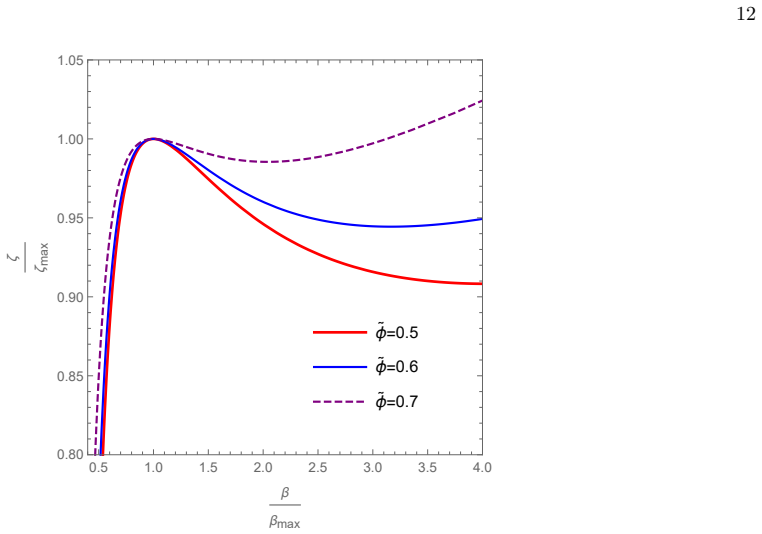
Starting from the flat 4D-EGB black hole mass $M = r_+/(2G) + \alpha/(2r_+G) + Q^2/(2r_+)$ and the Rényi entropy $S = (1/\lambda)\ln(1+\lambda\pi r_+^2/G)$ with $\beta=1/\lambda$, the paper derives the rescaled mass $\tilde{M} = [\beta^2(e^{S/\beta}-1)+\pi\beta^2\tilde{\alpha}+\pi\tilde{Q}^2]/[2\sqrt{\pi\beta}\sqrt{e^{S/\beta}-1}]$ and posits the first law $d\tilde{M} = T\,dS + \tilde{\phi}\,d\tilde{Q} + \tilde{A}\,d\tilde{\alpha} + \zeta\,d\beta$. Solving $\partial T/\partial S=0$ and $\partial^2 T/\partial S^2=0$ in the fixed $\tilde{Q}$ ensemble yields $S_C = \beta\ln(2(\sqrt{3}-1))$, $\tilde{Q}_C = \beta\sqrt{(7-4\sqrt{3})/\pi - \tilde{\alpha}}$, and $T_C = 0.256236$; in the fixed $\tilde{\Phi}$ ensemble, $S_C$ is the same, $\tilde{\Phi}_C = \sqrt{1-\pi\tilde{\alpha}(7+4\sqrt{3})}$, and $T_C = 11.2121\tilde{\alpha}$. Below these critical values the $T-S$ curves are non-monotonic and the $F-T$ curves are swallowtails, indicating van der Waals-like first-order phase transitions. The paper then shows that the GTD scalar $R_{GTD}(S)$ for the Rényi flat black hole coincides with the AdS RPST black hole when the central charge $C$ is chosen so that the Rényi parameter $\lambda$ is inversely related to $C$, and that both systems carry total topological charge $W=+1$ with small and large branches stable and the intermediate branch unstable. The conclusion is that the Rényi-modified flat black hole belongs to the same thermodynamic class as the 4D-EGB AdS black hole in RPST.
Load-bearing premise
The construction stands on treating the inverse Rényi parameter β as an independent, fluctuating thermodynamic coordinate in the first law, together with a rescaling that silently sets Newton's constant G=1; if β is merely a fixed parameter of the entropy formula, or if the rescaling is not legitimate, the ζ–β pair and the claimed RPST-like structure are formal artifacts.
Editorial extensions
If this is right
- If the central claim holds, asymptotically flat black holes with Rényi entropy exhibit genuine first-order phase transitions without any cosmological constant, so non-extensive entropy alone can replace an AdS background in generating critical phenomena.
- The ζ–β duality gives the Rényi deformation parameter the status of a thermodynamic coordinate, which in the RPST-like dictionary plays the role of the central charge C; this makes β a candidate for a microscopic count of degrees of freedom in flat-space gravitational thermodynamics.
- The coincidence of GTD curvature curves and of total topological charge W=+1 implies that the flat Rényi black hole and the AdS RPST black hole share the same stability pattern: small and large branches stable, intermediate branch unstable.
- The λ–Λ relation β ≈ πl²/G suggests that flat-space Rényi thermodynamics can be reinterpreted as AdS thermodynamics with an effective AdS radius, making the flat-space results a probe of bulk/boundary correspondence.
Reading between the lines
- Going beyond the paper, if the inverse proportionality between λ and C is universal, then a measurement of the Rényi parameter from flat-space black-hole data would directly fix the central charge of a putative dual field theory, giving a concrete holographic prediction.
- A natural test of the framework's robustness is to repeat the analysis for rotating (Kerr-like) flat black holes with Rényi entropy; if the W=+1 topology and swallowtail behaviour persist without spherical symmetry, the correspondence is a property of Rényi statistics rather than of the 4D-EGB solution.
- The paper leaves open whether the first law with β as a coordinate can be derived from a Hamiltonian or action principle; deriving dM~ from a variational principle with G explicitly varying would convert the formal β-duality into a mechanical one.
- If the RPST-like equivalence holds, the flat/Rényi description may give a way to simulate AdS phase structure in laboratory analogues (e.g., optical or condensed-matter systems) that realize non-extensive entropy, since the cosmological constant is no longer needed.
Editorial analysis
A structured set of objections, weighed in public.
Referee Report
Summary. The paper studies asymptotically flat charged 4D Einstein-Gauss-Bonnet black holes whose entropy is replaced by the Rényi entropy. The authors construct a rescaled mass function and propose a restricted-phase-space-like first law in which the inverse Rényi parameter β is promoted to a thermodynamic coordinate with conjugate potential ζ, analogous to the central charge/chemical potential pair of AdS RPST thermodynamics. They compute critical points in both fixed-charge and fixed-potential ensembles, report van der Waals-like first-order transitions, and compare the resulting GTD curvature and thermodynamic topology with those of the 4D-EGB AdS black hole in the standard RPST formalism. The central claim is that the flat Rényi system reproduces the thermodynamic, geometric, and topological features of the AdS RPST system.
Significance. If the construction is physically warranted, the paper would extend RPST-type holographic thermodynamics to asymptotically flat black holes and give evidence that Rényi non-extensive entropy can serve as a bridge between flat-space black hole physics and AdS holography. The critical-point algebra is internally consistent, and the paper makes an explicit, falsifiable prediction: the existence of van der Waals-like first-order phase transitions and a β-ζ conjugate pair in flat 4D-EGB black holes. The homogeneity check and Euler relation are useful explicit checks. However, the physical status of β as a fluctuating thermodynamic variable and the rescaling that produces the central mass function are not adequately justified, and the claimed equivalence with AdS RPST is largely qualitative.
major comments (4)
- [Section II, Eqs. (27)-(35)] The derivation of the rescaled mass \tilde M is not internally consistent as printed. Substituting r_+ from Eq. (29) into the flat mass Eq. (27) gives a numerator β(e^{S/β}-1) + πα/G + πQ^2, not β(e^{S/β}-1) + πα + πQ^2 as written in Eq. (30); the α term acquires an extra factor 1/G. If Eq. (30) is corrected in this way, the substitutions in Eq. (33) do indeed lead to Eq. (35) without any silent choice of κ. If, instead, the authors intend G=1 from the outset, then the substitution G→κ²/β in Eq. (33) is not a rescaling of the original flat EGB theory but a redefinition that introduces β as a variable. Either way, the manuscript must state the convention and show the intermediate algebra, because every subsequent quantity—T, ζ, the critical values, the GTD scalar, and the topological analysis—is computed from \tilde M in Eq. (35).
- [Section III, Eq. (39)] The first law promotes the inverse Rényi parameter β to an independent thermodynamic coordinate and defines ζ = ∂\tilde M/∂β. This is a postulate, not a consequence of the black hole solution: the Rényi parameter is fixed in the entropy functional, and varying it changes the statistical-mechanical definition of entropy rather than the black hole state. The Euler relation Eq. (40) then holds automatically because \tilde M in Eq. (35) is homogeneous of degree one in (S,\tilde Q,\tilde α,β), so the β-ζ duality is built in by construction. The paper should either justify β as a physical control parameter (for example, through an ensemble with variable non-extensivity) or explicitly present the formalism as a mathematical analogue. As it stands, the central claim that flat Rényi black holes have a holographic-like β-ζ pair is circular.
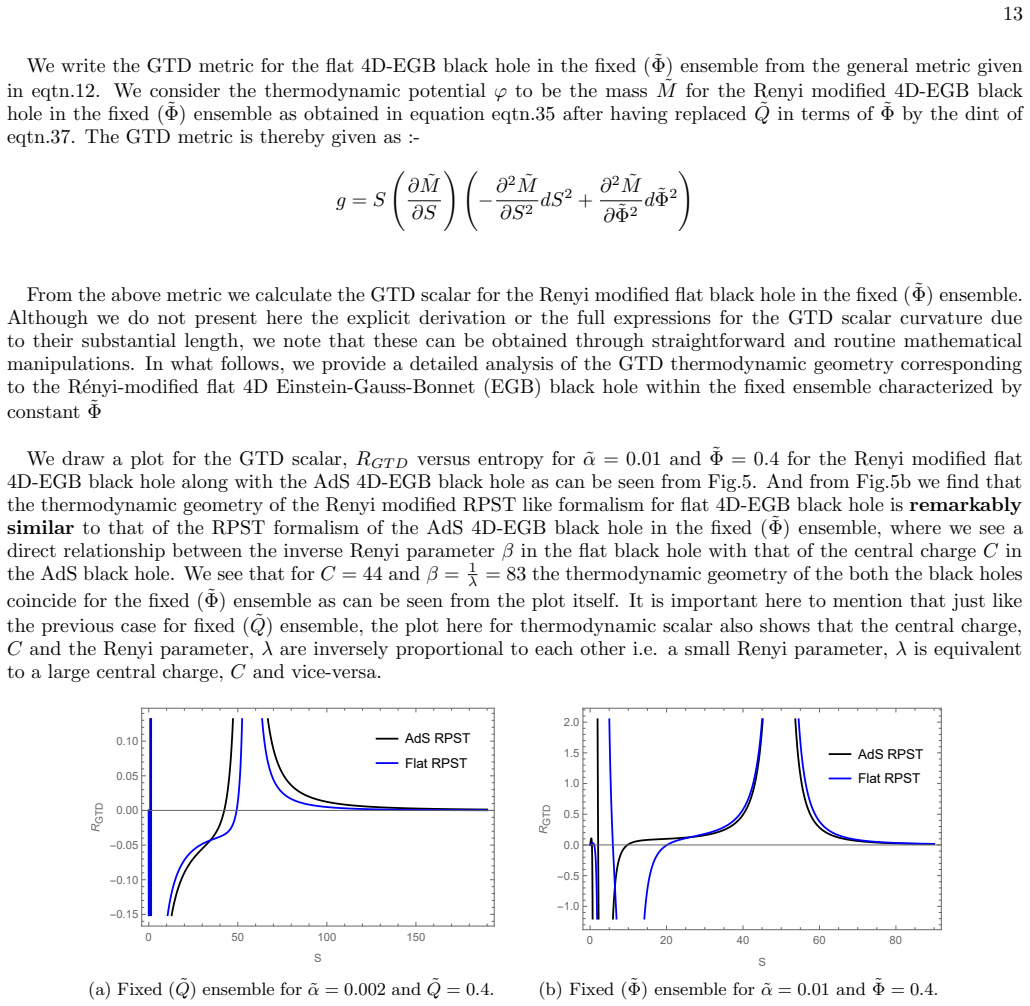
- [Section IV.1] The GTD comparison is not reproducible. The text states that the full expressions for R_GTD are omitted because of their substantial length, and only plots are shown (Fig. 5). Since the claim that the flat Rényi and AdS RPST geometries coincide is quantitative—the curves are said to match for specific C and β values—the authors should provide the explicit GTD scalar or at least a computational appendix. Without this, the geometric concordance claim cannot be independently checked.
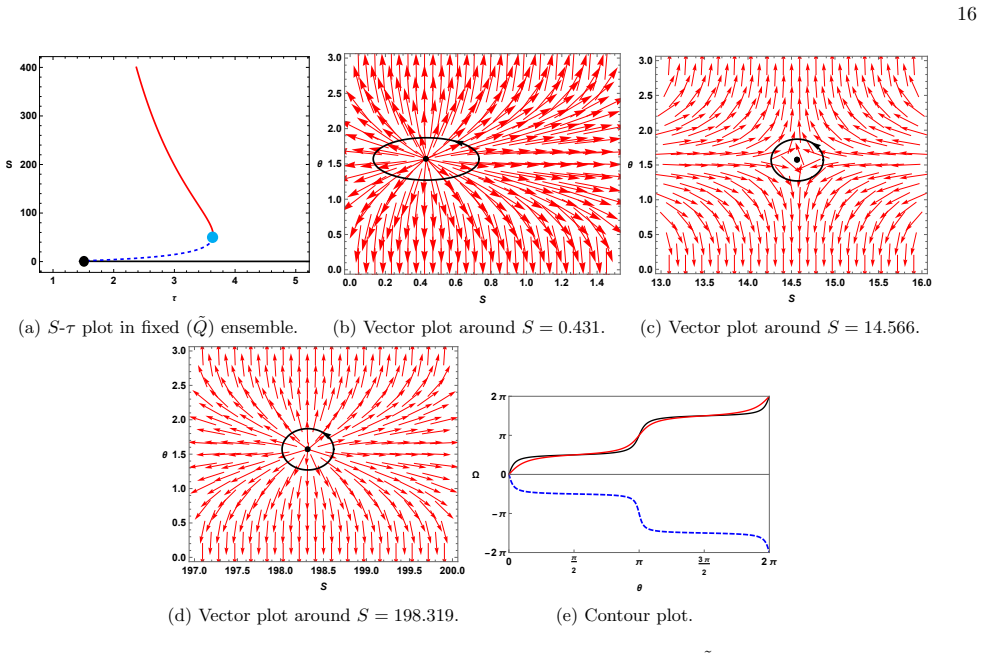
- [Section IV.2 and Conclusions] The topological comparison does not establish a parameter map between the two systems. The paper computes winding numbers W=+1 for both the flat Rényi and AdS RPST black holes in both ensembles, but W=+1 is the generic topological class for many black hole families; the same result would hold for any two mass functions with three branches. The relation β≈πl²/G from Eq. (32) is not used to derive a quantitative correspondence C↔β. To support the claimed mimicry, the authors should show that the two mass functions are the same function under this map, rather than only that the topological charge coincides.
minor comments (4)
- [Section III, Eq. (39)] The last term in Eq. (39) is written ζ dλ, but throughout the paper the conjugate variable is β; λ was replaced by 1/β in Eq. (29). Please correct this.
- [Section III.2, Eqs. (47)-(49)] The symbols ρ and e in Eq. (48) are used before being defined; define ρ = \tilde Φ/\tilde Φ_C and e explicitly, and check the displayed expression for t, which is very hard to parse in its current form.
- [Figures] There are several typographical errors: 'iso-e-charge' should be 'iso-charge' or 'fixed-charge' in Fig. 1; 'modidfied' appears in figure captions; and Fig. 9's caption says 'Rényi modified flat black hole' in the AdS RPST subsection, which is likely a copy-paste error.
- [Section IV.1, Eq. (12)] The reduction from the general GTD metric in Eq. (12) to the specific metric with coordinates S and \tilde Q is not shown; a one-line explanation of the choice of potential and coordinates would help the reader reproduce the plots.
Circularity Check
The flat/AdS RPST resemblance is partly circular: the rescaled mass is fixed by hidden choices κ²=β, G=1, the GTD coincidence is a two-parameter fit, and the β–ζ duality is definitional.
-
fitted input called prediction
[Section II, Eqs. (32)-(35)]
"Now, inspired by the relation in eqtn.(32) we use a rescaling constant κ to rewrite the Newton’s constant G, rescaled GB parameter ˜α and rescaled electric charge ˜Q as: ˜Q→ κ Q/√G, G→ κ²/β and ˜α→ α/κ². Using eq.(33) in eq.(30), the mass is rewritten as: M= β²(e^{S/β}−1)+πβ²˜α+π˜Q²/2√πκβ√(e^{S/β}−1) (34). And finally the rescaled mass ˜M=κM, is given by: ˜M= β²(e^{S/β}−1)+πβ²˜α+π˜Q²/2√πβ√(e^{S/β}−1) (35)."
Using the paper's own rescaling (33) in (30) gives M = [βD + πκ²α~ + πQ~²/β]/(2κ√(πD)) with D=e^{S/β}−1. Multiplying numerator and denominator by β, equality with the printed (34) requires κ²=β, which also forces G=κ²/β=1. These silent choices are not stated. Therefore M~ in (35) is not the flat EGB mass (27) in general units; it is a specially normalized expression. Every subsequent result—T, ζ, the critical values (42)/(47), the GTD scalar, and the topological class—is computed from this chosen M~. The claimed VdW-like transitions and AdS RPST resemblance are thus built into the fitted rescaling rather than derived from the original flat EGB black hole.
-
fitted input called prediction
[Section IV.1, Fig. 5 caption and surrounding text]
"We see that for C= 53 and β= 1/λ = 83.33 the thermodynamic geometry of the both the black holes coincide for the fixed ( ˜Q) ensemble as can be seen from the plot itself. ... We see that for C= 44 and β= 1/λ = 83 the thermodynamic geometry of the both the black holes coincide for the fixed ( ˜Φ) ensemble."
The claimed coincidence of the GTD geometries is obtained by choosing free parameters: C=53 paired with β=83.33 in the fixed-Q~ ensemble, and C=44 paired with β=83 in the fixed-Φ~ ensemble. No equation determines C from β; the curves are made to overlap by a two-parameter fit. The further statement that C and the Rényi parameter λ are inversely proportional is inferred from these chosen pairs. The 'remarkably similar' thermodynamic geometry is therefore an input of the parameter choice, not an independent prediction.
1 more flagged steps
-
self definitional
[Section II, Eq. (31) and Section III, Eq. (39)]
"Motivated by this parallel, we propose a formulation of the first law of black hole thermodynamics inspired by the RPST framework, extending it to non-AdS (asymptotically flat) black holes which is given as: dM=T dS+ ΦdQ+Adα+ζdβ, (31) where ... ζ= ∂M/∂β is the conjugate potential to β."
The β–ζ 'thermodynamic duality' is introduced by decree: ζ is defined as ∂M~/∂β in the proposed first law, and it is repeated in rescaled variables in Eq. (39). Since M~ already depends on β through the Rényi entropy and the rescaling, any one-parameter entropy deformation automatically produces such a conjugate variable. The claimed analogy to the C–µ duality of AdS RPST is therefore a definitional consequence of the ansatz, not an emergent structural fact established from the flat EGB dynamics.
full rationale
The central object of the paper is the rescaled mass M~ in Eq. (35), which generates all of the claimed AdS-RPST phenomena. Substituting the paper's own rescaling (33) into the Rényi mass (30) yields a form that matches the printed (34) only under the hidden conditions κ²=β and G=1. Thus the mass whose temperature, ζ, critical points, GTD curvature, and topological charges are computed is a specially normalized expression, not the flat EGB mass (27) in general units. The 'prediction' of VdW-like first-order transitions and RPST-like structure therefore reduces to the chosen rescaling. The GTD comparison is likewise fitted: C=53 with β=83.33 and C=44 with β=83 are selected so that the curves coincide; no independent relation fixes these pairs. Finally, the β–ζ duality is defined by ζ=∂M~/∂β, so it holds for any β-dependent mass by construction. I also note that the paper explicitly omits the GTD scalar derivation ('we do not present here the explicit derivation or the full expressions'), making the curve comparison hard to verify independently. The internal computations after M~ is adopted—critical values, Euler relation, and W=+1 topology—are consistent, and the paper does not invoke a uniqueness theorem, so the paper is not wholly circular; hence score 7 rather than 8–10.
Assumptions & free parameters
free parameters (4)
- β (inverse Rényi parameter) =
β = 83.33 in fixed-Q~ plots; β = 83 in fixed-Φ~ plots
- κ (rescaling constant) =
not stated; consistency with eqs. (33)-(35) implies κ = √β and G = 1
- α~ (rescaled Gauss-Bonnet coupling) =
0.002 (fixed-Q~ plots), 0.01 (fixed-Φ~ plots)
- C (AdS central charge in comparison) =
C = 53 (fixed-Q~), C = 44 (fixed-Φ~)
assumptions (5)
- domain assumption Rényi entropy formula S = (1/λ) ln(1 + λ S_BH)
- domain assumption Flat 4D-EGB black hole mass formula M = r_+/2G + α/(2r_+G) + Q²/(2r_+)
- ad hoc to paper β is a legitimate thermodynamic variable in the first law
- standard math GTD and Duan phi-mapping topology methods are valid diagnostic tools
- domain assumption Relation Λ ≈ ±3λπ/G from ref. [51]
invented entities (2)
-
β-ζ conjugate pair as analogue of central charge and chemical potential
-
Flat Rényi / AdS RPST thermodynamic equivalence
Cite this review
Pith. "Pith review of Thermodynamics of Flat 4D Einstein-Gauss-Bonnet Black Hole with R\'enyi Entropy: An RPST-like formalism." pith.science (2026). https://pith.science/paper/5ORSBFAY
@misc{pith2026250621917,
  author       = {Pith},
  title        = {Pith review of: Thermodynamics of Flat 4D Einstein-Gauss-Bonnet Black Hole with R\'enyi Entropy: An RPST-like formalism},
  year         = {2026},
  howpublished = {\url{https://pith.science/paper/5ORSBFAY}},
  note         = {Machine review of arXiv:2506.21917}
}
abstract
We investigate the thermodynamics of asymptotically flat black holes in four-dimensional Einstein-Gauss-Bonnet (4D-EGB) gravity using R\'enyi entropy as a non-extensive generalization of the Bekenstein-Hawking entropy. The resulting thermodynamic structure, formulated within a restricted phase space-like (RPST-like) framework, reveals a striking resemblance to the thermodynamics of AdS black holes in the standard RPST formalism. In particular, we identify a thermodynamic duality between the R\'enyi deformation parameter $\beta$ and a conjugate response potential $\zeta$, analogous to the central charge and chemical potential in holographic theories. An extensive thermodynamic analysis in both fixed charge-$(\tilde{Q})$ and fixed potential-$(\tilde{\Phi})$ ensembles reveal Van der Waals-like first-order phase transitions which is an unexpected feature for asymptotically flat black holes. Furthermore, through the formalism of geometrothermodynamics (GTD) and thermodynamic topology, It is shown that the R\'enyi modified flat black hole mimics, in both its thermodynamic topology and geometry, the features of its counterparts in the 4D-EGB AdS black hole under RPST, reinforcing the structural similarity between these seemingly different systems. Our findings point to a deeper correspondence between non-extensive entropy and holographic thermodynamics, suggesting that R\'enyi entropy may serve as a natural bridge between flat-space black hole thermodynamics and AdS holography.
Figures


Figures from the paper (6 more)



Reference graph
Works this paper leans on
-
[1]
J. D. Bekenstein, “Black holes and entropy,”Phys. Rev. D7, 2333 (1973)
work page 1973
-
[2]
Particle creation by black holes,
S. W. Hawking, “Particle creation by black holes,”Commun. Math. Phys.43, 199 (1975)
work page 1975
-
[3]
(47) By substituting the critical values from eqtn.47 in the expression forTin eqtn.36 after having replaced ˜Qin terms of ˜Φ, the critical temperature,T C is found to beT C = 11.2121 ˜α, and as we see it depends on the value of ˜αwhich is quite different from the previous case (fixed ˜Qensemble) where the critical temperature was a constant. Similar to w...
-
[4]
Reconstruction off(T) gravity: Rip cosmology, finite-time future singularities and thermodynamics,
K. Bamba, R. Myrzakulov, S. Nojiri, and S. D. Odintsov, “Reconstruction off(T) gravity: Rip cosmology, finite-time future singularities and thermodynamics,”Phys. Rev. D85, 104036 (2012), [arXiv:1202.4057 [gr-qc]]
arXiv 2012
-
[5]
The four laws of black hole mechanics,
J. M. Bardeen, B. Carter, and S. W. Hawking, “The four laws of black hole mechanics,”Commun. Math. Phys.31, 161 (1973)
work page 1973
-
[6]
Hawking radiation and black hole thermodynamics,
D. N. Page, “Hawking radiation and black hole thermodynamics,”New J. Phys.7, 203 (2005)
work page 2005
-
[7]
Unified cosmic history in modified gravity: from F(R) theory to Lorentz non-invariant models,
S. Nojiri and S. D. Odintsov, “Unified cosmic history in modified gravity: from F(R) theory to Lorentz non-invariant models,”Phys. Rept.505, 59–144 (2011)
work page 2011
-
[8]
Anti-de Sitter space and holography,
E. Witten, “Anti-de Sitter space and holography,”Adv. Theor. Math. Phys.2, 253–291 (1998)
1998
Show all 66 references
-
[9]
Black hole thermodynamics,
S. Carlip, “Black hole thermodynamics,”Int. J. Mod. Phys. D23, 1430023 (2014)
2014
-
[10]
Rovelli,Quantum Gravity, Cambridge University Press (2004)
C. Rovelli,Quantum Gravity, Cambridge University Press (2004)
2004
-
[11]
A holographic view on physics out of equilibrium,
V. E. Hubeny and M. Rangamani, “A holographic view on physics out of equilibrium,”Adv. High Energy Phys.2010, 297916 (2010)
2010
-
[12]
Enthalpy and the Mechanics of AdS Black Holes,
D. Kastor, S. Ray, and J. Traschen, “Enthalpy and the Mechanics of AdS Black Holes,”Class. Quant. Grav.26, 195011 (2009), [arXiv:0904.2765 [hep-th]]
2009 arXiv
-
[13]
Black hole evaporation: A paradigm,
A. Ashtekar and M. Bojowald, “Black hole evaporation: A paradigm,”Class. Quant. Grav.22, 3349–3362 (2005)
2005
-
[14]
Black hole chemistry: thermodynamics with Lambda,
D. Kubizˇ n´ ak, R. B. Mann, and M. Teo, “Black hole chemistry: thermodynamics with Lambda,”Class. Quant. Grav.34, 063001 (2017), [arXiv:1608.06147 [hep-th]]
2017 arXiv
-
[15]
P–V criticality of charged AdS black holes,
D. Kubizˇ n´ ak and R. B. Mann, “P–V criticality of charged AdS black holes,”JHEP1207, 033 (2012), [arXiv:1205.0559 [hep-th]]
2012 arXiv
-
[16]
Thermodynamics of AdS Black Holes: Central Charge Criticality,
W. Cong, D. Kubizˇ n´ ak, and R. B. Mann, “Thermodynamics of AdS Black Holes: Central Charge Criticality,”Phys. Rev. Lett.127, 091301 (2021), [arXiv:2105.02223 [hep-th]]
2021 arXiv
-
[17]
The Large N limit of superconformal field theories and supergravity,
J. M. Maldacena, “The Large N limit of superconformal field theories and supergravity,”Adv. Theor. Math. Phys.2, 231 (1998), [arXiv:hep-th/9711200]
1998 arXiv
-
[18]
Black hole thermodynamics is extensive with variable Newton constant,
T. Wang and L. Zhao, “Black hole thermodynamics is extensive with variable Newton constant,”Phys. Lett. B, vol. 827, p. 136935, 2022
2022
-
[19]
Holographic thermodynamics requires a chemical potential for color,
M. R. Visser, W. Cong, D. Kubizˇ n´ ak, and R. B. Mann, “Holographic thermodynamics requires a chemical potential for color,”SciPost Phys.13, 007 (2022), [arXiv:2203.08832 [hep-th]]
2022 arXiv
-
[20]
Restricted phase space thermodynamics of charged AdS black holes in conformal gravity,
X. Kong, Z. Zhang, and L. Zhao, “Restricted phase space thermodynamics of charged AdS black holes in conformal gravity,”Chin. Phys. C, vol. 47, no. 9, p. 095105, 2023
2023
-
[21]
Thermodynamics for regular black holes as intermediate thermodynamic states and quasinormal frequencies,
B.-H. Huang, H.-W. Hu, and L. Zhao, “Thermodynamics for regular black holes as intermediate thermodynamic states and quasinormal frequencies,”J. Cosmol. Astropart. Phys., vol. 2024, no. 03, p. 053, 2024
2024
-
[22]
In recent years, this modified theory has emerged as a valuable frame- work for investigating the physics and thermodynamics of black holes
and avoid Ostrogradsky instability [27]. In recent years, this modified theory has emerged as a valuable frame- work for investigating the physics and thermodynamics of black holes. Noteworthy studies include vacuum solutions for charged black holes and their thermodynamic cha...
-
[23]
RPST-inspired formalism for black holes in flat spacetime,
B. Hazarika and P. Phukon, “RPST-inspired formalism for black holes in flat spacetime,”Phys. Lett. B, p. 139477, 2025
2025
-
[24]
The Einstein tensor and its generalizations,
D. Lovelock, “The Einstein tensor and its generalizations,”J. Math. Phys.12, 498 (1971)
1971
-
[25]
A remarkable property of the Riemann-Christoffel tensor in four dimensions,
C. Lanczos, “A remarkable property of the Riemann-Christoffel tensor in four dimensions,”Annals Math.39, 842 (1938)
1938
-
[26]
Hayward black holes in Einstein–Gauss–Bonnet gravity,
A. Kumar, D. V. Singh, and S. G. Ghosh, “Hayward black holes in Einstein–Gauss–Bonnet gravity,”Annals of Physics, vol. 419, p. 168214, 2020. 20
2020
-
[27]
Radiation from Hayward black hole via tunneling process in Ein- stein–Gauss–Bonnet gravity,
S. S. Shahraeini, K. Nozari, and S. Saghafi, “Radiation from Hayward black hole via tunneling process in Ein- stein–Gauss–Bonnet gravity,”J. Hologr. Appl. Phys., vol. 2, no. 4, pp. 55–62, 2022
2022
-
[28]
Einstein–Gauss–Bonnet gravity in four-dimensional spacetime,
D. Glavan and C. Lin, “Einstein–Gauss–Bonnet gravity in four-dimensional spacetime,”Phys. Rev. Lett., vol. 124, no. 8, p. 081301, 2020
2020
-
[29]
Motohashi, Hayato and Suyama, Teruaki,Third order equations of motion and the Ostrogradsky instability, Phys. Rev. D 91, 085009 (2015)
2015
-
[30]
Charged black holes in AdS spaces in 4D Einstein Gauss–Bonnet gravity,
P. G. S. Fernandes, “Charged black holes in AdS spaces in 4D Einstein Gauss–Bonnet gravity,”Phys. Lett. B, vol. 805, p. 135468, 2020
2020
-
[31]
Extended thermodynamics and microstructures of four-dimensional charged Gauss–Bonnet black hole in AdS space,
S. W. Wei and Y. X. Liu, “Extended thermodynamics and microstructures of four-dimensional charged Gauss–Bonnet black hole in AdS space,”Phys. Rev. D, vol. 101, no. 10, p. 104018, 2020
2020
-
[32]
Thermodynamic geometry of the novel 4-D Gauss–Bonnet AdS black hole,
S. A. H. Mansoori, “Thermodynamic geometry of the novel 4-D Gauss–Bonnet AdS black hole,”Phys. Dark Universe, vol. 31, p. 100776, 2021
2021
-
[33]
Particle–antiparticle in 4D charged Einstein–Gauss–Bonnet black hole,
M. Bousder and M. Bennai, “Particle–antiparticle in 4D charged Einstein–Gauss–Bonnet black hole,”Phys. Lett. B, vol. 817, p. 136343, 2021
2021
-
[34]
Innermost stable circular orbit and shadow of the 4D Einstein–Gauss–Bonnet black hole,
M. Guo and P. C. Li, “Innermost stable circular orbit and shadow of the 4D Einstein–Gauss–Bonnet black hole,”Eur. Phys. J. C, vol. 80, no. 6, pp. 1–8, 2020
2020
-
[35]
Horizon-scale tests of gravity theories and fundamental physics from the Event Horizon Telescope image of Sagittarius A,
S. Vagnozzi, R. Roy, Y. D. Tsai, L. Visinelli, M. Afrin, A. Allahyari, P. Bambhaniya, D. Dey, S. G. Ghosh, P. S. Joshi,et al., “Horizon-scale tests of gravity theories and fundamental physics from the Event Horizon Telescope image of Sagittarius A,”Class. Quant. Grav., vol. 40...
2023
-
[36]
Greybody factor and power spectra of the Hawking radiation in the 4D Ein- stein–Gauss–Bonnet de Sitter gravity,
C. Y. Zhang, P. C. Li, and M. Guo, “Greybody factor and power spectra of the Hawking radiation in the 4D Ein- stein–Gauss–Bonnet de Sitter gravity,”Eur. Phys. J. C, vol. 80, no. 9, p. 874, 2020
2020
-
[37]
Superradiance and stability of the regularized 4D charged Ein- stein–Gauss–Bonnet black hole,
C. Y. Zhang, S. J. Zhang, P. C. Li, and M. Guo, “Superradiance and stability of the regularized 4D charged Ein- stein–Gauss–Bonnet black hole,”J. High Energy Phys., vol. 2020, no. 8, pp. 1–19, 2020
2020
-
[38]
Nonlinear charged planar black holes in four-dimensional scalar–Gauss–Bonnet theories,
M. Bravo-Gaete, L. Guajardo, and J. Oliva, “Nonlinear charged planar black holes in four-dimensional scalar–Gauss–Bonnet theories,”Phys. Rev. D, vol. 106, no. 2, p. 024017, 2022
2022
-
[39]
Weak cosmic censorship conjecture for the novel 4D charged Einstein–Gauss–Bonnet black hole with test scalar field and particle,
S. J. Yang, J. J. Wan, J. Chen, J. Yang, and Y. Q. Wang, “Weak cosmic censorship conjecture for the novel 4D charged Einstein–Gauss–Bonnet black hole with test scalar field and particle,”Eur. Phys. J. C, vol. 80, pp. 1–11, 2020
2020
-
[40]
R´ enyi,Probability Theory(North-Holland, Amsterdam, 1970)
A. R´ enyi,Probability Theory(North-Holland, Amsterdam, 1970)
1970
-
[41]
Nonadditive entropy and nonextensive statistical mechanics: An overview after 20 years,
C. Tsallis, “Nonadditive entropy and nonextensive statistical mechanics: An overview after 20 years,”Braz. J. Phys.39, 337–356 (2009), [arXiv:0812.4370 [cond-mat.stat-mech]]
2009 arXiv
-
[42]
A q-parameter bound for particle spectra based on black hole thermodynamics with R´ enyi entropy,
T. S. Bir´ o and V. G. Czinner, “A q-parameter bound for particle spectra based on black hole thermodynamics with R´ enyi entropy,”Phys. Lett. B726, 861–865 (2013), [arXiv:1309.4261 [gr-qc]]
2013 arXiv
-
[43]
R´ enyi entropy and the thermodynamic stability of black holes,
V. G. Czinner and H. Iguchi, “R´ enyi entropy and the thermodynamic stability of black holes,”Phys. Lett. B752, 306–310 (2016), [arXiv:1511.06963 [gr-qc]]
2016 arXiv
-
[44]
On R´ enyi universality formula of charged flat black holes from Hawking-Page phase transi- tion,
F. Barzi and H. El Moumni, “On R´ enyi universality formula of charged flat black holes from Hawking-Page phase transi- tion,”Phys. Lett. B833, 137378 (2022), doi:10.1016/j.physletb.2022.137378, [arXiv:2209.08195 [hep-th]]
2022
-
[45]
Riemann Surfaces and Winding Numbers of R´ enyi Phase Structure of Charged- Flat Black Holes,
F. Barzi, H. El Moumni and K. Masmar, “Riemann Surfaces and Winding Numbers of R´ enyi Phase Structure of Charged- Flat Black Holes,”Eur. Phys. J. C84, 1141 (2024), doi:10.1140/epjc/s10052-024-13511-0, [arXiv:2408.05870 [hep-th]]
2024 arXiv
-
[46]
Emergent phase, thermodynamic geometry, and criticality of charged black holes from R´ enyi statistics,
E. Hirunsirisawat, R. Nakarachinda and C. Promsiri, “Emergent phase, thermodynamic geometry, and criticality of charged black holes from R´ enyi statistics,”Phys. Rev. D105, 124049 (2022), doi:10.1103/PhysRevD.105.124049, [arXiv:2204.13023 [hep-th]]
2022 arXiv
-
[47]
On some phase equilibrium features of charged black holes in flat spacetime via R´ enyi statistics,
F. Barzi, H. El Moumni and K. Masmar, “On some phase equilibrium features of charged black holes in flat spacetime via R´ enyi statistics,”Gen. Rel. Grav.55, 109 (2023), doi:10.1007/s10714-023-03158-9, [arXiv:2304.04945 [gr-qc]]
2023 arXiv
-
[48]
Thermodynamics of asymptotically de Sitter black hole in dRGT massive gravity from R´ enyi entropy,
P. Chunaksorn, E. Hirunsirisawat, R. Nakarachinda, L. Tannukij and P. Wongjun, “Thermodynamics of asymptotically de Sitter black hole in dRGT massive gravity from R´ enyi entropy,”Eur. Phys. J. C82, 1174 (2022), doi:10.1140/epjc/s10052- 022-11110-5, [arXiv:2208.14770 [gr-qc]]
2022 arXiv
-
[49]
Thermodynamics and phase transition of Bardeen black hole via R´ enyi statistics in grand canonical ensemble and canonical ensemble,
Z. Wang, H. Ren, J. Chen and Y. Wang, “Thermodynamics and phase transition of Bardeen black hole via R´ enyi statistics in grand canonical ensemble and canonical ensemble,”Eur. Phys. J. C83, 527 (2023), doi:10.1140/epjc/s10052-023-11680- y
2023 doi
-
[50]
R´ enyi topology of charged-flat black hole: Hawking-Page and Van-der-Waals phase transitions,
F. Barzi, H. El Moumni and K. Masmar, “R´ enyi topology of charged-flat black hole: Hawking-Page and Van-der-Waals phase transitions,”JHEAp42, 63–86 (2024), doi:10.1016/j.jheap.2024.03.005, [arXiv:2309.14069 [hep-th]]
2024 arXiv
-
[51]
Thermal chaos of charged-flat black hole via R´ enyi formalism,
F. Barzi, H. El Moumni and K. Masmar, “Thermal chaos of charged-flat black hole via R´ enyi formalism,”Nucl. Phys. B 1005, 116606 (2024), doi:10.1016/j.nuclphysb.2024.116606, [arXiv:2404.14609 [hep-th]]
2024
-
[52]
Restricted Phase Space Thermodynamics of Dyonic AdS Black Holes: Comparative Analysis Using Different Entropy Models,
A. Baruah and P. Phukon, “Restricted Phase Space Thermodynamics of Dyonic AdS Black Holes: Comparative Analysis Using Different Entropy Models,” [arXiv:2411.02273 [hep-th]]
-
[53]
R´ enyi entropy correction to expanding universe,
H. R. Fazlollahi, “R´ enyi entropy correction to expanding universe,”Eur. Phys. J. C83, 29 (2023), doi:10.1140/epjc/s10052- 023-11183-w
2023 doi
-
[54]
Geometrothermodynamics,
H. Quevedo, “Geometrothermodynamics,”J. Math. Phys.48, 013506 (2007), doi:10.1063/1.2409524
2007 doi
-
[55]
Geometrothermodynamics of black holes,
H. Quevedo, “Geometrothermodynamics of black holes,”Gen. Rel. Grav.40, 971–984 (2008), doi:10.1007/s10714-007- 0586-0
2008 doi
-
[56]
Thermodynamic geometry of black holes inf(R) gravity,
S. Soroushfar, R. Saffari and N. Kamvar, “Thermodynamic geometry of black holes inf(R) gravity,”Eur. Phys. J. C76, 476 (2016), doi:10.1140/epjc/s10052-016-4311-8
2016 doi
-
[57]
Universal topological classifications of black hole thermodynamics,
S.-W. Wei, Y.-X. Liu, and R. B. Mann, “Universal topological classifications of black hole thermodynamics,”Phys. Rev. D110, L081501 (2024), [arXiv:2409.09333 [gr-qc]]. 21
2024 arXiv
-
[58]
Novel topological classes in black hole thermodynamics,
D. Wu, W. Liu, S.-Q. Wu, and R. B. Mann, “Novel topological classes in black hole thermodynamics,”Phys. Rev. D111, L061501 (2025), [arXiv:2411.10102 [hep-th]]
2025 arXiv
-
[59]
Universal thermodynamic topological classes of rotating black holes,
D. Wu, S. Gu, X. Zhu,et al., “Universal thermodynamic topological classes of rotating black holes,”JHEP06, 213 (2024), [arXiv:2409.12747 [gr-qc]]
2024 arXiv
-
[60]
Black hole solutions as topological thermodynamic defects,
S.-W. Wei, Y.-X. Liu, and R. B. Mann, “Black hole solutions as topological thermodynamic defects,”Phys. Rev. Lett. 129, 191101 (2022), [arXiv:2208.01932 [gr-qc]]
2022 arXiv
-
[61]
Topological classes of rotating black holes,
D. Wu, “Topological classes of rotating black holes,”Phys. Rev. D107, 024024 (2023), [arXiv:2211.15151 [gr-qc]]
2023 arXiv
-
[62]
Topological classes of thermodynamics of rotating AdS black holes,
D. Wu and S.-Q. Wu, “Topological classes of thermodynamics of rotating AdS black holes,”Phys. Rev. D107, 084002 (2023), [arXiv:2301.03002 [gr-qc]]
2023 arXiv
-
[63]
Topology of black hole thermodynamics,
S.-W. Wei and Y.-X. Liu, “Topology of black hole thermodynamics,”Phys. Rev. D105, 104003 (2022), [arXiv:2112.01706 [gr-qc]]
2022 arXiv
-
[64]
J. A. Schouten,Tensor Analysis for Physics(Oxford at the Clarendon Press, 1951)
1951
-
[65]
The 4D Einstein-Gauss-Bonnet theory of gravity: a review,
P. G. S. Fernandes, P. Carrilho, T. Clifton and D. J. Mulryne, “The 4D Einstein-Gauss-Bonnet theory of gravity: a review,” Class. Quant. Grav.39, no.6, 063001 (2022), doi:10.1088/1361-6382/ac500a [arXiv:2201.03060 [gr-qc]]
2022 arXiv
-
[66]
4D-EGB black holes in RPS thermodynamics,
Y. Ladghami, B. Asfour, A. Bouali, A. Errahmani and T. Ouali, “4D-EGB black holes in RPS thermodynamics,” Phys. Dark Univ.41, 101261 (2023), doi:10.1016/j.dark.2023.101261
2023
Reviewed August 6, 2026 · model on record in the stance chip above.
Discussion (0). Sign in to comment.