REVIEW 3 major objections 5 minor 110 references
Holographic Fractional Order Phase Transitions in CFTs Dual to AdS Black Holes
T0 review · 3 major / 5 minor · reviewed 2026-08-06 · deepseek-v4-flash
Pith's one-line read The two kinds of Davies points are fractional phase transitions of order 3/2 and 4/3 in the CFT duals of AdS black holes.
desk verdict The 3/2 vs 4/3 Ehrenfest classification is sound for RN and ModMax, but the Kaniadakis leg rests on an uncontrolled small-κ truncation and needs validation before the headline claim holds across all three models. read the letter →
The pith
A machine-rendered reading of the paper's core claim, the machinery that carries it, and where it could break.
The reading
What carries the argument
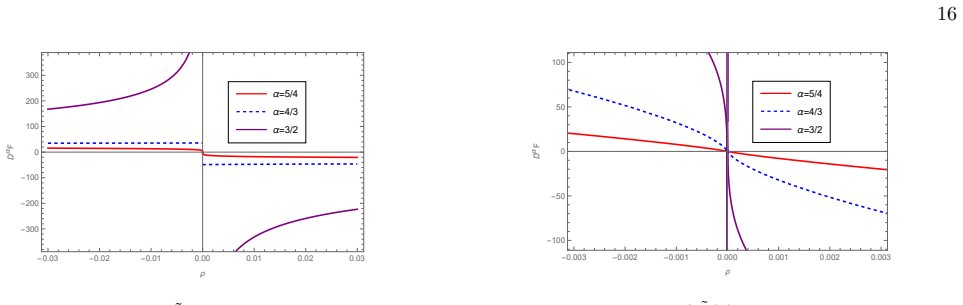
The machinery is the fractional-order Ehrenfest test: expand the free energy near the transition point in dimensionless variables and look for the smallest $\alpha$ at which the fractional derivative $D^\alpha_t F$ has a finite jump rather than being continuous or divergent. The equation of state is quartic in $\rho$, and its branches near the Davies point carry fractional powers of $t$, such as $\sqrt{-t}$ or $t^{2/3}$, which propagate into $F(t)$ as $(-t)^{3/2}$ or $t^{4/3}$ terms. Those leading fractional powers set the observed order: $3/2$ at temperature extrema and $4/3$ at the inflection-type critical point, with the same structure recurring across the three black hole systems.
What would settle it
Repeat the series expansion at a different parameter set: for RN-AdS take $Q=0.4$ or $Q=0.7$ at the left Davies point and evaluate $\lim_{t\to 0^-} D^{3/2}F$; if the limit is zero or divergent rather than a finite nonzero constant, the $3/2$ order claim fails. For the Kaniadakis model, run the same calculation at $\kappa=0.1$ or with the untruncated entropy to see whether the critical point still yields $4/3$.
Extended reading notes
Core claim
The paper's central claim is that the order of the CFT phase transition at a Davies point is fixed by the local shape of the temperature profile: an extremum gives $\alpha = 3/2$, while an inflection gives $\alpha = 4/3$. Concretely, expanding the CFT equation of state near the Davies point in the dimensionless variables $T = T_c(1+t)$, $S = S_c(1+\rho)$, $Q = Q_c(1+q)$ turns it into a quartic in $\rho$ whose solutions contain fractional powers of $t$; the leading fractional term in the free energy is $(-t)^{3/2}$ near temperature extrema and $t^{4/3}$ near the critical point. Using fractional derivatives of the free energy, $D^\alpha F$ is continuous for $\alpha$ below the order, has a finite jump at the order, and diverges above it, which identifies the transition order. The same $3/2$ versus $4/3$ pattern is obtained for RN-AdS, ModMax-AdS, and Kaniadakis-modified RN-AdS black holes. Under the particular constraint $2t+8q=0$, the critical point of RN-AdS and ModMax-AdS switches to $3/2$, whereas both critical points of the Kaniadakis model remain $4/3$, showing that the order is path-dependent and model-dependent.
Load-bearing premise
The load-bearing premise is that the leading fractional power read from a series expansion at one representative parameter choice fixes the transition order across the whole allowed parameter range, and that the small-$\kappa$ truncation and the hand-picked path $2t+8q=0$ do not change that order.
Editorial extensions
If this is right
- Heat-capacity divergence alone does not fix the order of a phase transition; the local shape of the temperature profile does.
- The generalized Ehrenfest classification transfers from bulk black hole thermodynamics to the boundary CFT side for these three models.
- Along the special path $2t+8q=0$, the critical point of RN-AdS and ModMax-AdS shows a $3/2$ transition that is absent in the bulk formulation, indicating boundary-specific critical features.
- With Kaniadakis entropy, two critical points appear and both keep order $4/3$ even on constrained paths, so the entropy model can remove path sensitivity of the transition order.
- The fractional order is not universal: it depends on both the underlying spacetime theory and the entropy statistics.
Reading between the lines
- If the $3/2$ versus $4/3$ split is robust across parameters, the fractional derivative order could serve as a boundary diagnostic that separates extremum-type instabilities from genuine critical points in holographic duals, possibly with analogues in systems where fractional derivatives of thermodynamic potentials are measurable.
- The hand-picked path $2t+8q=0$ suggests the critical point may have direction-dependent transition order; one natural extension is to map all directions in the $(t,q)$ plane and check whether $4/3$ is generic and $3/2$ exceptional.
- Because the Kaniadakis calculation truncates in small $\kappa$ without an error estimate, the natural stress test is to repeat it at larger $\kappa$ or with the untruncated entropy; a change in order would indicate an artifact of the truncation.
- The same fractional-derivative diagnostic could be applied to ordinary first-order transition lines, not only Davies points, extending the classification beyond divergent-heat-capacity loci.
Editorial analysis
A structured set of objections, weighed in public.
Referee Report
Summary. The paper applies a generalized Ehrenfest classification based on Caputo fractional derivatives of the free energy to the CFT thermodynamics of three AdS black hole families: Reissner-Nordström-AdS, ModMax-AdS, and RN-AdS with Kaniadakis entropy. It claims that Davies points of the first type, where the temperature has a local extremum, correspond to fractional phase transitions of order alpha=3/2, while the critical point, where the temperature has an inflection, corresponds to order alpha=4/3. The claim is worked out through series expansions of the CFT equation of state near the Davies/critical points, with explicit expansions for the free energy and with limiting behavior of fractional derivatives used to identify the transition order. Under a specially chosen path 2t+8q=0, the authors find 3/2 for RN-AdS and ModMax-AdS, whereas for the Kaniadakis case both critical points yield 4/3 under the analogous constrained paths. The paper states that these results are consistent with earlier bulk-side results [104,106].
Significance. If the central claim is correct, the paper provides a clean, parameter-free classification on the CFT side: temperature-extremum Davies points give a t^{3/2} free-energy term and hence a 3/2-order transition, while inflection-type critical points give a t^{4/3} term and a 4/3-order transition. For RN-AdS and ModMax-AdS the local scaling argument is independent of the particular numerical values used in the illustrations, and the series expansions are explicit and checkable. This is a useful extension of earlier gravitational-side studies to the boundary CFT, and the paper is appropriately careful in marking the 4/3 result as the generic one and the 3/2 constrained-path result as a special case. However, the Kaniadakis section, which is load-bearing for the claimed model-dependence of the constrained-path order, rests on an uncontrolled small-kappa truncation and on a special-path construction that appears internally inconsistent; those points need substantial work before the headline claim is fully supported.
major comments (3)
- [Section IV, Eqs. (72)-(77), (89), (96)] The Kaniadakis leg of the paper is built on a small-kappa expansion in which E and T are truncated at order kappa^2 before locating the critical points. For the first critical point, kappa*Sc = 0.016*19.339 ≈ 0.309, so kappa^2*Sc^2 ≈ 0.096; for the second critical point kappa*Sc ≈ 0.114. The omitted kappa^4 terms are therefore not negligible compared with the retained kappa^2 corrections, yet no error estimate, next-order check, or parameter scan is provided. If the truncated equation of state shifts the critical points or changes the local degeneracy of T(S), the claimed alpha=4/3 critical behavior—and the contrast with the RN/ModMax result—would not survive. The authors should verify the result with an explicit remainder bound, with a next-order calculation, or with a scan over kappa, and should state the range of kappa for which the truncation is controlled.
- [Section IV.B, Eqs. (90), (94), (97), (101)] The special-path construction is not implemented consistently. For the first Kaniadakis critical point the constraint is 2q+712.141t=0, i.e. q=-356.0705t. Substituting this into the last parenthesis of Eq. (90) gives q^2+2q-712.141t = 126787t^2 - 1424.28t, which still contains a linear term; Eq. (94) similarly retains a residual -0.001t term. The constrained direction therefore does not cancel the linear term that, in the RN-AdS case, changes the scaling of rho(t) from t^{1/3} to sqrt(t). Since the claimed 3/2-versus-4/3 contrast along fine-tuned paths depends on this cancellation, the derivation must be corrected or the claim about the Kaniadakis constrained paths must be withdrawn.
- [Section II.B, Eq. (41), and Section III.B] The text states immediately after Eq. (41) that 'this behavior was not observed in the case of RN-AdS black holes,' and Section III.B repeats that such behavior was 'absent in the RN-AdS black hole case.' This is contradicted by Eqs. (41)-(42), which explicitly produce fractional powers t^{3/2} and a 3/2-order transition for RN-AdS along the constrained path. The intended statement appears to be that the constrained path yields 4/3 only for the Kaniadakis model, not for RN-AdS, but as written the internal contradiction obscures the central comparison. Please rephrase these passages consistently and make the comparison model-by-model.
minor comments (5)
- [Section II.A] The sentence 'By substituting the solutions derived from Eq. (80) into the expression for the free energy above' should refer to Eq. (24), not Eq. (80), which appears later in the Kaniadakis section.
- [Section II.A] The phrase 'rather than being first-order, as traditionally presumed' contradicts the earlier statement in the same section that conventional Ehrenfest classification identifies these Davies points as second-order; the paper should use 'second-order' throughout or clarify the intended contrast.
- [Section IV, Figures 12-14] The captions of Figures 12-14 describe the plots as 'for the CFT of ModMax AdS black hole' and label them as left/right Davies points, even though these figures show the first, second, and third Davies points of the Kaniadakis-deformed RN-AdS model; the captions should be corrected.
- [Eqs. (81) and (91)] Equation (81) appears to have a missing decimal point in '0002rho^4', and Eq. (91) has a spurious '=0' at the end of the series solution for rho(t).
- [General] Several figure captions and inline references contain garbled phrases such as 'the right bottom panel presents the plots' and 'top panel displays the corresponding D^alpha_t F(t) vs t curves, while the bottom right panel presents'; the wording should be cleaned up throughout.
Circularity Check
No significant circularity: the fractional orders 3/2 and 4/3 follow from the paper's own re-derived local expansions of T(S) and F, not from fitted parameters or load-bearing self-citations.
full rationale
The central claim is that first-type Davies points (temperature extrema) correspond to fractional order 3/2 and second-type critical points (temperature inflections) correspond to 4/3. This is derived in the text from the local structure of the CFT equation of state. For example, near the left Davies point of RN-AdS, the paper solves the dimensionless equation of state and obtains series with leading non-analytic term proportional to sqrt(-t) (Eq. (24)), which produces a (-t)^{3/2} term in the free energy (Eq. (26)); the subsequent fractional-derivative analysis identifies the discontinuity at alpha = 3/2. Near the critical point, the quartic equation of state (Eq. (35)) is solved as a Puiseux series with leading term t^{1/3} (Eq. (36)), giving a t^{4/3} term in the free energy (Eq. (38)) and hence a discontinuity at alpha = 4/3. These expansions are re-derived in the paper itself rather than imported as conclusions from prior work. The self-citations to the authors' earlier papers ([52, 53, 61, 62]) concern the RPST/CFT dictionary and related thermodynamic frameworks, but the specific CFT energy, temperature, heat capacity, and free-energy expansions used for the fractional-order determination are presented explicitly in Sections II-IV, so the central claim does not reduce to those citations. The special constrained path 2t + 8q = 0 is chosen by hand and explicitly labeled as fine-tuned; this affects physical interpretation but is not circular because the resulting 3/2 order is still computed from the paper's own equation of state. The Kaniadakis section relies on a small-kappa truncation without an error estimate, which is a legitimate robustness concern, but it is a matter of approximation error, not circular reasoning: the exponents are computed from the truncated expressions that the paper states, not assumed as inputs. No parameter is fitted to a target result, and no prediction is equivalent by construction to an input. Therefore no specific circular step can be exhibited, and the appropriate finding is no significant circularity.
Assumptions & free parameters
free parameters (2)
- Kaniadakis parameter kappa =
0.016
- ModMax parameter eta =
1
assumptions (4)
- domain assumption AdS/CFT dictionary with central charge C and volume V as thermodynamic variables, and the CFT first law dE = T dS + phi dQ - p dV + mu dC
- domain assumption Kaniadakis entropy S = (1/kappa) sinh(pi kappa r^2/G) and its small-kappa expansion
- domain assumption Hilfer's generalized Ehrenfest classification using Caputo fractional derivatives of the free energy is a valid criterion for phase transition order
- standard math The quartic equation of state near Davies points can be series-expanded in fractional powers of t, with the leading terms determining the transition order
Cite this review
Pith. "Pith review of Holographic Fractional Order Phase Transitions in CFTs Dual to AdS Black Holes." pith.science (2026). https://pith.science/paper/ZZGSZ6NC
@misc{pith2026250621947,
  author       = {Pith},
  title        = {Pith review of: Holographic Fractional Order Phase Transitions in CFTs Dual to AdS Black Holes},
  year         = {2026},
  howpublished = {\url{https://pith.science/paper/ZZGSZ6NC}},
  note         = {Machine review of arXiv:2506.21947}
}
abstract
In this work, we investigate the CFT phase transitions of various AdS black hole solutions, including the Reissner-Nordstr\"om-AdS (RN-AdS) black hole, the ModMax-AdS black hole, and the RN-AdS black hole formulated within the framework of Kaniadakis statistics, through the lens of the AdS/CFT correspondence. Employing the generalized Ehrenfest classification scheme based on fractional-order derivatives, we analyze the nature of phase transitions at both Davies points and critical points. Davies points, defined as the loci of divergent heat capacity, are typically associated with second-order transitions in the classical Ehrenfest paradigm. However, a refined analysis reveals that these points can be categorized into two distinct types: the first corresponds to extrema in the temperature profile, while the second aligns with its inflection point, i.e., the thermodynamic critical point. Our findings demonstrate that the order of the phase transition is sensitive to this classification, with the first type corresponding to a fractional order of $3/2$, and the second to $4/3$, which is consistent across RN-AdS black holes. Notably, when a specific constraint is imposed, we observe a $3/2$-order phase transition for both the RN-AdS and ModMax-AdS black holes, whereas in the case of the RN-AdS black hole with Kaniadakis statistics, two critical points arise under constrained paths, each exhibiting a transition of order $4/3$. This generalized, fractional-order framework enables a more precise and discriminating characterization of CFT phase transitions in holographic settings, revealing distinctions that remain hidden under traditional classifications. The results provide deeper insight into the rich structure of black hole thermodynamics on the CFT side and highlight the significance of fractional calculus as a powerful tool for probing critical phenomena within the AdS/CFT framework.
Figures


Figures from the paper (14 more)




Reference graph
Works this paper leans on
-
[104]
N. Drepanou, A. Lymperis, E. N. Saridakis, and K. Yesmakhanova, arXiv:2109.09181 [gr-qc] (2021)
arXiv 2021
- [106]
-
[1]
S. W. Hawking, Phys. Rev. Lett. 26, 1344 (1971)
1971
-
[2]
+ ” sign denotes the case where the Davies point is approached from the left, while the “ −
(13) 4 The line element of the two-sphere is denoted bydΩ2 2, and ω represents an arbitrary, dimensionless conformal factor. In certain studies, this conformal factor is chosen as ω = R/l , where R corresponds to the curvature radius. The parameter ω facilitates the analysis of a holographic first law wherein Newton’s constant remains fixed while the cosm...
-
[3]
S. W. Hawking, Nature 248, 30 (1974)
1974
-
[4]
S. W. Hawking, Commun. Math. Phys. 43, 199 (1975)
1975
-
[5]
J. M. Bardeen, B. Carter, and S. W. Hawking, Commun. Math. Phys. 31, 161 (1973)
1973
-
[6]
Bekenstein, Phys
J. Bekenstein, Phys. Rev. D 7, 2333 (1973)
1973
Show all 110 references
-
[7]
R. M. Wald, Phys. Rev. D 20, 1271 (1979)
1979
-
[8]
J. D. Bekenstein, Phys. Today 33, 24 (1980)
1980
-
[9]
R. M. Wald, Living Rev. Rel. 4, 6 (2001)
2001
-
[10]
Hut, Mon
P. Hut, Mon. Not. R. Astron. Soc. 180, 379 (1977)
1977
-
[11]
P. C. W. Davies, Rep. Prog. Phys. 41, 1313 (1978)
1978
-
[12]
L. M. Sokolowski and P. Mazur, J. Phys. A: Math. Gen. 13, 1113 (1980)
1980
-
[13]
Chamblin, R
A. Chamblin, R. Emparan, C. V. Johnson, and R. C. Myers, Phys. Rev. D 60, 064018 (1999)
1999
-
[14]
Chamblin, R
A. Chamblin, R. Emparan, C. V. Johnson, and R. C. Myers, Phys. Rev. D 60, 104026 (1999)
1999
-
[15]
C. S. Pe¸ ca and J. P. S. Lemos, Phys. Rev. D59, 124007 (1999)
1999
-
[16]
Carlip and S
S. Carlip and S. Vaidya, Class. Quantum Grav.20, 3827 (2003)
2003
-
[17]
J. X. Lu, S. Roy, and Z. Xiao, JHEP 2011, 133 (2011)
2011
-
[18]
H. Liu, H. L¨ u, M. Luo, and K.-N. Shao, JHEP 2010, 054 (2010)
2010
-
[19]
Banerjee, S
R. Banerjee, S. K. Modak, and S. Samanta, Phys. Rev. D 84, 064024 (2011)
2011
-
[20]
Cao, Y.-X
Q.-J. Cao, Y.-X. Chen, and K.-N. Shao, Phys. Rev. D 83, 064015 (2011)
2011
-
[21]
M. Wang, S. Chen, and J. Jing, Phys. Lett. B 695, 401 (2011)
2011
-
[22]
C. Niu, Y. Tian, and X.-N. Wu, Phys. Rev. D85, 024017 (2012)
2012
-
[23]
Wei and Y.-X
S.-W. Wei and Y.-X. Liu, Phys. Rev. D 87, 044014 (2013)
2013
-
[24]
Wei and Y.-X
S.-W. Wei and Y.-X. Liu, Phys. Rev. D 105, 104003 (2022)
2022
-
[25]
Wei, Y.-X
S.-W. Wei, Y.-X. Liu, and R. B. Mann, Phys. Rev. Lett. 129, 191101 (2022)
2022
-
[26]
Hazarika and P
B. Hazarika and P. Phukon, Prog. Theor. Exp. Phys. 2024, 04 (2024), arXiv:2401.16756 [hep-th]
2024 arXiv
-
[27]
N. J. Gogoi and P. Phukon , arXiv:2312.13577 [hep-th] (2023)
2023 arXiv
- [28]
- [29]
-
[30]
B. P. Dolan, Class. Quantum Grav. 28, 235017 (2011)
2011
-
[31]
Kubizˇ n´ ak and R
D. Kubizˇ n´ ak and R. B. Mann, JHEP2012, 033 (2012)
2012
-
[32]
Cai, L.-M
R.-G. Cai, L.-M. Cao, L. Li, and et al., JHEP 2013, 005 (2013)
2013
-
[33]
S. H. Hendi and M. H. Vahidinia, Phys. Rev. D 88, 084045 (2013)
2013
-
[34]
Chen, X.-F
S.-B. Chen, X.-F. Liu, and C.-Q. Liu, Chin. Phys. Lett. 30, 060401 (2013)
2013
-
[35]
Mo, X.-X
J.-X. Mo, X.-X. Zeng, G.-Q. Li, and et al., JHEP 2013, 056 (2013)
2013
-
[36]
Liu, D.-C
Y. Liu, D.-C. Zou, and B. Wang, JHEP 2014, 179 (2014)
2014
-
[37]
M.-S. Ma, F. Liu, and R. Zhao, Class. Quantum Grav. 31, 095001 (2014)
2014
-
[38]
H. Xu, W. Xu, and L. Zhao, Eur. Phys. J. C 74, 3074 (2014)
2014
-
[39]
Ma and Y.-Q
M.-S. Ma and Y.-Q. Ma, Class. Quantum Grav. 32, 035024 (2015)
2015
-
[40]
Xu, L.-M
J. Xu, L.-M. Cao, and Y.-P. Hu, Phys. Rev. D 91, 124033 (2015)
2015
-
[41]
S.-W. Wei, P. Cheng, and Y.-X. Liu, Phys. Rev. D 93, 084015 (2016)
2016
-
[42]
Ma and R.-H
M.-S. Ma and R.-H. Wang, Phys. Rev. D 96, 024052 (2017)
2017
-
[43]
Xu, Phys
Z.-M. Xu, Phys. Rev. D 104, 104022 (2021)
2021
-
[44]
Gao and L
Z. Gao and L. Zhao, Class. Quantum Grav. 39, 075019 (2022)
2022
-
[45]
Z. Gao, X. Kong, and L. Zhao, Eur. Phys. J. C 82, 112 (2022) 20
2022
-
[46]
Sadeghi, M
J. Sadeghi, M. Shokri, S. N. Gashti, and M. R. Alipour, arXiv:2205.03648 [hep-th] (2022)
2022 arXiv
-
[47]
M. S. Ali, S. G. Ghosh, and A. Wang, arXiv:2308.00489 [hep-th] (2023)
2023 arXiv
-
[48]
M. B. Awal and P. Phukon, arXiv:2404.03261 [hep-th] (2024)
2024 arXiv
-
[49]
Ladghami, B
Y. Ladghami, B. Asfour, A. Bouali, A. Errahmani, and T. Ouali, Phys. Dark Universe 41, 101261 (2023)
2023
-
[50]
Sadeghi, M
J. Sadeghi, M. Shokri, S. N. Gashti, and M. R. Alipour, Gen. Relativ. Gravit. 54, 129 (2022)
2022
-
[51]
Sadeghi, M
J. Sadeghi, M. R. Alipour, S. N. Gashti, and M. A. S. Af- shar, Chin. Phys. C 48, 095106 (2024)
2024
-
[52]
M. R. Alipour, J. Sadeghi, S. N. Gashti, and M. A. S. Af- shar, arXiv:2406.13784 [hep-th] (2024)
2024 arXiv
-
[53]
Baruah and P
A. Baruah and P. Phukon, Eur. Phys. J. C 85, 536 (2025)
2025
-
[54]
Baruah and P
A. Baruah and P. Phukon, Gen. Relativ. Gravit. 57, 77 (2025)
2025
-
[55]
J. M. Maldacena, Adv. Theor. Math. Phys. 2, 231 (1998)
1998
-
[56]
Visser, Phys
M. Visser, Phys. Rev. D 105, 106014 (2022)
2022
-
[57]
Karch and B
A. Karch and B. H. Robinson, J. High Energ. Phys. 2015, 73 (2015)
2015
-
[58]
Mancilla, arXiv preprint arXiv:2410.06605 [hep-th] (2024)
R. Mancilla, arXiv preprint arXiv:2410.06605 [hep-th] (2024)
2024
-
[59]
W. Cong, D. Kubizˇ n´ ak, and R. B. Mann, Phys. Rev. Lett. 127, 091301 (2021)
2021
-
[60]
W. Cong, D. Kubizˇ n´ ak, R. B. Mann, et al., J. High Energy Phys. 2022, 174 (2022)
2022
-
[61]
M. B. Ahmed, W. Cong, D. Kubizˇ n´ ak,et al., J. High Energy Phys. 2023, 142 (2023)
2023
-
[62]
Baruah and P
A. Baruah and P. Phukon, Phys. Rev. D 111, 066022 (2025)
2025
-
[63]
Baruah and P
A. Baruah and P. Phukon, arXiv:2407.11058 [hep-th] (2024), last revised 19 Jun 2025, version 6
2024
-
[64]
S. J. Yang, M. S. Ali, S. W. Wei, and Y. X. Liu, Eur. Phys. J. C 85, 420 (2025)
2025
-
[65]
Hilfer, Phys
R. Hilfer, Phys. Rev. Lett. 68, 190 (1992)
1992
-
[66]
Hilfer, Applications of Fractional Calculus in Physics (World Scientific, 2000)
R. Hilfer, Applications of Fractional Calculus in Physics (World Scientific, 2000)
2000
-
[67]
Heisenberg and H
W. Heisenberg and H. Euler, Z. Phys. 98, 714 (1936)
1936
-
[68]
J. S. Schwinger, Phys. Rev. 82, 664 (1951)
1951
-
[69]
S. L. Adler, Ann. Phys. 67, 599 (1971)
1971
-
[70]
Bandos, K
I. Bandos, K. Lechner, D. Sorokin, and P. K. Townsend, Phys. Rev. Lett. 124, 161603 (2020), doi:10.1103/PhysRevLett.124.161603
2020 doi
-
[71]
Bordo, K
A. Bordo, K. Lechner, and L. Ravera, Phys. Lett. B807, 135519 (2020), doi:10.1016/j.physletb.2020.135519
2020
-
[72]
Barrientos, F
J. Barrientos, F. Correa, and A. Rinc´ on, Phys. Rev. D 105, 024059 (2022), doi:10.1103/PhysRevD.105.024059
2022 doi
-
[73]
Pantig, Y
R. Pantig, Y. K. Gergely, and A. ¨Ovg¨ un, Eur. Phys. J. C 83, 61 (2023), doi:10.1140/epjc/s10052-023-11140-9
2023 doi
-
[74]
Babaei-Aghbolagh, M
H. Babaei-Aghbolagh, M. M. Bagheri, and K. Nozari, Eur. Phys. J. C 82, 576 (2022), doi:10.1140/epjc/s10052-022-10535-4
2022 doi
-
[75]
Nojiri, S
S. Nojiri, S. D. Odintsov, and V. Faraoni, Phys. Rev. D 105, 044042 (2022)
2022
-
[76]
Nojiri, S
S. Nojiri, S. D. Odintsov, and T. Paul, Phys. Lett. B 831, 137189 (2022)
2022
-
[77]
Nojiri, S
S. Nojiri, S. D. Odintsov, and T. Paul, Phys. Lett. B 847, 138321 (2023)
2023
-
[78]
Nojiri and S
S. Nojiri and S. D. Odintsov, Phys. Lett. B 845, 138130 (2023)
2023
-
[79]
Nojiri, S
S. Nojiri, S. D. Odintsov, and V. Faraoni, Phys. Rev. D 104, 8, 084030 (2021), arXiv:2109.05315 [gr-qc]
2021 arXiv
-
[80]
Elizalde, S
E. Elizalde, S. Nojiri, and S. D. Odintsov, Universe 11, 2, 60 (2025), arXiv:2502.05801 [gr-qc]
2025 arXiv
-
[81]
Kumar, Gen
N. Kumar, Gen. Relativ. Gravit. 56, 47 (2024)
2024
-
[82]
Bialas, W
A. Bialas, W. Czyz, and R. En”tropies”, EPL 83, 60009 (2008)
2008
-
[83]
Huang and Y
X. Huang and Y. Zhou, JHEP 2015, 068 (2015)
2015
-
[84]
Brustein and A
R. Brustein and A. Medved, Phys. Rev. D 91, 084062 (2015)
2015
-
[85]
Nishioka, JHEP 2014, 061 (2014)
T. Nishioka, JHEP 2014, 061 (2014)
2014
-
[86]
V. G. Czinner and H. Iguchi, Phys. Lett. B 752, 306 (2016)
2016
-
[87]
Dong, Nat
X. Dong, Nat. Commun. 7, 12472 (2016)
2016
-
[88]
W. Y. Wen, Int. J. Mod. Phys. D 26, 1750106 (2017)
2017
-
[89]
V. G. Czinner and H. Iguchi, Eur. Phys. J. C 77, 892 (2017)
2017
-
[90]
Qolibikloo and A
S. Qolibikloo and A. Ghodsi, Eur. Phys. J. C 79, 406 (2019)
2019
-
[91]
C. V. Johnson, Int. J. Mod. Phys. D 28, 1950091 (2019)
2019
-
[92]
Tannukij, P
L. Tannukij, P. Wongjun, E. Hirunsirisawat, T. Deesuwan, and C. Promsiri, Eur. Phys. J. Plus 135, 500 (2020)
2020
-
[93]
Promsiri,E
C. Promsiri,E. Hirunsirisawat, and W. Liewrian, Phys. Rev. D 102, 064014 (2020)
2020
- [94]
-
[95]
Ren, JHEP 2021, 080 (2021)
J. Ren, JHEP 2021, 080 (2021)
2021
-
[96]
Mejrhit and R
K. Mejrhit and R. Hajji, Eur. Phys. J. C 80, 1060 (2020)
2020
-
[97]
Nakarachinda, E
R. Nakarachinda, E. Hirunsirisawat,L. Tannukij, and P. Wongjun, Phys. Rev. D 104, 064003 (2021)
2021
-
[98]
E. M. C. Abreu and J. AnaniasNeto,
-
[99]
R´ enyi, Proc
A. R´ enyi, Proc. 4th Berkeley Symp. on Mathematics, Statistics and Probability , 547–556 (1960)
1960
-
[100]
Tsallis, J
C. Tsallis, J. Stat. Phys. 52, 479 (1988)
1988
-
[101]
J. D. Barrow, Phys. Lett. B 808, 135643 (2020), arXiv:2004.09444 [gr-qc]
2020 arXiv
-
[102]
Sayahian Jahromi, S
A. Sayahian Jahromi, S. A. Moosavi, H. Morad- pour, J. P. Morais Gra¸ ca, I. P. Lobo, I. G. Salako, and A. Jawad, Phys. Lett. B 780, 21 (2018), arXiv:1802.07722 [gr-qc]
2018 arXiv
- [103]
-
[105]
Ma, Phys
M.-S. Ma, Phys. Lett. B 795, 490 (2019)
2019
-
[107]
L.-H. Wang, Y. He, and M.-S. Ma, Chin. Phys. C 47, 035102 (2023)
2023
-
[108]
Caputo, Geophys
M. Caputo, Geophys. J. Int. 13, 529 (1967)
1967
-
[109]
A. A. Kilbas, O. I. Marichev, and S. G. Samko, Frac- tional Integrals and Derivatives: Theory and Applica- tions (Gordon and Breach, Switzerland, 1993)
1993
-
[110]
Gorenflo and F
R. Gorenflo and F. Mainardi, Fractals and Fractional Calculus in Continuum Mechanics, edited by A. Carpin- teri and F. Mainardi (Springer, 1997)
1997
Reviewed August 6, 2026 · model on record in the stance chip above.
Discussion (0). Sign in to comment.